
Stock Solution Calculator
Concentrated stocks, working solutions and everything in between. This stock solution calculator gives the mass (or liquid volume) for a stock of any molarity or X-strength, converts stock to working with C₁V₁ = C₂V₂ in any unit, builds master mixes from several stocks, checks stock strength against solubility, and works backwards from a stock you already have.
✓ Trusted by molecular biologists, chemists & lab managersHow Much Solid (or Liquid) for a Stock Solution?
Enter the compound (formula or molar mass), the stock concentration (M, mM, mg/mL, %, or NX of a known 1X value) and the volume. The stock solution calculator returns the mass to weigh, corrected for purity and hydrate water, or the volume of a liquid reagent given its density.
Stock to Working Solution (C₁V₁ = C₂V₂)
Give the stock concentration, the working concentration and the working volume in any matching units (M/mM/µM/nM, mg/mL/µg/mL/ng/mL, %, X). The stock solution calculator returns the stock volume, the diluent, the dilution factor and a pipetting warning when the volume is too small to measure well.
Master Mix from Several Stocks
One line per component: name, stock, final, unit where stock and final share the unit (e.g. Tris, 1000, 50, mM or Buffer, 10, 1, X). Give the total volume and the number of reactions (with an overage), and the stock solution calculator lists each stock volume and the water to add.
Solubility Check: Is the Stock Even Possible?
A stock is only useful if it dissolves. Pick a common reagent (solubility in water at ~20–25 °C built in) or enter your own solubility, and the stock solution calculator shows the maximum molarity, compares it with your target and suggests the highest practical stock (80 % of saturation).
Reverse: What Stock Should I Make for These Experiments?
Start from the end: the working concentration, the volume per experiment, the number of experiments and the largest volume of stock you are happy to pipette per experiment. The stock solution calculator picks a convenient stock strength (round X-fold), the total stock volume and the mass to weigh.
🕘 Recent calculations
- No calculations yet — your last 10 results will appear here.
Formulas: mass (g) = M × V (L) × molar mass ÷ purity · liquid reagent volume = mass ÷ density · NX stock = N × the 1X concentration · C1V1 = C2V2: Vstock = Cworking × Vworking / Cstock · dilution factor = Cstock / Cworking · master mix volume per component = Vrxn × n × (1 + overage) × Cfinal/Cstock · maximum molarity = solubility (g/L) ÷ molar mass; practical stocks stay ≤ 80 % of saturation · pipette ≥ 2 µL (ideally ≥ 10 µL) or make an intermediate dilution · EDTA dissolves only near pH 8; SDS precipitates below ~15 °C; Tris pH shifts −0.03 per °C · IUPAC 2021 atomic weights.
A stock solution calculator plans the concentrated solutions a laboratory keeps on the shelf — 1 M Tris, 5 M NaCl, 0.5 M EDTA, 10 % SDS, 10X buffers, 100 mg/mL antibiotics, 10 mM compounds in DMSO — and the dilutions that turn them into working solutions. It gives the mass to weigh for a stock of any strength, the volume of stock and diluent for any working concentration, the recipe for a master mix built from several stocks, a check that the stock is below the compound’s solubility, and, run backwards, the most convenient stock strength for a planned series of experiments.
The free stock solution calculator on this page has five modes: make a stock (M, mM, µM, mg/mL, % w/v or NX of a stated 1X value, with purity, hydrate and liquid-density handling); stock to working by C1V1 = C2V2 in molar, mass, percent or X units with pipetting warnings; master mix from any number of stocks with reactions and overage; solubility and maximum practical stock for sixteen common reagents or a custom value; and reverse design, which picks a round X-fold stock that keeps every pipetting step comfortable. Every result shows the working, a table and a chart.
Below the tool you will find why stocks exist and how to choose their strength, the formulas, worked examples for Tris, NaCl, EDTA, SDS and PCR master mixes, the X notation, solubility limits and their traps, storage and labelling, ten practice problems, a checklist and the questions readers ask most about the stock solution calculator.
Key Takeaway
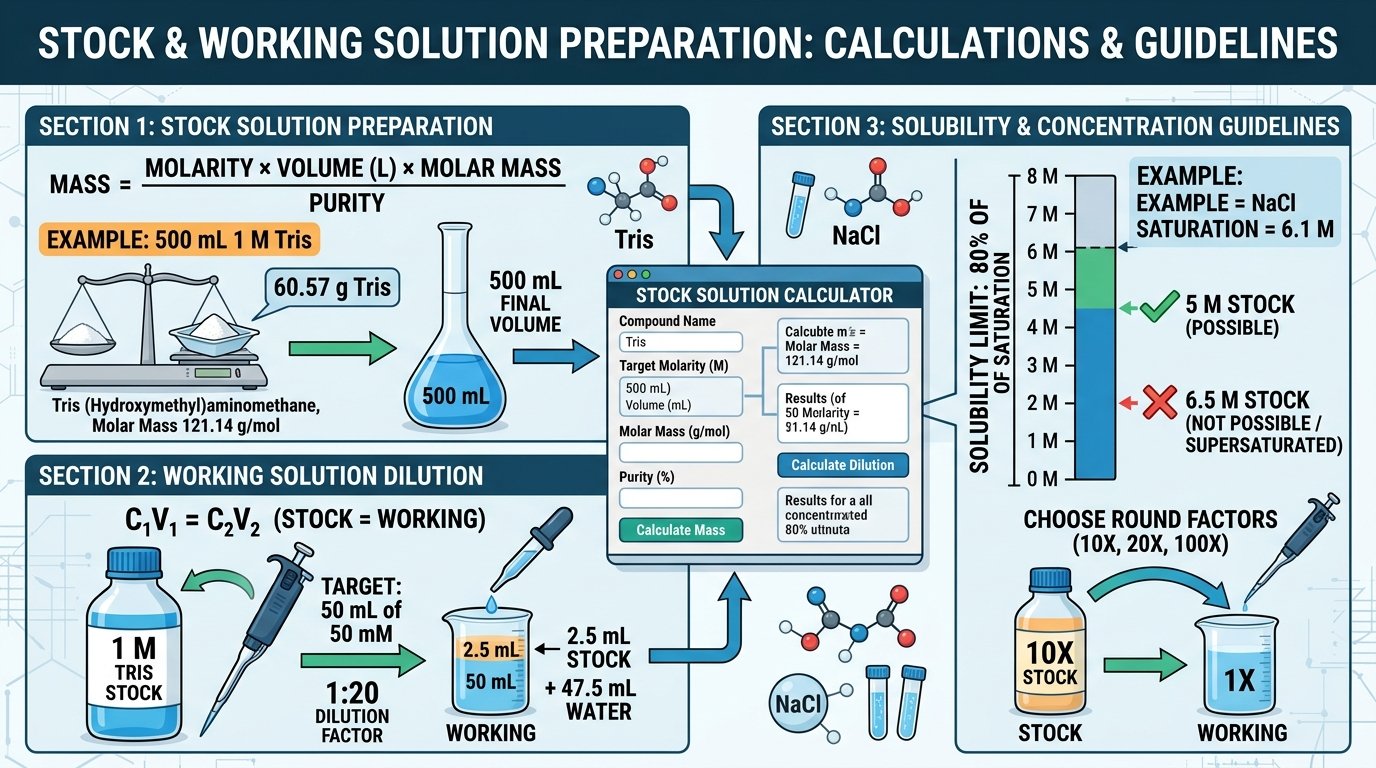
Mass for a stock = molarity × volume (L) × molar mass ÷ purity; working solutions follow C1V1 = C2V2. 500 mL of 1 M Tris (121.14 g/mol) needs 60.57 g; 50 mL of 50 mM from it needs 2.5 mL of stock + 47.5 mL water (1 : 20). Choose round factors (10X, 20X, 100X) below 80 % of the solubility limit — NaCl saturates at 6.1 M, so 5 M is possible and 6.5 M is not. The stock solution calculator above does all of this and shows every step.
📑 Table of Contents (click to expand)
- What Is a Stock Solution Calculator?
- How to Use the Stock Solution Calculator
- The Five Modes Explained
- The Formulas
- Worked Example: 1 M Tris Stock and 50 mM Working Buffer
- Choosing the Stock Strength
- Understanding X Notation
- More Worked Examples
- Master Mixes From Several Stocks
- Solubility Limits and the 80 % Rule
- Pipetting Limits at the Working Step
- Storage, Sterilisation and Labelling
- Liquid Reagents, Percent Stocks and Density
- Reference Table: Common Laboratory Stocks
- Visualising the Stock System
- Who Uses a Stock Solution Calculator
- Full Walkthrough: A Lysis Buffer From Stocks, 50 mL
- A Short History of Stock Solutions
- Limits and Assumptions
- Practice Problems With Answers
- Tips for Accurate Results
- Common Mistakes
- How This Stock Solution Calculator Is Different
- Where the Numbers Come From
- Checklist
- Frequently Asked Questions
- 10 Facts Worth Knowing
- Final Thoughts
What Is a Stock Solution Calculator?
A stock solution is a concentrated, accurately prepared solution kept so that working solutions can be made from it quickly by dilution rather than by weighing every time. Stocks save time, improve consistency (one careful weighing serves dozens of experiments), allow sterilisation and storage in bulk, and make small quantities practical — 0.1 mg of an antibiotic per litre of medium cannot be weighed, but 1 mL of a 100 mg/mL stock can be pipetted. A stock solution calculator handles both halves of the system: preparing the stock and diluting it.
The strength of a stock is a design choice, and the stock solution calculator treats it as one. Too weak and the working dilution consumes a large volume of stock and gives little benefit; too strong and the compound may not dissolve, may crystallise in the cold, or may require unmeasurably small volumes at the working step. The usual answer is a round multiple of the working concentration — 10X, 20X, 50X, 100X, 1000X — chosen so that the working volume of stock is between about 10 µL and a few millilitres and the concentration is comfortably below saturation. The stock solution calculator’s reverse mode makes that choice explicit.
Anatomy of a stock system
Stock: 5 M NaCl — 292.2 g per litre, autoclaved, room temperature, stable for years.
Working: 150 mM NaCl — 30 mL of stock per litre (1 : 33.3).
Why 5 M: near the top of the solubility range (6.1 M) but safe; a 33-fold factor keeps the working volume in the millilitres. The stock solution calculator reports each of these numbers.
How to Use the Stock Solution Calculator
- Pick the mode. Make a stock for the mass or liquid volume; Stock → working for the dilution; Master mix for multi-stock recipes; Solubility to check feasibility; Working → stock to design the strength.
- Enter the compound as a formula (
C4H11NO3for Tris,NaCl,MgCl2·6H2O,C12H25NaO4Sfor SDS) or as a molar mass; the stock solution calculator parses hydrates and uses IUPAC 2021 atomic weights. - Give the concentration and volume. M, mM, µM, mg/mL, % w/v or NX with the 1X value; L, mL or µL; purity if not 100 %; density if the reagent is a liquid.
- Press Calculate. The mass to weigh (or liquid volume) appears in blue with g/L, molarity and % equivalents, the steps, the procedure, a table and a chart for common batch sizes.
- Copy, download, print or share; each mode has its own Reset and the history box keeps the last ten results.
The chips load 1 M Tris, 5 M NaCl, 0.5 M EDTA, 10 % SDS, a 50X Tris stock, a PCR master mix, a lysis buffer, a solubility check on 5 M and 6.5 M NaCl and a reverse design for 50 mM Tris, so the stock solution calculator’s output is visible before you type.
The Five Modes Explained
Mode 1 — Make a stock. Any concentration convention including NX of a stated 1X; purity and hydrate correction; liquid reagents converted to volume by density; a note when the molarity is high enough to need a solubility check; procedure and label.
Mode 2 — Stock to working. C1V1 = C2V2 within a unit family (molar, mass, %, X); unit-family mismatches refused; stock volume, diluent, dilution factor and percent stock; warnings under 10 µL and under 2 µL with an intermediate-dilution suggestion.
Mode 3 — Master mix. One line per component (name, stock, final, unit); per-reaction and total volumes for N reactions with an overage; water to volume; template or sample volume held back; a flag for components under 1 µL per reaction.
Mode 4 — Solubility and maximum stock. Sixteen reagents with room-temperature water solubilities (NaCl, KCl, Tris, EDTA at pH 8, MgCl2, CaCl2, SDS, glucose, sucrose, phosphates, ammonium salts, DTT, citric acid, HEPES) or a custom value; maximum molarity, percent of saturation, an 80 % practical ceiling, and reagent-specific notes.
Mode 5 — Reverse design. Working concentration, volume per experiment, number of experiments, the largest stock volume you want to pipette and an optional solubility limit; the stock solution calculator chooses a round factor, the stock molarity, total volume with 15 % spare and the mass to weigh.
The Formulas
Mass for a stock (g) = C (mol/L) × V (L) × M (g/mol) ÷ (purity/100)
Mass from %: g = % × mL ÷ 100; from mg/mL: g = mg/mL × mL ÷ 1000
NX stock: Cstock = N × C1X
Liquid reagent: volume (mL) = mass (g) ÷ density (g/mL)
Stock to working: Vstock = Cworking × Vworking ÷ Cstock; diluent = Vworking − Vstock; DF = Cstock/Cworking
Master mix per component: V = Vrxn × Cfinal/Cstock × n × (1 + overage)
Maximum molarity: Mmax = solubility (g/L) ÷ molar mass; practical ceiling ≈ 0.8 Mmax
These are the same relationships as in our solution preparation calculator and dilution calculator; the stock solution calculator combines them around the stock/working workflow and adds the master-mix, solubility and design layers.
Worked Example: 1 M Tris Stock and 50 mM Working Buffer
- Stock. Tris base C4H11NO3, M = 121.14 g/mol. For 500 mL of 1 M: 1 × 0.5 × 121.14 = 60.57 g. Dissolve in ~400 mL, adjust pH with concentrated HCl (about 40 mL for pH 7.5, less for pH 8), make up to 500 mL, autoclave.
- Working. 50 mL of 50 mM: V1 = 50 × 50 ÷ 1000 = 2.5 mL of stock + 47.5 mL water; dilution factor 20 (5 % stock).
- Check. 2.5 mL × 1 M = 2.5 mmol; 2.5 mmol ÷ 0.05 L = 50 mM. ✓
- Solubility. Tris dissolves to about 550 g/L (4.5 M), so 1 M is 22 % of saturation — the stock solution calculator’s mode 4 confirms 2 M would also be fine.
Two Tris-specific notes the stock solution calculator prints: adjust the pH before making up to volume, because the HCl adds several percent to the volume; and the pH of Tris falls about 0.03 units per °C, so a stock adjusted at 25 °C reads 0.6 units lower at 4 °C and the 1 : 20 dilution shifts it slightly again. Neither is arithmetic, but both belong on the label.
Choosing the Stock Strength
Four considerations set the strength of a stock in the stock solution calculator, and the stock solution calculator’s reverse mode balances them:
- Solubility. Stay below about 80 % of saturation at the storage temperature so the stock survives a cold room and evaporation. 5 M NaCl (81 % of 6.14 M) is at the edge; 1 M Tris is comfortable; 0.5 M EDTA needs pH 8 to dissolve at all.
- Pipetting. The working step should use ≥ 10 µL (ideally ≥ 20 µL) and preferably not more than a few percent of the final volume. A 1000X antibiotic stock gives 1 mL per litre; a 10X buffer gives 100 mL per litre; both are convenient.
- Round factors. 10X, 20X, 50X, 100X, 1000X make mental arithmetic easy and errors rare. A 33.3-fold factor (5 M NaCl to 150 mM) is tolerated because the stock strength is itself round.
- Stability. Some compounds are more stable concentrated (DTT, ATP frozen in aliquots); some less (concentrated glucose caramelises on autoclaving; concentrated phosphate plus magnesium precipitates). Choose the strength that stores well.
The reverse mode takes the working concentration, the volume and number of experiments, the maximum stock volume you are willing to pipette per experiment and the solubility limit, and returns the smallest round factor that satisfies all of them — for 50 mM Tris in 20 × 50 mL with a 5 mL cap, a 10X (500 mM) stock of 115 mL from 6.97 g.
Understanding X Notation
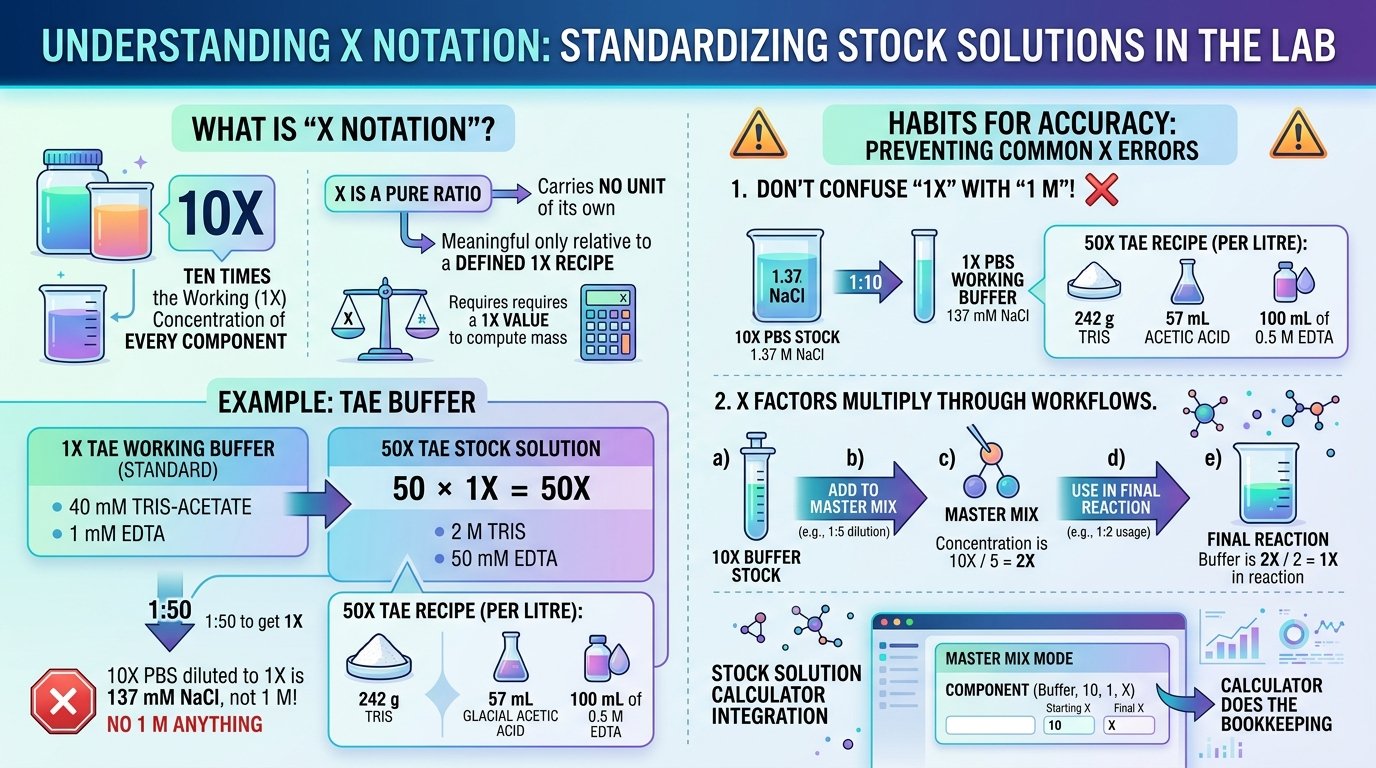
“10X”, a unit the stock solution calculator handles separately, means ten times the working (1X) concentration of every component; “50X TAE” is a buffer that becomes standard TAE when diluted 1 : 50. X is a pure ratio — it carries no unit of its own and is meaningful only relative to a defined 1X recipe, which is why the stock solution calculator keeps X in its own unit family and asks for the 1X value whenever it must compute a mass. 1X TAE is 40 mM Tris-acetate and 1 mM EDTA, so 50X is 2 M Tris and 50 mM EDTA: 242 g of Tris, 57 mL of glacial acetic acid and 100 mL of 0.5 M EDTA per litre.
Two habits prevent the classic X errors. First, “1X” is not “1 M” — a 10X PBS diluted to 1X is 137 mM NaCl, not 1 M anything. Second, X factors multiply through a workflow: a 2X master mix into which 10X buffer has been added at 1 : 5 delivers buffer at 1X in the final reaction only if the mix is used at 1 : 2. The master-mix mode of the stock solution calculator accepts X for components (Buffer, 10, 1, X) and does the bookkeeping. For percent stocks and how they convert see the w/v solution calculator.
More Worked Examples
Example 1 — 1 L of 5 M NaCl
5 × 1 × 58.44 = 292.2 g; dissolve in ~700 mL with stirring and gentle warming, make up to 1 L, autoclave. 81 % of saturation — may crystallise below 10 °C.
Example 2 — 250 mL of 0.5 M EDTA, pH 8.0
Na2EDTA·2H2O, 372.24 g/mol: 0.5 × 0.25 × 372.24 = 46.53 g; stir in ~200 mL, add NaOH pellets (~5 g) until pH 8.0 and the solid dissolves, make up to 250 mL.
Example 3 — 250 mL of 100 µg/mL ampicillin from 100 mg/mL
Factor 1000: 250 µL of stock into 250 mL of cooled medium. The stock solution calculator flags nothing — 250 µL is comfortable.
Example 4 — 2 mL of 10 µM drug from 10 mM in DMSO
Factor 1000: 2 µL — flagged as marginal; the tool suggests 1 : 100 first (10 µL + 990 µL) then 20 µL into 2 mL. Final DMSO 0.1 % either way.
Example 5 — 100 mL of 10 % DMSO (liquid, d 1.10)
10 g of DMSO ÷ 1.10 g/mL = 9.09 mL made up to 100 mL — the density step the stock solution calculator applies for liquid reagents.
Master Mixes From Several Stocks
A master mix — mode 3 of the stock solution calculator — is a batch of everything common to a set of reactions, made once and dispensed, so that each tube receives identical reagent proportions and the pipetting of small volumes happens once rather than N times. For each component, the volume per reaction is Vrxn × Cfinal ÷ Cstock; the master mix multiplies that by the number of reactions plus an overage (10 % is standard) to cover pipetting losses; water fills to the reaction volume minus whatever is added per tube separately (template, sample, enzyme).
For a 25 µL PCR with 10X buffer (2.5 µL), 25 mM MgCl2 to 1.5 mM (1.5 µL), 10 mM dNTPs to 0.2 mM (0.5 µL), two 10 µM primers to 0.5 µM (1.25 µL each), 5 U/µL Taq to 0.025 U/µL (0.125 µL) and 2 µL of template, the stock solution calculator gives 15.9 µL of water per reaction and, for 24 reactions with 10 % overage, a 607 µL mix to dispense at 23 µL per tube. It flags the 0.125 µL of enzyme per reaction as unpipettable individually — the very reason to make the mix — and would flag a component that was too dilute to fit.
Assembly order matters, and the stock solution calculator lists it: water first, then buffer, salts, nucleotides and primers, enzyme last; mix by gentle flicking, spin down, keep on ice, dispense. The same mode serves lysis buffers, kinase buffers, Laemmli sample buffer and any recipe written as “from stocks”. For single-stock dilution chains the serial dilution calculator complements it.
Solubility Limits and the 80 % Rule
| Reagent | Solubility (g/L, ~20–25 °C) | Max M | Usual stock | Note |
|---|---|---|---|---|
| NaCl | 360 | 6.1 | 5 M | Slow to dissolve; warm |
| KCl | 344 | 4.6 | 1–3 M | — |
| Tris base | 550 | 4.5 | 1–2 M | pH before volume |
| Na2EDTA·2H2O | 108 (pH 4.5) / ~200 (pH 8) | 0.29 / 0.54 | 0.5 M pH 8 | Needs NaOH to dissolve |
| MgCl2·6H2O | 1670 | 8.2 | 1 M | Hygroscopic |
| SDS | ~150 at 20 °C | 0.52 | 10–20 % | Warm to dissolve; precipitates cold |
| Na2HPO4 (anhydrous) | 77 | 0.54 | 0.2–0.5 M | 1 M not possible cold |
| Glucose | 909 | 5.0 | 20–40 % | Filter-sterilise |
| (NH4)2SO4 | 744 | 5.6 (4.1 saturated) | saturated | Used as % saturation |
| HEPES | 2380 | 10 | 1 M | pH with NaOH |
Solubility in the stock solution calculator’s table is quoted per litre of water, and the solute adds volume, so the maximum molarity of the solution is a little lower than the table implies; the 80 % rule absorbs that as well as temperature. The stock solution calculator’s mode 4 reports percent of saturation and applies reagent-specific notes — EDTA’s pH dependence, SDS’s cold precipitation, sodium phosphate’s poor cold solubility. For the underlying molar masses see the molar mass of hydrates calculator.
Pipetting Limits at the Working Step
A stock is only as useful as the smallest volume it forces you to pipette, which is why the stock solution calculator warns about it. The stock solution calculator warns when the working step needs under 10 µL and strongly under 2 µL, because air-displacement pipettes lose accuracy there and because a single small volume carries the whole error of the experiment. The remedies are an intermediate dilution (a 100X working stock made 1 : 10 from the 1000X), a larger working volume, or a master mix so that the small volume is pipetted once into a large batch.
The reverse-design mode builds this in: you state the largest stock volume you are prepared to pipette per experiment, and the factor is chosen so the actual volume is at or below it while remaining a round number. When solubility caps the factor lower than that, the tool says so. For the pipetting details of chained dilutions see the serial dilution calculator.
Storage, Sterilisation and Labelling
Salt and buffer stocks (NaCl, KCl, Tris, phosphate, EDTA, MgCl2) planned with the stock solution calculator are autoclaved and kept at room temperature for months to years. Sugars are filter-sterilised (autoclaving caramelises glucose at high concentration) and kept at 4 °C. SDS is neither autoclaved nor refrigerated. Antibiotics, DTT, ATP, nucleotides, enzymes and most small-molecule compounds are filter-sterilised or made in sterile solvent and stored frozen in single-use aliquots at −20 °C; DMSO stocks are stored dry and desiccated because DMSO absorbs water. Light-sensitive stocks (tetracycline, riboflavin, many dyes) go in amber tubes.
Concentrated stocks change on standing: evaporation from a loosely capped bottle raises the concentration a few percent a year; CO2 lowers the pH of dilute bases; Tris pH drifts with temperature. Label with name, concentration, pH (and the temperature at which it was set), solvent, date, initials and the intended dilution (“10X — use 100 mL/L”); the stock solution calculator prints a label line for exactly this. Date-limit frozen aliquots and discard on thaw.
Liquid Reagents, Percent Stocks and Density
Not every stock the stock solution calculator plans starts from a powder. Glycerol, Triton X-100, Tween 20, DMSO, ethanol, acetic acid and 2-mercaptoethanol are liquids, and a “10 % stock” of them may be v/v or w/v depending on the protocol’s habit. The stock solution calculator handles w/v liquids by converting the required mass to a volume with the density you enter (10 g of DMSO at 1.10 g/mL is 9.09 mL) and treats v/v stocks as simple volume fractions in the dilution mode; for the full set of percent conversions see the w/v solution calculator.
Viscous liquids deserve two practical notes that the tool prints: pipette them slowly with a wide-bore or cut tip and reverse-pipette, or better, weigh them (100 % glycerol is 1.26 g/mL, so 12.6 g is 10 mL); and remember that mixing concentrated organic liquids with water is not volume-additive — make the stock up to the final volume rather than adding the calculated difference.
Reference Table: Common Laboratory Stocks
| Stock | Compound weighed | g per 100 mL | Typical working | Storage |
|---|---|---|---|---|
| 1 M Tris-HCl pH 8 | Tris base 121.14 | 12.11 | 10–50 mM (1 : 20–100) | RT, autoclaved |
| 5 M NaCl | NaCl 58.44 | 29.22 | 150 mM (1 : 33) | RT |
| 0.5 M EDTA pH 8 | Na2EDTA·2H2O 372.24 | 18.61 | 1 mM (1 : 500) | RT |
| 1 M MgCl2 | MgCl2·6H2O 203.30 | 20.33 | 1–10 mM | RT |
| 10 % SDS | SDS 288.38 | 10 | 0.1 % (1 : 100) | RT, never cold |
| 1 M DTT | DTT 154.25 | 15.43 | 1 mM (1 : 1000) | −20 °C aliquots |
| 100 mg/mL ampicillin | Ampicillin sodium | 10 | 100 µg/mL (1 : 1000) | −20 °C |
| 20 % glucose | Glucose 180.16 | 20 | 0.2–2 % | 4 °C, filtered |
| 10X PBS | 4 salts | 9.87 | 1X (1 : 10) | RT |
| 10 mM compound in DMSO | varies | MW/1000 g | 1–10 µM (1 : 1000–10 000) | −20 °C, desiccated |
Each row is a single line in the stock solution calculator’s first mode; the working column is a single line in the second.
Visualising the Stock System
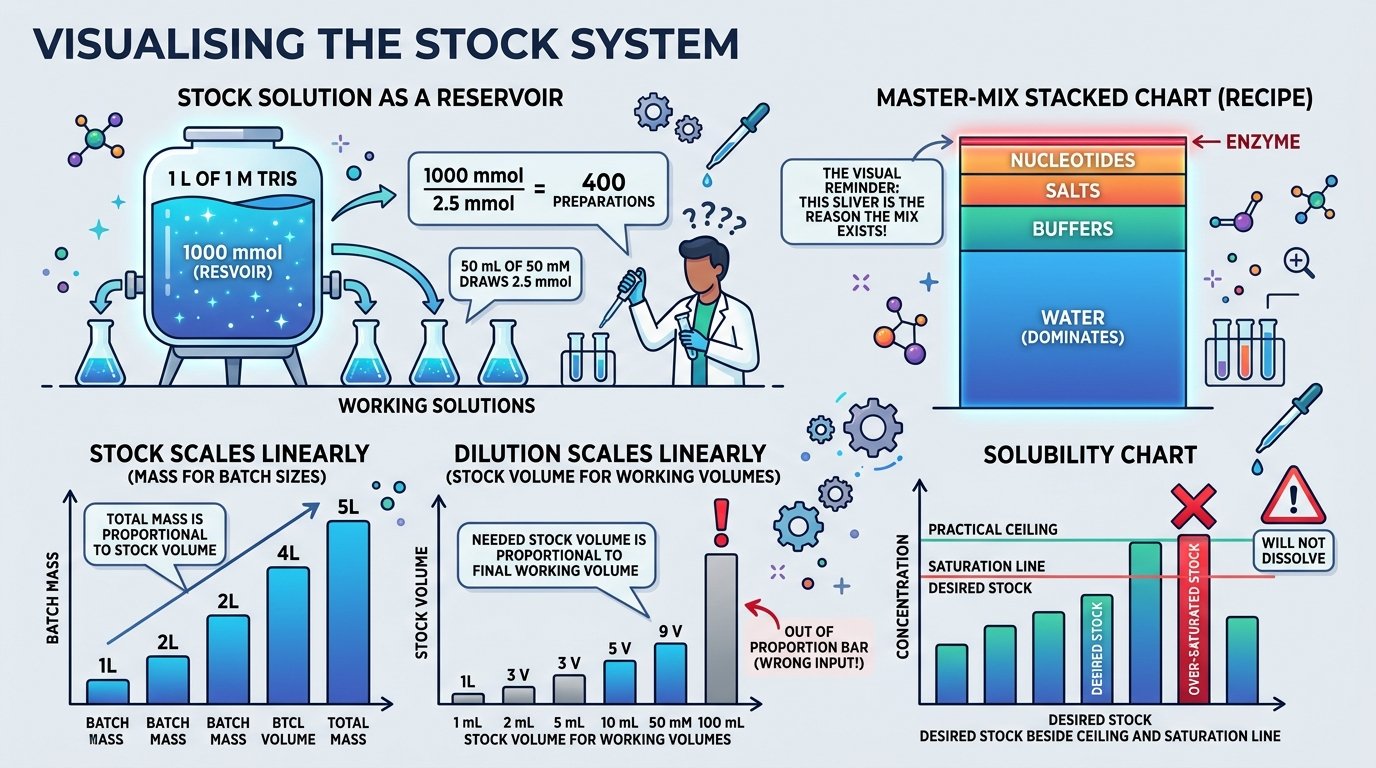
Think of a stock, as the stock solution calculator does, as a reservoir of solute measured in millimoles: a litre of 1 M Tris holds 1000 mmol. Each working solution draws a fixed number of millimoles — 50 mL of 50 mM draws 2.5 — so the reservoir serves 400 such preparations. The stock solution calculator’s bar charts show the mass for common batch sizes (a stock scales linearly with volume) and the stock volume for common working volumes (a dilution scales linearly too); if a bar looks out of proportion, an input is wrong.
The master-mix chart is a stacked recipe: water usually dominates, buffer and salts follow, and the enzyme is a sliver — the visual reminder that the sliver is the reason the mix exists. The solubility chart puts the desired stock beside the practical ceiling and the saturation line, and a bar that crosses the line is a stock that will not dissolve.
Who Uses a Stock Solution Calculator
Molecular biologists maintain shelves of 10X buffers, 5 M NaCl, 0.5 M EDTA and 1000X antibiotics and build PCR and ligation master mixes daily. Biochemists make protein-purification buffers from 1 M stocks and design salt gradients. Cell biologists keep 10 mM compound stocks in DMSO and dilute them to micromolar. Analytical chemists prepare 1000 mg/L standards and dilute them into calibration series. Teaching laboratories stock 1 M acids and bases for a term of experiments. Lab managers plan quantities and shelf lives.
The stock solution calculator is written for all of them because it treats the stock and the working solution as one system, checks feasibility before you weigh, and exports a recipe that a colleague can follow.
Full Walkthrough: A Lysis Buffer From Stocks, 50 mL
Recipe: 50 mM Tris-HCl pH 8, 150 mM NaCl, 1 mM EDTA, 1 % Triton X-100, to be made from 1 M Tris, 5 M NaCl, 0.5 M EDTA and 10 % Triton stocks.
- Enter in the stock solution calculator’s master-mix mode, one reaction of 50 mL: Tris 1000 → 50 mM; NaCl 5000 → 150 mM; EDTA 500 → 1 mM; Triton 10 → 1 %.
- Volumes. Tris 2.5 mL; NaCl 1.5 mL; EDTA 0.1 mL; Triton 5 mL; water 40.9 mL. Total solids from stocks negligible; total 50 mL.
- Check. 2.5 mL × 1 M / 50 mL = 50 mM ✓; 1.5 × 5 / 50 = 0.15 M ✓; 0.1 × 0.5 / 50 = 1 mM ✓; 5 × 10 / 50 = 1 % ✓.
- Assemble. Water, Tris, NaCl, EDTA, then the viscous Triton (reverse-pipetted), mix; add protease inhibitors fresh at use.
- Label with composition, pH, date; the stock solution calculator’s CSV goes in the buffer log.
Had the protocol needed 10 × 50 mL over a month, the reverse mode would suggest a 10X lysis-buffer concentrate (minus the detergent, which is added at 1X) — 500 mM Tris, 1.5 M NaCl, 10 mM EDTA — all within solubility, made once.
A Short History of Stock Solutions
The idea behind every stock solution calculator — standard solutions of fixed strength — was the foundation of nineteenth-century volumetric analysis, and the practice of keeping concentrated “stock” reagents from which working reagents were diluted followed naturally in analytical and clinical laboratories. Molecular biology, from the 1970s, turned the habit into a culture: Maniatis’s Molecular Cloning (1982) standardised the 10X, 50X and 1000X stocks that every laboratory still keeps, and the polymerase chain reaction (1985) made the master mix a daily ritual. Cell-based screening in the 1990s added the 10 mM DMSO compound stock, and with it the 0.1 % vehicle limit.
What has changed is scale and documentation: robotic liquid handlers, barcoded stocks and electronic notebooks. What has not changed is the arithmetic, and the stock solution calculator is a way of doing it correctly, quickly and traceably.
Limits and Assumptions
- Formula must match the bottle (hydrate, salt form); the stock solution calculator cannot see the label.
- Solubilities are room-temperature literature values per litre of water; cold rooms, mixed solvents and co-solutes change them.
- Volumes are assumed additive at the working step; fine for aqueous stocks, approximate for glycerol, DMSO and alcohols.
- pH is not predicted; adjust buffers before making up to volume and re-check after dilution.
- X notation is meaningful only relative to the 1X definition you supply.
- Pipetting warnings are heuristics for standard air-displacement pipettes.
Practice Problems With Answers
Work these by hand, then check with the stock solution calculator.
- Grams of KCl for 200 mL of 3 M? Answer: 44.73 g.
- Grams of MgCl2·6H2O for 100 mL of 1 M? Answer: 20.33 g.
- Grams of Tris for 1 L of 50X at 1X = 40 mM? Answer: 242.3 g (2 M).
- mL of 5 M NaCl for 250 mL of 200 mM? Answer: 10 mL.
- µL of 0.5 M EDTA for 100 mL of 1 mM? Answer: 200 µL.
- 10X buffer per 20 µL reaction? Answer: 2 µL.
- Master mix for 24 × 25 µL with 10 % overage: total volume? Answer: 660 µL (less any per-tube template).
- Is 6.5 M NaCl possible (360 g/L)? Answer: No — maximum 6.16 M.
- Max molarity of Tris (550 g/L)? Answer: 4.54 M.
- Reverse design: 150 mM NaCl, 10 × 1 L, max 50 mL stock per litre? Answer: 20X = 3 M; 575 mL; 100.8 g.
Tips for Accurate Results
- Enter the compound exactly as on the bottle; the stock solution calculator uses that molar mass.
- Run the solubility check before weighing anything above about 1 M.
- Dissolve in 60–80 % of the volume, adjust pH, then make up to the mark.
- Choose round factors and keep working volumes ≥ 10 µL.
- Make master mixes for anything under 2 µL per reaction; add 10 % overage.
- Reverse-pipette viscous stocks (glycerol, Triton, 10X buffers).
- Aliquot frozen stocks; never refreeze.
- Label with concentration, pH, date and the intended dilution; keep the CSV.
Common Mistakes
- Anhydrous molar mass for a hydrate (MgCl2 95.2 vs 203.3) — the stock solution calculator uses whatever formula you type.
- Making a stock above its solubility and decanting the supernatant as if it were the nominal strength.
- Treating 1X as 1 M or mixing X with molar units.
- Adjusting pH after making up to volume.
- Pipetting 0.5 µL per reaction instead of making a mix.
- No overage in a master mix — the last tube comes up short.
- Autoclaving glucose or SDS stocks.
- Refreezing DTT, ATP or enzyme stocks.
How This Stock Solution Calculator Is Different
| Feature | This stock solution calculator | Typical online calculator |
|---|---|---|
| Mass for M, mM, µM, mg/mL, % or NX stocks with purity, hydrate and liquid density | ✓ | Molarity only |
| Formula parser with IUPAC 2021 weights | ✓ | Manual molar mass |
| Stock → working in molar, mass, % or X with unit-family checks and pipetting warnings | ✓ | One unit |
| Master mix from any number of stocks with reactions, overage and held-back sample | ✓ | ✗ |
| Solubility check for 16 reagents or custom; max and practical molarity | ✓ | ✗ |
| Reverse design: best round-X stock for planned experiments | ✓ | ✗ |
| Procedure, storage note and label with every result | ✓ | ✗ |
| Steps, table, chart, copy, CSV, print, share, history, per-mode Reset | ✓ | Number only |
Most online tools compute one mass or one dilution. This stock solution calculator treats stock and working solution as a system, checks that the stock can exist, builds master mixes and designs the stock strength for you.
The stock solution calculator belongs to the same family as the site’s other free tools: molecular weight calculator, atomic mass calculator, formula weight calculator, molarity calculator, stoichiometry calculator, exact mass calculator, grams to moles calculator, molar mass of hydrates calculator, average molecular weight of a mixture, number average molecular weight, weight average molecular weight, polydispersity index, monoisotopic mass calculator, average vs monoisotopic mass, isotopic mass calculator, freezing point depression, boiling point elevation, osmotic pressure calculator, vapor density, molar mass from gas density, equivalent weight calculator, viscosity molecular weight, van der Waals equation, empirical formula calculator, molecular formula calculator, percent composition calculator, combustion analysis calculator, degree of unsaturation calculator, oxidation number calculator, formal charge calculator, limiting reactant calculator, theoretical yield calculator, percent yield calculator, atom economy calculator, chemical equation balancer, molality calculator, normality calculator, mole fraction calculator, ppm to ppb converter, dilution calculator, serial dilution calculator, solution preparation calculator, w/v solution calculator, ionic strength calculator, osmolarity calculator, peptide reconstitution calculator, Beer Lambert law calculator, protein concentration A280 calculator.
Where the Numbers Come From
The stock solution calculator uses IUPAC 2021 atomic weights, the dilution equation, room-temperature solubilities from standard reference tables, and the stock conventions of the molecular-biology literature:
- OpenStax Chemistry via LibreTexts — Molarity: molarity, preparation of solutions by mass and the dilution equation.
- NCBI Bookshelf — Molecular Biology Protocols (stock solution appendices): the standard 10X, 50X and 1000X laboratory stock recipes and their storage.
- CIAAW — Standard Atomic Weights: the atomic weights behind every molar mass on this site.
- Wikipedia — Stock solution: definition, X notation and dilution of stock solutions.
Found an error? Our corrections policy explains how we handle reports; contact us or read about the site.
Checklist
☐ Compound entered as on the bottle (hydrate, salt); purity applied
☐ Stock strength ≤ 80 % of solubility at storage temperature
☐ Round factor chosen (10X, 20X, 50X, 100X, 1000X)
☐ Working step volume ≥ 10 µL; intermediate dilution or master mix otherwise
☐ Master mix: per-reaction volumes × n × (1 + overage); sample held back; water to volume
☐ pH adjusted before making up to volume; re-checked at 1X
☐ Sterilised appropriately (autoclave / filter / none)
☐ Stored correctly (RT / 4 °C / −20 °C aliquots; desiccated DMSO)
☐ Labelled: name, concentration, pH, date, initials, intended dilution
☐ Recipe exported with lot numbers
Frequently Asked Questions
How do I calculate the mass for a stock solution?
mass (g) = molarity × volume (L) × molar mass ÷ purity. 500 mL of 1 M Tris (121.14 g/mol) needs 1 × 0.5 × 121.14 = 60.57 g; 1 L of 5 M NaCl needs 292.2 g.
How do I dilute a stock to a working solution?
C1V1 = C2V2. For 50 mL of 50 mM from 1 M: V1 = 50 × 50 ÷ 1000 = 2.5 mL of stock plus 47.5 mL of water. The dilution factor is 20.
What does 10X mean?
Ten times the working (1X) concentration of every component. Dilute 1 : 10 to use — 100 mL of 10X per litre. X is a ratio, not a unit, and is defined only relative to the 1X recipe.
How concentrated can a stock be?
No more than the solubility allows — and in practice about 80 % of it, so the stock survives cold storage. NaCl saturates at 6.1 M (5 M is the usual stock); Tris at 4.5 M; EDTA reaches 0.5 M only at pH 8; SDS at about 0.5 M (15 %).
How do I make a master mix?
For each component, volume per reaction = reaction volume × final ÷ stock; multiply by the number of reactions plus about 10 % overage; add water to the reaction volume minus any per-tube additions (template). Assemble water first and enzyme last; dispense on ice.
Why does 0.5 M EDTA not dissolve?
Disodium EDTA is only soluble to about 0.3 M until the pH is raised to 8 with NaOH, which deprotonates the third carboxyl. Add pellets slowly while stirring; the solid clears as pH 8.0 is reached.
How much 5 M NaCl is needed for 1 L of 150 mM?
V1 = 150 × 1000 ÷ 5000 = 30 mL of 5 M stock made up to 1 L.
What stock strength should I choose?
A round multiple of the working concentration (10X, 20X, 50X, 100X) that keeps the working-step volume between about 10 µL and a few millilitres and stays below 80 % of solubility. The calculator’s reverse mode picks it from your working concentration, volumes and number of experiments.
How should stock solutions be stored?
Autoclaved salt and buffer stocks at room temperature; sugars filter-sterilised at 4 °C; antibiotics, DTT, ATP and compound stocks in single-use aliquots at −20 °C (DMSO stocks desiccated); SDS at room temperature only. Label with concentration, pH, date and the dilution to use.
Is my data stored anywhere?
No. The stock solution calculator runs entirely in your browser; the history box uses your own local storage and Clear All empties it.
10 Facts Worth Knowing
- 5 M NaCl is 81 % saturated at 25 °C and grows crystals in a 4 °C cold room.
- Tris pH falls about 0.03 units for every degree the temperature rises; a pH 8.0 stock at 25 °C reads 8.6 on ice.
- Disodium EDTA needs roughly 20 g of NaOH per 186 g to reach pH 8 and dissolve to 0.5 M.
- A 10 % SDS stock clouds below about 15 °C and clears again on warming — nothing has decomposed.
- A 1000X antibiotic stock means one millilitre per litre of medium: the definition of convenient.
- Maniatis’s 1982 cloning manual fixed the 50X TAE and 10X TBE recipes still used today.
- Master mixes exist because 0.125 µL of Taq per reaction cannot be pipetted — but 3 µL for 24 reactions can.
- DMSO absorbs water from the air fast enough to dilute a 10 mM stock measurably within weeks if left open.
- Glucose caramelises when autoclaved concentrated; filter-sterilise sugar stocks instead.
- A 1 M DTT stock loses activity within days at room temperature but keeps for months frozen in aliquots.
Final Thoughts
A stock system is two calculations and a set of habits: mass for a strength that dissolves and stores well, C1V1 = C2V2 for a working step that pipettes comfortably, master mixes for the tiny volumes, and labels that say what to do with the bottle.
Use the stock solution calculator above to make, dilute, mix, check and design stocks — and keep its recipe with every bottle on the shelf.
Written by
Ahmad Raza, M.Phil. Chemistry ✓ Verified Expert
Ahmad has taught general and analytical chemistry for over a decade and builds the calculators on this site. He tests every tool — including this stock solution calculator — against textbook problems and laboratory recipes before it goes live, and he answers reader questions personally.