
Chemical Equation Balancer
Type any chemical equation and get it balanced instantly with the atom-count check, molar masses and a mass-conservation proof. Handles molecular equations, net ionic equations with charges, redox reactions in acidic or basic solution by the half-reaction method, verification of an equation you balanced yourself, and complete-combustion equations with the oxygen and air requirement.
✓ Trusted by students, teachers & lab chemistsBalance Any Chemical Equation
Enter the skeleton equation with an arrow (-> or =) between reactants and products. Parentheses, hydrates (CuSO4·5H2O) and state symbols (s, l, g, aq) are accepted. Optionally give the amount of one species and the calculator converts it into moles and grams of every other species.
Balance a Net Ionic or Redox Equation with Charges
Write charges as Fe^3+, SO4^2-, NO3-, NH4+ or Cu2+ (a single element followed by a digit and a sign is read as the charge). Electrons may be written as e-. Atoms and charge are balanced together.
Redox Equation by the Half-Reaction Method (Acidic or Basic)
Give only the skeleton: the species that are oxidised and reduced. The calculator splits it into half-reactions, balances each with H2O, H+ (or OH−) and electrons, equalises the electrons and adds them up — exactly the way it is done on paper.
Check Your Balanced Equation and Classify the Reaction
Type the equation with your coefficients. The calculator counts every atom (and the charge) on both sides, tells you exactly which element is off, shows the correct coefficients if needed, and names the reaction type: synthesis, decomposition, single or double displacement, combustion or neutralisation.
Complete Combustion Equation, Oxygen Demand and Air-Fuel Ratio
Enter the fuel formula (C, H, O, N and S allowed). The calculator writes the balanced complete-combustion equation (CO2, H2O, N2, SO2), the oxygen needed per mole and per kilogram of fuel, the stoichiometric air-fuel ratio and the CO2 produced.
🕘 Recent calculations
- No calculations yet — your last 10 results will appear here.
Method: each element (and the net charge) gives one linear equation in the unknown coefficients; the smallest whole-number solution of that system is the balanced equation (Gaussian elimination with exact fractions). Redox mode uses the half-reaction (ion-electron) method: balance the key element, O with H2O, H with H+, charge with e−, equalise electrons, add; in basic solution H+ is neutralised with OH−. Combustion: CxHyOzNwSv + (x + y/4 + v − z/2) O2 → x CO2 + y/2 H2O + w/2 N2 + v SO2; air taken as 20.95 vol% / 23.2 mass% O2. IUPAC 2021 atomic weights.
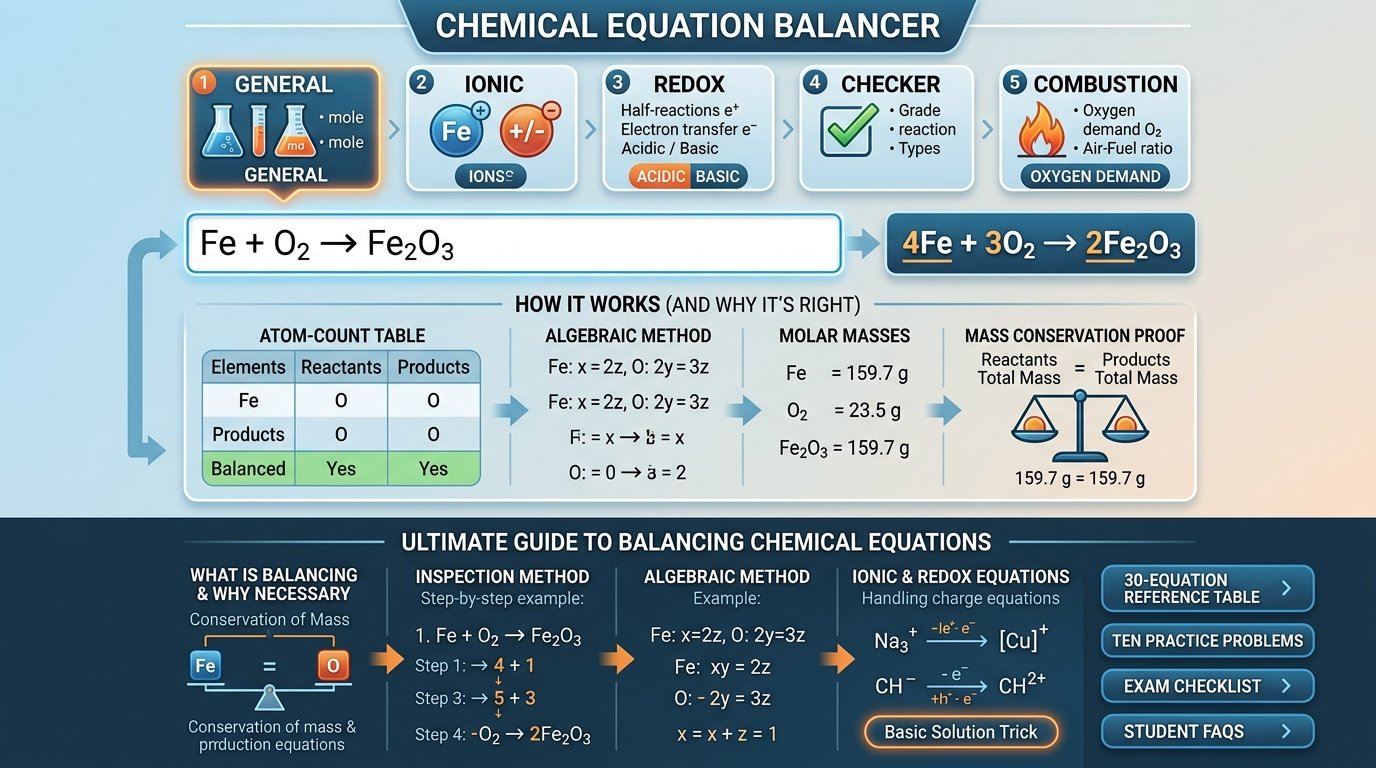
A chemical equation balancer takes the skeleton equation you type — Fe + O2 → Fe2O3, say — and returns the smallest whole-number coefficients that make every element (and, for ions, the charge) equal on both sides. It does in a fraction of a second what takes a careful student a minute of counting, and it never forgets an oxygen atom. The one above also shows you why the answer is right: the atom-count table, the algebra behind the coefficients, the molar masses and a proof that the total mass of reactants equals the total mass of products.
The free chemical equation balancer on this page works in five modes: a general balancer for molecular equations with an optional amount-to-moles conversion, an ionic balancer that treats charge as one more element, a redox balancer that writes out both half-reactions in acidic or basic solution, a checker that grades an equation you balanced yourself and names the reaction type, and a combustion writer that gives the oxygen demand and air-fuel ratio of any fuel.
This guide explains what balancing means and why it is non-negotiable, walks through the inspection method and the algebraic method, works the classic examples in full, covers ionic and redox equations (including the basic-solution trick everybody forgets), and ends with a 30-equation reference table, ten practice problems, an exam checklist and the questions students ask most.
Key Takeaway
Balancing changes coefficients, never subscripts. Count each element on both sides, fix the metals first, then non-metals, then hydrogen, then oxygen, and reduce to the smallest whole numbers. Fe + O2 → Fe2O3 becomes 4Fe + 3O2 → 2Fe2O3: 4 Fe and 6 O on each side, 319.4 g of reactants making 319.4 g of product. The chemical equation balancer above does exactly this by solving one linear equation per element and shows every step.
📑 Table of Contents (click to expand)
- What Is a Chemical Equation Balancer?
- How to Use the Chemical Equation Balancer
- The Five Modes Explained
- The Rules of Balancing
- Worked Example: Fe + O₂ Step by Step
- Balancing by Inspection: A Reliable Order
- The Algebraic (Matrix) Method
- More Worked Examples
- Ionic Equations and Charge Balance
- Redox: The Half-Reaction Method
- Balancing in Basic Solution
- Reference Table: 30 Equations Balanced
- Combustion Equations and Air-Fuel Ratio
- Classifying the Reaction
- From Balanced Equation to Stoichiometry
- Who Uses a Chemical Equation Balancer
- Full Walkthrough: A Homework Problem
- A Short History of the Balanced Equation
- Limits: When an Equation Cannot Be Balanced
- Practice Problems With Answers
- Tips for Accurate Results
- Common Mistakes
- How This Calculator Is Different
- Where the Numbers Come From
- Exam Checklist
- Frequently Asked Questions
- 10 Facts Worth Knowing
- Final Thoughts
What Is a Chemical Equation Balancer?
A chemical equation is a recipe written in formulas: reactants on the left, products on the right, an arrow between them. A balanced chemical equation is one in which the number of atoms of every element is the same on both sides, because atoms are neither created nor destroyed in a chemical change. A chemical equation balancer is a tool that finds the coefficients — the numbers in front of each formula — that make this true.
The need arises because formulas are fixed by nature but proportions are not. Water is always H2O; you cannot write H2O2 to make oxygen come out even, because that is a different compound. What you can change is how many molecules of each substance take part, and that is all a coefficient says: 2H2 + O2 → 2H2O means two molecules (or moles) of hydrogen react with one of oxygen to give two of water.
A good chemical equation balancer therefore does three things. It reads formulas correctly, including parentheses such as Ca3(PO4)2 and hydrates such as CuSO4·5H2O. It solves for coefficients that balance every element simultaneously and reduces them to the smallest whole numbers. And it proves the result, by counting atoms and by showing that the total mass on each side is identical.
Three words to keep straight
Subscript — the small number inside a formula (the 2 in H2O). Fixed. Never touched when balancing.
Coefficient — the number in front of a formula (the 2 in 2H2O). This is what the balancer adjusts.
Skeleton equation — correct formulas, no coefficients yet. This is the input to any chemical equation balancer.
How to Use the Chemical Equation Balancer
Using the chemical equation balancer takes about ten seconds:
- Pick a mode. Most homework equations belong in Balance Any Equation. Use Ionic Equation if your species carry charges, Redox if you have been told to use half-reactions, Check & Classify to grade your own attempt, and Combustion when a fuel burns in oxygen.
- Type the skeleton equation. Use
->or=for the arrow and+between species. Subscripts are plain digits (Fe2O3). State symbols such as (s), (aq) are ignored. Charges are writtenFe3+,Fe^3+,SO4^2-orNO3-. - Optionally add an amount. In mode 1 you can type, for example,
Fe2O3 100 g, and the tool converts that into moles and grams of every other species — a stoichiometry answer in the same click. - Read the result. The balanced equation appears in blue, followed by the coefficients, the atom-count table, the algebra steps and the mass check. A bar chart shows the atoms of each element on each side.
- Copy, download or share. The toolbar exports the working as text or CSV, prints a report, or shares it. The last ten results stay in the history box; each mode has its own Reset.
The example chips under every input are pre-loaded equations — the KMnO4 + HCl redox, the phosphorus furnace, dichromate and iodide in acid — that show the chemical equation balancer handling the awkward cases you meet in exams.
The Five Modes Explained
| Mode | You enter | You get | Typical use |
|---|---|---|---|
| 1. Balance Any Equation | Skeleton equation (+ optional amount) | Coefficients, atom table, algebra, mass check, moles and grams of every species | Homework, lab prep |
| 2. Ionic Equation | Species with charges, electrons allowed | Atoms and net charge balanced together; electrons transferred for half-reactions | Net ionic equations, electrochemistry |
| 3. Redox Half-Reaction | Skeleton redox pair + acidic/basic | Both half-reactions with H2O, H+/OH− and e−, electrons equalised, sum | Titrations, exam redox questions |
| 4. Check & Classify | Your equation with coefficients | Balanced or not, which element is off, correct form, reaction type | Self-marking, teaching |
| 5. Combustion | Fuel formula (C, H, O, N, S) + mass | Balanced combustion equation, O2 and air per kg, air-fuel ratio, CO2 produced | Energy, engines, environmental |
All five modes share the same engine: exact-fraction Gaussian elimination over one equation per element. That is why the chemical equation balancer never returns a “close enough” answer — the coefficients are integers or the equation is reported as unbalanceable, with a reason.
The Rules of Balancing
Every method, by hand or by chemical equation balancer, obeys the same four rules.
1. Formulas are sacred. Write every reactant and product correctly first. If a formula is wrong, no coefficients will fix it, and a balancer will either give nonsense coefficients or tell you the equation cannot be balanced.
2. Only coefficients change. A coefficient multiplies everything in the formula that follows it: 3Ca(OH)2 contains 3 Ca, 6 O and 6 H.
3. Conservation of atoms and of charge. Each element must total the same on both sides; in ionic equations the net charge must too.
4. Smallest whole numbers. 4H2 + 2O2 → 4H2O is balanced but not conventional; divide through to 2H2 + O2 → 2H2O. (Thermochemical equations are the exception, where fractional coefficients like ½O2 are allowed to keep one mole of product.)
The chemical equation balancer enforces rule 4 automatically, dividing the coefficients by their greatest common divisor, and mode 4 will tell you when your own answer shares a common factor.
Worked Example: Fe + O₂ → Fe₂O₃ Step by Step
Rusting, written as a skeleton: Fe + O2 → Fe2O3. Here is what the chemical equation balancer does, in the order a person would.
Count. Left: Fe 1, O 2. Right: Fe 2, O 3. Neither matches.
Metal first. Put 2 in front of Fe: 2Fe + O2 → Fe2O3. Fe now 2 = 2.
Oxygen. Left has 2 O per O2, right has 3. The least common multiple is 6: 3O2 on the left, 2Fe2O3 on the right.
Re-check the metal. 2Fe2O3 now has 4 Fe, so the iron coefficient becomes 4.
Result. 4Fe + 3O2 → 2Fe2O3. Fe 4 = 4, O 6 = 6. Already in smallest whole numbers.
Mass check. 4 × 55.845 + 3 × 31.998 = 223.38 + 95.99 = 319.37 g; 2 × 159.69 = 319.38 g. Equal within rounding.
Notice the loop: fixing oxygen disturbed iron, which had to be revisited. That is normal. The algebraic method the chemical equation balancer uses avoids the loop by solving all the constraints at once, which is the next topic after the inspection method.
Balancing by Inspection: A Reliable Order
“Inspection” is the trial-and-error method taught first, and with the right order it is not really trial and error at all. Work through the elements in this sequence and most equations fall into place:
- Metals that appear in only one compound on each side (Fe, Al, Ca …).
- Non-metals other than H and O (S, P, Cl, N …); treat a polyatomic ion that stays intact (SO4, PO4, NO3) as a single unit.
- Hydrogen.
- Oxygen last, because it usually appears in the most places and O2 as a free element gives you a coefficient that can absorb any even number.
- If you end up with an odd number of oxygen atoms facing O2, double everything and finish.
Example: Al + H2SO4 → Al2(SO4)3 + H2. Aluminium: 2Al. Sulfate as a unit: three on the right, so 3H2SO4. Hydrogen: 6 on the left, so 3H2. Done: 2Al + 3H2SO4 → Al2(SO4)3 + 3H2. The chemical equation balancer reports exactly this, and mode 4 will confirm your inspection answer in one click.
Inspection breaks down when an element appears in three or more species on one side, or when two elements change together in a redox reaction (Cu + HNO3, KMnO4 + HCl). For those, use the algebraic method or the half-reaction method.
The Algebraic (Matrix) Method the Balancer Uses
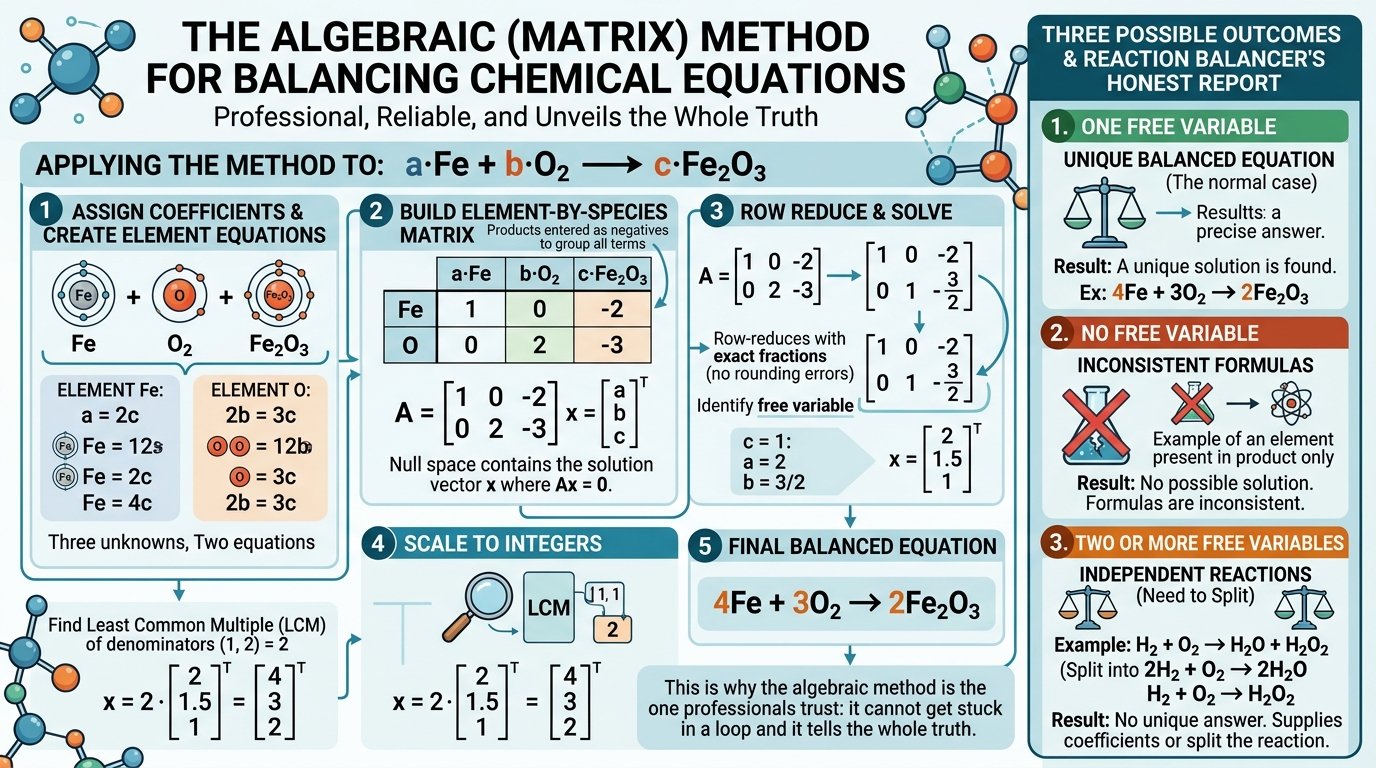
Give each species an unknown coefficient and write one equation per element. For a·Fe + b·O2 → c·Fe2O3:
Fe: a = 2c
O: 2b = 3c
Two equations, three unknowns — one degree of freedom, which is exactly right: a balanced equation can always be scaled. Set c = 1: a = 2, b = 3/2. Clear the fraction by multiplying by 2: a = 4, b = 3, c = 2.
In matrix language the element-by-species table is a matrix whose null space contains the coefficient vector. The chemical equation balancer builds that matrix (with products entered as negatives), row-reduces it with exact fractions so nothing is lost to rounding, reads off the free variable, scales to integers with a least common multiple and divides by the greatest common divisor. Charge, when present, is simply one more row.
Three outcomes are possible, and the chemical equation balancer reports each honestly:
- One free variable — a unique balanced equation. The normal case.
- No free variable — the only solution is all zeros. The formulas are inconsistent (for example a product containing an element no reactant has), and the tool says so.
- Two or more free variables — the “equation” is really two independent reactions added together (H2 + O2 → H2O + H2O2; the aspirin synthesis with acetic acid as by-product). There is no unique answer, so the balancer asks you to supply coefficients, which it then verifies, or to split the reaction.
This is why the algebraic method is the one professionals trust: it cannot get stuck in a loop and it tells you when the question itself is ill-posed.
More Worked Examples
Four equations of increasing difficulty, each verified with the chemical equation balancer.
1. Propane combustion — C3H8 + O2 → CO2 + H2O
Carbon: 3CO2. Hydrogen: 4H2O. Oxygen on the right: 6 + 4 = 10, so 5O2. C3H8 + 5O2 → 3CO2 + 4H2O. Mass: 44.10 + 159.99 = 204.09 g each side.
2. Copper and dilute nitric acid — Cu + HNO3 → Cu(NO3)2 + NO + H2O
Nitrogen appears in three species, so inspection stalls. Algebra: a Cu, b HNO3, c Cu(NO3)2, d NO, e H2O. Cu: a = c. H: b = 2e. N: b = 2c + d. O: 3b = 6c + d + e. Solving gives a : b : c : d : e = 3 : 8 : 3 : 2 : 4. 3Cu + 8HNO3 → 3Cu(NO3)2 + 2NO + 4H2O.
3. Permanganate and hydrochloric acid — KMnO4 + HCl → KCl + MnCl2 + H2O + Cl2
Chlorine is in four species. The chemical equation balancer returns 2KMnO4 + 16HCl → 2KCl + 2MnCl2 + 8H2O + 5Cl2. Check Cl: 16 = 2 + 4 + 10. Check O: 8 = 8. This is the classic laboratory preparation of chlorine and a favourite exam question precisely because inspection is so slow.
4. The phosphorus furnace — Ca3(PO4)2 + SiO2 + C → CaSiO3 + P4 + CO
Six species, five elements. Phosphorus: P4 needs two phosphate units, so 2Ca3(PO4)2. Calcium: 6CaSiO3, hence 6SiO2. Oxygen: 16 + 12 = 28 on the left, 18 in silicate, so 10CO and 10C. 2Ca3(PO4)2 + 6SiO2 + 10C → 6CaSiO3 + P4 + 10CO.
Other results from the chemical equation balancer that appear in the reference table below: 4NH3 + 5O2 → 4NO + 6H2O (the Ostwald process), 4FeS2 + 11O2 → 2Fe2O3 + 8SO2 (pyrite roasting) and C6H12O6 + 6O2 → 6CO2 + 6H2O (respiration).
Ionic Equations and Charge Balance
In solution, many reactions are best written with only the ions that change. A net ionic equation must balance atoms and charge, and the chemical equation balancer treats charge as one more conservation law — one more row in the matrix.
Take permanganate oxidising iron(II) in acid: MnO4− + Fe2+ + H+ → Mn2+ + Fe3+ + H2O. Atoms alone give Mn 1 = 1, O 4 = 4H2O, H 8 = 8, but the iron coefficient is not fixed by atoms — any number of Fe2+ becoming the same number of Fe3+ balances iron. Charge fixes it: left = −1 + 2n + 8, right = +2 + 3n; equal when n = 5. Result: MnO4− + 5Fe2+ + 8H+ → Mn2+ + 5Fe3+ + 4H2O, net charge +17 on each side.
| Skeleton ionic equation | Balanced by the chemical equation balancer | Net charge |
|---|---|---|
| Cr2O72− + Fe2+ + H+ → Cr3+ + Fe3+ + H2O | Cr2O72− + 6Fe2+ + 14H+ → 2Cr3+ + 6Fe3+ + 7H2O | +24 |
| Cu + Ag+ → Cu2+ + Ag | Cu + 2Ag+ → Cu2+ + 2Ag | +2 |
| S2O32− + I2 → S4O62− + I− | 2S2O32− + I2 → S4O62− + 2I− | −4 |
| Ba2+ + PO43− → Ba3(PO4)2 | 3Ba2+ + 2PO43− → Ba3(PO4)2 | 0 |
| MnO4− + H+ + e− → Mn2+ + H2O | MnO4− + 8H+ + 5e− → Mn2+ + 4H2O | +2 (5 e− gained) |
The last row shows that electrons can be typed as a species (e-). The chemical equation balancer then balances a half-reaction directly and reports how many electrons are gained or lost, which is the number you need for the equivalent weight of an oxidising agent or the normality of its solution. If you are unsure of an oxidation state, the oxidation number calculator will assign it.
Redox: The Half-Reaction Method
Examiners often insist on the half-reaction (ion-electron) method for redox equations, and mode 3 of the chemical equation balancer reproduces it line by line. The procedure in acidic solution:
- Split the skeleton into an oxidation half and a reduction half.
- In each half, balance the element other than H and O.
- Balance oxygen by adding H2O.
- Balance hydrogen by adding H+.
- Balance charge by adding electrons (e−) to the more positive side.
- Multiply the halves so the electrons are equal, add them, cancel anything common to both sides.
Hydrogen peroxide and permanganate in acid, H2O2 + MnO4− → O2 + Mn2+, as the chemical equation balancer writes it:
Oxidation: H2O2 → O2; O balanced; H: add 2H+ on the right; charge 0 vs +2: add 2e− on the right. H2O2 → O2 + 2H+ + 2e−
Reduction: MnO4− → Mn2+; O: + 4H2O right; H: + 8H+ left; charge +7 vs +2: + 5e− left. MnO4− + 8H+ + 5e− → Mn2+ + 4H2O
Equalise: lcm(2, 5) = 10 → oxidation × 5, reduction × 2.
Add and cancel 10 of the 16 H+: 5H2O2 + 2MnO4− + 6H+ → 5O2 + 2Mn2+ + 8H2O. Ten electrons transferred.
The tool also names the oxidising agent (the species reduced, MnO4−) and the reducing agent (H2O2), and reports the electrons transferred per mole of reaction — the number that converts a molarity into a normality and fixes the mole ratio in any redox titration. Other acidic examples verified with the chemical equation balancer: Cu + 2NO3− + 4H+ → Cu2+ + 2NO2 + 2H2O; 4Zn + NO3− + 10H+ → 4Zn2+ + NH4+ + 3H2O; IO3− + 5I− + 6H+ → 3I2 + 3H2O.
Balancing in Basic Solution
In basic solution there is no free H+, so after balancing as if in acid you add enough OH− to both sides to neutralise every H+, combine H+ + OH− into H2O, and cancel water that now appears on both sides. Selecting Basic in mode 3 makes the chemical equation balancer do this automatically and show the extra line.
Permanganate oxidising iodide in base, MnO4− + I− → MnO2 + I2: the reduction half in acid is MnO4− + 4H+ + 3e− → MnO2 + 2H2O; add 4OH− to each side and cancel two waters to get MnO4− + 2H2O + 3e− → MnO2 + 4OH−. Combine with 2I− → I2 + 2e− (electrons 6): 2MnO4− + 6I− + 4H2O → 2MnO2 + 3I2 + 8OH−.
| Skeleton (basic solution) | Balanced | e− |
|---|---|---|
| Cl2 → Cl− + ClO3− (disproportionation) | 3Cl2 + 6OH− → 5Cl− + ClO3− + 3H2O | 10 |
| Cr(OH)3 + ClO3− → CrO42− + Cl− | 2Cr(OH)3 + ClO3− + 4OH− → 2CrO42− + Cl− + 5H2O | 6 |
| MnO4− + SO32− → MnO2 + SO42− | 2MnO4− + 3SO32− + H2O → 2MnO2 + 3SO42− + 2OH− | 6 |
Disproportionation (the same species oxidised and reduced, as with Cl2) is handled by the chemical equation balancer by splitting the reactant into two half-reactions, one to each product.
Reference Table: 30 Common Equations Balanced
Every equation below was produced by the chemical equation balancer. Use the table to check homework quickly or to build practice sets.
| # | Reaction | Balanced equation | Type |
|---|---|---|---|
| 1 | Hydrogen + oxygen | 2H2 + O2 → 2H2O | Synthesis |
| 2 | Haber process | N2 + 3H2 → 2NH3 | Synthesis |
| 3 | Rusting | 4Fe + 3O2 → 2Fe2O3 | Synthesis |
| 4 | Aluminium + oxygen | 4Al + 3O2 → 2Al2O3 | Synthesis |
| 5 | Sodium + chlorine | 2Na + Cl2 → 2NaCl | Synthesis |
| 6 | Potassium chlorate | 2KClO3 → 2KCl + 3O2 | Decomposition |
| 7 | Lime kiln | CaCO3 → CaO + CO2 | Decomposition |
| 8 | Hydrogen peroxide | 2H2O2 → 2H2O + O2 | Decomposition |
| 9 | Electrolysis of water | 2H2O → 2H2 + O2 | Decomposition |
| 10 | Zinc + hydrochloric acid | Zn + 2HCl → ZnCl2 + H2 | Single displacement |
| 11 | Aluminium + copper sulfate | 2Al + 3CuSO4 → Al2(SO4)3 + 3Cu | Single displacement |
| 12 | Thermite | Fe2O3 + 2Al → 2Fe + Al2O3 | Single displacement |
| 13 | Aluminium + sulfuric acid | 2Al + 3H2SO4 → Al2(SO4)3 + 3H2 | Single displacement |
| 14 | Silver nitrate + sodium chloride | AgNO3 + NaCl → AgCl + NaNO3 | Double displacement |
| 15 | Lead nitrate + potassium iodide | Pb(NO3)2 + 2KI → PbI2 + 2KNO3 | Double displacement |
| 16 | Sulfuric acid + sodium hydroxide | H2SO4 + 2NaOH → Na2SO4 + 2H2O | Neutralisation |
| 17 | Phosphoric acid + calcium hydroxide | 2H3PO4 + 3Ca(OH)2 → Ca3(PO4)2 + 6H2O | Neutralisation |
| 18 | Methane | CH4 + 2O2 → CO2 + 2H2O | Combustion |
| 19 | Propane | C3H8 + 5O2 → 3CO2 + 4H2O | Combustion |
| 20 | Octane | 2C8H18 + 25O2 → 16CO2 + 18H2O | Combustion |
| 21 | Ethanol | C2H5OH + 3O2 → 2CO2 + 3H2O | Combustion |
| 22 | Glucose (respiration) | C6H12O6 + 6O2 → 6CO2 + 6H2O | Combustion |
| 23 | Acetylene | 2C2H2 + 5O2 → 4CO2 + 2H2O | Combustion |
| 24 | Ostwald process | 4NH3 + 5O2 → 4NO + 6H2O | Redox |
| 25 | Blast furnace | Fe2O3 + 3CO → 2Fe + 3CO2 | Redox |
| 26 | Pyrite roasting | 4FeS2 + 11O2 → 2Fe2O3 + 8SO2 | Redox |
| 27 | Copper + dilute nitric acid | 3Cu + 8HNO3 → 3Cu(NO3)2 + 2NO + 4H2O | Redox |
| 28 | Permanganate + HCl | 2KMnO4 + 16HCl → 2KCl + 2MnCl2 + 8H2O + 5Cl2 | Redox |
| 29 | Phosphorus furnace | 2Ca3(PO4)2 + 6SiO2 + 10C → 6CaSiO3 + P4 + 10CO | Redox |
| 30 | Photosynthesis | 6CO2 + 6H2O → C6H12O6 + 6O2 | Redox |
Combustion Equations and Air-Fuel Ratio
Combustion equations have a fixed pattern — fuel + O2 → CO2 + H2O (+ N2 or SO2 if the fuel contains N or S) — so mode 5 of the chemical equation balancer only asks for the fuel formula. For a hydrocarbon CxHyOz the oxygen coefficient is x + y/4 − z/2; if that is not a whole number the equation is doubled.
| Fuel | Balanced equation | O2 per kg fuel | Stoichiometric AFR | CO2 per kg |
|---|---|---|---|---|
| Methane CH4 | CH4 + 2O2 → CO2 + 2H2O | 3.99 kg | 17.2 : 1 | 2.74 kg |
| Propane C3H8 | C3H8 + 5O2 → 3CO2 + 4H2O | 3.63 kg | 15.6 : 1 | 2.99 kg |
| Octane C8H18 | 2C8H18 + 25O2 → 16CO2 + 18H2O | 3.50 kg | 15.1 : 1 | 3.08 kg |
| Ethanol C2H5OH | C2H5OH + 3O2 → 2CO2 + 3H2O | 2.08 kg | 9.0 : 1 | 1.91 kg |
| Hydrogen H2 | 2H2 + O2 → 2H2O | 7.94 kg | 34.2 : 1 | 0 |
Air is taken as 23.2 % oxygen by mass, so the air-fuel ratio is the oxygen mass divided by 0.232. The chemical equation balancer prints both figures, along with the CO2 emitted per kilogram of fuel, which is why the same mode is useful for a carbon-footprint estimate. For the reverse problem — deducing a formula from combustion products — use the combustion analysis calculator.
Classifying the Reaction
Once an equation is balanced, mode 4 of the chemical equation balancer names the reaction type using the standard school scheme:
| Type | Pattern | Example |
|---|---|---|
| Synthesis (combination) | A + B → AB | N2 + 3H2 → 2NH3 |
| Decomposition | AB → A + B | CaCO3 → CaO + CO2 |
| Single displacement | A + BC → AC + B | Zn + 2HCl → ZnCl2 + H2 |
| Double displacement | AB + CD → AD + CB | AgNO3 + NaCl → AgCl + NaNO3 |
| Neutralisation | acid + base → salt + water | HCl + NaOH → NaCl + H2O |
| Combustion | fuel + O2 → CO2 + H2O | CH4 + 2O2 → CO2 + 2H2O |
| Redox (general) | oxidation numbers change | Fe2O3 + 3CO → 2Fe + 3CO2 |
The categories overlap — every combustion and single displacement is also a redox reaction — so the chemical equation balancer reports the most specific label that fits and notes when a reaction is also redox. Rusting, for example, is a synthesis that is also an oxidation of iron.
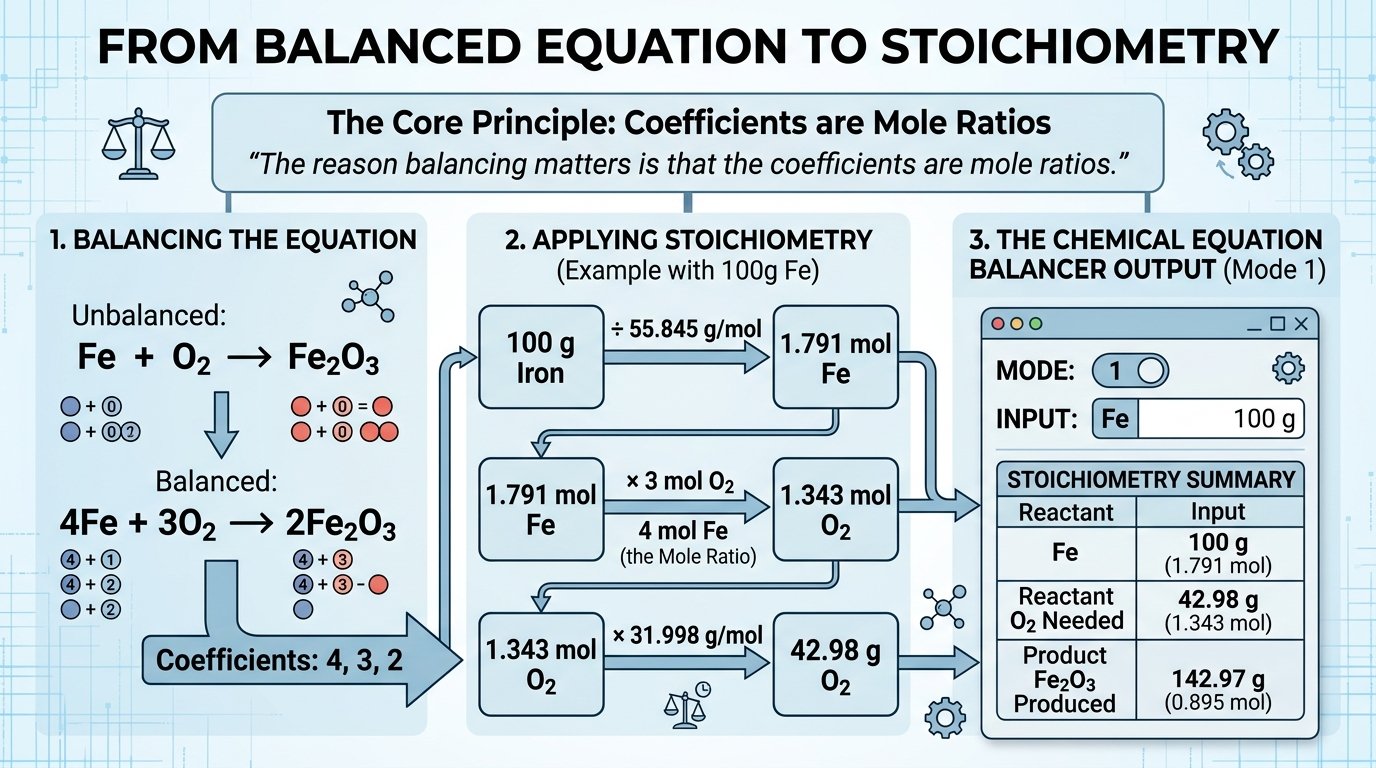
From Balanced Equation to Stoichiometry
The reason balancing matters is that the coefficients are mole ratios. Once 4Fe + 3O2 → 2Fe2O3 is in hand, “how much oxygen does 100 g of iron need?” is three lines: 100 g ÷ 55.845 g/mol = 1.791 mol Fe; × 3/4 = 1.343 mol O2; × 31.998 g/mol = 42.98 g O2. Type Fe 100 g in mode 1 and the chemical equation balancer prints that, plus the 142.97 g of Fe2O3 produced, in the same table.
For fuller treatment — limiting reagents, percent yield, excess reactant — the balanced equation feeds straight into the stoichiometry calculator, the limiting reactant calculator, the theoretical yield calculator and the percent yield calculator. The molar masses the chemical equation balancer uses come from the same IUPAC 2021 table as the molecular weight calculator on the home page.
The mass-balance proof
A balanced equation must conserve mass exactly. The chemical equation balancer multiplies each coefficient by its molar mass and sums each side; for 2KMnO4 + 16HCl → 2KCl + 2MnCl2 + 8H2O + 5Cl2 both sides come to 899.3 g. If your own coefficients pass the atom count but fail this test, a formula is wrong.
Who Uses a Chemical Equation Balancer
- Students from grade 9 to first-year university, for whom balancing is the gateway to stoichiometry and the single most-tested skill in introductory chemistry.
- Teachers and tutors who build worksheets and need a trustworthy answer key with the working shown.
- Analytical chemists writing redox titration equations, where the electron count fixes the mole ratio between titrant and analyte.
- Process and combustion engineers who need oxygen demand, air-fuel ratios and flue-gas composition from a fuel formula.
- Environmental scientists computing CO2 per kilogram of fuel or the stoichiometric oxygen demand of a waste stream.
- Anyone writing a report who wants an equation checked before it is printed.
For all of these, the chemical equation balancer removes the counting error and leaves the chemistry.
Full Walkthrough: A Homework Problem
“Balance the equation for the reaction of potassium dichromate with iodide ions in acidic solution, identify the oxidising and reducing agents, and state how many moles of iodine form per mole of dichromate.”
Skeleton: Cr2O72− + I− → Cr3+ + I2, acidic.
Reduction half: Cr2O72− → 2Cr3+; + 7H2O right; + 14H+ left; charge +12 vs +6: + 6e− left. Cr2O72− + 14H+ + 6e− → 2Cr3+ + 7H2O
Oxidation half: 2I− → I2 + 2e−
Equalise electrons (6): oxidation × 3.
Overall: Cr2O72− + 6I− + 14H+ → 2Cr3+ + 3I2 + 7H2O. Charge: −2 − 6 + 14 = +6; right 2 × 3 = +6. ✓
Agents: dichromate is reduced (Cr +6 → +3), so it is the oxidising agent; iodide is oxidised (−1 → 0), the reducing agent.
Answer: 3 mol I2 per mol Cr2O72−; 6 electrons transferred.
Typing the skeleton into mode 3 of the chemical equation balancer with Acidic selected reproduces every line above, and the “6 e−” is also the n-factor you would use in a normality calculation for dichromate.
A Short History of the Balanced Equation
Balancing rests on the law of conservation of mass, established by Antoine Lavoisier in the 1780s with carefully weighed sealed-vessel experiments. Dalton’s atomic theory (1803–1808) explained why mass is conserved — atoms are rearranged, not made or lost — and Berzelius introduced the letter symbols and subscripts we still use around 1813. Once formulas were fixed, the equation with coefficients followed naturally, and by the mid-nineteenth century the arrow notation and the practice of balancing were standard in textbooks.
The algebraic method dates to at least the 1870s, and the matrix formulation was worked out fully in the twentieth century; it became the obvious approach once computers could row-reduce a matrix instantly. That is the lineage of every chemical equation balancer online today, including this one.
Limits: When an Equation Cannot Be Balanced
A chemical equation balancer is only as good as the skeleton it is given. It will return an error, rather than a wrong answer, in these cases:
- An element on one side only. Na + H2O → NaOH (hydrogen has nowhere to go). Add the missing product, H2.
- Wrong formula. Mg + O2 → MgO2 balances trivially but MgO2 is not magnesium oxide. A balancer cannot know your chemistry; check formulas with the formula weight calculator first.
- Two independent reactions written as one. The null space has two dimensions and there is no unique answer. The chemical equation balancer asks for your coefficients and verifies them.
- Charges that do not add up. An ionic skeleton that cannot be charge-balanced with the species given usually needs H+, OH− or H2O added — which is exactly what mode 3 does for you.
- Nuclear equations. Balancing mass and atomic numbers is a different problem; this tool is for chemical reactions.
Practice Problems With Answers
Try each by hand, then check with the chemical equation balancer. Answers are hidden below the question.
1. Al + O2 → Al2O3
Show answer
4Al + 3O2 → 2Al2O3. Same pattern as iron: metal 2, oxygen lcm 6, metal 4.
2. C4H10 + O2 → CO2 + H2O
Show answer
2C4H10 + 13O2 → 8CO2 + 10H2O. The oxygen count (4 + 2.5 = 6.5) was fractional, so everything was doubled.
3. Fe2O3 + CO → Fe + CO2
Show answer
Fe2O3 + 3CO → 2Fe + 3CO2. Each CO removes one oxygen; three are needed.
4. NH3 + O2 → NO + H2O
Show answer
4NH3 + 5O2 → 4NO + 6H2O. Hydrogen forces 2NH3 : 3H2O; oxygen (2 + 3 = 5, odd) forces doubling.
5. Ca(OH)2 + H3PO4 → Ca3(PO4)2 + H2O
Show answer
3Ca(OH)2 + 2H3PO4 → Ca3(PO4)2 + 6H2O. Treat PO4 as a unit; hydrogen 6 + 6 = 12 gives 6H2O.
6. KMnO4 + HCl → KCl + MnCl2 + H2O + Cl2
Show answer
2KMnO4 + 16HCl → 2KCl + 2MnCl2 + 8H2O + 5Cl2. Use algebra or half-reactions; inspection is slow here.
7. (Ionic) Cu + NO3− + H+ → Cu2+ + NO2 + H2O
Show answer
Cu + 2NO3− + 4H+ → Cu2+ + 2NO2 + 2H2O. Charge +2 on each side; 2 electrons transferred.
8. (Redox, acidic) MnO4− + C2O42− → Mn2+ + CO2
Show answer
2MnO4− + 5C2O42− + 16H+ → 2Mn2+ + 10CO2 + 8H2O. Electrons: 5 per MnO4−, 2 per oxalate, lcm 10.
9. (Redox, basic) Cl2 → Cl− + ClO3−
Show answer
3Cl2 + 6OH− → 5Cl− + ClO3− + 3H2O. A disproportionation: one Cl goes to +5, five go to −1.
10. Is 2Fe + 3Cl2 → 2FeCl3 balanced? What type is it?
Show answer
Yes: Fe 2 = 2, Cl 6 = 6, already in lowest terms. Synthesis, also redox (Fe 0 → +3). Mode 4 of the chemical equation balancer confirms both.
Tips for Accurate Results
- Write the formulas first, then balance. Ninety percent of “impossible” equations are formula errors, not balancing errors.
- Keep polyatomic ions whole when they appear unchanged on both sides — count SO4, not S and O separately.
- Leave free elements (O2, H2, Cl2) for last. Their coefficient can be anything without disturbing another element.
- For redox, count electrons. The number of electrons lost must equal the number gained; if your overall equation balances atoms but not charge, the electrons are wrong.
- Reduce. Divide by any common factor. The chemical equation balancer does this automatically and mode 4 warns you if you did not.
- Check mass. Total molar mass left = total molar mass right. It takes twenty seconds and catches everything.
Common Mistakes
| Mistake | Why it is wrong | Fix |
|---|---|---|
| Changing a subscript (H2O → H2O2) | Creates a different compound | Only coefficients change |
| Forgetting a coefficient multiplies the whole formula | 3Ca(OH)2 has 6 O and 6 H, not 2 | Multiply every subscript by the coefficient |
| Leaving 4H2 + 2O2 → 4H2O | Not lowest terms; marked wrong | Divide by the common factor |
| Balancing atoms but not charge in an ionic equation | Electrons are not conserved | Add the charge row; use mode 2 or 3 |
| Using H+ in a basic-solution redox equation | No free H+ in base | Neutralise with OH−, cancel water |
| Diatomic elements written as atoms (O, H, Cl) | Free O, H, N, halogens are O2, H2, N2, Cl2 | Remember the seven diatomics |
Mode 4 of the chemical equation balancer catches the first four automatically, telling you which element or the charge is off and by how much.
How This Chemical Equation Balancer Is Different
| Feature | This chemical equation balancer | Typical online balancer |
|---|---|---|
| Shows the algebra and atom-count table | ✓ | Coefficients only |
| Mass-balance proof with IUPAC 2021 masses | ✓ | Rare |
| Redox half-reactions, acidic and basic | ✓ | Sometimes |
| Checks and grades your own answer, names the type | ✓ | ✗ |
| Amount → moles and grams of every species | ✓ | ✗ |
| Combustion with air-fuel ratio and CO2 per kg | ✓ | ✗ |
| Honest about unbalanceable / non-unique equations | ✓ | Silent or wrong |
| Copy, CSV, TXT, print, share, history, per-mode Reset | ✓ | Partial |
| Free, no sign-up, runs in your browser | ✓ | Varies |
The chemical equation balancer is one of a family of free tools on this site. The concentration set covers the molarity calculator, molality calculator, normality calculator, mole fraction calculator and ppm to ppb converter. For formulas and masses there are the atomic mass calculator, grams to moles calculator, exact mass calculator, monoisotopic mass calculator, isotopic mass calculator, average vs monoisotopic mass, molar mass of hydrates calculator, empirical formula calculator, molecular formula calculator, percent composition calculator, degree of unsaturation calculator, formal charge calculator and atom economy calculator. Physical-chemistry tools include the freezing point depression, boiling point elevation, osmotic pressure, vapor density, molar mass from gas density and van der Waals equation calculators, and for polymers the average molecular weight of a mixture, number average, weight average, polydispersity index and viscosity molecular weight tools.
Where the Numbers Come From
The chemical equation balancer uses exact rational arithmetic for the coefficients, so there is no rounding at all in the balancing step. Molar masses for the mass check and the amount conversions come from the IUPAC 2021 standard atomic weights (conventional values for elements with an interval). Definitions and methods follow the standard references:
- IUPAC Gold Book — stoichiometric number: the formal definition of the coefficients in a balanced equation.
- OpenStax Chemistry via LibreTexts — Writing and Balancing Chemical Equations: the inspection method, ionic equations and the half-reaction method.
- CIAAW — Standard Atomic Weights: the atomic weights behind every molar mass on this site.
- Wikipedia — Chemical equation: notation, history and the matrix method of balancing.
Found an error? Our corrections policy explains how we handle reports; contact us or read about the site.
Exam Checklist
☐ Every formula written correctly, diatomic elements as X2
☐ Only coefficients changed — no subscript touched
☐ Metals, then non-metals, then H, then O
☐ Polyatomic ions counted as units when unchanged
☐ Atom count identical on both sides for every element
☐ Net charge identical on both sides (ionic / redox)
☐ Electrons lost = electrons gained (redox)
☐ Basic solution: H+ neutralised with OH−, water cancelled
☐ Coefficients reduced to smallest whole numbers
☐ Total mass left = total mass right
Frequently Asked Questions
What does a chemical equation balancer do?
It finds the smallest whole-number coefficients that make the number of atoms of every element — and, for ionic equations, the net charge — identical on both sides of the arrow. This one also shows the algebra, the atom-count table and a mass-balance proof.
Why can’t I change subscripts to balance an equation?
Subscripts define the compound. H2O2 is hydrogen peroxide, not water. Changing a subscript describes a different reaction; changing a coefficient only changes how many molecules take part.
How do I type charges and arrows?
Use -> or = for the arrow, + between species, and write charges as Fe3+, Fe^3+, SO4^2- or NO3-. Electrons are e-. State symbols like (aq) are ignored.
What is the fastest way to balance by hand?
Metals first, then other non-metals, then hydrogen, then oxygen; keep polyatomic ions whole; leave free elements like O2 for last; double everything if you end with a fraction. For redox, use half-reactions.
Why does the balancer say my equation cannot be balanced?
Usually an element appears on one side only, or a formula is wrong. Occasionally the “equation” is really two independent reactions, in which case there is no unique answer and the tool asks you for coefficients to verify.
Does the chemical equation balancer handle redox in basic solution?
Yes. Choose Basic in mode 3; it balances in acid, adds OH− to neutralise every H+, cancels water and shows the extra step.
Are fractional coefficients ever allowed?
In thermochemistry, yes — H2 + ½O2 → H2O keeps one mole of product so the enthalpy is per mole. In ordinary balancing the convention is smallest whole numbers, which is what the tool returns.
Can it balance equations with hydrates and parentheses?
Yes. Nested parentheses such as Ca3(PO4)2 and hydrate dots such as CuSO4·5H2O (type CuSO4*5H2O or CuSO4.5H2O) are parsed correctly.
How do I get the mass of product from the balanced equation?
In mode 1 add an amount after a species, e.g. Fe 100 g. The chemical equation balancer converts it to moles, applies the coefficient ratios and reports moles and grams of every other species.
Is my data stored anywhere?
No. Everything runs in your browser; the history box lives in your own local storage and Clear All empties it.
10 Facts Worth Knowing
- Lavoisier’s balance experiments in the 1780s established that mass is conserved — the physical law every balanced equation obeys.
- The seven diatomic elements — H2, N2, O2, F2, Cl2, Br2, I2 — cause more balancing errors than anything else.
- The octane equation 2C8H18 + 25O2 → 16CO2 + 18H2O consumes 3.5 kg of oxygen, about 15 kg of air, per kilogram of fuel.
- The permanganate–HCl equation has coefficients summing to 35; it is the most-searched redox equation online.
- In the matrix method, a unique balanced equation corresponds to a one-dimensional null space.
- Photosynthesis and respiration are the same balanced equation read in opposite directions.
- A balanced ionic equation conserves charge as well as atoms; both are stated in every result the chemical equation balancer gives.
- The half-reaction method was popularised in the 1920s and remains the examiners’ preferred way to show redox working.
- Doubling every coefficient never breaks a balanced equation; dividing by a common factor is what makes it conventional.
- Every combustion of a CxHy hydrocarbon needs exactly x + y/4 moles of O2 per mole of fuel.
Final Thoughts
Balancing an equation is the first place chemistry insists on being quantitative, and it stays with you through every stoichiometry, titration and yield problem afterwards. Learn the inspection order, understand why the algebraic method always works, and practise the half-reaction method until the basic-solution step is automatic.
Then use the chemical equation balancer above the way a professional uses any calculator: to check, to speed up and to see the working laid out when a question turns awkward. Type a skeleton equation, press Balance, and read the atom table and the mass proof — that is what a balanced equation looks like.
Written by
Ahmad Raza, M.Phil. Chemistry ✓ Verified Expert
Ahmad has taught general and analytical chemistry for over a decade and builds the calculators on this site. He tests every tool — including this chemical equation balancer — against textbook problems and published data before it goes live, and he answers reader questions personally.