
Molarity Calculator
Calculate solution concentration with transparent steps
Molarity Calculator finds molarity, required solute mass, solution volume, or dilution volume. Use moles directly or enter a chemical formula to convert measured mass into amount of substance.
Calculation result
Select a mode, enter the known values, and calculate the missing solution quantity.
Molarity uses final solution volume, not merely solvent volume. Verify critical laboratory, clinical, manufacturing, and regulatory work against the applicable method.
Concentration relationship
Amount increases linearly with volume at fixed molarity.
| Volume in liters | Amount in moles |
|---|
Calculation details
Substituted values, normalized units, and molar-mass contributions where applicable.
| Element | Atoms | Atomic weight | Contribution | Mass percent |
|---|
A molarity calculator answers the question every chemistry student and lab worker asks daily: how concentrated is this solution — and how much solute do I need? Dissolve 5.844 g of NaCl in a liter of water and the tool above tells you instantly: 0.1 M, with every step of the working shown.
This free molarity calculator goes well beyond the basic definition. It computes formula weights automatically from any chemical formula (hydrates included), tells you the exact grams to weigh for a target solution, solves dilutions with M₁V₁ = M₂V₂, handles the molarity-moles-volume triangle in any direction, and converts between M, mM, µM, g/L and mg/mL. Every mode has its own one-click ↺ Reset button, so starting a fresh calculation never means hunting through old numbers.
In this guide, I’ll walk you through all five modes, the molarity formula with worked examples, the dilution math laboratories run on, and the practice problems exams love. Let’s dive in.
🔑 KEY TAKEAWAY
A molarity calculator is a free online tool that computes solution concentration in moles per liter (M) using the formula M = moles of solute ÷ liters of solution. The calculator on this page offers five modes — molarity from mass and volume (with automatic IUPAC formula weights), grams needed for solution preparation, dilution solving via M₁V₁ = M₂V₂, a molarity-moles-volume triangle solver, and a concentration unit converter (M, mM, µM, g/L, mg/mL) — each with step-by-step working, tables, graphs and a one-click reset.
📑 Table of Contents (click to expand)
- What Is a Molarity Calculator?
- How to Use This Molarity Calculator
- The 5 Modes Explained
- The Molarity Formula (M = n ÷ V) With Examples
- Molarity vs Molality vs Normality vs ppm
- Dilutions: Mastering M₁V₁ = M₂V₂
- Molarity Table of Common Lab Stock Solutions
- Preparing a Solution: Complete Walkthrough
- Who Uses a Molarity Calculator?
- From Molarity to Titrations & Stoichiometry
- A Short History of the Mole & Molarity
- Molarity in Everyday Life
- Practice Problems With Answers
- Tips for Accurate Results
- Common Mistakes to Avoid
- What Makes This Tool Different
- Where the Data Comes From
- Quick Exam Checklist
- Frequently Asked Questions
- 10 Molarity Facts Worth Knowing
- Final Thoughts
What Is a Molarity Calculator?
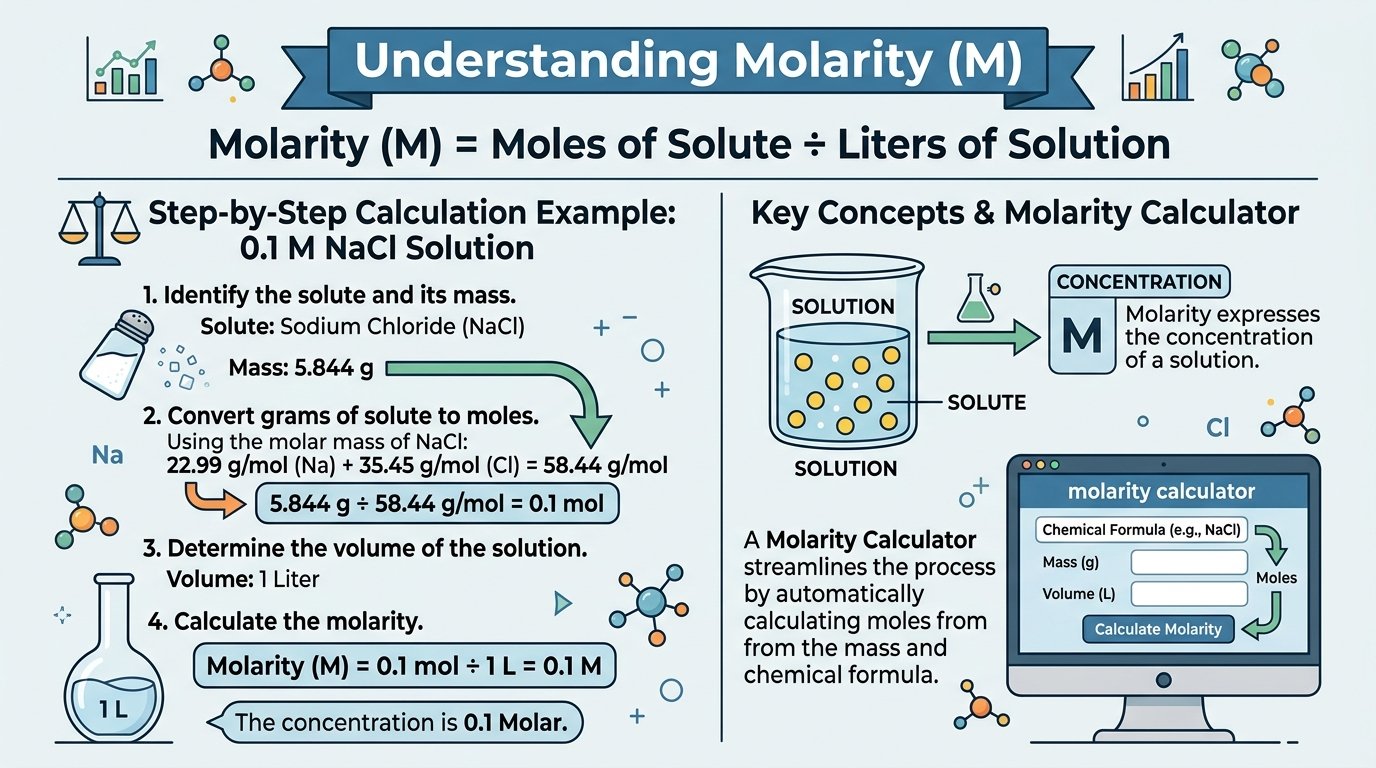
A molarity calculator is an online tool that computes molarity — the number of moles of solute dissolved per liter of solution, written M or mol/L. Molarity is chemistry’s favorite concentration unit because it counts particles, not grams: a 1 M solution of anything contains the same number of solute particles per liter, which is exactly what reactions care about.
The catch with molarity by hand is that it’s a two-step calculation wearing a one-step disguise. Before you can divide moles by liters, you need moles — and that means finding the compound’s formula weight first, converting your weighed grams, and keeping the volume units straight. Each step is easy; chaining them under exam pressure is where errors creep in.
A good molarity calculator collapses the whole chain. Type the formula — the tool above parses anything from NaCl to CuSO₄·5H₂O using IUPAC 2021 atomic masses — enter mass and volume, and the molarity appears with the formula weight, mole count and unit conversion all shown. And because real work is iterative, every mode carries a ↺ Reset button that clears the inputs and results in one click, ready for the next calculation.
💡 Quick definition: Molarity (M) = moles of solute ÷ liters of solution. 5.844 g of NaCl (0.1 mol) in 1 L of solution = 0.1 M. Our molarity calculator does the moles step automatically from any chemical formula.
How to Use This Molarity Calculator
Using this molarity calculator takes four steps — no sign-up, any device:
- Pick a mode. Molarity from mass, mass for solution prep, dilution, M·n·V solver or unit converter — the tabs switch instantly.
- Enter your values. Formulas can include parentheses and hydrates; volumes accept mL or L via the unit dropdown. Example chips (NaCl, NaOH, glucose…) fill the field in one tap.
- Hit Calculate. The answer lands in a highlight box with step-by-step working, a data table and — where it helps — an animated graph.
- Export, share or reset. Copy the result, download CSV/TXT, print a dated report, share to WhatsApp, Facebook or X — or press ↺ Reset to wipe the panel clean for the next problem. Your last ten calculations stay in the history list either way.
Working with the compound itself rather than its solution? The formula-weight step this molarity calculator performs silently is available as a full standalone tool — our molecular weight calculator for molecules, and the formula weight calculator for ionic compounds for salts.
The 5 Modes of Our Molarity Calculator Explained
🧪 Mode 1 — Molarity from Mass & Volume
The core question: I dissolved X grams in Y milliliters — what’s the molarity? Enter formula, mass and volume; the molarity calculator finds the formula weight itself, converts to moles, divides by liters and reports M, mM and g/L side by side. The steps box shows the full chain, ready to copy into homework.
⚖️ Mode 2 — Mass for Solution Prep
The lab-bench reverse: I need 500 mL of 0.5 M NaOH — what do I weigh? Mass = M × V × FW, computed in one click (10.00 g for that example), with a built-in reminder of good technique: dissolve in ~80% of the volume, then top up in a volumetric flask.
💧 Mode 3 — Dilution Solver (M₁V₁ = M₂V₂)
Fill any three of M₁, V₁, M₂, V₂ and leave the unknown blank — the solver rearranges the equation, reports the answer, the dilution factor and the exact volume of solvent to add. It even refuses politely if your numbers describe a concentration increase, because dilutions only go one way.
🔺 Mode 4 — Molarity · Moles · Volume Solver
The M = n ÷ V triangle, solved for whichever corner you’re missing. Two knowns in, one unknown out — with the rearranged formula printed so you learn the algebra, not just the answer.
🔄 Mode 5 — Concentration Unit Converter
Biology papers say mM, reagent bottles say g/L, protocols say mg/mL. Enter a value in any of M, mM, µM, g/L or mg/mL and get all the others at once — the formula weight bridges molar and mass units automatically. Few free molarity calculator tools include this, and it saves endless back-of-envelope arithmetic.
The Molarity Formula (M = n ÷ V) With Worked Examples
Everything a molarity calculator does traces back to one definition:
Molarity (M) = moles of solute ÷ liters of solution · moles = mass ÷ formula weight
Example 1: Table salt — the benchmark
Dissolve 5.844 g of NaCl (FW 58.44 g/mol) to a final volume of 1.000 L. Moles = 5.844 ÷ 58.44 = 0.1000 mol. Molarity = 0.1000 ÷ 1.000 = 0.100 M. Clean numbers by design — this is the example to memorize.
Example 2: Potassium permanganate titrant
A molarity calculator favorite from titration labs: you dissolve 3.161 g of KMnO₄ (FW 158.03) to 500.0 mL. Moles = 3.161 ÷ 158.03 = 0.02000 mol. Volume = 0.5000 L. Molarity = 0.02000 ÷ 0.5000 = 0.0400 M. Note the volume conversion — forgetting mL → L is the single most common molarity error.
Example 3: Glucose for a biology buffer
18.02 g of glucose, C₆H₁₂O₆ (FW 180.16), made up to 2.00 L: moles = 18.02 ÷ 180.16 = 0.1000 mol; M = 0.1000 ÷ 2.00 = 0.0500 M = 50.0 mM. Biology speaks millimolar — multiply M by 1000, or let Mode 5 of the molarity calculator translate.
Example 4: The hydrate catch
Preparing 0.100 M copper sulfate from blue CuSO₄·5H₂O crystals, 250 mL: moles = 0.100 × 0.250 = 0.0250 mol; mass = 0.0250 × 249.68 (pentahydrate FW, not 159.60!) = 6.24 g. Use the anhydrous weight by mistake and your solution is 56% too concentrated — the molarity calculator parses the ·5H₂O and protects you automatically.
Molarity vs Molality vs Normality vs ppm
Four concentration units, four different jobs — here’s the map:
| Unit | Definition | Symbol | Best For |
|---|---|---|---|
| Molarity | Moles of solute per liter of solution | M (mol/L) | Everyday lab work, titrations, stoichiometry |
| Molality | Moles of solute per kilogram of solvent | m (mol/kg) | Temperature-dependent work (boiling/freezing points) — mass doesn’t expand with heat |
| Normality | Gram-equivalents per liter (molarity × equivalents per formula unit) | N (eq/L) | Acid-base and redox titrations (1 M H₂SO₄ = 2 N) |
| ppm | Parts per million by mass — for dilute aqueous solutions, ≈ mg per liter | ppm (mg/L) | Trace analysis, water quality, environmental limits |
A molarity calculator reports M — the first row of that table. The pair everyone confuses: molarity is per liter of solution, molality per kilogram of solvent. For dilute aqueous solutions at room temperature they’re numerically close, but they are different quantities — and only molality survives a temperature change unchanged, because liters expand and kilograms don’t. For everyday concentration work, molarity wins on convenience, which is why a molarity calculator is the tool you’ll reach for most.
Dilutions: Mastering M₁V₁ = M₂V₂
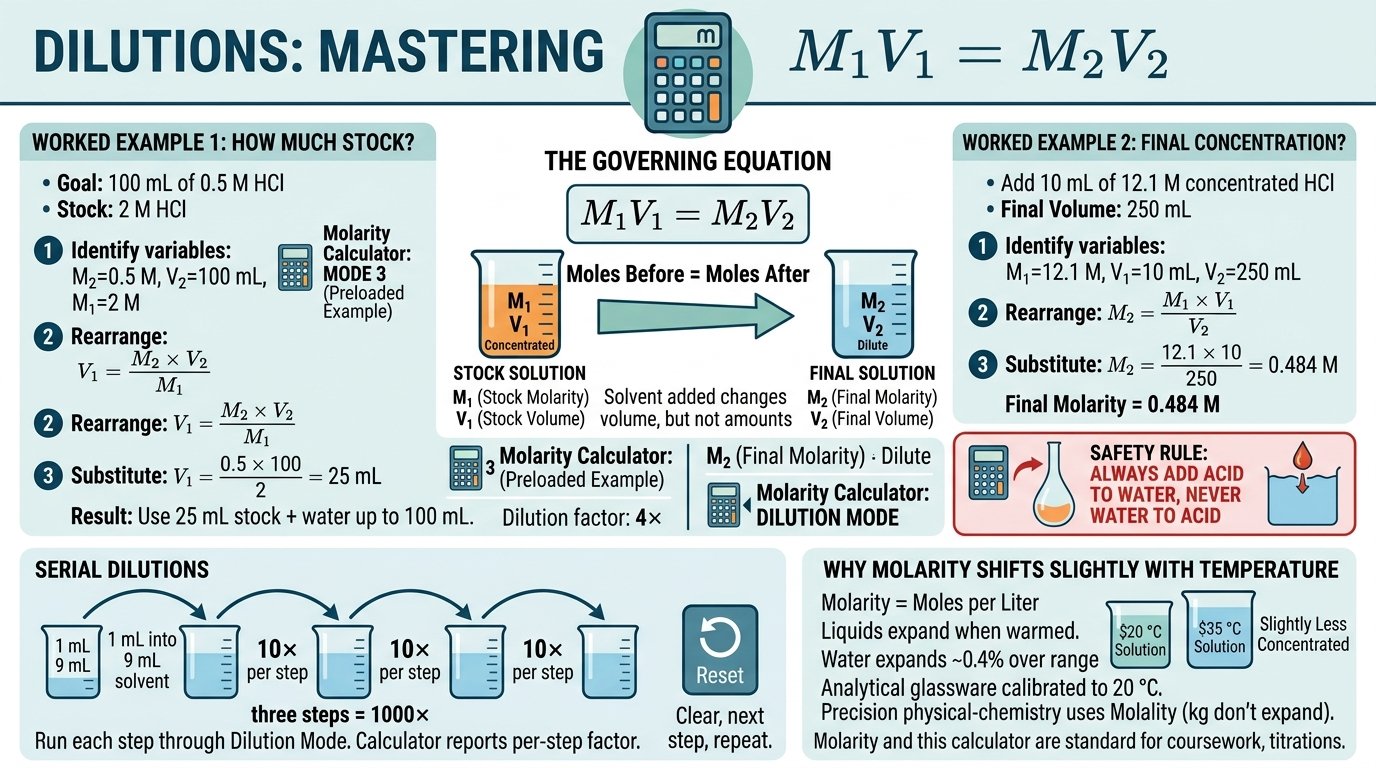
Dilution is the second superpower of a molarity calculator. Labs rarely make solutions from powder every time — they keep concentrated stocks and dilute. The governing equation is beautifully simple: since adding solvent changes volume but not the amount of solute, moles before = moles after, so:
M₁V₁ = M₂V₂ (stock molarity × stock volume = final molarity × final volume)
Worked example 1: How much stock?
You need 100 mL of 0.5 M HCl from a 2 M stock. Solve for V₁: V₁ = M₂V₂ ÷ M₁ = (0.5 × 100) ÷ 2 = 25 mL of stock, then water up to 100 mL. Dilution factor 4×. This is the exact example preloaded in Mode 3 of the molarity calculator.
Worked example 2: What’s my final concentration?
Run this one in the molarity calculator’s dilution mode: you add 10 mL of 12.1 M concentrated HCl to water for a final 250 mL. M₂ = M₁V₁ ÷ V₂ = (12.1 × 10) ÷ 250 = 0.484 M. (And remember the safety rule the equation doesn’t show: always add acid to water, never water to acid.)
Serial dilutions
Biology and microbiology chain dilutions: 1 mL into 9 mL = 10× per step, so three steps = 1000×. Run each step through the dilution mode — the calculator reports the per-step factor, and multiplying factors gives the overall dilution. The ↺ Reset button earns its keep here: clear, next step, repeat.
Why molarity shifts slightly with temperature
One subtlety worth knowing: because molarity is defined per liter of solution, and liquids expand when warmed, a solution prepared at 20 °C is very slightly less concentrated at 35 °C — the same moles now occupy a bit more volume. For routine work the effect is negligible (water expands only ~0.4% over that range), but analytical laboratories calibrate volumetric glassware to 20 °C for exactly this reason. It’s also the technical argument for molality in precision physical-chemistry work: kilograms don’t expand. For everything else — coursework, preps, titrations — molarity and this molarity calculator are the standard.
Molarity Table of Common Lab Stock Solutions
Every dilution you’ll type into a molarity calculator starts from a stock. Concentrated reagents arrive at fixed, well-known molarities — the starting point of nearly every dilution. Approximate values for standard commercial concentrations:
| Reagent (as sold) | Typical Strength | Approx. Molarity |
|---|---|---|
| Hydrochloric acid, HCl | 37% | 12.1 M |
| Sulfuric acid, H₂SO₄ | 96–98% | 18.0 M |
| Nitric acid, HNO₃ | 70% | 15.8 M |
| Phosphoric acid, H₃PO₄ | 85% | 14.8 M |
| Acetic acid, CH₃COOH (glacial) | 99.7% | 17.4 M |
| Ammonia solution, NH₃ | 28% | 14.8 M |
| Sodium hydroxide, NaOH (solution) | 50% | 19.1 M |
| Physiological saline, NaCl | 0.9% w/v | 0.154 M |
Values vary slightly by manufacturer and density — treat these as planning numbers and check the bottle’s certificate for analytical work. Feed any of them into the dilution mode of the molarity calculator and your bench math is done before the fume hood warms up.
Preparing a Solution: A Complete Walkthrough
Let’s run one realistic task end to end with the molarity calculator. Assignment: prepare 250 mL of 0.100 M copper(II) sulfate from CuSO₄·5H₂O crystals.
- Mode 2, enter the real reagent. Formula CuSO₄·5H₂O, molarity 0.100, volume 250 mL. The tool reads the hydrate correctly: FW = 249.68 g/mol.
- Read the answer: 6.24 g. The steps confirm: 0.100 × 0.250 L = 0.0250 mol; 0.0250 × 249.68 = 6.242 g.
- Weigh and dissolve in roughly 200 mL of distilled water, stirring until the blue crystals disappear completely.
- Top up to exactly 250 mL in a volumetric flask — final volume is defined by the flask line, not by the water you started with.
- Verify with Mode 1. Enter 6.24 g, 250 mL: the calculator returns 0.100 M. Numbers that close the loop are numbers you can trust.
- Document. Print the report or save the CSV for your lab notebook, then hit ↺ Reset — ready for the next solution.
Same six-step rhythm — reagent, grams, dissolve, top up, verify, document — for every solution you’ll ever make. Total calculator time: under a minute.
💡 Pro workflow: Keep two tabs open during any prep session — this molarity calculator for the solution math, and the formula weight calculator for ionic compounds when you need the full element-by-element breakdown of a salt. Both run on the same IUPAC data, so their numbers always agree.
Who Uses a Molarity Calculator?
Students — FSc, MDCAT, NEET, A-Levels and beyond
Molarity and dilution problems are guaranteed marks in every chemistry paper. A molarity calculator verifies each homework answer in seconds, and the visible working teaches the method — the difference between copying an answer and owning it.
Teachers and Tutors
Generate consistent answer keys, build worksheet problems with clean numbers, and project the step-by-step working in class. The dilution mode’s “solvent to add” line settles the classic student confusion — V₂ − V₁, not V₂ — visually.
Biology and Biochemistry Labs
Buffers, media, stains and stocks all speak mM and mg/mL. The unit converter translates protocols between molar and mass units instantly, and the prep mode handles every salt in the recipe — hydrates included.
Pharmacy and Medical Sciences
From reconstituting standards to understanding why normal saline is 0.154 M, concentration fluency is daily business. The molarity calculator’s dual molar/mass reporting mirrors how pharmaceutical concentrations are actually written.
Industry and Water Treatment
Dosing calculations, QC standards and reagent management all run on molarity and dilution factors. Batch after batch, the history panel keeps the last ten calculations one glance away.

From Molarity to Titrations & Stoichiometry
Molarity isn’t an endpoint — it’s the currency reactions trade in. Here’s where the molarity calculator sits in the full chain:
- Formula weight → moles. Our atomic mass calculator supplies element masses, the formula weight calculator for ionic compounds sums salts, and this molarity calculator converts your weighed grams into moles automatically.
- Molarity × volume → moles in any aliquot. Pipette 25.0 mL of 0.100 M NaOH and you’ve dispensed exactly 2.50 mmol — no weighing required. This is why solutions are chemistry’s favorite delivery system.
- Mole ratios → titration results. If 25.0 mL of your NaOH neutralizes 20.0 mL of HCl, then the HCl is (0.100 × 25.0) ÷ 20.0 = 0.125 M. Every titration is M₁V₁-style algebra plus a balanced equation.
- Dilution factors → working standards. Calibration curves are serial dilutions of one stock — Mode 3, repeated, with the reset button between steps.
Master M = n ÷ V and M₁V₁ = M₂V₂, and titration chapters become bookkeeping. The molarity calculator handles the bookkeeping; you keep the understanding.
A Short History of the Mole & Molarity
The concentration unit inside every molarity calculator has a surprisingly rich backstory — knowing it makes the whole concept feel less arbitrary.
1811 — Avogadro’s hypothesis. Amedeo Avogadro proposed that equal volumes of gases at the same temperature and pressure contain equal numbers of particles. The idea languished for fifty years, but it planted the seed: chemistry could count particles, not just weigh them.
1860s–1890s — the mole takes shape. Wilhelm Ostwald coined the term “mole” (from the Latin moles, “massive heap”) to describe the gram-molecular-weight of a substance. Suddenly there was a bridge between the invisible particle world and the weighable gram world — the same bridge every molarity calculation crosses.
1909 — counting the uncountable. Jean Perrin’s experiments on Brownian motion produced the first solid estimates of Avogadro’s number, earning him a Nobel Prize and cementing the mole as physical reality rather than bookkeeping fiction.
20th century — molarity becomes the lab standard. As volumetric glassware improved, chemists standardized on moles-per-liter: a volumetric flask defines a liter far faster than a balance defines a kilogram of solvent. Titration handbooks, pharmacopoeias and textbooks all adopted M — and the notation stuck.
2019 — the mole becomes exact. The SI redefinition fixed Avogadro’s constant at exactly 6.02214076 × 10²³ per mole. From that day, the mole no longer depends on any physical artifact — and every number a molarity calculator produces rests on an exact, internationally agreed definition.
Molarity in Everyday Life
Molarity sounds like a classroom word, but you swim in it daily — sometimes literally:
- The IV drip in every hospital is 0.154 M NaCl — “normal saline,” matched (approximately) to your blood so red cells neither swell nor shrivel. A molarity calculation keeps every transfusion safe.
- Your morning tea’s sweetness — two teaspoons of sugar (~8 g sucrose) in a 250 mL cup is about 0.09 M. Run it through the molarity calculator: formula C₁₂H₂₂O₁₁, 8 g, 250 mL.
- Swimming pool chlorine is dosed in ppm — mg/L — which Mode 5 converts straight to molarity. A typical 3 ppm free chlorine target is roughly 4 × 10⁻⁵ M.
- Household vinegar is about 0.8–0.9 M acetic acid (5% w/v). The label says percent; the chemistry happens in molarity.
- ORS sachets (oral rehydration salts) are a precision molarity recipe — glucose ~75 mM, sodium ~75 mM — tuned so intestinal co-transporters absorb water optimally. One of medicine’s biggest life-savers is, at heart, a solution-prep worksheet.
- Car batteries run on ~4–5 M sulfuric acid; window-cleaner ammonia is ~1–2 M; even the fluoride in toothpaste (1450 ppm) translates to about 0.076 M.
Once you see concentrations this way, every label becomes a chemistry problem you can actually solve — usually in one trip through the molarity calculator above. It’s a genuinely useful party trick for a chemistry student: pick up any bottle in the kitchen or bathroom, find the percent or ppm on the label, and translate it into molarity before anyone finishes asking what molarity means.
Practice Problems (Try Them, Then Check With the Calculator)
Paper first, molarity calculator second. Answers hide under each problem.
Problem 1 — 11.1 g of CaCl₂ dissolved to 500 mL. Molarity?
Answer: FW CaCl₂ = 110.98. Moles = 11.1 ÷ 110.98 = 0.1000 mol. M = 0.1000 ÷ 0.500 L = 0.200 M.
Problem 2 — How many grams of AgNO₃ for 250 mL of 0.0500 M solution?
Answer: Moles = 0.0500 × 0.250 = 0.0125 mol. FW AgNO₃ = 169.87. Mass = 0.0125 × 169.87 = 2.12 g. Mode 2 reproduces this instantly.
Problem 3 — Dilute 15.0 mL of 6.00 M HCl to 500 mL. Final molarity?
Answer: M₂ = M₁V₁ ÷ V₂ = (6.00 × 15.0) ÷ 500 = 0.180 M. Dilution factor 33.3×. The molarity calculator’s dilution mode confirms it and shows the solvent to add.
Problem 4 — What volume of 0.400 M NaOH contains 0.100 mol?
Answer: V = n ÷ M = 0.100 ÷ 0.400 = 0.250 L = 250 mL. Mode 4, leave volume empty.
Problem 5 — A protocol calls for 20 mM glucose. What’s that in g/L? (C₆H₁₂O₆, FW 180.16)
Answer: 20 mM = 0.020 M. Mass conc. = 0.020 × 180.16 = 3.60 g/L (= 3.60 mg/mL). Mode 5 converts all five units at once.
Five for five? Solutions chapter — done. If any slipped, re-read the molarity formula section and rematch with the tool’s steps as your coach.
Tips for Accurate Results Every Time
- Convert mL to L before dividing. Molarity is per liter — 250 mL is 0.250 L. The molarity calculator’s unit dropdown does this for you, but your hand calculations must too.
- Write concentrations with units. “0.5” is ambiguous; “0.5 M” is chemistry. Every result box in the molarity calculator carries its unit for exactly this reason.
- Use the bottle’s formula, hydrate and all. CuSO₄·5H₂O ≠ CuSO₄; the pentahydrate’s FW is 56% larger. Type the label exactly.
- Final volume means final. Dissolve, then top up to the line in a volumetric flask. Adding 250 mL of water to solid is not the same as making 250 mL of solution.
- Match V₁ and V₂ units in dilutions. M₁V₁ = M₂V₂ works in any volume unit — as long as both sides use the same one.
- Reset between problems. The ↺ Reset button clears stale inputs — the silent cause of many “impossible” answers.
- Cross-check critical preps against the NIST Chemistry WebBook or your reagent’s certificate of analysis.
5 Common Mistakes to Avoid
Ten years of grading solution-prep reports, five recurring errors — every one preventable with a quick molarity calculator check:
- Forgetting mL → L. Dividing moles by 250 instead of 0.250 makes your answer 1000× too small. If your molarity looks absurd, check the volume unit first.
- Ignoring hydrate water. Weighing 159.60 g/mol worth of CuSO₄·5H₂O crystals — a 36% error baked in before the stirring starts.
- Confusing molarity with moles. 0.5 M is a concentration; 0.5 mol is an amount. You need a volume to convert between them — that’s Mode 4’s whole job.
- Adding solvent volume instead of diluting to volume. “Add 475 mL water to 25 mL stock” ≈ 500 mL but isn’t exact — volumes aren’t perfectly additive. Dilute to the mark.
- Molarity vs molality mix-ups. M is per liter of solution, m is per kilogram of solvent. Close numerically in dilute aqueous work, conceptually different everywhere.
What Makes This Molarity Calculator Different?
| Feature | This Tool | Typical Molarity Tool |
|---|---|---|
| Molarity from mass & volume | ✅ | ✅ |
| Automatic formula weight from any formula (hydrates too) | ✅ | Manual FW entry |
| Dilution solver for ANY missing variable | ✅ | Partial |
| M · n · V triangle solver | ✅ | ❌ |
| Unit converter (M, mM, µM, g/L, mg/mL) | ✅ | ❌ |
| Step-by-step working shown | ✅ | ❌ |
| One-click ↺ Reset per mode | ✅ | ❌ |
| Copy / CSV / TXT / print / share + history | ✅ | ❌ |
| Free, no sign-up, no limits | ✅ | Varies |
The design goal: one molarity calculator that follows a solution from “what do I weigh?” through dilution and unit translation to a printable record — without ever asking you to look up a formula weight somewhere else first.
Where the Data Comes From
The formula weights inside this molarity calculator are computed from standard atomic weights published by IUPAC and maintained by CIAAW — the identical dataset behind every calculator on this site, so cross-checking between tools always agrees to the last digit.
Mole arithmetic uses the exact 2019 SI Avogadro constant, 6.02214076 × 10²³ per mole. For the concept itself, Wikipedia’s molar concentration article is a solid reference. Data updates follow our Corrections Policy.
Quick Exam Checklist: Molarity in 60 Seconds
- ✅ M = n ÷ V — moles of solute per liter of solution.
- ✅ n = mass ÷ FW — get the formula weight right first (hydrates!).
- ✅ mL → L before dividing: 250 mL = 0.250 L.
- ✅ Dilutions: M₁V₁ = M₂V₂ — same volume unit both sides; solvent to add = V₂ − V₁.
- ✅ Prep mass = M × V(L) × FW.
- ✅ mM = M × 1000; g/L = M × FW.
- ✅ Molality ≠ molarity — per kg solvent vs per L solution.
- ✅ Reset, then verify with the molarity calculator above before submitting — stale inputs cause phantom errors.
Frequently Asked Questions
What is a molarity calculator and how does it work?
It’s a free online tool that computes solution concentration using M = moles ÷ liters. This one also derives the formula weight automatically from any chemical formula, so you enter grams and volume and get molarity with full working — plus dilution, solver and unit-conversion modes.
How do I calculate molarity from grams?
Divide the grams by the compound’s formula weight to get moles, then divide by the solution volume in liters. Example: 5.844 g NaCl ÷ 58.44 g/mol = 0.1 mol; in 1 L that’s 0.1 M.
What is the M₁V₁ = M₂V₂ formula used for?
Dilutions. Because adding solvent doesn’t change the moles of solute, stock molarity × stock volume equals final molarity × final volume. Fill any three values in the calculator’s dilution mode and it solves the fourth, plus the dilution factor and solvent to add.
Does this molarity calculator handle hydrates like CuSO₄·5H₂O?
Yes — type the formula with the dot (· or a period or *) and the water of crystallization is included in the formula weight: CuSO₄·5H₂O = 249.68 g/mol, not 159.60. That difference alone prevents the most common solution-prep error.
What’s the difference between molarity and molality?
Molarity (M) is moles per liter of solution; molality (m) is moles per kilogram of solvent. Molality doesn’t change with temperature because mass doesn’t expand. For routine lab work and titrations, molarity is standard.
How do I convert molarity to mg/mL?
Multiply molarity by the formula weight to get g/L, which numerically equals mg/mL: 0.1 M NaCl × 58.44 = 5.844 g/L = 5.844 mg/mL. Mode 5 of the molarity calculator does all five units at once.
What does the Reset button do?
Each mode’s ↺ Reset button clears that panel’s inputs, restores the unit dropdowns to default, and hides previous results — a clean slate in one click. Your saved history stays untouched until you press Clear All.
Is this molarity calculator free?
Completely free — no registration, no limits. All five modes of the molarity calculator, exports, sharing and history work for everyone on any device.
Why is normal saline 0.154 M?
Physiological saline is 0.9% w/v — 9 g NaCl per liter. Divide by NaCl’s formula weight: 9 ÷ 58.44 = 0.154 mol, hence 0.154 M. It’s a molarity calculation hiding inside a medical standard.
Can it find the formula weight of my compound too?
Yes — every calculation displays the formula weight it derived. For a dedicated breakdown by element, use our molecular weight calculator or the formula weight calculator for ionic compounds — all three tools share the same IUPAC dataset.
10 Molarity Facts Worth Knowing
Favorites from a decade of teaching — each checkable in seconds with the molarity calculator above:
- Your blood is a solution — sodium runs about 0.140 M, potassium 0.004 M, glucose roughly 5 mM. Clinical chemistry is molarity in a white coat.
- Ocean water is ~0.6 M NaCl — nearly four times saltier than your body’s 0.154 M, which is why drinking it dehydrates you.
- Concentrated H₂SO₄ (18 M) is the strongest common stock on the acid shelf — and one of the reasons “add acid to water” is drilled into every first-year student.
- Pure water has a molarity too: about 55.5 M in itself (1000 g/L ÷ 18.02 g/mol) — the silent denominator of aqueous chemistry.
- pH is molarity in disguise: pH 7 means the H⁺ concentration is 10⁻⁷ M. Every pH meter is reporting a molarity on a log scale.
- A 1 M sugar solution is mostly water: 342 g of sucrose per liter sounds like a lot, but water molecules still outnumber sugar about 55 to 1.
- Serial 10× dilutions reach absurd territory fast: nine steps take 1 M down to 1 nM — a billion-fold in nine pipette moves.
- The 2019 SI redefinition fixed Avogadro’s number exactly at 6.02214076 × 10²³, making the mole — and thus molarity — exact by definition.
- “Normal saline” isn’t quite physiological: 0.154 M slightly exceeds plasma sodium (0.140 M), a century-old approximation medicine still uses daily.
- Molarity was born of convenience: volumes are faster to measure than masses — a liter takes one flask; a kilogram takes a balance. That pragmatism made M the default unit of the wet lab.
Trusted resources for going deeper
- IUPAC Periodic Table of Elements — official standard atomic weights.
- NIST Chemistry WebBook — reference data for thousands of species.
- Molar concentration — Wikipedia — definitions and unit relationships.
- Our formula weight calculator for ionic compounds and atomic mass calculator — the same IUPAC dataset, one level down the calculation chain.
Final Thoughts: Bookmark This Molarity Calculator
Concentration is the language solutions speak, and molarity is its grammar. Every titration, buffer, standard and dilution you’ll ever run reduces to M = n ÷ V and M₁V₁ = M₂V₂ — two small equations with an outsized workload. Understanding them makes you a competent chemist; having a fast, IUPAC-accurate molarity calculator with automatic formula weights makes you an efficient one.
The tool above covers the whole workflow — grams to molarity, molarity to grams, dilutions, the M·n·V triangle and five-unit conversion — with visible steps, exportable results and a reset button that keeps the bench moving. Try the molarity calculator with whatever solution is on your bench right now; and for the compounds themselves, our molecular weight calculator, formula weight calculator for ionic compounds and atomic mass calculator complete the set.
Found a bug, want another unit in the converter, or have a solution-prep question? Reach us via the contact page or read about this project — several features across the site began as user suggestions.
Written & Reviewed By
Ahmad Raza, M.Phil. Chemistry
Ahmad is a chemistry educator and science content developer with over 10 years of experience teaching analytical and physical chemistry. He builds free calculation tools that help students and lab professionals work faster and make fewer errors. When he’s not writing about solutions, he’s usually grading titration reports.