
Limiting Reactant Calculator
Type any reaction and the amount of each reactant — grams, moles or millilitres of a solution — and get the limiting reactant, the theoretical yield of every product, the excess left over and the percent yield, with the balanced equation and every mole-ratio step written out.
✓ Trusted by students, teachers & lab chemistsFind the Limiting Reactant of Any Reaction
Enter the equation (balanced or not — the calculator balances it) and the amount of each reactant, one per line or separated by semicolons. Amounts may be in g, mg, kg, mol, mmol, or a solution volume plus molarity (25 mL 0.1 M). The reactant with the smallest moles ÷ coefficient ratio is limiting.
Two-Reactant Quick Check (Coefficients and Amounts Only)
No equation needed — give the coefficient and amount of each reactant and the calculator compares the mole ratio you have with the ratio the equation demands. Enter grams (with the formula so the molar mass is looked up) or moles directly.
Theoretical Yield of a Product from the Limiting Reactant
Same inputs as Mode 1, plus the product you care about. The calculator finds the limiting reactant, then converts its moles through the mole ratio into grams and moles of the chosen product (and of every other product).
Excess Reactant: How Much Is Used and How Much Is Left
Reports, for every excess reactant, the moles and grams consumed, the moles and grams remaining, the percentage excess and the extra amount of limiting reactant that would have used it all up.
Percent Yield from the Limiting Reactant and the Actual Yield
Give the equation, the reactant amounts and the mass (or moles) of product you actually isolated. The calculator finds the limiting reactant, computes the theoretical yield and reports percent yield = actual ÷ theoretical × 100.
🕘 Recent calculations
- No calculations yet — your last 10 results will appear here.
Method: balance the equation · convert every reactant to moles (n = m/M or n = C×V) · divide each by its coefficient · the smallest ratio is the limiting reactant · theoretical yield = nlimiting × (coefproduct/coeflimiting) × Mproduct · excess left = ngiven − nused · percent yield = actual/theoretical × 100 · IUPAC 2021 atomic weights.
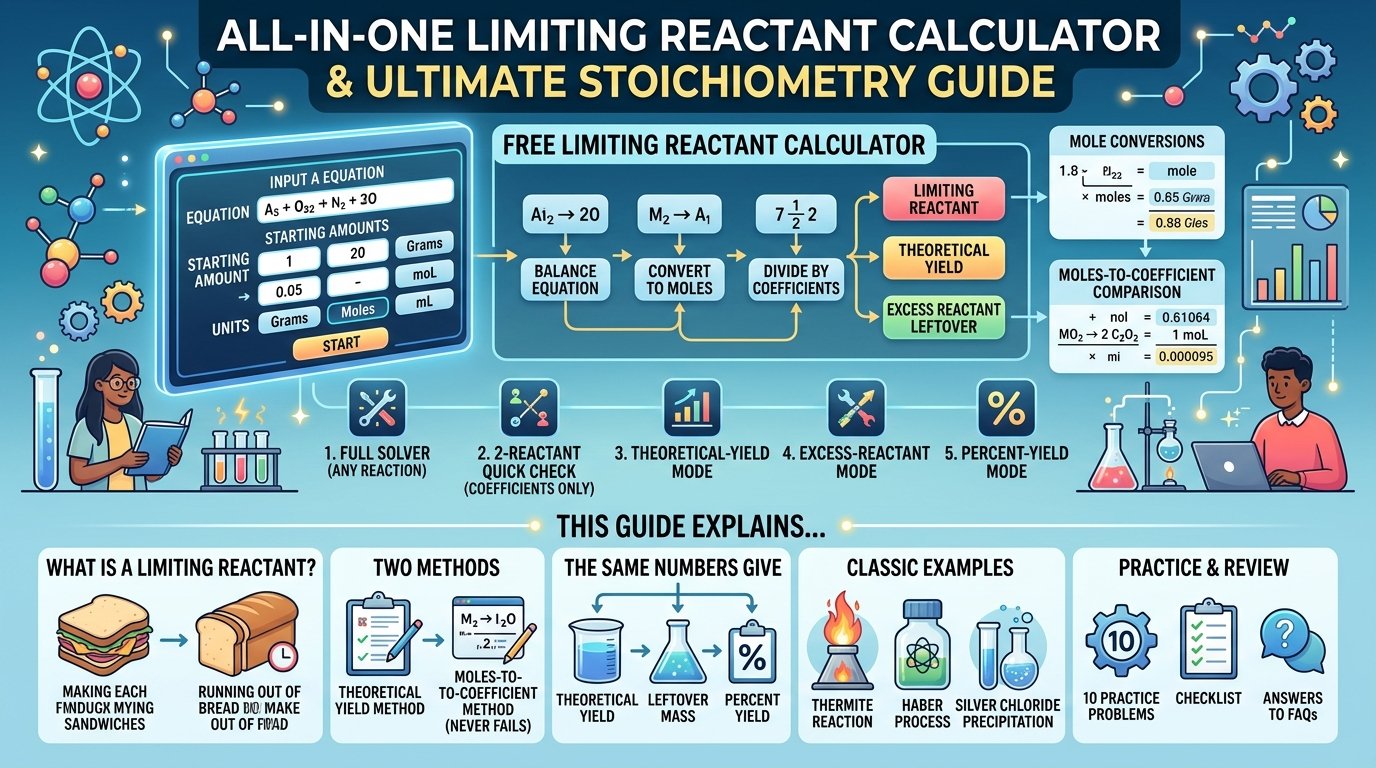
A limiting reactant calculator answers the question every stoichiometry problem eventually asks: which reactant runs out first, and how much product can that reactant make? Type the equation and the amount of each starting material — grams, moles or millilitres of a solution — and the calculator balances the equation, converts each amount to moles, divides by the coefficient, names the limiting reactant, works out the theoretical yield of every product and tells you how much of the excess reactant is left over.
The free limiting reactant calculator above does this in five modes: a full solver for any reaction, a two-reactant quick check that needs only coefficients, a theoretical-yield mode, an excess-reactant mode and a percent-yield mode. Every result comes with the balanced equation, the mole conversions and the moles-to-coefficient comparison written out, so you can copy the working straight into a lab report or an exam answer.
This guide explains what a limiting reactant is, the two methods for finding it, why the moles-to-coefficient method never fails, and how the same numbers give theoretical yield, leftover mass and percent yield. It works through the classic examples — thermite, the Haber process, silver chloride precipitation from two solutions — and finishes with ten practice problems, a checklist and answers to the questions students ask most.
Key Takeaway
Balance the equation, convert every reactant to moles, divide each by its coefficient. The smallest result is the limiting reactant; it fixes the theoretical yield of every product (moles × ratio × molar mass) and everything else is in excess. For Fe2O3 + 2Al with 20 g and 5 g: 0.1252/1 = 0.1252 vs 0.1853/2 = 0.0927 — aluminium limits, 10.35 g of iron is the most you can make, and 5.20 g of Fe2O3 is left over.
📑 Table of Contents (click to expand)
- What Is a Limiting Reactant?
- How to Use the Limiting Reactant Calculator
- The Five Modes Explained
- The Moles-to-Coefficient Method
- Worked Example: Thermite Step by Step
- More Worked Examples
- Method 1 vs Method 2: Which to Use
- From Limiting Reactant to Theoretical Yield
- Excess Reactant: Used, Left Over, Percent Excess
- Reference Table: 30 Classic Problems Solved
- Reactants in Solution: Molarity × Volume
- Percent Yield and Why It Is Below 100%
- Gases: Volumes, STP and Avogadro’s Law
- Three or More Reactants
- Exact Stoichiometric Amounts
- Who Uses a Limiting Reactant Calculator
- Full Walkthrough: A Lab Report Problem
- A Short History of Stoichiometry
- Limits: When the Concept Does Not Apply
- Practice Problems With Answers
- Tips for Accurate Results
- Common Mistakes
- How This Calculator Is Different
- Where the Numbers Come From
- Exam Checklist
- Frequently Asked Questions
- 10 Facts Worth Knowing
- Final Thoughts
What Is a Limiting Reactant?
The limiting reactant (also called the limiting reagent) — the quantity every limiting reactant calculator is built to identify — is the reactant that is completely consumed first in a chemical reaction. Once it is gone, the reaction stops, no matter how much of the other reactants remains. It therefore limits the amount of product that can form. Every other reactant is an excess reactant: some of it is left unreacted when the limiting reactant runs out.
The kitchen analogy is worn but accurate. A sandwich needs two slices of bread and one slice of cheese. With ten slices of bread and three slices of cheese you can make three sandwiches; cheese is the limiting ingredient and four slices of bread are left over. Notice that you cannot decide this by counting slices alone (ten bread versus three cheese) — you have to divide by the recipe’s ratio (10/2 = 5 sandwiches’ worth of bread, 3/1 = 3 sandwiches’ worth of cheese). Chemical reactions work exactly the same way, with the balanced equation as the recipe and moles as the slices; a limiting reactant calculator simply does the division for you.
That is the whole reason a limiting reactant calculator is useful: the comparison has to be done in moles and scaled by the coefficients. Comparing masses is wrong (20 g of Fe2O3 is far fewer moles than 5 g of Al would suggest), and comparing raw moles is wrong whenever the coefficients differ. The calculator handles both conversions and shows them.
Three linked definitions
Limiting reactant — the reactant with the smallest value of (moles available ÷ stoichiometric coefficient). It is used up completely.
Theoretical yield — the maximum amount of a product, calculated from the limiting reactant: nproduct = nlimiting × (coefproduct / coeflimiting).
Excess — for every other reactant, moles left = moles given − (coefficient × extent of reaction), where the extent of reaction is that smallest ratio.
How to Use the Limiting Reactant Calculator
- Type the equation. Balanced or not —
Fe2O3 + Al -> Al2O3 + Feis enough; the limiting reactant calculator balances it by the matrix method and shows the result. Arrows can be->,=or →; state symbols such as (aq) and (g) are ignored. - Enter each reactant with its amount. One per line or separated by semicolons:
Fe2O3 20 g; Al 5 g. Units may be g, mg, kg, mol, mmol, or a volume plus a molarity for solutions:HCl 25 mL 0.1 M. The order does not matter. - Click Find Limiting Reactant. The answer box names the limiting reactant and the excess reactants; below it the steps show the balanced equation, every mole conversion, the moles ÷ coefficient comparison, the theoretical yield of each product and the leftover of each excess reactant.
- Read the table and the chart. The table lists molar mass, moles, coefficient, ratio, moles used and moles left for every reactant; the bar chart makes the smallest ratio obvious at a glance.
- Export. Copy the summary, download CSV or TXT, print a one-page report or share the result. The last ten calculations stay in the history panel until you clear them.
Modes 3, 4 and 5 of the limiting reactant calculator use the same inputs and add a product (for theoretical yield), report the leftover in detail (excess mode) or take the actual mass isolated (percent yield). Mode 2 is for the quick homework case where you already know the coefficients and only want the comparison. Each mode has its own Reset button.
The Five Modes Explained
| Mode | You enter | You get | Typical use |
|---|---|---|---|
| 1. Limiting Reactant | Equation + amount of every reactant | Limiting and excess reactants, ratio table, yields of all products, leftovers | Any textbook problem; any number of reactants |
| 2. Two-Reactant Quick Check | Coefficient, formula and amount of A and B | Which limits, how much of the other is needed, leftover | Fast homework check without typing products |
| 3. Theoretical Yield | As mode 1 + the product of interest | Grams and moles of that product (and all others) | Synthesis planning, lab pre-work |
| 4. Excess Reactant | As mode 1 | Used, left over (mol and g), percent excess, how much more limiting reactant would consume it | “How much remains?” questions; scale-up |
| 5. Percent Yield | As mode 1 + product + actual yield | Theoretical yield, percent yield, mass lost, over-100% warning | Lab reports |
The Moles-to-Coefficient Method
Every limiting reactant calculator problem reduces to four steps. The limiting reactant calculator follows them exactly and prints each one.
Step 1 — Balance the equation. The coefficients are the recipe. An unbalanced equation gives a wrong answer even when the arithmetic is perfect.
Step 2 — Convert every reactant amount to moles. n = mass ÷ molar mass for solids and liquids; n = molarity × volume (in litres) for solutions; n = volume ÷ 22.4 L/mol for gases at STP.
Step 3 — Divide each mole amount by its coefficient. The quotient is “how many times the reaction can run” on that reactant alone.
Step 4 — The smallest quotient is the limiting reactant. Call it ξ (the extent of reaction). Every product forms in the amount coefficient × ξ; every other reactant loses coefficient × ξ.
The beauty of this method is that step 4 works for any number of reactants and never requires a second calculation. The older “method 1” — pick one reactant, calculate how much of the other it needs, compare — works fine for two reactants but becomes a tangle with three. Both are covered below; the limiting reactant calculator uses the quotient method internally and reports the numbers method 1 would have produced as well.
Worked Example: Thermite Step by Step
Problem. 20.0 g of iron(III) oxide is mixed with 5.00 g of aluminium powder and ignited. This is the first example most students run through a limiting reactant calculator. Which reactant is limiting, what mass of iron forms, and how much of the excess reactant remains?
1. Balance. Fe2O3 + 2Al → Al2O3 + 2Fe
2. Moles. M(Fe2O3) = 2(55.845) + 3(15.999) = 159.69 g/mol → n = 20.0/159.69 = 0.1252 mol. M(Al) = 26.982 g/mol → n = 5.00/26.982 = 0.1853 mol.
3. Divide by coefficients. Fe2O3: 0.1252/1 = 0.1252. Al: 0.1853/2 = 0.0927.
4. Smallest wins. 0.0927 < 0.1252, so aluminium is the limiting reactant and ξ = 0.0927 mol.
5. Theoretical yield of Fe. n(Fe) = 2 × 0.0927 = 0.1853 mol → 0.1853 × 55.845 = 10.35 g. (Al2O3: 0.0927 × 101.96 = 9.45 g.)
6. Excess Fe2O3. Used = 1 × 0.0927 = 0.0927 mol; left = 0.1252 − 0.0927 = 0.0326 mol → 0.0326 × 159.69 = 5.20 g unreacted (35% excess).
7. Mass check. In: 20.0 + 5.00 = 25.0 g. Out: 10.35 + 9.45 + 5.20 = 25.0 g. ✓
Notice the trap in this problem: there are more grams of Fe2O3 and more moles of Al, yet aluminium is limiting because the equation needs two Al for every Fe2O3. Only the moles-to-coefficient comparison gets it right, which is why the limiting reactant calculator always shows step 3 explicitly. Click the “Thermite 20 g / 5 g” chip in Mode 1 to see the identical working generated live.
More Worked Examples
Example 2: The Haber process — 28 g N2 + 10 g H2
N2 + 3H2 → 2NH3. Moles: N2 28/28.014 = 0.9995; H2 10/2.016 = 4.960. Ratios: 0.9995/1 = 0.9995; 4.960/3 = 1.653. Nitrogen limits. NH3 = 2 × 0.9995 = 1.999 mol = 34.04 g. Hydrogen used = 3 × 0.9995 = 2.999 mol; left = 1.962 mol = 3.96 g. A common wrong answer is “hydrogen limits because 10 g is less than 28 g” — the mass comparison is meaningless, and the limiting reactant calculator shows why in step 3.
Example 3: Two solutions — 25.0 mL of 0.200 M AgNO3 + 30.0 mL of 0.150 M NaCl
AgNO3 + NaCl → AgCl + NaNO3. Moles: AgNO3 0.200 × 0.0250 = 5.00 mmol; NaCl 0.150 × 0.0300 = 4.50 mmol. Both coefficients are 1, so NaCl limits. AgCl = 4.50 mmol × 143.32 g/mol = 0.645 g of precipitate. Excess AgNO3 = 0.50 mmol, which stays in the 55 mL of solution at 0.0091 M. Type AgNO3 25 mL 0.2 M; NaCl 30 mL 0.15 M in the limiting reactant calculator to reproduce it.
Example 4: Combustion — 10.0 g propane in 30.0 g oxygen
C3H8 + 5O2 → 3CO2 + 4H2O. Moles: C3H8 10.0/44.10 = 0.2268; O2 30.0/31.998 = 0.9376. Ratios: 0.2268/1 = 0.2268; 0.9376/5 = 0.1875. Oxygen limits (as the limiting reactant calculator confirms) even though there is three times as much of it by mass and four times as much by moles — the coefficient of 5 swamps that. CO2 = 3 × 0.1875 = 0.5626 mol = 24.76 g; propane left = 0.2268 − 0.1875 = 0.0393 mol = 1.73 g.
Example 5: Copper and silver nitrate — 3.00 g Cu + 12.0 g AgNO3
Cu + 2AgNO3 → Cu(NO3)2 + 2Ag. Moles: Cu 3.00/63.546 = 0.04721; AgNO3 12.0/169.87 = 0.07064. Ratios: Cu 0.04721; AgNO3 0.07064/2 = 0.03532. Silver nitrate limits. Silver formed = 2 × 0.03532 = 0.07064 mol = 7.62 g. Copper left = 0.04721 − 0.03532 = 0.01189 mol = 0.756 g. In the “silver tree” experiment this leftover copper is the wire you can still see under the silver crystals; the limiting reactant calculator’s excess mode gives the same 0.756 g.
Example 6: Exact amounts — 1.00 mol H2 + 1.00 mol Cl2
H2 + Cl2 → 2HCl. Both ratios equal 1.00. Neither reactant is in excess; the reactants are in stoichiometric proportion. The limiting reactant calculator flags this case and uses either reactant to compute 2.00 mol of HCl. It is the exception that proves the rule: the “limiting reactant” only exists when the ratios differ.
Method 1 vs Method 2: Which to Use
Textbooks teach two ways of identifying the limiting reactant, and a good limiting reactant calculator should display both. They always agree; they differ in bookkeeping.
| Aspect | Method 1: “How much do I need?” | Method 2: moles ÷ coefficient |
|---|---|---|
| Procedure | Take reactant A; calculate the moles of B needed to react with all of it; compare with the moles of B available. If you need more B than you have, B limits; otherwise A limits. | Divide each reactant’s moles by its coefficient; the smallest quotient limits. |
| Thermite numbers | 0.1252 mol Fe2O3 needs 2 × 0.1252 = 0.2504 mol Al; only 0.1853 available → Al limits | 0.1252/1 = 0.1252 vs 0.1853/2 = 0.0927 → Al limits |
| Three+ reactants | Awkward: every pair must be checked | Identical procedure, one line per reactant |
| Alternative | “Method 1b”: calculate the product from each reactant separately; the reactant giving the least product limits | Same as 1b but stops before multiplying by the product coefficient |
| Best for | Building intuition; two-reactant problems | Everything, especially under exam time pressure |
Whichever you learn, write the moles of every reactant first. Both methods fail identically if you forget to balance the equation or convert to moles — the two errors the limiting reactant calculator is designed to make impossible.
From Limiting Reactant to Theoretical Yield
Once the limiting reactant calculator has named the limiting reactant, the theoretical yield of any product is one multiplication away:
nproduct = nlimiting × (coefproduct / coeflimiting) and massproduct = nproduct × Mproduct
It is called theoretical because it assumes the limiting reactant is converted completely, the reaction has no side products and none of the product is lost in work-up. Real yields are lower — the ratio is the percent yield, covered in Section 12. Two habits keep this step error-free:
- Always start from the limiting reactant. Starting from an excess reactant overstates the yield, sometimes by a factor of two or three.
- Use the coefficient ratio product/limiting, not limiting/product. For 2Al → 2Fe the ratio is 1; for N2 → 2NH3 it is 2; for 2KClO3 → 3O2 it is 3/2.
The limiting reactant calculator computes the theoretical yield of every product at once (it is just coefficient × ξ for each) and shows the featured one in the answer box. For a dedicated yield tool with reverse planning and multi-step routes, see the theoretical yield calculator.
Excess Reactant: Used, Left Over, Percent Excess
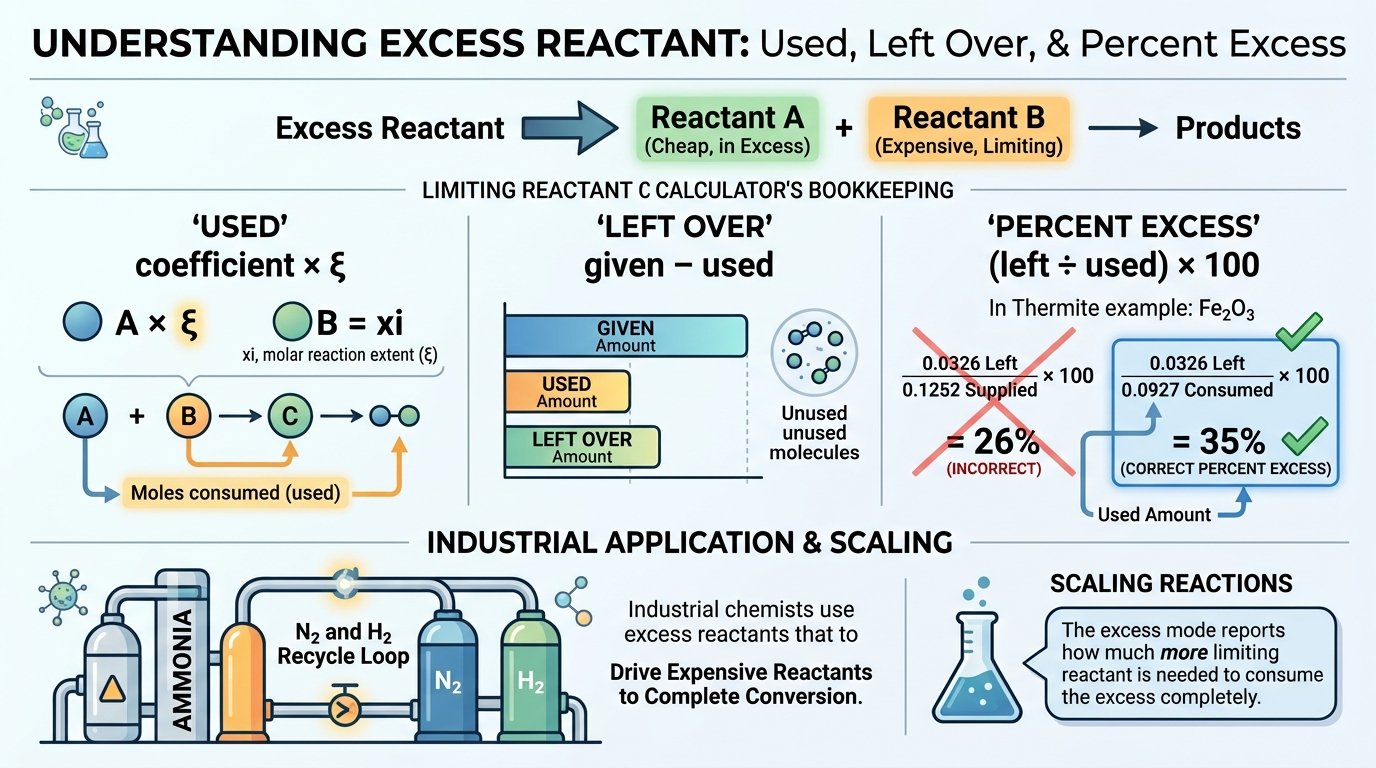
For each excess reactant the limiting reactant calculator’s bookkeeping is: used = coefficient × ξ; left = given − used; percent excess = left ÷ used × 100. Percent excess is defined relative to the amount consumed, not the amount supplied, which is why the thermite Fe2O3 comes out as 35% excess (0.0326/0.0927) rather than 26% (0.0326/0.1252).
Industrial chemists deliberately run reactions with one reactant in excess — the cheap one, or the one that is easy to recover — to drive the expensive reactant to complete conversion. Ammonia plants, for example, recycle unreacted N2 and H2 around the loop many times. The excess mode of the limiting reactant calculator also reports how much more limiting reactant would be needed to consume the excess completely, which is exactly the number you need when scaling a reaction up or down.
| Reaction (amounts) | Limiting | Excess reactant | Used | Left | % excess |
|---|---|---|---|---|---|
| Fe2O3 + 2Al (20 g, 5 g) | Al | Fe2O3 | 14.80 g | 5.20 g | 35.2% |
| N2 + 3H2 (28 g, 10 g) | N2 | H2 | 6.05 g | 3.96 g | 65.4% |
| Zn + 2HCl (6.54 g, 0.150 mol) | HCl | Zn | 4.90 g | 1.64 g | 33.4% |
| 2NaOH + H2SO4 (10 g, 10 g) | H2SO4 | NaOH | 8.16 g | 1.84 g | 22.6% |
| P4 + 6Cl2 (12.4 g, 35.5 g) | Cl2 | P4 | 10.34 g | 2.06 g | 19.9% |
Reference Table: 30 Classic Problems Solved
Every row below was generated with the limiting reactant calculator using IUPAC 2021 atomic weights. Use it to check homework or to spot the pattern: the limiting reactant is rarely the one with the smaller mass.
| # | Balanced equation | Amounts given | Limiting | Theoretical yield | Excess left |
|---|---|---|---|---|---|
| 1 | Fe2O3 + 2Al → Al2O3 + 2Fe | 20.0 g, 5.00 g | Al | 10.35 g Fe | 5.20 g Fe2O3 |
| 2 | N2 + 3H2 → 2NH3 | 28.0 g, 10.0 g | N2 | 34.04 g NH3 | 3.96 g H2 |
| 3 | 2H2 + O2 → 2H2O | 4.00 g, 40.0 g | H2 | 35.74 g H2O | 8.26 g O2 |
| 4 | AgNO3 + NaCl → AgCl + NaNO3 | 25 mL 0.200 M, 30 mL 0.150 M | NaCl | 0.645 g AgCl | 0.50 mmol AgNO3 |
| 5 | Zn + 2HCl → ZnCl2 + H2 | 6.54 g, 0.150 mol | HCl | 0.151 g H2 (1.68 L STP) | 1.64 g Zn |
| 6 | C3H8 + 5O2 → 3CO2 + 4H2O | 10.0 g, 30.0 g | O2 | 24.76 g CO2 | 1.73 g C3H8 |
| 7 | Cu + 2AgNO3 → Cu(NO3)2 + 2Ag | 3.00 g, 12.0 g | AgNO3 | 7.62 g Ag | 0.756 g Cu |
| 8 | Pb(NO3)2 + 2KI → PbI2 + 2KNO3 | 50 mL 0.100 M each | KI | 1.152 g PbI2 | 2.50 mmol Pb(NO3)2 |
| 9 | 2Na + Cl2 → 2NaCl | 10.0 g, 10.0 g | Cl2 | 16.48 g NaCl | 3.51 g Na |
| 10 | CaCO3 + 2HCl → CaCl2 + H2O + CO2 | 10.0 g, 100 mL 1.00 M | HCl | 2.20 g CO2 | 5.00 g CaCO3 |
| 11 | 2Al + 3Cl2 → 2AlCl3 | 5.40 g, 21.3 g | Cl2 (barely) | 26.7 g AlCl3 | 0.0 g Al (stoichiometric) |
| 12 | CH4 + 2O2 → CO2 + 2H2O | 16.0 g, 48.0 g | CH4 | 43.9 g CO2 | 16.2 g O2 |
| 13 | Mg + 2HCl → MgCl2 + H2 | 2.43 g, 50 mL 2.00 M | HCl | 0.101 g H2 | 1.22 g Mg |
| 14 | 2C2H6 + 7O2 → 4CO2 + 6H2O | 0.500 mol, 1.50 mol | O2 | 0.857 mol CO2 (37.7 g) | 0.071 mol C2H6 |
| 15 | SiO2 + 3C → SiC + 2CO | 100 g, 50.0 g | C | 55.6 g SiC | 16.6 g SiO2 |
| 16 | 2KClO3 → 2KCl + 3O2 | 10.0 g (single reactant) | KClO3 | 3.92 g O2 | — |
| 17 | C7H6O3 + C4H6O3 → C9H8O4 + CH3COOH | 2.00 g, 5.00 g | salicylic acid | 2.61 g aspirin | 3.52 g Ac2O |
| 18 | BaCl2 + Na2SO4 → BaSO4 + 2NaCl | 20 mL 0.50 M, 25 mL 0.30 M | Na2SO4 | 1.75 g BaSO4 | 2.5 mmol BaCl2 |
| 19 | 4NH3 + 5O2 → 4NO + 6H2O | 2.00 mol, 2.00 mol | O2 | 1.60 mol NO (48.0 g) | 0.40 mol NH3 |
| 20 | 2NaOH + H2SO4 → Na2SO4 + 2H2O | 10.0 g, 10.0 g | H2SO4 | 14.48 g Na2SO4 | 1.84 g NaOH |
| 21 | TiCl4 + 2Mg → Ti + 2MgCl2 | 100 g, 30.0 g | TiCl4 | 25.2 g Ti | 4.37 g Mg |
| 22 | P4 + 6Cl2 → 4PCl3 | 12.4 g, 35.5 g | Cl2 | 45.8 g PCl3 | 2.06 g P4 |
| 23 | CuO + H2 → Cu + H2O | 7.95 g, 0.500 g | CuO | 6.35 g Cu | 0.298 g H2 |
| 24 | 3Ca(OH)2 + 2H3PO4 → Ca3(PO4)2 + 6H2O | 15.0 g, 15.0 g | Ca(OH)2 | 20.9 g Ca3(PO4)2 | 1.78 g H3PO4 |
| 25 | 2SO2 + O2 → 2SO3 | 64.0 g, 24.0 g | SO2 | 80.0 g SO3 | 8.0 g O2 |
| 26 | Fe + S → FeS | 7.00 g, 4.00 g | S (barely) | 10.97 g FeS | 0.03 g Fe |
| 27 | C2H5OH + CH3COOH → CH3COOC2H5 + H2O | 4.60 g, 6.00 g | ethanol (barely) | 8.80 g ester | 0.005 g acid |
| 28 | Al2(SO4)3 + 6NaOH → 2Al(OH)3 + 3Na2SO4 | 34.2 g, 20.0 g | NaOH | 13.0 g Al(OH)3 | 5.69 g Al2(SO4)3 |
| 29 | 2C8H18 + 25O2 → 16CO2 + 18H2O | 100 g, 300 g | O2 | 264 g CO2 | 14.3 g octane |
| 30 | NaHCO3 + CH3COOH → CH3COONa + H2O + CO2 | 8.40 g, 50 mL 0.833 M | acetic acid | 1.83 g CO2 (1.02 L at 25 °C) | 4.90 g NaHCO3 |
Reactants in Solution: Molarity × Volume
Many precipitation and neutralisation problems give volumes and concentrations instead of masses, and a limiting reactant calculator must handle them without a separate conversion. The mole conversion is simply n = c × V, with V in litres (or c in mol/L and V in mL giving millimoles). The limiting reactant calculator accepts 25 mL 0.2 M directly and converts it for you; it also accepts 0.025 L 0.2 mol/L. Two points deserve care:
- The total volume changes. Mixing 25 mL and 30 mL gives 55 mL. Concentrations of the excess reactant and of soluble products after mixing must be divided by the combined volume — the calculator reports the leftover in moles and grams, and you divide by the total volume if you need molarity.
- Polyprotic acids and multivalent ions carry their own coefficients. 2NaOH + H2SO4: 20 mL of 0.1 M NaOH (2.0 mmol) is exactly neutralised by 10 mL of 0.1 M H2SO4 (1.0 mmol), because the coefficient ratio is 2:1. Equal volumes of equal molarity would leave NaOH as the limiting reactant. The molarity calculator handles the dilution side of these problems.
Percent Yield and Why It Is Below 100%
Percent yield = actual yield ÷ theoretical yield × 100. The theoretical yield comes from the limiting reactant calculator’s result; the actual yield is what you weighed after isolating and drying the product. In the thermite example, if 8.90 g of iron were recovered the percent yield would be 8.90/10.35 = 86.0%.
Yields fall short for four reasons: the reaction reaches equilibrium before completion (esterifications, the Haber process); competing side reactions consume the limiting reactant (over-oxidation, elimination alongside substitution); mechanical losses during filtration, transfer and recrystallisation; and impure or wet starting materials that contained fewer moles than the balance suggested. A yield above 100% almost always means the product is wet or contaminated — the limiting reactant calculator flags this rather than silently reporting 104%. The full treatment, including multi-step yields and percent recovery, is in the percent yield calculator.
Gases: Volumes, STP and Avogadro’s Law
When every reactant and product is a gas at the same temperature and pressure, Avogadro’s law lets you skip moles entirely — and a limiting reactant calculator can work in litres: volumes are in the same ratio as coefficients. 10 L of N2 and 20 L of H2 → the H2 quotient is 20/3 = 6.67 L-equivalents against 10 for N2, so hydrogen limits and 2 × 6.67 = 13.3 L of NH3 forms. When gases are mixed with solids or solutions you must convert: n = V/22.414 L at STP (0 °C, 1 bar gives 22.711 L; 25 °C and 1 atm gives 24.465 L), or n = PV/RT in general. Enter the moles in the limiting reactant calculator, and it reports gaseous products in litres at STP alongside the mass. For non-ideal corrections at high pressure see the van der Waals equation calculator.
Three or More Reactants
The moles ÷ coefficient method scales without change, which is why the limiting reactant calculator accepts any number of reactants. Consider the classic three-reactant problem 4FeS2 + 11O2 → 2Fe2O3 + 8SO2 followed by industrial oxidation, or more simply the preparation of 1-bromobutane: C4H9OH + NaBr + H2SO4 → C4H9Br + NaHSO4 + H2O with 7.4 g butanol (0.0998 mol), 12.4 g NaBr (0.1205 mol) and 12 g H2SO4 (0.1223 mol). All coefficients are 1, so butanol (0.0998) limits and the theoretical yield is 0.0998 × 137.02 = 13.68 g of 1-bromobutane. With unequal coefficients, e.g. 2KMnO4 + 16HCl → 2KCl + 2MnCl2 + 5Cl2 + 8H2O, the coefficient of 16 makes HCl the limiting reactant far more often than students expect — the limiting reactant calculator lists all three quotients so nothing is missed.
Exact Stoichiometric Amounts
When all quotients in the limiting reactant calculator are equal the reactants are in exact stoichiometric proportion: nothing is left over and any reactant can be used for the yield. In practice this is rare because atomic weights are not round numbers. Row 11 of the reference table (5.40 g Al with 21.3 g Cl2) is a near-tie: Al 0.2001/2 = 0.10006, Cl2 0.3004/3 = 0.10014, so aluminium technically limits by 0.08%. The limiting reactant calculator reports ties within 0.1% as “stoichiometric (essentially equal)” so that rounding noise does not masquerade as a real limiting reactant. When a question says “stoichiometric amounts were used”, it is telling you to skip the limiting step.
Who Uses a Limiting Reactant Calculator
🎓 High-school and first-year students
Limiting reactant questions appear on every general chemistry exam (AP, IB, A-level, FSc, JEE, MCAT). The step-by-step output teaches the method rather than hiding it.
🔬 Lab students and TAs
Pre-lab calculations of theoretical yield and post-lab percent yield for synthesis experiments — aspirin, esters, alum, copper cycle.
🔧 Process and plant engineers
Choosing which feed to run in excess, sizing recycle streams and estimating conversion per pass.
📊 Analytical chemists
Gravimetric analysis relies on adding the precipitating reagent in excess so that the analyte is the limiting reactant and precipitates completely.
📚 Teachers
Generating worked answers and printable keys; the reference table above is a ready-made problem set.
🏭 Pharmaceutical and fine-chemical chemists
Setting equivalents of coupling reagents and bases so the valuable intermediate is limiting and fully consumed.
Full Walkthrough: A Lab Report Problem
Problem. This is the kind of question a limiting reactant calculator is used for most often. In a synthesis of aspirin a student uses 2.00 g of salicylic acid (C7H6O3) and 5.00 mL of acetic anhydride (C4H6O3, density 1.08 g/mL). After recrystallisation 2.15 g of dry aspirin (C9H8O4) is obtained. Identify the limiting reactant, the theoretical yield and the percent yield.
1. Equation. C7H6O3 + C4H6O3 → C9H8O4 + CH3COOH (already balanced, all coefficients 1).
2. Convert the liquid to mass. 5.00 mL × 1.08 g/mL = 5.40 g acetic anhydride.
3. Moles. Salicylic acid: 2.00/138.12 = 0.01448 mol. Acetic anhydride: 5.40/102.09 = 0.05289 mol.
4. Compare. Both coefficients are 1, so 0.01448 < 0.05289: salicylic acid is limiting; anhydride is in 265% excess (deliberately — it also serves as solvent).
5. Theoretical yield. 0.01448 mol × 180.16 g/mol = 2.609 g aspirin.
6. Percent yield. 2.15/2.609 × 100 = 82.4%.
7. Report sentence. “Salicylic acid (0.01448 mol) was the limiting reactant; the theoretical yield of acetylsalicylic acid was 2.61 g and the isolated yield was 2.15 g (82.4%).”
In the limiting reactant calculator, enter C7H6O3 2.0 g; C4H6O3 5.4 g in Mode 5 with product C9H8O4 and actual yield 2.15 to get the same three numbers and a printable summary.
A Short History of Stoichiometry
Long before any limiting reactant calculator existed, the word stoichiometry was coined in 1792 by Jeremias Benjamin Richter, who measured the masses of acids and bases that exactly neutralised each other and realised the proportions were fixed. Joseph Proust’s law of definite proportions (1794–1799) and John Dalton’s atomic theory (1803–1808) explained why: compounds contain elements in fixed ratios of whole atoms. Amedeo Avogadro’s hypothesis (1811) — equal volumes of gas contain equal numbers of molecules — supplied the link between gas volumes and moles, and Stanislao Cannizzaro’s 1858 pamphlet finally put consistent atomic weights in chemists’ hands. The mole itself entered the vocabulary through Wilhelm Ostwald around 1900; the modern definition (exactly 6.02214076 × 10²³ entities) dates from the 2019 SI revision. The limiting reactant concept is implicit in all of this: once you know that reactants combine in fixed mole ratios, one of them must run out first. What has changed is the arithmetic — from log tables to a limiting reactant calculator that also balances the equation.
Limits: When the Concept Does Not Apply
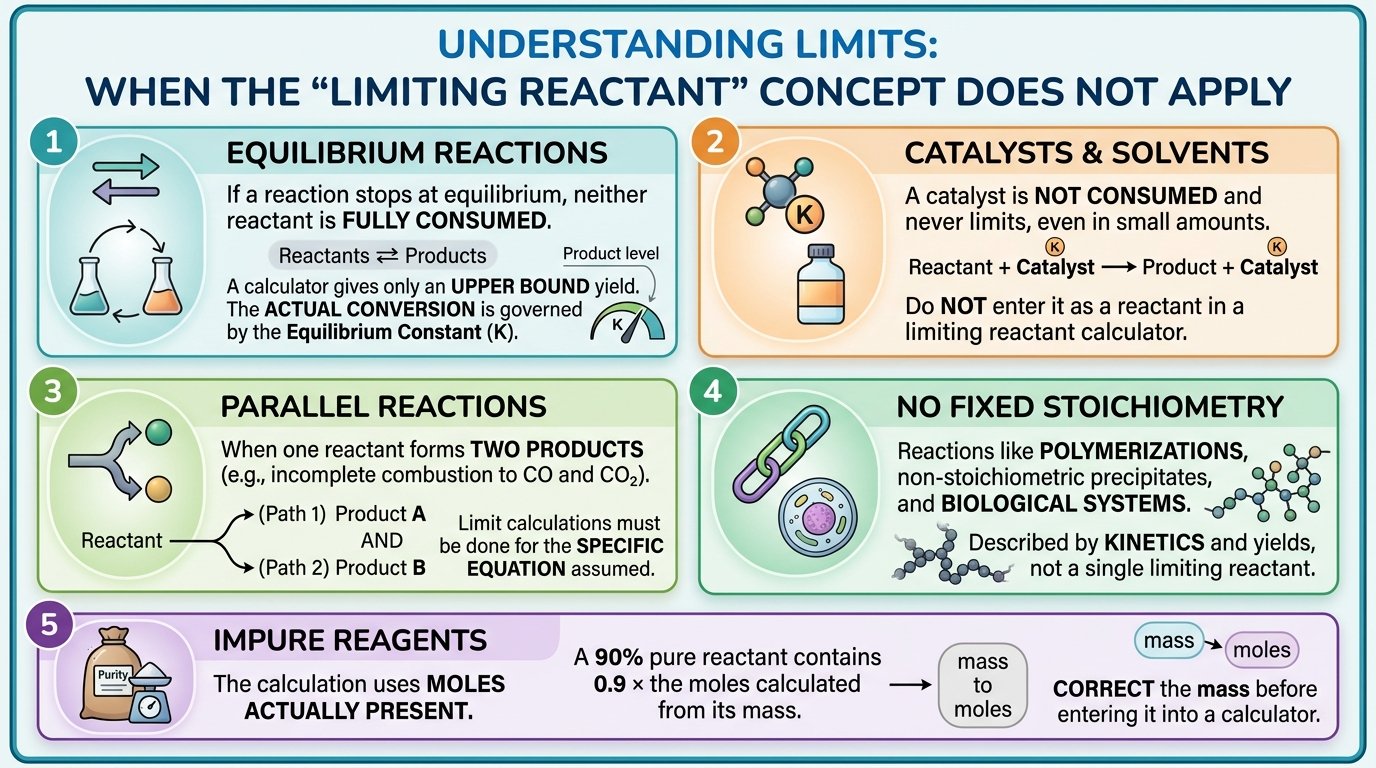
- Equilibrium reactions. If the reaction stops at equilibrium, neither reactant is fully consumed and a limiting reactant calculator gives only an upper bound. The limiting reactant still sets the maximum possible yield, but the actual conversion is governed by K.
- Catalysts and solvents. A catalyst is not consumed and never limits, even when present in tiny amount. Do not enter it in the limiting reactant calculator as a reactant.
- Parallel reactions. When one reactant can give two products (e.g. incomplete combustion to CO and CO2), the limiting reactant calculation must be done for the specific equation you assume.
- Reactions with no fixed stoichiometry. Polymerisations, precipitations of non-stoichiometric solids and biological systems are described by kinetics and yields rather than a single limiting reactant.
- Impure reagents. The calculation uses the moles actually present. A reactant that is 90% pure contains 0.9 × the moles you calculate from its mass; correct the mass before entering it.
Practice Problems With Answers
Work each one on paper, then check with the limiting reactant calculator. Molar masses: use IUPAC 2021 values, as the limiting reactant calculator does.
1. 2H2 + O2 → 2H2O with 4.00 g H2 and 40.0 g O2. Limiting reactant and mass of water?
Answer: H2 (1.984/2 = 0.992 vs 1.250/1); water = 1.984 mol = 35.7 g; 8.26 g O2 left.
2. Zn + 2HCl → ZnCl2 + H2 with 6.54 g Zn and 0.150 mol HCl. Volume of H2 at STP?
Answer: HCl limits (0.150/2 = 0.075 vs 0.100); H2 = 0.075 mol = 1.68 L; 1.64 g Zn left.
3. Pb(NO3)2 + 2KI → PbI2 + 2KNO3; 50.0 mL of 0.100 M each. Mass of PbI2?
Answer: KI limits (5.00 mmol/2 = 2.50 vs 5.00); PbI2 = 2.50 mmol × 461.0 = 1.15 g.
4. CaCO3 + 2HCl with 10.0 g CaCO3 and 100 mL of 1.00 M HCl. Mass of CO2 and CaCO3 left?
Answer: HCl limits (0.100/2 = 0.050 vs 0.0999); CO2 = 0.050 mol = 2.20 g; CaCO3 left = 0.0499 mol = 5.00 g.
5. 2Na + Cl2 → 2NaCl with 10.0 g of each. Mass of NaCl?
Answer: Cl2 limits (0.1410 vs 0.4350/2 = 0.2175); NaCl = 0.2821 mol = 16.5 g; 3.51 g Na left.
6. 3.00 g Cu with 12.0 g AgNO3. Mass of silver?
Answer: AgNO3 limits (0.07064/2 = 0.0353 vs 0.0472); Ag = 0.0706 mol = 7.62 g.
7. 2NaOH + H2SO4 with 10.0 g of each. Which is limiting and what is left?
Answer: H2SO4 limits (0.1020 vs 0.2500/2 = 0.1250); NaOH used 0.2039 mol (8.16 g), left 1.84 g.
8. SiO2 + 3C → SiC + 2CO with 100 g SiO2 and 50.0 g C. Mass of SiC?
Answer: C limits (4.163/3 = 1.388 vs 1.664); SiC = 1.388 mol = 55.6 g; SiO2 left = 0.276 mol = 16.6 g.
9. 4NH3 + 5O2 → 4NO + 6H2O with 2.00 mol of each. Moles of NO?
Answer: O2 limits (2.00/5 = 0.400 vs 2.00/4 = 0.500); NO = 4 × 0.400 = 1.60 mol; 0.40 mol NH3 left.
10. Thermite with 20.0 g Fe2O3 and 5.00 g Al gives 8.90 g Fe. Percent yield?
Answer: Al limits; theoretical Fe = 10.35 g; percent yield = 8.90/10.35 = 86.0%.
Tips for Accurate Results
- Balance first, always. The limiting reactant calculator balances for you, but check that the coefficients it shows match the reaction you meant — especially for combustion, where CO versus CO2 changes everything.
- Carry four significant figures in moles (the limiting reactant calculator keeps five) and round only the final answer. Near-ties (rows 11, 26, 27 in the table) flip if you round early.
- Convert liquids by density before entering them in the limiting reactant calculator: mL × g/mL = g. Only solutions with a stated molarity should be entered as volumes.
- Use molar masses from the same source for every species. Mixing 16 and 15.999 for oxygen introduces avoidable discrepancies; the molecular weight calculator and this tool share the IUPAC 2021 table.
- Check mass conservation. Total mass of products + leftovers must equal total mass of reactants. The calculator prints this check; if it fails in your hand calculation, a coefficient or molar mass is wrong.
- Write the extent of reaction ξ once — the limiting reactant calculator calls it the limiting quotient — and derive everything else from it. It is the single number that connects limiting reactant, yields and leftovers.
Common Mistakes
| Mistake | Why it is wrong | Fix |
|---|---|---|
| Comparing grams | Atoms react by count, not by mass; 5 g Al is more moles than 20 g Fe2O3 | Convert to moles first |
| Comparing moles without dividing by coefficients | 0.1853 mol Al > 0.1252 mol Fe2O3, yet Al limits because two are needed | Divide each by its coefficient |
| Choosing the reactant with the smallest mass or moles as limiting | Rows 2, 6, 12 of the reference table all contradict this shortcut | Smallest quotient limits |
| Calculating yield from the excess reactant | Overstates the yield; the excess is never fully used | Always start from the limiting reactant |
| Using an unbalanced equation | Wrong coefficients give wrong quotients and wrong ratios | Let the limiting reactant calculator balance, then verify |
| Forgetting the volume of a solution is in mL | 0.2 M × 25 = 5 mol instead of 5 mmol — a factor of 1000 | c × V with V in litres |
| Percent excess based on the amount supplied | Definition is (left ÷ used) × 100 | Divide by the amount consumed |
| Counting a catalyst or solvent as a reactant | Not consumed; cannot limit | Enter only species in the balanced equation |
How This Calculator Is Different
| Feature | This limiting reactant calculator | Typical online tools |
|---|---|---|
| Equation balancing | Automatic (matrix method), shown in the steps | Usually requires a pre-balanced equation |
| Input units | g, mg, kg, mol, mmol, mL + M in the same box | Grams only |
| Number of reactants | Unlimited | Two |
| Output | Limiting + excess, all product yields, leftovers, % excess, mass-balance check, percent yield | Name of the limiting reactant |
| Working shown | Every conversion and quotient, table and chart | Final number only |
| Export | Copy, CSV, TXT, print, share, 10-item history | None |
Related tools on this site: the stoichiometry calculator for mole-ratio conversions without a limiting step, the grams to moles calculator, the theoretical yield calculator, the percent yield calculator, the atom economy calculator for the green-chemistry view of the same equation, and the formal charge calculator and oxidation number calculator for the bonding side. Molar masses of any species come from the atomic mass calculator, formula weight calculator, molar mass of hydrates calculator, exact mass calculator, monoisotopic mass calculator, isotopic mass calculator and average vs monoisotopic mass guide; formulas from experimental data via the empirical formula calculator, molecular formula calculator, percent composition calculator, combustion analysis calculator and degree of unsaturation calculator; solution and gas properties via the equivalent weight calculator, freezing point depression, boiling point elevation, osmotic pressure, vapor density and gas density tools; and polymer averages via the average molecular weight of a mixture, number average, weight average, polydispersity index and viscosity calculators.
Where the Numbers Come From
The limiting reactant calculator uses atomic weights from the IUPAC 2021 standard values (conventional values for elements with an interval); the mole and STP conventions follow IUPAC recommendations. The method is the one presented in every standard general-chemistry text. Trusted references for further reading:
- IUPAC Gold Book — extent of reaction, the quantity ξ behind the moles-to-coefficient method.
- LibreTexts / OpenStax Chemistry 4.4 — Reaction Yields: limiting reactant, theoretical and percent yield with examples.
- CIAAW — Standard atomic weights, the source of every molar mass used here.
- Wikipedia — Limiting reagent, both textbook methods with worked examples.
Found an error? See our corrections policy, contact us, or read about the site.
Exam Checklist
☐ Equation balanced and coefficients copied correctly
☐ Every reactant converted to moles (g ÷ M, or c × V in litres, or V ÷ 22.4 at STP)
☐ Each mole amount divided by its coefficient
☐ Smallest quotient identified as the limiting reactant, and the answer says so (the limiting reactant calculator prints this line for you)
☐ Product moles = quotient × product coefficient, then × molar mass
☐ Excess reactant: used = coefficient × quotient, left = given − used
☐ Percent yield = actual ÷ theoretical × 100 (if asked)
☐ Mass balance checked; units and significant figures stated
Frequently Asked Questions
What is the easiest way to find the limiting reactant?
Convert every reactant to moles and divide each by its coefficient in the balanced equation. The reactant with the smallest result is the limiting reactant. This works for any number of reactants and is exactly what the limiting reactant calculator does.
Is the limiting reactant always the one with the smaller mass?
No. Mass tells you nothing until it is converted to moles and scaled by the coefficient. In the Haber example 28 g of N2 limits while 10 g of H2 is in excess; in the thermite example 5 g of Al limits while 20 g of Fe2O3 is in excess.
What is the difference between limiting reactant and limiting reagent?
Nothing in practice; the terms are used interchangeably, and a limiting reactant calculator answers both. Strictly, a reagent is any substance added to a reaction mixture, while a reactant is one consumed in the reaction, so “limiting reactant” is the more precise term.
How do I calculate the theoretical yield from the limiting reactant?
Multiply the moles of limiting reactant by the ratio (coefficient of product ÷ coefficient of limiting reactant), then by the molar mass of the product. For 0.0927 × 2 mol Al in Fe2O3 + 2Al → 2Fe: 0.1853 × (2/2) × 55.845 = 10.35 g Fe.
How much of the excess reactant is left over?
Left = moles given − (its coefficient × the limiting quotient). Multiply by molar mass for grams. The excess mode of the limiting reactant calculator reports used, left and percent excess for every non-limiting reactant.
Can there be no limiting reactant?
Yes, when the reactants are in exact stoichiometric proportion — all moles ÷ coefficient quotients are equal. Then every reactant is consumed completely and any of them can be used to calculate the yield. The calculator reports this as a tie.
How do I handle reactants given as solutions?
Moles = molarity × volume in litres. Type the volume and concentration directly (e.g. NaCl 30 mL 0.15 M) and the limiting reactant calculator converts it. Remember the total volume after mixing if you need the concentration of what remains.
Does the limiting reactant change with temperature or pressure?
No. It depends only on the amounts and the balanced equation, so the limiting reactant calculator does not ask for them. Temperature and pressure affect how fast the reaction goes and, for equilibria, how far — but not which reactant would run out first if the reaction went to completion.
Why do chemists deliberately add one reactant in excess?
To make sure the expensive or hard-to-remove reactant is completely consumed (it becomes the limiting reactant), to speed up the reaction, or to shift an equilibrium toward products. The excess is chosen to be cheap, volatile or easy to wash away — acetic anhydride in aspirin synthesis is a classic example.
Is this limiting reactant calculator free, and does it work on mobile?
Yes on both counts. It runs entirely in your browser, needs no sign-up, stores your last ten calculations locally, and the layout adapts to any screen width.
10 Facts Worth Knowing
- The concept behind every limiting reactant calculator is older than the word: Richter’s 1792 neutralisation experiments already showed that one reagent is exhausted first.
- In the Haber process the recycle loop is so effective that the overall conversion of the limiting reactant exceeds 97% even though a single pass converts only about 15%.
- In an automobile engine air is supplied at roughly the stoichiometric ratio (14.7 : 1 by mass for petrol); a “rich” mixture makes oxygen the limiting reactant and produces CO.
- In gravimetric analysis the precipitating agent is added in 10–20% excess so that the analyte is always the limiting reactant — a limiting reactant calculator tells you how much excess that is.
- The extent of reaction ξ is an official IUPAC quantity with the unit mol; the limiting reactant is the one for which n0/ν is smallest.
- Rocket engines run fuel-rich on purpose: the limiting oxidiser leaves light unburned H2 in the exhaust, which raises specific impulse.
- For a reaction A + B where both are 1 M and 1:1, mixing equal volumes gives a perfect tie — but weighing errors of 0.1% break it in real life.
- The mole was redefined in 2019 as exactly 6.02214076 × 10²³ entities, removing its dependence on the kilogram.
- Percent excess is defined relative to the amount consumed, so a reactant can be “200% in excess” while only two-thirds of it is unused.
- Photosynthesis in a closed greenhouse is often CO2-limited — growers add CO2 to relieve the limiting reactant, exactly as a chemist would.
Final Thoughts
The limiting reactant is not a trick question, and a limiting reactant calculator is not a shortcut around understanding it; it is the one place in stoichiometry where you have to compare reactants against each other rather than convert one into another. Balance, convert to moles, divide by the coefficient, take the smallest — then every yield and every leftover follows from that single number. The limiting reactant calculator on this page automates the arithmetic but keeps the reasoning visible, so use it to check your working, to generate practice sets from the reference table, and to make sure that on exam day the balance-moles-divide habit is automatic.
About the author
Ahmad Raza, M.Phil. Chemistry
Ahmad has taught general and analytical chemistry for over a decade and builds the calculators on this site. He writes every guide from the perspective of the student who has to get the exam question right, and cross-checks every number against IUPAC data. Reach him at contact@molecularweightcalculator.org.