
Molecular Weight Osmotic Pressure Calculator
The osmometry toolkit: find the molar mass of an unknown — sugar, protein or polymer — from a measured osmotic pressure (M = w · R · T ÷ Π · V), predict Π and osmolarity from any formula, extract van ’t Hoff factors from real data, dose an isotonic solution to a target pressure, and extrapolate Π/c to get a polymer’s Mn and second virial coefficient — all with every step shown.
✓ Trusted by students, teachers & lab professionalsMolar Mass of an Unknown from Osmotic Pressure (Osmometry)
The headline experiment: dissolve a weighed sample, measure the osmotic pressure across a semipermeable membrane, and the molar mass follows from Π = i · C · R · T ⇒ M = i · w · R · T ÷ (Π · V). Works from sugars to proteins. Leave i blank for nonelectrolytes (i = 1).
Osmotic Pressure & Osmolarity from a Formula
Enter the solute’s formula, mass and solution volume — the tool computes the molar mass (IUPAC 2021), molarity, osmolarity (i · C), Π = i · C · R · T in atm, kPa, mmHg and bar, the equivalent water-column height, and a tonicity verdict against blood plasma. Parentheses and hydrates work.
Van ’t Hoff Factor from Measured Osmotic Pressure
Electrolytes split into ions and exert more osmotic pressure than their molarity suggests. From a measured Π: i = Π ÷ (C · R · T). Add the expected ion count n to get the apparent % dissociation α = (i − 1) ÷ (n − 1).
Dose for a Target Osmotic Pressure — Isotonic Solutions
Work the law backwards: pick the osmotic pressure you want (blood plasma ≈ 7.7 atm at 37 °C), the solute and the volume — the tool returns the required molarity, osmolarity, grams and % w/v: C = Π ÷ (i · R · T), grams = C × L × M.
Polymer Mn from a Π/c Extrapolation (Membrane Osmometry)
Real polymer solutions are not ideal, so osmometry uses the virial form Π/c = RT(1/Mn + A₂c + …). Enter 2–4 concentrations with their osmotic pressures; the tool fits Π/c against c by least squares, reads Mn from the intercept and the second virial coefficient A₂ from the slope. Enter Π in pressure units or as a solvent-column height in cm.
🕘 Recent calculations
- No calculations yet — your last 10 results will appear here.
Π = i · C · R · T · R = 0.082057 L·atm/(mol·K) = 8.314 J/(mol·K) · Molar masses: IUPAC 2021 · Free tool by molecularweightcalculator.org
A molecular weight osmotic pressure calculator solves the one colligative experiment that actually works for big molecules. Freezing points and boiling points barely twitch when you dissolve a protein — but osmotic pressure shouts: a single millimole per liter pushes a water column up 25 centimeters. Dissolve a weighed sample, measure the pressure across a semipermeable membrane, and the molecular weight follows from van ‘t Hoff’s law: M = w × R × T ÷ (Π × V). Feed the tool above the textbook numbers — 1.00 g of hemoglobin in 100 mL, 2.75 mmHg at 20 °C — and 66,480 g/mol appears instantly, with every step written out.
The free calculator above covers the whole osmometry workflow in five modes: molar mass of an unknown from a measured osmotic pressure in any of six units, the pressure and osmolarity predicted from any solute formula with a tonicity verdict against blood plasma, van ‘t Hoff factors extracted from real electrolyte data, solute doses computed backwards from a target pressure (isotonic saline and dextrose included), and the polymer chemist’s Π/c extrapolation that returns a number-average molar mass and second virial coefficient. Each mode has its own ↺ Reset button, and every result can be copied, downloaded, printed or shared.
In this guide I’ll explain why solutions pull solvent through membranes at all, derive the molecular weight osmotic pressure calculator formula from Π = i·C·R·T, show why osmometry is roughly 700 times more sensitive than cryoscopy, walk through the worked examples every exam recycles, and finish with practice problems and the mistakes that cost the most marks. Let’s begin.
🔑 KEY TAKEAWAY
Osmotic pressure obeys the van ‘t Hoff equation Π = i · C · R · T (C = molarity in mol/L, R = 0.082057 L·atm/(mol·K), T in kelvin, i = van ‘t Hoff factor, 1 for nonelectrolytes). Rearranged, it delivers the molecular weight of an unknown: M = i · w · R · T ÷ (Π · V), with w in grams and V in liters. Example: 1.00 g of hemoglobin in 0.100 L at 20 °C gives Π = 2.75 mmHg = 0.003618 atm → M = 1.00 × 0.082057 × 293.15 ÷ (0.003618 × 0.100) = 66,480 g/mol. The calculator above runs all of it — both directions, six pressure units — with every step shown.
📑 Table of Contents (click to expand)
- What Is Osmotic Pressure?
- How to Use This Calculator
- The Five Modes Explained
- The Formula (With the Box You Should Memorize)
- Why It Works: Membranes, Entropy and Colligative Properties
- Electrolytes and the Van ‘t Hoff Factor
- Three Worked Examples, Step by Step
- Reference Table: Osmometry vs the Other Colligative Methods
- Running the Experiment Well
- Who Uses the Osmotic Pressure Method?
- Full Lab Walkthrough: A Protein Unknown
- A Short History: Pfeffer, van ‘t Hoff & the Membrane Osmometer
- Osmotic Pressure in Everyday Life
- Practice Problems (With Answers)
- Tips for Fast, Error-Free Calculations
- 5 Common Mistakes to Avoid
- How This Calculator Is Different
- Where the Numbers Come From
- Exam Checklist
- Frequently Asked Questions
- 10 Osmometry Facts Worth Knowing
What Is Osmotic Pressure?
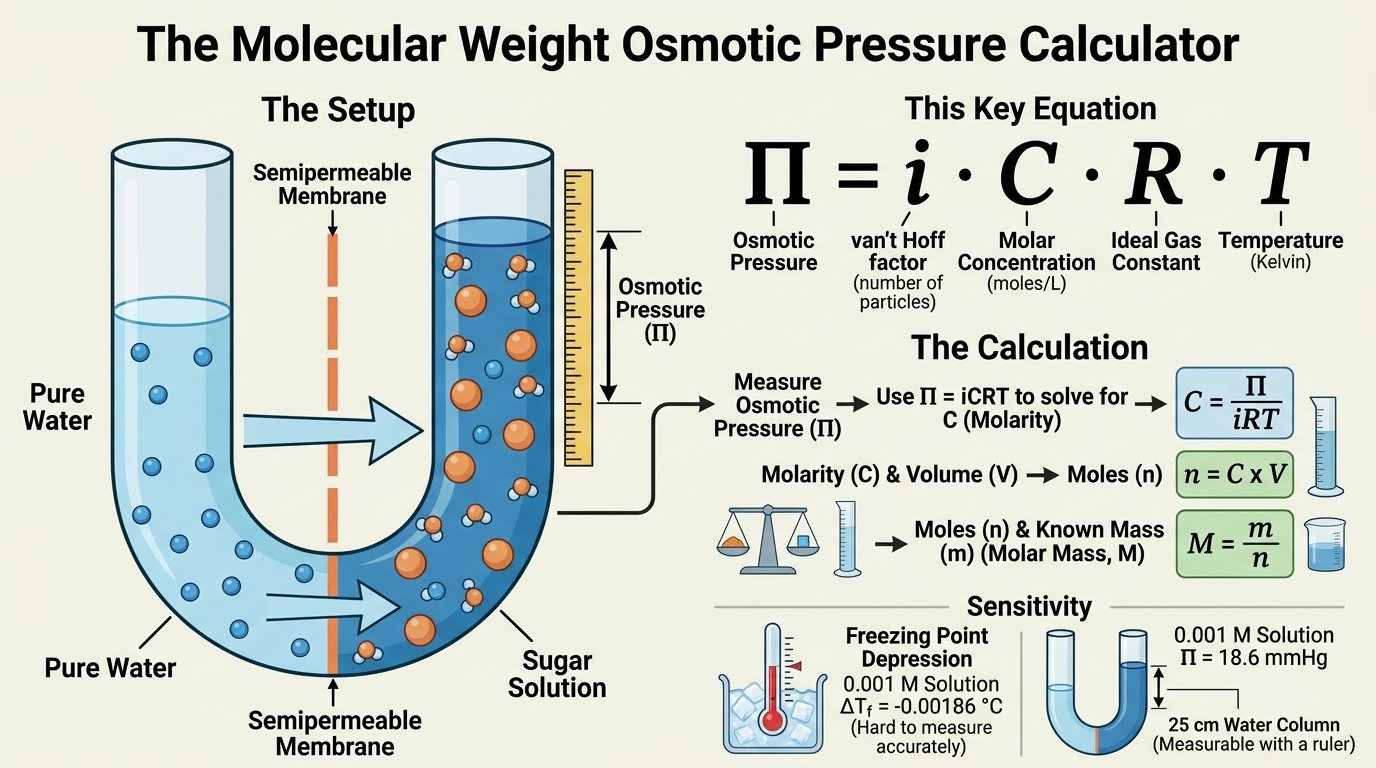
Every molecular weight osmotic pressure calculator story starts with a membrane. Put pure water on one side of a barrier that passes water but not sugar, and sugar solution on the other, and water flows into the solution — relentlessly, until the rising column on the solution side pushes back hard enough to stop it. That balancing pressure is the osmotic pressure, Π. It depends on how many dissolved particles are present per liter — not what they are — which makes it the fourth colligative property, and it obeys a law that looks suspiciously like the ideal gas equation: Π = i · C · R · T, where C is the molarity, R is the gas constant, T the kelvin temperature, and i counts the particles each formula unit releases.
The molecular weight osmotic pressure calculator connection comes from reading that law backwards. Π tells you the molarity; the molarity and the volume tell you the moles; and moles under a weighed sample tell you the molar mass. One pressure measurement — the whole molecular weight osmotic pressure calculator trick — converts grams into a molecular weight, and unlike its freezing- and boiling-point cousins it keeps working when the molecules are enormous.
That sensitivity is the point. A 0.001 mol/L solution depresses water’s freezing point by 0.00186 °C — unreadable — but exerts an osmotic pressure of 18.6 mmHg, a 25-centimeter water column anyone can measure with a ruler. This is why osmometry, not cryoscopy, first weighed proteins and polymers, and why it still anchors every physical chemistry course alongside molality-based methods (as opposed to the molarity our molarity calculator handles — osmotic pressure is the one colligative law that uses molarity directly). The calculator above runs the arithmetic in both directions — unknown to molar mass, and formula to predicted pressure — with molar masses drawn from the same IUPAC data as our molecular weight calculator homepage.
How to Use This Calculator
Solving a problem with the molecular weight osmotic pressure calculator takes under ten seconds:
- Pick a molecular weight osmotic pressure calculator mode from the five tabs — Molar Mass from Π, Π from Formula, Van ‘t Hoff (i), Target Π Dose, or Polymer Mn (Π/c).
- Enter your data — sample mass, solution volume, the measured pressure with its unit (atm, mmHg, kPa, bar, Pa or cm of water) and the temperature in °C; or a solute formula and the conditions. The preset chips load classic textbook setups in one click.
- Press the blue button (or hit Enter). The answer appears with the molarity, the moles, a full data table and an animated comparison graph.
- Read the molecular weight osmotic pressure calculator extras — the tonicity verdict and water-column height in Mode 2, the dissociation verdict in Mode 3, the % w/v in Mode 4, or the A₂ solvent-quality verdict and R² in Mode 5.
- Copy, download or share the result — CSV, TXT, print, WhatsApp, Facebook or X — and press ↺ Reset to start the next problem clean.
Your last ten calculations are saved in the history panel under the tool (stored only in your own browser), and Clear All wipes them instantly. Nothing is sent to any server — the entire molecular weight osmotic pressure calculator runs on your device, which is also why it loads fast and works offline once the page is open.
The Five Modes Explained
🧬 Mode 1 — Molar Mass from Π
The headline molecular weight osmotic pressure calculator experiment: sample mass, solution volume, measured pressure in any unit, temperature — and out comes the molar mass via M = i·w·R·T ÷ (Π·V). The hemoglobin preset (1.00 g, 100 mL, 2.75 mmHg, 20 °C) returns 66,480 g/mol; the insulin preset (0.500 g, 16.0 mmHg) gives 5,810 g/mol; and the glucose check (1.80 g, 2.447 atm) lands on 180 g/mol, proving the arithmetic against a known compound.
💧 Mode 2 — Π from Formula
The forward molecular weight osmotic pressure calculator direction: type a solute formula (parentheses and hydrates work), the mass, volume and temperature — the mode computes the molar mass from IUPAC 2021 atomic weights, the molarity, the osmolarity (i·C), Π in atm, kPa, mmHg and bar, the equivalent water column, and a tonicity verdict against blood plasma (~300 mOsm/L). Normal saline — 0.9 g NaCl per 100 mL at 37 °C with i = 1.9 — comes out at 292.6 mOsm/L and 7.45 atm: isotonic, exactly as the pharmacopoeia intends.
🧂 Mode 3 — Van ‘t Hoff Factor (i)
Electrolytes overshoot every molecular weight osmotic pressure calculator prediction: 0.100 M NaCl should exert 2.45 atm at 25 °C as a nonelectrolyte, but measures about 4.57 atm. This mode extracts i = Π ÷ (C·R·T) = 1.868 and, given the expected ion count, the apparent dissociation (86.8%) — with a verdict explaining ion pairing and the effective osmolarity.
🎯 Mode 4 — Target Π Dose
The molecular weight osmotic pressure calculator law worked backwards — the pharmacist’s mode: pick a target pressure (blood plasma ≈ 7.7 atm at 37 °C), the solute and the volume, and the mode returns the required molarity, osmolarity, grams and % w/v. Isotonic glucose works out to 54.5 g per liter — 5.45%, essentially the D5W bag — and isotonic saline to 9.3 g per liter with i = 1.9, the familiar 0.9%.
📈 Mode 5 — Polymer Mn (Π/c)
Real polymer solutions aren’t ideal, so membrane osmometry never uses a single point. Enter two to four (c, Π) pairs — in Pa, kPa, mmHg, atm or as solvent-column heights in cm — and the mode fits Π/c against c by least squares, reads Mn from the intercept via Π/c = RT(1/Mn + A₂c), and reports the second virial coefficient A₂ with a solvent-quality verdict and R². The polystyrene/toluene preset returns Mn = 99,957 g/mol, while the single-point estimate at 2 g/L would have said 92,559 — the 7% error that extrapolation exists to remove. It makes this the molecular weight osmotic pressure calculator that polymer students actually need.
The Formula (With the Box You Should Memorize)
Every problem this molecular weight osmotic pressure calculator solves — no exceptions — is one of these three lines rearranged:
Π = i · C · R · T (C = mol solute ÷ L solution)
M = i · w · R · T ÷ (Π · V)
Π/c = R·T·(1/Mn + A₂·c) · i = Π ÷ (C · R · T) · osmolarity = i · C
R = 0.082057 L·atm/(mol·K) = 8.314 J/(mol·K) · 1 atm = 760 mmHg = 101.325 kPa = 1,033 cm H₂O · T in kelvin
Two details in that molecular weight osmotic pressure calculator box decide most marks. First, molarity, not molality: osmotic pressure is the odd one out among colligative laws — it counts particles per liter of solution, because the membrane cares about concentration in the liquid pressing against it. Dissolve the solute and make the volume up to the mark; don’t add solute to a fixed volume of water. Second, units must match R: with R = 0.082057, the pressure must be in atmospheres, the volume in liters and the temperature in kelvin. Most wrong answers are a forgotten 273.15 or a pressure left in mmHg.
Notice also what the molecular weight osmotic pressure calculator formula rewards: at 25 °C the product R·T is 24.47 L·atm/mol, so every mole per liter of particles exerts 24.5 atm — about 360 psi. Divide by a thousand and a mere millimole per liter still produces 0.0245 atm = 18.6 mmHg = 25 cm of water. Compare that with the 0.00186 °C the same solution would shave off water’s freezing point, and the sensitivity advantage of osmometry — roughly a factor of 700 in practical resolution — is obvious. It is the only colligative method with enough signal left over once a molecule weighs tens of thousands of grams per mole.
Why It Works: Membranes, Entropy and Colligative Properties
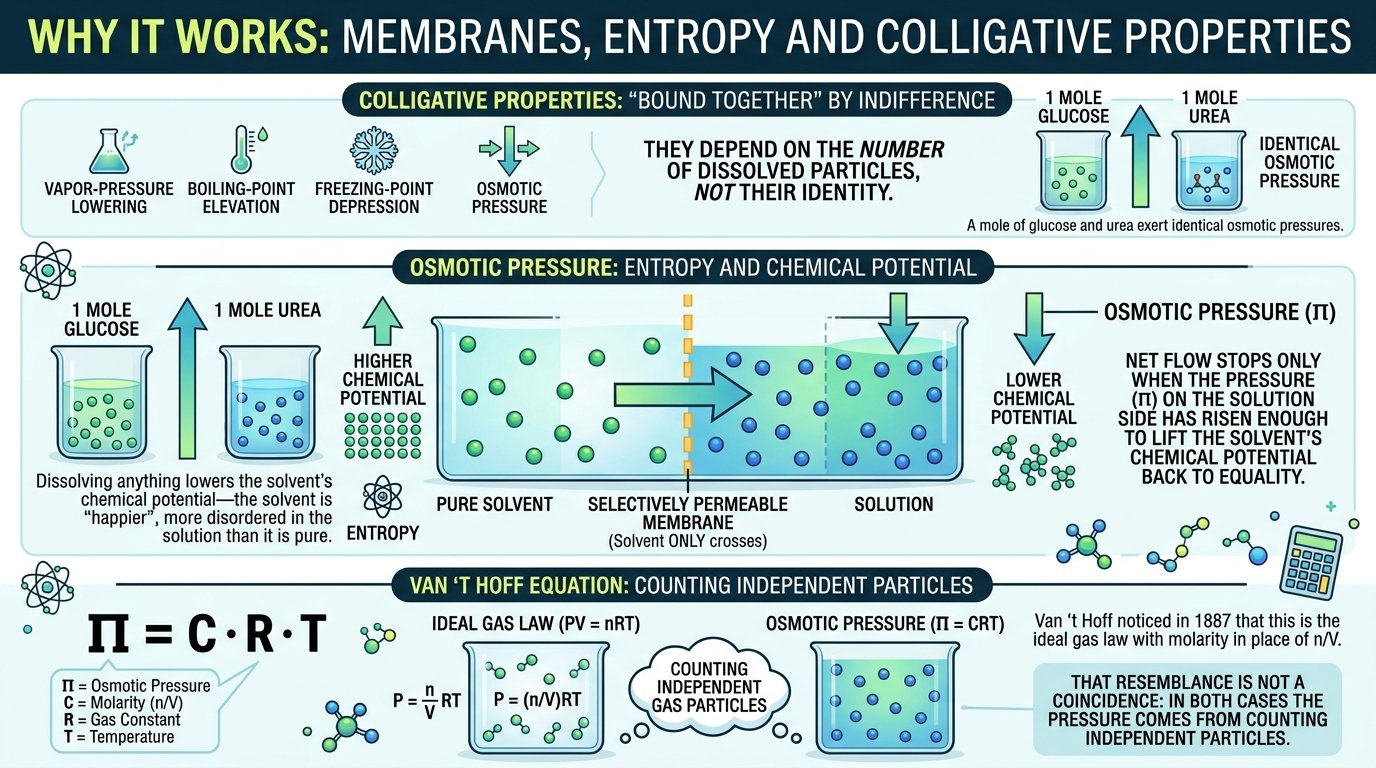
The physics behind every molecular weight osmotic pressure calculator result belongs to a family of four — vapor-pressure lowering, boiling-point elevation, freezing-point depression and osmotic pressure — called colligative properties, from the Latin colligatus, “bound together.” What binds them is indifference: they depend on the number of dissolved particles, not their identity. A mole of glucose and a mole of urea exert identical osmotic pressures, despite having nothing chemically in common.
The mechanism a molecular weight osmotic pressure calculator quietly relies on is chemical potential, which is a formal way of saying entropy. Dissolving anything in a solvent lowers the solvent’s chemical potential — the solvent is “happier,” more disordered, in the solution than it is pure. Put pure solvent and solution on opposite sides of a membrane that only solvent can cross, and solvent molecules migrate toward the lower chemical potential: into the solution. The flow stops only when the pressure on the solution side has risen enough to lift the solvent’s chemical potential back to equality — and that extra pressure, to first order, is Π = C·R·T. Van ‘t Hoff noticed in 1887 that this is the ideal gas law with molarity in place of n/V, and that resemblance is not a coincidence: in both cases the pressure comes from counting independent particles.
Particle-counting is also the molecular weight osmotic pressure calculator fine print. The law is exact only in the dilute limit; concentrated solutions deviate as particles start interacting, which is why polymer osmometry extrapolates Π/c to zero concentration rather than trusting a single point. The membrane must be truly semipermeable — a membrane that leaks solute reads low. And “number of particles” is precisely where electrolytes cause drama — the subject of the next section, and the reason the i sits in front of every formula on this page. It’s the same headcount logic that runs our average molecular weight of mixture guide, applied to a membrane instead of a mixture.
Electrolytes and the Van ‘t Hoff Factor
Run the baseline molecular weight osmotic pressure calculator check: dissolve 0.100 mol of sucrose to make a liter of solution at 25 °C and the osmotic pressure is 2.45 atm — exactly C × R × T. Dissolve 0.100 mol of NaCl and it climbs to about 4.57 atm, nearly twice as much. The salt has split into Na⁺ and Cl⁻, and the membrane counts both. The van ‘t Hoff factor i captures this: i = 1 for nonelectrolytes, approaching 2 for NaCl, 3 for CaCl₂, 4 for AlCl₃ — approaching, never quite reaching.
The shortfall is the interesting part of molecular weight osmotic pressure calculator data. NaCl’s measured i of about 1.87 (not 2.00) at 0.1 M doesn’t mean 13% of the salt failed to dissolve — it means oppositely charged ions occasionally travel as paired couples, momentarily counting as one particle. Ion pairing grows with concentration and with charge: CaCl₂ manages i ≈ 2.7 out of an ideal 3, and MgSO₄, with its doubly charged pair, limps along near 1.2. Mode 3 turns any measurement into i and an apparent dissociation percentage, with the verdict spelled out. Clinicians package the same idea as osmolarity — i × C, in milliosmoles per liter — which is why a 0.154 M saline bag is labeled roughly 300 mOsm/L rather than 154 mmol/L.
For molecular weight osmotic pressure calculator work the practical rule is simple: determining an unknown’s molar mass assumes i = 1, so use nonelectrolyte solutes or, for proteins, buffer against the Donnan effect (charged macromolecules drag counter-ions across the membrane and inflate Π unless salt is added). Conversely, if you already know the formula — say from our formula weight calculator — a measured Π becomes a probe of how completely the compound dissociates. One law, two instruments.
Three Worked Examples, Step by Step
Example 1 — The classic molecular weight osmotic pressure calculator problem
Step 1. Units: Π = 2.75 ÷ 760 = 0.003618 atm; T = 293.15 K; V = 0.100 L.
Step 2. Molarity: C = Π ÷ (R·T) = 0.003618 ÷ (0.082057 × 293.15) = 1.504 × 10⁻⁴ mol/L.
Step 3. Moles: n = 1.504 × 10⁻⁴ × 0.100 = 1.504 × 10⁻⁵ mol.
Step 4. Molar mass: M = 1.00 ÷ 1.504 × 10⁻⁵ = 66,480 g/mol — the accepted value for hemoglobin is 64,500; a 3% gap is typical of a single-point protein measurement.
Example 2 — Predicting a pressure and a tonicity from a formula
Step 1. M(NaCl) = 58.44 → 0.01540 mol → C = 0.01540 ÷ 0.100 L = 0.1540 mol/L; osmolarity = 1.9 × 154.0 = 292.6 mOsm/L.
Step 2. Π = 1.9 × 0.1540 × 0.082057 × 310.15 = 7.447 atm = 754.6 kPa = 5,660 mmHg.
Verdict. Blood plasma sits near 300 mOsm/L and 7.7 atm — the solution is isotonic, which is precisely why 0.9% is the clinical standard.
Example 3 — A polymer’s Mn from a Π/c extrapolation
Step 1. Convert Π = ρ·g·h: 53.57, 115.05, 184.4 and 261.8 Pa; form Π/c: 26.79, 28.76, 30.74 and 32.73 Pa·L/g.
Step 2. Least squares: slope 0.990 Pa·L²/g², intercept 24.80 Pa·L/g, R² = 0.999998.
Step 3. Mn = 1000·R·T ÷ intercept = 1000 × 8.314 × 298.15 ÷ 24.80 = 99,957 g/mol; A₂ = slope ÷ RT = 3.99 × 10⁻⁴ mol·mL/g² — a positive value, so toluene is a good solvent for polystyrene. The single point at 2 g/L alone would have given 92,559 g/mol, 7% low.
Run all three in the free molecular weight osmotic pressure calculator above and compare its printed steps with these — they match line for line, because the tool executes exactly this arithmetic at full precision.
Reference Table: Osmometry vs the Other Colligative Methods
The reason a molecular weight osmotic pressure calculator earns its own page: the four colligative signals for the same solution are wildly different in size. Here is 1.00 g of each solute in 100 mL (or 100 g) of water at 25 °C:
| Solute (M, g/mol) | Concentration | ΔTf (Kf 1.86) | ΔTb (Kb 0.512) | Π (mmHg / cm H₂O) |
|---|---|---|---|---|
| Glucose (180) | 0.0555 mol/L | 0.103 °C | 0.028 °C | 1,032 mmHg / 1,404 cm |
| Sucrose (342) | 0.0292 mol/L | 0.054 °C | 0.015 °C | 543 mmHg / 739 cm |
| Insulin (5,800) | 1.72 mmol/L | 0.0032 °C | 0.0009 °C | 32.1 mmHg / 43.6 cm |
| Hemoglobin (64,500) | 0.155 mmol/L | 0.00029 °C | 0.00008 °C | 2.88 mmHg / 3.92 cm |
| Polystyrene (100,000) | 0.100 mmol/L | 0.00019 °C | 0.00005 °C | 1.86 mmHg / 2.53 cm |
Read the last column as the molecular weight osmotic pressure calculator sensitivity dial. For hemoglobin the freezing-point signal is a third of a millidegree — below even a Beckmann thermometer — while the osmotic signal is a 4-centimeter column of water, trivially measurable. The rule of thumb: cryoscopy and ebullioscopy top out near 1,000–3,000 g/mol; membrane osmometry covers roughly 10,000 to 500,000 g/mol (below that the membrane leaks solute, above it the signal fades into the noise). For the two thermometer methods, see our molecular weight freezing point depression and molecular weight boiling point elevation guides. Hydrated solutes deserve care in all three — dissolve CuSO₄·5H₂O and the water of crystallization joins the solvent; our molar mass of hydrates calculator covers that bookkeeping.
Running the Experiment Well
The arithmetic is the easy 10% of molecular weight osmotic pressure calculator work — the measurement is where osmometry earns its error bars, and membranes have their own personality:
- Choose the membrane for the molecule — the heart of molecular weight osmotic pressure calculator technique. Cellulose or regenerated-cellulose membranes with a cut-off well below the solute’s size; anything that leaks solute reads low, and the leak is worst for the smallest chains in a polymer sample.
- Wait for equilibrium — or don’t — static osmometers take hours to days to settle; modern dynamic (servo) osmometers hold the solvent level fixed and read the counter-pressure in minutes, which also starves the leak of time.
- Control temperature to ±0.01 °C — Π scales with T directly, and thermal expansion of the solvent in a capillary mimics an osmotic head.
- Correct the capillary rise — both arms must have identical bores, or surface tension adds a fake few millimeters; subtract the solvent blank measured the same day.
- Suppress the Donnan effect for polyelectrolytes and proteins — add 0.1–0.2 M salt so counter-ions distribute evenly; otherwise a charged macromolecule can double the apparent Π.
- Measure several concentrations and extrapolate — the virial slope is not a nuisance to be averaged away; it is data (the second virial coefficient A₂ tells you the solvent quality). Mode 5 fits it for you.
That Donnan footnote is a classic molecular weight osmotic pressure calculator exam twist: a protein at pH far from its isoelectric point in salt-free water returns roughly half its true molar mass because the membrane counts the mobile counter-ions too. The membrane never lies — it just counts particles you didn’t know you had.
Who Uses the Osmotic Pressure Method?
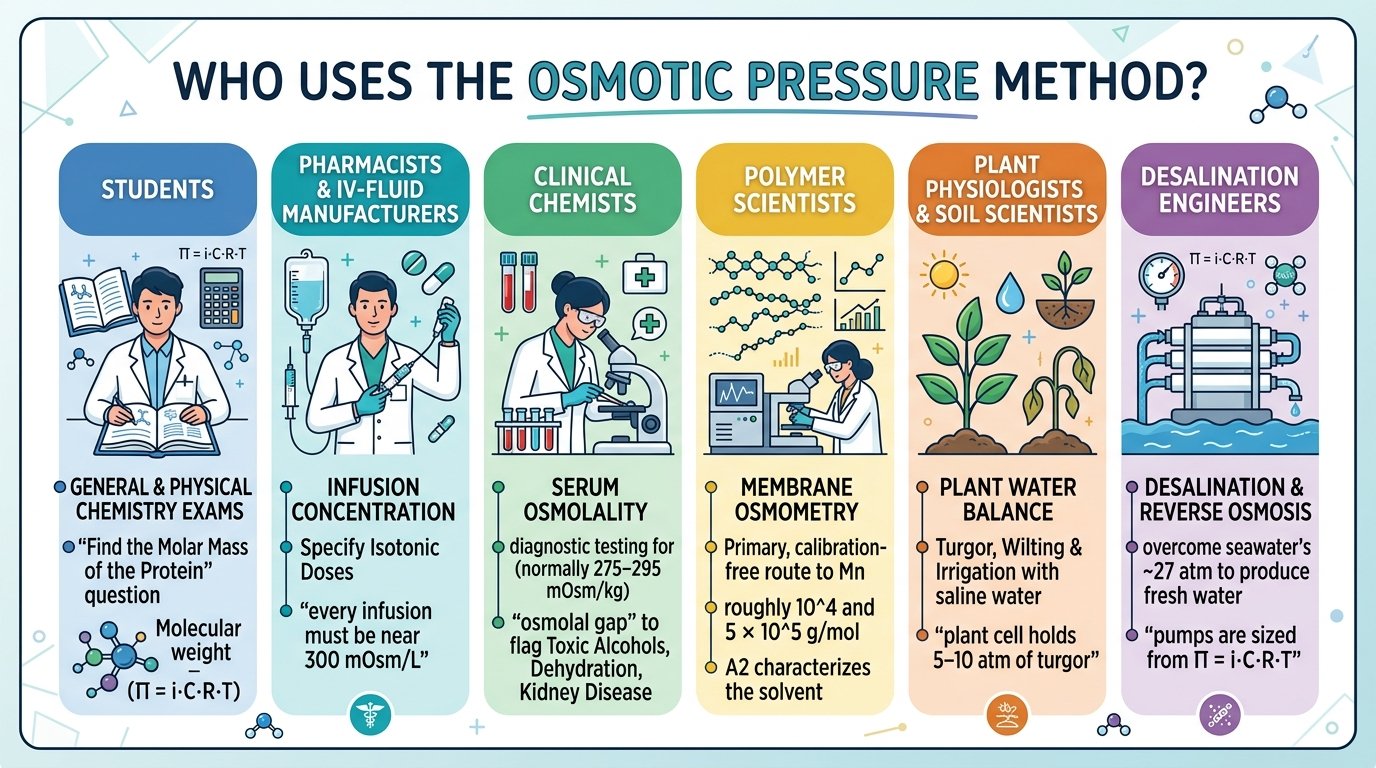
- Students — the molecular weight osmotic pressure calculator problem is a guaranteed fixture of general and physical chemistry exams, usually the “find the molar mass of the protein” question.
- Pharmacists and IV-fluid manufacturers — every infusion must be near 300 mOsm/L; the isotonic-dose arithmetic in Mode 4 is exactly how 0.9% saline and 5% dextrose were specified.
- Clinical chemists — serum osmolality (normally 275–295 mOsm/kg) and the “osmolal gap” flag toxic alcohols, dehydration and kidney disease.
- Polymer scientists — membrane osmometry is a primary, calibration-free route to Mn between roughly 10⁴ and 5 × 10⁵ g/mol, and A₂ characterizes the solvent.
- Plant physiologists and soil scientists — turgor, wilting and irrigation with saline water are osmotic-pressure budgets; a plant cell holds 5–10 atm of turgor.
- Desalination engineers — reverse osmosis must overcome seawater’s ~27 atm before it produces a drop of fresh water; the pumps are sized from Π = i·C·R·T.
For the reaction-side math these labs run next — yields, limiting reagents, conversions — our stoichiometry calculator and grams to moles calculator continue the workflow.
Full Lab Walkthrough: A Protein Unknown
Here’s a complete molecular weight osmotic pressure calculator determination, exactly as the biochemistry teaching lab runs it.
The task: a molecular weight osmotic pressure calculator identification of a purified protein believed to be either myoglobin (17,000), ovalbumin (45,000) or hemoglobin (64,500).
- Prepare. Dissolve 0.500 g of the lyophilized protein in pure water and make up to 50.0 mL (10.0 g/L). Load the membrane osmometer against pure water at 20.0 °C.
- Measure. After equilibration the solution arm stands 8.86 cm of water above the solvent arm — Π = 8.86 cm H₂O = 6.52 mmHg, ready for the molecular weight osmotic pressure calculator.
- Compute with the molecular weight osmotic pressure calculator. Mode 1: 0.500 g, 50 mL, 6.52 mmHg, 20 °C → C = 3.566 × 10⁻⁴ mol/L, n = 1.783 × 10⁻⁵ mol, M = 28,040 g/mol… which matches none of the candidates.
- Diagnose. Donnan effect! The protein is charged at neutral pH in salt-free water, so its counter-ions inflated Π. Repeat with both arms in 0.15 M NaCl buffer: the head falls to 3.88 cm = 2.85 mmHg.
- Recompute. M = 0.500 × 0.082057 × 293.15 ÷ ((2.85 ÷ 760) × 0.0500) = 64,150 g/mol — hemoglobin, within 0.6% of 64,500.
- Cross-check. Run 5, 10 and 15 g/L in the same buffer and fit them in Mode 5: the Π/c intercept gives Mn = 64,400 with a small positive A₂. Confirmed; report printed from the toolbar.
The molecular weight osmotic pressure calculator lesson the numbers teach: the arithmetic was never the risk — the uncontrolled counter-ions were. Verify the conditions, then trust the calculator.
A Short History: Pfeffer, van ‘t Hoff & the Membrane Osmometer
The law behind every molecular weight osmotic pressure calculator came from botany before it came from chemistry. Jean-Antoine Nollet noticed in 1748 that a pig’s bladder full of wine swelled when immersed in water; Henri Dutrochet named the phenomenon “osmosis” in the 1820s; and Moritz Traube built the first artificial semipermeable membrane — copper ferrocyanide — in 1867. The decisive step was Wilhelm Pfeffer’s in 1877: by depositing Traube’s membrane inside the pores of an unglazed clay pot, the plant physiologist made a cell strong enough to hold several atmospheres, and measured that sugar solutions exert an osmotic pressure proportional to concentration and to absolute temperature.
Molecular weight osmotic pressure calculator arithmetic was born when Jacobus van ‘t Hoff read Pfeffer’s tables in 1885–1887 and recognized the ideal gas law: Π·V = n·R·T, with the same R as for gases. That analogy launched physical chemistry as a discipline and earned van ‘t Hoff the first Nobel Prize in Chemistry in 1901. The electrolyte anomalies in the same data drove Svante Arrhenius to propose free ions in solution, worth his own Nobel in 1903. By the 1920s Theodor Svedberg’s ultracentrifuge and the osmometers of Sørensen and Adair had weighed hemoglobin at about 67,000 — the first convincing proof that proteins are true giant molecules rather than colloidal aggregates — and Adair’s osmotic work also uncovered the Donnan correction. Hermann Staudinger’s macromolecular hypothesis for polymers was confirmed the same way, and by mid-century membrane osmometry was routine for polymer Mn. Mass spectrometry eventually took the crown for small-molecule precision — the story our monoisotopic mass calculator tells — but for a number-average of a broad polymer, an osmometer still gives an answer no spectrometer can.
Osmotic Pressure in Everyday Life
Once the molecular weight osmotic pressure calculator law is in your head, you start noticing it in kitchens, hospitals and coastlines:
- IV drips — 0.9% saline and 5% dextrose are both ~300 mOsm/L, matched to blood so red cells neither swell and burst (hypotonic) nor shrivel (hypertonic). Mode 4 reproduces both recipes.
- Salting and sugaring food — brine cures and jam preserves work by osmotic dehydration: a 20% sugar solution exerts over 15 atm, and microbial cells simply lose their water.
- Reverse osmosis — push seawater against its membrane harder than its own ~27 atm and pure water flows the “wrong” way; RO plants run at 55–70 bar for that reason.
- Wilting lettuce, crisp lettuce — limp leaves have lost turgor; soaking them in cold water refills the cells osmotically. Salad dressing does the reverse, which is why you dress at the last minute.
- Slugs and salt — the cruelest kitchen demonstration of a hypertonic solution pulling water through a membrane.
- Trees taller than a pump can lift — root pressure is osmotic, and osmotic loading of sugars drives phloem flow from leaves to roots.
- Blood tests — a serum osmolality that exceeds the value calculated from sodium, glucose and urea by more than ~10 mOsm/kg points to an unmeasured solute, classically methanol or ethylene glycol.
Every bullet is the same molecular weight osmotic pressure calculator law wearing different clothes — particles in a solvent, counted by a membrane.
Practice Problems (With Answers)
Work each problem by hand first, then verify with the free molecular weight osmotic pressure calculator above. Answers are hidden until you click.
Problem 1 — 0.500 g of insulin in 100 mL of solution exerts 16.0 mmHg at 25 °C. Find M.
Π = 16.0 ÷ 760 = 0.02105 atm → C = 0.02105 ÷ (0.082057 × 298.15) = 8.605 × 10⁻⁴ mol/L → n = 8.605 × 10⁻⁵ mol → M = 0.500 ÷ 8.605 × 10⁻⁵ = 5,810 g/mol — insulin’s monomer.
Problem 2 — What osmotic pressure does 10.0 g of glucose in 100 mL exert at 25 °C, and is it isotonic?
M = 180.156 → 0.05551 mol → C = 0.5551 mol/L → Π = 0.5551 × 0.082057 × 298.15 = 13.58 atm = 1,376 kPa. At 555 mOsm/L it is strongly hypertonic — nearly twice plasma.
Problem 3 — 0.100 M CaCl₂ exerts 6.60 atm at 25 °C. Find i and the apparent dissociation.
Ideal Π = 0.100 × 0.082057 × 298.15 = 2.447 atm → i = 6.60 ÷ 2.447 = 2.698; α = (2.698 − 1) ÷ (3 − 1) = 84.9% — ion pairing accounts for the rest.
Problem 4 — How many grams of glucose make 1.00 L of solution isotonic with blood (Π = 7.7 atm) at 37 °C?
C = 7.7 ÷ (0.082057 × 310.15) = 0.3026 mol/L → n = 0.3026 mol → grams = 0.3026 × 180.156 = 54.5 g — 5.45% w/v, which is why the hospital bag says “D5W.”
Problem 5 — Poly(vinyl alcohol) in water at 25 °C gives heads of 1.562, 3.215 and 4.960 cm at 3, 6 and 9 g/L. Find Mn.
Π = ρgh → 153.2, 315.3, 486.4 Pa; Π/c = 51.06, 52.55, 54.05 Pa·L/g; least-squares intercept 49.57 Pa·L/g → Mn = 1000 × 8.314 × 298.15 ÷ 49.57 = 50,010 g/mol, with A₂ ≈ 2.0 × 10⁻⁴ mol·mL/g² (water is a good solvent for PVA).
Tips for Fast, Error-Free Calculations
- ✅ Convert everything to R’s units first — the number-one molecular weight osmotic pressure calculator habit: atm, liters, kelvin. Write Π ÷ 760, V ÷ 1000 and t + 273.15 on the page before touching anything else, and the units audit themselves.
- ✅ Molarity, not molality — osmotic pressure is the one colligative law that counts per liter of solution; make the volume up to the mark.
- ✅ Keep the 1 mmol/L benchmark in your head — 18.6 mmHg at 25 °C. If a protein solution reads 2,000 mmHg, someone entered the pressure in the wrong unit.
- ✅ Check i before you start — nonelectrolyte? i = 1 and vanishes. Salt? Count the ions and expect a little less (ion pairing). Protein? Add salt to kill the Donnan effect.
- ✅ Sanity-check every molecular weight osmotic pressure calculator result against a candidate — an osmometric 66,000 g/mol with 3% error brackets 64,000–68,000; compare candidates before celebrating.
- ✅ Reset between problems — the ↺ Reset button on each molecular weight osmotic pressure calculator mode keeps old inputs from contaminating the next calculation.
⚗️ Pro workflow: Mode 1 for any molecular weight osmotic pressure calculator unknown → Mode 2 to predict a pressure and tonicity before mixing → Mode 3 when the solute is an electrolyte → Mode 4 to formulate an isotonic solution → Mode 5 whenever the solute is a polymer and one concentration is not enough. Five tabs, one colligative law, zero unit slips.
5 Common Mistakes to Avoid
A decade of marking molecular weight osmotic pressure calculator answers produces the same five errors on repeat:
- Using Celsius instead of kelvin. Π is proportional to absolute temperature; 25 instead of 298.15 makes every molar mass twelve times too small — instantly recognizable, still endlessly submitted.
- Leaving the pressure in mmHg while using R = 0.082057. The classic molecular weight osmotic pressure calculator trap: the answer is off by exactly 760. The tool converts for you; the exam does not.
- Dropping the van ‘t Hoff factor. For NaCl solutions every prediction is nearly double without i — and conversely, using i on a nonelectrolyte halves it.
- Trusting a single concentration for a polymer. The molecular weight osmotic pressure calculator error polymer students make most: Π/c rises with c in a good solvent, so one point overestimates 1/Mn and underestimates Mn — by 7% in our polystyrene example. Extrapolate.
- Confusing osmolarity with molarity. A 0.154 M NaCl solution is ~300 mOsm/L, not 154; tonicity comparisons and Π both need the particle count, not the formula-unit count.
How This Calculator Is Different
| Feature | This calculator | Generic Π tool | By hand |
|---|---|---|---|
| Molar mass from Π (the inverse problem) | ✅ With molarity & moles shown | ⚠️ Forward only | ✅ If units survive |
| Six pressure units incl. cm H₂O | ✅ Auto-converted, all shown | ⚠️ atm only | ⚠️ Manual, error-prone |
| Formula input (IUPAC 2021 masses) + tonicity verdict | ✅ Parentheses, hydrates, mOsm/L | ❌ Numbers only | ⚠️ Separate lookup |
| Van ‘t Hoff factor & dissociation verdicts | ✅ i and α with interpretation | ❌ | ✅ If you know the trick |
| Isotonic dose (inverse to grams and % w/v) | ✅ Against D5W / saline benchmarks | ❌ | ⚠️ Two rearrangements |
| Polymer Π/c least-squares fit (Mn, A₂, R²) | ✅ Up to 4 points, single-point M shown | ❌ | ⚠️ Graph paper |
| Export & history | ✅ CSV/TXT/print/share + last 10 | ❌ Usually none | ❌ Notebook |
Related molecular weight osmotic pressure calculator companions carry the theme onward: exact and isotope-level masses in the exact mass calculator, isotopic mass calculator and average vs monoisotopic mass guide — and the polymer averages that Mode 5 produces one of, via the number average molecular weight polymer, weight average molecular weight polymer and polydispersity index calculator trilogy (osmometry measures Mn; light scattering measures Mw; their ratio is the dispersity).
Where the Numbers Come From
The constants built into this molecular weight osmotic pressure calculator are the CODATA values: R = 0.082057366 L·atm/(mol·K) = 8.314462618 J/(mol·K), standard gravity 9.80665 m/s² and 1 atm = 101,325 Pa = 760 mmHg exactly; the cm H₂O unit uses the conventional 98.0665 Pa per centimeter, and the water-column equivalents assume a density of 997 kg/m³ at 25 °C. Molar masses computed from formulas use IUPAC 2021 standard atomic weights — the same 118-element dataset behind every tool on this site. The atomic mass calculator exposes that dataset element by element.
Molecular weight osmotic pressure calculator textbooks differ slightly in what they call “plasma osmolarity” (280–310 mOsm/L) and in the van ‘t Hoff factor assumed for saline (1.8–2.0), so the tonicity verdicts use a generous 270–330 mOsm/L isotonic band; if your course sheet specifies a value, type it directly into Modes 2, 3 or 4. Spot a discrepancy worth checking? Our corrections policy explains how we verify and fix reports — usually within days.
Exam Checklist
☐ I can rearrange it to M = i·w·R·T ÷ (Π·V) without notes.
☐ I know R = 0.082057 L·atm/(mol·K), 1 atm = 760 mmHg, and that T must be in kelvin.
☐ I know why osmometry, not cryoscopy, measures proteins and polymers (1 mmol/L → 18.6 mmHg vs 0.00186 °C).
☐ I can compute a van ‘t Hoff factor from data, interpret i < n as ion pairing, and convert molarity to osmolarity.
☐ I can formulate an isotonic solution from a target of ~300 mOsm/L or 7.7 atm.
☐ I know the classic traps: Celsius, mmHg, the Donnan effect, and single-point polymer estimates.
☐ I’ve verified my practice answers with the molecular weight osmotic pressure calculator above.
Frequently Asked Questions
How do you find molecular weight from osmotic pressure?
Dissolve a weighed sample (w grams) to a known solution volume (V liters), measure the osmotic pressure Π, and apply M = w × R × T ÷ (Π × V) with R = 0.082057 L·atm/(mol·K), Π in atm and T in kelvin. Example: 1.00 g of hemoglobin in 0.100 L at 20 °C with Π = 2.75 mmHg gives M = 66,480 g/mol.
What is the osmotic pressure formula?
Π = i · C · R · T — the van ‘t Hoff equation — where C is molarity (mol per liter of solution), R is the gas constant, T is the kelvin temperature and i is the van ‘t Hoff factor (1 for nonelectrolytes). It is the ideal gas law with molarity in place of n/V.
Why does osmotic pressure use molarity when the other colligative properties use molality?
Because the membrane responds to the concentration of particles in the liquid pressing against it — moles per liter of solution — whereas freezing and boiling points are tied to the solvent’s mole fraction, which molality tracks independently of temperature. In dilute aqueous solutions the two are nearly equal, but Π is defined with molarity.
Why is osmotic pressure the best colligative method for proteins and polymers?
Sensitivity. A 1 mmol/L solution exerts 18.6 mmHg of osmotic pressure at 25 °C — a 25-centimeter water column — but lowers the freezing point by only 0.00186 °C. For a 65,000 g/mol protein at 10 g/L, the osmotic signal is easily measurable while the thermometer signal is lost in the noise.
Is this molecular weight osmotic pressure calculator free?
Yes, completely free — no registration, no daily limits. It runs entirely in your browser, and your history stays on your own device.
What is the osmotic pressure of blood?
About 7.7 atm (5,800 mmHg) at 37 °C, corresponding to roughly 300 mOsm/L. Intravenous fluids are formulated to match it: 0.9% NaCl and 5% glucose (D5W) are both approximately isotonic, which Mode 4 reproduces from first principles.
What is the van ‘t Hoff factor?
The effective number of particles each formula unit releases: 1 for sugar, ~1.9 for NaCl, ~2.7 for CaCl₂ at ordinary concentrations. Measured i values fall short of the ideal ion count because of ion pairing; Mode 3 computes both i and the apparent dissociation, and i × C is the osmolarity.
What is the Donnan effect and why does it matter?
A charged macromolecule that cannot cross the membrane forces its small counter-ions to distribute unequally across it, adding their own osmotic contribution. Measured in salt-free water, a protein can appear to have half its true molar mass. Adding 0.1–0.2 M salt swamps the effect and restores the correct answer.
Why extrapolate Π/c to zero concentration for polymers?
Because polymer solutions are not ideal: Π/c = RT(1/Mn + A₂c + …). At any finite concentration the second virial term inflates Π/c, so a single point underestimates Mn. Plotting Π/c against c and reading the intercept removes the bias and delivers A₂ — the solvent-quality parameter — as a bonus.
What molar mass range can membrane osmometry measure?
Roughly 10,000 to 500,000 g/mol. Below that, small molecules leak through the membrane and the reading drifts low; above it, the pressure from a workable concentration falls below the instrument’s resolution. Small molecules go to cryoscopy or mass spectrometry; very large polymers go to light scattering.
10 Osmometry Facts Worth Knowing
- Pfeffer’s 1877 clay-pot osmometer measured sugar solutions at several atmospheres — a decade before van ‘t Hoff explained the numbers.
- Van ‘t Hoff’s Π·V = n·R·T uses the same R as the gas law — the analogy that launched physical chemistry and won the first chemistry Nobel in 1901.
- At 25 °C a 1 mol/L ideal solution exerts 24.5 atm — about 360 psi, enough to lift a water column 253 meters.
- Seawater’s osmotic pressure is roughly 27 atm; reverse-osmosis plants run at 55–70 bar to beat it with margin.
- Adair’s 1925 osmotic measurements gave hemoglobin a molar mass near 67,000 — the first solid proof that proteins are single giant molecules.
- Osmometry yields a number-average molecular weight: every particle votes once, exactly like the polymer Mn our tools compute.
- The second virial coefficient A₂ read from the Π/c slope is positive in good solvents, zero at the theta temperature and negative just before the polymer precipitates.
- Plant cells routinely hold 5–10 atm of turgor; some halophytes and desert plants exceed 40 atm.
- Clinical osmometers usually measure freezing points, not pressures — but report the result in mOsm/kg because osmolality is what the body regulates.
- Hypertonic saline at 3% is about 1,000 mOsm/L, over three times plasma — which is why it is infused slowly and only through central lines.
🔗 Trusted external resources
Final Thoughts
The molecular weight osmotic pressure calculator method is a rare thing in chemistry: a molecular measurement sensitive enough to weigh a protein, using nothing more exotic than a membrane and a ruler. Behind it sit four small rules — molarity per liter of solution, kelvin not Celsius, pressure in the units that match R, and an i for every electrolyte — plus one piece of lab wisdom: extrapolate polymers and salt-buffer proteins. Master those, let the calculator above verify every line, and osmometry becomes one of the most dependable places to score — in the exam hall and at the bench.
Bookmark this molecular weight osmotic pressure calculator page for your next problem set or lab report, share it with a labmate before the colligative-properties practical, and explore the rest of our free chemistry tools — from the molecular weight calculator homepage to the molarity calculator for the solution-prep side. Questions or corrections? Reach us any time through the contact page — and you can read more about the site’s mission on our about page.
Written & Reviewed By
Ahmad Raza, M.Phil. Chemistry
Ahmad is a chemistry educator and science content developer with over 10 years of experience teaching analytical and physical chemistry. He builds free calculation tools that help students and lab professionals work faster and make fewer errors. When he’s not balancing equations, he’s usually grading titration reports.