
Degree of Unsaturation Calculator
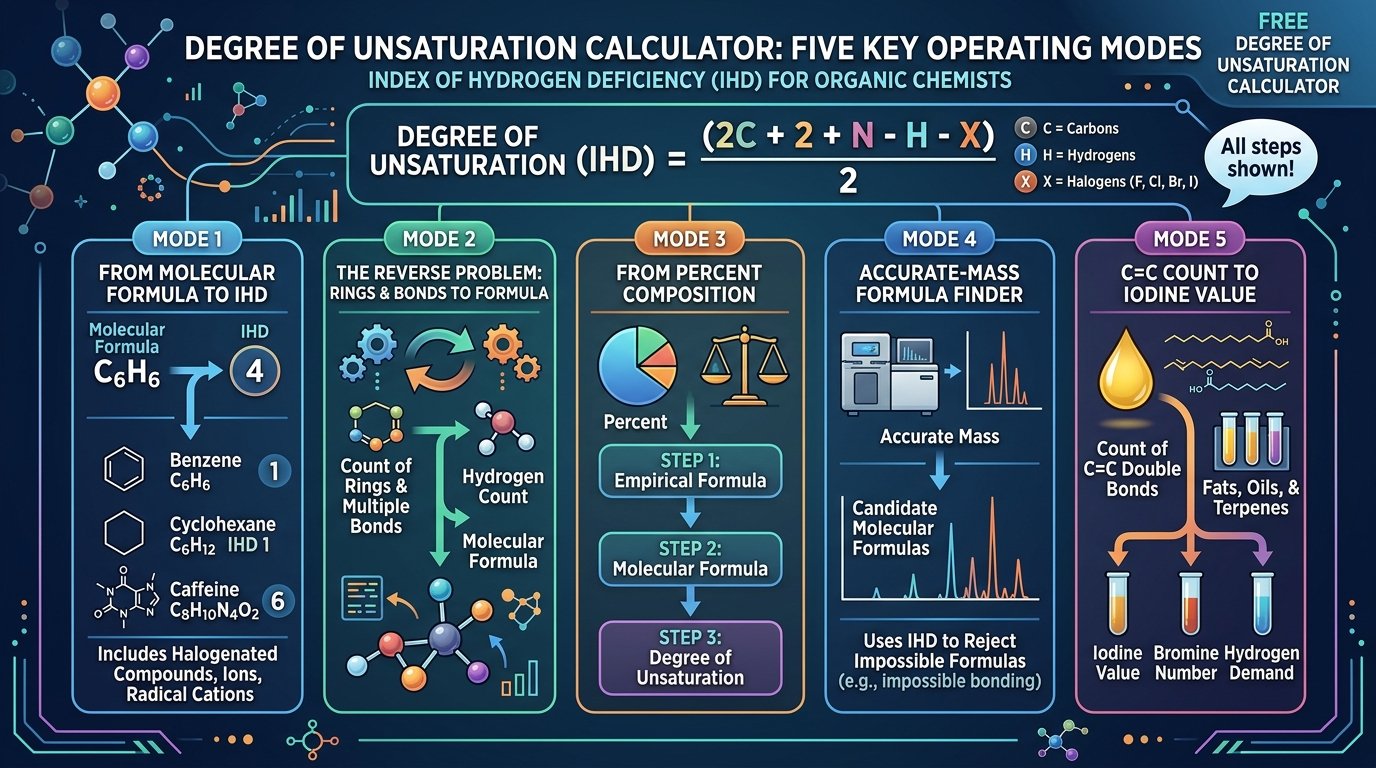
Count the rings and π bonds hidden in any molecular formula. Enter C6H6, C8H10N4O2, a chlorinated compound or an ion and get the degree of unsaturation (index of hydrogen deficiency) with the formula written out, every element's contribution, and the ring / double-bond / triple-bond combinations it allows. Work backwards from rings and multiple bonds to a formula, start from percent composition, find candidate formulas from an accurate mass, or turn C=C counts into an iodine value.
✓ Trusted by students, teachers & spectroscopistsDegree of Unsaturation (Index of Hydrogen Deficiency) from a Molecular Formula
The classic calculation. Type a molecular formula — brackets, hydrates and a trailing charge are all understood — and the calculator applies the general rule DoU = 1 + ½Σ ni(vi − 2): each carbon adds 1, each hydrogen or halogen subtracts ½, each nitrogen adds ½, oxygen and sulfur add nothing. The result is the number of rings plus π bonds, with a triple bond counting as two.
Rings and Multiple Bonds → Hydrogen Count and Molecular Formula
The reverse problem, and the fastest way to check a proposed structure against a formula. Enter how many carbons, nitrogens, oxygens, sulfurs and halogens the structure has, then count its rings, double bonds (C=C, C=O, C=N, N=O) and triple bonds. The calculator returns the degree of unsaturation, the number of hydrogens the structure must carry (H = 2C + 2 + N − X − 2·DoU) and the complete molecular formula with its molar mass.
Degree of Unsaturation from Percent Composition (Empirical → Molecular Formula)
Start from an elemental analysis instead of a formula. Enter the mass percent of C, H and, if present, N, S and a halogen; the remainder is taken as oxygen if you allow it. The calculator finds the empirical formula, its degree of unsaturation (which may be fractional — a sign the molecular formula is a multiple), and with a molar mass the molecular formula and its true DoU, using DoUmol = n·DoUemp − (n − 1).
Accurate-Mass Formula Finder with Degree-of-Unsaturation Filter
Give the calculator an accurate m/z from a high-resolution mass spectrum and the ion type; it strips the adduct, searches every C/H/N/O/S (and optional halogen) combination within your element limits, keeps only formulas whose degree of unsaturation is a non-negative whole number (which automatically enforces the nitrogen rule), and ranks them by mass error in ppm. Enter an expected DoU from NMR or UV to narrow the list further.
C=C Count, Iodine Value, Bromine Number and Hydrogen for Hydrogenation
Unsaturation in the everyday sense — fats, oils, terpenes, rubbers. Enter the formula and the number of unsaturations that are not C=C double bonds (rings, C=O groups, C≡N: one for a fatty acid's carboxyl, three for a triglyceride, four for a benzene ring). The calculator subtracts them from the degree of unsaturation to get the C=C count, then converts it to the theoretical iodine value (g I2 per 100 g), the bromine number and the hydrogen needed to saturate a sample. Enter a measured iodine value to back out the average number of C=C per molecule.
🕘 Recent calculations
- No calculations yet — your last 10 results will appear here.
DoU (IHD) = (2C + 2 + N − H − X) / 2 · general form DoU = 1 + ½Σ ni(vi − 2) with v = 4 (C, Si), 3 (N, P), 2 (O, S), 1 (H, halogens) · oxygen and sulfur do not change DoU · one ring or one double bond = 1, one triple bond = 2, benzene ring = 4 · even-electron ions: add z/2 · H = 2C + 2 + N − X − 2·DoU · iodine value = C=C × 253.81 × 100 / M · monoisotopic masses: C 12.0000, H 1.007825, N 14.003074, O 15.994915, S 31.972071, proton 1.007276 · IUPAC 2021 atomic weights.
A degree of unsaturation calculator answers a question every organic chemist asks the moment a molecular formula lands on the bench: how many rings and multiple bonds must this molecule contain? Benzene, C6H6, has a degree of unsaturation of 4 — one ring and three double bonds. Cyclohexane, C6H12, has 1. Caffeine, C8H10N4O2, has 6. The number comes from a one-line formula, (2C + 2 + N − H − X)/2, and it tells you before you record a single spectrum whether you are looking at an alkane, an alkene, an aromatic or a polycyclic natural product. This page teaches that formula and the reasoning behind it, and the free degree of unsaturation calculator above performs it with every step shown.
The degree of unsaturation calculator covers the whole family of problems in five modes: the degree of unsaturation (also called the index of hydrogen deficiency) from any molecular formula, including halogenated compounds, ions and radical cations; the reverse problem, from a count of rings and multiple bonds to the hydrogen count and molecular formula; the degree of unsaturation from percent composition, through the empirical and molecular formula; an accurate-mass formula finder that lists candidate formulas for a mass-spectrometry peak and uses the degree of unsaturation to reject impossible ones; and the conversion of C=C counts into the iodine value, bromine number and hydrogen demand of fats, oils and terpenes.
Below the tool is a complete guide: what the degree of unsaturation means and why oxygen does not count, the formula and its general form for any element, three fully worked examples, a reference table of forty-six common compounds, how to use the number with IR, NMR and mass spectra, the special cases of ions and radicals, ten practice problems with hidden answers and a set of frequently asked questions. All molar masses use IUPAC 2021 standard atomic weights, the same numbers the degree of unsaturation calculator uses internally.
🔑 KEY TAKEAWAY
The degree of unsaturation (DoU, also index of hydrogen deficiency, IHD, or double-bond equivalents, DBE) is the number of rings plus π bonds in a molecule: DoU = (2C + 2 + N − H − X) / 2, where C, H, N and X are the numbers of carbon, hydrogen, nitrogen and halogen atoms. Oxygen and sulfur do not change it. Each ring or double bond counts 1, each triple bond counts 2, a benzene ring counts 4. Examples: benzene C6H6 → (12 + 2 − 6)/2 = 4; caffeine C8H10N4O2 → (16 + 2 + 4 − 10)/2 = 6; DDT C14H9Cl5 → (28 + 2 − 9 − 5)/2 = 8; chloroform CHCl3 → 0. A neutral molecule always gives a whole number of zero or more; a half-integer means an ion, a radical or a typo. Reverse it with H = 2C + 2 + N − X − 2·DoU. Use the degree of unsaturation calculator above to check any formula in seconds.
📑 Table of Contents (click to expand)
- What Is the Degree of Unsaturation?
- How to Use This Degree of Unsaturation Calculator
- The Five Modes Explained
- The Formula and Where It Comes From
- A Fully Worked Example: Caffeine
- Two More Worked Examples: DDT and an Unknown from Percent Composition
- Why Oxygen and Sulfur Do Not Count
- Halogens, Nitrogen, Phosphorus and Silicon
- Ions, Radicals and Half-Integer Results
- Reference Table: Degree of Unsaturation of 46 Common Compounds
- Interpreting the Number: Rings, Double Bonds and Triple Bonds
- Using the Degree of Unsaturation with IR, NMR and Mass Spectra
- Unsaturation in Fats and Oils: Iodine Value and Hydrogenation
- From Percent Composition and Empirical Formulas
- Who Uses a Degree of Unsaturation Calculator?
- Step-by-Step Walkthrough in the Tool
- A Short History: From Kekulé to the Nitrogen Rule
- Limitations and Pitfalls
- Practice Problems (With Answers)
- Tips for Accurate Results
- Common Mistakes
- How This Calculator Is Different
- Where the Numbers Come From
- Exam Checklist
- Frequently Asked Questions
- 10 Facts Worth Knowing
- Final Thoughts
What Is the Degree of Unsaturation?
A saturated, acyclic hydrocarbon — an alkane — holds the maximum number of hydrogens its carbon skeleton allows: CnH2n+2. Hexane is C6H14. Every time you close a ring you must remove two hydrogens (cyclohexane, C6H12); every time you insert a double bond you remove two more (cyclohexene, C6H10); a triple bond costs four (hexyne, C6H10, has one triple bond and no ring, the same H count as a ring plus a double bond). The degree of unsaturation counts these missing pairs of hydrogens. It is therefore the number of rings plus the number of π bonds, with each triple bond contributing two π bonds.
The quantity a degree of unsaturation calculator returns goes by several names, all equivalent: degree of unsaturation (DoU or DU), index of hydrogen deficiency (IHD), double-bond equivalents (DBE), rings plus double bonds (RDB, common in mass spectrometry) and simply unsaturation number. Whatever the label, it is a whole number greater than or equal to zero for any neutral molecule, and it is a property of the formula, not the structure: every isomer of C6H10 has DoU 2, whether it is cyclohexene, 1,3-hexadiene or 1-hexyne.
That is exactly why it is useful. The formula comes first — from combustion analysis, high-resolution mass spectrometry or a supplier’s label — and the degree of unsaturation converts it into a structural constraint before any spectrum is interpreted. A DoU of 0 rules out every carbonyl, alkene and ring at once. A DoU of 4 or more almost always means a benzene ring. A DoU of 6 for a C8 compound with four nitrogens says “fused heteroaromatic” loudly enough that caffeine’s purine skeleton becomes the obvious first guess. The degree of unsaturation calculator on this page gives you that number, and its interpretation, instantly.
How to Use This Degree of Unsaturation Calculator
Pick a mode with the pill tabs at the top of the degree of unsaturation calculator:
- DoU from Formula — type the molecular formula (C6H6, C8H10N4O2, CHCl3, C2H3O2−). Brackets, hydrate dots and a trailing charge are understood. Choose neutral molecule, even-electron ion or radical ion and press Calculate.
- Rings & Bonds → Formula — enter the heavy-atom counts of a proposed structure and its rings, double bonds and triple bonds; get the hydrogen count and the molecular formula with its molar mass.
- From % Composition — enter % C, % H and any N, S or halogen, let the remainder be oxygen, add the molar mass if known; get the empirical formula, the molecular formula and its degree of unsaturation.
- Mass Spec Formula Finder — enter an accurate m/z, the ion type ([M+H]+, [M−H]−, M+•, [M+Na]+…) and a ppm tolerance; get every C/H/N/O/S formula that fits, ranked by mass error, each with its degree of unsaturation.
- C=C & Iodine Value — enter a fatty acid, triglyceride or terpene and the number of unsaturations that are not C=C; get the C=C count, the theoretical iodine value, bromine number and hydrogen needed for hydrogenation.
Every mode of the degree of unsaturation calculator has example chips that fill the fields with a classic textbook case so you can see the expected answer, a Reset button that clears only that panel, and an Enter-key shortcut. Results appear in a highlighted answer box, followed by numbered steps, a table and a bar chart. The toolbar copies the result as text, downloads CSV or TXT, prints a clean report or shares to WhatsApp, Facebook, X or the native share sheet. The last ten calculations are kept in a history list on your own device.
The Five Modes Explained
Mode 1 — Degree of unsaturation from a molecular formula
The core degree of unsaturation calculator problem. The parser reads the formula, looks up the valence of every element (4 for C and Si, 3 for N and P, 2 for O and S, 1 for H and the halogens) and applies the general rule DoU = 1 + ½Σni(vi − 2). For the usual C, H, N, O, S, X compounds this reduces to the textbook (2C + 2 + N − H − X)/2, and the steps show that form. You get the element-by-element contribution table, the maximum hydrogen count for a saturated acyclic skeleton, a plain-language interpretation, and for DoU 1–6 every combination of rings, double bonds and triple bonds that adds up to it. Ions are handled with the z/2 correction and radical ions without it; metals with no fixed valence are refused with an explanation.
Mode 2 — Rings and multiple bonds to a molecular formula
The reverse direction, which is how you check that a structure you have drawn agrees with the formula you were given. Count the heavy atoms, rings, double bonds and triple bonds; the degree of unsaturation calculator computes DoU = rings + double bonds + 2 × triple bonds, then H = 2C + 2 + N − X − 2·DoU, and assembles the formula. If the hydrogen count goes negative — you asked for more unsaturation than the skeleton can hold — it tells you the maximum possible.
Mode 3 — From percent composition
Elemental analysis gives percentages, not a formula. This mode converts them to an empirical formula, computes its degree of unsaturation (which may be a fraction, such as 1.5 for CH), and with a molar mass finds the molecular formula and its true DoU. It prints the relation DoUmol = n·DoUemp − (n − 1) so you can see why the numbers are not simply proportional: six CH units have DoU 6 × 1.5 − 5 = 4, benzene.
Mode 4 — Accurate-mass formula finder
A high-resolution mass spectrometer measures m/z to a few parts per million, but many formulas fall within that window. The degree of unsaturation calculator strips the adduct (a proton, a sodium ion, an electron), enumerates every C/H/N/O/S combination within your element limits, keeps only those with a non-negative whole-number DoU — which automatically enforces the nitrogen rule — and ranks the survivors by ppm error. For m/z 195.0877 as [M+H]+, C8H10N4O2 (caffeine, DoU 6) matches within 0.3 ppm while C7H14O6 (DoU 1) is 7 ppm away. Enter an expected DoU from your NMR and the list shrinks further.
Mode 5 — C=C count, iodine value and hydrogenation
Food and oleochemists use “unsaturation” to mean C=C double bonds in fatty chains. This mode subtracts the non-C=C unsaturations you specify (one for a carboxyl or ester C=O, three for a triglyceride, four for a benzene ring) from the degree of unsaturation to get the C=C count, then converts it to the theoretical iodine value (g I2 per 100 g), the bromine number and the mass and volume of H2 needed to hydrogenate a sample. Linoleic acid, C18H32O2: DoU 3, one C=O, two C=C, iodine value 181.0. Enter a measured iodine value and the degree of unsaturation calculator back-calculates the average C=C per molecule.
The Formula and Where It Comes From
Start, as any degree of unsaturation calculator does internally, with the saturated acyclic reference. A chain of C carbons with no rings and no multiple bonds carries 2C + 2 hydrogens. Each nitrogen (trivalent) inserted into the chain brings one extra hydrogen with it, so the reference becomes 2C + 2 + N. Each halogen simply replaces a hydrogen, so the actual hydrogen-plus-halogen count is compared with the reference. Oxygen and sulfur (divalent) slot into a chain or hang off it without changing the hydrogen count at all. The difference between the reference and the actual count, divided by two because each ring or π bond removes a pair, is the degree of unsaturation:
The general form is worth understanding because it explains the textbook rule instead of just stating it. Each atom contributes (v − 2)/2: a tetravalent carbon contributes +1, a trivalent nitrogen +½, a divalent oxygen 0, a monovalent hydrogen or halogen −½, and the constant 1 accounts for the two chain ends. Sum the contributions and you have the number of rings plus π bonds. The degree of unsaturation calculator prints this contribution table for every formula, so the “why” is always visible next to the answer.
Two consequences follow immediately, and a good degree of unsaturation calculator checks both. A neutral closed-shell molecule must have an even number of (H + X) when N is even, and an odd number when N is odd — otherwise the DoU is a half-integer. That parity condition is the nitrogen rule of mass spectrometry in disguise. And the number can never be negative: if it is, the formula has more hydrogens than any structure can hold, and the error is in the formula, not the molecule.
A Fully Worked Example: Caffeine
Caffeine has the molecular formula C8H10N4O2. Find its degree of unsaturation and propose how the unsaturations are distributed.
Step 1 — Count the atoms. C = 8, H = 10, N = 4, O = 2, X = 0.
Step 2 — Apply the formula. DoU = (2×8 + 2 + 4 − 10 − 0)/2 = (16 + 2 + 4 − 10)/2 = 12/2 = 6. The two oxygens play no part.
Step 3 — Check with the contribution table. 8 C × (+1) = +8; 4 N × (+½) = +2; 10 H × (−½) = −5; 2 O × 0 = 0; plus the constant 1: 8 + 2 − 5 + 0 + 1 = 6 ✔.
Step 4 — Hydrogen deficiency. A saturated acyclic C8N4O2 skeleton would hold 2×8 + 2 + 4 = 22 hydrogens; caffeine has 10, so it is short by 12 hydrogens = 6 pairs.
Step 5 — Interpret. Six unsaturations in a C8 molecule with four nitrogens points to a fused bicyclic heteroaromatic. Caffeine’s actual structure — a purine: two rings, two C=O groups, one C=C and one C=N — gives 2 + 4 = 6 ✔. The degree of unsaturation calculator lists this and every other partition of 6 (e.g. 3 rings + 3 double bonds, 2 rings + 2 double bonds + 1 triple bond) so you can match it to the spectra.
Note how the interpretation from the degree of unsaturation calculator narrows the search. Without any spectrum, the number 6 already excludes a single benzene ring plus simple substituents (that would be 4 or 5), and it makes an open-chain structure with six carbonyls or alkenes chemically implausible for a stable natural product. This is the routine use of the number: not to prove a structure but to discard most of the wrong ones early.
Two More Worked Examples: DDT and an Unknown from Percent Composition
Example 2 — A polyhalogenated compound (DDT)
DDT is C14H9Cl5. Degree of unsaturation?
Halogens count like hydrogens: H + X = 9 + 5 = 14. DoU = (2×14 + 2 − 14)/2 = (28 + 2 − 14)/2 = 16/2 = 8. Two benzene rings account for 2 × 4 = 8, leaving nothing for the CCl3–CH bridge — correct, that bridge is saturated. Had you forgotten the five chlorines, you would have obtained (30 − 9)/2 = 10.5, and the half-integer would have been the warning. The degree of unsaturation calculator shows the halogen term explicitly in Step 2 for exactly this reason.
Example 3 — An unknown from percent composition
An unknown liquid analyses as C 88.16%, H 11.84%, and its molar mass by vapour density is 136 g/mol. Find the molecular formula and degree of unsaturation.
Per 100 g: C 88.16/12.011 = 7.340 mol; H 11.84/1.008 = 11.75 mol. Divide by 7.340: C 1 : H 1.60 → ×5 → C5H8, empirical mass 68.12. n = 136/68.12 = 2 → C10H16. DoU = (20 + 2 − 16)/2 = 3. Check via the empirical route: DoU(C5H8) = (10 + 2 − 8)/2 = 2; DoUmol = 2 × 2 − 1 = 3 ✔. C10H16 with DoU 3 is the formula of the monoterpenes: limonene (one ring, two C=C), α-pinene (two rings, one C=C), myrcene (no ring, three C=C). Mode 3 of the degree of unsaturation calculator reproduces this from the “limonene” chip; telling the isomers apart is the job of NMR.
Why Oxygen and Sulfur Do Not Count
Students using a degree of unsaturation calculator for the first time find it strange that a formula can gain six oxygens without changing its degree of unsaturation, so it is worth seeing why. Take ethane, C2H6, DoU 0. Insert an oxygen into a C–H bond and you get ethanol, C2H6O: the hydrogen count is unchanged because the oxygen made two bonds, one to carbon and one to the hydrogen it displaced. Insert it into the C–C bond and you get dimethyl ether, same formula. Either way a divalent atom simply lengthens a chain; it neither adds nor removes hydrogens, and so it contributes (2 − 2)/2 = 0 to the count. Sulfur, also divalent in thiols, sulfides and thiophene, behaves identically.
This does not mean oxygen-containing groups have no unsaturation. A carbonyl group C=O has a π bond and counts 1 — but the count arises from the carbon losing two hydrogens, not from the oxygen. Acetaldehyde, C2H4O, has DoU (4 + 2 − 4)/2 = 1: the oxygen contributed nothing, the two missing hydrogens contributed everything. Compare acetic acid C2H4O2, DoU 1 (one C=O), and glucose C6H12O6, DoU 1 (a pyranose ring, or the open-chain aldehyde C=O). The degree of unsaturation calculator lists oxygen and sulfur in its contribution table with a zero next to them so the point is never lost.
The same reasoning, built into the degree of unsaturation calculator, covers sulfur in higher oxidation states. Dimethyl sulfoxide, C2H6OS, and dimethyl sulfone, C2H6O2S, both give DoU 0 under the divalent-sulfur convention even though the S=O bonds are often drawn as double bonds; the convention treats them as S+–O− single bonds, and their hydrogen count is that of a saturated molecule. The number is a hydrogen count, not a bond-order count, and it is best read that way.
Halogens, Nitrogen, Phosphorus and Silicon
Halogens. In the degree of unsaturation calculator, as on paper, F, Cl, Br and I are monovalent and each replaces one hydrogen, so they are added to the hydrogen count: chloroform CHCl3 has H + X = 4, the same as methane, and DoU 0. Chlorobenzene C6H5Cl has 5 + 1 = 6 and DoU 4, like benzene. Forgetting the halogens is the single most common error with this formula, and it always produces a half-integer.
Nitrogen. A trivalent nitrogen brings one extra hydrogen to the saturated reference, so N is added in the numerator with a plus sign. Methylamine CH5N: (2 + 2 + 1 − 5)/2 = 0. Acetonitrile C2H3N: (4 + 2 + 1 − 3)/2 = 2, the triple bond. Pyridine C5H5N: (10 + 2 + 1 − 5)/2 = 4, an aromatic ring. Nitro groups, N-oxides and quaternary ammonium centres are formally tetravalent or carry charges; the convention keeps v = 3 for nitrogen and treats the group as a charge-separated form (nitrobenzene C6H5NO2 gives 5 = benzene 4 + one N=O counted as a π bond), which gives sensible answers in practice.
Phosphorus, arsenic, boron are treated by the degree of unsaturation calculator as trivalent like nitrogen; silicon, germanium, tin as tetravalent like carbon. The general formula handles them automatically: triphenylphosphine C18H15P gives 1 + ½(18×2 + 1×1 − 15) = 12, three benzene rings. Metals that have no single fixed valence — iron in ferrocene, sodium in a salt — are not covered by the definition, which is a statement about the covalent organic framework. For a salt, enter the organic ion with its charge: sodium acetate becomes C2H3O2−, DoU 1 (the C=O). The degree of unsaturation calculator stops with a clear message if a metal is entered and tells you what to do instead.
Ions, Radicals and Half-Integer Results
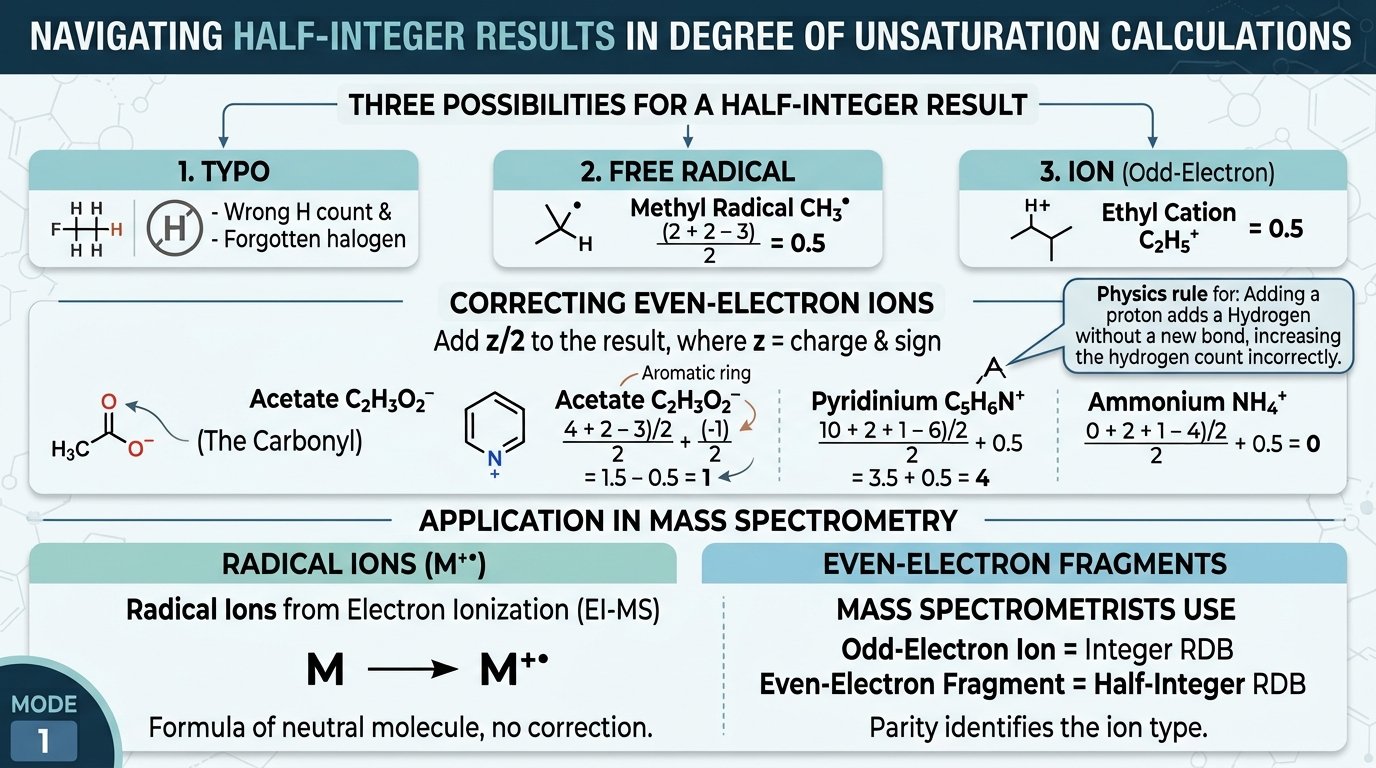
A half-integer result from a degree of unsaturation calculator is not an error message from the universe; it is information. It means the formula cannot describe a neutral closed-shell molecule, and there are three possibilities: a typo (usually a wrong hydrogen count or a forgotten halogen), a free radical, or an ion. The methyl radical CH3• gives (2 + 2 − 3)/2 = 0.5; the ethyl cation C2H5+ also gives 0.5. Species with an odd number of electrons legitimately sit halfway between integers.
For even-electron ions in the degree of unsaturation calculator — the protonated and deprotonated molecules of electrospray mass spectrometry, carbocations, carbanions, ammonium and carboxylate ions — the count is made whole by adding z/2, where z is the charge with its sign. Acetate C2H3O2−: (4 + 2 − 3)/2 + (−1)/2 = 1.5 − 0.5 = 1, the carbonyl. Pyridinium C5H6N+: (10 + 2 + 1 − 6)/2 + 0.5 = 3.5 + 0.5 = 4, the aromatic ring. Ammonium NH4+: (0 + 2 + 1 − 4)/2 + 0.5 = 0. The rule is easy to remember from the physics: adding a proton adds a hydrogen without adding a bond pair, so the hydrogen count is one too high and must be corrected by half a unit.
For radical ions — the M+• of electron-ionisation mass spectrometry — the formula is that of the neutral molecule with one electron removed, so its degree of unsaturation is the neutral value; no correction is applied. Mass spectrometrists use exactly this: an odd-electron ion has an integer RDB, an even-electron fragment has a half-integer RDB, and the parity tells you which kind of ion you are looking at. Mode 1 of the degree of unsaturation calculator has a species selector for these three cases and shows the correction, if any, in the steps.
Reference Table: Degree of Unsaturation of 46 Common Compounds
The table gives, for each compound, the molecular formula, molar mass, the arithmetic, the degree of unsaturation and how the real structure spends it. Use it to check homework, to build intuition for what a given number looks like, or as a source of test cases for the degree of unsaturation calculator. Every value was computed with IUPAC 2021 atomic weights and every ring/π-bond partition was checked against the structure.
| Compound | Formula | M (g/mol) | Arithmetic | DoU | Rings | π bonds | Note |
|---|---|---|---|---|---|---|---|
| Methane | CH4 | 16.043 | (2×1 + 2 − 4)/2 | 0 | 0 | 0 | saturated, acyclic |
| Ethene | C2H4 | 28.054 | (2×2 + 2 − 4)/2 | 1 | 0 | 1 | one C=C |
| Ethyne | C2H2 | 26.038 | (2×2 + 2 − 2)/2 | 2 | 0 | 2 (incl. triple) | one C≡C counts 2 |
| 1,3-Butadiene | C4H6 | 54.092 | (2×4 + 2 − 6)/2 | 2 | 0 | 2 | two C=C |
| Cyclohexane | C6H12 | 84.162 | (2×6 + 2 − 12)/2 | 1 | 1 | 0 | one ring |
| Cyclohexene | C6H10 | 82.146 | (2×6 + 2 − 10)/2 | 2 | 1 | 1 | ring + C=C |
| Benzene | C6H6 | 78.114 | (2×6 + 2 − 6)/2 | 4 | 1 | 3 | aromatic ring = 4 |
| Toluene | C7H8 | 92.141 | (2×7 + 2 − 8)/2 | 4 | 1 | 3 | aromatic ring = 4 |
| Styrene | C8H8 | 104.152 | (2×8 + 2 − 8)/2 | 5 | 1 | 4 | benzene + vinyl C=C |
| Naphthalene | C10H8 | 128.174 | (2×10 + 2 − 8)/2 | 7 | 2 | 5 | fused bicyclic aromatic |
| Anthracene | C14H10 | 178.234 | (2×14 + 2 − 10)/2 | 10 | 3 | 7 | three fused rings |
| Limonene | C10H16 | 136.238 | (2×10 + 2 − 16)/2 | 3 | 1 | 2 | monoterpene |
| α-Pinene | C10H16 | 136.238 | (2×10 + 2 − 16)/2 | 3 | 2 | 1 | bicyclic monoterpene |
| Squalene | C30H50 | 410.730 | (2×30 + 2 − 50)/2 | 6 | 0 | 6 | acyclic triterpene |
| β-Carotene | C40H56 | 536.888 | (2×40 + 2 − 56)/2 | 13 | 2 | 11 | two rings + 11 C=C |
| Ethanol | C2H6O | 46.069 | (2×2 + 2 − 6)/2 | 0 | 0 | 0 | O adds nothing |
| Acetaldehyde | C2H4O | 44.053 | (2×2 + 2 − 4)/2 | 1 | 0 | 1 | one C=O |
| Acetic acid | C2H4O2 | 60.052 | (2×2 + 2 − 4)/2 | 1 | 0 | 1 | one C=O |
| Acetone | C3H6O | 58.080 | (2×3 + 2 − 6)/2 | 1 | 0 | 1 | one C=O |
| Cyclohexanone | C6H10O | 98.145 | (2×6 + 2 − 10)/2 | 2 | 1 | 1 | ring + C=O |
| Phenol | C6H6O | 94.113 | (2×6 + 2 − 6)/2 | 4 | 1 | 3 | aromatic ring |
| Benzaldehyde | C7H6O | 106.124 | (2×7 + 2 − 6)/2 | 5 | 1 | 4 | benzene + C=O |
| Benzoic acid | C7H6O2 | 122.123 | (2×7 + 2 − 6)/2 | 5 | 1 | 4 | benzene + C=O |
| Aspirin | C9H8O4 | 180.159 | (2×9 + 2 − 8)/2 | 6 | 1 | 5 | benzene + 2 C=O |
| Paracetamol | C8H9NO2 | 151.165 | (2×8 + 2 + 1 − 9 − 0)/2 | 5 | 1 | 4 | benzene + amide C=O |
| Ibuprofen | C13H18O2 | 206.285 | (2×13 + 2 − 18)/2 | 5 | 1 | 4 | benzene + acid C=O |
| Caffeine | C8H10N4O2 | 194.194 | (2×8 + 2 + 4 − 10 − 0)/2 | 6 | 2 | 4 | 2 rings + 2 C=O + C=C + C=N |
| Nicotine | C10H14N2 | 162.236 | (2×10 + 2 + 2 − 14 − 0)/2 | 5 | 2 | 3 | pyridine (4) + pyrrolidine ring (1) |
| Glucose | C6H12O6 | 180.156 | (2×6 + 2 − 12)/2 | 1 | 1 | 0 | pyranose ring (or open-chain C=O) |
| Cholesterol | C27H46O | 386.664 | (2×27 + 2 − 46)/2 | 5 | 4 | 1 | steroid: 4 rings + 1 C=C |
| Testosterone | C19H28O2 | 288.431 | (2×19 + 2 − 28)/2 | 6 | 4 | 2 | 4 rings + C=C + C=O |
| Retinol (vitamin A) | C20H30O | 286.459 | (2×20 + 2 − 30)/2 | 6 | 1 | 5 | ring + 5 conjugated C=C |
| Ascorbic acid (vitamin C) | C6H8O6 | 176.124 | (2×6 + 2 − 8)/2 | 3 | 1 | 2 | lactone ring + C=C + C=O |
| Acetonitrile | C2H3N | 41.053 | (2×2 + 2 + 1 − 3 − 0)/2 | 2 | 0 | 2 (incl. triple) | one C≡N counts 2 |
| Pyridine | C5H5N | 79.102 | (2×5 + 2 + 1 − 5 − 0)/2 | 4 | 1 | 3 | aromatic ring = 4 |
| Nitrobenzene | C6H5NO2 | 123.111 | (2×6 + 2 + 1 − 5 − 0)/2 | 5 | 1 | 4 | benzene + N=O |
| Urea | CH4N2O | 60.056 | (2×1 + 2 + 2 − 4 − 0)/2 | 1 | 0 | 1 | one C=O |
| Chloroform | CHCl3 | 119.369 | (2×1 + 2 + 0 − 1 − 3)/2 | 0 | 0 | 0 | halogens count like H |
| DDT | C14H9Cl5 | 354.476 | (2×14 + 2 + 0 − 9 − 5)/2 | 8 | 2 | 6 | two benzene rings |
| Thiophene | C4H4S | 84.136 | (2×4 + 2 − 4)/2 | 3 | 1 | 2 | S adds nothing |
| Oleic acid | C18H34O2 | 282.468 | (2×18 + 2 − 34)/2 | 2 | 0 | 2 | C=C + C=O |
| Linoleic acid | C18H32O2 | 280.452 | (2×18 + 2 − 32)/2 | 3 | 0 | 3 | 2 C=C + C=O |
| TNT | C7H5N3O6 | 227.132 | (2×7 + 2 + 3 − 5 − 0)/2 | 7 | 1 | 6 | benzene + 3 N=O |
| Morphine | C17H19NO3 | 285.343 | (2×17 + 2 + 1 − 19 − 0)/2 | 9 | 5 | 4 | 5 rings + benzene π + C=C |
| Penicillin G | C16H18N2O4S | 334.390 | (2×16 + 2 + 2 − 18 − 0)/2 | 9 | 3 | 6 | 3 rings + 3 C=C + 3 C=O |
| Indigo | C16H10N2O2 | 262.268 | (2×16 + 2 + 2 − 10 − 0)/2 | 13 | 4 | 9 | 4 rings + 9 double bonds |
Patterns worth noticing: every simple benzene derivative sits at 4 or 5; the steroids (cholesterol, testosterone) at 5 and 6 because of their four rings; fused aromatics climb quickly (naphthalene 7, anthracene 10); and the “heavily unsaturated” polyunsaturated fatty acids are still low because a long chain of CH2 groups dilutes a handful of double bonds. Try any row in the degree of unsaturation calculator and compare the combinations it lists with the note column.
Interpreting the Number: Rings, Double Bonds and Triple Bonds
The degree of unsaturation calculator returns a sum, and a sum can be partitioned many ways. The number of partitions grows quickly — there is one way to make 0, two ways to make 1 (a ring or a double bond), four ways to make 2 (two rings; two double bonds; ring + double bond; one triple bond) — so the number alone never fixes a structure. What it does is set the budget, and a few rules of thumb spend it quickly:
- DoU = 0. Fully saturated and acyclic. Alkanes, alcohols, ethers, amines, alkyl halides, thiols. No C=O, no C=C, no ring. If the IR shows a carbonyl, the formula is wrong.
- DoU = 1. One ring or one double bond. Cycloalkanes, alkenes, aldehydes, ketones, carboxylic acids, esters, amides, imines. A strong IR band near 1700 cm−1 spends it on C=O; its absence and a ¹H NMR signal at 5–6 ppm spend it on C=C; neither points to a ring.
- DoU = 2. Two of the above, or one triple bond. A nitrile (2250 cm−1) or alkyne (2100–2260 cm−1, terminal ≡C–H at 3300) uses both at once. Conjugated dienes and α,β-unsaturated carbonyls are the common two-π-bond answers.
- DoU = 3. Terpenes, cyclic enones, dienones, lactones with a C=C. Still below the aromatic threshold.
- DoU ≥ 4. Think benzene first. One aromatic ring uses exactly 4; each extra unit above 4 is a substituent carbonyl, alkene or additional ring. Aromatic C–H stretches above 3000 cm−1, ¹H NMR signals at 7–8 ppm and ¹³C signals at 120–150 ppm confirm it.
- DoU ≥ 7. Two aromatic rings (biphenyl 8, naphthalene 7), steroids with carbonyls, alkaloids, most drug molecules. Morphine sits at 9, penicillin G at 9, indigo at 13.
The degree of unsaturation calculator prints a short interpretation with every result and, for values from 1 to 6, the complete list of ring / double-bond / triple-bond partitions with the benzene combination highlighted. The list is not there to be memorised; it is there so that a spectrum can strike entries off it.
Using the Degree of Unsaturation with IR, NMR and Mass Spectra
Structure determination is bookkeeping, and the number from the degree of unsaturation calculator is the ledger’s opening balance. A typical workflow for an unknown C9H10O (DoU 5) runs like this. IR: strong band at 1690 cm−1 — a conjugated C=O, spend 1. ¹H NMR: five protons between 7.2 and 8.0 ppm — a monosubstituted benzene, spend 4. Balance now zero, so the remaining C2H5 fragment must be saturated and acyclic: an ethyl group. A quartet at 3.0 ppm and a triplet at 1.2 ppm confirm CH2CH3 next to the carbonyl. The compound is propiophenone. At no point was a structure guessed; the number kept the accounts honest.
In ¹³C NMR the number of sp2 carbons is a direct check: each C=C or C=O accounts for two or one sp2 carbons respectively, and any unsaturation left over after all sp2 carbons are assigned must be a ring. In high-resolution mass spectrometry the roles reverse: the accurate mass proposes formulas and the degree of unsaturation rejects those that are chemically impossible (negative or half-integer for an odd-electron ion) or implausible (a DoU of 15 for a C12 compound). Software vendors call it the RDB filter; Mode 4 of the degree of unsaturation calculator applies it and shows you what it removed.
Two more connections are worth making explicit. The nitrogen rule — a neutral molecule with an odd nominal mass contains an odd number of nitrogens — is the same parity condition that makes the degree of unsaturation an integer, so a formula that passes one passes the other. And in UV–visible spectroscopy, absorption above about 200 nm needs conjugated π bonds; a compound with DoU 0 or 1 cannot have a UV chromophore beyond a lone carbonyl’s weak n→π* band, which is why β-carotene (DoU 13, eleven conjugated C=C) is orange and cyclohexane is not.
Unsaturation in Fats and Oils: Iodine Value and Hydrogenation
When a nutrition label says “polyunsaturated” it is using the same word a degree of unsaturation calculator uses, but in a narrower sense: C=C double bonds in fatty-acid chains. A fatty acid’s degree of unsaturation always includes one unit for the carboxyl C=O, so the number of C=C is DoU − 1: stearic acid C18H36O2, DoU 1, no C=C, saturated; oleic C18H34O2, DoU 2, one C=C, monounsaturated; linoleic C18H32O2, DoU 3, two C=C; α-linolenic C18H30O2, DoU 4, three C=C; DHA C22H32O2, DoU 7, six C=C. For a triglyceride subtract three for the three ester carbonyls: triolein C57H104O6, DoU 6, three C=C.
The classical laboratory measure, and the one the degree of unsaturation calculator converts to, is the iodine value: the grams of iodine (as I2, adding across each C=C) absorbed by 100 g of fat. Theoretically, IV = (number of C=C) × 253.81 × 100 / M. Linoleic acid: 2 × 253.81 × 100 / 280.45 = 181.0; oleic acid 89.9; triolein 86.0. Real oils are mixtures, so their iodine values are averages: olive oil 80–90, sunflower 120–140, linseed 170–200, coconut 7–10. Given a measured value and a representative molar mass, the calculation runs backwards to the average number of C=C per molecule — olive oil at IV 84 with M ≈ 885 has about 2.9 C=C per triglyceride.
Hydrogenation uses one H2 per C=C. To saturate 100 g of linoleic acid: 100/280.45 = 0.3566 mol × 2 = 0.7131 mol H2 = 1.438 g = 15.98 L at STP. Mode 5 of the degree of unsaturation calculator reports the C=C count, iodine value, bromine number (the Br2 analogue, 159.81 g/mol) and the hydrogen demand for any sample mass, and back-calculates C=C from a measured iodine value. It is the bridge between the organic chemist’s integer and the oleochemist’s titration.
From Percent Composition and Empirical Formulas
Elemental analysis delivers percentages, and the route from percentages to a degree of unsaturation runs through the empirical formula. The empirical formula’s own DoU is often fractional and always misleading if read literally: CH has DoU 1.5, CH2 has 1, CH2O has 1. The reason is that the constant “+1” in the formula belongs to the whole molecule, not to each repeat unit. If the molecular formula is (empirical)n, then
A fractional empirical DoU from the degree of unsaturation calculator is itself useful: it tells you n must be even. CH cannot be a molecule; C2H2, C4H4, C6H6 and C8H8 can. Mode 3 of the degree of unsaturation calculator performs the whole chain — percent to moles to ratio to empirical formula, then molar mass to n to molecular formula to DoU — and displays the relation above with your numbers. For the empirical-formula step on its own see our empirical formula calculator; for combustion data (CO2 and H2O masses rather than percentages) start with the combustion analysis calculator and bring its formula here.
Who Uses a Degree of Unsaturation Calculator?
- Organic chemistry students, for whom it is the first step of every structure-determination problem and a reliable source of exam marks.
- Spectroscopists and NMR facility staff confirming that an assigned structure matches the formula from the mass spectrometer.
- Mass spectrometrists filtering formula candidates for an accurate-mass peak by RDB and the nitrogen rule.
- Natural-product and medicinal chemists ranking possible skeletons for an isolate before running 2D NMR.
- Food scientists and oleochemists converting between fatty-acid formulas, iodine values and hydrogen consumption.
- Polymer and materials chemists checking the unsaturation of monomers, rubbers and drying oils.
- Teachers and tutors who need clean examples of each integer — Mode 2 of the degree of unsaturation calculator builds a formula from any combination of rings and bonds.
Step-by-Step Walkthrough in the Tool
Suppose the problem is: An unknown has the formula C10H14N2. What is its degree of unsaturation, and what structural types are possible?
- Open the degree of unsaturation calculator and stay on the first tab, DoU from Formula.
- Type C10H14N2 in the formula box (plain digits are fine; subscripts are added for you). Leave the species selector at neutral molecule.
- Press Calculate. The answer box reads: degree of unsaturation = 5 — 5 rings and/or π bonds in total; molar mass 162.236 g/mol.
- Read the steps: atoms C 10, H 14, N 2; (2×10 + 2 + 2 − 14 − 0)/2 = 10/2 = 5; a saturated acyclic skeleton would hold 24 H, this one has 14, short by 10 = 5 pairs.
- The interpretation says a benzene-type ring is likely with one unit left over. The combination list includes 2 rings + 3 double bonds — which is nicotine: a pyridine ring (4) and a saturated pyrrolidine ring (1).
- The table shows each element’s contribution (+10, −7, +1, constant +1 = 5) and the bar chart compares the 14 hydrogens with the 24 a saturated skeleton would carry.
- Use Copy to paste the working into a report, TXT or CSV to save it, or Print for a clean page. The calculation is saved in the history strip; Reset clears the panel.
To confirm the nicotine hypothesis, switch to Mode 2, enter 10 C, 2 N, 2 rings and 3 double bonds, and the degree of unsaturation calculator returns C10H14N2 — the structure and the formula agree.
A Short History: From Kekulé to the Nitrogen Rule
The idea behind every degree of unsaturation calculator — that hydrogen content measures “saturation” — is as old as structural theory. August Kekulé’s 1858 proposal that carbon is tetravalent and forms chains made CnH2n+2 the natural formula of a saturated hydrocarbon, and the general formulas CnH2n for olefins and cycloparaffins and CnH2n−2 for acetylenes followed within a few years. Kekulé’s 1865 benzene ring was itself an exercise in the same accounting: C6H6 was eight hydrogens short of hexane, and a ring with three double bonds spent exactly that deficit.
The word “unsaturated” entered chemistry from the language of solutions — a compound that could still take up hydrogen or bromine was not yet “saturated” with it — and the bromine and iodine addition tests of the late nineteenth century (Hübl’s iodine value dates from 1884, Wijs’s improved reagent from 1898) made the count quantitative for fats. The general formula in terms of valences, DoU = 1 + ½Σni(vi − 2), appears in twentieth-century textbooks under various names; “index of hydrogen deficiency” became standard in American organic chemistry texts, “double-bond equivalents” in British ones.
Mass spectrometry gave the number a second life. Fred McLafferty’s 1960s treatments of fragmentation used “rings plus double bonds” to classify ions as odd- or even-electron, and the nitrogen rule — a consequence of the same parity — became a routine check on every proposed formula. With the arrival of high-resolution instruments the RDB filter became a standard part of formula-assignment software, which is essentially what Mode 4 of the degree of unsaturation calculator reproduces in the browser.
Limitations and Pitfalls
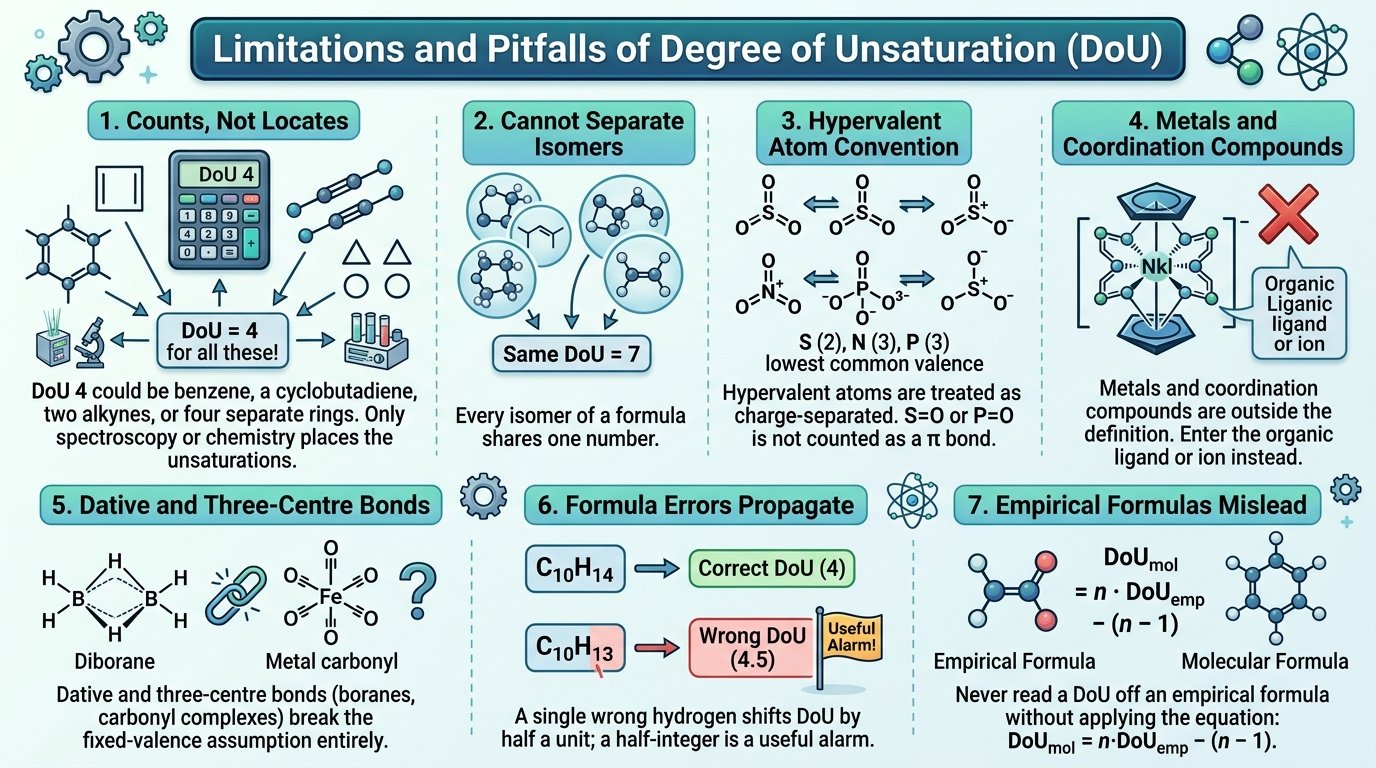
- It counts, it does not locate. DoU 4 could be benzene, a cyclobutadiene, two alkynes, or four separate rings. Only spectroscopy or chemistry places the unsaturations.
- It cannot separate isomers. Every isomer of a formula shares one number.
- Hypervalent atoms need a convention. Sulfoxides, sulfones, nitro groups, phosphates and N-oxides are treated as charge-separated with the lowest common valence (S 2, N 3, P 3). This gives internally consistent answers but means an S=O or P=O is not counted as a π bond.
- Metals and coordination compounds are outside the definition. Enter the organic ligand or ion instead.
- Dative and three-centre bonds (boranes, carbonyl complexes) break the fixed-valence assumption entirely.
- Formula errors propagate. The number is only as good as the formula; a single wrong hydrogen shifts it by half a unit, which is why a half-integer is such a useful alarm.
- Empirical formulas mislead. Never read a DoU off an empirical formula without applying DoUmol = n·DoUemp − (n − 1).
Practice Problems (With Answers)
Work each problem by hand first, then verify with the free degree of unsaturation calculator above. Answers are hidden until you click.
Problem 1 — Find the degree of unsaturation of toluene, C7H8.
(2×7 + 2 − 8)/2 = 8/2 = 4. One benzene ring (1 ring + 3 C=C); the methyl group is saturated. Mode 1.
Problem 2 — Nitrobenzene is C6H5NO2. Degree of unsaturation?
(12 + 2 + 1 − 5)/2 = 10/2 = 5. Benzene ring 4 + one N=O counted as a π bond. The two oxygens contribute nothing. Mode 1.
Problem 3 — A compound is C4H6. List every possible way to distribute its unsaturation.
DoU = (8 + 2 − 6)/2 = 2. Options: two C=C (1,3-butadiene, 1,2-butadiene), one C≡C (1-butyne, 2-butyne), one ring + one C=C (cyclobutene, methylcyclopropene), two rings (bicyclo[1.1.0]butane). Mode 1 lists the four partition types.
Problem 4 — A structure has 9 carbons, 1 oxygen, one benzene ring and one C=O. What is its molecular formula?
DoU = 4 + 1 = 5. H = 2×9 + 2 − 2×5 = 20 − 10 = 10 → C9H10O, 134.18 g/mol (e.g. propiophenone). Mode 2.
Problem 5 — Bromobenzene is C6H5Br. A student calculates (12 + 2 − 5)/2 = 4.5. What went wrong, and what is the correct value?
The bromine was omitted. Halogens count like hydrogens: (12 + 2 − 5 − 1)/2 = 4. A half-integer for a neutral molecule always signals a missing halogen or a wrong H count. Mode 1.
Problem 6 — An unknown is C 40.92%, H 4.58%, O 54.50%, M = 176.12 g/mol. Molecular formula and degree of unsaturation?
Moles per 100 g: C 3.407, H 4.544, O 3.407 → 1 : 1.333 : 1 → ×3 → C3H4O3 (88.06). n = 176.12/88.06 = 2 → C6H8O6, ascorbic acid. DoU = (12 + 2 − 8)/2 = 3 (lactone ring + C=C + C=O). Mode 3.
Problem 7 — The acetate ion is C2H3O2−. Degree of unsaturation?
Neutral formula gives (4 + 2 − 3)/2 = 1.5; for an even-electron ion add z/2 = −0.5 → 1, the C=O. Mode 1 with the ion option.
Problem 8 — An ESI spectrum shows [M+H]+ at m/z 195.0877. Is C8H10N4O2 a plausible formula? Give its DoU.
Neutral mass = 195.0877 − 1.00728 = 194.0804. C8H10N4O2 calculates to 194.0804 (0.2 ppm) and has DoU = (16 + 2 + 4 − 10)/2 = 6, a whole number with even N for an even nominal mass — plausible; it is caffeine. Mode 4.
Problem 9 — How many C=C double bonds does α-linolenic acid, C18H30O2, have, and what is its theoretical iodine value?
DoU = (36 + 2 − 30)/2 = 4; minus one carboxyl C=O = 3 C=C. M = 278.44; IV = 3 × 253.81 × 100 / 278.44 = 273.5 g I2/100 g. Mode 5.
Problem 10 — Cholesterol is C27H46O. Its structure has four rings. How many C=C does it have?
DoU = (54 + 2 − 46)/2 = 5. Four rings use 4, leaving one C=C (the Δ5 double bond); the hydroxyl oxygen contributes nothing. Mode 1, then Mode 2 with 27 C, 1 O, 4 rings, 1 double bond returns C27H46O.
Tips for Accurate Results
- Write the formula in the order C, H, N, X before you start. It puts every term of (2C + 2 + N − H − X)/2 in front of you and makes a forgotten halogen obvious.
- Cross out the oxygens and sulfurs. Literally. They cannot change the answer, and removing them removes a distraction.
- Check the parity first. If N is even, H + X must be even; if N is odd, H + X must be odd. Otherwise stop — the formula is not a neutral molecule.
- Spend 4 on a benzene ring as soon as the spectra allow it. Most structure problems with DoU ≥ 4 contain one, and the remaining budget is small and easy to place.
- Count sp2 carbons in the ¹³C spectrum. Any unsaturation not explained by them is a ring.
- For ions, decide even- or odd-electron before applying a correction. [M+H]+ gets +½; M+• gets nothing.
- Never take a DoU from an empirical formula at face value. Multiply up to the molecular formula first, or use DoUmol = n·DoUemp − (n − 1).
- Save the working. Copy or print the steps from the degree of unsaturation calculator so the method, not just the integer, goes into your report.
Common Mistakes
| Mistake | What goes wrong | Fix |
|---|---|---|
| Forgetting the halogens | Half-integer answer (bromobenzene 4.5 instead of 4) | Add F, Cl, Br, I to the hydrogen count |
| Subtracting nitrogen instead of adding it | Answer too low by N (pyridine 3 instead of 4) | Nitrogen carries a plus sign: +N/2 |
| Counting oxygen | Any answer; usually wrong by a whole number | Oxygen and sulfur contribute zero |
| Counting a triple bond as 1 | Structure short by one unsaturation | Two π bonds = 2 |
| Counting a benzene ring as 3 (or 1) | Structure over- or under-spends the budget | 1 ring + 3 π bonds = 4 |
| Forgetting the “+2” | Every answer one too low; alkanes come out at −1 | 2C + 2: the 2 is the two chain ends |
| Applying the z/2 correction to a radical cation | M+• of benzene reported as 4.5 | Radical ions keep the neutral value; only even-electron ions are corrected |
| Reading DoU from the empirical formula | CH “has 1.5”; benzene reported as 1.5 or 9 | Use the molecular formula, or n·DoUemp − (n − 1) |
How This Calculator Is Different
| Feature | This calculator | Generic degree of unsaturation tool | By hand |
|---|---|---|---|
| DoU from any formula with every step and element contributions | ✅ textbook and general (valence) forms shown | ⚠️ number only | ✅ slow |
| Halogens, P, Si, ions and radical ions | ✅ z/2 correction, charge parsed from the formula | ⚠️ C, H, N, O only | ⚠️ error-prone |
| Ring / double bond / triple bond combinations listed | ✅ with benzene highlighted | ❌ | ⚠️ easy to miss one |
| Rings + bonds → hydrogen count and formula | ✅ with impossibility check | ❌ | ✅ |
| From percent composition via empirical and molecular formula | ✅ shows n·DoUemp − (n − 1) | ❌ | ✅ |
| Accurate-mass formula finder with DoU / nitrogen-rule filter | ✅ seven ion types, ppm ranking | ❌ | ❌ |
| C=C → iodine value, bromine number, H2 demand | ✅ and measured IV → C=C | ❌ | ✅ |
| Bar chart, table, CSV/TXT, print, share, history, reset | ✅ | ❌ | ❌ |
This degree of unsaturation calculator is one of a family of free tools on molecularweightcalculator.org. Start with the molecular weight calculator for any formula’s molar mass, the atomic mass calculator for individual elements and the formula weight calculator for salts. The formula you feed into this page usually comes from the combustion analysis calculator, the empirical formula calculator, the molecular formula calculator or the percent composition calculator. The molar mass that fixes the molecular formula can come from the vapor density calculator, the molar mass from gas density calculator, the freezing point depression calculator, the boiling point elevation calculator or the osmotic pressure calculator. For the mass-spectrometry side use the exact mass calculator, the monoisotopic mass calculator, the isotopic mass calculator and the guide to average vs monoisotopic mass. Related stoichiometry lives in the stoichiometry calculator, the grams to moles calculator, the molarity calculator, the molar mass of hydrates calculator, the equivalent weight calculator and the van der Waals equation calculator. Mixtures and materials connect to the average molecular weight of a mixture and the polymer set — number average, weight average, polydispersity index and molecular weight from viscosity — where the unsaturation of monomers and drying oils decides how a material cures.
Where the Numbers Come From
The degree of unsaturation itself needs no data beyond atom counts and the standard valences (C, Si 4; N, P 3; O, S 2; H, F, Cl, Br, I 1), which follow the IUPAC definition of the quantity. The molar masses quoted alongside every result use the IUPAC 2021 standard atomic weights as published by the Commission on Isotopic Abundances and Atomic Weights, with the conventional value for elements given as an interval: H 1.008, C 12.011, N 14.007, O 15.999, S 32.06, Cl 35.45, Br 79.904, I 126.904. The accurate-mass finder uses the monoisotopic masses ¹H 1.007825, ¹²C 12 exactly, ¹⁴N 14.003074, ¹⁶O 15.994915, ³²S 31.972071, ³⁵Cl 34.968853, ⁷⁹Br 78.918338, the proton mass 1.007276 and the electron mass 0.000549. Iodine values use M(I2) = 253.81 and bromine numbers M(Br2) = 159.81 g/mol. Every example on this page was recomputed with these values.
If you spot a discrepancy worth checking, our corrections policy explains how reports are handled, and the contact page is the fastest route to us. More about the site and its author is on the about page.
Trusted external references for further degree of unsaturation calculator reading:
- IUPAC Gold Book — degree of unsaturation (iupac.org): the formal definition
- LibreTexts — Calculating Degree of Unsaturation (libretexts.org): textbook treatment with worked examples
- IUPAC CIAAW — Standard Atomic Weights (ciaaw.org): the atomic weights used for every molar mass on this page
- Wikipedia — Degree of unsaturation (wikipedia.org): overview, general formula and examples
Exam Checklist
Frequently Asked Questions
What does a degree of unsaturation calculator do?
It takes a molecular formula and returns the number of rings plus π bonds the molecule must contain, using DoU = (2C + 2 + N − H − X)/2. This one also shows each element’s contribution, lists the possible ring / double-bond / triple-bond combinations, handles ions, works backwards from a structure to a formula, starts from percent composition or an accurate mass, and converts C=C counts to iodine values.
What is the formula for the degree of unsaturation?
DoU = (2C + 2 + N − H − X)/2, where C, H, N and X are the numbers of carbon, hydrogen, nitrogen and halogen atoms. Oxygen and sulfur are ignored. In general, DoU = 1 + ½Σni(vi − 2) with v the valence of each element.
Why does oxygen not affect the degree of unsaturation?
Oxygen is divalent: inserting it into a C–H or C–C bond neither adds nor removes hydrogens, so the hydrogen deficiency is unchanged. Ethane C2H6 and ethanol C2H6O both have DoU 0. A C=O group does count 1, but that unit comes from the two hydrogens the carbon lost, not from the oxygen.
What is the degree of unsaturation of benzene?
4. C6H6: (2×6 + 2 − 6)/2 = 8/2 = 4, made up of one ring and three C=C double bonds. Any benzene derivative therefore starts with 4 and adds 1 for each extra ring, C=C or C=O.
How do halogens and nitrogen change the calculation?
Halogens (F, Cl, Br, I) are monovalent like hydrogen and are added to the H count with a minus sign. Nitrogen is trivalent and adds one hydrogen to the saturated reference, so it enters with a plus sign. Chlorobenzene C6H5Cl: (12 + 2 − 5 − 1)/2 = 4. Pyridine C5H5N: (10 + 2 + 1 − 5)/2 = 4.
What does a half-integer degree of unsaturation mean?
That the formula is not a neutral closed-shell molecule. It is either a typo (most often a forgotten halogen or a wrong hydrogen count), a free radical, or an ion. For even-electron ions such as [M+H]+ or a carboxylate, add z/2 to make the value whole; radical ions keep the neutral value.
Are degree of unsaturation, IHD and DBE the same thing?
Yes. Degree of unsaturation (DoU), index of hydrogen deficiency (IHD), double-bond equivalents (DBE), rings plus double bonds (RDB) and unsaturation number are different names for the same quantity: the number of rings plus π bonds implied by a molecular formula.
Can the degree of unsaturation tell me the structure?
No. It tells you how many rings and multiple bonds there are in total, not where they are or which kind. C4H6 (DoU 2) could be butadiene, butyne, cyclobutene or bicyclobutane. Its job is to set the budget that IR, NMR and mass spectra then spend.
How is the degree of unsaturation related to the iodine value of an oil?
The iodine value counts C=C double bonds by the mass of I2 they absorb per 100 g. For a fatty acid, C=C = DoU − 1 (the carboxyl C=O); for a triglyceride, DoU − 3. Iodine value = C=C × 253.81 × 100 / M. Linoleic acid (DoU 3, two C=C, M 280.45) has a theoretical iodine value of 181.
Is this degree of unsaturation calculator free, and does it store my data?
Yes, it is free with no sign-up. All calculations run in your browser; nothing is sent to a server. The history list is saved only in your own browser’s local storage and can be cleared with one click.
10 Facts Worth Knowing
- Every isomer of a formula shares the same degree of unsaturation — it is a property of the formula, not the structure.
- Benzene’s 4 is the most useful number in structure determination: any DoU ≥ 4 should make you look for an aromatic ring first.
- Adding oxygen never changes the number: glucose C6H12O6 and cyclohexane C6H12 both have DoU 1.
- The nitrogen rule of mass spectrometry and the integer requirement of the degree of unsaturation are the same parity condition.
- β-Carotene has DoU 13 — two rings and eleven conjugated C=C — which is why it is orange.
- Buckminsterfullerene C60 has DoU 61: (120 + 2 − 0)/2 — 31 rings (of the 32 faces, one is redundant) and 30 double bonds.
- A half-integer result is the fastest typo detector in organic chemistry.
- Hübl introduced the iodine value in 1884, forty years before the general valence formula for the degree of unsaturation appeared in textbooks.
- The empirical formula CH has a “degree of unsaturation” of 1.5, which is why it cannot be a molecule — but C6H6 (4) and C8H8 (5) can.
- Mass-spectrometry software calls the same quantity RDB and uses it to discard impossible formulas before you ever see them.
Final Thoughts
The degree of unsaturation is the cheapest structural information in chemistry: one line of arithmetic on a formula you already have, and it tells you how many rings and multiple bonds you are looking for before a single spectrum is run. The places students stumble are always the same — the forgotten halogen, the nitrogen sign, the temptation to count oxygen, the triple bond worth two, the benzene ring worth four, and the empirical formula that lies about its own value. The worked examples, the reference table and the practice problems above are meant to make each of those reflexes automatic.
Whenever you need to check a formula, test a proposed structure, filter a mass-spec candidate list or turn a fatty-acid formula into an iodine value, the free degree of unsaturation calculator at the top of this page will do the arithmetic and show its working. Bookmark it, share it with a study group, and if a number comes out as a half, trust the number: the formula is wrong.
Ahmad Raza, M.Phil. Chemistry
Founder & Lead Author, molecularweightcalculator.org · ✓ Verified Expert
Ahmad has taught general and organic chemistry for over a decade and has marked more structure-determination scripts than he cares to count. He builds every calculator on this site from the underlying chemistry, checks each one against textbook and literature data, and writes the guides so that the method — not just the answer — is what you take away.