
Formal Charge Calculator
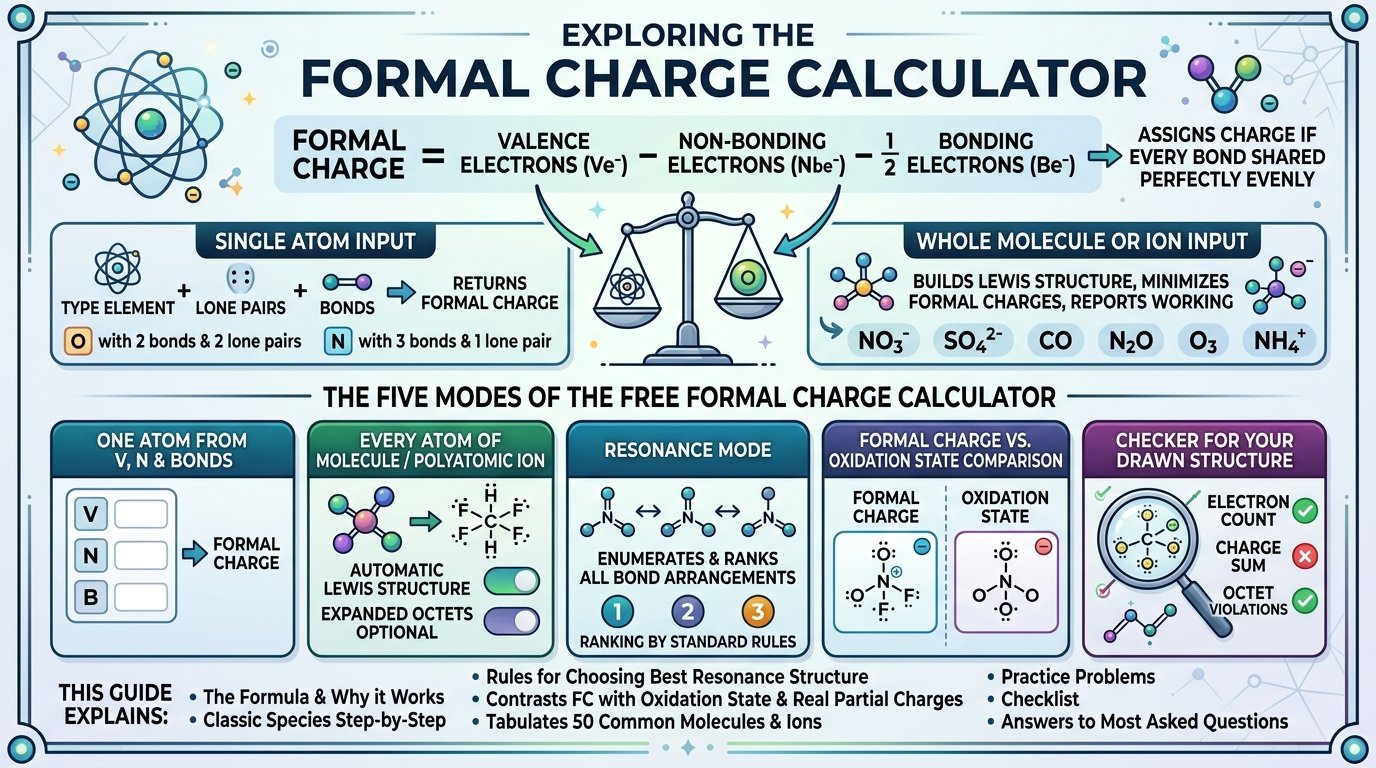
Formal charge = valence electrons − non-bonding electrons − ½ bonding electrons. Enter an atom's numbers, or type a whole molecule or ion — CO2, NO3−, SO42−, N2O, CO, O3, NH4+ — and the calculator builds the Lewis structure, assigns every formal charge, ranks the resonance structures and compares formal charge with oxidation state, all with the working shown.
✓ Trusted by students, teachers & tutorsFormal Charge of a Single Atom in a Lewis Structure
Pick the element (its valence electrons are filled in), then enter the lone-pair electrons and bonds drawn on that atom in your structure. FC = V − N − B/2, where B counts bonding electrons (2 per bond).
Formal Charges of Every Atom in a Molecule or Polyatomic Ion
Type the formula with the charge at the end (NO3-, SO4^2-, NH4+, CO, N2O, O3, ClO4-). The calculator counts valence electrons, builds the Lewis structure around the central atom, chooses the arrangement that minimises formal charges (allowing expanded octets for period-3+ atoms) and reports the formal charge of every atom with the working.
Which Resonance Structure Is Best?
Enter the formula and the calculator enumerates every distribution of bonds around the central atom that satisfies the electron count, lists the formal charges of each, and ranks them by the standard rules: (1) smallest formal charges, (2) fewest charges, (3) negative charge on the most electronegative atom, (4) no adjacent like charges.
Formal Charge vs Oxidation State for the Same Atom
Formal charge splits every bond evenly; oxidation state gives both bonding electrons to the more electronegative atom. Enter the atom, its valence electrons, lone-pair electrons, and each bond as partner symbol × bond order (e.g. O2, O1, H1) to see both numbers computed side by side.
Check a Drawn Lewis Structure: Electron Count and Formal-Charge Sum
List every atom in your drawing as symbol, lone-pair electrons, bonds (e.g. N 0 4; H 0 1; H 0 1; H 0 1; H 0 1) and the overall charge. The calculator verifies that the total electrons match the valence count, that the formal charges sum to the charge, flags octet violations and reports each formal charge.
🕘 Recent calculations
- No calculations yet — your last 10 results will appear here.
Formal charge = V − N − B/2 (V = valence electrons of the free atom, N = non-bonding electrons, B = electrons shared in bonds) · the formal charges of all atoms sum to the charge of the species · best structure: formal charges closest to zero, fewest charges, negative charge on the most electronegative atom, no like charges on adjacent atoms · period-3+ central atoms (S, P, Cl, Br, I, Xe) may exceed an octet to reduce formal charge · oxidation state assigns both bonding electrons to the more electronegative atom, formal charge splits them equally · valence electrons = main-group number.
A formal charge calculator assigns to each atom in a Lewis structure the charge it would carry if every bond were shared perfectly evenly: formal charge = valence electrons − non-bonding electrons − half the bonding electrons. Type an element with its lone pairs and bonds and the calculator returns the number; type a whole molecule or ion — NO3−, SO42−, CO, N2O, O3, NH4+ — and it builds the Lewis structure, chooses the arrangement of bonds that minimises formal charges and reports the formal charge of every atom with the working.
The free formal charge calculator above has five modes: one atom from V, N and bonds; every atom of a molecule or polyatomic ion with an automatic Lewis structure (expanded octets optional); a resonance mode that enumerates all bond arrangements and ranks them by the standard rules; a formal charge versus oxidation state comparison for the same atom; and a checker that verifies a structure you have drawn for electron count, charge sum and octet violations.
This guide explains the formula and why it works, walks through the classic species step by step, sets out the rules for choosing the best resonance structure, contrasts formal charge with oxidation state and with real partial charges, tabulates fifty common molecules and ions, and finishes with practice problems, a checklist and answers to the questions students ask most.
Key Takeaway
FC = V − N − B/2, or more simply FC = valence electrons − lone-pair electrons − number of bonds. Nitrogen in NH4+: 5 − 0 − 4 = +1. A single-bonded oxygen with three lone pairs: 6 − 6 − 1 = −1. The formal charges of all atoms sum to the charge of the species. The best Lewis structure has the smallest formal charges, with any negative charge on the most electronegative atom.
📑 Table of Contents (click to expand)
- What Is Formal Charge?
- How to Use the Formal Charge Calculator
- The Five Modes Explained
- The Formal Charge Formula
- Worked Example: Nitrate Ion Step by Step
- More Worked Examples
- Drawing the Lewis Structure First
- Rules for the Best Resonance Structure
- Expanded Octets: Sulfate, Phosphate, Perchlorate
- Reference Table: 50 Common Species
- Formal Charge vs Oxidation State
- Formal Charge vs Real Partial Charge
- Formal Charges in Organic Chemistry
- Radicals, Carbenes and Odd-Electron Species
- Patterns Worth Memorising
- Who Uses a Formal Charge Calculator
- Full Walkthrough: Thiocyanate Resonance
- A Short History of the Concept
- Limits: What Formal Charge Is Not
- Practice Problems With Answers
- Tips for Accurate Results
- Common Mistakes
- How This Calculator Is Different
- Where the Numbers Come From
- Exam Checklist
- Frequently Asked Questions
- 10 Facts Worth Knowing
- Final Thoughts
What Is Formal Charge?
Formal charge — the number a formal charge calculator reports for each atom — is a bookkeeping quantity assigned to each atom in a Lewis structure. It answers the question: if every bonding pair were split exactly in half between the two atoms it joins, how many electrons would this atom “own”, and how does that compare with the number it brought as a neutral atom? An atom that owns exactly its valence-electron count has a formal charge of zero; one that owns one fewer is +1; one that owns one more is −1.
Formal charge is not the real charge on the atom — real bonds are never split exactly evenly — but it is enormously useful for two things. First, it tells you which of several possible Lewis structures is the best description of a molecule: the one with the smallest formal charges, placed on the atoms that can bear them. Second, it makes electron accounting in reaction mechanisms honest: every curved arrow moves a pair and changes two formal charges, and the sum must always equal the total charge. A formal charge calculator does the arithmetic for every atom so the reasoning can be checked at a glance.
Three things formal charge is used for
Choosing between Lewis structures — prefer the one with formal charges closest to zero.
Locating charge in ions — the −1 in NO3− sits on the single-bonded oxygens; the +1 in NH4+ sits on nitrogen.
Checking mechanisms — formal charges must balance across every arrow-pushing step.
How to Use the Formal Charge Calculator
- For one atom (Mode 1): type the element symbol (valence electrons fill in automatically), the number of lone-pair electrons (not pairs) on it in your drawing, and the number of bonds (a double bond counts 2, a triple 3). Click Calculate. You get FC = V − N − B/2 with the electron count around the atom and an octet check.
- For a whole species (Mode 2): type the formula with the charge at the end —
NO3-,SO4^2-,NH4+,CO. Optionally name the central atom; the formal charge calculator otherwise picks the least electronegative non-hydrogen atom. Choose whether period-3+ central atoms may expand their octet. Click Build Lewis Structure. - Read the result. The answer box lists the formal charge of every atom, the bonding pattern chosen and the check that the charges sum to the overall charge. The steps show the total electron count, the central atom, each atom’s V, N and bonds, and, when relevant, the runner-up structure and why it lost.
- Explore resonance (Mode 3) to see every arrangement ranked; compare with oxidation state (Mode 4); check your own drawing (Mode 5) by listing each atom as symbol, lone electrons, bonds.
- Export. Copy, CSV, TXT, print or share; the last ten calculations stay in the history. Each mode has a Reset button.
The Five Modes Explained
| Mode | You enter | You get | Best for |
|---|---|---|---|
| 1. One Atom | Element, lone-pair electrons, bonds | Formal charge, electrons owned, octet status | Checking one atom in a structure you drew |
| 2. Whole Molecule / Ion | Formula with charge; optional central atom; octet option | Best Lewis structure, formal charge of every atom, sum check | Homework, exam revision |
| 3. Resonance Ranking | Same as Mode 2 | Every bond arrangement, formal charges of each, ranked with reasons | N2O, SCN−, NCO−, N3− |
| 4. FC vs Oxidation State | Atom, lone-pair electrons, list of bonds with partner and order | Both numbers side by side with the electron assignment | Understanding why C in CO is −1 and +2 at once |
| 5. Structure Checker | Each atom as symbol, lone electrons, bonds; overall charge | Electron count vs available, ΣFC vs charge, octet flags | Verifying a hand-drawn structure before an exam |
The Formal Charge Formula
FC = V − N − B/2
V = valence electrons of the free atom (main-group number: H 1, B 3, C 4, N 5, O 6, halogens 7) · N = non-bonding (lone-pair) electrons on the atom · B = electrons in bonds to the atom (2 per single, 4 per double, 6 per triple)
Equivalent shortcut: FC = V − (lone-pair electrons) − (number of bonds), counting a double bond as 2 and a triple as 3.
The logic behind the formal charge calculator formula is that the atom is credited with all of its lone-pair electrons and half of every bonding pair. Subtracting that total from V gives the deficit (+) or surplus (−) relative to the neutral atom. Two consequences follow. The formal charges of all atoms in a species add up to its overall charge, which is the first check the formal charge calculator performs. And for a given atom the sum N + B always equals the number of electrons in its valence shell in that structure, so the same three numbers also tell you whether the atom has an octet (8), an incomplete octet (fewer) or an expanded one (more).
| Atom in structure | V | N | Bonds (B/2) | Formal charge |
|---|---|---|---|---|
| N with 4 bonds, no lone pair (NH4+) | 5 | 0 | 4 | +1 |
| N with 3 bonds, 1 lone pair (NH3) | 5 | 2 | 3 | 0 |
| O with 1 bond, 3 lone pairs (alkoxide, NO3− terminal) | 6 | 6 | 1 | −1 |
| O with 2 bonds, 2 lone pairs (C=O, H2O) | 6 | 4 | 2 | 0 |
| O with 3 bonds, 1 lone pair (H3O+, central O of O3) | 6 | 2 | 3 | +1 |
| C with triple bond + 1 lone pair (CO, CN−) | 4 | 2 | 3 | −1 |
| B with 4 bonds (BF4−, BH4−) | 3 | 0 | 4 | −1 |
| S with 6 bonds (2 S=O + 2 S–O), no lone pair (SO42− expanded) | 6 | 0 | 6 | 0 |
Worked Example: Nitrate Ion Step by Step
Problem. The first species most students put into a formal charge calculator: draw the Lewis structure of NO3− and assign formal charges to every atom.
1. Count valence electrons. N 5 + 3 × O 6 = 23, plus 1 for the negative charge = 24 electrons (12 pairs).
2. Skeleton. Nitrogen is central (less electronegative than oxygen, occurs once); three N–O single bonds use 6 electrons.
3. Complete the octets of the outer atoms. Each O takes 3 lone pairs: 18 electrons. Total used 24. Nitrogen now has only 6 electrons.
4. Fix the central octet. Move one lone pair from an oxygen into an N=O double bond. Now N has 8 electrons.
5. Formal charges. N: 5 − 0 − 4 = +1. Double-bonded O: 6 − 4 − 2 = 0. Each single-bonded O: 6 − 6 − 1 = −1.
6. Check. +1 + 0 + (−1) + (−1) = −1 = charge of the ion. ✓
7. Resonance. The double bond can be on any of the three oxygens: three equivalent structures. The real ion is their average — every N–O bond identical (bond order 1⅓), each O carrying −⅔.
Nitrogen’s +1 cannot be removed, and no formal charge calculator should try: a fourth bond to N is impossible without exceeding its octet (nitrogen is period 2 and has no d orbitals), so the +1/−1 separation is a genuine feature of the nitrate ion, not a mistake. The formal charge calculator’s Mode 2 with NO3- gives exactly this result and explains that no alternative arrangement reduces the charges.
More Worked Examples
Example 2: Carbon dioxide — all zeros
16 electrons. The formal charge calculator gives O=C=O with two lone pairs on each O. C: 4 − 0 − 4 = 0; each O: 6 − 4 − 2 = 0. The alternative O≡C–O (triple + single) gives O +1 and O −1 — larger charges, so it is a minor contributor. The formal charge calculator ranks it second.
Example 3: Carbon monoxide — the famous inversion
10 electrons. Only the triple bond :C≡O: gives both atoms an octet. C: 4 − 2 − 3 = −1; O: 6 − 2 − 3 = +1. The less electronegative atom carries the negative formal charge — unusual, but unavoidable, and it correctly predicts that CO binds to metals through carbon.
Example 4: Ozone
18 electrons. O=O–O with the central O carrying one lone pair. Central O: 6 − 2 − 3 = +1; double-bonded terminal O: 0; single-bonded terminal O: 6 − 6 − 1 = −1. Two equivalent resonance forms; each terminal oxygen averages −½, as the formal charge calculator notes.
Example 5: Ammonium and hydronium
NH4+: N has four bonds and no lone pair: 5 − 0 − 4 = +1; each H 1 − 0 − 1 = 0. H3O+: O has three bonds and one lone pair: 6 − 2 − 3 = +1. The positive charge sits on the central atom in both, and the formal charge calculator places it there.
Example 6: Tetrafluoroborate and cyanide
Two results from the formal charge calculator that surprise students. BF4−: B has four bonds: 3 − 0 − 4 = −1; each F 7 − 6 − 1 = 0. The negative charge is on boron, the least electronegative atom — formal charge is bookkeeping, not electronegativity. CN−: :C≡N: gives C 4 − 2 − 3 = −1, N 5 − 2 − 3 = 0; cyanide attacks through carbon for exactly this reason.
Example 7: Nitrous oxide — which structure is best?
N2O, 16 electrons, N central. Candidates: N≡N–O (0, +1, −1), N=N=O (−1, +1, 0), N–N≡O (−2, +1, +1). The third has a −2 and a +1 on oxygen; discard. The first two tie on magnitude, but the first puts the −1 on oxygen (more electronegative) and is preferred. Mode 3 of the formal charge calculator lists all three with these reasons.
Drawing the Lewis Structure First
Formal charge is a property of a specific Lewis structure, so the structure has to exist before any formal charge calculator can compute the charges. The formal charge calculator follows the standard procedure:
- Count total valence electrons. Sum the group numbers; add one electron per negative charge, subtract one per positive charge.
- Choose the central atom. The least electronegative atom that is not hydrogen, usually the one that appears once (C in HCN, S in SO42−, N in N2O). Hydrogen and (almost always) halogens are terminal.
- Connect with single bonds and subtract 2 electrons per bond.
- Complete the octets of the terminal atoms (duet for H) with lone pairs.
- Put any remaining electrons on the central atom.
- If the central atom lacks an octet, convert terminal lone pairs into double or triple bonds until it has one.
- Compute formal charges; if a period-3+ central atom carries a positive formal charge, consider converting further lone pairs into double bonds (an expanded octet) to bring it to zero.
Step 7 is where textbooks differ; see the expanded-octet section below. Step 2 is where most hand errors occur — putting oxygen in the middle of N2O or hydrogen in the middle of anything.
Rules for the Best Resonance Structure
Rule 1. Structures with formal charges closest to zero (smallest sum of |FC|) are preferred.
Rule 2. Fewer charged atoms is better than more, for the same total.
Rule 3. Negative formal charge belongs on the more electronegative atom; positive on the less electronegative.
Rule 4. Like charges on adjacent atoms are strongly disfavoured; opposite charges should be adjacent, not separated.
Rule 5. Octets must be complete on period-2 atoms (never more than 8 on C, N, O, F); a structure with an incomplete octet on a period-2 central atom is worse than one with formal charges (B, Be and Al are the tolerated exceptions).
The formal charge calculator applies these rules in order; a later rule only breaks ties left by earlier ones. Structures related by symmetry (the three nitrate forms, the two ozone forms) are equivalent and contribute equally; structures that differ in bond pattern (the three N2O forms) contribute in proportion to how well they score. Mode 3 of the formal charge calculator prints the score components — total magnitude, number of charged atoms, electronegativity placement — for every structure so the ranking is transparent.
Expanded Octets: Sulfate, Phosphate, Perchlorate
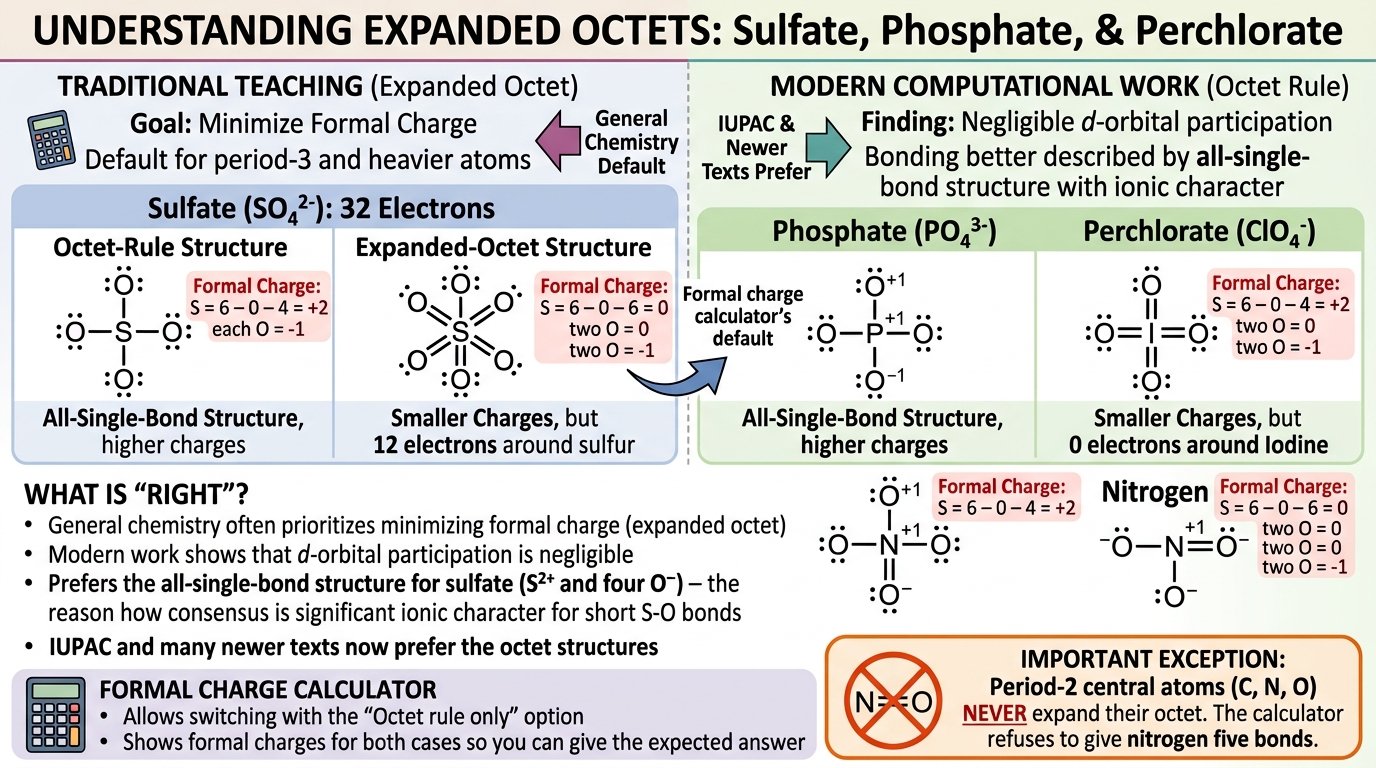
For sulfate, SO42− (32 electrons), the formal charge calculator can give two answers. The octet-rule structure has four S–O single bonds: S 6 − 0 − 4 = +2 and each O −1. Converting two lone pairs into two S=O double bonds gives S 6 − 0 − 6 = 0, two O at 0 and two O at −1 — smaller charges, but 12 electrons around sulfur. The same choice arises for PO43− (P +1 with four single bonds, 0 with one P=O), ClO4− (Cl +3 with four single bonds, 0 with three Cl=O), SO2, SO3 and H2SO4.
Which is “right”? Most general-chemistry courses teach the expanded-octet structures because they minimise formal charge, and that is the formal charge calculator’s default for period-3 and heavier central atoms. Modern computational work, however, shows that d-orbital participation is negligible and that the bonding in sulfate is better described by the all-single-bond structure with ionic character (S2+ and four O−, which is why the S–O bonds are short). IUPAC and many newer texts now prefer the octet structures. The calculator lets you switch with the “Octet rule only” option, and in either case shows the formal charges so you can give the answer your course expects. Period-2 central atoms (C, N, O) never expand — the calculator refuses to give nitrogen five bonds.
Reference Table: 50 Common Species
Best Lewis structure and formal charges as reported by the formal charge calculator (expanded octets allowed for period-3+ central atoms; the octet-only alternative is noted where it differs).
| Species | e− | Best structure | Formal charges | Note |
|---|---|---|---|---|
| H2O | 8 | H–O–H, 2 lp on O | all 0 | — |
| NH3 | 8 | 3 N–H, 1 lp | all 0 | — |
| NH4+ | 8 | 4 N–H | N +1 | charge on N |
| H3O+ | 8 | 3 O–H, 1 lp | O +1 | — |
| OH− | 8 | O–H, 3 lp | O −1 | — |
| CH4 | 8 | 4 C–H | all 0 | — |
| CO2 | 16 | O=C=O | all 0 | O≡C–O minor (+1/−1) |
| CO | 10 | :C≡O: | C −1, O +1 | only octet structure |
| CN− | 10 | :C≡N: | C −1, N 0 | C-nucleophile |
| HCN | 10 | H–C≡N: | all 0 | HNC isomer: N +1, C −1 |
| N2 | 10 | :N≡N: | all 0 | — |
| O2 | 12 | O=O, 2 lp each | all 0 | Lewis misses paramagnetism |
| O3 | 18 | O=O–O | central +1, single-bonded O −1 | 2 equivalent forms |
| NO3− | 24 | 1 N=O, 2 N–O | N +1, O 0, 2 O −1 | 3 equivalent forms |
| NO2− | 18 | O=N–O, 1 lp on N | N 0, O 0, O −1 | 2 equivalent forms |
| NO2+ | 16 | O=N=O | N +1, O 0 | isoelectronic with CO2 |
| N2O | 16 | N≡N–O | 0, +1, −1 | N=N=O close second |
| N3− | 16 | N=N=N | −1, +1, −1 | N≡N–N (0,+1,−2) minor |
| SCN− | 16 | S–C≡N / S=C=N | S −1, C 0, N 0 / S 0, C 0, N −1 | both important; ambidentate |
| NCO− | 16 | N≡C–O | N 0, C 0, O −1 | N=C=O (−1, 0, 0) second |
| CO32− | 24 | 1 C=O, 2 C–O | C 0, O 0, 2 O −1 | 3 equivalent forms |
| HCO3− | 24 | C=O, C–O−, C–OH | one O −1 | — |
| HCOO− | 18 | H–C(=O)–O | one O −1 | 2 equivalent forms |
| SO2 | 18 | O=S=O, 1 lp on S | all 0 | octet-only: S +1, O −1 |
| SO3 | 24 | 3 S=O | all 0 | octet-only: S +2, 2 O −1 |
| SO42− | 32 | 2 S=O, 2 S–O | S 0, 2 O −1 | octet-only: S +2, 4 O −1 |
| SO32− | 26 | 1 S=O, 2 S–O, 1 lp | S 0, 2 O −1 | octet-only: S +1 |
| PO43− | 32 | 1 P=O, 3 P–O | P 0, 3 O −1 | octet-only: P +1, 4 O −1 |
| ClO4− | 32 | 3 Cl=O, 1 Cl–O | Cl 0, 1 O −1 | octet-only: Cl +3 |
| ClO3− | 26 | 2 Cl=O, 1 Cl–O, 1 lp | Cl 0, 1 O −1 | octet-only: Cl +2 |
| ClO− | 14 | Cl–O, 3 lp each | O −1 | — |
| BF3 | 24 | 3 B–F | all 0 | B has 6 e−; B=F form gives F +1 |
| BF4− | 32 | 4 B–F | B −1 | charge on B |
| BH4− | 8 | 4 B–H | B −1 | — |
| AlCl4− | 32 | 4 Al–Cl | Al −1 | — |
| PCl5 | 40 | 5 P–Cl | all 0 | 10 e− on P |
| SF6 | 48 | 6 S–F | all 0 | 12 e− on S |
| XeF4 | 36 | 4 Xe–F, 2 lp | all 0 | 12 e− on Xe |
| I3− | 22 | I–I–I, 3 lp on central | central I −1 | 10 e− on central I |
| H2O2 | 14 | H–O–O–H | all 0 | — |
| H2CO | 12 | H2C=O | all 0 | — |
| CH3+ | 6 | 3 C–H | C +1 | carbocation, 6 e− |
| CH3− | 8 | 3 C–H, 1 lp | C −1 | carbanion |
| CH3NC | 16 | CH3–N≡C: | N +1, C −1 | isocyanide |
| CH2N2 | 16 | H2C=N+=N− | N +1, N −1 | diazomethane; H2C−–N+≡N second |
| (CH3)3N–O | 32 | N–O single | N +1, O −1 | amine oxide; N cannot expand |
| (CH3)2S–O | 26 | S=O (expanded) or S+–O− | 0 / S +1, O −1 | DMSO; both drawn |
| Ph3P=CH2 | — | P=C (ylene) or P+–C− (ylide) | 0 / P +1, C −1 | Wittig reagent; ylide form dominant |
| NO (radical) | 11 | N=O with odd e− on N | all 0 | odd electron; see radicals |
| NO2 (radical) | 17 | O=N–O, odd e− on N | N 0, O 0, O −1 (+ odd e−) | dimerises to N2O4 |
Formal Charge vs Oxidation State
Both numbers assign electrons to atoms, and a formal charge calculator with an oxidation-state mode shows the contrast directly; they differ only in how a bonding pair is divided. Formal charge splits every bond 50 : 50 regardless of the atoms. Oxidation state gives both electrons of every bond to the more electronegative atom (and splits homonuclear bonds evenly). Formal charge is therefore a tool for comparing Lewis structures; oxidation state is a tool for tracking redox. Neither is the real charge, which lies somewhere between them.
| Atom | Structure | Formal charge | Oxidation state |
|---|---|---|---|
| C in CO2 | O=C=O | 0 | +4 |
| C in CO | :C≡O: | −1 | +2 |
| N in NH4+ | 4 N–H | +1 | −3 |
| N in NO3− | 1 N=O, 2 N–O | +1 | +5 |
| S in SO42− | 2 S=O, 2 S–O | 0 (+2 octet-only) | +6 |
| O in H3O+ | 3 O–H, 1 lp | +1 | −2 |
| C in CH3Cl | 3 C–H, 1 C–Cl | 0 | −2 |
| B in BF4− | 4 B–F | −1 | +3 |
Mode 4 of the formal charge calculator computes both for any atom from the same input, showing exactly which electrons went where under each convention. For oxidation states of every element in a whole compound, and for redox analysis, use the oxidation number calculator.
Formal Charge vs Real Partial Charge
The real charge distribution in a molecule — which no formal charge calculator claims to give — is continuous and is measured by dipole moments or computed by quantum chemistry (Mulliken, NBO or Hirshfeld charges). It never matches formal charge exactly. In CO the formal charges are C −1, O +1, yet the actual dipole is tiny (0.11 D) with carbon only very slightly negative, because oxygen’s electronegativity pulls the bonding electrons back. In BF4− the formal −1 on boron is unphysical; boron is actually positive and the fluorines carry the negative charge. In NH4+ the nitrogen with formal +1 is in fact negative (about −0.8), and the hydrogens are positive. Formal charge should therefore be read as “where the charge is placed in this particular drawing”, a tool for comparing drawings, not as a measurement. The formal charge calculator makes this point in its interpretation line whenever a formal charge lands on an atom that electronegativity says should not bear it.
Formal Charges in Organic Chemistry
Organic chemists use formal charge constantly and rarely reach for a formal charge calculator, because a handful of patterns cover almost every case. Carbon with four bonds is neutral; three bonds and no lone pair is a carbocation (+1, six electrons); three bonds and a lone pair is a carbanion (−1); three bonds and a single electron is a radical (0). Nitrogen with three bonds and a lone pair is neutral; four bonds is +1 (ammonium, iminium, nitro nitrogen); two bonds and two lone pairs is −1 (amide anion). Oxygen with two bonds is neutral; three bonds is +1 (oxonium, protonated carbonyl); one bond is −1 (alkoxide, carboxylate). Halogens with one bond are neutral, with two bonds +1 (halonium ions).
The nitro group is the classic case where formal charges are mandatory: R–N(=O)–O− with N at +1 and one O at −1, because nitrogen cannot make a fifth bond. Ylides (P+–C−), N-oxides (N+–O−), diazo compounds (C=N+=N−) and azides (N=N+=N−) are others. In mechanisms, every curved arrow moves two electrons and changes the formal charge of the atom it leaves by +1 and of the atom it reaches by −1; the sum is invariant. The formal charge calculator’s structure checker (Mode 5) is a quick way to confirm that the charges in a drawn intermediate add up.
Radicals, Carbenes and Odd-Electron Species
For a species with an odd number of valence electrons the formal charge calculator needs help: (NO 11, NO2 17, ClO2 19, CH3• 7) no structure can give every atom an octet. The formal-charge formula still works — count the unpaired electron as a non-bonding electron (N = 1 for a single unpaired electron) — but the choice of which atom carries the odd electron is itself a resonance question. In NO2 the odd electron is placed on nitrogen in the O=N–O form: N owns 1 non-bonding electron and 3 bonds, so FC = 5 − 1 − 3 = +1, the double-bonded O is 0 and the single-bonded O is −1 — the same +1/−1 pattern as nitrite’s neutral parent, with the charges summing to zero. Carbenes (:CH2, six electrons on carbon, two bonds and one lone pair) are neutral by the formula: 4 − 2 − 2 = 0. The automatic Lewis builder in the formal charge calculator declines odd-electron formulas with a message rather than inventing a closed-shell structure; use Mode 1 or Mode 5 with the electron count you intend.
Patterns Worth Memorising
| Element | FC = +1 | FC = 0 | FC = −1 |
|---|---|---|---|
| C (V = 4) | 3 bonds, 0 lp (carbocation) | 4 bonds | 3 bonds, 1 lp (carbanion, CO, CN−) |
| N (V = 5) | 4 bonds, 0 lp | 3 bonds, 1 lp | 2 bonds, 2 lp |
| O (V = 6) | 3 bonds, 1 lp | 2 bonds, 2 lp | 1 bond, 3 lp |
| F, Cl, Br, I (V = 7) | 2 bonds, 2 lp (halonium) | 1 bond, 3 lp | 0 bonds, 4 lp (halide) |
| B (V = 3) | — | 3 bonds (6 e−) | 4 bonds |
| S (V = 6) | 3 bonds, 1 lp (sulfonium) | 2 bonds, 2 lp; or 4/6 bonds expanded | 1 bond, 3 lp (thiolate) |
| P (V = 5) | 4 bonds (phosphonium) | 3 bonds, 1 lp; or 5 bonds expanded | 6 bonds (PF6−) |
Reading the table (which summarises what the formal charge calculator does for period-2 atoms): the number of bonds for FC = 0 equals 8 − V (C 4, N 3, O 2, F 1). Each extra bond beyond that (without adding a lone pair) is +1; each bond fewer, replaced by a lone pair, is −1. With that rule you can assign formal charges to any drawn structure by inspection, and use the formal charge calculator only to confirm.
Who Uses a Formal Charge Calculator
🎓 General chemistry students
Lewis structures, resonance and formal charge are a core exam topic (AP, IB, A-level, first-year university).
⚗️ Organic chemistry students
Checking charges on intermediates, ylides, nitro groups and mechanism arrows.
🔬 Inorganic and coordination chemists
Deciding which end of an ambidentate ligand (SCN−, NO2−, CN−) binds a metal.
📚 Teachers and tutors
Generating worked answers, especially the octet-versus-expanded-octet variants.
💻 Cheminformatics users
SMILES and molfiles require explicit formal charges on every charged atom; a wrong charge is a wrong molecule.
📊 Computational chemists
Setting the total charge and multiplicity of an input structure correctly.
Full Walkthrough: Thiocyanate Resonance
Problem. A resonance question of the kind the formal charge calculator’s Mode 3 is built for: draw the resonance structures of the thiocyanate ion, SCN− (carbon central), assign formal charges and decide which structure contributes most. Use the result to explain why SCN− can bind metals through either S or N.
1. Electrons. S 6 + C 4 + N 5 + 1 = 16 (8 pairs). Skeleton S–C–N uses 2 pairs; 6 pairs remain.
2. Structure A: S=C=N. S 2 lp, N 2 lp. S: 6 − 4 − 2 = 0; C: 4 − 0 − 4 = 0; N: 5 − 4 − 2 = −1.
3. Structure B: S–C≡N. S 3 lp, N 1 lp. S: 6 − 6 − 1 = −1; C: 0; N: 5 − 2 − 3 = 0.
4. Structure C: S≡C–N. S 1 lp, N 3 lp. S: 6 − 2 − 3 = +1; C: 0; N: 5 − 6 − 1 = −2. Charges of +1 and −2 — discard.
5. Ranking A vs B. Same total magnitude (1) and same number of charged atoms (1). Rule 3: nitrogen (EN 3.04) is more electronegative than sulfur (2.58), so A (−1 on N) is preferred; but sulfur is larger and more polarisable and B is a strong second contributor.
6. Consequence. Because both A and B matter, both ends carry negative charge and both can bind: hard metals (Fe3+, Cr3+) prefer N, soft metals (Ag+, Hg2+, Pt2+) prefer S — thiocyanate is ambidentate.
Mode 3 of the formal charge calculator with SCN- and central atom C produces this ranking with the reasons attached; Mode 3 with NCO- shows the same analysis for cyanate, where oxygen wins the negative charge decisively.
A Short History of the Concept
Long before any formal charge calculator, Gilbert N. Lewis introduced the shared electron pair and the octet in “The Atom and the Molecule” (1916); Irving Langmuir popularised the “covalent bond” and the octet rule in 1919. The idea of assigning a formal charge to each atom by splitting bonding pairs evenly grew out of Lewis’s own bookkeeping and was formalised in the 1930s as resonance theory developed — Linus Pauling’s The Nature of the Chemical Bond (1939) used formal charges to rank resonance structures and stated the “electroneutrality principle” that stable structures keep formal charges near zero. The octet-versus-expanded-octet debate for sulfate and phosphate ran through the second half of the twentieth century; computational studies from the 1990s onward (Reed and Schleyer, Gillespie, and others) showed d orbitals contribute little, and IUPAC-aligned texts have moved back toward octet structures with formal charges. The formal charge calculator offers both because both are still taught.
Limits: What Formal Charge Is Not
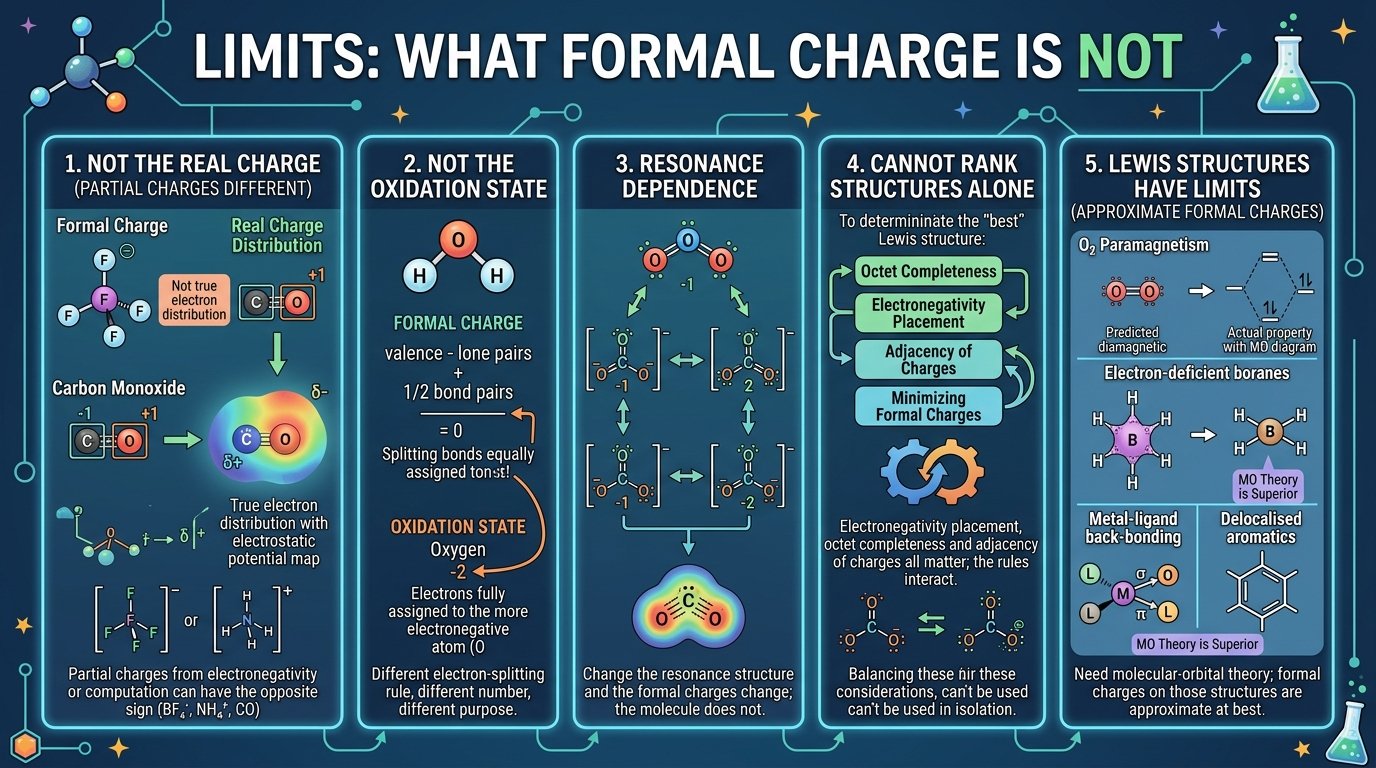
- A formal charge calculator does not give the real charge. Partial charges from electronegativity or computation can have the opposite sign (BF4−, NH4+, CO).
- It is not the oxidation state. Different electron-splitting rule, different number, different purpose.
- The formal charge calculator result depends on the drawing. Change the resonance structure and the formal charges change; the molecule does not.
- It cannot rank structures alone. Electronegativity placement, octet completeness and adjacency of charges all matter; the rules interact.
- Lewis structures themselves have limits. O2‘s paramagnetism, electron-deficient boranes, metal–ligand back-bonding and delocalised aromatics need molecular-orbital theory; formal charges on those structures are approximate at best.
Practice Problems With Answers
Draw first, compute second, then check with the formal charge calculator.
1. Formal charge of N in NH4+?
Answer: 5 − 0 − 4 = +1.
2. Formal charges in CO (triple bond, one lone pair each)?
Answer: C 4 − 2 − 3 = −1; O 6 − 2 − 3 = +1.
3. Formal charges in NO3−?
Answer: N +1; double-bonded O 0; two single-bonded O −1 each; sum −1.
4. Formal charge of S in SO42− with four single bonds? With two double bonds?
Answer: 6 − 0 − 4 = +2; 6 − 0 − 6 = 0.
5. Formal charges in ozone O=O–O?
Answer: central +1, single-bonded terminal −1, double-bonded terminal 0.
6. Which N2O structure is best: N≡N–O, N=N=O or N–N≡O?
Answer: N≡N–O (0, +1, −1) — negative charge on O; N–N≡O has −2 on N and +1 on O.
7. Formal charge of B in BF4− and of each F?
Answer: B 3 − 0 − 4 = −1; F 7 − 6 − 1 = 0.
8. Formal charge of O in H3O+?
Answer: 6 − 2 − 3 = +1.
9. Formal charge and oxidation state of C in CO2?
Answer: FC 0; OS +4.
10. A student draws NO3− with two N=O bonds and one N–O. What is wrong?
Answer: N would have 10 electrons (5 bonds) — impossible for a period-2 atom; formal charges would be N 0, O 0, 0, −1, sum −1, but the structure violates the octet.
Tips for Accurate Results
- Count lone-pair electrons, not pairs. Three lone pairs are 6 electrons. The formal charge calculator asks for electrons for exactly this reason.
- Count a double bond as 2 and a triple as 3 in the bond total you give the formal charge calculator.
- Check the sum. Formal charges must add up to the species’ charge; if not, an electron was lost or gained somewhere.
- Check octets at the same time. N + 2 × bonds = electrons around the atom; 8 for period-2 atoms (2 for H), never more.
- Know your course’s convention for sulfate-type ions and set the formal charge calculator’s octet/expanded switch accordingly.
- Put the least electronegative atom in the centre (never H, rarely a halogen or oxygen).
- Write the charges on the drawing — a nitrate ion drawn without the +1 and −1 loses marks.
Common Mistakes
| Mistake | Symptom | Fix |
|---|---|---|
| Subtracting all bonding electrons instead of half | Charges far too negative (N in NH4+ = −3) | That is the oxidation-state rule; use B/2 (the formal charge calculator shows both) |
| Counting lone pairs as N | Charges too positive by the number of pairs | N = electrons = 2 × pairs |
| Forgetting to add electrons for a negative charge | Structure short of electrons; charges do not sum | +1 electron per negative charge, −1 per positive |
| Giving nitrogen five bonds | “Neutral” nitrate, nitro or N-oxide | Period-2 atoms never exceed 8 electrons |
| Treating formal charge as real charge | “Boron is negative in BF4−“ | It is bookkeeping for one drawing |
| Confusing with oxidation state | C in CO2 reported as +4 formal charge | Different splitting rule; FC = 0 here |
| Wrong central atom | N–O–N for N2O; H in the middle | Least electronegative non-H atom is central |
| Not writing the charges on the structure | Lost marks even with correct arithmetic | Draw ⊕ and ⊖ on the atoms |
How This Calculator Is Different
| Feature | This formal charge calculator | Typical online tools |
|---|---|---|
| Input | One atom (V auto-filled) or a whole formula with charge | Three numbers for one atom |
| Lewis structure | Built automatically; central atom chosen; octet/expanded switch | You must draw it yourself |
| Resonance | All arrangements enumerated and ranked with reasons | Not available |
| Oxidation state | Side-by-side comparison with electron assignment | Not available |
| Validation | Electron count, charge sum and octet checks on your own drawing | None |
| Working and export | Every step; table; chart; copy, CSV, TXT, print, share, history | Final number |
Related tools: the oxidation number calculator for the other electron-bookkeeping convention, the degree of unsaturation calculator for ring and π-bond counts before drawing organic structures, and the reaction tools — stoichiometry calculator, limiting reactant calculator, theoretical yield calculator, percent yield calculator, atom economy calculator and grams to moles calculator. Molar masses: atomic mass calculator, formula weight calculator, molar mass of hydrates calculator, exact mass calculator, monoisotopic mass calculator, isotopic mass calculator, average vs monoisotopic mass. Formulas from data: empirical formula, molecular formula, percent composition, combustion analysis. Solutions and gases: molarity, equivalent weight, freezing point depression, boiling point elevation, osmotic pressure, vapor density, gas density, van der Waals. Polymers: average molecular weight of a mixture, number average, weight average, polydispersity index, viscosity. All share the molecular weight calculator engine.
Where the Numbers Come From
The formal charge calculator takes valence-electron counts from the main-group numbers; electronegativities used for ranking are Pauling values; the resonance rules are those of every standard general-chemistry text. References:
- IUPAC Gold Book — formal charge: the formal definition.
- LibreTexts / OpenStax Chemistry 7.4 — Formal Charges and Resonance: the formula, worked examples and the rules for choosing structures.
- CIAAW — Standard atomic weights: the molar masses used elsewhere on this site.
- Wikipedia — Formal charge: examples, the contrast with oxidation state and the electroneutrality principle.
Found an error? See our corrections policy, contact us, or read about the site.
Exam Checklist
☐ Total valence electrons counted, charge included
☐ Least electronegative non-H atom in the centre
☐ All octets complete (duet for H); no period-2 atom above 8
☐ FC = V − N − bonds computed for every atom (verify with the formal charge calculator)
☐ Formal charges sum to the overall charge
☐ Best structure chosen: smallest charges, negative on most electronegative atom
☐ Charges written on the drawing; equivalent resonance forms shown if asked
Frequently Asked Questions
How do you calculate formal charge?
Formal charge = valence electrons − lone-pair electrons − half the bonding electrons (equivalently, minus the number of bonds). For nitrogen in NH4+: 5 − 0 − 4 = +1. The formal charge calculator does this for one atom or for every atom in a formula.
What is the difference between formal charge and oxidation state?
Formal charge splits each bond’s electrons equally between the two atoms; oxidation state gives them all to the more electronegative atom. The formal charge calculator computes both in Mode 4. C in CO2 has formal charge 0 but oxidation state +4.
Why do formal charges have to add up to the charge of the ion?
Because every electron in the structure is assigned to exactly one atom, and the formal charge calculator uses this as its first check. The total assigned equals the total present, so the sum of (valence − assigned) over all atoms equals the overall charge. It is the first check to make on any structure.
Which Lewis structure is best?
The one with formal charges closest to zero, the fewest charged atoms, negative charges on the most electronegative atoms, no like charges on adjacent atoms, and complete octets on period-2 atoms. Mode 3 of the formal charge calculator applies these rules in order.
Why does carbon have a negative formal charge in CO?
The only structure giving both atoms an octet is a triple bond with one lone pair each. Carbon then owns 2 + 3 = 5 electrons against its 4 valence electrons (−1); oxygen owns 5 against 6 (+1). It is a bookkeeping result, and it correctly predicts that CO bonds to metals through carbon.
Should sulfate be drawn with double bonds?
Both conventions are in use. Two S=O bonds give sulfur a formal charge of 0 (expanded octet, 12 electrons); four single bonds keep the octet but give S +2. Most general-chemistry courses teach the former; IUPAC and newer texts prefer the latter. The formal charge calculator offers both.
Is formal charge the real charge on the atom?
No. The formal charge calculator, like the formula, assumes perfectly even sharing. Real partial charges, from electronegativity or calculation, can even have the opposite sign (boron in BF4− is actually positive despite a formal −1).
Can a molecule have formal charges and still be neutral?
Yes. Run CO, O3, N2O, nitro compounds, amine oxides or ylides through the formal charge calculator and you find they all have +1 and −1 formal charges on different atoms that cancel to zero overall.
How do I handle radicals like NO or NO2?
Count the unpaired electron as one non-bonding electron on the atom that carries it and apply the same formula. The automatic builder needs an even electron count, so use the single-atom or structure-checker modes for odd-electron species.
Is this formal charge calculator free?
Yes. It runs in your browser with no sign-up, works on mobile and stores the last ten calculations locally.
10 Facts Worth Knowing
- Gilbert Lewis’s 1916 paper introduced the shared pair; the word “covalent” came from Langmuir in 1919.
- Pauling’s electroneutrality principle (1948) states that stable molecules keep every atom’s formal charge between about −1 and +1.
- Carbon monoxide’s formal charges (C −1, O +1, as any formal charge calculator confirms) predict its carbon-end binding to haemoglobin iron — the reason it is toxic.
- Thiocyanate binds hard metals through N and soft metals through S because two resonance forms place the negative charge on each end.
- Nitrogen can never have a zero-formal-charge nitro group; the +1/−1 pair is unavoidable because N cannot exceed an octet.
- In SMILES notation, every non-zero formal charge must be written explicitly: nitrate is
[O-][N+](=O)[O-]. - The expanded-octet drawing of sulfate gives an S=O bond order of 1.5; measured S–O bonds (149 pm) are indeed shorter than a single bond, but ionic contraction explains this without d orbitals.
- Ozone’s central oxygen carries a formal +1 even though all three atoms are the same element.
- Boron in BF4− and BH4− has a formal charge of −1 while being the most electropositive atom present.
- Formal charge and oxidation state (Mode 4 of the formal charge calculator) coincide only when the bonding partners are identical in electronegativity — effectively only in elements.
Final Thoughts
Formal charge is a small piece of arithmetic — valence electrons minus lone-pair electrons minus bonds — but it decides which Lewis structure you draw, where the charges go in an ion, whether a mechanism’s electrons balance and which end of a ligand binds a metal. Learn the handful of patterns (four-bond nitrogen is +1, one-bond oxygen is −1, three-bond carbon with a lone pair is −1), always check that the charges sum to the total, and use the formal charge calculator on this page to build the structure, rank the resonance forms and confirm the numbers before they go on paper.
About the author
Ahmad Raza, M.Phil. Chemistry
Ahmad has taught general and analytical chemistry for over a decade and builds the calculators on this site. He writes every guide from the perspective of the student who has to get the exam question right, and cross-checks every number against IUPAC data. Reach him at contact@molecularweightcalculator.org.