
Equivalent Weight Calculator
Every equivalent-weight problem in one place: E = M ÷ n-factor for acids, bases, salts and redox agents (with the n-factor detected for you), element equivalents from atomic mass and valency, the classical hydrogen-displacement, oxide, chloride and metal-displacement experiments, and normality, titration and purity by the law of equivalents — all with every step shown.
✓ Trusted by students, teachers & lab professionalsEquivalent Weight from a Formula
E = molar mass ÷ n-factor. The n-factor is the basicity of an acid (replaceable H⁽), the acidity of a base (OH⁻ supplied), the total cation charge of a salt, or the electrons gained or lost by a redox agent. Pick the type and the tool suggests n from the formula — or type your own.
Element: Atomic Mass, Valency and Equivalent Weight
For an element, equivalent weight = atomic mass ÷ valency. Run it forwards (symbol or atomic mass + valency → E), backwards (E + valency → atomic mass), or use Dulong–Petit: atomic mass × specific heat ≈ 6.4 cal/(mol·°C) gives an approximate atomic mass, the nearest whole-number ratio to E gives the valency, and E × valency gives the accurate atomic mass.
Hydrogen Displacement Method
A weighed metal dissolves in acid and the hydrogen it liberates is collected. One gram-equivalent of any metal displaces one gram-equivalent of hydrogen (1.008 g = 11,200 mL at STP), so E = mass of metal × 11,200 ÷ VSTP(mL). Enter the volume as measured; the tool corrects it to STP and subtracts the aqueous tension if the gas was collected over water.
Oxide, Chloride and Metal-Displacement Methods
Equal equivalents combine: the mass of metal that joins 7.9995 g of oxygen (≈ 8) or 35.45 g of chlorine is its equivalent weight, and in a displacement reaction the two metals exchange equivalent for equivalent (mA/EA = mB/EB). Choose the method and enter the two masses.
Normality, Titration and Purity (Law of Equivalents)
Normality = gram-equivalents per liter = mass ÷ (E × VL), and at the end-point N₁V₁ = N₂V₂. Choose what you want to find; enter the substance as a formula (with its n-factor) or directly as an equivalent weight.
🕘 Recent calculations
- No calculations yet — your last 10 results will appear here.
E = M ÷ n · E(H) = 1.008 · E(O) = 7.9995 (≈ 8) · E(Cl) = 35.45 · 1 g-eq H₂ = 11,200 mL at STP (textbook; exact 11,207 mL) · Dulong–Petit constant 6.4 cal/(mol·°C) = 26.8 J/(mol·K) · R = 0.082057 L·atm/(mol·K) · Molar masses: IUPAC 2021 · Free tool by molecularweightcalculator.org
An equivalent weight calculator answers the oldest quantitative question in chemistry: how much of this substance reacts with how much of that one? Before anyone knew what a molecule was, chemists weighed the amount of a metal that displaced 1 gram of hydrogen, or combined with 8 grams of oxygen, and called it the equivalent. Two centuries later the same number still runs every titration, every normality calculation, every water-hardness report in meq/L and every electroplating bath, because reactions happen equivalent for equivalent, whatever the balanced equation looks like.
The free equivalent weight calculator above covers the whole topic in five modes: equivalent weight from any formula with the n-factor detected automatically for acids, bases, salts and elements; element calculations that include the classic Dulong–Petit route from specific heat to valency and atomic mass; the hydrogen-displacement method with temperature, pressure and aqueous-tension corrections; the oxide, chloride and metal-displacement methods; and a normality-and-titration mode that finds the equivalent weight of an unknown, the normality of a solution, the mass to weigh for a target normality, and the percentage purity of a sample. Every mode prints the working line by line.
In this equivalent weight calculator guide I’ll define equivalent weight properly, show the n-factor rules that decide 90% of the marks, connect equivalent weight to normality and molarity, walk through the worked examples every exam recycles, describe the four laboratory methods and the history behind them, and finish with practice problems, an exam checklist and the mistakes that cost the most points. Let’s begin.
🔑 KEY TAKEAWAY
Equivalent weight is the mass of a substance that supplies or reacts with one mole of hydrogen ions, hydroxide ions or electrons: E = molar mass ÷ n-factor. For an acid n is the number of replaceable H⁺ (H₂SO₄: 98.07 ÷ 2 = 49.04 g/eq), for a base the number of OH⁻ it supplies (Ca(OH)₂: 74.09 ÷ 2 = 37.05), for a salt the total cation charge (Na₂CO₃: 105.99 ÷ 2 = 53.00), for an oxidising or reducing agent the electrons transferred per formula unit (KMnO₄ in acid: 158.03 ÷ 5 = 31.61) and for an element its valency (Al: 26.98 ÷ 3 = 8.99). Experimentally, one equivalent of a metal displaces 11,200 mL of hydrogen at STP, combines with 8 g of oxygen or with 35.45 g of chlorine. Normality is gram-equivalents per litre, so N = n × M and N₁V₁ = N₂V₂ works for any reaction without a balanced equation — and the equivalent weight calculator above performs every one of these steps for you.
📑 Table of Contents (click to expand)
- What Is Equivalent Weight?
- How to Use This Equivalent Weight Calculator
- The Five Modes Explained
- The Equivalent Weight Formula (With the Box You Should Memorize)
- How to Find the n-Factor: Acids, Bases, Salts, Redox Agents and Elements
- Equivalent Weight, Normality and Molarity
- Three Worked Examples, Step by Step
- Reference Table: Equivalent Weights of Common Substances
- Measuring Equivalent Weight in the Lab: Five Classical Methods
- Who Uses Equivalent Weights Today?
- Full Lab Walkthrough: Equivalent Weight of Magnesium
- A Short History: Richter, Dalton, Faraday and Cannizzaro
- Equivalent Weight in Everyday Life and Industry
- Practice Problems (With Answers)
- Tips for Fast, Error-Free Calculations
- 5 Common Mistakes to Avoid
- How This Equivalent Weight Calculator Is Different
- Where the Numbers Come From
- Exam Checklist
- Frequently Asked Questions
- 10 Equivalent Weight Facts Worth Knowing
What Is Equivalent Weight?
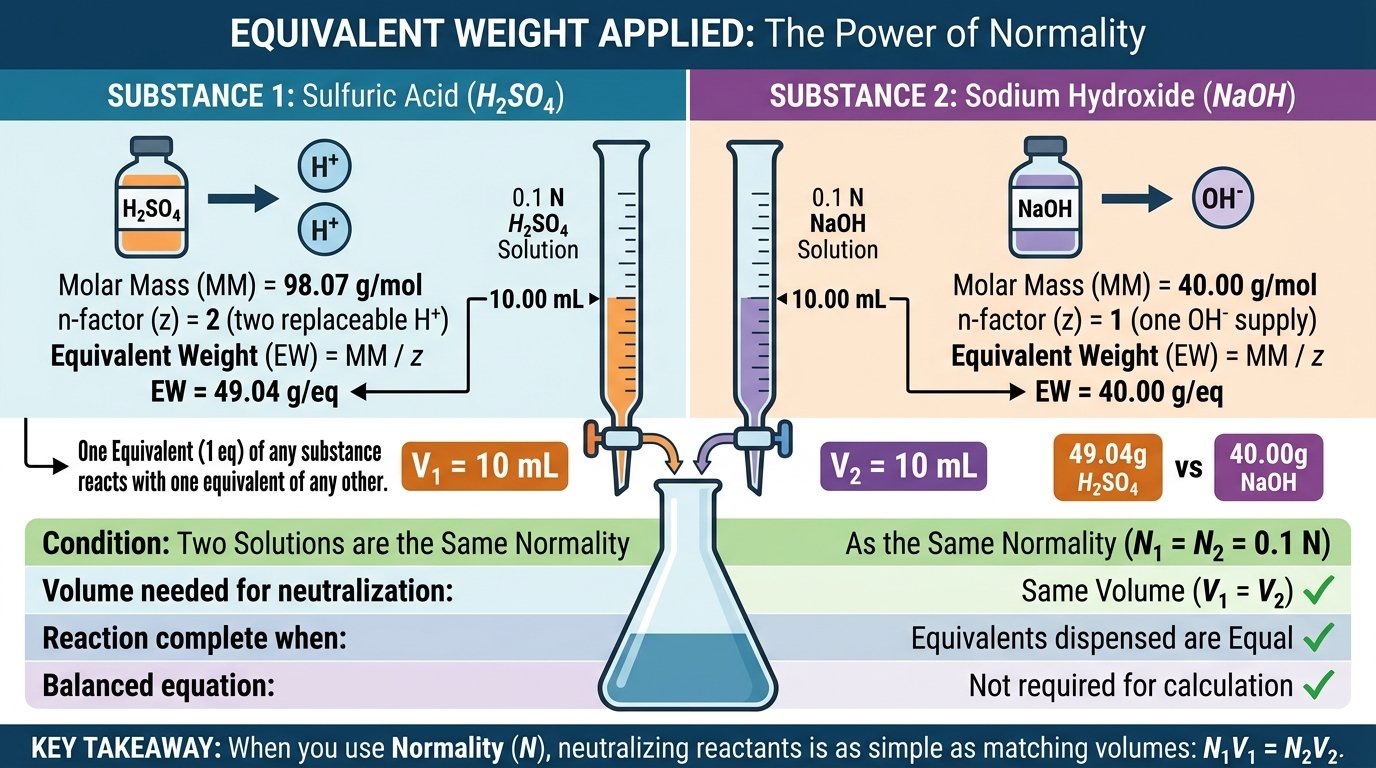
The equivalent weight of a substance is the mass of it that reacts with, supplies or replaces one mole of a reference particle — a hydrogen ion in acid–base chemistry, an electron in redox chemistry, or one unit of positive charge in a salt. Because 1.008 g of hydrogen carries exactly one mole of those reference particles, the historical definition and the modern one agree: one equivalent of anything reacts with one equivalent of anything else. That single sentence is why the concept survived the arrival of the mole, and why an equivalent weight calculator is still worth having. Two solutions of the same normality neutralise each other volume for volume, whatever the substances are, and no balanced equation is needed.
Numerically — and this is what any equivalent weight calculator does — equivalent weight is the molar mass divided by a small whole number called the n-factor (also written as valence factor or simply z). The molar mass comes straight from the formula — it is the same number our molecular weight calculator homepage computes — and the n-factor comes from chemistry: how many H⁺ an acid gives up, how many OH⁻ a base supplies, how much positive charge a salt carries, how many electrons a redox agent transfers, or what valency an element shows. Sulfuric acid, molar mass 98.07 g/mol, has two replaceable hydrogens, so its equivalent weight is 49.04 g/eq; one equivalent of it neutralises exactly 40.00 g of sodium hydroxide, which is one equivalent of that.
Two things worth being clear about from the start. First, equivalent weight is not a fixed property of a substance in the way molar mass is — it belongs to a reaction. Potassium permanganate has an equivalent weight of 31.61 in acid (five electrons), 52.68 in neutral solution (three electrons) and 158.03 in strong alkali (one electron); phosphoric acid has 32.67 if all three protons react but 97.99 if only the first one does. An equivalent weight calculator therefore needs to know the reaction type, which is exactly what the type selector in Mode 1 asks. Second, the units are grams per equivalent (g/eq), and the older name “gram-equivalent” simply means one equivalent weight expressed in grams. Milliequivalents (meq), the unit of clinical and water chemistry, are one-thousandth of that.
How to Use This Equivalent Weight Calculator
The tool at the top of the page was built so that an equivalent weight problem takes less time to solve than to read. Here is the workflow:
- Pick the mode that matches your data: a chemical formula (Mode 1), an element with a valency, specific heat or experimental E (Mode 2), a hydrogen-displacement experiment (Mode 3), an oxide, chloride or metal-displacement experiment (Mode 4), or a normality, titration, solution-preparation or purity question (Mode 5).
- Type the formula the way you would write it — H2SO4, Ca(OH)2, KMnO4, FeSO4·7H2O or H2C2O4.2H2O. Parentheses, square brackets, hydrate dots and leading multipliers are all understood, and the molar mass is built from IUPAC 2021 atomic weights.
- Choose the reaction type in Mode 1 (acid, base, salt, redox agent or element). The equivalent weight calculator detects the n-factor for acids, bases, salts and elements and looks up standard redox n-factors for common oxidants and reductants; type your own n whenever the reaction differs.
- Enter experimental data in the units you have. Mode 3 accepts the hydrogen volume as measured, with temperature in °C and pressure in mmHg, atm or kPa, and subtracts the aqueous tension if you collected the gas over water.
- Press Calculate (or Enter). The equivalent weight calculator prints the headline result first, then the step-by-step derivation, a table of every derived quantity, and a bar chart — for example, the equivalent weight at each possible n-factor with yours highlighted, or the elements whose equivalent weights fall within 2% of your experimental value.
- Export with Copy, CSV, TXT, Print or Share — and hit ↺ Reset before the next problem so stale inputs never contaminate a fresh calculation.
Your last ten results are stored in the history panel below the calculator (locally in your browser, nothing is uploaded). Clear All wipes it in one click. Click any preset chip in the equivalent weight calculator to load a classic textbook example and see what a complete answer looks like.
The Five Modes Explained
⚖️ Mode 1 — Equivalent Weight from a Formula
The core of any equivalent weight calculator. Enter a formula, choose whether it is acting as an acid, base, salt, redox agent or element, and the tool computes the molar mass, works out the n-factor and divides. For acids it counts replaceable hydrogens — the leading hydrogens of an inorganic formula or the –COOH groups of an organic one, so CH₃COOH correctly gets n = 1 despite its four hydrogens. For bases it counts hydroxide groups; for salts it adds up the positive charge of the cations; for elements it uses the most common valency and lists the others. For redox agents it applies the standard n-factor of two dozen common oxidants and reductants (KMnO₄ 5, K₂Cr₂O₇ 6, Na₂S₂O₃ 1, H₂O₂ 2 …) and lets you override it. The output includes the grams per litre for 1 N, 0.1 N and 0.01 N solutions and a chart of E at every n from 1 to 6.
🔬 Mode 2 — Element, Valency and Dulong–Petit
Three element calculations in one panel. E = atomic mass ÷ valency gives the equivalent weight of a metal, together with the mass of oxide and chloride one equivalent forms. The Dulong–Petit sub-mode reproduces the nineteenth-century route to an atomic mass: approximate atomic mass = 6.4 ÷ specific heat, valency = approximate atomic mass ÷ experimental E rounded to a whole number, accurate atomic mass = E × valency — enter E = 12.15 and c = 0.25 cal/(g·°C) and the equivalent weight calculator returns valency 2, atomic mass 24.30, magnesium. The third sub-mode finds the valency from a known atomic mass and an experimental equivalent weight, which is how you check a lab result against the periodic table.
💧 Mode 3 — Hydrogen Displacement
The most common school and first-year practical, and the reason many students look for an equivalent weight calculator in the first place. A weighed piece of metal dissolves in acid and the hydrogen is collected; since one equivalent of any metal displaces one equivalent of hydrogen (1.008 g, 11,200 mL at STP), E = mass × 11,200 ÷ VSTP. Enter the volume as you measured it, the temperature and the barometric pressure, and — if the gas was collected over water — the aqueous tension; the tool applies Dalton’s law and the combined gas law to reduce the volume to STP, then names the metals whose equivalent weights fall within 2% of the answer. 0.120 g of metal giving 123.2 mL of hydrogen at 27 °C and 750 mmHg comes out at E = 12.15: magnesium.
🔥 Mode 4 — Oxide, Chloride and Displacement
The combining-mass methods. In the oxide method the mass of metal that combines with 8 g (strictly 7.9995 g) of oxygen is its equivalent weight; in the chloride method the reference is 35.45 g of chlorine; in the displacement method a more reactive metal replaces a less reactive one from solution and the two masses stand in the ratio of their equivalent weights, mA/EA = mB/EB. Enter the mass of metal and the mass of oxide or chloride formed (or the mass of the second metal deposited and its equivalent weight or symbol), and the equivalent weight calculator returns E, the textbook value with the rounded constant, and the candidate elements. 0.540 g of metal forming 1.020 g of oxide gives E = 9.00 — aluminium.
🧬 Mode 5 — Normality, Titration, Preparation and Purity
Where an equivalent weight calculator earns its keep. Four sub-modes: the equivalent weight of an unknown from the mass titrated and the volume and normality of the titrant (0.630 g neutralised by 100 mL of 0.1 N NaOH → E = 63.0, with the molar mass it implies for n = 1, 2 and 3); the normality of a solution from the mass dissolved (4.9 g of H₂SO₄ in 250 mL → 0.400 N = 0.200 M); the mass to weigh out for a target normality (500 mL of 0.1 N H₂SO₄ needs 2.452 g); and the percentage purity of a sample from a titration (1.200 g of impure Na₂CO₃ needing 40.0 mL of 0.5 N acid → 88.3% pure). The substance can be a formula, with the n-factor detected, or a bare equivalent weight.
The Equivalent Weight Formula (With the Box You Should Memorize)
Every problem this page — or any equivalent weight calculator — can pose is one of these lines rearranged:
E = M ÷ n · gram-equivalents = mass ÷ E · N = gram-equivalents ÷ VL = n × Molarity
Element: E = atomic mass ÷ valency · N₁V₁ = N₂V₂
H₂ method: E = m × 11,200 ÷ VSTP(mL) · oxide: E = mmetal × 8 ÷ mO · chloride: E = mmetal × 35.45 ÷ mCl · displacement: mA/EA = mB/EB
Dulong–Petit: atomic mass × specific heat ≈ 6.4 cal/(mol·°C) · n = basicity (acid), acidity (base), total cation charge (salt), electrons transferred (redox), valency (element) · E(H) = 1.008, E(O) = 8.00, E(Cl) = 35.45
Two details in that box decide most marks. First, the n-factor is a count, not a lookup. It is the number of moles of H⁺, OH⁻, charge or electrons per mole of substance in the reaction you are considering, and the same formula can carry different n-factors in different reactions. Second, the experimental constants are rounded: 11,200 mL is really 11,207 mL (half of 22.414 L), 8 is really 7.9995 (half of 15.999) and 6.4 cal is an empirical value that sits a little above the theoretical 3R = 5.96 cal/(mol·°C). Examiners expect the rounded values; an equivalent weight calculator that shows both, as this one does, lets you quote whichever your syllabus uses.
Notice also what the equivalent weight calculator formula rewards: pattern recognition. Sulfuric acid at 49, sodium hydroxide at 40, sodium carbonate at 53, permanganate at 31.6 and dichromate at 49.0 recur in almost every problem set. Recognise them and you can sanity-check a result in your head before writing it down. When two acids of different basicity have the same equivalent weight — oxalic acid dihydrate (63.03) and nitric acid (63.01) are the classic near-coincidence — a titration alone cannot tell them apart, which is a favourite trick question.
How to Find the n-Factor: Acids, Bases, Salts, Redox Agents and Elements
The n-factor is where equivalent weight problems are won or lost, so it deserves its own rulebook. The equivalent weight calculator applies these rules automatically, but you should be able to apply them by hand.
Acids: n = basicity, the number of replaceable H⁺
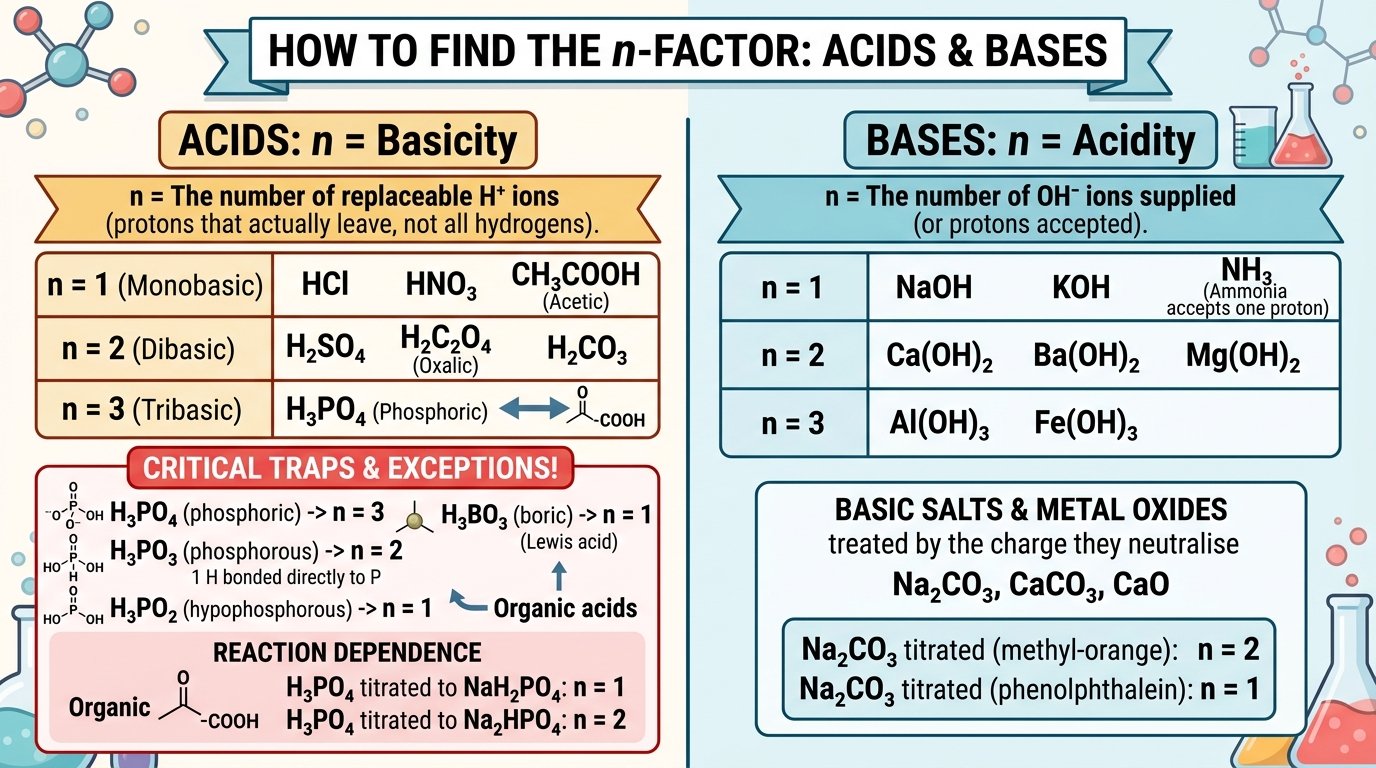
Count the hydrogens that actually leave as protons, not every hydrogen in the formula. HCl, HNO₃ and CH₃COOH are monobasic (n = 1); H₂SO₄, H₂C₂O₄ and H₂CO₃ are dibasic (n = 2); H₃PO₄ is tribasic (n = 3). The traps are the lower phosphorus acids: H₃PO₃ has one hydrogen bonded directly to phosphorus and is only dibasic (E = 82.00 ÷ 2 = 41.00), and H₃PO₂ is monobasic (E = 66.00). Boric acid H₃BO₃ behaves as a monobasic Lewis acid. Organic acids are counted by –COOH groups, which is how the equivalent weight calculator handles them: acetic acid n = 1, oxalic n = 2, citric n = 3. And remember that basicity depends on how far the reaction is taken — H₃PO₄ titrated to the methyl-orange end-point (NaH₂PO₄) has n = 1 and E = 97.99, to phenolphthalein (Na₂HPO₄) n = 2 and E = 49.00.
Bases: n = acidity, the number of OH⁻ supplied
NaOH and KOH have n = 1 (E = 40.00 and 56.11); Ca(OH)₂, Ba(OH)₂ and Mg(OH)₂ have n = 2 (E = 37.05, 85.67 and 29.16); Al(OH)₃ and Fe(OH)₃ have n = 3 (E = 26.00 and 35.62). Ammonia accepts one proton, so n = 1 and E = 17.03. Basic salts and metal oxides that neutralise acids — Na₂CO₃, CaCO₃, CaO — are treated by the charge they neutralise: sodium carbonate reacts with two H⁺ when titrated to the methyl-orange end-point (n = 2, E = 53.00) but only one to phenolphthalein (n = 1, E = 105.99).
Salts: n = total positive charge per formula unit
Multiply the cation charge by the number of cations. NaCl: 1 × 1 = 1 (E = 58.44). Na₂CO₃: 2 × 1 = 2 (E = 53.00). CaCO₃: 1 × 2 = 2 (E = 50.04). Al₂(SO₄)₃: 2 × 3 = 6 (E = 342.13 ÷ 6 = 57.02). FeCl₃: 1 × 3 = 3 (E = 54.07). The total negative charge is of course the same number, so counting anions works equally well; the equivalent weight calculator counts cations. Hydrated salts keep their water in the molar mass: CuSO₄·5H₂O has M = 249.68 and E = 124.84 as a salt — the hydrate handling is the same one our molar mass of hydrates calculator uses.
Oxidising and reducing agents: n = electrons transferred
Work out the change in oxidation number per atom and multiply by the number of atoms that change. KMnO₄ in acid: Mn⁺⁷ → Mn⁺², 5 electrons, E = 158.03 ÷ 5 = 31.61. In neutral or weakly alkaline solution Mn⁺⁷ → Mn⁺⁴ (MnO₂), 3 electrons, E = 52.68; in strong alkali Mn⁺⁷ → Mn⁺⁶ (manganate), 1 electron, E = 158.03. K₂Cr₂O₇: two Cr⁺⁶ → two Cr⁺³, 6 electrons, E = 294.18 ÷ 6 = 49.03. Reductants: FeSO₄ (Fe⁺² → Fe⁺³) n = 1, E = 151.90 (278.01 for the heptahydrate); oxalic acid or oxalate (C⁺³ → C⁺⁴, two carbons) n = 2; sodium thiosulfate in iodometry (2 S₂O₃²⁻ → S₄O₆²⁻) n = 1 per formula unit, E = 248.17 for the pentahydrate; hydrogen peroxide n = 2 whether it oxidises or reduces, E = 17.01. Iodine as an oxidant, I₂ → 2 I⁻, n = 2, E = 126.90. Note that a single substance can have two equivalent weights in one problem if it disproportionates — no equivalent weight calculator can guess that, so type n yourself.
Elements: n = valency
For a metal the n-factor is the valency it shows in the compound formed, so E = atomic mass ÷ valency: Na 22.99, Mg 12.15, Al 8.99, Zn 32.69, Ca 20.04, Ag 107.87. Metals with variable valency have one equivalent weight per valency — iron is 27.92 as Fe(II) and 18.62 as Fe(III), copper 63.55 as Cu(I) and 31.77 as Cu(II) — which is exactly why the Dulong–Petit method was needed: an experiment gives E, but only the approximate atomic mass tells you which valency multiplies it back to the atomic mass. The atomic masses themselves, and how they are averaged over isotopes, are the subject of our atomic mass calculator.
Equivalent Weight, Normality and Molarity
Normality is the concentration scale built on equivalent weight: the number of gram-equivalents of solute per litre of solution. Because one gram-equivalent is E grams, N = mass ÷ (E × VL); and because E = M ÷ n, a solution’s normality is always n times its molarity. A 1 M sulfuric acid solution is 2 N; 1 M KMnO₄ used in acid is 5 N; 1 M NaOH is 1 N. The molarity calculator handles the mole-based scale; the equivalent weight calculator on this page converts between the two in every Mode 5 result.
The payoff is the titration equation N₁V₁ = N₂V₂. At the end-point the equivalents of acid equal the equivalents of base, of oxidant equal those of reductant, and since normality already contains the n-factor, no balanced equation and no mole ratio are needed. 25.0 mL of an acid needing 20.0 mL of 0.100 N NaOH is 0.0800 N, full stop — it does not matter whether the acid is monobasic or tribasic. Compare the molarity route, where you must first balance the equation and then insert the stoichiometric ratio, which is what the stoichiometry calculator automates. Both give the same answer; normality — and an equivalent weight calculator — is simply faster when the n-factor is known and the equation is not.
A word about status. IUPAC discourages the terms “normality” and “equivalent weight” because they are ambiguous unless the reaction is stated, and most university courses now teach molarity first. But the concept has not gone away: pharmacopoeial titrimetry, water and wastewater analysis, soil science, clinical chemistry, electroplating and polymer formulation all still report in equivalents, and every competitive exam in South Asia still sets equivalent weight questions. The sensible position is to understand both scales and to state the reaction whenever you quote an equivalent weight — which is why every result from this equivalent weight calculator names the n-factor and how it was obtained.
Three Worked Examples, Step by Step
Example 1 — Equivalent weight of KMnO₄ in acidic, neutral and alkaline medium
Problem: Calculate the equivalent weight of potassium permanganate as an oxidising agent in (a) acidic, (b) neutral and (c) strongly alkaline solution.
Step 1 — Molar mass: K 39.098 + Mn 54.938 + 4 × O 15.999 = 158.03 g/mol.
Step 2 — Electrons transferred: (a) MnO₄⁻ → Mn²⁺, oxidation number +7 → +2, 5 electrons; (b) MnO₄⁻ → MnO₂, +7 → +4, 3 electrons; (c) MnO₄⁻ → MnO₄²⁻, +7 → +6, 1 electron.
Step 3 — Divide: (a) 158.03 ÷ 5 = 31.61 g/eq; (b) 158.03 ÷ 3 = 52.68 g/eq; (c) 158.03 ÷ 1 = 158.03 g/eq.
Meaning: A 0.1 N permanganate solution for acid titrations contains 3.161 g/L; the same bottle would be 0.06 N in neutral medium and 0.02 N in alkali. This is why permanganate normality is meaningless without the medium — and why Mode 1 of the equivalent weight calculator defaults to n = 5 but prints all three.
Example 2 — The oxide method: identifying a metal from its oxide
Problem: 0.540 g of a metal is heated in oxygen and forms 1.020 g of oxide. Its specific heat is 0.215 cal/(g·°C). Find the equivalent weight, valency and atomic mass, and identify the metal.
Step 1 — Mass of oxygen: 1.020 − 0.540 = 0.480 g.
Step 2 — Equivalent weight: E = 0.540 × 8 ÷ 0.480 = 9.00 g/eq (8.999 with the exact 7.9995).
Step 3 — Dulong–Petit: approximate atomic mass = 6.4 ÷ 0.215 = 29.8; valency = 29.8 ÷ 9.00 = 3.3 → 3; accurate atomic mass = 9.00 × 3 = 27.0.
Identity: Aluminium (26.98, valency 3, E = 8.994) — a 0.07% match. In the equivalent weight calculator, Mode 4 gives the E and Mode 2’s Dulong–Petit sub-mode finishes the identification, both listing aluminium as the only element within 2%.
Example 3 — Equivalent weight of an unknown acid from a titration
Problem: 0.630 g of a crystalline dibasic acid is dissolved in water and titrated with 0.1000 N NaOH; 100.0 mL are required. Find the equivalent weight and molar mass and identify the acid.
Step 1 — Equivalents of base: N × V = 0.1000 × 0.1000 L = 0.01000 g-eq.
Step 2 — Equivalent weight: E = mass ÷ equivalents = 0.630 ÷ 0.01000 = 63.0 g/eq.
Step 3 — Molar mass: dibasic, so M = E × 2 = 126.0 g/mol.
Identity: Oxalic acid dihydrate, H₂C₂O₄·2H₂O, M = 126.07 g/mol (E = 63.03), the standard primary standard for alkali. Had the problem said “monobasic”, M would be 63.0 and the answer nitric acid (63.01) — an illustration that the titration measures E, and only the basicity turns it into M.
Reference Table: Equivalent Weights of Common Substances
Keep this table beside you when checking an equivalent weight calculator answer — every value in it recurs in problem sets, and a result that lands near one of them is usually right. Molar masses use IUPAC 2021 atomic weights; hydrates include their water.
| Substance | Acting as | M (g/mol) | n-factor | E (g/eq) | Why |
|---|---|---|---|---|---|
| H₂SO₄ | acid | 98.07 | 2 | 49.04 | two replaceable H⁺ |
| HCl | acid | 36.46 | 1 | 36.46 | monobasic |
| HNO₃ | acid | 63.01 | 1 | 63.01 | monobasic |
| H₃PO₄ | acid | 97.99 | 3 (or 1, 2) | 32.67 (97.99, 49.00) | depends on end-point |
| CH₃COOH | acid | 60.05 | 1 | 60.05 | one –COOH |
| H₂C₂O₄·2H₂O | acid / reductant | 126.07 | 2 | 63.03 | 2 H⁺ or 2 e⁻ |
| NaOH / KOH | base | 40.00 / 56.11 | 1 | 40.00 / 56.11 | one OH⁻ |
| Ca(OH)₂ | base | 74.09 | 2 | 37.05 | two OH⁻ |
| Na₂CO₃ | salt / base | 105.99 | 2 | 53.00 | 2 Na⁺ (methyl orange) |
| CaCO₃ | salt | 100.09 | 2 | 50.04 | Ca²⁺ — hardness unit |
| KMnO₄ | oxidant | 158.03 | 5 / 3 / 1 | 31.61 / 52.68 / 158.03 | acid / neutral / alkali |
| K₂Cr₂O₇ | oxidant | 294.18 | 6 | 49.03 | 2 Cr⁺⁶ → 2 Cr⁺³ |
| FeSO₄·7H₂O | reductant | 278.01 | 1 | 278.01 | Fe²⁺ → Fe³⁺ |
| Na₂S₂O₃·5H₂O | reductant | 248.17 | 1 | 248.17 | iodometry |
| H₂O₂ | oxidant / reductant | 34.01 | 2 | 17.01 | 2 e⁻ either way |
| I₂ | oxidant | 253.81 | 2 | 126.90 | I₂ → 2 I⁻ |
| Mg / Al / Zn | element | 24.31 / 26.98 / 65.38 | 2 / 3 / 2 | 12.15 / 8.99 / 32.69 | valency |
| Cu / Fe / Ag | element | 63.55 / 55.85 / 107.87 | 2 / 2 or 3 / 1 | 31.77 / 27.92 or 18.62 / 107.87 | variable valency |
Three patterns worth noticing. The acids and bases that serve as primary standards — oxalic acid dihydrate (63.03), sodium carbonate (53.00), potassium hydrogen phthalate (204.22, monobasic) — all have equivalent weights large enough to weigh accurately, which is part of why they were chosen. Every hydrate carries its water into E, so FeSO₄·7H₂O (278.01) and anhydrous FeSO₄ (151.90) are different reagents to a balance even though they are the same reductant in solution. And the elements form a ladder — 8.99, 12.15, 20.04, 27.92, 31.77, 32.69 — that an experimental E can be matched against, which is what the equivalent weight calculator’s candidate list in Modes 2, 3 and 4 does automatically.
Measuring Equivalent Weight in the Lab: Five Classical Methods
Every equivalent weight in the reference table was once measured, and the methods are still run in teaching laboratories because each one demonstrates a law of chemical combination directly.
1. Hydrogen displacement — for metals above hydrogen in the activity series. A weighed piece of Mg, Zn, Al or Fe is dropped into dilute acid and the hydrogen is collected in a eudiometer or an inverted burette over water. The volume is corrected to STP (and for aqueous tension), and since 1.008 g of hydrogen occupies 11,207 mL at 0 °C and 1 atm, E = mass × 11,200 ÷ VSTP. Accuracy is about 1% and limited by reading the volume and by hydrogen dissolving in the water. This is Mode 3 of the equivalent weight calculator, and the full procedure is in the walkthrough below.
2. The oxide method — for metals that burn cleanly or whose oxides can be reduced. Either a weighed metal is oxidised (magnesium ribbon in a crucible — the classic) or a weighed oxide is reduced in a stream of hydrogen (copper(II) oxide) and the loss in mass gives the oxygen. Since equivalents combine one to one, E = mass of metal × 8 ÷ mass of oxygen. The magnesium version is notorious for giving E too high because some of the metal forms nitride instead of oxide; a drop of water converts the nitride and the error disappears.
3. The chloride method — for metals whose chlorides are stable and non-volatile. A weighed metal is dissolved in hydrochloric acid, the solution evaporated to dryness and the chloride weighed; alternatively the chloride is precipitated as silver chloride. E = mass of metal × 35.45 ÷ mass of chlorine. Silver itself was the reference for the most precise atomic weights of the nineteenth century, when Stas determined ratios such as Ag : AgCl to five figures.
4. The displacement method — for any pair of metals in the activity series. A weighed strip of the more reactive metal (zinc, iron) is left in a solution of the less reactive one (copper sulfate, silver nitrate) until the reaction is complete, and the deposited metal is dried and weighed. The masses are in the ratio of the equivalent weights, so a known EB gives EA. 0.650 g of zinc depositing 0.632 g of copper (E = 31.77) gives EZn = 32.68. Mode 4 of the equivalent weight calculator covers all three combining-mass methods.
5. Electrolysis — Faraday’s second law. Pass a measured charge through solutions of different salts in series and the masses deposited are in the ratio of the equivalent weights; 96,485 coulombs (one faraday) deposits exactly one gram-equivalent of anything. This is the most precise method of all — the international ampere was defined until 1948 as the current that deposits 1.11800 mg of silver per second, i.e. 107.87 g per 96,485 C — and it is the reason plating shops still think in equivalents.
Whatever the method, an experimental equivalent weight becomes an atomic mass only when the valency is known, and for a new element in 1820 it was not. Dulong and Petit’s specific-heat rule (atomic mass × specific heat ≈ 6.4 cal/(mol·°C)) fixed the valency, and Cannizzaro’s vapour-density method — the subject of our molecular weight vapor density page — confirmed the molar masses of volatile compounds. Where the compound is a gas, measuring its density at known temperature and pressure gives the molar mass directly, as the molar mass from gas density tool shows; equivalent weight then reveals the valency by division.
Who Uses Equivalent Weights Today?
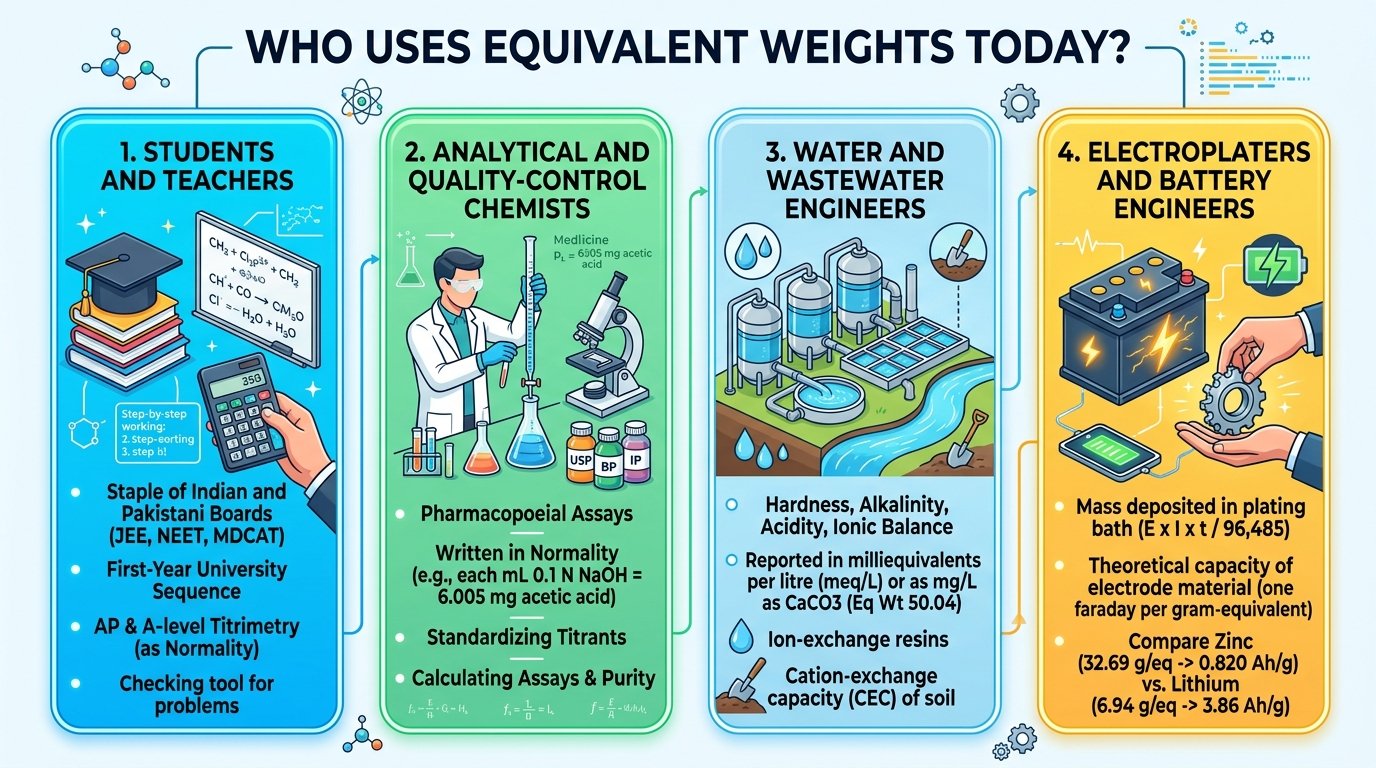
Students and teachers. Equivalent weight is a staple of the Indian and Pakistani boards, JEE, NEET, MDCAT and the first-year university sequence, and it appears in AP and A-level titrimetry under the name of normality. An equivalent weight calculator that shows every step is a checking tool, not a shortcut: work the problem by hand, then compare.
Analytical and quality-control chemists. Pharmacopoeial assays (USP, BP, IP) are written in normality — “each mL of 0.1 N sodium hydroxide is equivalent to 6.005 mg of acetic acid” — and the numbers in those monographs are equivalent weights divided by ten. Standardising a titrant, calculating an assay and reporting a purity are all Mode 5 calculations in the equivalent weight calculator.
Water and wastewater engineers. Hardness, alkalinity, acidity and the ionic balance of a water analysis are reported in milliequivalents per litre or as “mg/L as CaCO₃”, a unit that works because the equivalent weight of calcium carbonate is a convenient 50.04: 1 meq/L of any hardness ion equals 50 mg/L as CaCO₃. Ion-exchange resins are rated in equivalents per litre of bed, and the cation-exchange capacity of a soil in cmol(+)/kg, numerically the old meq/100 g.
Electroplaters and battery engineers. The mass deposited in a plating bath is E × I × t ÷ 96,485; the theoretical capacity of an electrode material is one faraday, 26.80 ampere-hours, per gram-equivalent. Zinc at 32.69 g/eq therefore stores 0.820 Ah per gram, lithium at 6.94 g/eq a formidable 3.86 Ah per gram — the single number that explains why lithium won.
Polymer, coatings and adhesive formulators. Epoxy resins are sold by epoxy equivalent weight (EEW, the grams of resin containing one mole of epoxide groups — about 182–192 g/eq for standard liquid DGEBA), amines by amine hydrogen equivalent weight (AHEW), and the mix ratio is simply AHEW × 100 ÷ EEW parts of hardener per hundred of resin. Because the same resin has a distribution of chain lengths, its EEW is an average in exactly the sense our number average molecular weight and weight average molecular weight pages describe; acid value and hydroxyl value in mg KOH/g are equivalent weights in disguise.
Clinicians and nutritionists. Electrolytes are prescribed and reported in mEq/L because what matters physiologically is charge: 1 mmol of Ca²⁺ is 2 mEq, normal saline is 154 mEq/L of Na⁺ and Cl⁻, and potassium chloride injection is labelled 2 mEq/mL. Converting a laboratory mg/dL to mEq/L is an equivalent weight calculation with the valency doing the work.
Full Lab Walkthrough: Equivalent Weight of Magnesium by Hydrogen Displacement
Suppose you are handed a coil of magnesium ribbon, a eudiometer tube, 6 M hydrochloric acid and a 500 mL beaker of water, and asked for the equivalent weight of the metal. Here is the complete workflow, with the numbers a good run produces.
- Weigh the metal. Clean a 6–7 cm length of ribbon with fine emery paper to remove the oxide film, roll it loosely and weigh on a four-figure balance: 0.0600 g. (Too much metal will generate more hydrogen than the tube holds — 0.06 g gives about 60 mL.)
- Set up the eudiometer. Pour 10 mL of 6 M HCl into the graduated tube, fill the rest with water slowly so the layers do not mix, hang the coiled ribbon in a copper-wire cage a few centimetres inside the mouth, stopper with a one-hole bung and invert into the beaker of water. The dense acid diffuses down and reaches the metal within a minute.
- Collect the gas. Wait until the ribbon has completely dissolved and no more bubbles rise, then tap the tube to dislodge bubbles clinging to the walls. Allow ten minutes for the gas to reach room temperature.
- Read the volume and equalise the levels. Lower the tube (or raise it into a tall cylinder of water) until the water level inside matches the level outside, so the gas is exactly at atmospheric pressure; read the volume: 62.3 mL. If the levels cannot be equalised, subtract the height difference in mm of water ÷ 13.6 from the barometric pressure.
- Record the conditions. Room temperature 25.0 °C; barometer 760.0 mmHg; aqueous tension at 25 °C 23.8 mmHg (from a table). Pressure of dry hydrogen = 760.0 − 23.8 = 736.2 mmHg.
- Reduce the volume to STP. VSTP = 62.3 × (736.2 ÷ 760) × (273.15 ÷ 298.15) = 62.3 × 0.9687 × 0.9162 = 55.29 mL.
- Calculate E. E = 0.0600 × 11,200 ÷ 55.29 = 12.15 g/eq (12.16 with the exact 11,207 mL).
- Interpret and report. Magnesium, atomic mass 24.305, valency 2, theoretical E = 12.15 — agreement within 0.1%. Report E = 12.15 ± 0.15 g/eq, the uncertainty dominated by the ±0.5 mL volume reading, and note that the valency follows from atomic mass ÷ E = 2.00. Mode 3 of the equivalent weight calculator with these five inputs reproduces every line.
Two lessons from the walkthrough. The aqueous-tension correction is worth 3% and the temperature correction 8%; skip both and you report E = 10.8 and a metal that does not exist. And the equivalent weight calculator’s candidate list is a check, not a proof — titanium(IV) at 11.97 is also within 2% of 12.15, and only the chemistry (a ribbon that burns with a white flame and dissolves violently in acid) settles the identification.
A Short History: Richter, Dalton, Faraday and Cannizzaro
Equivalent weight is older than the atom. In 1792 Jeremias Benjamin Richter published the tables of neutralising masses — how much of each base neutralises a fixed mass of each acid — that founded stoichiometry and stated the law of reciprocal proportions: the masses of two substances that react with a fixed mass of a third also react with each other in the same ratio. That law is the equivalent concept in its purest form. Dalton’s atomic theory of 1803–08 gave the masses a physical meaning but also a problem: without knowing the formula of water, was oxygen’s atomic weight 8 (HO) or 16 (H₂O)? Chemists could measure equivalents with confidence and atomic weights only with assumptions, so for half a century William Hyde Wollaston’s 1814 table of “chemical equivalents” — and the slide rule he built to multiply them — was the practical currency of the laboratory.
Two discoveries turned equivalents into atomic weights. In 1819 Pierre Dulong and Alexis Petit noticed that the product of atomic weight and specific heat is roughly constant for solid elements, about 6.4 cal/(mol·°C); a rough atomic weight from the specific heat, divided by the accurately measured equivalent weight, gives the valency as a whole number, and valency times equivalent gives the accurate atomic weight. Berzelius used the rule to correct his tables, and it remained the standard method for metals until X-ray spectroscopy. In 1833–34 Michael Faraday showed that a fixed quantity of electricity liberates masses of different elements in the ratio of their equivalent weights — the “electrochemical equivalent” — which made the equivalent a fundamental electrical quantity as well as a chemical one and, a century later, gave us the Faraday constant.
The confusion between equivalents and atoms was finally cleared at the Karlsruhe Congress of 1860, when Stanislao Cannizzaro circulated a pamphlet showing that Avogadro’s hypothesis, applied to vapour densities, fixed molecular formulas unambiguously and therefore atomic weights too. Within a decade Mendeleev could arrange the corrected atomic weights into the periodic table. The equivalent did not disappear — Ostwald was still defining concentration in normalities in 1900, and the twentieth century’s analytical chemistry was built on them — but it became what it is today: a derived quantity, the molar mass divided by a reaction-specific n-factor. Modern mass spectrometry, which weighs individual isotopes to a millionth of a unit (see our exact mass calculator and monoisotopic mass calculator), has made the classical methods obsolete for atomic weights, yet every titration — and every equivalent weight calculator — still runs on Richter’s law.
Equivalent Weight in Everyday Life and Industry
Because equivalent weight links mass to reacting capacity, it turns up wherever a substance is bought or dosed for what it does rather than what it weighs.
Antacids and neutralising capacity. Gram for gram, a magnesium hydroxide tablet (E = 29.16) neutralises 1.7 times as much stomach acid as a calcium carbonate tablet (E = 50.04), because 50.04 ÷ 29.16 = 1.72 — the “acid neutralising capacity” on the label is measured by exactly the back-titration in Mode 5 of the equivalent weight calculator. Water softening. A household softener’s capacity is quoted in grains or in equivalents of hardness; 1 meq/L of Ca²⁺ or Mg²⁺ is 50 mg/L as CaCO₃, and each litre of a resin with 2 eq/L of capacity treats 1,000 L of water at 2 meq/L hardness before regeneration. Fertilisers and soils. Liming recommendations are in equivalents of CaCO₃ because what the soil needs is neutralising capacity, and the cation-exchange capacity of a soil — its ability to hold K⁺, Ca²⁺, Mg²⁺ against leaching — is an equivalent-based number.
Electroplating and refining. A chrome-plating line running 10,000 A deposits chromium at E × I ÷ 96,485 grams per second; with E = 8.67 (Cr⁺⁶, 52.00 ÷ 6) that is 0.90 g/s at 100% efficiency, and the efficiency (typically 12–15% for chromium) is measured against exactly that theoretical figure. Bleach and disinfectants. “Available chlorine” in hypochlorite bleach is an equivalent-weight comparison: the oxidising power of the product expressed as the mass of Cl₂ (E = 35.45) with the same number of electrons. Medicine. An intravenous bag labelled “20 mEq KCl” contains 20 × 74.55 = 1,491 mg of potassium chloride, and the choice of milliequivalents over milligrams is deliberate: the heart responds to charge, not mass.
Adhesives and composites. Every two-part epoxy kit is a live equivalent weight calculation: the resin’s EEW and the hardener’s AHEW determine the stoichiometric mix ratio, and departing from it leaves unreacted epoxide or amine and a soft, weak cure. The same logic — reactive groups per gram, not molecules per gram — governs polyurethanes (isocyanate equivalent weight), polyesters (acid value) and the vulcanisation of rubber, and it is why an equivalent weight calculator is as much a formulator’s tool as a student’s.
Practice Problems (With Answers)
Work each problem by hand first, then verify with the free equivalent weight calculator above. Answers are hidden until you click.
Problem 1 — Calculate the equivalent weight of Ca(OH)₂ as a base and the mass needed for 250 mL of 0.2 N lime water.
M = 40.078 + 2 × (15.999 + 1.008) = 74.09 g/mol; two OH⁻ per formula unit, so n = 2 and E = 74.09 ÷ 2 = 37.05 g/eq. Mass = N × E × VL = 0.2 × 37.05 × 0.250 = 1.852 g (in practice lime water is saturated at only about 0.04 N, so this would be a suspension — a detail examiners like).
Problem 2 — 0.327 g of zinc liberates 112 mL of hydrogen at STP from dilute acid. Find the equivalent weight of zinc and its valency.
E = 0.327 × 11,200 ÷ 112 = 32.7 g/eq. Atomic mass of zinc 65.38 ÷ 32.7 = 2.00, so the valency is 2. (Notice that 112 mL is exactly 0.01 gram-equivalent of hydrogen, so the metal mass is E ÷ 100 — the reason 112 mL and 224 mL appear so often in problems.)
Problem 3 — 4.903 g of K₂Cr₂O₇ is dissolved to make 1.000 L. Find the normality and molarity of the solution as an oxidant in acid.
M = 294.18 g/mol; n = 6 (two Cr⁺⁶ → two Cr⁺³), E = 49.03 g/eq. Normality = 4.903 ÷ (49.03 × 1.000) = 0.1000 N; molarity = N ÷ n = 0.01667 M (or 4.903 ÷ 294.18 directly). Dichromate is a primary standard, which is why 4.903 g per litre is the standard recipe for 0.1 N.
Problem 4 — A metal has specific heat 0.093 cal/(g·°C) and its chloride contains 52.0% chlorine by mass. Find the equivalent weight, valency and atomic mass.
In 100 g of chloride: 52.0 g Cl and 48.0 g metal. E = 48.0 × 35.45 ÷ 52.0 = 32.7 g/eq. Dulong–Petit: approximate atomic mass = 6.4 ÷ 0.093 = 68.8; valency = 68.8 ÷ 32.7 = 2.1 → 2; accurate atomic mass = 32.7 × 2 = 65.4. The metal is zinc (65.38) and the chloride ZnCl₂.
Problem 5 — 1.200 g of impure sodium carbonate requires 40.0 mL of 0.500 N HCl for complete neutralisation (methyl orange). Find the percentage purity.
Equivalents of acid = 0.500 × 0.0400 = 0.0200 g-eq = equivalents of Na₂CO₃. E(Na₂CO₃) = 105.99 ÷ 2 = 53.00, so pure Na₂CO₃ = 0.0200 × 53.00 = 1.060 g. Purity = 1.060 ÷ 1.200 × 100 = 88.3%. Had the titration been to phenolphthalein, n would be 1, E = 105.99 and the same volume would imply an impossible 177% — a sign that the wrong end-point was assumed, which is precisely the check the purity sub-mode performs.
Tips for Fast, Error-Free Calculations
- ✅ Write the reaction before the n-factor. The single most important habit: decide what the substance is doing — giving H⁺, taking H⁺, transferring electrons, supplying charge — and count. An equivalent weight quoted without a reaction is a number without a meaning.
- ✅ Count replaceable hydrogens, not all hydrogens. CH₃COOH has four H and n = 1; H₃PO₃ has three H and n = 2; NH₄Cl as a salt has n = 1. The equivalent weight calculator’s Mode 1 counts –COOH groups and leading hydrogens for this reason, but you should know the rule.
- ✅ Keep the five reference numbers in your head: E(H) = 1.008, E(O) = 8, E(Cl) = 35.45, 11,200 mL of H₂ per equivalent at STP, 96,485 C per equivalent. Most experimental problems are one proportion built on one of them, and the equivalent weight calculator shows which.
- ✅ Correct gas volumes to STP before dividing. Room-temperature hydrogen over water is 8–10% “too big”; subtract the aqueous tension, convert to kelvin, then apply the combined gas law. Forgetting the correction always makes E come out too low.
- ✅ Carry hydrate water into the molar mass. Oxalic acid dihydrate is 126.07 and E = 63.03, not 90.03 and 45.02. If the label says ·5H₂O, the balance is weighing that water too.
- ✅ Reset between problems — the ↺ Reset button on each mode of the equivalent weight calculator keeps an old n-factor or aqueous tension from contaminating the next calculation, which is the most common cause of a “the tool is wrong” moment.
⚗️ Pro workflow: Mode 1 to get E from a formula and confirm the n-factor → Mode 5 to turn E into a normality, a mass to weigh or a purity → Mode 3 or 4 when the data are a lab measurement rather than a formula → Mode 2’s Dulong–Petit sub-mode to promote an experimental E to a valency and atomic mass → the candidate list to sanity-check the identity. Export the steps with Copy or Print and paste them straight into the report.
5 Common Mistakes to Avoid
A decade of marking equivalent weight answers produces the same five errors on repeat:
- Using the wrong n-factor for a redox agent. KMnO₄ is 5 only in acid; K₂Cr₂O₇ is 6, not 2 (two chromium atoms each change by 3); Na₂S₂O₃ is 1, not 2 or 8. Write the half-equation, or let the equivalent weight calculator’s redox table remind you, but never guess from the formula.
- Confusing equivalent weight with molar mass in N = M × n. Normality is larger than molarity (or equal), never smaller: 0.1 M H₂SO₄ is 0.2 N. If your normality came out smaller than your molarity, you divided where you should have multiplied; the equivalent weight calculator prints both so the slip is obvious.
- Forgetting the aqueous tension and temperature correction in hydrogen-displacement problems, or applying the pressure correction the wrong way round. The dry-gas pressure is barometric minus aqueous tension, and VSTP is smaller than the measured volume at room temperature.
- Mixing up “mass of oxide” and “mass of oxygen”. In the oxide method E = mmetal × 8 ÷ moxygen, and the oxygen is the oxide mass minus the metal mass. Using the oxide mass in the denominator gives an E roughly half the true value — the equivalent weight calculator asks for the oxide mass and does the subtraction itself.
- Rounding the Dulong–Petit valency the wrong way, or not at all. The approximate atomic mass is rough by design (the 6.4 constant is only good to ±10%); its job is to pick the nearest integer valency. A ratio of 2.3 means valency 2, not 2.3, and the accurate atomic mass is E × 2, not 6.4 ÷ c.
How This Equivalent Weight Calculator Is Different
| Feature | This calculator | Generic E = M/n tool | By hand |
|---|---|---|---|
| Formula parsing (parentheses, hydrates, IUPAC 2021 masses) | ✅ Molar mass built and shown atom by atom | ⚠️ Usually asks you for M | Periodic table needed |
| n-factor detection (basicity, acidity, cation charge, valency, 25 redox agents) | ✅ Automatic, with the reason printed, override any time | ❌ You type n | Most common error source |
| Hydrogen displacement with T, P and aqueous-tension correction | ✅ mmHg, atm or kPa; VSTP shown | ❌ | ✅ Slow, error-prone |
| Oxide, chloride and metal-displacement methods | ✅ Exact and textbook constants both reported | ❌ | ✅ |
| Dulong–Petit valency and atomic mass, element candidates within 2% | ✅ Named candidates with % deviation | ❌ | Table lookup |
| Normality, N ↔ M, unknown E from titration, mass to prepare, % purity | ✅ Four sub-modes with impossible-purity check | ⚠️ Normality only, if at all | ✅ |
| Export & history | ✅ CSV/TXT/print/share + last 10 | ❌ Usually none | Notebook |
Related equivalent weight calculator companions carry the theme onward. Molar masses of ionic compounds, the starting point of every salt calculation, are covered by the formula weight calculator for ionic compounds; converting a weighed mass to moles and equivalents by the grams to moles calculator; the average molar mass of a mixed electrolyte or gas by the average molecular weight of a mixture tool. The other classical routes to a molar mass — the colligative methods — have their own pages: freezing point depression, boiling point elevation and osmotic pressure. For the isotope-level view of atomic mass that underlies the averages used here, see the isotopic mass calculator and the comparison of average vs monoisotopic mass; for polymer equivalent weights, the polydispersity index calculator explains why an EEW is an average of a distribution.
Where the Numbers Come From
The molar masses in this equivalent weight calculator are built from the IUPAC 2021 conventional atomic weights (H 1.008, C 12.011, O 15.999, S 32.06, Cl 35.45, K 39.098, Mn 54.938, Fe 55.845 …), the same table used across this site. The reference equivalents follow from them: E(H) = 1.008, E(O) = 15.999 ÷ 2 = 7.9995, E(Cl) = 35.45. One gram-equivalent of hydrogen is 0.5 mol of H₂, which occupies 22.414 ÷ 2 = 11.207 L at 0 °C and 1 atm (R = 0.082057 L·atm/(mol·K)); the tool uses the textbook 11,200 mL and prints the 11,207 mL result beside it. The Dulong–Petit constant is the empirical 6.4 cal/(mol·°C) ≈ 26.8 J/(mol·K); the theoretical high-temperature limit is 3R = 24.94 J/(mol·K) = 5.96 cal/(mol·°C). The Faraday constant quoted in the text is the CODATA value 96,485.33 C/mol.
Redox n-factors are the standard ones for the common reagents under their usual conditions (KMnO₄ 5 in acid, K₂Cr₂O₇ 6, Na₂S₂O₃ 1, H₂O₂ 2, I₂ 2, FeSO₄ 1) and can always be overridden in the equivalent weight calculator. If you spot a discrepancy worth checking, our corrections policy explains how reports are handled, and the contact page is the fastest way to reach us; more about the site and its author is on the about page.
Exam Checklist
☐ I can find the n-factor of an acid (basicity), a base (acidity), a salt (total cation charge), a redox agent (electrons transferred) and an element (valency).
☐ I know KMnO₄ is 5, 3 and 1 in acidic, neutral and alkaline medium, K₂Cr₂O₇ is 6, and thiosulfate is 1.
☐ I can convert between normality and molarity with N = n × M and use N₁V₁ = N₂V₂ without a balanced equation.
☐ I can reduce a hydrogen-displacement result to STP, subtract the aqueous tension and apply E = m × 11,200 ÷ VSTP.
☐ I can apply the oxide (× 8), chloride (× 35.45) and displacement (mA/EA = mB/EB) methods.
☐ I can use Dulong–Petit to turn an experimental E into a valency and an accurate atomic mass.
☐ I’ve verified my practice answers with the equivalent weight calculator above.
Frequently Asked Questions
How do you calculate equivalent weight?
Divide the molar mass by the n-factor: E = M ÷ n. The n-factor is the number of replaceable H⁺ for an acid, OH⁻ for a base, the total positive charge for a salt, the electrons transferred per formula unit for a redox agent, and the valency for an element. H₂SO₄: 98.07 ÷ 2 = 49.04 g/eq; KMnO₄ in acid: 158.03 ÷ 5 = 31.61 g/eq; aluminium: 26.98 ÷ 3 = 8.99 g/eq.
What is the difference between equivalent weight and molar mass?
Molar mass is the mass of one mole of a substance and is fixed by its formula. Equivalent weight is the mass that reacts with one mole of H⁺, OH⁻ or electrons in a particular reaction, so it is the molar mass divided by a reaction-dependent whole number. They are equal only when n = 1 (HCl, NaOH, NaCl, FeSO₄ as a reductant).
Why does KMnO₄ have three different equivalent weights?
Because manganese ends in a different oxidation state depending on the medium: Mn²⁺ in acid (5 electrons, E = 31.61), MnO₂ in neutral or weakly alkaline solution (3 electrons, E = 52.68) and manganate MnO₄²⁻ in strong alkali (1 electron, E = 158.03). Always state the medium when quoting the normality of a permanganate solution.
What is the relationship between normality and molarity?
Normality = n-factor × molarity, because normality counts gram-equivalents per litre and molarity counts moles per litre, and one mole contains n equivalents. 0.5 M H₂SO₄ is 1.0 N as an acid; 0.02 M KMnO₄ is 0.1 N in acid; for NaOH or HCl the two are equal.
How do you find the equivalent weight of a metal by hydrogen displacement?
Dissolve a weighed mass of the metal in acid, collect the hydrogen, correct its volume to STP (subtracting the aqueous tension if it was collected over water), and use E = mass × 11,200 ÷ VSTP in mL, because one equivalent of any metal displaces one equivalent of hydrogen, 1.008 g or 11,200 mL at STP. 0.327 g of zinc giving 112 mL at STP has E = 32.7 g/eq.
What is the equivalent weight of an element, and can it have more than one?
E = atomic mass ÷ valency. Elements with a single valency have one value (Mg 12.15, Al 8.99, Na 22.99); elements with variable valency have one per valency — iron is 27.92 as Fe(II) and 18.62 as Fe(III), copper 63.55 as Cu(I) and 31.77 as Cu(II). The equivalent weight calculator lists every stored valency for such elements.
What is the Dulong–Petit method for atomic mass?
For solid elements, atomic mass × specific heat ≈ 6.4 cal/(mol·°C). Divide 6.4 by the measured specific heat to get an approximate atomic mass, divide that by the accurately measured equivalent weight and round to the nearest whole number to get the valency, then multiply the equivalent weight by the valency for the accurate atomic mass. A metal with E = 12.15 and c = 0.25 cal/(g·°C) gives 25.6 → valency 2 → atomic mass 24.30, magnesium.
How do you find the equivalent weight of an unknown acid from a titration?
At the end-point, equivalents of acid = equivalents of base = N × VL of the titrant, so E = mass of acid ÷ (N × VL) = mass × 1000 ÷ (N × VmL). 0.630 g of an acid neutralised by 100.0 mL of 0.100 N NaOH has E = 63.0 g/eq; if it is dibasic, M = 126.0 g/mol — oxalic acid dihydrate.
Is equivalent weight still used, or is it obsolete?
IUPAC discourages “normality” and “equivalent weight” because they are ambiguous unless the reaction is stated, and most university courses teach molarity first. But pharmacopoeial assays, water analysis (meq/L, mg/L as CaCO₃), clinical electrolytes (mEq/L), electroplating, soil science and epoxy formulation (EEW, AHEW) still use equivalents daily, and competitive exams still test them.
Is this equivalent weight calculator free, and does it work on phones?
Yes. All five modes are free with no sign-up, the page is fully responsive, and calculations run in the browser so nothing typed is sent to a server. The last ten results are stored locally and can be cleared with one click.
10 Equivalent Weight Facts Worth Knowing
- The equivalent is older than the atom: Richter’s 1792 neutralisation tables and Wollaston’s 1814 “scale of chemical equivalents” predate any agreed atomic weights by half a century.
- One gram-equivalent of hydrogen is 1.008 g, 0.5 mol of H₂ and 11.2 L at STP — which is why 112 mL and 224 mL of hydrogen appear in so many problems (0.01 and 0.02 equivalents).
- The 8 in the oxide formula is half the atomic mass of oxygen, 7.9995 — a reminder that the early “oxygen = 8” atomic weight was actually an equivalent weight.
- One faraday, 96,485 C, deposits exactly one gram-equivalent of any element; expressed in ampere-hours it is 26.80 Ah, the number battery engineers use to rate electrode materials.
- The international ampere was defined from 1908 to 1948 by the equivalent weight of silver: the current depositing 1.11800 mg of silver per second.
- Water hardness is reported “as CaCO₃” because calcium carbonate’s equivalent weight is a tidy 50.04 — 1 meq/L of any hardness ion is 50 mg/L as CaCO₃.
- Potassium permanganate has three equivalent weights (31.61, 52.68, 158.03) and hydrogen peroxide only one (17.01), even though H₂O₂ can act as either oxidant or reductant.
- The Dulong–Petit constant 6.4 cal/(mol·°C) is about 7% above the theoretical 3R because it was fitted to room-temperature metals; light elements like beryllium, boron and carbon break the rule badly, which is why their atomic weights were wrong for decades.
- An epoxy resin’s EEW (about 190 g/eq for liquid DGEBA) and a hardener’s AHEW set the mix ratio of every two-part adhesive; get it wrong by 20% and the cured strength can halve.
- Nitric acid (63.01) and oxalic acid dihydrate (63.03) have equivalent weights that agree to 0.03% — a titration alone cannot distinguish a monobasic acid from a dibasic one with twice the molar mass.
🔗 Trusted external resources
Final Thoughts
Equivalent weight is chemistry’s oldest bookkeeping device and, once the n-factor rules are second nature, its simplest: molar mass divided by the number of H⁺, OH⁻, charges or electrons that a formula unit brings to the reaction. Behind E = M ÷ n sit four small habits — write the reaction before you count, count replaceable hydrogens rather than all of them, carry hydrate water into the molar mass, and correct gas volumes to STP before dividing — plus one piece of lab wisdom: an experiment gives you E, and only the valency turns it into an atomic mass.
Bookmark this equivalent weight calculator for your next problem set or titration report, share it with a labmate before the volumetric-analysis practical, and explore the rest of our free chemistry tools — from the molecular weight calculator homepage to the molarity calculator for the mole-based side of the same solutions. If an equivalent weight calculator result surprises you, read the steps: the reason is almost always in the n-factor.
Written & Reviewed By
Ahmad Raza, M.Phil. Chemistry
Ahmad is a chemistry educator and science content developer with over 10 years of experience teaching analytical and physical chemistry. He builds free calculation tools that help students and lab professionals work faster and make fewer errors. When he’s not balancing equations, he’s usually grading titration reports.