
Theoretical Yield Calculator
Enter a reaction and what you started with — grams, moles or a solution volume — and get the theoretical yield of any product in grams, moles and (for gases) litres, with the balanced equation, the limiting reactant and every mole-ratio step written out. Plan a synthesis backwards from a target mass, predict the real yield from a percent yield, or chain the steps of a multi-step route.
✓ Trusted by students, teachers & synthesis chemistsTheoretical Yield from the Balanced Equation and Reactant Amounts
Type the equation (the calculator balances it) and the amount of each reactant — g, mg, kg, mol, mmol or mL + molarity, one per line or separated by semicolons. The limiting reactant is found automatically and the theoretical yield of every product is reported; pick one product to feature.
Quick Yield from One Reactant and a Mole Ratio
When you already know which reactant limits, skip the equation: give its formula, coefficient and amount, plus the product's formula and coefficient. The calculator converts to moles, applies the ratio and reports grams, moles, molecules and — if the product is a gas — litres at STP and at 25 °C.
Solve for Theoretical Yield, Actual Yield or Percent Yield
The three are linked by percent yield = actual ÷ theoretical × 100. Fill any two and the calculator finds the third; give the product formula if you mix grams and moles.
How Much Reactant Do I Need for a Target Amount of Product?
Work backwards: give the equation, the product and the mass (or moles) you want, and the percent yield you expect. The calculator scales the theoretical requirement of the chosen limiting reactant and lists the stoichiometric amount of every other reactant (with an optional excess).
Overall Theoretical and Expected Yield of a Multi-Step Synthesis
Give the starting material and its amount, the final product, the overall mole ratio (moles of product per mole of starting material, usually 1) and the percent yield of each step. The calculator multiplies the step yields into an overall yield and reports the theoretical and expected mass of the final product.
🕘 Recent calculations
- No calculations yet — your last 10 results will appear here.
Method: balance the equation · moles of each reactant (n = m/M or C×V) · limiting reactant = smallest n/coefficient · theoretical yield = nlimiting × (coefproduct/coeflimiting) × Mproduct · gas volume = n × 22.414 L/mol (STP, 0 °C, 1 atm) or 24.465 L/mol (25 °C, 1 atm) · percent yield = actual/theoretical × 100 · overall yield of n steps = product of the fractional step yields · IUPAC 2021 atomic weights.
A theoretical yield calculator tells you the maximum amount of product a reaction can possibly make from the reactants you start with. Type the equation and the amount of each reactant — grams, moles, millilitres of a solution or litres of a gas — and the calculator balances the equation, finds the limiting reactant, multiplies through by the mole ratio and reports the theoretical yield of every product in grams, moles and (for gases) litres, with each step written out.
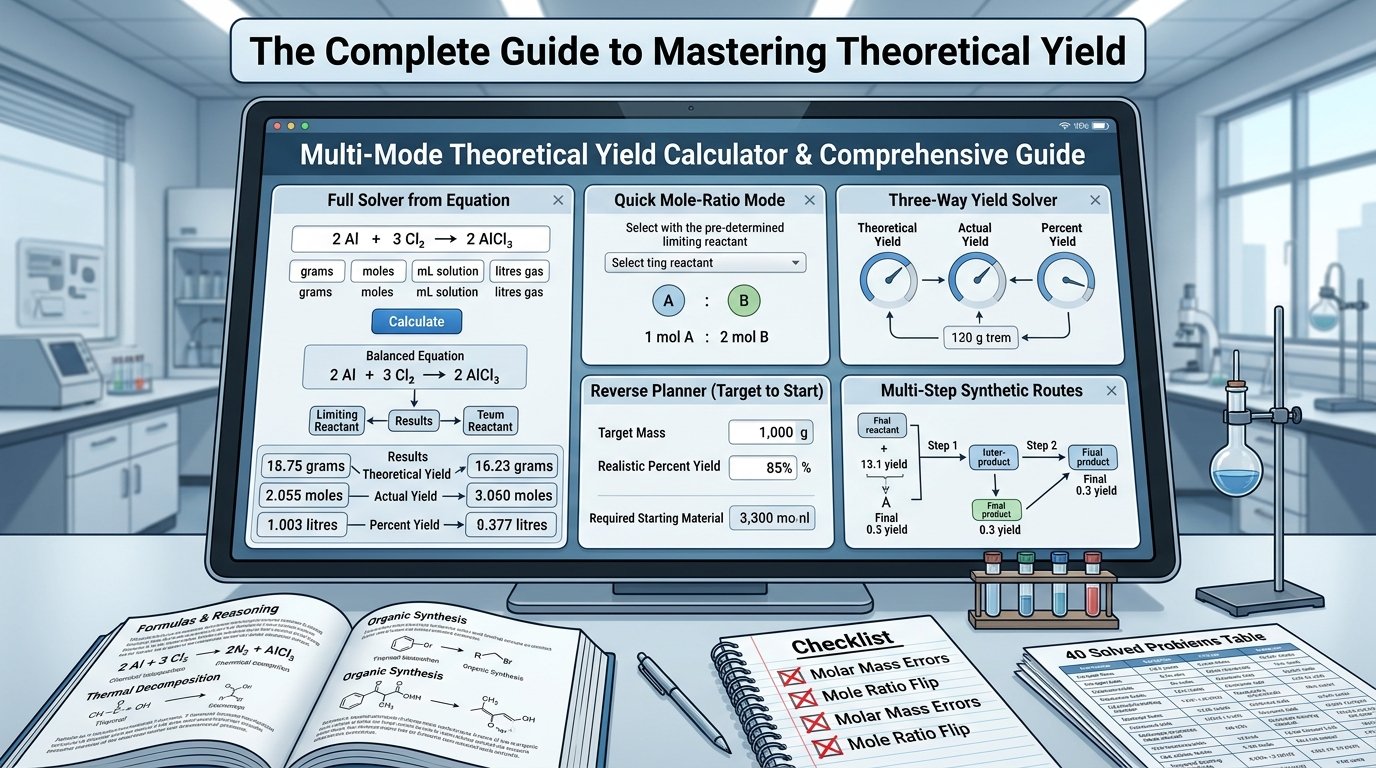
The free theoretical yield calculator above has five modes: the full solver from an equation, a quick mole-ratio mode for when you already know the limiting reactant, a three-way solver that finds theoretical yield, actual yield or percent yield from the other two, a reverse planner that tells you how much starting material you need for a target mass at a realistic percent yield, and a multi-step mode for synthetic routes. Every mode shows the balanced equation, the mole conversions and the ratio used.
This guide covers the formula and the reasoning behind it, the difference between theoretical, actual and percent yield, worked examples from thermal decomposition to organic synthesis, a reference table of forty solved problems, and the mistakes that cost the most marks. It ends with practice problems, a checklist and answers to common questions.
Key Takeaway
Theoretical yield = moles of limiting reactant × (coefficient of product ÷ coefficient of limiting reactant) × molar mass of product. For 25.0 g of CaCO3 heated to CaO + CO2: 25.0/100.09 = 0.2498 mol → 0.2498 × 56.08 = 14.01 g CaO and 0.2498 × 44.01 = 10.99 g CO2 (5.60 L at STP). It is the ceiling; the real (actual) yield is always at or below it, and the ratio of the two is the percent yield.
📑 Table of Contents (click to expand)
- What Is Theoretical Yield?
- How to Use the Theoretical Yield Calculator
- The Five Modes Explained
- The Theoretical Yield Formula
- Worked Example: Limestone Step by Step
- More Worked Examples
- Theoretical vs Actual vs Percent Yield
- Why the Limiting Reactant Comes First
- Gaseous Products: Litres at STP
- Reference Table: 40 Reactions Solved
- Reverse Planning: How Much Do I Need?
- Multi-Step Syntheses and Overall Yield
- Reactants in Solution and Liquids by Density
- Organic Synthesis: Equivalents and Excess
- Why Actual Yields Fall Short
- Who Uses a Theoretical Yield Calculator
- Full Walkthrough: An Esterification Report
- A Short History of Yield
- Limits of the Calculation
- Practice Problems With Answers
- Tips for Accurate Results
- Common Mistakes
- How This Calculator Is Different
- Where the Numbers Come From
- Exam Checklist
- Frequently Asked Questions
- 10 Facts Worth Knowing
- Final Thoughts
What Is Theoretical Yield?
The theoretical yield — the number a theoretical yield calculator exists to produce — is the amount of product that would form if the limiting reactant were converted completely into product, with no side reactions and no losses. It is calculated, never measured. It is expressed in grams (most often), moles, or litres for a gas, and it is the number against which the amount you actually isolate — the actual yield — is judged.
Three ideas are packed into that definition, and a theoretical yield calculator has to handle all three. First, the limiting reactant: if you start with several reactants, only the one that runs out first determines the yield; the others are in excess and leave leftovers. Second, the mole ratio: the balanced equation states how many moles of product form per mole of limiting reactant. Third, molar mass: moles of product must be turned back into grams before they can be compared with a balance reading.
Because the theoretical yield is an upper bound, a measured yield above it is impossible. When it happens, the product is wet, contaminated with a by-product or unreacted starting material, or the theoretical yield was calculated from the wrong (excess) reactant. A theoretical yield calculator that shows its working lets you find which of those it was.
Vocabulary in one place
Theoretical yield — the maximum product, computed from the limiting reactant and the balanced equation.
Actual yield — the mass of pure, dry product you actually obtain.
Percent yield — actual ÷ theoretical × 100.
Limiting reactant — the reactant with the smallest (moles ÷ coefficient); it fixes the theoretical yield.
How to Use the Theoretical Yield Calculator
- Enter the equation.
CaCO3 -> CaO + CO2orFe2O3 + Al -> Al2O3 + Fe; the theoretical yield calculator balances it if needed and shows the coefficients. - Enter the reactant amounts.
CaCO3 25 g, or several reactants separated by semicolons:Fe2O3 20 g; Al 5 g. Units: g, mg, kg, mol, mmol, mL + M for solutions, L for gases at STP. - Name the product you want (or leave blank for the first product). Click Calculate Theoretical Yield.
- Read the answer. Grams and moles of the product, litres at STP if it is a gas, the limiting reactant, and the theoretical yield of every other product too. The steps beneath show every conversion.
- Export or continue. Copy, download CSV/TXT, print or share; or switch to Mode 3 to enter your actual yield and get percent yield, or to Mode 4 to plan the next run.
Each mode of the theoretical yield calculator has a Reset button. The history panel keeps the last ten results, and the sample chips load the classic textbook problems so you can see the format before typing your own.
The Five Modes Explained
| Mode | You enter | You get | Best for |
|---|---|---|---|
| 1. From Equation | Equation, all reactant amounts, product | Limiting reactant, theoretical yield of each product (g, mol, L STP), leftovers | Any textbook or lab problem |
| 2. Quick Mole Ratio | Moles (or grams) of the limiting reactant, its coefficient, product coefficient and formula | Theoretical yield in g and mol (and L for gases) | One-reactant problems, fast checks |
| 3. Yield Solver | Any two of theoretical, actual, percent yield | The third, with a mass-lost figure and over-100% warning | Lab reports |
| 4. Reverse Planner | Equation, target mass of product, expected % yield, optional excess of other reactants | Mass of each reactant to weigh out | Planning a synthesis or scale-up |
| 5. Multi-Step | Starting mass, chain of mole ratios, per-step % yields | Theoretical and expected yield after each step and overall | Organic routes, industrial processes |
The Theoretical Yield Formula
Theoretical yield (g) = nlimiting × (cproduct / climiting) × Mproduct
where nlimiting = masslimiting ÷ Mlimiting (or molarity × volume, or gas volume ÷ molar volume), c = stoichiometric coefficient, M = molar mass.
Read the theoretical yield calculator formula as a chain of three conversions — grams to moles, moles to moles, moles to grams — and it becomes impossible to forget. The theoretical yield calculator prints exactly these three lines:
Line 1 (g → mol): nlimiting = 25.0 g ÷ 100.09 g/mol = 0.2498 mol CaCO3
Line 2 (mol → mol): nCaO = 0.2498 × (1/1) = 0.2498 mol CaO
Line 3 (mol → g): massCaO = 0.2498 × 56.08 g/mol = 14.01 g
For a product that is a gas, add a fourth line: V = n × 22.414 L/mol at STP (0 °C, 1 atm) or 24.465 L/mol at 25 °C and 1 atm. For a product in solution you may instead want moles ÷ volume = molarity. The molar masses come from the same IUPAC table used by the molecular weight calculator.
Worked Example: Limestone Step by Step
Problem. 25.0 g of calcium carbonate is heated strongly until it decomposes completely — the first problem most students run through a theoretical yield calculator. What is the theoretical yield of calcium oxide, and what volume of carbon dioxide is released at STP?
1. Balanced equation. CaCO3 → CaO + CO2 (all coefficients 1).
2. Molar masses. CaCO3 = 40.078 + 12.011 + 3(15.999) = 100.09 g/mol; CaO = 56.08 g/mol; CO2 = 44.01 g/mol.
3. Moles of reactant. 25.0 ÷ 100.09 = 0.2498 mol. (One reactant, so it is automatically the limiting reactant.)
4. Mole ratio. 1 mol CaCO3 → 1 mol CaO and 1 mol CO2: 0.2498 mol of each.
5. Theoretical yields. CaO: 0.2498 × 56.08 = 14.01 g. CO2: 0.2498 × 44.01 = 10.99 g = 0.2498 × 22.414 = 5.60 L at STP.
6. Mass check. 14.01 + 10.99 = 25.00 g = mass of CaCO3. ✓
If the student recovers 12.6 g of CaO, the percent yield is 12.6/14.01 = 89.9% — typical when some carbonate remains undecomposed at the centre of the sample. Click the “CaCO3 25 g” chip in the theoretical yield calculator to see this working generated, then switch to Mode 3 and type 12.6 to get the percent yield.
More Worked Examples
Example 2: Two reactants — thermite with 20.0 g Fe2O3 and 5.00 g Al
Fe2O3 + 2Al → Al2O3 + 2Fe. The theoretical yield calculator first has to decide which reactant limits. Moles: Fe2O3 0.1252, Al 0.1853. Quotients: 0.1252/1 and 0.1853/2 = 0.0927 → Al limits. Theoretical yield of Fe = 0.1853 × (2/2) × 55.845 = 10.35 g; of Al2O3 = 0.0927 × 101.96 = 9.45 g. Starting from the Fe2O3 instead would give 13.98 g — wrong, because that iron oxide can never all react. The limiting reactant calculator goes deeper into this step.
Example 3: Coefficient ratio not 1 — 10.0 g KClO3 heated
2KClO3 → 2KCl + 3O2. n = 10.0/122.55 = 0.08160 mol. O2 = 0.08160 × (3/2) = 0.1224 mol = 3.92 g = 2.74 L at STP. The 3/2 ratio is where most errors occur, and a theoretical yield calculator earns its keep here: it shows the ratio explicitly as “× 3/2”.
Example 4: The Haber process — 28.0 g N2 + 10.0 g H2
N2 + 3H2 → 2NH3. N2 0.9995 mol (quotient 0.9995), H2 4.960 mol (quotient 1.653) → N2 limits. NH3 = 0.9995 × 2 × 17.031 = 34.04 g. The real plant gets about 15% of this per pass and recycles the rest; the theoretical yield calculator reports the ceiling, not the per-pass conversion.
Example 5: Precipitation from solutions — 25.0 mL of 0.200 M AgNO3 + 30.0 mL of 0.150 M NaCl
AgNO3 + NaCl → AgCl + NaNO3. AgNO3 5.00 mmol, NaCl 4.50 mmol → NaCl limits. AgCl = 4.50 mmol × 143.32 = 0.645 g. Filtered, dried and weighed at 0.61 g, the percent yield is 94.5% — Mode 3 of the theoretical yield calculator gives it in one step.
Example 6: Organic synthesis — 2.00 g salicylic acid + 5.00 g acetic anhydride
C7H6O3 + C4H6O3 → C9H8O4 + CH3COOH. Salicylic acid 2.00/138.12 = 0.01448 mol; anhydride 5.00/102.09 = 0.04898 mol → salicylic acid limits. Aspirin = 0.01448 × 180.16 = 2.61 g. A student who isolates 2.15 g reports 82.4%.
Theoretical vs Actual vs Percent Yield
| Quantity | How it is obtained | Units | Aspirin example |
|---|---|---|---|
| Theoretical yield | Calculated from the limiting reactant and the balanced equation | g, mol, L | 2.61 g |
| Actual yield | Weighed after isolation and drying | g, mol, L | 2.15 g |
| Percent yield | Actual ÷ theoretical × 100 | % | 82.4% |
Mode 3 of the theoretical yield calculator solves this theoretical-actual-percent triangle in any direction: given theoretical and actual it returns percent; given theoretical and percent it returns the actual mass you should expect (2.61 g × 0.78 = 2.04 g at 78%); given actual and percent it back-calculates the theoretical yield (8.90 g at 86% → 10.35 g). For the full treatment of percent yield — multi-step yields, percent recovery, purity corrections — use the percent yield calculator.
Why the Limiting Reactant Comes First
With one reactant there is nothing to decide, and a theoretical yield calculator goes straight to the mole ratio. With two or more, the theoretical yield must be computed from the one that runs out first, because the reaction stops the moment it is gone. The test is simple: divide each reactant’s moles by its coefficient; the smallest quotient identifies the limiting reactant, and that quotient (the extent of reaction) multiplied by a product’s coefficient gives the product’s moles.
Two common shortcuts are wrong. The reactant with the smaller mass is not necessarily limiting (28 g N2 limits against 10 g H2). The reactant with fewer moles is not necessarily limiting either (0.1252 mol Fe2O3 is in excess against 0.1853 mol Al). Only the quotient works, and the theoretical yield calculator lists every quotient before it computes a single gram of product.
Gaseous Products: Litres at STP
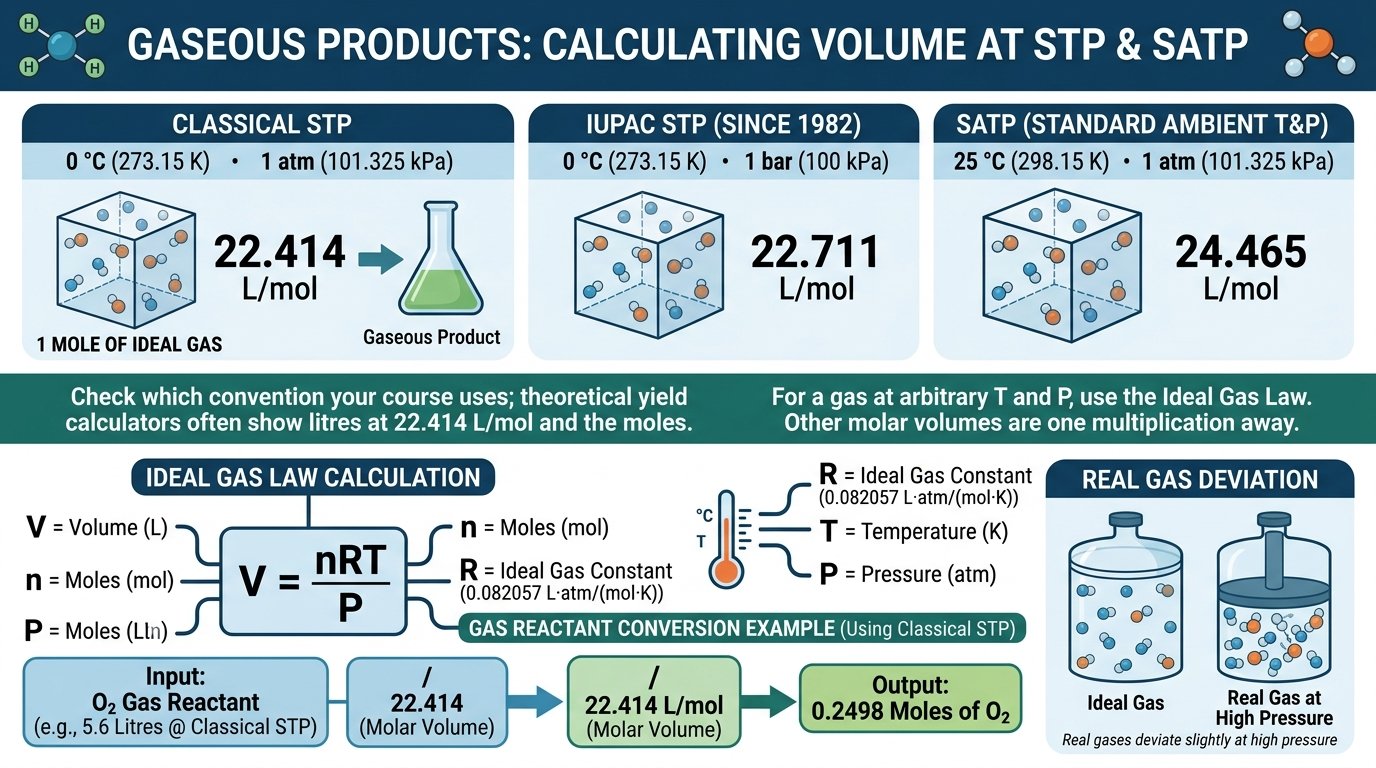
Gas yields are usually reported as volumes, so a theoretical yield calculator must know the molar volume. One mole of ideal gas occupies 22.414 L at 0 °C and 1 atm (the classical STP), 22.711 L at 0 °C and 1 bar (IUPAC STP since 1982), and 24.465 L at 25 °C and 1 atm (SATP). Check which convention your course uses; the theoretical yield calculator shows litres at 22.414 L/mol and the moles, so any other molar volume is one multiplication away. For a gas at arbitrary T and P use V = nRT/P with R = 0.082057 L·atm/(mol·K). Gas reactants can be entered as litres at STP too, e.g. O2 5.6 L; the calculator converts to 0.2498 mol. Real gases deviate slightly at high pressure — see the van der Waals equation calculator — but the correction is negligible in yield problems.
Reference Table: 40 Reactions Solved
All rows were produced with the theoretical yield calculator using IUPAC 2021 atomic weights and 22.414 L/mol for gases at STP. Use the table to check homework or as a problem set.
| # | Balanced equation | Starting amount(s) | Limiting | Theoretical yield |
|---|---|---|---|---|
| 1 | CaCO3 → CaO + CO2 | 25.0 g | — | 14.01 g CaO; 10.99 g (5.60 L) CO2 |
| 2 | 2KClO3 → 2KCl + 3O2 | 10.0 g | — | 3.92 g (2.74 L) O2; 6.08 g KCl |
| 3 | 2H2O2 → 2H2O + O2 | 34.0 g | — | 16.0 g (11.2 L) O2 |
| 4 | 2NaHCO3 → Na2CO3 + H2O + CO2 | 8.40 g | — | 5.30 g Na2CO3; 2.20 g CO2 |
| 5 | CuSO4·5H2O → CuSO4 + 5H2O | 5.00 g | — | 3.20 g CuSO4; 1.80 g H2O |
| 6 | Fe2O3 + 2Al → Al2O3 + 2Fe | 20.0 g, 5.00 g | Al | 10.35 g Fe; 9.45 g Al2O3 |
| 7 | Fe2O3 + 3CO → 2Fe + 3CO2 | 1.00 kg Fe2O3 (CO excess) | Fe2O3 | 699.4 g Fe |
| 8 | N2 + 3H2 → 2NH3 | 28.0 g, 10.0 g | N2 | 34.04 g (44.8 L) NH3 |
| 9 | 2H2 + O2 → 2H2O | 4.00 g, 40.0 g | H2 | 35.74 g H2O |
| 10 | CH4 + 2O2 → CO2 + 2H2O | 16.0 g, 48.0 g | CH4 | 43.9 g (22.4 L) CO2 |
| 11 | C3H8 + 5O2 → 3CO2 + 4H2O | 10.0 g, 30.0 g | O2 | 24.76 g CO2; 13.51 g H2O |
| 12 | Zn + 2HCl → ZnCl2 + H2 | 6.54 g, 0.150 mol | HCl | 0.151 g (1.68 L) H2 |
| 13 | Mg + 2HCl → MgCl2 + H2 | 0.243 g (acid excess) | Mg | 0.0202 g (224 mL) H2 |
| 14 | AgNO3 + NaCl → AgCl + NaNO3 | 25 mL 0.200 M, 30 mL 0.150 M | NaCl | 0.645 g AgCl |
| 15 | Pb(NO3)2 + 2KI → PbI2 + 2KNO3 | 50 mL 0.100 M each | KI | 1.152 g PbI2 |
| 16 | BaCl2 + Na2SO4 → BaSO4 + 2NaCl | 20 mL 0.50 M, 25 mL 0.30 M | Na2SO4 | 1.75 g BaSO4 |
| 17 | Cu + 2AgNO3 → Cu(NO3)2 + 2Ag | 3.00 g, 12.0 g | AgNO3 | 7.62 g Ag |
| 18 | CuO + H2 → Cu + H2O | 7.95 g (H2 excess) | CuO | 6.35 g Cu |
| 19 | 2Na + Cl2 → 2NaCl | 10.0 g, 10.0 g | Cl2 | 16.48 g NaCl |
| 20 | 2Al + 3Cl2 → 2AlCl3 | 5.40 g, 21.3 g | Al (tie) | 26.7 g AlCl3 |
| 21 | 2SO2 + O2 → 2SO3 | 64.0 g, 24.0 g | SO2 | 80.0 g SO3 |
| 22 | 4NH3 + 5O2 → 4NO + 6H2O | 2.00 mol, 2.00 mol | O2 | 1.60 mol (48.0 g) NO |
| 23 | SiO2 + 3C → SiC + 2CO | 100 g, 50.0 g | C | 55.6 g SiC |
| 24 | TiCl4 + 2Mg → Ti + 2MgCl2 | 100 g, 30.0 g | TiCl4 | 25.2 g Ti |
| 25 | P4 + 6Cl2 → 4PCl3 | 12.4 g, 35.5 g | Cl2 | 45.8 g PCl3 |
| 26 | C7H6O3 + C4H6O3 → C9H8O4 + CH3COOH | 2.00 g, 5.00 g | salicylic acid | 2.61 g aspirin |
| 27 | CH3COOH + C2H5OH → CH3COOC2H5 + H2O | 6.00 g, 4.60 g | ethanol (tie) | 8.80 g ethyl acetate |
| 28 | C6H5NO2 + 3H2 → C6H5NH2 + 2H2O | 12.3 g (H2 excess) | nitrobenzene | 9.31 g aniline |
| 29 | C6H6 + HNO3 → C6H5NO2 + H2O | 10.0 g (acid excess) | benzene | 15.76 g nitrobenzene |
| 30 | C6H12O6 → 2C2H5OH + 2CO2 | 100 g | — | 51.1 g ethanol; 48.9 g CO2 |
| 31 | C4H9OH + NaBr + H2SO4 → C4H9Br + NaHSO4 + H2O | 7.4 g, 12.4 g, 12 g | butanol | 13.68 g 1-bromobutane |
| 32 | 2NaOH + H2SO4 → Na2SO4 + 2H2O | 10.0 g, 10.0 g | H2SO4 | 14.48 g Na2SO4 |
| 33 | CaCO3 + 2HCl → CaCl2 + H2O + CO2 | 10.0 g, 100 mL 1.00 M | HCl | 2.20 g (1.12 L) CO2 |
| 34 | Al2(SO4)3 + 6NaOH → 2Al(OH)3 + 3Na2SO4 | 34.2 g, 20.0 g | NaOH | 13.0 g Al(OH)3 |
| 35 | 3Ca(OH)2 + 2H3PO4 → Ca3(PO4)2 + 6H2O | 15.0 g, 15.0 g | Ca(OH)2 | 20.9 g Ca3(PO4)2 |
| 36 | 2C8H18 + 25O2 → 16CO2 + 18H2O | 100 g, 300 g | O2 | 264 g CO2 |
| 37 | Fe + S → FeS | 7.00 g, 4.00 g | S (tie) | 10.97 g FeS |
| 38 | 2Mg + O2 → 2MgO | 1.00 g (air excess) | Mg | 1.658 g MgO |
| 39 | KAl(SO4)2·12H2O from 1.00 g Al | 1.00 g Al (others excess) | Al | 17.58 g alum |
| 40 | 2C2H6 + 7O2 → 4CO2 + 6H2O | 0.500 mol, 1.50 mol | O2 | 0.857 mol (37.7 g) CO2 |
Reverse Planning: How Much Do I Need?
In the lab the question a theoretical yield calculator is asked is usually backwards: “I need 5.00 g of aspirin and I expect about 75% yield — how much salicylic acid should I weigh out?” The arithmetic is the theoretical yield formula run in reverse with a yield correction:
1. Required theoretical yield = target ÷ expected fraction = 5.00 / 0.75 = 6.667 g aspirin.
2. Moles of aspirin = 6.667 / 180.16 = 0.03701 mol.
3. Moles of salicylic acid = 0.03701 × (1/1) = 0.03701 mol → × 138.12 = 5.11 g.
4. Acetic anhydride, stoichiometric: 0.03701 × 102.09 = 3.78 g; with 100% excess (the usual practice) weigh 7.56 g (7.0 mL).
Mode 4 of the theoretical yield calculator does this for any equation, target and yield, and lets you set a percent excess for each non-limiting reactant. Industrial versions of the same calculation are routine: to make 1.00 tonne of ammonia at 15% per-pass conversion, 5.48 tonnes of nitrogen must enter the reactor each pass (the unreacted 85% is recycled); to make 1.00 tonne of quicklime, 1.785 tonnes of limestone must be calcined.
Multi-Step Syntheses and Overall Yield
In a synthetic route the product of one step is the limiting reactant of the next, and a theoretical yield calculator must chain the steps. The theoretical yield of the final product is computed by chaining the mole ratios; the expected yield multiplies in each step’s fractional yield. Two steps at 85% and 90% give an overall 0.85 × 0.90 = 76.5%; ten steps at 90% each give only 0.9010 = 34.9%. This is why medicinal chemists care so much about step count: a linear twelve-step synthesis averaging 80% per step delivers 6.9% of the theoretical maximum.
Example: 10.0 g of benzene → nitrobenzene (85%) → aniline (90%). Theoretical aniline = 10.0/78.11 = 0.1280 mol × 93.13 = 11.92 g; expected = 11.92 × 0.765 = 9.12 g. Mode 5 of the theoretical yield calculator tabulates theoretical and expected mass after each step, and also solves the inverse: what per-step yield is needed for 50% overall in five steps? (0.50)1/5 = 87.1%.
Reactants in Solution and Liquids by Density
Solutions: moles = molarity × litres, and the theoretical yield calculator does the conversion when you type the volume and concentration. Type NaCl 30 mL 0.15 M and the theoretical yield calculator converts it to 4.50 mmol. Pure liquids: mass = volume × density first. 5.00 mL of acetic anhydride (1.08 g/mL) is 5.40 g; 3.00 mL of ethanol (0.789 g/mL) is 2.37 g. Enter the gram value. Hydrated salts: use the molar mass of the hydrate as weighed (CuSO4·5H2O = 249.69, not 159.61), or the yield will be overstated by 56%. The molar mass of hydrates calculator handles that conversion, and the molarity calculator the dilution side.
Organic Synthesis: Equivalents and Excess
Organic chemists feed a theoretical yield calculator amounts in equivalents relative to the limiting reactant: “1.0 equiv of aldehyde, 1.2 equiv of Grignard reagent, 2.0 equiv of base”. One equivalent is the number of moles the balanced equation requires per mole of limiting reactant. Anything above 1.0 equiv (after dividing by the coefficient) is excess and does not enter the theoretical yield. The theoretical yield is therefore always moles of limiting reactant × coefficient ratio × molar mass, exactly as for inorganic reactions — the theoretical yield calculator simply reads the 1.2 and 2.0 equivalents as excess reagents and reports their leftovers. Yields in organic synthesis are quoted for isolated, purified product; a crude mass before chromatography is not an actual yield.
Why Actual Yields Fall Short
| Cause | Mechanism | Typical example |
|---|---|---|
| Equilibrium | Reaction stops before the limiting reactant is exhausted | Esterification (~67% at equilibrium with 1:1 reactants) |
| Side reactions | Limiting reactant diverted to other products | Dinitration in nitrobenzene synthesis; elimination competing with substitution |
| Mechanical losses | Product left on filter paper, in the flask, dissolved in wash liquid | Recrystallisation typically loses 10–20% |
| Incomplete reaction | Not enough time or temperature | CaCO3 decomposition with unreacted core |
| Impure reactants | Fewer moles than the balance suggested | Hygroscopic or technical-grade starting material |
| Apparent >100% | Wet, contaminated or wrongly calculated theoretical yield | Undried precipitate; yield computed from the excess reactant |
Who Uses a Theoretical Yield Calculator
🎓 Students
Every stoichiometry unit ends with theoretical and percent yield; the step-by-step output is a worked solution for each homework problem.
🔬 Lab students and researchers
Pre-lab calculation of the theoretical yield and post-lab percent yield are required in every synthesis report.
🔧 Process chemists and engineers
Raw-material requirements, reactor sizing and cost per kilogram all start from the theoretical yield.
💊 Pharmaceutical development
Multi-step overall yield decides whether a route is viable; the reverse planner sizes each batch.
🏭 Quality control
A batch yield far below the expected value flags a process deviation before the product is even analysed.
📚 Teachers
The reference table and printable reports make ready-made answer keys.
Full Walkthrough: An Esterification Report
Problem. A student refluxes 6.00 g of acetic acid (a typical theoretical yield calculator lab-report question) with 3.00 mL of ethanol (density 0.789 g/mL) and a few drops of sulfuric acid, then isolates 3.10 g of ethyl acetate. Report the limiting reactant, theoretical yield and percent yield.
1. Equation. CH3COOH + C2H5OH → CH3COOC2H5 + H2O. (H2SO4 is a catalyst — not entered.)
2. Ethanol mass. 3.00 mL × 0.789 = 2.367 g.
3. Moles. Acetic acid 6.00/60.05 = 0.09992 mol; ethanol 2.367/46.07 = 0.05138 mol.
4. Limiting reactant. Coefficients 1:1 → ethanol (0.05138) limits; acetic acid is in 94% excess.
5. Theoretical yield. 0.05138 × 88.11 = 4.527 g ethyl acetate.
6. Percent yield. 3.10/4.527 = 68.5% — close to the equilibrium limit for this reaction, which is why industrial processes remove the water as it forms.
In the theoretical yield calculator: Mode 1 with CH3COOH 6.0 g; C2H5OH 2.367 g and product CH3COOC2H5, then Mode 3 with 4.527 and 3.10.
A Short History of Yield
The idea behind every theoretical yield calculator — that a reaction has a calculable maximum output — needed three discoveries: the conservation of mass (Lavoisier, 1789), definite proportions (Proust, 1799) and the atomic theory with its multiple proportions (Dalton, 1808). Richter’s stoichiometry (1792) provided the word and the first equivalent-weight tables. Through the nineteenth century, as Liebig and Wöhler built organic chemistry on gravimetric analysis, “yield” became the standard measure of a preparation’s success, and by the time of Emil Fischer’s sugar syntheses (1890s) reporting the percent of theory was routine. Woodward’s mid-twentieth-century total syntheses made overall yield across dozens of steps a figure of merit, and the green-chemistry movement of the 1990s added atom economy as a complementary metric — see the atom economy calculator. What a theoretical yield calculator does today in a millisecond, Fischer did with log tables and the 1890s atomic weights.
Limits of the Calculation
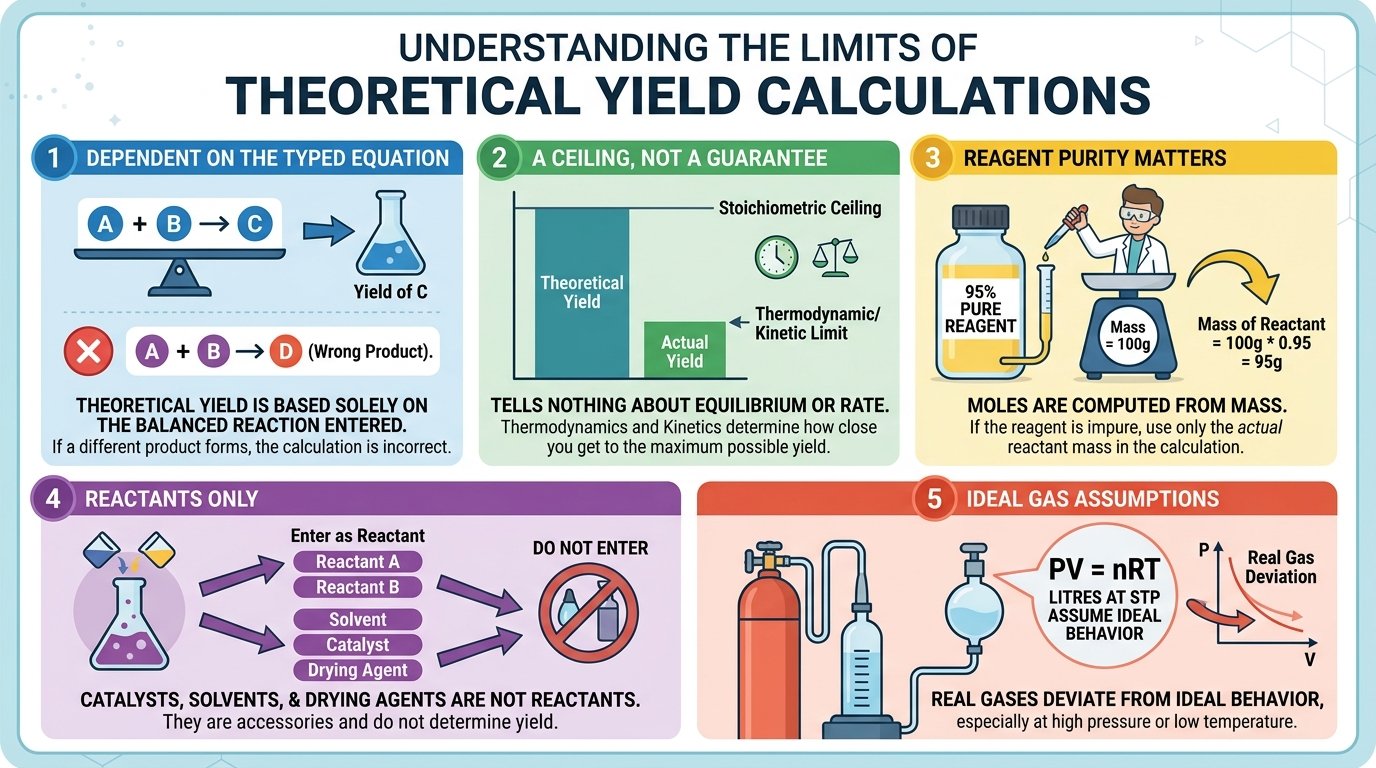
- A theoretical yield calculator assumes the equation you typed. If the real reaction gives a different product (CO instead of CO2, a dinitro compound instead of mono), the theoretical yield refers to the wrong product.
- The theoretical yield calculator says nothing about equilibrium or rate. The theoretical yield is a stoichiometric ceiling; thermodynamics and kinetics determine how close you get.
- Purity matters. Moles are computed from the mass you enter; if the reagent is 95% pure, enter 95% of the mass.
- Catalysts, solvents and drying agents are not reactants and must not be entered as such.
- Ideal-gas volumes. Litres at STP assume ideal behaviour; at high pressure or for easily liquefied gases the deviation can reach a few percent.
Practice Problems With Answers
Solve on paper first, then verify with the theoretical yield calculator.
1. What is the theoretical yield of O2 (g and L at STP) from 10.0 g of KClO3?
Answer: 0.08160 mol × 3/2 = 0.1224 mol = 3.92 g = 2.74 L.
2. 0.500 mol of Fe2O3 is reduced with excess CO. Theoretical yield of iron?
Answer: 0.500 × 2 = 1.00 mol = 55.85 g Fe.
3. 28.0 g N2 and 10.0 g H2 react. Theoretical yield of NH3? If 0.85 mol forms, percent yield?
Answer: N2 limits; 1.999 mol = 34.04 g NH3; 0.85/1.999 = 42.5%.
4. A reaction has a theoretical yield of 12.5 g and runs at 78%. Expected actual mass?
Answer: 12.5 × 0.78 = 9.75 g.
5. 8.90 g of product is 86% of theory. What was the theoretical yield?
Answer: 8.90/0.86 = 10.35 g.
6. 25.0 mL of 0.200 M AgNO3 + 30.0 mL of 0.150 M NaCl. Theoretical yield of AgCl?
Answer: NaCl limits (4.50 mmol); 4.50 × 143.32 = 0.645 g.
7. You need 5.00 g of aspirin at 75% expected yield. Mass of salicylic acid required?
Answer: 5.00/0.75 = 6.667 g theoretical → 0.03701 mol → 5.11 g salicylic acid.
8. 100 g of glucose is fermented to ethanol at 90%. Theoretical and expected ethanol?
Answer: 0.5551 mol × 2 × 46.07 = 51.1 g theoretical; 46.0 g expected.
9. A three-step route runs at 80%, 75% and 90%. Overall yield? What per-step yield gives 50% in three steps?
Answer: 0.80 × 0.75 × 0.90 = 54.0%; (0.50)1/3 = 79.4%.
10. How many grams of CaCO3 must be heated to produce 1.00 kg of CaO?
Answer: 1000/56.08 = 17.83 mol × 100.09 = 1785 g.
Tips for Accurate Results
- Balance before anything else. A wrong coefficient ratio is the single largest source of error; the theoretical yield calculator prints the balanced equation so you can confirm it matches the reaction you intend.
- Identify the limiting reactant explicitly whenever there is more than one reactant (the theoretical yield calculator names it in the answer box), and write “limiting” next to it in your answer.
- Keep four or five significant figures in intermediate moles; round the final mass to the precision of your least precise measurement.
- Convert liquids by density and hydrates by hydrate molar mass before entering masses in the theoretical yield calculator.
- State the STP convention when reporting gas volumes (22.414 L/mol at 0 °C, 1 atm).
- Check mass conservation. The sum of theoretical yields of all products plus leftovers equals the total mass of reactants entered.
- Use one atomic-weight table throughout — the atomic mass calculator and this tool share IUPAC 2021 values.
Common Mistakes
| Mistake | Consequence | Fix |
|---|---|---|
| Calculating from the excess reactant | Theoretical yield too high; percent yield too low | Find the limiting reactant first (the theoretical yield calculator does this automatically) |
| Skipping the mole ratio | Off by the coefficient ratio (e.g. 3/2 for KClO3 → O2) | Write the mol → mol line |
| Inverting the ratio | 2/3 instead of 3/2 | Product coefficient on top |
| Using the reactant’s molar mass for the product | Grams of the wrong substance | Label every molar mass |
| Grams of reactant × ratio directly | Mass ratios are not mole ratios | Go through moles |
| Reporting a crude, wet mass as actual yield | Percent yield > 100% | Dry to constant mass; purify |
| Anhydrous molar mass for a hydrate | Moles overstated | Use the hydrate formula as weighed |
| Wrong molar volume | Gas volumes off by 1–9% | Match the STP/SATP convention of your course |
How This Calculator Is Different
| Feature | This theoretical yield calculator | Typical online tools |
|---|---|---|
| Input | Any equation (auto-balanced), any number of reactants, g/mol/mL+M/L | Two numbers: moles and molar mass |
| Limiting reactant | Found automatically and shown | You must supply it |
| Output | Every product in g, mol and L; leftovers; mass check | One number |
| Planning | Reverse mode with expected yield and excess; multi-step routes | Not available |
| Working | Every step, table, chart | Hidden |
| Export | Copy, CSV, TXT, print, share, history | None |
Related tools: the limiting reactant calculator, percent yield calculator, atom economy calculator, stoichiometry calculator and grams to moles calculator cover the rest of the reaction arithmetic; the formal charge calculator and oxidation number calculator handle bonding and redox. Molar masses come from the atomic mass calculator, formula weight calculator, hydrates calculator, exact mass calculator, monoisotopic mass calculator, isotopic mass calculator and the average vs monoisotopic mass guide. Formulas from data: empirical formula, molecular formula, percent composition, combustion analysis and degree of unsaturation calculators. Solutions and gases: molarity, equivalent weight, freezing point depression, boiling point elevation, osmotic pressure, vapor density, gas density and van der Waals calculators. Polymers: average molecular weight of a mixture, number average, weight average, polydispersity index and viscosity tools.
Where the Numbers Come From
The theoretical yield calculator uses IUPAC 2021 standard atomic weights for molar masses; the molar volume 22.414 L/mol corresponds to 0 °C and 1 atm for an ideal gas. Definitions follow IUPAC and standard general-chemistry texts:
- IUPAC Gold Book — yield: the definition of yield relative to the limiting reactant.
- LibreTexts / OpenStax Chemistry 4.4 — Reaction Yields: theoretical, actual and percent yield with worked examples.
- CIAAW — Standard atomic weights: the source of every molar mass used.
- Wikipedia — Yield (chemistry): theoretical, actual, percent and overall yield in context.
Found an error? See our corrections policy, contact us, or read about the site.
Exam Checklist
☐ Equation balanced; coefficients of limiting reactant and product identified
☐ All reactant amounts converted to moles (g ÷ M, c × V, V ÷ 22.414)
☐ Limiting reactant found by moles ÷ coefficient (if more than one reactant)
☐ Moles of product = moles of limiting × (cproduct/climiting)
☐ Theoretical yield = moles of product × Mproduct (or × 22.414 L/mol for gas volume) — compare with the theoretical yield calculator
☐ Percent yield = actual ÷ theoretical × 100, if asked
☐ Units, significant figures and the word “theoretical” in the answer
Frequently Asked Questions
How do you calculate theoretical yield?
Convert the limiting reactant to moles, multiply by the mole ratio (product coefficient ÷ limiting-reactant coefficient) from the balanced equation, then multiply by the molar mass of the product. The theoretical yield calculator prints these three lines for any reaction.
What is the difference between theoretical yield and actual yield?
Theoretical yield is calculated from stoichiometry (by hand or with a theoretical yield calculator) and is the maximum possible; actual yield is what you weigh after isolating and drying the product. Percent yield is the ratio of the two × 100.
Do I always need the limiting reactant?
Only when more than one reactant amount is given — the theoretical yield calculator checks this for you. With a single reactant (decompositions, or when the problem says the other reactant is in excess) that reactant is the limiting one automatically.
Can the theoretical yield be in moles or litres instead of grams?
Yes. It is a quantity of product; grams are just the most common unit. The theoretical yield calculator reports moles and grams for every product, and litres at STP for gases.
Why is my percent yield over 100%?
The product is wet or impure, or the theoretical yield was computed from the excess reactant instead of the limiting one. Dry the product to constant mass and recheck which reactant limits.
How do I find how much reactant I need for a target yield?
Divide the target mass by the expected fractional yield to get the required theoretical yield, convert to moles, apply the inverse mole ratio and multiply by the reactant’s molar mass. Mode 4 of the theoretical yield calculator does this and adds any excess you specify.
How is the overall yield of a multi-step synthesis calculated?
Multiply the fractional yields of each step: 85% then 90% gives 0.85 × 0.90 = 76.5%; Mode 5 of the theoretical yield calculator tabulates it. The theoretical yield of the final product is found by chaining the mole ratios from the starting material.
Does temperature affect theoretical yield?
No. Theoretical yield depends only on the amounts and the balanced equation, which is why the theoretical yield calculator does not ask for temperature. Temperature affects the actual yield through rate and equilibrium, and the volume of a gaseous product through the molar volume.
What molar volume should I use for gases?
22.414 L/mol at 0 °C and 1 atm (classical STP), 22.711 L/mol at 0 °C and 1 bar (IUPAC STP), 24.465 L/mol at 25 °C and 1 atm (SATP). Follow the convention of your course; the calculator shows moles so you can convert to any of them.
Is this theoretical yield calculator free?
Yes. It runs in your browser with no sign-up, works on phones and tablets, and keeps your last ten calculations locally.
10 Facts Worth Knowing
- Run 1.00 tonne of pure limestone through the theoretical yield calculator and it gives 560 kg of quicklime and 440 kg of CO2 — the reason cement production is so carbon-intensive.
- The single-pass yield of ammonia in a Haber–Bosch reactor is about 15% of theoretical; recycling pushes the overall figure above 97%.
- Fermentation converts glucose to ethanol at up to 90–95% of the theoretical 51.1 g per 100 g; the rest becomes yeast biomass and glycerol.
- A twelve-step linear synthesis at 80% per step delivers 6.9% of theoretical overall; the same steps arranged convergently (two six-step branches) deliver 26% relative to the longest branch.
- Emil Fischer’s 1890 synthesis of glucose reported yields as “percent of theory” — already the modern convention.
- In the Kroll process 1.00 kg of TiCl4 gives a theoretical 252 g of titanium; the other 748 g leaves as MgCl2, which is why titanium is expensive.
- One mole of ideal gas at STP (22.414 L) would fill a cube 28.2 cm on a side.
- Yields above 100% are common in undergraduate aspirin labs — almost always because the product is still wet with water or acetic acid.
- The IUPAC definition of yield is relative to the limiting reactant, which is why a theoretical yield calculator and a limiting reactant calculator are inseparable.
- Process chemists distinguish “isolated yield”, “assay yield” (by HPLC, before isolation) and “in-process yield”; all are fractions of the same theoretical yield.
Final Thoughts
Theoretical yield is the ceiling every reaction is measured against, and it comes from three conversions in a row: grams to moles of the limiting reactant, moles to moles by the coefficient ratio, moles to grams of product. The theoretical yield calculator on this page performs those conversions for any equation, finds the limiting reactant for you, handles solutions and gases, and works the problem backwards when you need to plan a synthesis. Use it to check every homework answer, to fill in the pre-lab sheet, and to make the reasoning — not just the number — automatic.
About the author
Ahmad Raza, M.Phil. Chemistry
Ahmad has taught general and analytical chemistry for over a decade and builds the calculators on this site. He writes every guide from the perspective of the student who has to get the exam question right, and cross-checks every number against IUPAC data. Reach him at contact@molecularweightcalculator.org.