
Peptide Reconstitution Calculator
Lyophilised vial to a labelled stock in one screen. This peptide reconstitution calculator turns the mass on the vial (with net-peptide-content and salt corrections) into the exact volume of solvent for any target concentration in mg/mL, µM or mM, tells you how many units to draw on an insulin syringe for a given dose, plans aliquots to avoid freeze-thaw, estimates the molecular weight from a sequence, and gives a solvent-selection guide.
✓ Trusted by researchers, core facilities & lab techniciansHow Much Solvent to Add to the Vial?
Volume (mL) = peptide mass (mg) ÷ target concentration (mg/mL). Enter the vial content, the net peptide content from the CoA (typically 70–90 %, the rest is water and counter-ion), and your target. The peptide reconstitution calculator returns the exact solvent volume, the true peptide concentration and the label text.
Dose to Volume and Insulin-Syringe Units
Once reconstituted, volume per dose = dose ÷ concentration. Enter the vial amount, the solvent you added and the dose you need; the peptide reconstitution calculator gives the volume in mL and in units on a U-100 insulin syringe (100 units = 1 mL), plus how many doses the vial holds. Research use only.
Molar Stock: mg of Peptide → µM or mM
Cell-based assays need molar stocks. Give the peptide molecular weight (from the CoA, or estimate it in mode 4), the mass, the net content and the molar target; the peptide reconstitution calculator returns the solvent volume, or — if you already dissolved it — the molar concentration you actually have.
Molecular Weight, pI Estimate and Solvent Guide from the Sequence
Paste a one-letter sequence (e.g. HAEGTFTSDVSSYLEGQAAKEFIAWLVKGRG). The peptide reconstitution calculator computes the average molecular weight (with optional N-acetyl / C-amide modifications), the residue count, the net charge at pH 7 and a hydrophobicity index, then recommends a starting solvent.
Aliquot Planner and Working Dilution
Peptides degrade with repeated freeze-thaw. Enter the stock you made, the amount used per experiment and the working concentration; the peptide reconstitution calculator plans single-use aliquots (with a 10 % pipetting margin), the dilution of stock into assay medium (C₁V₁ = C₂V₂) and the final DMSO or solvent percentage.
🕘 Recent calculations
- No calculations yet — your last 10 results will appear here.
Formulas: solvent volume (mL) = peptide mass (mg) × net content ÷ target (mg/mL) · concentration (mg/mL) = mass (mg) ÷ volume (mL) · molar: volume (L) = mass (g) ÷ (MW × target mol/L) · U-100 insulin syringe: 1 mL = 100 units, so units = mL × 100 · sequence MW = Σ residue masses + 18.015 (H₂O) + modifications (Ac +42.037, amide −0.984, each S–S −2.016) · C₁V₁ = C₂V₂ for working dilutions · store lyophilised peptides at −20 °C, reconstituted aliquots at −20/−80 °C; avoid repeated freeze-thaw · solvent guide: net charge > 0 → water or dilute acetic acid; < 0 → water or dilute NH₄OH/PBS; hydrophobic (> 50 % apolar residues) → DMSO then dilute · research use only, not medical advice.
A peptide reconstitution calculator turns the milligrams printed on a lyophilised vial into the millilitres of solvent that give the concentration you want, and then into the volume — or the units on an insulin syringe — that delivers a given dose. The arithmetic is short (volume = mass ÷ concentration; dose volume = dose ÷ concentration) but the details are not: net peptide content, salt form, molecular weight for molar stocks, solvent choice, aliquoting to avoid freeze-thaw, and the vehicle limit when the stock is in DMSO.
The free peptide reconstitution calculator on this page has five modes: reconstitute a vial (mass, net peptide content, target mg/mL or µg/mL, seven solvents with notes); dose to volume and U-100 syringe units with doses per vial; molar stocks in µM or mM from mass and molecular weight, or the molarity of a stock you already made; molecular weight, net charge, isoelectric point, hydropathy and a solvent recommendation from the one-letter sequence; and an aliquot planner with working-dilution and solvent-percentage checks. Every result shows the steps, a table, a chart and a label line.
Below the tool you will find the formulas, the meaning of net peptide content and counter-ion, how to pick a solvent from the sequence, the insulin-syringe unit system, molar-stock arithmetic, storage and stability, worked examples, a reference table of common research peptides, ten practice problems, a bench checklist and the questions readers ask most about the peptide reconstitution calculator. All of it is written for research use.
Key Takeaway
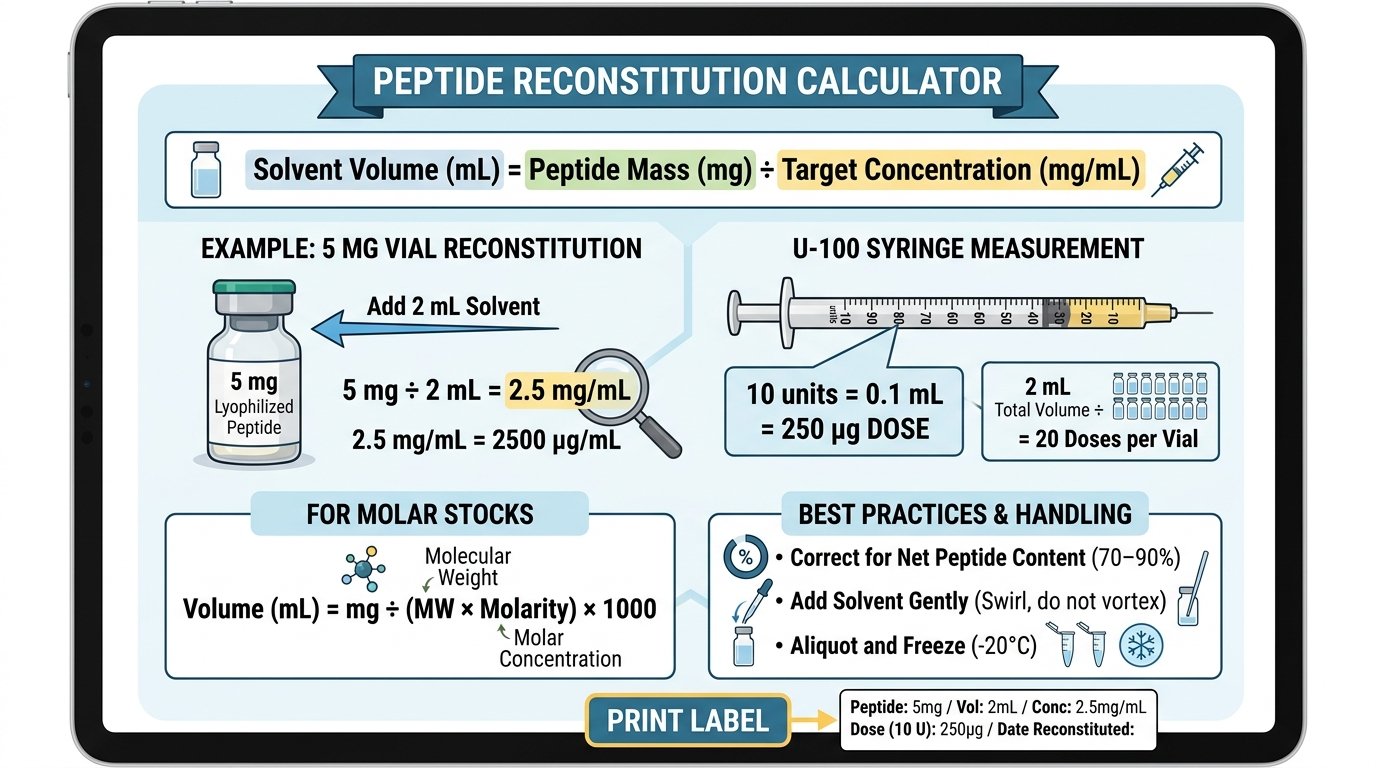
Solvent volume (mL) = peptide mass (mg) ÷ target concentration (mg/mL). A 5 mg vial + 2 mL gives 2.5 mg/mL = 2500 µg/mL, so 250 µg is 0.1 mL = 10 units on a U-100 syringe and the vial holds 20 doses. For molar stocks, volume (mL) = mg ÷ (MW × molarity) × 1000. Correct for net peptide content (70–90 %), add solvent gently, aliquot and freeze. The peptide reconstitution calculator above does all of this and prints the label.
📑 Table of Contents (click to expand)
- What Is a Peptide Reconstitution Calculator?
- How to Use the Peptide Reconstitution Calculator
- The Five Modes Explained
- The Formulas Behind the Peptide Reconstitution Calculator
- Worked Example: A 5 mg Vial to 2.5 mg/mL and a 250 µg Dose
- Net Peptide Content, Counter-ions and Salt Forms
- Choosing a Solvent From the Sequence
- More Worked Examples
- Insulin Syringes and the Unit System
- Molar Stocks: From mg to µM and mM
- Storage, Stability and Aliquoting
- Working Dilutions and the Vehicle Limit
- Reading the Sequence: MW, Charge, pI and Hydropathy
- Reference Table: Common Research Peptides
- Visualising Concentration, Dose and Units
- Who Uses a Peptide Reconstitution Calculator
- Full Walkthrough: From Vial to Cell Assay
- A Short History of Peptide Handling
- Limits and Assumptions
- Practice Problems With Answers
- Tips for Accurate Results
- Common Mistakes
- How This Peptide Reconstitution Calculator Is Different
- Where the Numbers Come From
- Checklist
- Frequently Asked Questions
- 10 Facts Worth Knowing
- Final Thoughts
What Is a Peptide Reconstitution Calculator?
Synthetic peptides are shipped as a freeze-dried (lyophilised) powder because most are unstable in solution. Reconstitution is the act of adding a measured volume of solvent to that powder to make a stock of known concentration, and every later step — dosing an animal, treating cells, running a binding assay — depends on that number being right. A peptide reconstitution calculator does the arithmetic in both directions: solvent volume from vial mass and target concentration, and concentration (or dose volume) from what was actually added.
Three complications make a dedicated peptide reconstitution calculator worthwhile. First, the “5 mg” on the vial is gross weight; the peptide itself is typically 70–90 % of it, the rest being bound water and the trifluoroacetate or acetate counter-ion, and the certificate of analysis states this net peptide content. Second, molar concentrations require the molecular weight, which for a salt form differs from the sequence mass. Third, the volumes involved are small (0.05–0.5 mL) and are often measured on insulin syringes graduated in units rather than millilitres. The peptide reconstitution calculator handles all three and adds the practical layer: which solvent, how to add it, how to store the result.
The two equations
Reconstitution: volume of solvent (mL) = peptide mass (mg) × net content ÷ target (mg/mL)
Dosing: volume per dose (mL) = dose (mg) ÷ concentration (mg/mL); U-100 units = mL × 100
How to Use the Peptide Reconstitution Calculator
- Pick the mode. Reconstitute a vial for solvent volume; Dose → volume for syringe units; Molar stock for µM/mM; MW from sequence when the certificate is missing or to choose a solvent; Aliquots to plan storage and working dilutions.
- Enter the vial content (mg, µg or g), the net peptide content from the certificate (leave 100 % if unknown, but expect the true concentration to be lower), and the target concentration.
- Choose the solvent — sterile water, bacteriostatic water, PBS, dilute acetic acid, dilute ammonia, DMSO or acetonitrile/water; the peptide reconstitution calculator adds a note on when each is appropriate.
- Press Calculate. The solvent volume appears in blue with the resulting mg/mL and µg/mL, the micrograms per insulin unit, the procedure, a label line, a table and a chart of concentration versus solvent volume.
- Copy, download, print or share; each mode has its own Reset and the history box keeps the last ten calculations.
The chips load 5 mg → 1 mg/mL, 5 mg → 2.5 mg/mL in bacteriostatic water, 10 mg → 5 mg/mL, a 250 µg dose, 1 mg of GLP-1 to 1 mM, oxytocin and amyloid-β sequences, and a 10 mM DMSO stock to 10 µM, so the peptide reconstitution calculator’s output is visible before you type.
The Five Modes Explained
Mode 1 — Reconstitute a vial. Mass, net content, target in mg/mL, µg/mL or mg/L, solvent. Output: solvent volume, true concentration, gross-weight concentration for comparison, µg per U-100 unit, total units in the vial, procedure and label. Warns if the volume exceeds what a vial holds.
Mode 2 — Dose to volume. Vial mass, solvent added, dose in µg, mg or µg/kg with body mass, syringe type. Output: mL and units, doses per vial, a warning below 2 units and a suggested reconstitution volume that lands the dose on a whole number of units.
Mode 3 — Molar stock. Molecular weight, mass, net content and either a molar target (solvent volume out) or a solvent volume (molarity out); mass concentration cross-check and a chart of volumes for 10 mM, 1 mM, 100 µM and 10 µM.
Mode 4 — Sequence analysis. One-letter sequence with N-acetyl, C-amide and disulfide options: average molecular weight, residue composition, net charge at pH 7, estimated pI, Kyte-Doolittle GRAVY, percent apolar, ε280 and a solvent recommendation; a charge-versus-pH chart.
Mode 5 — Aliquots and working dilution. Stock concentration and volume, working concentration and volume, solvent limit: stock per experiment by C1V1 = C2V2, solvent percentage in the assay, an intermediate dilution when the limit is exceeded, aliquot size with a 10 % margin and the number of tubes.
The Formulas Behind the Peptide Reconstitution Calculator
Net peptide (mg) = vial mass (mg) × net peptide content (%) ÷ 100
Solvent volume (mL) = net peptide (mg) ÷ target (mg/mL)
Concentration (mg/mL) = net peptide (mg) ÷ solvent (mL); µg/mL = mg/mL × 1000
Dose volume (mL) = dose (µg) ÷ concentration (µg/mL); U-100 units = mL × 100; µg per unit = µg/mL ÷ 100
Doses per vial = net peptide (µg) ÷ dose (µg), rounded down
Molar stock: moles = mg ÷ 1000 ÷ MW; volume (L) = moles ÷ molarity; 1 mM needs mg × 106 ÷ MW microlitres
Sequence MW = Σ residue masses + 18.015 (+ 42.037 for N-acetyl, − 0.984 for C-amide, − 2.016 per disulfide)
Everything else in the peptide reconstitution calculator — the solvent notes, the pipetting warnings, the aliquot margin — is practice rather than arithmetic, distilled from supplier technical notes and laboratory experience.
Worked Example: A 5 mg Vial to 2.5 mg/mL and a 250 µg Dose
- Target. 2.5 mg/mL is convenient: 250 µg will be 0.1 mL, a clean 10 units.
- Solvent volume. 5 mg ÷ 2.5 mg/mL = 2.0 mL of bacteriostatic water.
- Concentration. 2.5 mg/mL = 2500 µg/mL = 25 µg per U-100 unit.
- Dose. 250 µg ÷ 2500 µg/mL = 0.1 mL = 10 units; the vial holds 5000 ÷ 250 = 20 doses.
- Procedure. Let the vial reach room temperature; draw 2.0 mL of solvent; inject slowly down the inside wall; swirl gently; stand 5–10 minutes until clear; label “peptide X, 2.5 mg/mL, BAC water, date”.
With a net peptide content of 80 % the same vial holds only 4 mg of peptide, so 2.0 mL gives 2.0 mg/mL and a 250 µg dose becomes 12.5 units; alternatively add 1.6 mL to keep 2.5 mg/mL. The peptide reconstitution calculator shows both the net and the gross-weight concentration so the choice is explicit.
Net Peptide Content, Counter-ions and Salt Forms
Lyophilised peptides — the starting point for every peptide reconstitution calculator problem — are hygroscopic and are isolated as salts of the acid used in purification — almost always trifluoroacetic acid (TFA), sometimes acetic acid or HCl. Each basic residue (Lys, Arg, His) and the N-terminus can carry a counter-ion, so a 30-residue peptide with four basic groups may be 10–15 % TFA by mass, plus 5–10 % water. The net peptide content on the certificate of analysis (typically 70–90 %) is the fraction of the gross weight that is peptide; purity (e.g. 98 % by HPLC) is a different number describing what fraction of the peptide is the right sequence.
The peptide reconstitution calculator applies net content before dividing by the target concentration. Ignoring it makes every stock 10–30 % weaker than labelled, which is invisible in a single experiment but ruins comparisons between lots. For molar stocks the molecular weight question is separate: the sequence mass (free base) is what mode 4 computes; the salt mass per mole of peptide is larger. Use the free-base MW with the net-content-corrected mass, which is what most certificates intend, unless the certificate states a salt MW explicitly.
TFA itself can be biologically active in cell assays at the concentrations left by a 1 mg/mL stock; acetate-exchanged peptides are available for sensitive work. For related molar-mass questions see the molarity calculator and average vs monoisotopic mass guide.
Choosing a Solvent From the Sequence
| Peptide character | Indicator | First solvent | If cloudy |
|---|---|---|---|
| Basic | Net charge > 0 at pH 7 (Lys, Arg, His rich) | Sterile water | 10 % acetic acid dropwise |
| Acidic | Net charge < 0 (Asp, Glu rich) | Water or PBS | 0.1 % NH4OH dropwise |
| Neutral, hydrophilic | Charge ≈ 0, < 50 % apolar | Water | Acetic acid, then a little DMSO |
| Hydrophobic | > 50 % apolar residues, GRAVY > 0.5 | DMSO (or DMF), then dilute | Acetonitrile/water, isopropanol |
| Cys / Met / Trp containing | Oxidation-prone | Degassed water or buffer | Avoid DMSO for storage; protect from light |
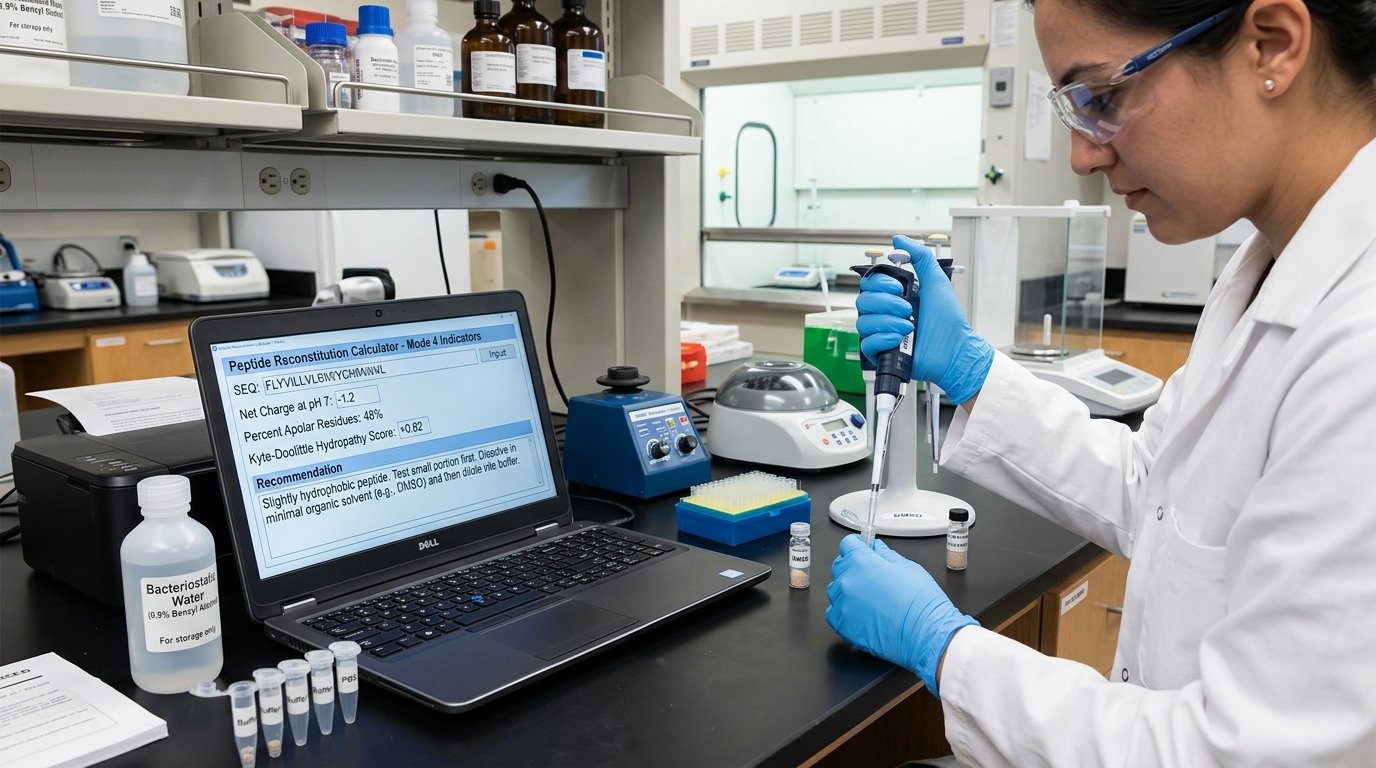
Mode 4 of the peptide reconstitution calculator computes the indicators — net charge at pH 7 from Henderson-Hasselbalch on the ionisable side chains and termini, percent apolar residues and the Kyte-Doolittle hydropathy — and prints the corresponding recommendation. Always test-dissolve a small portion first; a peptide that will not dissolve in water can rarely be rescued by adding more water, but can often be dissolved in a little organic solvent and then diluted into buffer. Bacteriostatic water (0.9 % benzyl alcohol) is for multi-dose vials that will be stored refrigerated for up to about four weeks; it is not appropriate for cell culture.
More Worked Examples
Example 1 — 10 mg vial, 5 mg/mL, 1 mg dose
10 ÷ 5 = 2 mL solvent; 1 mg ÷ 5 mg/mL = 0.2 mL = 20 units; 10 doses per vial.
Example 2 — 1 mg at 80 % net to 1 mg/mL true
0.8 mg ÷ 1 mg/mL = 0.8 mL; the gross-weight concentration would read 1.25 mg/mL.
Example 3 — 1 µg/kg for a 70 kg subject from 5 mg in 3 mL
Dose 70 µg; stock 1667 µg/mL; volume 0.042 mL = 4.2 units — between marks. The peptide reconstitution calculator suggests 3.57 mL of solvent instead, which makes the dose exactly 5 units.
Example 4 — 1 mg of GLP-1 (7-37), MW 3355.7, to 1 mM
1 mg ÷ 3355.7 = 0.298 µmol; ÷ 1 mmol/L = 298 µL of solvent (3.36 mg/mL).
Example 5 — 10 mM DMSO stock to 10 µM in 20 mL medium
Factor 1000: 20 µL stock + 19.98 mL medium; DMSO = 0.1 %, at the usual limit; aliquots of 22 µL, 45 tubes from 1 mL.
Insulin Syringes and the Unit System
Research doses of peptides are often measured with U-100 insulin syringes, which is why the peptide reconstitution calculator reports units: on which 100 “units” occupy 1 mL — a unit is simply 0.01 mL, regardless of what is in the syringe. Syringes come in 1 mL (100 units, 2-unit marks), 0.5 mL (50 units, 1-unit marks) and 0.3 mL (30 units, half-unit marks); the smaller barrels are more precise for small volumes. The peptide reconstitution calculator converts every dose volume to units and back, and reports the micrograms per unit of your stock so that a dose can be read straight off the barrel.
Two practical rules follow, and the peptide reconstitution calculator enforces both. First, choose the reconstitution volume so that the common dose is a round number of units — 2.5 mg/mL makes 250 µg exactly 10 units; the tool suggests such a volume when your dose lands between marks. Second, avoid draws below 5 units (0.05 mL): dead space, air bubbles and parallax dominate, and a 1-unit error is 20 %. If the dose needs fewer than 5 units, reconstitute more dilute. The same reasoning applies to pipettes in the laboratory, where the dilution calculator flags volumes under 10 µL.
Molar Stocks: From mg to µM and mM
Cell and biochemical assays are designed in molar units, so the peptide reconstitution calculator has a molar mode: so a peptide stock is usually made at 1 or 10 mM in water or DMSO. The conversion needs the molecular weight: moles = mass ÷ MW, and volume = moles ÷ molarity. A handy form is that a 1 mM stock needs (mg × 106 ÷ MW) microlitres — for 1 mg of a 1000 Da peptide, 1000 µL; for 1 mg of a 3356 Da peptide, 298 µL. The peptide reconstitution calculator’s mode 3 does this with net-content correction and also runs backwards: 1 mg of bradykinin (MW 1060.2) already dissolved in 1 mL is 0.943 mM.
The molecular weight entered in the peptide reconstitution calculator should be the average (not monoisotopic) mass of the exact form in the vial — with modifications such as amidation, acetylation, PEGylation or a fluorescent label, which mode 4 accounts for at the sequence level. Small peptides (< 1000 Da) are often 5–10 % counter-ion by mass; large ones (> 4000 Da) less. When a certificate gives both the molecular weight and the net peptide content, use them together and the molar concentration will be right to within a few percent; when neither is available, estimate the MW from the sequence and assume 80 % net content, and say so in the notebook.
Storage, Stability and Aliquoting
Lyophilised peptides keep for years at −20 °C, but once the peptide reconstitution calculator has been used they are in solution, and solution in the dark and dry; once in solution their lifetime is days to weeks at 4 °C and months at −20 or −80 °C, and every freeze-thaw cycle costs activity through aggregation, oxidation and adsorption to plastic. The rule is therefore: reconstitute, divide immediately into single-use aliquots sized for one experiment, freeze, and thaw each tube once. The peptide reconstitution calculator’s mode 5 sizes the aliquots (stock volume per experiment plus 10 %) and counts the tubes, and warns when an aliquot would be under 10 µL, where evaporation and pipetting error take over.
Sequences with Cys, Met or Trp oxidise, as the peptide reconstitution calculator’s sequence mode warns; Asn-Gly and Asp-Gly motifs deamidate or isomerise; N-terminal Gln cyclises to pyroglutamate. Degassed solvents, low-bind tubes, pH 5–6 buffers and avoidance of DMSO for long-term storage of Cys/Met peptides all help. Bacteriostatic-water vials for multi-dose use are conventionally discarded after 28 days refrigerated. Label every tube with peptide, concentration, solvent, date and lot — the tool prints the label line for that purpose.
Working Dilutions and the Vehicle Limit
A stock is rarely used neat, and the peptide reconstitution calculator’s last mode covers the dilution. The working dilution follows C1V1 = C2V2: 10 µM in 20 mL from a 10 mM stock takes 20 µL. When the stock is in DMSO, ethanol or acetic acid the carried-over solvent must stay below the assay’s tolerance — typically 0.1 % DMSO for primary cells, up to 0.5–1 % for robust lines. A 1 : 1000 dilution of a DMSO stock gives exactly 0.1 %; a 1 : 100 dilution gives 1 % and needs an intermediate step in medium so that the final well sees 0.1 % or less.
The peptide reconstitution calculator’s mode 5 computes the solvent percentage, compares it with your limit, and when it is exceeded proposes an intermediate dilution and the volumes that keep every pipetting step above 2 µL. It also reminds you to include a vehicle control at the same solvent percentage — the most commonly omitted control in peptide assays. For dose-response series that keep the vehicle constant across all concentrations, the serial dilution calculator designs the intermediate plate.
Reading the Sequence: MW, Charge, pI and Hydropathy
When the certificate is missing, or when you want to know how a peptide will behave before choosing a solvent in the peptide reconstitution calculator, the sequence itself is enough for a first estimate. The peptide reconstitution calculator’s mode 4 sums the average residue masses and adds one water for the termini (plus 42.04 for an N-acetyl, minus 0.98 for a C-amide and minus 2.02 per disulfide); Leu-enkephalin YGGFL comes to 555.6 g/mol, GLP-1 (7-37) to 3355.7 and amyloid-β (1-42) to 4514.1. It then applies Henderson-Hasselbalch to the ionisable groups (Lys 10.5, Arg 12.5, His 6.0, Asp 3.9, Glu 4.1, Cys 8.3, Tyr 10.1, N-terminus 9.0, C-terminus 2.0) to give the net charge at pH 7 and the pH at which it crosses zero — the isoelectric point.
The Kyte-Doolittle GRAVY score (average hydropathy per residue) and the percentage of apolar residues (A, V, I, L, M, F, W, P, G, C) complete the picture: GLP-1 at GRAVY −0.24 and 52 % apolar is borderline and dissolves in water; Aβ(1-42) at 60 % apolar with a strongly hydrophobic C-terminus needs DMSO or HFIP. The tool also estimates ε280 from Trp, Tyr and cystine so that a stock can be checked spectrophotometrically — the subject of our protein concentration A280 calculator.
Reference Table: Common Research Peptides
| Peptide | Residues | MW (g/mol) | µL for 1 mM per mg | Typical solvent |
|---|---|---|---|---|
| Leu-enkephalin (YGGFL) | 5 | 555.6 | 1800 | Water |
| Oxytocin (amide, 1 S–S) | 9 | 1007.2 | 993 | Water / dilute acetic acid |
| Angiotensin II (DRVYIHPF) | 8 | 1046.2 | 956 | Water |
| Bradykinin (RPPGFSPFR) | 9 | 1060.2 | 943 | Water |
| Substance P (amide) | 11 | 1347.6 | 742 | Water; low-bind tubes |
| BPC-157 (GEPPPGKPADDAGLV) | 15 | 1419.6 | 704 | Water / BAC water |
| GLP-1 (7-37) | 31 | 3355.7 | 298 | Water / dilute NH4OH |
| Amyloid-β (1-42) | 42 | 4514.1 | 222 | DMSO or HFIP, then dilute |
| Insulin (human) | 51 | 5807.6 | 172 | Dilute HCl, then buffer |
Molecular weights are sequence (free-base) averages from mode 4 of the peptide reconstitution calculator; salt forms weigh more per mole. The “µL for 1 mM per mg” column is 106 ÷ MW.
Visualising Concentration, Dose and Units
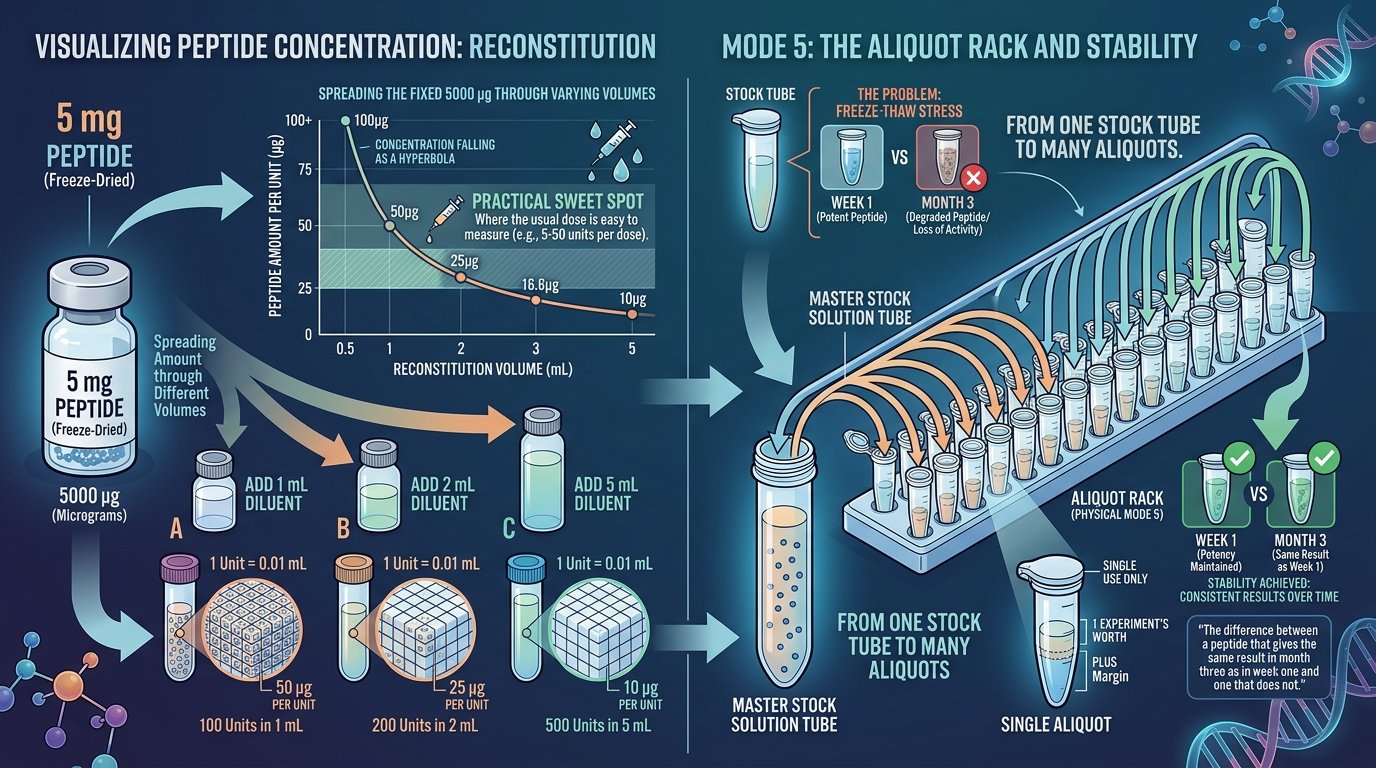
Picture the vial the peptide reconstitution calculator starts from as a fixed number of micrograms — 5000 for a 5 mg vial — that you spread through whatever volume you add. Add 1 mL and every 0.01 mL (one unit) holds 50 µg; add 2 mL and a unit holds 25 µg; add 5 mL and a unit holds 10 µg. The chart the peptide reconstitution calculator draws for 0.5, 1, 2, 3 and 5 mL shows the concentration falling as a hyperbola, and the practical sweet spot — where the usual dose is 5–50 units — is easy to see.
The second picture is the aliquot rack: one stock tube becomes a row of small tubes, each holding one experiment’s worth plus a little margin. The row is the tool’s mode 5 in physical form, and it is the difference between a peptide that gives the same result in month three as in week one and one that does not.
Who Uses a Peptide Reconstitution Calculator
Cell biologists and pharmacologists make molar stocks of peptide agonists, inhibitors and hormones. Biochemists prepare substrates and standards for kinetics and mass spectrometry. Immunologists reconstitute epitope peptides and pools for T-cell assays. Neuroscientists prepare amyloid and neuropeptide preparations whose aggregation state depends on the solvent history. Animal-facility staff calculate µg/kg doses and syringe volumes. Core facilities and students need the arithmetic checked and documented.
The peptide reconstitution calculator serves all of them by starting from the vial and the certificate, and by translating between the units each group uses — mg/mL, µM, µg/kg and syringe units. It is a research and teaching tool; it does not provide medical advice.
Full Walkthrough: From Vial to Cell Assay
A 1 mg vial of a 20-residue peptide (certificate: MW 2245.5, net peptide content 82 %, TFA salt) is to be tested at 1 µM in 6-well plates (2 mL per well) with a DMSO limit of 0.1 %.
- Sequence check (peptide reconstitution calculator mode 4): 55 % apolar, GRAVY 0.6 → hydrophobic; recommendation: DMSO, then dilute.
- Molar stock (mode 3): 1 mg × 0.82 = 0.82 mg = 0.365 µmol; for 1 mM add 365 µL of DMSO.
- Working dilution (mode 5): 1 mM → 1 µM is 1 : 1000, so 2 µL of stock per 2 mL well, DMSO 0.1 % — at the limit and a marginal pipetting volume. The peptide reconstitution calculator suggests a master mix: 13 µL of stock into 13 mL of medium for six wells with overage.
- Aliquots: 365 µL of stock into 15 µL tubes (13 + 10 % margin, rounded up) → 24 aliquots at −80 °C.
- Vehicle control: 13 µL of DMSO into 13 mL of medium.
- Record: lot, net content, MW, 1 mM in DMSO, date; export the table.
A Short History of Peptide Handling
The peptides a peptide reconstitution calculator handles became widely available after Merrifield’s solid-phase synthesis (1963) and the automated synthesisers of the 1980s; reversed-phase HPLC purification with trifluoroacetic acid, introduced in the same period, is why most peptides arrive as TFA salts. Lyophilisation, borrowed from the pharmaceutical industry’s handling of penicillin and plasma in the 1940s, became the standard shipping form because it removes the water that drives hydrolysis and aggregation.
The insulin syringe’s unit graduations date from the standardisation of insulin at 100 units per mL in the 1970s; their adoption for other small-volume subcutaneous doses in research followed simply because the syringes were accurate and everywhere. The peptide reconstitution calculator sits at the intersection of these histories, converting between the chemist’s mg and µM and the syringe’s units.
Limits and Assumptions
- Net peptide content entered in the peptide reconstitution calculator must come from the certificate; 100 % is an upper bound, not a default truth.
- Sequence MW is the average mass of the free base with the modifications you specify; salt forms and unlisted modifications change it.
- Charge and pI estimates use generic side-chain pKa values; folded or aggregated peptides deviate.
- Solvent recommendations are starting points; test-dissolve first.
- Syringe units assume U-100 (100 units = 1 mL).
- Research use only: the tool does not give clinical dosing advice.
Practice Problems With Answers
Work these by hand, then check with the peptide reconstitution calculator.
- 2 mg vial to 1 mg/mL: solvent? Answer: 2 mL.
- 5 mg in 2.5 mL: µg per unit? Answer: 20 µg.
- 500 µg dose from 2 mg/mL: units? Answer: 25 units.
- 10 mg at 85 % net, target 5 mg/mL true: solvent? Answer: 1.7 mL.
- 1 mg, MW 1007.2, to 10 mM: solvent? Answer: 99.3 µL.
- 0.5 mg (90 % net), MW 1419.6, to 500 µM: solvent? Answer: 634 µL.
- YGGFL molecular weight? Answer: 555.6 g/mol.
- 10 mM stock to 5 µM in 10 mL: stock volume and DMSO %? Answer: 5 µL; 0.05 %.
- 0.25 µg/kg for 80 kg from 2 mg in 2 mL: units? Answer: 20 µg → 0.02 mL = 2 units (too small; dilute).
- How many 12 µL aliquots from 300 µL? Answer: 25.
Tips for Accurate Results
- Read the certificate: net peptide content, MW, counter-ion, purity. Enter the first two in the peptide reconstitution calculator.
- Let the vial warm to room temperature before opening; condensation adds water.
- Choose a reconstitution volume that makes the usual dose 5–50 units; the peptide reconstitution calculator suggests one.
- Add solvent down the wall; swirl; never vortex or shake.
- Test-dissolve a fraction before committing the whole vial to a solvent.
- Aliquot immediately; freeze; thaw once.
- Keep DMSO in assays ≤ 0.1 % and always run a vehicle control.
- Label with concentration, solvent, date and lot; export the calculator’s record.
Common Mistakes
- Ignoring net peptide content — stocks 10–30 % weak; the peptide reconstitution calculator shows net and gross side by side.
- Confusing units with mL — a hundredfold error.
- Confusing 1 : 1000 syringe units with mg — 10 units of 2.5 mg/mL is 250 µg, not 10 mg.
- Shaking the vial — foam and aggregates.
- Using the monoisotopic mass or the wrong salt MW for molar stocks.
- Repeated freeze-thaw of a single stock tube.
- Bacteriostatic water in cell culture.
- Forgetting the vehicle control.
How This Peptide Reconstitution Calculator Is Different
| Feature | This peptide reconstitution calculator | Typical online calculator |
|---|---|---|
| Net peptide content correction with net vs gross concentration shown | ✓ | ✗ |
| Seven solvents with suitability notes | ✓ | Water only |
| Dose → mL and U-100 units, doses per vial, round-unit suggestion | ✓ | Partial |
| Molar stocks (µM/mM) from mg and MW, forwards and backwards | ✓ | ✗ |
| MW, charge, pI, GRAVY and solvent guide from sequence | ✓ | ✗ |
| Aliquot planner and working dilution with solvent-% limit | ✓ | ✗ |
| Procedure and label line with every result | ✓ | ✗ |
| Steps, table, chart, copy, CSV, print, share, history, per-mode Reset | ✓ | Number only |
Most reconstitution tools divide milligrams by millilitres and stop. This peptide reconstitution calculator carries the certificate’s net content through, speaks both mg/mL and molar, converts to syringe units, reads the sequence and plans the aliquots.
The peptide reconstitution calculator belongs to the same family as the site’s other free tools: molecular weight calculator, atomic mass calculator, formula weight calculator, molarity calculator, stoichiometry calculator, exact mass calculator, grams to moles calculator, molar mass of hydrates calculator, average molecular weight of a mixture, number average molecular weight, weight average molecular weight, polydispersity index, monoisotopic mass calculator, average vs monoisotopic mass, isotopic mass calculator, freezing point depression, boiling point elevation, osmotic pressure calculator, vapor density, molar mass from gas density, equivalent weight calculator, viscosity molecular weight, van der Waals equation, empirical formula calculator, molecular formula calculator, percent composition calculator, combustion analysis calculator, degree of unsaturation calculator, oxidation number calculator, formal charge calculator, limiting reactant calculator, theoretical yield calculator, percent yield calculator, atom economy calculator, chemical equation balancer, molality calculator, normality calculator, mole fraction calculator, ppm to ppb converter, dilution calculator, serial dilution calculator, solution preparation calculator, w/v solution calculator, ionic strength calculator, osmolarity calculator, stock solution calculator, Beer Lambert law calculator, protein concentration A280 calculator.
Where the Numbers Come From
The peptide reconstitution calculator uses average residue masses from IUPAC 2021 atomic weights, generic side-chain pKa values for charge and pI, Kyte-Doolittle hydropathy indices, the Pace coefficients for ε280, and supplier technical guidance for solvent selection and storage:
- Pace et al., Protein Science 1995 — How to measure and predict the molar absorption coefficient of a protein: the 5500 / 1490 / 125 M−1cm−1 values used for the ε280 estimate in sequence mode.
- ExPASy ProtParam (SIB): reference implementation for molecular weight, pI, GRAVY and composition from a sequence; our mode 4 follows the same conventions.
- CIAAW — Standard Atomic Weights: the atomic weights behind the residue masses used for sequence molecular weights.
- Wikipedia — Peptide synthesis: solid-phase synthesis, TFA cleavage and purification — the origin of counter-ions and net peptide content.
Found an error? Our corrections policy explains how we handle reports; contact us or read about the site.
Checklist
☐ Certificate read: net peptide content, MW, counter-ion, purity
☐ Vial at room temperature before opening
☐ Target concentration chosen so the usual dose is 5–50 units
☐ Solvent chosen from sequence character; small test-dissolve done
☐ Solvent added down the wall; swirled, not shaken
☐ Concentration = net mg ÷ mL; µg per unit noted
☐ Dose volume = dose ÷ concentration; units = mL × 100
☐ Aliquots sized (one experiment + 10 %) and frozen; single thaw
☐ Working dilution solvent % within limit; vehicle control planned
☐ Tubes labelled: peptide, concentration, solvent, date, lot
Frequently Asked Questions
How do I calculate how much water to add to a peptide vial?
Volume (mL) = peptide mass (mg) ÷ desired concentration (mg/mL). For 5 mg at 2.5 mg/mL add 2 mL. If the certificate gives a net peptide content, multiply the mass by it first (5 mg × 0.8 = 4 mg → 1.6 mL).
How many units on an insulin syringe is 250 µg?
It depends on the concentration. On a U-100 syringe 1 unit = 0.01 mL. At 2.5 mg/mL (5 mg in 2 mL) 250 µg is 0.1 mL = 10 units; at 5 mg/mL it is 5 units; at 1 mg/mL it is 25 units.
What is net peptide content and why does it matter?
The fraction of the vial’s weight that is actually peptide, typically 70–90 %; the rest is water and counter-ion (usually TFA). Ignoring it makes stocks 10–30 % weaker than labelled. It is different from HPLC purity.
Should I use sterile water or bacteriostatic water?
Sterile water for single-use or cell-culture stocks; bacteriostatic water (0.9 % benzyl alcohol) for multi-dose vials kept refrigerated for up to about four weeks. Do not use bacteriostatic water for cell culture. Hydrophobic peptides may need DMSO first.
How do I make a 1 mM peptide stock?
Volume in microlitres = mg × 106 ÷ molecular weight. For 1 mg of a 3355.7 Da peptide: 298 µL. Correct the mass for net peptide content first if known.
How do I choose a solvent for my peptide?
From the sequence: basic peptides (net positive charge) dissolve in water or dilute acetic acid; acidic ones in water, PBS or dilute ammonia; hydrophobic ones (over ~50 % apolar residues) need DMSO or acetonitrile first, then dilution. Mode 4 computes the charge and hydropathy and recommends a starting solvent.
How should reconstituted peptides be stored?
Divide into single-use aliquots immediately and freeze at −20 °C (or −80 °C for long term); thaw each once. Solutions at 4 °C last days to a few weeks. Keep Cys/Met/Trp peptides away from oxygen and light.
Why does the calculator warn about small volumes?
Below about 5 units (0.05 mL) on a syringe, or 2 µL on a pipette, the relative error is large. Reconstitute more dilute so the dose is 5–50 units, or make an intermediate dilution; the tool suggests the volume that makes the dose a round number of units.
Can I shake the vial to dissolve the peptide?
No — shaking foams and denatures peptides. Inject the solvent slowly down the inside of the vial, swirl gently or roll, and let it stand a few minutes. Brief, gentle sonication is acceptable for stubborn powders.
Is my data stored anywhere?
No. The peptide reconstitution calculator runs entirely in your browser; the history box uses your own local storage and Clear All empties it.
10 Facts Worth Knowing
- A “5 mg” peptide vial may contain as little as 3.5 mg of peptide once water and TFA are subtracted.
- One unit on a U-100 insulin syringe is 10 µL — the same volume whatever is in the barrel.
- Trifluoroacetate from a typical 1 mg/mL stock can reach 100 µM in an assay, enough to affect some cells.
- Amyloid-β (1-42) gives different aggregation results depending on whether it was dissolved in DMSO, HFIP or ammonia first.
- Oxytocin’s molecular weight (1007.2) includes a disulfide and a C-terminal amide; the linear free acid would be 1010.2.
- Insulin was standardised at 100 units per mL in the 1970s; before that U-40 and U-80 syringes coexisted and caused dosing errors.
- Solid-phase peptide synthesis (Merrifield, 1963) won the 1984 Nobel Prize and made custom peptides a catalogue item.
- N-terminal glutamine cyclises spontaneously to pyroglutamate in solution, lowering the mass by 17 Da.
- Substance P sticks to ordinary polypropylene so strongly that dilute solutions can lose half their peptide to the tube wall.
- A 10 mM DMSO stock diluted 1 : 1000 leaves 0.1 % DMSO — the ceiling most primary-cell protocols allow.
Final Thoughts
Reconstitution is mass divided by concentration, but a good stock also respects the certificate’s net content, the right molecular weight, a solvent chosen for the sequence, gentle handling and single-use aliquots. Dosing is the same division run the other way, with the syringe’s units as the final language.
Use the peptide reconstitution calculator above to size the solvent, convert doses to units, make molar stocks, read the sequence and plan the freezer — and keep the label it prints on every tube.
Written by
Ahmad Raza, M.Phil. Chemistry ✓ Verified Expert
Ahmad has taught general and analytical chemistry for over a decade and builds the calculators on this site. He tests every tool — including this peptide reconstitution calculator — against supplier technical notes, textbook problems and bench practice before it goes live, and he answers reader questions personally.