
Combustion Analysis Calculator
Turn the masses of CO2, H2O, N2 and SO2 collected from a burned sample into the mass of each element, the percent composition, the empirical formula and — with a molar mass — the molecular formula. Add a halogen or sulfur precipitate, predict the products of any formula, check a CHN report against theory, or work out the air a fuel needs and the flue gas it makes. Every conversion factor and every division is shown.
✓ Trusted by students, teachers & analytical labsEmpirical and Molecular Formula from Combustion Data
The classic problem. Enter the mass of the sample burned and the masses of CO2 and H2O collected (plus N2 from a Dumas train and SO2 if measured), in grams or milligrams. The calculator converts each product to the element it carries (C = CO2 × 12.011/44.009, H = H2O × 2.016/18.015), finds oxygen by difference, converts to moles, divides by the smallest and multiplies to whole numbers. Add the molar mass to get the molecular formula.
Combustion Plus a Halogen or Sulfur Precipitate (Carius / Schöniger)
Halogens and sulfur are usually determined on a second portion of the sample: chlorine, bromine and iodine are weighed as AgCl, AgBr or AgI; sulfur as BaSO4. Enter the combustion data for the first portion and the precipitate data for the second. The calculator converts the precipitate to its element (Cl = AgCl × 35.45/143.32, S = BaSO4 × 32.06/233.39), scales it to the first sample mass, finds oxygen by difference if you ask, and returns the empirical and molecular formula.
Predict the Combustion Products, Oxygen Needed and Balanced Equation
The reverse problem, and the way to set or check a combustion question. Type a formula and a sample mass; the calculator writes the balanced combustion equation (C → CO2, H → H2O, N → N2, S → SO2), gives the mass of every product and of the oxygen consumed, and lists the percent composition the analysis should return.
CHN(S) Report Check: Found vs Calculated Within ±0.4 %
What every research chemist does with an elemental-analysis report. Enter the proposed formula and the percentages the analyser found; the calculator computes the theoretical values, the deviation for each element and whether all fall within the tolerance journals require (±0.4 % by default). If the fit fails, add a solvate — half a water, one dichloromethane — and see whether the corrected formula fits; the tool also tries water for you and tells you if it helps.
Fuel Combustion: Stoichiometric Air, Air–Fuel Ratio and Flue-Gas Composition
Combustion analysis in the engineering sense. Give the fuel formula (CH4, C8H18, C2H6O, C12H23 for diesel, or C for coal) and the excess air. The calculator returns the oxygen and air required, the air–fuel ratio by mass and by mole, the CO2 produced per kilogram of fuel, and the wet and dry flue-gas composition. Type the O2 reading from a flue-gas analyser instead and it back-calculates the excess air. Air is taken as 20.95 % O2 by mole, the rest N2 (argon counted with nitrogen), M = 28.96 g/mol.
🕘 Recent calculations
- No calculations yet — your last 10 results will appear here.
mass of C = m(CO₂) × 12.011/44.009 · mass of H = m(H₂O) × 2.016/18.015 · N = m(N₂) · S = m(SO₂) × 32.06/64.064 · Cl = m(AgCl) × 35.45/143.32 · Br = m(AgBr) × 79.904/187.77 · S = m(BaSO₄) × 32.06/233.39 · O = sample − (C + H + N + S + X) · moles = mass ÷ atomic weight → ÷ smallest → whole numbers · n = M ÷ EFM · CcHhOoNnSs + (c + h/4 + s − o/2) O₂ → c CO₂ + h/2 H₂O + n/2 N₂ + s SO₂ · air 20.95 % O₂, M 28.96 · Atomic weights: IUPAC 2021.
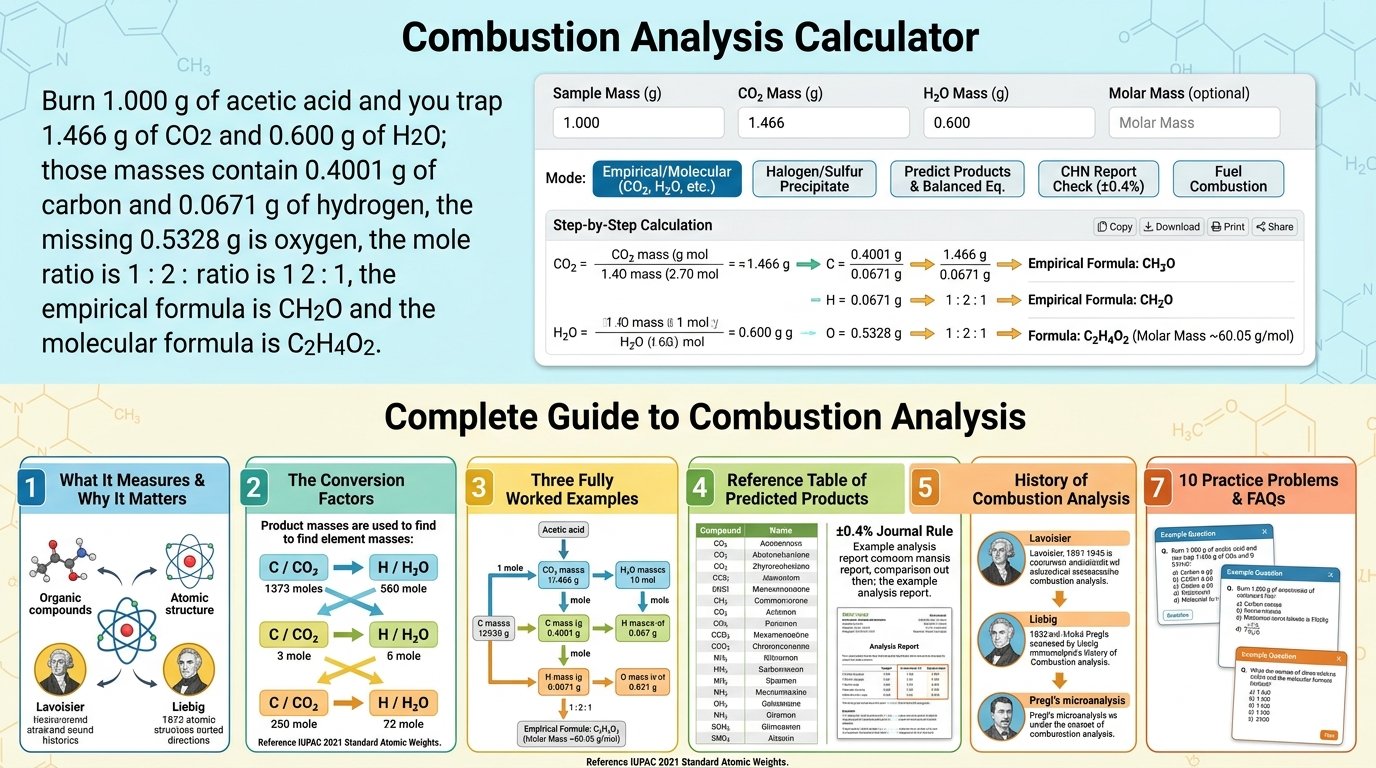
A combustion analysis calculator turns the two numbers a combustion train gives you — the mass of carbon dioxide and the mass of water collected when a weighed sample burns in excess oxygen — into the empirical formula, and with a molar mass the molecular formula, of the compound. Burn 1.000 g of acetic acid and you trap 1.466 g of CO2 and 0.600 g of H2O; those masses contain 0.4001 g of carbon and 0.0671 g of hydrogen, the missing 0.5328 g is oxygen, the mole ratio is 1 : 2 : 1, the empirical formula is CH2O and the molecular formula is C2H4O2. That chain of arithmetic is what this page teaches and what the free combustion analysis calculator above performs, with every step written out.
The combustion analysis calculator covers the whole family of problems in five modes: empirical and molecular formula from CO2, H2O and optionally N2 and SO2 masses, with oxygen by difference; the same problem when a halogen or sulfur is measured as a silver halide or barium sulfate precipitate; prediction of the products, the oxygen consumed and the balanced equation for any C, H, N, O, S compound; a CHN elemental-analysis report check against the ±0.4% journal rule, including solvates; and fuel combustion, giving the stoichiometric air–fuel ratio, excess air and flue-gas composition. Every mode shows its steps, draws a chart and lets you copy, download, print or share the result.
Below the tool is a complete guide: what combustion analysis measures and why it still matters, the conversion factors that take you from product masses to element masses, three fully worked examples, a reference table of predicted products for thirty-two common compounds, the ±0.4% rule used by journals, the history from Lavoisier and Liebig to Pregl’s microanalysis, ten practice problems with hidden answers and a set of frequently asked questions. All values use IUPAC 2021 standard atomic weights, the same numbers the combustion analysis calculator uses internally.
🔑 KEY TAKEAWAY
Combustion analysis finds the formula of a compound from the masses of CO2 and H2O produced when a weighed sample burns completely. mass C = mass CO2 × 12.011 ÷ 44.009 (= 0.2729 × CO2); mass H = mass H2O × 2.016 ÷ 18.015 (= 0.1119 × H2O); nitrogen comes from N2, sulfur from SO2 or BaSO4, halogens from AgX; oxygen = sample mass − all other elements. Convert each mass to moles, divide by the smallest, multiply to whole numbers → empirical formula; divide the molar mass by the empirical mass to get the multiplier → molecular formula. Example: 1.000 g acetic acid → 1.466 g CO2 and 0.600 g H2O → C 0.4001 g, H 0.0671 g, O 0.5328 g → 0.0333 : 0.0666 : 0.0333 mol → CH2O; 60.05 ÷ 30.03 = 2 → C2H4O2. Use the combustion analysis calculator above to check any problem in seconds.
📑 Table of Contents (click to expand)
- What Is Combustion Analysis?
- How to Use This Combustion Analysis Calculator
- The Five Modes Explained
- The Formulas: From Product Masses to Element Masses
- A Fully Worked Example: Acetic Acid
- Two More Worked Examples: Nicotine and Chlorobenzene
- Oxygen by Difference: Why It Matters
- Nitrogen, Sulfur and Halogens
- From Empirical to Molecular Formula
- Reference Table: Predicted Combustion Products for 32 Compounds
- Reading a CHN Report: The ±0.4% Rule
- Predicting Products, Oxygen Needed and the Balanced Equation
- Fuel Combustion: Air–Fuel Ratio and Flue Gas
- Inside the Apparatus: From Liebig’s Train to the CHN Analyser
- Who Uses a Combustion Analysis Calculator?
- Step-by-Step Walkthrough in the Tool
- A Short History: Lavoisier, Liebig and Pregl
- Limitations and Sources of Error
- Practice Problems (With Answers)
- Tips for Accurate Results
- Common Mistakes
- How This Calculator Is Different
- Where the Numbers Come From
- Exam Checklist
- Frequently Asked Questions
- 10 Facts Worth Knowing
- Final Thoughts
What Is Combustion Analysis?
Combustion analysis is the classic method for finding the elemental composition — and from it the empirical formula — of an organic compound. A precisely weighed sample, typically 1–3 mg in a modern instrument or a few hundred milligrams in the old glass trains, is burned completely in a stream of pure oxygen at 900–1000 °C. Every carbon atom leaves as CO2, every hydrogen atom as H2O, nitrogen as N2 after the nitrogen oxides are reduced over hot copper, and sulfur as SO2. The products are separated and weighed (or, in a CHN analyser, measured by thermal conductivity), and because each product carries a fixed fraction of its element, the mass of every element in the original sample follows directly.
Oxygen is the one element that cannot be measured this way: the sample burns in oxygen, so oxygen in the products comes from both the compound and the gas stream. Instead, oxygen is found by difference — the sample mass minus the masses of all the elements that were measured. That single subtraction is where most textbook errors happen, and it is why a good combustion analysis calculator always shows it explicitly.
The output of the experiment is a set of element masses. The output of the calculation is a formula. The bridge between them is the mole: divide each element mass by its atomic weight, divide all the mole numbers by the smallest, and clear any fractions by multiplying. If the molar mass is known from mass spectrometry, freezing-point depression or vapour density, one more division gives the molecular formula. The combustion analysis calculator on this page runs that bridge in both directions — data to formula, and formula back to the products you should expect.
How to Use This Combustion Analysis Calculator
Pick a mode with the pill tabs at the top of the combustion analysis calculator:
- Formula from CO2 & H2O — type the sample mass, the CO2 and H2O masses, and if you have them the N2 and SO2 masses. Choose grams or milligrams, say whether the compound may contain oxygen, add the molar mass if known, and press Calculate.
- With Halogen / Sulfur — the same combustion data plus a second sample that was converted to AgCl, AgBr, AgI or BaSO4. The tool scales the precipitate result to the combustion sample automatically.
- Predict Products — enter a formula and a sample mass; get the masses of CO2, H2O, N2 and SO2, the oxygen consumed, the air required and the balanced equation.
- CHN Report Check — enter a proposed formula and the found % C, H, N, S from an analytical report; the tool calculates the theoretical values, flags every element outside ±0.4% and suggests a water or solvent count that would fit.
- Fuel & Flue Gas — enter a fuel formula and either the excess air or the O2 reading from a flue-gas analyser; get the stoichiometric air–fuel ratio, CO2 per kilogram and the dry and wet flue-gas percentages.
Every mode of the combustion analysis calculator has example chips that fill the fields with a classic textbook problem so you can see the expected answer, a Reset button that clears only that panel, and an Enter-key shortcut. Results appear in a highlighted answer box, followed by numbered steps, a table and a bar chart. The toolbar copies the result as text, downloads CSV or TXT, prints a clean report or shares to WhatsApp, Facebook, X or the native share sheet. The last twelve calculations are kept in a history list on your own device.
The Five Modes Explained
Mode 1 — Empirical and molecular formula from CO2 and H2O
The core combustion analysis calculator problem. The tool converts each product mass to an element mass with the fixed fractions 12.011/44.009 for carbon, 2.016/18.015 for hydrogen, 1 for N2 and 32.06/64.064 for SO2, subtracts to find oxygen if you allow it, converts to moles, finds the smallest whole-number ratio (testing multipliers up to 12 to clear fractions such as 1.5 or 1.333) and, if a molar mass is supplied, the molecular formula. If the measured element masses exceed the sample mass, or if you tell the tool the compound has no oxygen but 2% or more of the mass is unaccounted for, it stops and says so.
Mode 2 — Combustion plus a halogen or sulfur precipitate
Chlorine, bromine and iodine are not measured by burning; a separate portion is decomposed (the Carius tube or Schöniger flask) and the halide is weighed as silver halide. Sulfur may be weighed as BaSO4. Because the two portions rarely have the same mass, the combustion analysis calculator scales the halogen mass from the precipitate sample to the combustion sample before combining the two data sets, then proceeds exactly as in Mode 1. Oxygen is off by default here, since most halogen problems are halocarbons; switch it on for compounds such as chloroacetic acid.
Mode 3 — Predict the products
The inverse problem, and the best way to check a data set before an exam or to plan an experiment. Type C6H12O6 and 1.500 g and the tool returns 2.199 g CO2, 0.900 g H2O, 1.599 g of O2 consumed and the balanced equation C6H12O6 + 6 O2 → 6 CO2 + 6 H2O, with fractional coefficients doubled where needed, as in 2 C8H18 + 25 O2 → 16 CO2 + 18 H2O.
Mode 4 — CHN report check
Journals ask that found values agree with calculated values to within ±0.4 percentage points. The combustion analysis calculator computes the theoretical percentages for your proposed formula (with any number of water or solvent molecules), compares them with the found values, colours each element pass or fail, and if the plain formula fails it searches 0.5 to 3 solvate molecules for a count that would bring every element inside tolerance. Caffeine found at C 45.30, H 5.70, N 26.40 fails as C8H10N4O2 but fits perfectly as the monohydrate.
Mode 5 — Fuel combustion and flue gas
Engineers use the same stoichiometry to size burners and tune boilers. Enter a fuel such as CH4, C8H18 or C12H23 and the excess air; the tool returns the stoichiometric air–fuel ratio by mass (17.23 : 1 for methane), the kilograms of CO2 per kilogram of fuel, and the flue-gas composition on a dry and a wet basis. Enter a measured O2 percentage instead and the combustion analysis calculator back-calculates the excess air — 3.83% O2 in dry methane flue gas means 20% excess air.
The Formulas: From Product Masses to Element Masses
Each combustion product carries a fixed mass fraction of the element it came from. That fraction is simply the mass of the element in one mole of the product divided by the molar mass of the product:
Then the standard empirical-formula routine: n(element) = m(element) ÷ atomic weight; divide every n by the smallest n; if a ratio lands near 1.5, 1.33, 1.25 or 1.2, multiply the whole set by 2, 3, 4 or 5. The molecular multiplier is the molar mass divided by the empirical formula mass, rounded to the nearest whole number. The combustion analysis calculator prints each of these lines with your numbers substituted, so a graded answer can be copied straight from the steps box.
Two checks are worth building into the habit whenever you use a combustion analysis calculator or work by hand. First, the element masses must add up to no more than the sample mass; if they exceed it, a product was over-weighed or the sample was under-weighed. Second, the percent composition implied by the element masses (mass of element ÷ sample mass × 100) should look like a real compound — 40% C, 6.7% H and 53% O is a carbohydrate, 93.7% C and 6.3% H is an aromatic hydrocarbon. Our percent composition calculator works the formula-to-percent direction if you want to cross-check.
A Fully Worked Example: Acetic Acid
A 1.000 g sample of a compound containing only C, H and O is burned completely, producing 1.466 g of CO2 and 0.600 g of H2O. The molar mass is 60.05 g/mol. Find the empirical and molecular formulas.
Step 1 — Carbon from CO2. m(C) = 1.466 × 12.011 / 44.009 = 0.4001 g.
Step 2 — Hydrogen from H2O. m(H) = 0.600 × 2.016 / 18.015 = 0.0671 g.
Step 3 — Oxygen by difference. m(O) = 1.000 − 0.4001 − 0.0671 = 0.5328 g.
Step 4 — Moles. C 0.4001/12.011 = 0.03331; H 0.0671/1.008 = 0.06661; O 0.5328/15.999 = 0.03330.
Step 5 — Divide by the smallest (0.03330). C 1.000; H 2.000; O 1.000 → empirical formula CH2O, empirical mass 30.03 g/mol.
Step 6 — Molecular formula. n = 60.05 / 30.03 = 2.00 → C2H4O2, acetic acid. Percent composition: C 40.01%, H 6.71%, O 53.28%.
Notice how much of the sample was oxygen — more than half. Had the problem said “a hydrocarbon” and you forgot to check the mass balance, you would have tried to build a formula from 0.4672 g of a 1.000 g sample. The combustion analysis calculator guards against this: with oxygen switched off and a third of the mass missing, it refuses to continue and tells you how many grams are unaccounted for.
Two More Worked Examples: Nicotine and Chlorobenzene
Example 2 — A nitrogen compound (nicotine)
1.000 g of nicotine gives 2.7127 g CO2, 0.7773 g H2O and 0.1727 g N2. The molar mass is 162.24 g/mol.
m(C) = 2.7127 × 0.27292 = 0.7404 g; m(H) = 0.7773 × 0.11191 = 0.0870 g; m(N) = 0.1727 g. Sum = 1.0001 g — equal to the sample mass, so there is no oxygen. Moles: C 0.06164, H 0.08629, N 0.01233. Divide by 0.01233: C 5.00, H 7.00, N 1.00 → C5H7N (81.12 g/mol). Multiplier 162.24 / 81.12 = 2 → C10H14N2. In the combustion analysis calculator the oxygen line reads “essentially zero” and the formula is printed without O.
Example 3 — A chlorine compound (chlorobenzene)
0.500 g of a compound gives 1.173 g CO2 and 0.2001 g H2O. A separate 0.500 g portion, decomposed and treated with silver nitrate, gives 0.6367 g AgCl. M = 112.56 g/mol.
m(C) = 1.173 × 0.27292 = 0.3201 g; m(H) = 0.2001 × 0.11191 = 0.0224 g; m(Cl) = 0.6367 × 35.45 / 143.32 = 0.1575 g (same sample mass, so no scaling). Sum = 0.5000 g, no oxygen. Moles: C 0.02665, H 0.02221, Cl 0.004443. Divide by 0.004443: C 6.00, H 5.00, Cl 1.00 → C6H5Cl, empirical mass 112.56 — identical to the molar mass, so the molecular formula is the same. Mode 2 of the combustion analysis calculator reproduces this in one click from the “Chlorobenzene” chip.
Oxygen by Difference: Why It Matters
Because the sample is burned in a stream of oxygen, the oxygen in the CO2 and H2O comes partly from the compound and partly from the gas. There is no way to tell the two apart by weighing the products, so oxygen is never measured directly in a classical combustion analysis; it is what is left after every other element has been accounted for. This has three practical consequences.
- You must know the sample mass. The masses of CO2 and H2O alone give you the C : H ratio but not the oxygen. A problem that omits the sample mass is asking for a hydrocarbon formula, or is incomplete.
- All errors pile into oxygen. If the CO2 absorber gained 1% too much mass, carbon is 1% high and oxygen carries the whole error with the opposite sign. Oxygen by difference is the least reliable number in the analysis, which is why modern laboratories sometimes run a separate pyrolysis (oxygen-mode) determination.
- “Contains only C and H” is a claim to test. Add the element masses; if they fall short of the sample by more than the balance uncertainty, the compound contains something else — usually oxygen. The combustion analysis calculator makes this test automatically and reports the unaccounted mass.
A useful sanity check: a pure hydrocarbon has C + H = 100% of the sample, alcohols and ethers are roughly 20–35% oxygen, carbohydrates and carboxylic acids 50–55%. If your oxygen by difference comes out at 70% for a compound described as an ester, look for an arithmetic slip before you look for a new compound.
Nitrogen, Sulfur and Halogens
Nitrogen. In the Dumas method — and in every modern CHN analyser — the nitrogen oxides formed on combustion are passed over hot copper, which reduces them to N2. The gas is either collected over concentrated KOH and its volume measured, or detected by thermal conductivity. Because N2 is the element itself, m(N) = m(N2): no conversion factor. If the problem gives a volume of nitrogen at STP instead, convert first: 1 mol N2 = 28.014 g occupies 22.414 L at 0 °C and 1 atm. The older Kjeldahl method converts nitrogen to ammonia and titrates it; it gives m(N) directly and slots into the same calculation.
Sulfur. Sulfur burns to SO2 (with a little SO3 that instruments reduce or catalytically fix). Either the SO2 is weighed — m(S) = m(SO2) × 32.06/64.064 — or, in the gravimetric tradition, the sulfur is oxidised to sulfate and weighed as BaSO4, in which case m(S) = m(BaSO4) × 32.06/233.386 = 0.1374 × m(BaSO4). Mode 1 of the combustion analysis calculator takes the SO2 mass; Mode 2 takes the barium sulfate.
Halogens. Chlorine, bromine and iodine survive combustion as HX and, in a plain train, would contaminate the water absorber. They are therefore determined on a separate portion: in the Carius method the sample is heated with fuming nitric acid and silver nitrate in a sealed tube; in the Schöniger flask it is burned over an alkaline absorber and the halide precipitated afterwards. The silver halide is dried and weighed: m(Cl) = m(AgCl) × 35.45/143.32 = 0.2473 × m(AgCl); m(Br) = m(AgBr) × 79.904/187.774 = 0.4255 × m(AgBr); m(I) = m(AgI) × 126.904/234.77 = 0.5405 × m(AgI). Since the halogen portion and the combustion portion usually differ in mass, express the halogen as a fraction of its own portion and multiply by the combustion sample mass before adding it to the mass balance — the combustion analysis calculator prints this scaling factor so you can see it.
Fluorine, phosphorus and metals need other methods (ion-selective electrode, colorimetry, ICP or ashing) and are entered as element masses if you have them; the empirical-formula step is the same. For percentages rather than masses, our empirical formula calculator accepts % C, % H and so on directly.
From Empirical to Molecular Formula
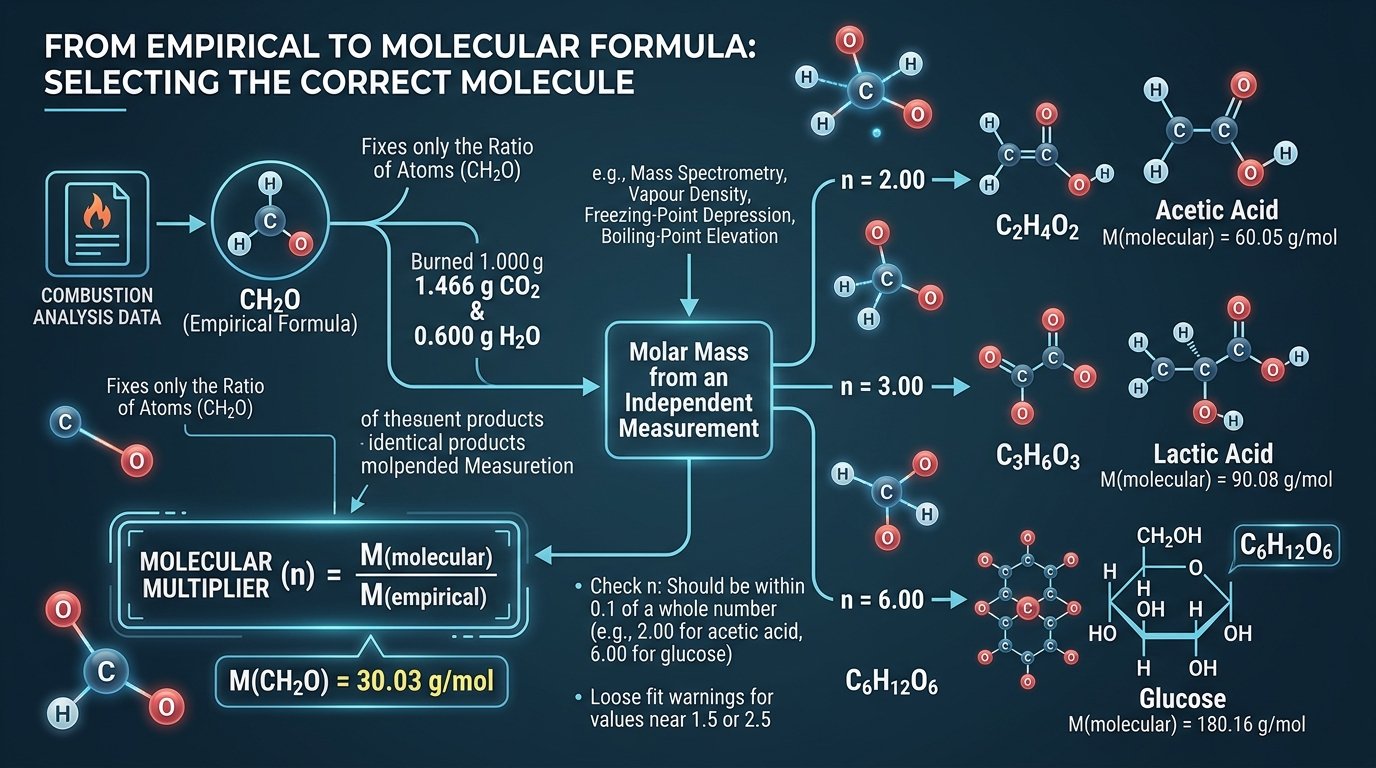
Combustion data — whether from a laboratory train or a combustion analysis calculator — fix only the ratio of atoms. CH2O is the empirical formula of formaldehyde (30.03 g/mol), acetic acid (60.05), lactic acid (90.08), glucose (180.16) and a dozen other compounds; the products of burning 1.000 g of any of them are the same 1.466 g CO2 and 0.600 g H2O. To choose between them you need the molar mass from an independent measurement — mass spectrometry today, and historically vapour density, freezing-point depression, boiling-point elevation or osmotic pressure, each of which has its own calculator on this site.
The molecular multiplier is n = M(molecular) ÷ M(empirical). It should come out within about 0.1 of a whole number; 2.00 for acetic acid, 6.00 for glucose, 2.00 for nicotine (162.24 / 81.12). If n lands near 2.5 or 1.5 the empirical formula itself is probably wrong — go back to the ratio step and try a larger multiplier. The combustion analysis calculator reports n to two decimals before rounding so you can see how clean the fit is, and warns when the fit is loose.
Two special cases deserve a mention before you trust any combustion analysis calculator output. Sometimes the molar mass is only approximate (from a vapour-density experiment, say, with 5% error); then round n to the nearest integer and recompute M from the molecular formula to see whether the approximate value is consistent. And sometimes the empirical mass already equals the molar mass, as with chlorobenzene above; n = 1 and the two formulas coincide. For the full treatment of this step, see our molecular formula calculator.
Reference Table: Predicted Combustion Products for 32 Compounds
The table gives, for each compound, the grams of CO2 and H2O produced per gram of sample burned, together with the percent composition a CHN analyser should report. Use it to check a homework data set, to recognise a compound from its products, or to set a trap for yourself: pick a row, multiply by any sample mass, and feed the products back into Mode 1 of the combustion analysis calculator. Every value was computed with IUPAC 2021 atomic weights.
| Compound | Formula | M (g/mol) | g CO2 per g | g H2O per g | % C | % H | Other % |
|---|---|---|---|---|---|---|---|
| Methane | CH4 | 16.043 | 2.7432 | 2.2458 | 74.87 | 25.13 | — |
| Ethane | C2H6 | 30.070 | 2.9271 | 1.7973 | 79.89 | 20.11 | — |
| Propane | C3H8 | 44.097 | 2.9940 | 1.6341 | 81.71 | 18.29 | — |
| Butane | C4H10 | 58.124 | 3.0286 | 1.5497 | 82.66 | 17.34 | — |
| Octane | C8H18 | 114.232 | 3.0821 | 1.4193 | 84.12 | 15.88 | — |
| Ethene | C2H4 | 28.054 | 3.1374 | 1.2843 | 85.63 | 14.37 | — |
| Ethyne | C2H2 | 26.038 | 3.3804 | 0.6919 | 92.26 | 7.74 | — |
| Benzene | C6H6 | 78.114 | 3.3804 | 0.6919 | 92.26 | 7.74 | — |
| Toluene | C7H8 | 92.141 | 3.3434 | 0.7821 | 91.25 | 8.75 | — |
| Naphthalene | C10H8 | 128.174 | 3.4335 | 0.5622 | 93.71 | 6.29 | — |
| Methanol | CH4O | 32.042 | 1.3735 | 1.1245 | 37.49 | 12.58 | O 49.93 |
| Ethanol | C2H6O | 46.069 | 1.9106 | 1.1731 | 52.14 | 13.13 | O 34.73 |
| Acetic acid | C2H4O2 | 60.052 | 1.4657 | 0.6000 | 40.00 | 6.71 | O 53.28 |
| Ethyl acetate | C4H8O2 | 88.106 | 1.9980 | 0.8179 | 54.53 | 9.15 | O 36.32 |
| Acetone | C3H6O | 58.080 | 2.2732 | 0.9305 | 62.04 | 10.41 | O 27.55 |
| Diethyl ether | C4H10O | 74.123 | 2.3749 | 1.2152 | 64.82 | 13.60 | O 21.58 |
| Glucose | C6H12O6 | 180.156 | 1.4657 | 0.6000 | 40.00 | 6.71 | O 53.28 |
| Sucrose | C12H22O11 | 342.297 | 1.5428 | 0.5789 | 42.11 | 6.48 | O 51.41 |
| Aspirin | C9H8O4 | 180.159 | 2.1985 | 0.4000 | 60.00 | 4.48 | O 35.52 |
| Ascorbic acid | C6H8O6 | 176.124 | 1.4993 | 0.4091 | 40.92 | 4.58 | O 54.50 |
| Citric acid | C6H8O7 | 192.123 | 1.3744 | 0.3751 | 37.51 | 4.20 | O 58.29 |
| Menthol | C10H20O | 156.269 | 2.8162 | 1.1528 | 76.86 | 12.90 | O 10.24 |
| Vanillin | C8H8O3 | 152.149 | 2.3140 | 0.4736 | 63.15 | 5.30 | O 31.55 |
| Urea | CH4N2O | 60.056 | 0.7328 | 0.5999 | 20.00 | 6.71 | N 46.65 · O 26.64 |
| Caffeine | C8H10N4O2 | 194.194 | 1.8130 | 0.4638 | 49.48 | 5.19 | N 28.85 · O 16.48 |
| Nicotine | C10H14N2 | 162.236 | 2.7127 | 0.7773 | 74.03 | 8.70 | N 17.27 |
| Paracetamol | C8H9NO2 | 151.165 | 2.3291 | 0.5363 | 63.56 | 6.00 | N 9.27 · O 21.17 |
| Glycine | C2H5NO2 | 75.067 | 1.1725 | 0.6000 | 32.00 | 6.71 | N 18.66 · O 42.63 |
| Aniline | C6H7N | 93.129 | 2.8354 | 0.6770 | 77.38 | 7.58 | N 15.04 |
| Pyridine | C5H5N | 79.102 | 2.7818 | 0.5694 | 75.92 | 6.37 | N 17.71 |
| Methionine | C5H11NO2S | 149.208 | 1.4748 | 0.6641 | 40.25 | 7.43 | N 9.39 · S 21.49 · O 21.45 |
| Thiophene | C4H4S | 84.136 | 2.0923 | 0.4282 | 57.10 | 4.79 | S 38.10 |
Patterns worth noticing: hydrocarbons produce more than 3 g of CO2 per gram (methane 2.74 g is the exception because a quarter of its mass is hydrogen); every compound with the empirical formula CH2O — acetic acid, glucose — produces exactly 1.4657 g CO2 and 0.600 g H2O per gram; and the water yield tracks the hydrogen content, from 0.47 g for vanillin to 2.25 g for methane. Halogen compounds are omitted from the table because their halogen is measured separately; run them in Mode 2 of the combustion analysis calculator instead.
Reading a CHN Report: The ±0.4% Rule
When a research group submits a new compound to a journal, the editors want evidence that the material is what the authors say it is and that it is pure. The traditional evidence is a CHN (or CHNS) analysis: the found percentages of carbon, hydrogen and nitrogen must agree with the values calculated from the proposed formula to within ±0.4 percentage points for each element. The rule is a convention rather than a law of nature, and it is debated, but it remains in the author guidelines of most chemistry journals.
Take caffeine, C8H10N4O2, M = 194.19 g/mol, and follow the same arithmetic the combustion analysis calculator uses. Calculated: C 8 × 12.011 / 194.194 = 49.48%; H 10 × 1.008 / 194.194 = 5.19%; N 4 × 14.007 / 194.194 = 28.85%. A report of C 49.31, H 5.22, N 28.70 differs by −0.17, +0.03 and −0.15 — all inside the window, so the analysis supports the formula. A report of C 45.30, H 5.70, N 26.40 misses by more than four points on carbon. That does not mean the compound is wrong; it means the sample was not anhydrous caffeine. Add one water: C8H10N4O2·H2O (212.21 g/mol) calculates to C 45.28, H 5.70, N 26.40, a perfect fit for the monohydrate.
Mode 4 of the combustion analysis calculator automates this reasoning: it computes the theoretical percentages, colours each element pass or fail against your tolerance (0.4 by default; tighten to 0.3 for a journal that asks for it), and when the plain formula fails it tries 0.5, 1, 1.5, 2, 2.5 and 3 molecules of the solvent you name — water by default, or CH2Cl2, EtOAc, hexane — and tells you which count would bring every element inside tolerance. Fractional solvates are real: half a molecule of dichloromethane per formula unit is common in crystals grown from that solvent.
Three things a pass does not prove. It does not prove purity below about 1–2%, because the method is not sensitive enough. It does not distinguish isomers, which have identical composition. And it does not rule out a mixture that happens to average to the right numbers. It is a necessary check, not a sufficient one — which is why journals also want NMR and mass spectra.
Predicting Products, Oxygen Needed and the Balanced Equation
The forward calculation is ordinary stoichiometry. For a compound CaHbNcOdSe burned completely:
Glucose, 1.500 g, exactly as the combustion analysis calculator reports it: n = 1.500 / 180.156 = 0.008326 mol; CO2 = 6 × 0.008326 × 44.009 = 2.199 g; H2O = 6 × 0.008326 × 18.015 = 0.900 g; O2 consumed = 6 × 0.008326 × 31.998 = 1.599 g. Mass balance: 1.500 + 1.599 = 3.099 g in, 2.199 + 0.900 = 3.099 g out. TNT, C7H5N3O6, 0.300 g: 0.4069 g CO2, 0.0595 g H2O, 0.0555 g N2, and only 0.222 g of external O2 because the molecule carries so much of its own oxygen — the reason it is an explosive.
Mode 3 of the combustion analysis calculator prints the balanced equation with whole-number coefficients (doubling when b/4 or d/2 is fractional), the product masses, the oxygen consumed and the mass of air that carries that oxygen (air is 23.14% O2 by mass). It accepts C, H, N, O and S; halogen compounds are refused here because their products (HCl, Cl2) depend on conditions.
Fuel Combustion: Air–Fuel Ratio and Flue Gas
The same equation that gives the analytical chemist a formula gives the combustion engineer an air requirement. For methane, CH4 + 2 O2 → CO2 + 2 H2O: one mole of fuel (16.043 g) needs 2 mol of O2 (63.996 g). Air is 20.95% O2 by volume and 23.14% by mass, so the stoichiometric air is 63.996 / 0.2315 = 276.5 g per 16.043 g of methane — an air–fuel ratio of 17.23 : 1 by mass. Octane gives 15.13 : 1, ethanol 9.00 : 1 (it carries its own oxygen), pure carbon 11.51 : 1. Every kilogram of methane releases 2.743 kg of CO2; every kilogram of octane 3.082 kg; every kilogram of coal carbon 3.664 kg.
Real burners — and the fuel mode of the combustion analysis calculator — run with excess air to make sure every fuel molecule meets enough oxygen. Excess air dilutes the flue gas and shows up as free O2 on the analyser. For methane with 20% excess air the dry flue gas is 9.56% CO2, 3.83% O2 and the rest nitrogen; at stoichiometric it is 11.70% CO2 and 0% O2. Boiler technicians use this the other way round: a reading of 3.8–4.0% O2 on a natural-gas boiler means about 20% excess air, a typical tuning target; 8% O2 means far too much air and heat going up the stack.
Mode 5 of the combustion analysis calculator does both directions. Give it the fuel and the excess air and it returns the air–fuel ratio, CO2 per kilogram, the dry-basis and wet-basis flue-gas percentages and, if you enter a fuel mass, the kilograms of air and products. Give it the measured O2 instead and it solves for the excess air. It handles gaseous, liquid and solid fuels by formula — C12H23 for diesel, C8H18 for petrol, C2H6O for ethanol, plain C for coke — and the stoichiometry calculator covers any reaction beyond combustion.
Inside the Apparatus: From Liebig’s Train to the CHN Analyser
The classical combustion train that generations of students drew in their notebooks has four parts. An oxygen supply, dried and purified. A combustion tube packed with copper(II) oxide, heated to red heat, in which the weighed sample (in a small boat) is burned; the CuO supplies extra oxygen and guarantees complete oxidation of any CO to CO2. A water absorber — a U-tube of anhydrous magnesium perchlorate or calcium chloride — weighed before and after. And a CO2 absorber — soda lime or Ascarite (NaOH on asbestos) — also weighed before and after. The order matters: water first, because the CO2 absorber also traps water. Two weighings give two masses, and the combustion analysis calculator does the rest.
A modern CHN analyser miniaturises and automates the same chemistry. A 1–3 mg sample in a tin capsule drops into a furnace at about 1000 °C; the tin flashes exothermically and raises the local temperature to 1800 °C in a pulse of pure oxygen. The gases pass over oxidation catalysts, then over hot copper to reduce nitrogen oxides to N2 and remove excess oxygen. A gas chromatography column or a set of selective traps separates N2, CO2, H2O and SO2, and a thermal-conductivity detector measures each one. The instrument is calibrated with a standard of known composition (acetanilide, C8H9NO: C 71.09%, H 6.71%, N 10.36%) and reports percentages directly — which is why Mode 4 takes percentages while Modes 1 and 2 take masses.
Oxygen, when it is needed directly rather than by the difference a combustion analysis calculator computes, is done by pyrolysis in the absence of oxygen: the sample is cracked over carbon at 1060–1100 °C so that all its oxygen becomes CO, which is then measured. This closes the mass balance independently and is the check that catches an unexpected element.
Who Uses a Combustion Analysis Calculator?
- Students in first-year chemistry, where the combustion problem is the standard test of stoichiometry; in organic chemistry, where it introduces structure determination; and in analytical courses, where the apparatus itself is examined.
- Synthetic chemists checking that a new compound’s CHN report satisfies the ±0.4% rule before submission, or working out how much solvent a crystal retains.
- Pharmaceutical analysts confirming the hydration state of an active ingredient, since a monohydrate and an anhydrate differ in dose per milligram.
- Materials and polymer scientists determining the composition of copolymers, carbon fibres and doped carbons where NMR is unhelpful.
- Soil, fuel and environmental laboratories reporting total carbon, nitrogen and sulfur in soils, coals, biomass and sediments.
- Combustion and HVAC engineers sizing air supply, estimating CO2 emissions per unit of fuel and interpreting flue-gas analyser readings.
- Teachers and tutors who need a data set that comes out to clean whole-number ratios — Mode 3 of the combustion analysis calculator generates one from any formula.
Step-by-Step Walkthrough in the Tool
Suppose the problem is: 0.2500 g of vanillin gives 0.5785 g CO2 and 0.1184 g H2O; M = 152.15 g/mol.
- Open the combustion analysis calculator and stay on the first tab, Formula from CO2 & H2O.
- Type 0.2500 in Mass of sample burned, 0.5785 in Mass of CO2, 0.1184 in Mass of H2O. Leave N2 and SO2 blank.
- Keep the unit at grams and Oxygen in the compound at “Yes, by difference”. Enter 152.15 as the molar mass.
- Press Calculate. The answer box reads: empirical formula C8H8O3, molecular formula C8H8O3.
- Read the steps: C 0.1579 g, H 0.0133 g, O by difference 0.0789 g; moles 0.01315, 0.01315, 0.00493; ratio 2.667 : 2.667 : 1 → ×3 → 8 : 8 : 3; n = 152.15 / 152.15 = 1.
- The table lists each element’s mass, moles, ratio and percent; the bar chart shows the percent composition (C 63.15%, H 5.30%, O 31.55%).
- Use Copy to paste the working into a lab notebook, TXT or CSV to save it, or Print for a clean one-page report. The calculation is saved in the history strip; Reset clears the panel for the next problem.
The 2.667 ratio is a good example of why the multiplier search matters: a student who rounds 2.67 to 3 gets C3H3O, which has the wrong C : O ratio; the combustion analysis calculator recognises 2.667 as 8/3 and multiplies by 3.
A Short History: Lavoisier, Liebig and Pregl
Long before any combustion analysis calculator, Antoine Lavoisier burned alcohol and oils in the 1780s and weighed the water and “fixed air” produced, establishing that organic matter is made of carbon, hydrogen and oxygen — but his apparatus was unwieldy and his results rough. Joseph Louis Gay-Lussac and Louis Jacques Thénard improved the method with potassium chlorate as oxidant in 1810, and Jöns Jacob Berzelius made it quantitative enough to support his tables of atomic weights.
The decisive step was Justus von Liebig’s Kaliapparat of 1831: a five-bulb glass vessel filled with potassium hydroxide solution that absorbed CO2 quantitatively and could simply be weighed. With copper(II) oxide as the oxidant and calcium chloride for water, Liebig’s train reduced an analysis from days to under an hour and made it reliable enough for students. The five-bulb shape is still the emblem of the American Chemical Society. Jean-Baptiste Dumas added the nitrogen determination in 1833, reducing nitrogen oxides over copper and collecting N2 over potash.
Fritz Pregl, at Graz, scaled the whole procedure down between 1911 and 1917 so that 2–5 mg of sample sufficed, using a microbalance sensitive to a microgram. Micro-analysis made it possible to characterise the tiny quantities of natural products — hormones, vitamins, alkaloids — that biochemists were isolating, and Pregl received the 1923 Nobel Prize in Chemistry for it. The automated CHN analyser of the 1960s replaced the absorption tubes with a thermal-conductivity detector; the arithmetic that a combustion analysis calculator performs has not changed since Liebig.
Limitations and Sources of Error
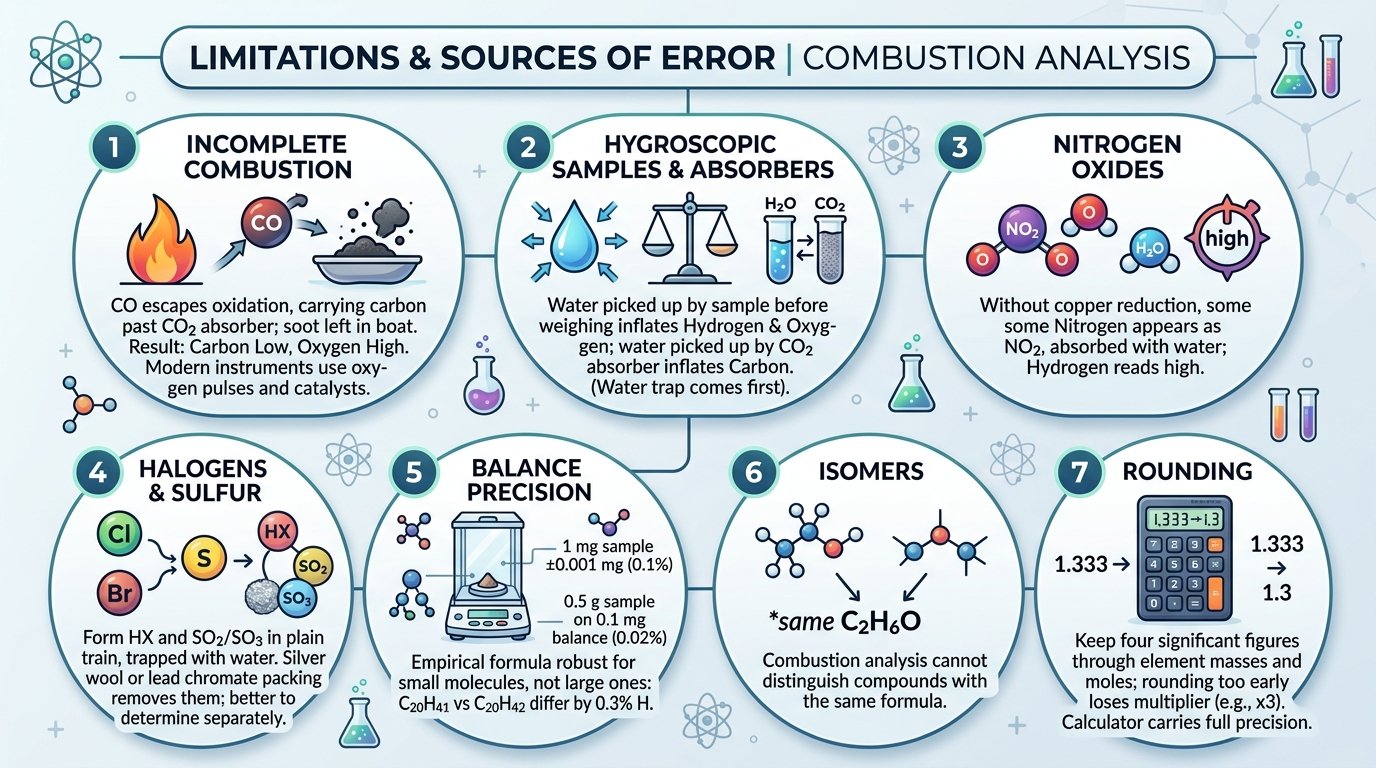
- Incomplete combustion. Any CO that escapes oxidation carries carbon past the CO2 absorber; soot left in the boat does the same. Result: carbon low, oxygen by difference high. Modern instruments use oxygen pulses and catalysts to prevent this.
- Hygroscopic samples and absorbers. Water picked up by the sample before weighing inflates the hydrogen and oxygen; water picked up by the CO2 absorber inflates carbon. This is why the water trap comes first.
- Nitrogen oxides. Without the copper reduction stage, some nitrogen appears as NO2, is absorbed with the water, and hydrogen reads high.
- Halogens and sulfur in a plain train form HX and SO2/SO3 that are trapped with the water. Silver wool or lead chromate packing removes them; better still, determine them separately as Mode 2 assumes.
- Balance precision. A 1 mg sample weighed to ±0.001 mg is 0.1%; a 0.5 g sample on a 0.1 mg balance is 0.02%. The empirical formula is robust to 1% errors for small molecules but not for large ones: C20H41 and C20H42 differ by 0.3% in hydrogen.
- Isomers. Combustion analysis cannot distinguish compounds with the same formula — ethanol and dimethyl ether both give C2H6O.
- Rounding. Keep four significant figures through the element masses and moles; rounding to two before dividing by the smallest turns 1.333 into 1.3 and loses the ×3 multiplier. The combustion analysis calculator carries full precision and rounds only for display.
Practice Problems (With Answers)
Work each problem by hand first, then verify with the free combustion analysis calculator above. Answers are hidden until you click.
Problem 1 — A 0.1500 g sample of a hydrocarbon gives 0.5150 g CO2 and 0.0843 g H2O. Empirical formula? If M = 128.17 g/mol, molecular formula?
C = 0.5150 × 0.2729 = 0.1406 g (0.01170 mol); H = 0.0843 × 0.1119 = 0.00943 g (0.00936 mol). Sum 0.1500 g — no oxygen. Ratio 1.25 : 1 → ×4 → C5H4 (64.09). n = 128.17/64.09 = 2 → C10H8, naphthalene. Mode 1, oxygen set to No.
Problem 2 — 0.3000 g of urea gives 0.2198 g CO2, 0.1800 g H2O and 0.1399 g N2. Find the empirical formula.
C 0.0600 g (0.004994 mol); H 0.02014 g (0.01998 mol); N 0.1399 g (0.009988 mol); O by difference 0.3000 − 0.2200 = 0.0800 g (0.004998 mol). Divide by 0.004994: 1 : 4 : 2 : 1 → CH4N2O. Mode 1 with the N2 field filled.
Problem 3 — How many grams of CO2 and H2O are produced when 0.300 g of aspirin, C9H8O4, burns completely?
n = 0.300/180.159 = 0.001665 mol. CO2 = 9 × 0.001665 × 44.009 = 0.6596 g; H2O = 4 × 0.001665 × 18.015 = 0.1200 g. Mode 3.
Problem 4 — A 0.250 g sample of thiophene gives 0.5231 g CO2 and 0.1071 g H2O; a second 0.250 g portion gives 0.6935 g BaSO4. Empirical formula?
C 0.1428 g (0.01189 mol); H 0.01199 g (0.01189 mol); S = 0.6935 × 0.1374 = 0.09527 g (0.002971 mol). Sum 0.2500 g, no oxygen. Divide by 0.002971: 4 : 4 : 1 → C4H4S. Mode 2 with BaSO4 selected.
Problem 5 — A CHN report for a compound claimed to be paracetamol, C8H9NO2, reads C 63.40, H 6.10, N 9.20. Does it pass the ±0.4% test?
M = 151.165. Calculated: C 63.56%, H 6.00%, N 9.27%. Differences −0.16, +0.10, −0.07 — all within 0.4, pass. Mode 4.
Problem 6 — 11.5 mg of a compound gives 21.97 mg CO2 and 13.49 mg H2O; M = 46.07 g/mol. Molecular formula?
C 5.996 mg (0.4992 mmol); H 1.510 mg (1.498 mmol); O 11.5 − 7.506 = 3.994 mg (0.2497 mmol). Ratio 2 : 6 : 1 → C2H6O (46.07) → n = 1 → C2H6O, ethanol or dimethyl ether. Mode 1 in milligrams.
Problem 7 — What is the stoichiometric air–fuel ratio (by mass) for octane, C8H18, and how much CO2 is released per kilogram?
C8H18 + 12.5 O2 → 8 CO2 + 9 H2O. O2 per kg fuel = 12.5 × 31.998 / 114.232 = 3.501 kg; air = 3.501 / 0.2314 = 15.13 kg per kg. CO2 = 8 × 44.009 / 114.232 = 3.082 kg per kg. Mode 5.
Problem 8 — 0.2000 g of vitamin C gives 0.2999 g CO2 and 0.0818 g H2O; M = 176.12 g/mol. Molecular formula?
C 0.08185 g (0.006815 mol); H 0.009154 g (0.009081 mol); O 0.1090 g (0.006813 mol). Ratio 1 : 1.333 : 1 → ×3 → C3H4O3 (88.06). n = 176.12/88.06 = 2 → C6H8O6, ascorbic acid. Mode 1.
Problem 9 — A methane boiler’s analyser reads 4.0% O2 (dry). Roughly what excess air is it running, and what CO2 reading should accompany it?
For CH4, 20% excess air gives 3.83% O2 and 9.56% CO2 dry; 4.0% O2 corresponds to about 21% excess air and roughly 9.5% CO2. Mode 5, “Measured O2” field.
Problem 10 — 0.2500 g of aniline gives 0.7088 g CO2, 0.1693 g H2O and 0.0376 g N2. Empirical formula, and is there any oxygen?
C 0.1935 g (0.01611 mol); H 0.01895 g (0.01880 mol); N 0.0376 g (0.002684 mol). Sum 0.2500 g → no oxygen. Divide by 0.002684: 6 : 7 : 1 → C6H7N (93.13, which is also the molar mass). Mode 1.
Tips for Accurate Results
- Write the mass balance first. Sample mass on the left, element masses on the right. Whatever is missing is oxygen (or an error). This one line prevents most wrong answers.
- Use the conversion fractions, not memorised percentages. 12.011/44.009 and 2.016/18.015 with four figures; 0.27 and 0.11 are not accurate enough for a molecular formula.
- Keep the product masses in the same unit as the sample. Milligrams throughout or grams throughout; the combustion analysis calculator has a unit switch so you never convert by hand.
- Do not round the mole ratio too early. 1.33 means ×3, 1.25 means ×4, 1.5 means ×2, 1.67 means ×3. A ratio of 1.1 or 1.9 usually means an arithmetic error, not a multiplier.
- Check n before you trust the molecular formula. M / M(empirical) should be within 0.1 of an integer.
- For halogen problems, scale the second portion. Cl as a fraction of the Carius sample, then times the combustion sample mass.
- Sanity-check the percent composition. Compare with the reference table above; a “sugar” at 75% carbon is not a sugar.
- Save the steps. Copy or print the working from the combustion analysis calculator so you can show the method, not just the answer.
Common Mistakes
| Mistake | What goes wrong | Fix |
|---|---|---|
| Using the CO2 mass as the carbon mass | Carbon 3.7 times too high; the mass balance goes negative | Multiply by 12.011/44.009 |
| Using 1.008/18.015 for hydrogen | Hydrogen halved; ratios such as C2H3O instead of C2H6O | Water has two H: 2.016/18.015 |
| Finding oxygen from the O in CO2 and H2O | Counts the oxygen from the gas stream; wildly high O | Oxygen only by difference from the sample mass |
| Forgetting oxygen altogether | Acetic acid comes out as CH2 | Check whether C + H (+N, S) equals the sample mass |
| Converting N2 with a factor | Nitrogen halved | N2 is 100% nitrogen; m(N) = m(N2) |
| Adding the AgCl result from a different sample mass without scaling | Chlorine too high or too low by the mass ratio | Scale by m(combustion sample)/m(halogen sample) |
| Rounding 1.33 or 1.5 to a whole number | Wrong empirical formula, then wrong multiplier | Multiply the whole set by 2, 3 or 4 |
| Reporting the empirical formula as the molecular formula | CH2O instead of C6H12O6 | Divide the molar mass by the empirical mass and multiply |
How This Calculator Is Different
| Feature | This calculator | Generic combustion analysis tool | By hand |
|---|---|---|---|
| CO2/H2O → empirical and molecular formula with every step | ✅ element masses, moles, ratio, multiplier search, n | ⚠️ formula only | ✅ slow |
| N2 and SO2 masses, oxygen by difference with mass-balance check | ✅ plus unaccounted-mass warning | ⚠️ C, H, O only | ⚠️ easy to forget |
| Halogen / sulfur precipitates with second-sample scaling | ✅ AgCl, AgBr, AgI, BaSO4 | ❌ | ✅ |
| Predict products, O2 and air needed, balanced equation | ✅ whole-number coefficients | ❌ | ✅ |
| CHN report check with ±0.4% rule and solvate search | ✅ pass/fail per element, hydrate hint | ❌ | ⚠️ tedious |
| Fuel air–fuel ratio, excess air and flue gas | ✅ both directions (excess air ↔ O2) | ❌ | ✅ |
| Bar chart, table, CSV/TXT, print, share, history, reset | ✅ | ❌ | ❌ |
| IUPAC 2021 atomic weights, grams or milligrams | ✅ | ⚠️ varies | ⚠️ depends on your table |
This combustion analysis calculator is one of a family of free tools on molecularweightcalculator.org. Start with the molecular weight calculator for any formula’s molar mass, the atomic mass calculator for individual elements and the formula weight calculator for salts. Combustion data feed straight into the empirical formula calculator, the molecular formula calculator and the percent composition calculator. The molar mass you need for the molecular formula can come from the vapor density calculator, the molar mass from gas density calculator, the freezing point depression calculator, the boiling point elevation calculator or the osmotic pressure calculator. For the mass spectrometry route use the exact mass calculator, the monoisotopic mass calculator, the isotopic mass calculator and the guide to average vs monoisotopic mass. Related stoichiometry lives in the stoichiometry calculator, the grams to moles calculator, the molarity calculator, the molar mass of hydrates calculator, the equivalent weight calculator and the van der Waals equation calculator. Gas mixtures and fuels connect to the average molecular weight of a mixture, and the polymer set — number average, weight average, polydispersity index and molecular weight from viscosity — covers materials whose composition is often confirmed by CHN analysis.
Where the Numbers Come From
The atomic weights in this combustion analysis calculator are the IUPAC 2021 standard atomic weights as published by the Commission on Isotopic Abundances and Atomic Weights, using the conventional value for elements given as an interval: H 1.008, C 12.011, N 14.007, O 15.999, S 32.06, Cl 35.45, Br 79.904, I 126.904, Ag 107.868, Ba 137.327. The derived molar masses are CO2 44.009, H2O 18.015, N2 28.014, SO2 64.064, O2 31.998, AgCl 143.32, AgBr 187.774, AgI 234.77 and BaSO4 233.386 g/mol. Air is taken as 20.95% O2 by volume with a mean molar mass of 28.96 g/mol, giving 23.14% O2 by mass and 3.773 mol N2 (plus argon) per mol O2. Every example on this page was recomputed with these values; where a textbook quotes 0.273 or 0.2727 for the carbon fraction of CO2 the difference is rounding or an older atomic weight, not data.
If you spot a discrepancy worth checking, our corrections policy explains how reports are handled, and the contact page is the fastest route to us. More about the site and its author is on the about page.
Trusted external references for further combustion analysis calculator reading:
- LibreTexts — Determining Empirical and Molecular Formulas (libretexts.org): textbook treatment of combustion analysis with worked examples
- IUPAC CIAAW — Standard Atomic Weights (ciaaw.org): the atomic weights used in every calculation on this page
- Wikipedia — Combustion analysis (wikipedia.org): history, apparatus and modern instrumentation
- The Nobel Prize in Chemistry 1923 — Fritz Pregl (nobelprize.org): the invention of organic micro-analysis
Exam Checklist
Frequently Asked Questions
What does a combustion analysis calculator do?
It converts the masses of CO2, H2O (and N2, SO2 or a precipitate) produced when a weighed sample burns into the mass and moles of each element, finds oxygen by difference, reduces the mole ratio to whole numbers to give the empirical formula, and uses the molar mass to give the molecular formula. This one also predicts products, checks CHN reports and computes air–fuel ratios.
How do I find the mass of carbon from the mass of CO2?
Multiply by the mass fraction of carbon in CO2: 12.011 / 44.009 = 0.2729. So 1.466 g of CO2 contains 0.4001 g of carbon. For hydrogen multiply the water mass by 2.016 / 18.015 = 0.1119.
Why is oxygen found by difference in combustion analysis?
Because the sample is burned in oxygen, the oxygen in the products comes from both the compound and the gas stream and cannot be separated by weighing. Oxygen is therefore taken as the sample mass minus the masses of all the other elements. If that difference is zero, the compound contains no oxygen.
Can combustion analysis give the molecular formula?
Not alone. It gives the empirical formula, the simplest whole-number ratio. To get the molecular formula you also need the molar mass, from mass spectrometry, vapour density or a colligative property; divide it by the empirical formula mass and multiply the subscripts. Enter the molar mass in the combustion analysis calculator and it does this step for you.
How is nitrogen measured in combustion analysis?
The nitrogen oxides formed on burning are reduced to N2 over hot copper (the Dumas method) and the gas is measured by volume or thermal conductivity. Because N2 is pure nitrogen, the mass of nitrogen equals the mass of N2 collected — no conversion factor is needed.
How are chlorine and sulfur handled?
A separate portion is decomposed (Carius tube or Schöniger flask) and the halogen precipitated as AgCl, AgBr or AgI; sulfur can be weighed as SO2 or as BaSO4. Mass of Cl = mass of AgCl × 35.45/143.32 = 0.2473 × AgCl; mass of S = BaSO4 × 0.1374. Scale the result to the combustion sample mass before adding it to the mass balance.
What is the ±0.4% rule for CHN analysis?
Most chemistry journals require that the found percentage of each element agree with the value calculated from the proposed formula to within 0.4 percentage points as evidence of identity and purity. Caffeine calculated C 49.48%, found 49.31% passes (difference 0.17); found 45.30% fails unless the sample is the monohydrate (calculated 45.28%).
How much CO2 does burning one gram of glucose produce?
1.466 g. Glucose is 40.00% carbon by mass, and each gram of carbon becomes 44.009/12.011 = 3.664 g of CO2; 0.4000 × 3.664 = 1.466 g. It also produces 0.600 g of water and consumes 1.066 g of oxygen.
What is the stoichiometric air–fuel ratio of methane?
17.23 kg of air per kg of methane by mass (9.55 mol of air per mol of fuel). Each kilogram of methane releases 2.743 kg of CO2 and 2.246 kg of water. With 20% excess air the dry flue gas contains 9.56% CO2 and 3.83% O2.
Is this combustion analysis calculator free, and does it store my data?
Yes, it is free with no sign-up. All calculations run in your browser; nothing is sent to a server. The history list is saved only in your own browser’s local storage and can be cleared with one click.
10 Facts Worth Knowing
- Carbon is exactly 27.29% of the mass of CO2 and hydrogen 11.19% of the mass of water — the two numbers behind every combustion analysis calculator.
- Liebig’s five-bulb Kaliapparat of 1831, which absorbed the CO2, is still the logo of the American Chemical Society.
- Fritz Pregl won the 1923 Nobel Prize in Chemistry for shrinking the analysis to a few milligrams of sample.
- A modern CHN analyser burns the sample in a tin capsule whose flash oxidation briefly reaches about 1800 °C.
- Oxygen is the only common element in organic compounds that a combustion train cannot measure directly.
- Formaldehyde, acetic acid, lactic acid and glucose all give identical combustion data per gram: they share the empirical formula CH2O.
- Acetanilide (C 71.09%, H 6.71%, N 10.36%) is the standard most CHN laboratories use to calibrate their instruments.
- Burning one kilogram of methane produces 2.74 kg of CO2; one kilogram of coal carbon produces 3.66 kg.
- The ±0.4% agreement rule for CHN data has been in journal author guidelines for more than a century and is still debated.
- Ethanol needs only 9.0 kg of air per kilogram, against 15.1 for petrol, because oxygen already makes up a third of its mass.
Final Thoughts
Combustion analysis — and the combustion analysis calculator that automates it — is two centuries old and still the first quantitative test a new organic compound faces. The experiment is elegant — burn it, weigh the smoke — and the calculation is a straight line from product masses to element masses to moles to a formula, with one subtraction for oxygen along the way. The places students stumble are always the same: the conversion fractions, the mass balance, the multiplier that clears 1.33, and the extra molar mass needed for a molecular formula. The worked examples, the reference table and the practice problems above are meant to make each of those steps automatic.
Whenever you need to check a data set, predict what a compound should give, read a CHN report or size the air for a burner, the free combustion analysis calculator at the top of this page will do the arithmetic and show its working. Bookmark it, share it with a study group, and if a problem behaves strangely, use the mass balance line to find out why.
Ahmad Raza, M.Phil. Chemistry
Founder & Lead Author, molecularweightcalculator.org · ✓ Verified Expert
Ahmad has taught general and analytical chemistry for over a decade and has run more CHN samples than he cares to count. He builds every calculator on this site from the underlying stoichiometry, checks each one against textbook and literature data, and writes the guides so that the method — not just the answer — is what you take away.