
Normality Calculator
Normality (N) = gram equivalents of solute ÷ litres of solution = molarity × n-factor. Type a formula and this normality calculator finds the equivalent weight and n-factor automatically (acids, bases, salts, oxidising and reducing agents), converts molarity to normality and back, works out the grams needed to prepare a solution of given normality, solves titration problems with N1V1 = N2V2, and handles dilutions.
✓ Trusted by students, teachers & analytical chemistsNormality from Mass of Solute and Volume of Solution
Enter the solute, its mass and the final solution volume. The normality calculator looks up the molar mass, works out the n-factor for the reaction type you choose (or auto-detects it), computes the equivalent weight and gives normality, molarity and g/L.
Convert Molarity to Normality (or Normality to Molarity)
N = M × n-factor and M = N ÷ n-factor. Give the formula so the n-factor and equivalent weight are found automatically, or type the n-factor yourself for redox reagents.
Grams Needed to Prepare a Solution of Given Normality
Mass = N × V(L) × equivalent weight. Give the target normality, the volume and the solute (with optional purity % for impure or hydrated reagents).
Titration: N₁V₁ = N₂V₂
At the equivalence point the equivalents of the two reactants are equal, whatever the mole ratio. Leave exactly one of the four boxes empty and the normality calculator solves for it. Optionally give the analyte formula to also get its mass and molarity.
Dilution (N₁V₁ = N₂V₂) and Mixing Two Solutions
Dilute a stock to a lower normality (volume of stock needed and water to add), or mix two solutions of the same solute and get the resulting normality. Equivalents are conserved in both cases.
🕘 Recent calculations
- No calculations yet — your last 10 results will appear here.
Formulas: normality N = equivalents / L = (mass / equivalent weight) / L · equivalent weight = molar mass / n-factor · n-factor = replaceable H+ (acids), OH− or H+ accepted (bases), total positive charge (salts), electrons gained or lost per formula unit (redox) · N = M × n · mass to prepare = N × V(L) × Ew ÷ purity · titration and dilution: N1V1 = N2V2 · mixing: N = (N1V1 + N2V2) / (V1 + V2) · IUPAC 2021 atomic weights. Auto-detection assumes complete neutralisation (e.g. H3PO4 n = 3, Na2CO3 n = 2); choose the redox or custom option for other cases.
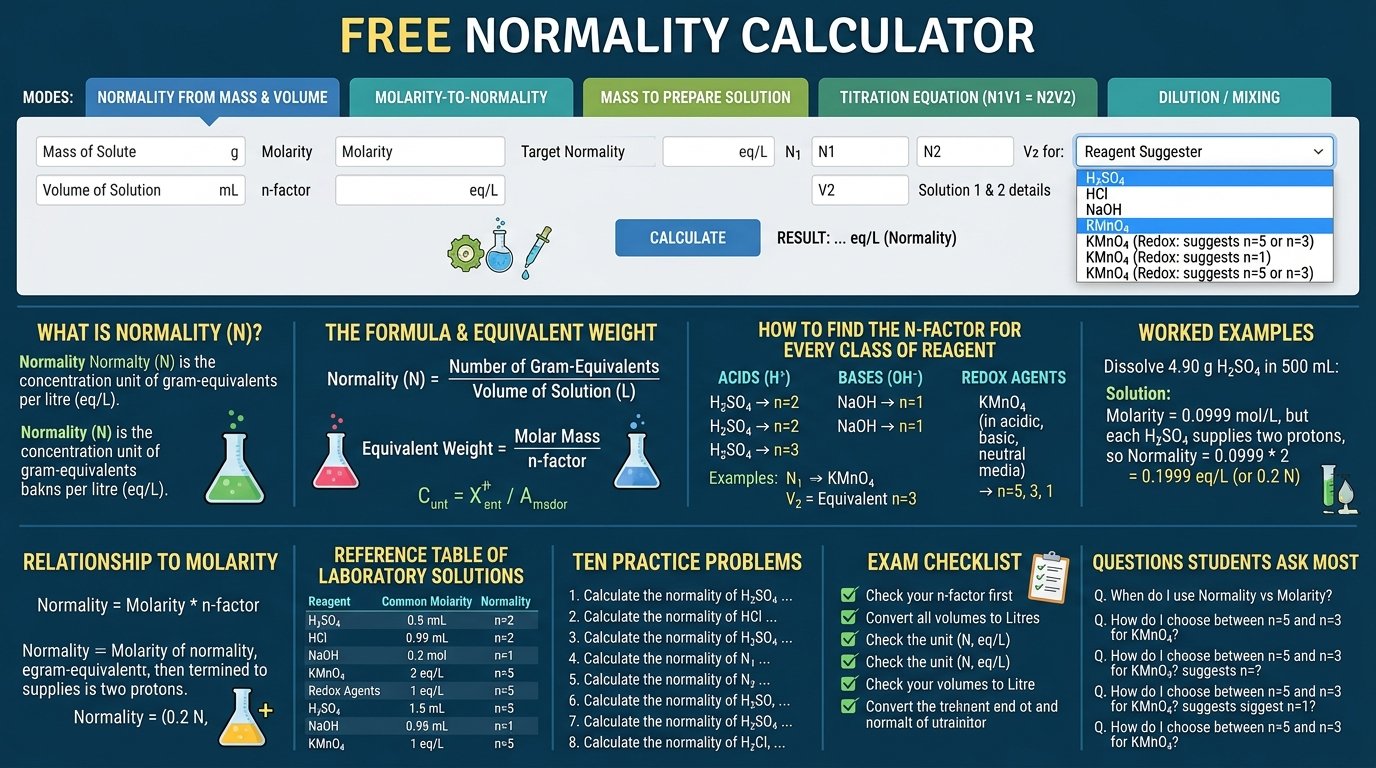
A normality calculator converts the mass of an acid, base, salt or oxidising agent into gram-equivalents per litre — the concentration unit that makes titration arithmetic trivial, because at the end point the equivalents of acid always equal the equivalents of base. Dissolve 4.90 g of sulfuric acid in 500 mL and the molarity is 0.0999 mol/L, but because each H2SO4 supplies two protons the normality is twice that: 0.1999 eq/L, or “0.2 N”.
The free normality calculator on this page has five modes: normality from mass and volume, molarity-to-normality conversion (and back) using the n-factor, the mass needed to prepare a solution of chosen normality, the titration equation N1V1 = N2V2 solved for any unknown, and dilution or mixing of two solutions. It recognises the common acids, bases and redox reagents and suggests the correct n-factor, so you are never guessing whether KMnO4 is 5 or 3 equivalents.
Below the tool: what normality is, the formula and the equivalent weight it depends on, how to find the n-factor for every class of reagent, worked examples, the relationship to molarity, a reference table of laboratory solutions, ten practice problems, an exam checklist and the questions students ask most.
Key Takeaway
Normality (N) = equivalents of solute ÷ litres of solution = Molarity × n-factor. The n-factor is the number of H+ an acid gives, OH− a base gives, electrons a redox reagent transfers, or the total positive charge of a salt. So 0.5 M H2SO4 = 1.0 N, 0.1 M H3PO4 = 0.3 N, and 0.02 M KMnO4 in acid = 0.1 N. At the end point of any titration N1V1 = N2V2. The normality calculator above finds the n-factor and does the rest.
📑 Table of Contents (click to expand)
- What Is a Normality Calculator?
- How to Use the Normality Calculator
- The Five Modes Explained
- The Normality Formula and Equivalent Weight
- How to Find the n-Factor
- Worked Example: H₂SO₄ Step by Step
- Normality vs Molarity
- More Worked Examples
- Titrations: N₁V₁ = N₂V₂
- Redox Normality
- Dilution and Mixing
- Reference Table: Common Solutions
- Preparing a Standard Solution
- Why Normality Depends on the Reaction
- Is Normality Still Used?
- Who Uses a Normality Calculator
- Full Walkthrough: An Exam Problem
- A Short History of the Equivalent
- Limits and Assumptions
- Practice Problems With Answers
- Tips for Accurate Results
- Common Mistakes
- How This Calculator Is Different
- Where the Numbers Come From
- Exam Checklist
- Frequently Asked Questions
- 10 Facts Worth Knowing
- Final Thoughts
What Is a Normality Calculator?
Normality is a concentration expressed in equivalents of solute per litre of solution. An equivalent is the amount of a substance that supplies one mole of the reacting unit — one mole of H+ in an acid-base reaction, one mole of electrons in a redox reaction, one mole of positive charge in a precipitation or exchange reaction. A normality calculator therefore needs two things a molarity calculator does not: the reaction the solute will take part in, and the resulting n-factor (equivalents per mole).
The appeal is practical. Molarity tells you how many molecules are present; normality tells you how much reacting power is present. One litre of 1 N acid neutralises exactly one litre of 1 N base, whatever the acid and whatever the base. That is why volumetric analysis was built on normality for over a century, and why titration formulas written in N have no stoichiometric ratio to remember.
A normality calculator does the bookkeeping: it turns grams into moles with the molar mass, moles into equivalents with the n-factor, and equivalents into eq/L with the volume. It also reports the equivalent weight — the molar mass divided by the n-factor — which is the number you actually weigh out in the lab.
Vocabulary in one place
n-factor (valence factor) — equivalents per mole: protons donated, hydroxides supplied, electrons transferred, or total cation charge.
Equivalent weight — molar mass ÷ n-factor, in g/eq. For H2SO4: 98.08 ÷ 2 = 49.04 g/eq.
Gram-equivalent — grams ÷ equivalent weight = moles × n-factor.
Normality — gram-equivalents ÷ litres of solution, written N or eq/L.
How to Use the Normality Calculator
- Pick a mode — Normality (from mass), Molarity ↔ Normality, Mass Needed, Titration or Dilution & Mixing.
- Enter the solute as a formula (
H2SO4,Ca(OH)2,KMnO4,Na2CO3) or as a molar mass. The normality calculator parses the formula, looks up IUPAC 2021 atomic weights and, for the common reagents, fills in the usual n-factor with a note explaining it. - Check the n-factor. It is the one chemical decision the tool cannot make for you in every case: KMnO4 is 5 in acid, 3 in neutral solution, 1 in strong base. Override the suggestion when your reaction is different.
- Enter masses and volumes with units (g, mg, kg; mL, L).
- Press Calculate. The normality appears in blue with the molarity and equivalent weight beneath, then the formula with numbers substituted, a table and a chart. Copy, CSV, TXT, print and share buttons follow; each mode has its own Reset; the last ten results are kept in the history box.
The example chips load the classic cases — 0.1 N sulfuric acid, 0.1 N permanganate, sodium carbonate primary standard, an HCl/NaOH titration — so you can see the normality calculator’s working before typing your own.
The Five Modes Explained
| Mode | You enter | Formula used | You get |
|---|---|---|---|
| 1. Normality | Solute, n-factor, mass, volume | N = (g ÷ M) × n ÷ L | N, M, equivalent weight, equivalents |
| 2. Molarity ↔ Normality | M or N, n-factor | N = M × n ; M = N ÷ n | the other unit |
| 3. Mass Needed | Target N, volume, solute, n-factor | g = N × L × (M ÷ n) | grams to weigh out |
| 4. Titration | Any three of N1, V1, N2, V2 | N1V1 = N2V2 | the fourth, plus equivalents reacted |
| 5. Dilution & Mixing | Stock N and target, or two solutions | N1V1 = N2V2 ; Nmix = ΣNiVi ÷ ΣVi | volumes of stock and water, or mixed N |
The Normality Formula and Equivalent Weight
N = equivalents ÷ V (L) = mass (g) ÷ [ Ew (g/eq) × V (L) ]
Ew = M (g/mol) ÷ n-factor N = Molarity × n-factor
Three equivalent ways of writing the same thing, and the normality calculator prints all three so you can use whichever your textbook prefers. The middle one, with the equivalent weight, is the traditional lab form: you weigh out Ew grams per litre for a 1 N solution. The last one is the quick conversion from molarity.
Equivalent weight is the concept doing the work. It is the mass of substance that delivers one mole of reacting units, and it has its own detailed treatment in our equivalent weight calculator. For the normality calculator, the essential point is that Ew is smaller than the molar mass by exactly the n-factor, so normality is larger than molarity by the same factor.
How to Find the n-Factor
| Class of reagent | n-factor is … | Examples |
|---|---|---|
| Acid | replaceable H+ per molecule | HCl 1 · H2SO4 2 · H3PO4 3 (or 1, 2 to a given end point) · CH3COOH 1 · H2C2O4 2 |
| Base | OH− supplied (or H+ accepted) per formula unit | NaOH 1 · Ca(OH)2 2 · Al(OH)3 3 · Na2CO3 2 (to methyl orange) · NH3 1 |
| Salt (precipitation, exchange) | total positive charge per formula unit | NaCl 1 · CaCl2 2 · Al2(SO4)3 6 · AgNO3 1 · CaCO3 2 |
| Oxidising agent | electrons gained per formula unit | KMnO4 5 (acid), 3 (neutral), 1 (base) · K2Cr2O7 6 · I2 2 · Ce4+ 1 · H2O2 2 |
| Reducing agent | electrons lost per formula unit | FeSO4 1 · Na2C2O4 2 · Na2S2O3 1 · Mohr’s salt 1 · SnCl2 2 |
Two rules cover most cases when you feed an n-factor to the normality calculator. For acids and bases, count the protons that actually transfer to the end point you titrate to. For redox reagents, write the half-reaction (the chemical equation balancer will do it for you) and read the electrons; the oxidation number calculator gives the change in oxidation state if you prefer that route. The normality calculator’s built-in list suggests these values but always lets you override them.
Worked Example: 4.90 g H₂SO₄ in 500 mL, Step by Step
Step 1 — molar mass. H2SO4 = 2(1.008) + 32.06 + 4(15.999) = 98.08 g/mol.
Step 2 — n-factor. Diprotic acid, both protons titrated: n = 2.
Step 3 — equivalent weight. 98.08 ÷ 2 = 49.04 g/eq.
Step 4 — equivalents. 4.90 g ÷ 49.04 g/eq = 0.09992 eq.
Step 5 — divide by litres. 0.09992 eq ÷ 0.500 L = 0.1998 N (the normality calculator shows 0.1999 with unrounded intermediates).
Check via molarity. 4.90 ÷ 98.08 = 0.04996 mol; ÷ 0.500 L = 0.0999 M; × 2 = 0.1998 N. ✓
Both routes appear in the normality calculator’s step list, and the table underneath shows moles, equivalents, molarity and normality side by side so the factor of two is visible rather than hidden.
Normality vs Molarity
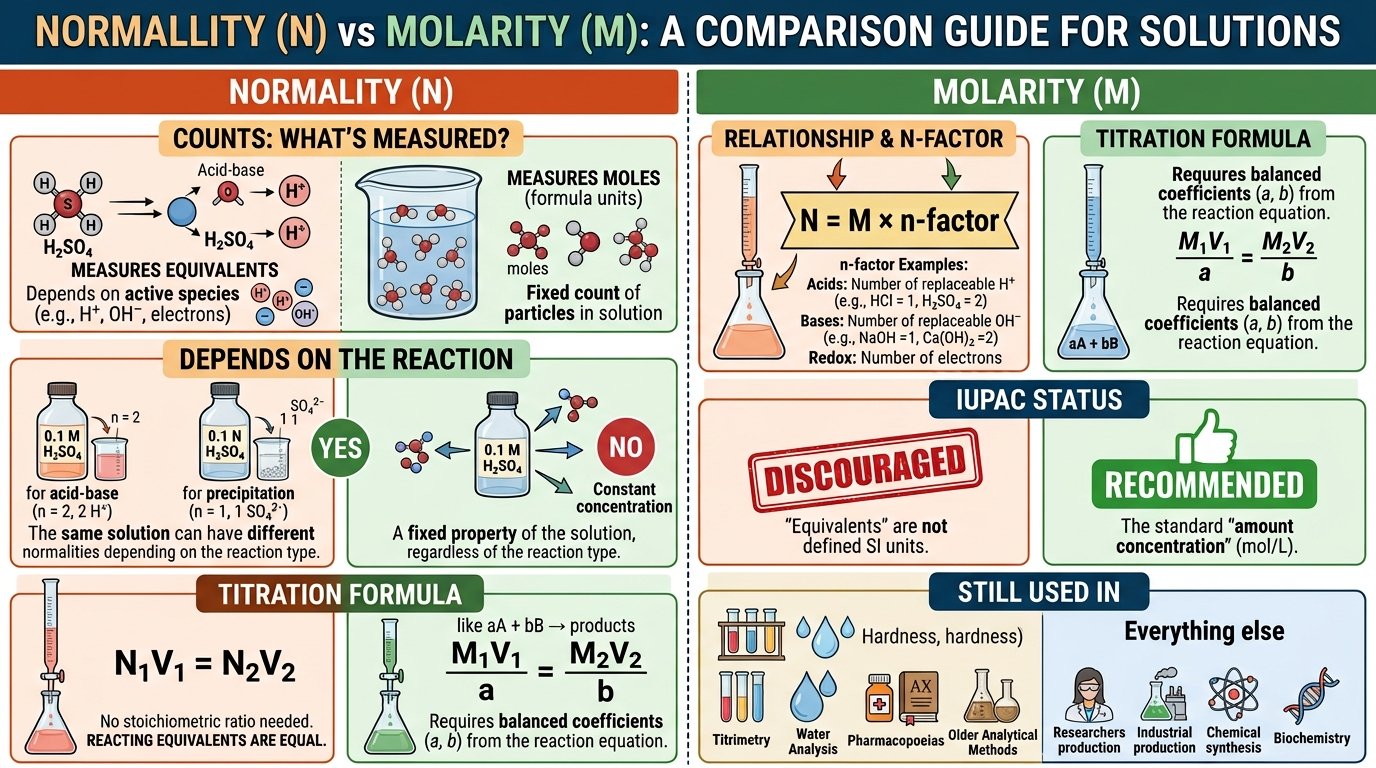
| Property | Normality (N) | Molarity (M) |
|---|---|---|
| Counts | Equivalents (reacting units) | Moles (formula units) |
| Depends on the reaction | Yes — same bottle can be 0.1 N or 0.3 N | No — fixed property of the solution |
| Relation | N = M × n-factor, so N ≥ M always | |
| Titration formula | N1V1 = N2V2 (no ratio) | M1V1/a = M2V2/b (needs coefficients) |
| IUPAC status | Discouraged; equivalents not SI | Recommended (amount concentration) |
| Still used in | Titrimetry, water analysis, pharmacopoeias, older methods | Everything else |
Monoprotic acids and monobasic bases (HCl, HNO3, NaOH, KOH) have n = 1 in the normality calculator, so their normality equals their molarity; the distinction only bites for polyprotic acids, polyvalent bases and redox reagents. Mode 2 of the normality calculator converts either way instantly, and the molarity calculator is the natural companion for the molar side.
More Worked Examples
1. Potassium permanganate for acid titrations — 3.16 g in 1.00 L
M = 158.03 g/mol; n = 5 in acid; Ew = 31.61 g/eq. Equivalents = 3.16 ÷ 31.61 = 0.1000. N = 0.100 N (0.0200 M). The normality calculator’s KMnO4 chip reproduces this and notes that in neutral solution the same bottle is 0.060 N.
2. Sodium carbonate primary standard — 0.1 N, 250 mL
Na2CO3, M = 105.99; n = 2 (both carbonate protons to the methyl-orange end point); Ew = 52.99 g/eq. Mass = 0.1 × 0.250 × 52.99 = 1.325 g. Mode 3.
3. Phosphoric acid — 0.1 M to phenolphthalein
To phenolphthalein only two protons are titrated, so n = 2 and 0.1 M H3PO4 is 0.2 N; to a hypothetical complete neutralisation n = 3 and it would be 0.3 N. The normality calculator lets you set n to the end point you actually use.
4. Calcium hydroxide — 0.74 g in 1.00 L
Ca(OH)2, M = 74.09; n = 2; Ew = 37.05 g/eq. N = 0.74 ÷ 37.05 ÷ 1.00 = 0.0200 N (0.0100 M) — roughly saturated limewater.
5. Aluminium sulfate as a coagulant — 0.05 M
Al2(SO4)3: total positive charge 2 × 3 = 6, so n = 6 and 0.05 M = 0.30 N. Equivalent weight = 342.15 ÷ 6 = 57.03 g/eq.
Titrations: N₁V₁ = N₂V₂
The reason normality survives — and the reason a normality calculator is still worth building — is this equation. At the end point, equivalents of titrant = equivalents of analyte, and equivalents = N × V, so N1V1 = N2V2 with no stoichiometric coefficients at all. Mode 4 of the normality calculator solves it for whichever of the four quantities is missing.
Example. 25.0 mL of sulfuric acid is neutralised by 23.5 mL of 0.100 N NaOH.
Nacid = Nbase × Vbase ÷ Vacid = 0.100 × 23.5 ÷ 25.0 = 0.0940 N.
Because H2SO4 has n = 2, the molarity is 0.0470 M — and notice that in molarity the same calculation needs the 1 : 2 ratio from the balanced equation.
The same equation works for redox titrations provided both normalities are computed for the reaction at hand: 20.0 mL of Fe2+ solution requiring 18.4 mL of 0.100 N KMnO4 is 0.0920 N in iron(II), which for n = 1 is 0.0920 M. The normality calculator reports the equivalents reacted so you can convert to grams of analyte in one more step.
Redox Normality: Electrons Are the Equivalents
In a redox reaction the reacting unit is the electron, and the normality calculator counts electrons as equivalents. Write the half-reaction, count the electrons, and that number is the n-factor:
| Reagent | Half-reaction | n | Ew (g/eq) |
|---|---|---|---|
| KMnO4 (acid) | MnO4− + 8H+ + 5e− → Mn2+ + 4H2O | 5 | 31.61 |
| KMnO4 (neutral) | MnO4− + 2H2O + 3e− → MnO2 + 4OH− | 3 | 52.68 |
| K2Cr2O7 | Cr2O72− + 14H+ + 6e− → 2Cr3+ + 7H2O | 6 | 49.03 |
| I2 | I2 + 2e− → 2I− | 2 | 126.90 |
| Na2S2O3 | 2S2O32− → S4O62− + 2e− | 1 | 158.11 |
| H2C2O4 (as reductant) | C2O42− → 2CO2 + 2e− | 2 | 45.02 |
| FeSO4·7H2O | Fe2+ → Fe3+ + e− | 1 | 278.01 |
The permanganate rows are the classic trap. Oxalic acid is n = 2 as an acid and n = 2 as a reductant (a coincidence), but permanganate is 5, 3 or 1 depending on the medium, and the normality calculator’s note for KMnO4 spells out all three.
Dilution and Mixing
Because normality is proportional to concentration, dilution in the normality calculator follows N1V1 = N2V2 exactly as molarity does. To make 500 mL of 0.1 N from 1 N stock: V1 = 0.1 × 500 ÷ 1 = 50 mL of stock, made up to 500 mL with 450 mL of water. Mode 5 of the normality calculator returns both volumes.
Mixing two solutions of the same solute is a weighted average: Nmix = (N1V1 + N2V2) ÷ (V1 + V2). Mixing 200 mL of 0.5 N with 300 mL of 0.125 N gives (100 + 37.5) ÷ 500 = 0.275 N. Mixing an acid with a base is a neutralisation, not a mixture — the equivalents subtract, and the excess is what remains: 100 mL of 0.2 N HCl + 150 mL of 0.1 N NaOH leaves 20 − 15 = 5 meq of acid in 250 mL, i.e. 0.020 N acid.
Reference Table: Common Laboratory Solutions in the Normality Calculator
| Solute | M (g/mol) | n | Ew (g/eq) | g per L for 1 N | g per L for 0.1 N |
|---|---|---|---|---|---|
| HCl | 36.46 | 1 | 36.46 | 36.46 | 3.646 |
| H2SO4 | 98.08 | 2 | 49.04 | 49.04 | 4.904 |
| HNO3 | 63.01 | 1 | 63.01 | 63.01 | 6.301 |
| H3PO4 (n = 3) | 97.99 | 3 | 32.66 | 32.66 | 3.266 |
| H2C2O4·2H2O | 126.07 | 2 | 63.03 | 63.03 | 6.303 |
| CH3COOH | 60.05 | 1 | 60.05 | 60.05 | 6.005 |
| NaOH | 40.00 | 1 | 40.00 | 40.00 | 4.000 |
| KOH | 56.11 | 1 | 56.11 | 56.11 | 5.611 |
| Ca(OH)2 | 74.09 | 2 | 37.05 | 37.05 | 3.705 |
| Na2CO3 | 105.99 | 2 | 52.99 | 52.99 | 5.299 |
| KMnO4 (acid) | 158.03 | 5 | 31.61 | 31.61 | 3.161 |
| K2Cr2O7 | 294.18 | 6 | 49.03 | 49.03 | 4.903 |
| Na2S2O3·5H2O | 248.18 | 1 | 248.18 | 248.18 | 24.82 |
| AgNO3 | 169.87 | 1 | 169.87 | 169.87 | 16.99 |
| EDTA disodium·2H2O | 372.24 | 2 | 186.12 | 186.12 | 18.61 |
The last two columns are what you weigh into a one-litre volumetric flask. For any other volume or normality, mode 3 of the normality calculator scales them.
Preparing a Standard Solution of Known Normality
- Compute the mass with mode 3 of the normality calculator: g = N × V(L) × Ew. For 250 mL of 0.1 N Na2CO3: 0.1 × 0.250 × 52.99 = 1.325 g.
- Dry the primary standard (Na2CO3 at 270 °C, KHP at 110 °C) and weigh it accurately by difference.
- Dissolve and transfer quantitatively to a volumetric flask; make up to the mark at the calibration temperature; invert twenty times.
- For secondary standards (NaOH, HCl, KMnO4, Na2S2O3), make an approximate solution and standardise it by titration against a primary standard using mode 4.
- Record the exact normality, the date, and — for redox reagents — the reaction it refers to.
Step 5 is the one people skip, and the one the normality calculator refuses to let you skip. A bottle labelled “0.1 N KMnO4” is meaningless without “in acid”; the normality calculator prints the assumed reaction with every result for exactly this reason.
Why Normality Depends on the Reaction
Molarity is a property of the bottle. Normality — and therefore every result of a normality calculator — is a property of the bottle and the reaction you are about to run. The same 0.1 M phosphoric acid is 0.1 N when titrated to the first end point (H3PO4 → H2PO4−), 0.2 N to the second, and 0.3 N if all three protons could be removed. The same 0.02 M permanganate is 0.1 N in acid and 0.06 N in neutral solution.
This is both normality’s strength and the reason IUPAC now discourages it. It is strong because it folds the stoichiometry into the concentration, so titration arithmetic collapses to N1V1 = N2V2. It is weak because a number without its reaction is ambiguous. The normality calculator resolves the ambiguity by asking for the n-factor explicitly and echoing it in the result.
Is Normality Still Used?
Officially, IUPAC and the SI recommend amount concentration (mol/L) and regard the equivalent as an obsolete unit. In practice normality remains everywhere in analytical work: water and wastewater methods report alkalinity and acidity in terms of N solutions; pharmacopoeias specify volumetric solutions as 0.1 N; textile, food and agricultural labs run decades-old methods written in normality; and many national curricula still teach it. A working chemist has to be fluent in both, which is why this normality calculator converts to and from molarity in every mode.
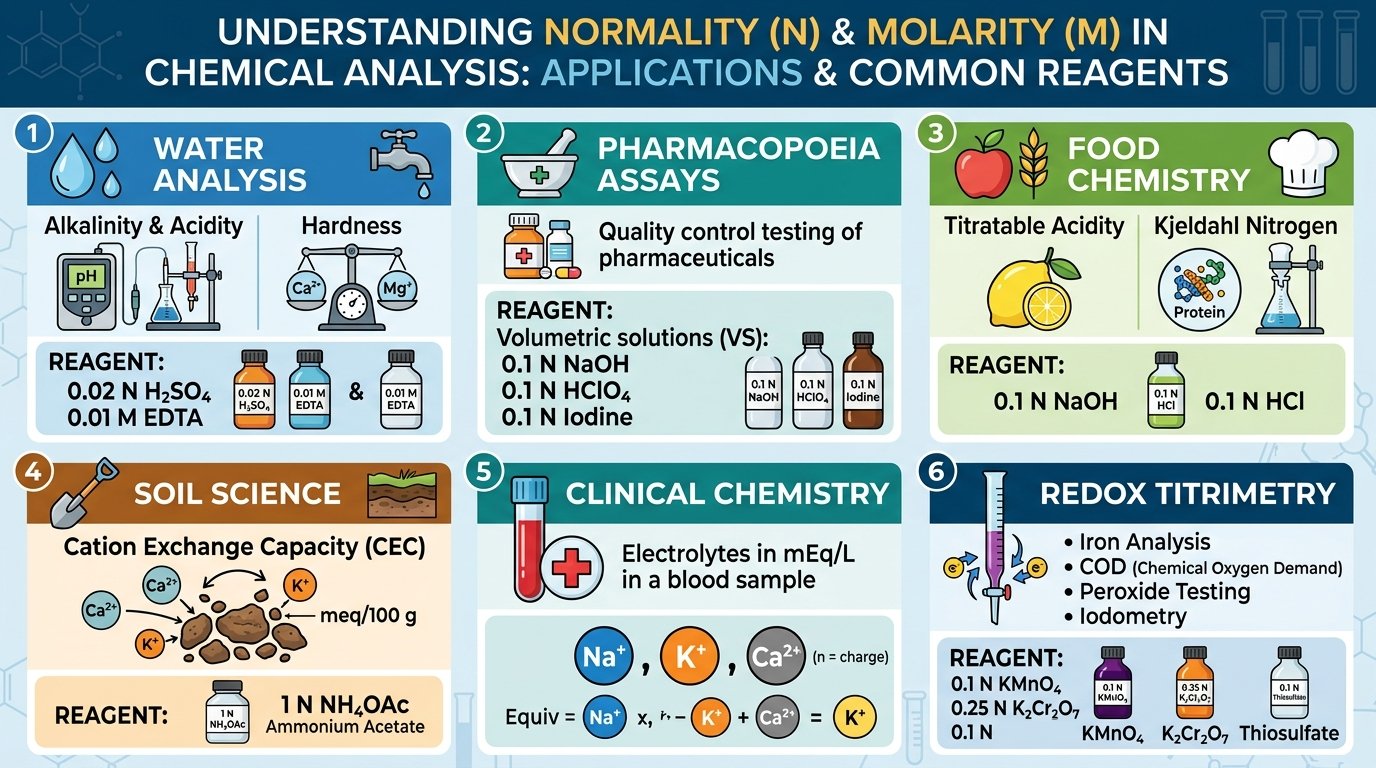
| Field | Typical normality use | Reagent |
|---|---|---|
| Water analysis | Alkalinity, acidity, hardness | 0.02 N H2SO4, 0.01 M EDTA |
| Pharmacopoeia assays | Volumetric solutions (VS) | 0.1 N NaOH, 0.1 N HClO4, 0.1 N iodine |
| Food chemistry | Titratable acidity, Kjeldahl nitrogen | 0.1 N NaOH, 0.1 N HCl |
| Soil science | Cation exchange capacity (meq/100 g) | 1 N NH4OAc |
| Clinical chemistry | Electrolytes in mEq/L | Na+, K+, Ca2+ (n = charge) |
| Redox titrimetry | Iron, COD, peroxide, iodometry | 0.1 N KMnO4, 0.25 N K2Cr2O7, 0.1 N thiosulfate |
Who Uses a Normality Calculator
- Students in school and first-year analytical courses, where normality, equivalent weight and titration problems are examined together.
- Analytical and QC chemists using a normality calculator when preparing and standardising volumetric solutions to a pharmacopoeia or ISO method.
- Water and wastewater technicians running alkalinity, acidity, chloride and COD titrations.
- Food and agriculture labs reporting titratable acidity and protein by Kjeldahl.
- Clinical laboratory staff converting between mmol/L and mEq/L for electrolytes.
- Teachers generating worked answer keys with the n-factor logic spelled out.
Full Walkthrough: An Exam Problem
“A 1.250 g sample of impure oxalic acid dihydrate is dissolved and made up to 250 mL. A 25.0 mL aliquot requires 18.6 mL of 0.0500 N KMnO4 in acid. Find (a) the normality of the oxalic acid solution, (b) its molarity, (c) the percentage purity of the sample.”
(a) N1V1 = N2V2: Nox = 0.0500 × 18.6 ÷ 25.0 = 0.0372 N.
(b) As a reductant oxalic acid has n = 2 (C2O42− → 2CO2 + 2e−). M = 0.0372 ÷ 2 = 0.0186 M.
(c) Moles in 250 mL = 0.0186 × 0.250 = 0.00465 mol; mass of H2C2O4·2H2O = 0.00465 × 126.07 = 0.586 g. Purity = 0.586 ÷ 1.250 = 46.9 %.
Alternative for (c) in equivalents: 0.0372 eq/L × 0.250 L = 0.0093 eq × 63.03 g/eq = 0.586 g. Same answer, no division by n needed.
Mode 4 of the normality calculator gives (a) and mode 2 gives (b); the last line shows the elegance of working in equivalents throughout.
A Short History of the Equivalent
Equivalent weights, the heart of any normality calculator, are older than atomic weights. Jeremias Richter measured the masses of acids and bases that neutralise one another in the 1790s and called the study stoichiometry; William Wollaston published a table of “chemical equivalents” in 1814. Because equivalents could be measured directly by titration while atomic weights depended on disputed formulas, nineteenth-century analysts standardised on the equivalent and the normal solution — Karl Friedrich Mohr’s 1855 textbook of titrimetry made the practice universal.
The mole and the molar solution gained ground after 1900, and once the reaction-dependence of the equivalent was seen as a liability rather than a convenience IUPAC moved to amount-of-substance concentration. The normality calculator exists because the old unit never actually left the laboratory.
Limits and Assumptions
- The n-factor is yours to confirm. The normality calculator suggests standard values, but the correct one depends on the reaction and the end point you use.
- Volume means solution volume, made up to the mark — not volume of solvent added.
- Hydrated reagents must be typed with their water (e.g.
H2C2O4*2H2O); the molar mass changes and so does the equivalent weight. - Mixing mode assumes the same solute (or same reacting unit). Acid + base is a neutralisation, handled by subtracting equivalents.
- Normality is not temperature-independent; like molarity it is per litre. For thermodynamic work use the molality calculator.
Practice Problems With Answers
Solve each, then confirm with the normality calculator.
1. Normality of 0.25 M H2SO4?
Show answer
n = 2. 0.50 N.
2. Equivalent weight of Ca(OH)2?
Show answer
74.09 ÷ 2 = 37.05 g/eq.
3. 5.30 g Na2CO3 in 500 mL, n = 2. Normality?
Show answer
Ew = 52.99; eq = 5.30 ÷ 52.99 = 0.1000; ÷ 0.500 L = 0.200 N.
4. Grams of KMnO4 for 2.00 L of 0.05 N (acid)?
Show answer
0.05 × 2.00 × 31.61 = 3.16 g.
5. 20.0 mL of NaOH needs 24.0 mL of 0.125 N HCl. Normality of the NaOH?
Show answer
0.125 × 24.0 ÷ 20.0 = 0.150 N (= 0.150 M).
6. 0.1 N K2Cr2O7 is what molarity?
Show answer
n = 6. 0.01667 M.
7. Volume of 2.0 N stock to make 250 mL of 0.4 N?
Show answer
0.4 × 250 ÷ 2.0 = 50 mL, plus 200 mL water.
8. 100 mL of 0.3 N + 200 mL of 0.15 N of the same acid. Mixed normality?
Show answer
(30 + 30) ÷ 300 = 0.20 N.
9. Serum calcium is 2.50 mmol/L. In mEq/L?
Show answer
Ca2+, n = 2. 5.00 mEq/L.
10. 25.0 mL of 0.100 N KMnO4 oxidises how many grams of Fe2+?
Show answer
Equivalents = 0.100 × 0.0250 = 0.00250 eq; Fe2+ has n = 1, Ew = 55.845. 0.140 g Fe.
Tips for Accurate Results
- Write the reaction first, before touching the normality calculator. The n-factor comes from it, and so does the choice between 5 and 3 for permanganate.
- Work in milliequivalents for titrations. N × mL = meq, and the numbers stay tidy.
- Use the hydrate’s molar mass when you weigh a hydrate; the normality calculator’s parser accepts the dot or asterisk notation.
- Quote the reaction on the label for every redox and polyprotic standard.
- Sanity-check N ≥ M. If your normality came out smaller than your molarity, the n-factor went on the wrong side.
- Keep four significant figures in molar masses; the normality calculator uses IUPAC 2021 values.
Common Mistakes
| Mistake | Effect | Fix |
|---|---|---|
| Using n = 1 for H2SO4 | Normality halved | Count replaceable protons: 2 |
| KMnO4 n = 5 in neutral solution | Normality 67 % too high | n = 3 when MnO2 forms |
| Dividing molarity by n instead of multiplying | N < M, impossible | N = M × n |
| Anhydrous molar mass for a hydrate | Solution too dilute | Include the water of crystallisation |
| Volume of water instead of volume of solution | Normality slightly high | Make up to the mark |
| Applying the mole ratio as well as N1V1 = N2V2 | Ratio counted twice | The ratio is already inside N |
How This Normality Calculator Is Different
| Feature | This normality calculator | Typical online tool |
|---|---|---|
| Formula parser + IUPAC 2021 atomic weights | ✓ | Molar mass typed by hand |
| Suggested n-factor with the reaction explained | ✓ | ✗ |
| Equivalent weight and molarity in every result | ✓ | Sometimes |
| Titration solver for any unknown; dilution and mixing | ✓ | ✗ |
| Step-by-step working, table and chart | ✓ | Number only |
| Copy, CSV, TXT, print, share, history, per-mode Reset | ✓ | Partial |
| Free, no sign-up, runs in the browser | ✓ | Varies |
The normality calculator is part of a full set of free chemistry tools: the molecular weight calculator, atomic mass calculator, formula weight calculator, grams to moles calculator, mole fraction calculator, ppm to ppb converter, stoichiometry calculator, limiting reactant calculator, theoretical yield calculator, percent yield calculator, atom economy calculator, molar mass of hydrates calculator, exact mass calculator, monoisotopic mass calculator, isotopic mass calculator, average vs monoisotopic mass, empirical formula calculator, molecular formula calculator, percent composition calculator, combustion analysis calculator, degree of unsaturation calculator, formal charge calculator, freezing point depression, boiling point elevation, osmotic pressure, vapor density, molar mass from gas density, van der Waals equation, and the polymer tools — average molecular weight of a mixture, number average, weight average, polydispersity index and viscosity molecular weight.
Where the Numbers Come From
The normality calculator uses IUPAC 2021 standard atomic weights for every molar mass; n-factors follow the standard half-reactions and proton counts given in analytical chemistry references:
- IUPAC Gold Book — amount concentration: the recommended molar unit that normality is converted to and from (Green Book, 2nd ed., p. 42).
- Harvey, Analytical Chemistry 2.1 via LibreTexts — Concentration: normality, equivalents and the n-factor for acid-base, redox and precipitation reactions.
- CIAAW — Standard Atomic Weights: the atomic weights behind every molar mass on this site.
- Wikipedia — Equivalent concentration (normality): definition, usage and the IUPAC position.
Found an error? Our corrections policy explains how we handle reports; contact us or read about the site.
Exam Checklist
☐ Reaction written; n-factor identified and justified
☐ Molar mass correct (hydrate water included)
☐ Equivalent weight = M ÷ n
☐ Equivalents = grams ÷ Ew (or moles × n)
☐ Volume in litres of solution
☐ N = M × n checked (N ≥ M)
☐ Titration: N1V1 = N2V2, no extra mole ratio
☐ Units written: N or eq/L; meq for small amounts
☐ Reaction stated with any redox or polyprotic normality
Frequently Asked Questions
What is the formula for normality?
Normality = equivalents of solute ÷ litres of solution, where equivalents = grams ÷ equivalent weight and equivalent weight = molar mass ÷ n-factor. Equivalently, N = molarity × n-factor.
How do I convert molarity to normality?
Multiply by the n-factor: N = M × n. For H2SO4 n = 2, so 0.5 M = 1.0 N; for H3PO4 fully neutralised n = 3, so 0.1 M = 0.3 N. Mode 2 of the normality calculator does it both ways.
What is the n-factor of KMnO4?
5 in acidic solution (Mn7+ → Mn2+), 3 in neutral or weakly basic solution (→ MnO2), 1 in strongly basic solution (→ MnO42−). Most titrations are in acid, so 0.02 M KMnO4 is 0.1 N.
Is normality the same as molarity for HCl and NaOH?
Yes. Both have n = 1, so 0.1 M HCl is 0.1 N and 0.1 M NaOH is 0.1 N. The distinction matters only for polyprotic acids, polyvalent bases, salts with multiply charged ions and redox reagents.
Why does IUPAC discourage normality?
Because the equivalent depends on the reaction, so the same solution can have several normalities. IUPAC prefers amount concentration (mol/L), which is a property of the solution alone. Normality nevertheless remains standard in titrimetry and many official methods.
How do I use N1V1 = N2V2?
At the end point the equivalents of the two reactants are equal, so normality × volume of one equals normality × volume of the other. Know any three, solve for the fourth — no balanced-equation ratio is needed. Mode 4 solves it for you.
What is a milliequivalent?
One thousandth of an equivalent. N × mL = meq, which is why titration arithmetic is done in meq. Clinical electrolytes are reported in mEq/L: a 2.5 mmol/L calcium is 5.0 mEq/L because Ca2+ has n = 2.
How many grams make 1 L of 1 N H2SO4?
One equivalent weight: 98.08 ÷ 2 = 49.04 g. For 0.1 N, 4.904 g. Mode 3 of the normality calculator gives the mass for any volume and normality.
Can normality be less than molarity?
No. The n-factor is at least 1, so N ≥ M always. If your result says otherwise, you divided by n instead of multiplying.
Is my data stored anywhere?
No. The normality calculator runs entirely in your browser; the history box uses your own local storage and Clear All empties it.
10 Facts Worth Knowing
- Equivalent weights were measured by Richter in the 1790s, decades before reliable atomic weights existed.
- 1 N and 1 M are the same for HCl, HNO3, NaOH and KOH — the reason so many students never notice the difference.
- The equivalent weight of K2Cr2O7 (49.03) is almost identical to that of H2SO4 (49.04) by pure coincidence.
- KMnO4 has three different normalities for one molarity, depending on pH.
- Clinical labs still report electrolytes in mEq/L; for Na+ and K+ the number equals mmol/L.
- The equivalent is not an SI unit, and IUPAC has recommended against normality since the 1970s.
- The word “normal” was chosen in the nineteenth century to mean a solution of “standard” reacting strength, not a “usual” one.
- Water hardness in mg/L as CaCO3 uses an equivalent weight of 50.04 g/eq, half the molar mass of calcium carbonate.
- N1V1 = N2V2 works for any titration type — acid-base, redox, precipitation, complexometric — as long as n is chosen for that reaction.
- The normality calculator uses IUPAC 2021 atomic weights, so 4.90 g H2SO4 in 500 mL gives 0.1999 N rather than a rounded 0.2.
Final Thoughts
Normality is molarity with the reaction built in. Once you can write the reaction and count its protons, hydroxides, electrons or charges, the rest is a molar mass and a division — and titration problems reduce to N1V1 = N2V2.
Use the normality calculator above to get the n-factor right, to see the equivalent weight and molarity alongside every result, and to solve titrations, dilutions and preparations with the working shown. Then check it against your own arithmetic until the unit feels as natural as molarity.
Written by
Ahmad Raza, M.Phil. Chemistry ✓ Verified Expert
Ahmad has taught general and analytical chemistry for over a decade and builds the calculators on this site. He tests every tool — including this normality calculator — against textbook problems and published data before it goes live, and he answers reader questions personally.