
Solution Preparation Calculator
From a target concentration to a weighing-boat number. This solution preparation calculator gives the mass of solid to weigh for any molar, mass or percent concentration (with hydrate and purity corrections), the volume of concentrated acid or liquid stock to measure, the recipe for multi-component buffers and media, and a printable label — every step shown.
✓ Trusted by students, lab technicians & research scientistsMass of Solid Needed for a Molar Solution
mass = M × V × molar mass ÷ purity. Type the formula (hydrates like CuSO4·5H2O are parsed), the concentration and the volume; the solution preparation calculator returns the mass to weigh, corrected for purity and, if you tick it, the water of hydration.
Percent (w/v, w/w, v/v) and mg/mL Solutions
% w/v = g per 100 mL; % w/w = g per 100 g of solution; % v/v = mL per 100 mL. Enter the target, the amount to prepare and (for w/w) the solution density, and the solution preparation calculator gives the mass or volume of solute and solvent, plus the molarity if a formula is given.
Dilute a Concentrated Acid, Base or Liquid Stock
Concentrated reagents are labelled by % w/w and density, so their molarity = 10 × % × density ÷ molar mass. Pick a reagent (or type your own), give the target and volume, and the solution preparation calculator returns the volume to measure and the safety order of addition.
Multi-Component Buffer or Medium Recipe
List each component as formula, concentration, unit per line (units: M, mM, uM, %, g/L, mg/mL). Give the total volume and the solution preparation calculator produces the complete weighing list, with molar masses and the mass of each solid.
Reverse: What Concentration Did I Actually Make?
You weighed a little more or less than planned — enter the actual mass, the formula and the final volume, and the solution preparation calculator returns the real molarity, % w/v and mg/mL, plus the volume you would need to add to hit the intended concentration.
🕘 Recent calculations
- No calculations yet — your last 10 results will appear here.
Formulas: mass (g) = M (mol/L) × V (L) × molar mass (g/mol) ÷ (purity/100) · % w/v: g = % × mL / 100 · % w/w: g solute = % × g solution / 100 · molarity of a concentrated reagent = 10 × %w/w × density (g/mL) ÷ molar mass · N = M × n · hydrates: use the molar mass of the hydrate when weighing the hydrate · always add acid to water, dissolve in ~80 % of the final volume, then make up to the mark at 20 °C · IUPAC 2021 atomic weights.
A solution preparation calculator converts the concentration written in a protocol into the number that matters at the balance: how many grams of solid to weigh, or how many millilitres of concentrated liquid to measure, to make a given volume of solution. It multiplies molarity by volume and molar mass, corrects for purity and water of crystallisation, converts percent solutions of every kind, works out the true molarity of bottled acids and bases from their density and assay, and lays out whole buffer recipes component by component.
The free solution preparation calculator on this page has five modes: solid to molar solution (M, mM, µM or normality, with any formula including hydrates and a purity field); percent and mg/mL solutions (w/v, w/w, v/v, mg/mL, µg/mL, g/L, with the molarity alongside); dilution of concentrated acids, bases and hydrogen peroxide from a built-in reagent table or your own label data; multi-component recipes such as PBS, TAE and lysis buffers at 1X or NX; and a reverse mode that tells you what concentration you actually made from the mass you actually weighed. Each result shows the working, a table, a chart, a procedure and a label line.
Below the tool you will find the formulas, the meaning of each concentration unit, worked examples for saline, sodium hydroxide, copper sulfate, hydrochloric acid and PBS, the practical steps of dissolving and making up to volume, hydrate and purity corrections, safety for concentrated reagents, ten practice problems, a bench checklist and the questions readers ask most about the solution preparation calculator.
Key Takeaway
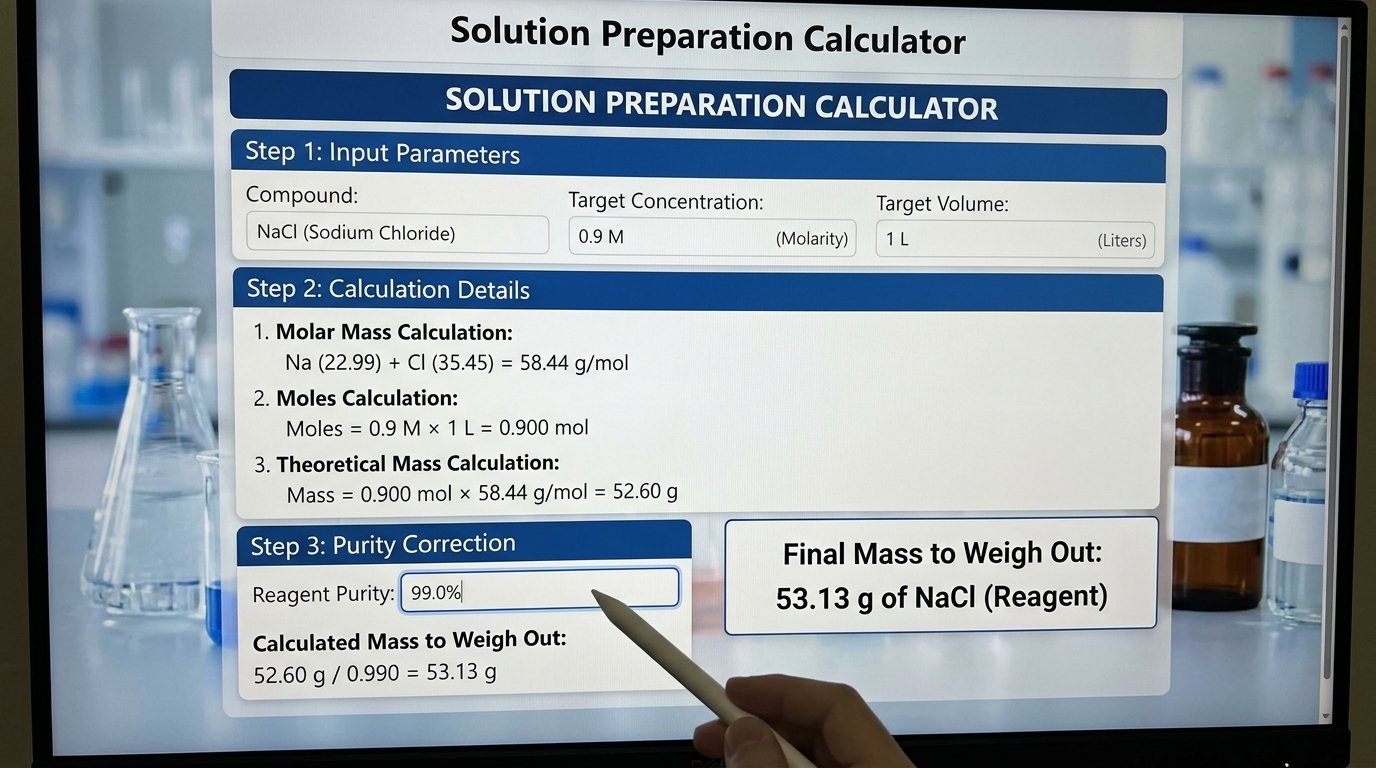
mass (g) = molarity (mol/L) × volume (L) × molar mass (g/mol) ÷ purity. 1 L of 0.9 M NaCl needs 0.9 × 1 × 58.44 = 52.60 g; 250 mL of 0.1 M copper sulfate from CuSO4·5H2O (249.69 g/mol) needs 6.24 g of the hydrate. For percent solutions, g = % × mL ÷ 100. Concentrated 37 % HCl (d 1.19) is 12.1 M, so 1 L of 1 M needs 82.8 mL added to water. The solution preparation calculator above does all of this and prints the procedure.
📑 Table of Contents (click to expand)
- What Is a Solution Preparation Calculator?
- How to Use the Solution Preparation Calculator
- The Five Modes Explained
- The Formulas Behind Every Mode
- Worked Example: 250 mL of 0.1 M Copper Sulfate From the Pentahydrate
- The Procedure: Dissolve, Transfer, Make Up to Volume
- Percent Solutions: w/v, w/w and v/v
- More Worked Examples
- Hydrates, Purity and Salt Forms
- Concentrated Acids and Bases: Molarity From the Label
- Multi-Component Recipes: PBS, TAE and Friends
- Reverse Mode: What Did I Actually Make?
- Normality and Equivalents in Solution Preparation
- Reference Table: Grams per Litre for Common Solutions
- Visualising Concentration and Amount
- Who Uses a Solution Preparation Calculator
- Full Walkthrough: A Litre of 1X PBS From Scratch
- A Short History of Standard Solutions
- Limits and Assumptions
- Practice Problems With Answers
- Tips for Accurate Results
- Common Mistakes
- How This Solution Preparation Calculator Is Different
- Where the Numbers Come From
- Checklist
- Frequently Asked Questions
- 10 Facts Worth Knowing
- Final Thoughts
What Is a Solution Preparation Calculator?
Preparing a solution means dissolving a known amount of a substance in a solvent to reach a stated concentration in a stated volume. The concentration may be expressed as molarity (moles per litre), normality (equivalents per litre), percent by mass or volume, mass per volume (mg/mL, g/L) or a dilution of a stronger stock. A solution preparation calculator takes whichever expression the protocol uses and returns the mass or volume of the pure reagent required, then adjusts for the realities of the bottle on the shelf: the reagent may be a hydrate, it may be 98 % pure, or it may be a concentrated liquid whose strength is given as % w/w and density rather than molarity.
The underlying idea is always the same: concentration × volume gives the amount of solute needed, and the amount is turned into a measurable quantity — grams or millilitres — by the molar mass or the density. What makes a solution preparation calculator useful is not the multiplication but the bookkeeping: getting the units to line up, remembering the water in a hydrate, using the right definition of percent, and converting a concentrated acid correctly.
Five ways a protocol can state the same salt solution
0.154 M NaCl — molarity
0.9 % w/v NaCl — grams per 100 mL
9 g/L or 9 mg/mL NaCl — mass per volume
154 mmol/L Na+ — ionic concentration (clinical)
0.154 N NaCl — normality (n = 1). The solution preparation calculator accepts all of them and gives the same 9 g per litre.
How to Use the Solution Preparation Calculator
- Pick the mode. Solid → molar for M, mM, µM or N solutions of a solid; Percent & mg/mL for w/v, w/w, v/v and mass-per-volume; Concentrated acid / liquid when the reagent is a bottled liquid; Multi-component for buffers and media; Reverse to find what you actually made.
- Type the formula (
NaCl,CuSO4·5H2O,C4H11NO3) or a molar mass; the solution preparation calculator parses hydrates and uses IUPAC 2021 atomic weights. - Enter concentration, volume and purity (assay from the certificate; 100 % if unknown). For normality add the number of equivalents per formula unit.
- Press Calculate. You get the mass to weigh in blue, the moles, the equivalent mg/mL and %, the step-by-step working, a table, a bar chart for common volumes, the procedure and a ready-to-copy label.
- Copy, download, print or share; each mode has its own Reset and the history box keeps the last ten preparations.
The chips load standard preparations — 0.9 M NaCl, 0.1 M NaOH from 98 % pellets, 0.1 M CuSO4 from the pentahydrate, 1 M Tris, 0.1 N Na2CO3, 1 M HCl from 37 %, PBS — so the solution preparation calculator’s output is visible before you type anything.
The Five Modes Explained
Mode 1 — Solid to molar solution. mass = M × V × molar mass ÷ purity. Hydrates are recognised from the formula and the anhydrous equivalent is reported; normality is converted to molarity through n.
Mode 2 — Percent and mg/mL. % w/v (g per 100 mL), % w/w (g per 100 g, with density to reach a volume), % v/v (mL per 100 mL), mg/mL, µg/mL and g/L, each with the molarity if a formula is given and a purity correction for solids.
Mode 3 — Concentrated acid, base or liquid. Ten common reagents (HCl 37 %, H2SO4 98 %, HNO3 70 %, acetic acid, H3PO4 85 %, ammonia 28 %, HClO4, HF, H2O2 30 %, NaOH 50 %) or a custom % w/w and density. The solution preparation calculator computes the reagent’s molarity, then the volume for any M, mM, N or % w/v target, with a safety note.
Mode 4 — Multi-component recipe. One line per component (formula, amount, unit) and a total volume; optionally an NX concentrate. Returns molar masses, grams of each solid and the total.
Mode 5 — Reverse. The mass you actually weighed, the formula, the volume and the purity give the real molarity, mg/mL and % w/v, plus the volume adjustment or top-up mass that would hit the intended value.
The Formulas Behind Every Mode
Molar solution: m (g) = C (mol/L) × V (L) × M (g/mol) ÷ (purity/100)
Normal solution: C (mol/L) = N ÷ n, where n = equivalents per formula unit
% w/v: m (g) = % × V (mL) ÷ 100 % w/w: m (g) = % × mass of solution (g) ÷ 100
% v/v: Vsolute (mL) = % × V (mL) ÷ 100
mg/mL, g/L: m (g) = (mg/mL) × V (mL) ÷ 1000 = (g/L) × V (L)
Concentrated reagent: M = 10 × (% w/w) × density (g/mL) ÷ molar mass; then V1 = C2V2 / M
Molarity from % w/v: M = % × 10 ÷ molar mass
All of these solution preparation calculator formulas are unit conversions rather than chemistry, which is why the solution preparation calculator can apply them to any formula. The chemistry enters in the molar mass (which must match what is actually weighed — hydrate or anhydrous, salt or free base), in the purity, and in the physical procedure of dissolving and making up to volume.
The concentrated-reagent formula deserves a second look: one litre of 37 % HCl weighs 1190 g, of which 37 % (440 g) is HCl; 440 ÷ 36.46 = 12.1 mol, so the bottle is 12.1 M. The “10” in the formula converts % and g/mL to g/L.
Worked Example: 250 mL of 0.1 M Copper Sulfate From the Pentahydrate
The bottle is labelled CuSO4·5H2O, 99 %. Enter CuSO4·5H2O, 0.1 M, 250 mL, purity 99 % in the solution preparation calculator.
- Molar mass of the hydrate: CuSO4 159.61 + 5 × 18.015 = 249.69 g/mol.
- Moles needed: 0.1 mol/L × 0.250 L = 0.025 mol.
- Mass of pure hydrate: 0.025 × 249.69 = 6.242 g.
- Purity: 6.242 ÷ 0.99 = 6.305 g to weigh.
- Procedure: weigh 6.305 g, dissolve in about 200 mL of water in a beaker, transfer to a 250 mL volumetric flask with rinsings, make up to the mark at 20 °C, stopper and invert 20 times.
Had the anhydrous molar mass (159.61) been used, only 4.03 g would have been weighed and the solution would be 0.064 M — 36 % weak. This is the single most common error in solution preparation, and the solution preparation calculator prevents it by reading the water of crystallisation from the formula and reporting the anhydrous equivalent (3.99 g of CuSO4) alongside.
The Procedure: Dissolve, Transfer, Make Up to Volume
A concentration is only as good as the volume it is defined in, and the procedure the solution preparation calculator prints follows the volumetric tradition. Volumetric flasks are calibrated “to contain” a stated volume at 20 °C, and the correct order of operations is:
- Weigh the solid on a tared weighing boat or paper; record the actual mass (the reverse mode uses it).
- Dissolve in a beaker with roughly 60–80 % of the final volume of solvent. Stir; warm gently only if the compound tolerates it, then cool to room temperature.
- Adjust pH now if the recipe requires it (Tris, phosphate, EDTA) — acid or base added later changes the volume.
- Transfer quantitatively to the volumetric flask, rinsing the beaker and funnel into it two or three times.
- Make up to the mark with solvent, using a dropper for the last millilitre; the bottom of the meniscus should sit on the line at eye level.
- Mix by stoppering and inverting 15–20 times. Density gradients persist surprisingly long without this.
- Label: name, concentration, solvent, date, initials — the solution preparation calculator prints this line for you.
Never add the full final volume of solvent to the solid: the solute occupies space, and for concentrated solutions the error is several percent. Never make up to volume while the solution is warm or cold. And for percent w/w solutions the flask is irrelevant — everything is weighed.
Percent Solutions: w/v, w/w and v/v
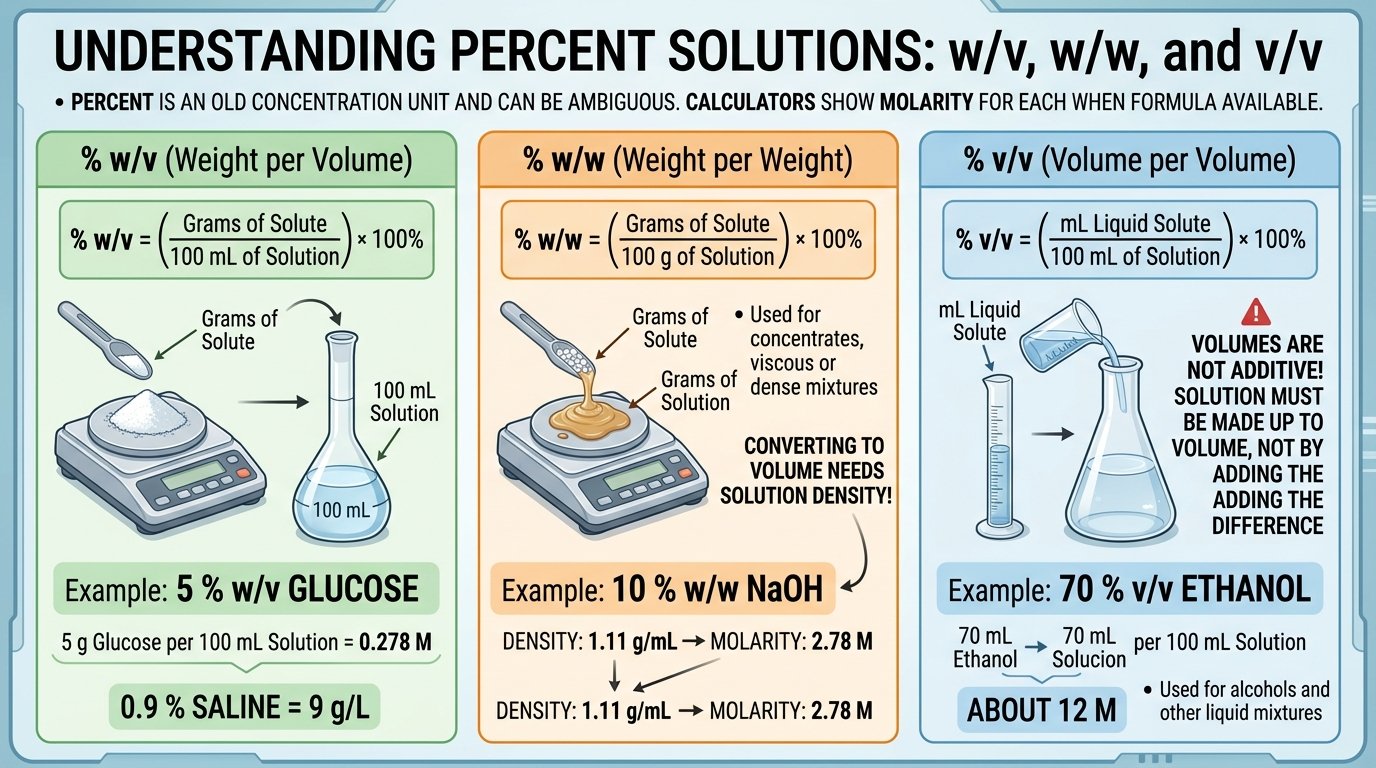
Percent is the oldest concentration unit and the most ambiguous, which is why the solution preparation calculator asks for the basis explicitly. % w/v is grams of solute per 100 mL of solution (0.9 % saline = 9 g/L). % w/w is grams per 100 g of solution, used for concentrated reagents and viscous or dense mixtures; converting it to a volume needs the solution density. % v/v is millilitres of liquid solute per 100 mL of solution, used for alcohols and other liquid mixtures, and because volumes are not additive the solution must be made up to volume, not by adding the difference.
The solution preparation calculator treats the three separately and reports the molarity next to each when a formula is available: 5 % w/v glucose is 0.278 M, 10 % w/w NaOH at density 1.11 g/mL is 2.78 M, 70 % v/v ethanol is about 12 M. For the full set of interconversions between the three conventions, including the pharmacy-style dose calculations, use the w/v solution calculator.
Two habits avoid most percent errors: write the basis explicitly on every label (% w/v, not just %), and remember that for dilute aqueous solutions w/v and w/w agree within 1–2 %, while for concentrated acids or alcohols they differ by 20–80 %.
More Worked Examples
Example 1 — 500 mL of 0.1 M NaOH from 98 % pellets
0.1 × 0.5 × 39.997 = 2.000 g pure; ÷ 0.98 = 2.041 g. Weigh quickly (hygroscopic); standardise against KHP if used for titration.
Example 2 — 250 mL of 0.1 N Na2CO3
n = 2 for the carbonate, so 0.1 N = 0.05 M; 0.05 × 0.25 × 105.99 = 1.325 g (1.331 g at 99.5 %). The solution preparation calculator converts N to M through n before the mass step.
Example 3 — 500 mL of 0.9 % w/v saline
0.9 × 500 ÷ 100 = 4.5 g NaCl; = 0.154 M = 154 mmol/L Na+.
Example 4 — 1 L of 1 M HCl from 37 % (d 1.19)
Reagent molarity 10 × 37 × 1.19 ÷ 36.46 = 12.08 M; V = 1 × 1000 ÷ 12.08 = 82.8 mL into about 600 mL water, cool, make up to 1 L.
Example 5 — 200 mL of 50 mM MgCl2 from the hexahydrate
M(MgCl2·6H2O) = 203.30; 0.05 × 0.2 × 203.30 = 2.033 g (0.952 g as anhydrous MgCl2).
Hydrates, Purity and Salt Forms
Hydrates. Many salts the solution preparation calculator is asked about crystallise with water: CuSO4·5H2O, MgSO4·7H2O, Na2HPO4·7H2O, CaCl2·2H2O. The water is part of what you weigh, so the hydrate’s molar mass must be used; the solute in solution is still the anhydrous salt. The solution preparation calculator parses the dot notation and reports both masses. Our molar mass of hydrates calculator goes deeper into hydrate arithmetic.
Purity (assay). Reagent labels state an assay — 98 %, 99.5 %, ≥ 99.99 % — and the balance cannot tell the difference. Divide the pure mass by the assay fraction. For hygroscopic solids (NaOH, KOH, CaCl2) the effective purity falls with exposure to air; for primary standards (KHP, Na2CO3, K2Cr2O7) dry before weighing.
Salt forms. Drugs, amino acids and buffers are sold as free acids/bases or as salts (Tris base vs Tris-HCl, glycine vs glycine-HCl, EDTA free acid vs disodium dihydrate). The molar mass differs by the counter-ion and any water; use the form on the label. Equivalent weights for normality follow the same logic — see the equivalent weight calculator and normality calculator.
Concentrated Acids and Bases: Molarity From the Label
| Reagent | % w/w | Density | Molarity | mL per litre of 1 M |
|---|---|---|---|---|
| HCl | 37 | 1.19 | 12.1 | 82.8 |
| H2SO4 | 98 | 1.84 | 18.4 | 54.4 |
| HNO3 | 70 | 1.42 | 15.8 | 63.4 |
| CH3COOH | 99.7 | 1.05 | 17.4 | 57.4 |
| H3PO4 | 85 | 1.69 | 14.7 | 68.2 |
| NH3 (aq) | 28 | 0.90 | 14.8 | 67.6 |
| HClO4 | 70 | 1.67 | 11.6 | 86.0 |
| H2O2 | 30 | 1.11 | 9.8 | 102 |
| NaOH | 50 | 1.53 | 19.1 | 52.3 |
Assays vary by lot (HCl is sold at 36–38 %) and the solution preparation calculator’s presets are typical values, so the solution preparation calculator lets you type the values from your own bottle. Solutions made this way are approximately the stated molarity; for titrimetric work, standardise against a primary standard.
Safety. Always add acid to water, slowly, with stirring; sulfuric acid in particular releases enough heat to boil water on contact. Work in a fume hood for HCl, HNO3, ammonia and HF; wear eye protection; let the solution cool before making up to the mark.
Multi-Component Recipes: PBS, TAE and Friends
Buffers and media are several single-solute problems solved for the same volume, and the solution preparation calculator solves them together. For 1 L of PBS (137 mM NaCl, 2.7 mM KCl, 10 mM Na2HPO4, 1.8 mM KH2PO4) the solution preparation calculator returns 8.01 g NaCl, 0.201 g KCl, 1.42 g Na2HPO4 and 0.245 g KH2PO4; for a 10X concentrate every mass is multiplied by ten. It also accepts % and g/L lines, so media recipes written by mass work directly.
Concentrates deserve a solubility check: 10X PBS is fine, but 50X TAE (2 M Tris, 1 M acetic acid, 50 mM EDTA) is near the limit for EDTA and needs pH adjustment to dissolve, and some phosphate concentrates precipitate in the cold. The recipe mode flags concentrates above 1X so you remember to check. For stock-and-working planning across many experiments see the stock solution calculator; for ionic strength of the finished buffer, the ionic strength calculator; and for its osmolarity, the osmolarity calculator.
Order of dissolution matters in practice: add salts one at a time to about 80 % of the water, let each dissolve, adjust pH last, then make up to volume. Autoclave or filter-sterilise according to the components (glucose caramelises; phosphate and magnesium precipitate together when autoclaved concentrated).
Reverse Mode: What Did I Actually Make?
Balances do not deliver exactly the target mass — which is why the solution preparation calculator has a reverse mode — and for careful work it is better to record what was weighed and calculate the true concentration than to chase the last milligram. Weighing 5.921 g of NaCl into 100 mL gives 1.0132 M, not 1.000 M; the solution preparation calculator’s reverse mode reports that, together with the volume that would bring it to exactly 1.000 M (101.3 mL) or the mass that would be needed for the intended value.
The same mode answers “is this old bottle still right?” questions when a label gives mass and volume, and it converts any mass/volume pair into mg/mL and % w/v for reports. Combined with purity it becomes a small audit trail: mass, assay, volume, actual concentration — the four numbers a reviewer wants to see.
Normality and Equivalents in Solution Preparation
Normality (N), the fourth unit the solution preparation calculator accepts, is equivalents per litre, and an equivalent depends on the reaction: one mole of H2SO4 supplies two moles of H+, so 1 M H2SO4 is 2 N as an acid; one mole of Na2CO3 neutralises two moles of acid, so 0.1 N is 0.05 M; one mole of KMnO4 accepts five electrons in acid, so 0.1 N is 0.02 M. The solution preparation calculator asks for n — the equivalents per formula unit — and converts N to M before the mass step, printing both so the label can carry either.
The advantage of normality is that equal volumes of equal normality react exactly, which is why titration methods still quote it; the disadvantage is that n changes with the reaction (KMnO4 is 3-electron in neutral solution) and must be stated. When in doubt, prepare and label in molarity and convert at the point of use.
Reference Table: Grams per Litre for Common Solutions
| Solution | Formula weighed | M (g/mol) | g per litre |
|---|---|---|---|
| 1 M NaCl | NaCl | 58.44 | 58.44 |
| 1 M Tris base | C4H11NO3 | 121.14 | 121.14 |
| 0.5 M EDTA | Na2EDTA·2H2O | 372.24 | 186.1 (pH 8) |
| 1 M MgCl2 | MgCl2·6H2O | 203.30 | 203.3 |
| 1 M CaCl2 | CaCl2·2H2O | 147.01 | 147.0 |
| 0.1 M KMnO4 | KMnO4 | 158.03 | 15.80 |
| 0.1 M CuSO4 | CuSO4·5H2O | 249.69 | 24.97 |
| 1 M glucose | C6H12O6 | 180.16 | 180.2 |
| 0.1 M AgNO3 | AgNO3 | 169.87 | 16.99 |
| 1 M KCl | KCl | 74.55 | 74.55 |
Scale linearly for other volumes and concentrations, or let the solution preparation calculator do it; the solution preparation calculator does the scaling and the purity correction for you.
Visualising Concentration and Amount
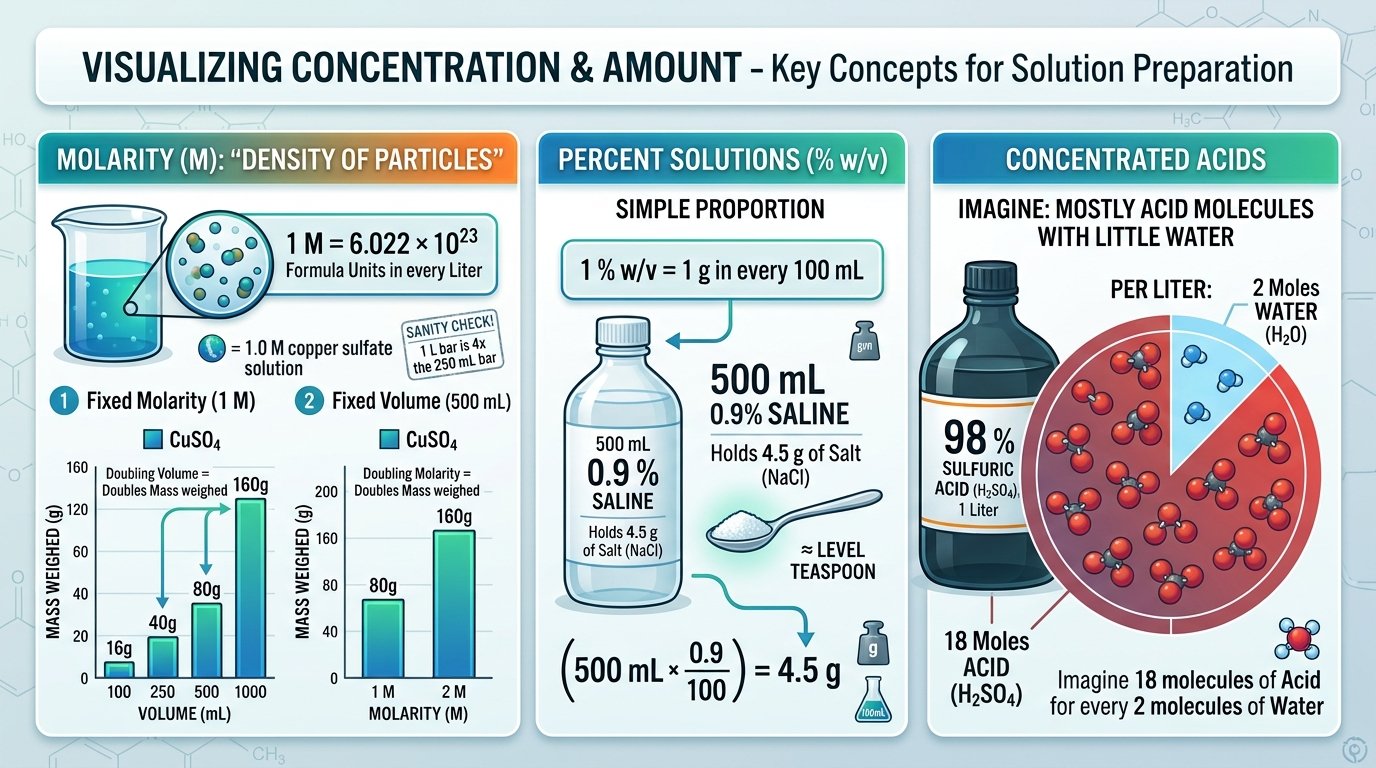
Think of the molarity the solution preparation calculator asks for as a density of particles: 1 M means 6.022 × 10²³ formula units in every litre. Doubling the volume at fixed molarity doubles the mass you weigh; doubling the molarity at fixed volume does the same. The bar chart the solution preparation calculator draws for 100, 250, 500 and 1000 mL makes this proportionality visible, and it is a quick sanity check — if the 1 L bar is not four times the 250 mL bar, something is wrong with the inputs.
For percent solutions the picture is simpler still: 1 % w/v is 1 g in every 100 mL, so a 500 mL bottle of 0.9 % saline holds 4.5 g of salt — about a level teaspoon. For concentrated acids imagine the bottle as mostly acid molecules with a little water: 98 % sulfuric acid is 18 mol of H2SO4 and only 2 mol of water per litre.
Who Uses a Solution Preparation Calculator
Teaching laboratories prepare litres of 0.1 M acids, bases and salts each week. Analytical chemists make standards from primary-standard solids and standardise acids diluted from concentrates. Molecular and cell biologists prepare Tris, EDTA, PBS, media and lysis buffers by the litre. Pharmacists and nurses compound percent solutions and dilute injectables. Water-treatment and environmental technicians prepare reagents for field kits. Students meet every one of these calculations in first-year chemistry and again in every practical course after that.
The solution preparation calculator serves all of them because it starts from the reagent as it is on the shelf — hydrate, assay, % w/w, density — rather than from an idealised pure substance, and because it writes the procedure and the label as well as the number.
Full Walkthrough: A Litre of 1X PBS From Scratch
- Recipe. 137 mM NaCl, 2.7 mM KCl, 10 mM Na2HPO4, 1.8 mM KH2PO4; pH 7.4; 1 L.
- Masses from the solution preparation calculator’s recipe mode: NaCl 8.01 g, KCl 0.201 g, Na2HPO4 1.42 g (or 2.68 g of the heptahydrate — enter the hydrate formula if that is the bottle), KH2PO4 0.245 g. Total solids 9.87 g.
- Dissolve each in turn in 800 mL of purified water with stirring.
- pH. Check; adjust to 7.4 with 1 M HCl or NaOH if needed (usually within 0.1 already).
- Make up to 1000 mL in a graduated cylinder or volumetric flask; mix.
- Sterilise (the solution preparation calculator notes this in the procedure) by autoclaving (121 °C, 20 min) or 0.22 µm filtration; label with name, 1X, pH, date.
- Check (optional): ionic strength ≈ 0.17 M, osmolarity ≈ 310 mOsm/L — isotonic, as intended.
For a 10X concentrate multiply every mass by ten and omit the pH adjustment (the 1X dilution will read about 7.4; the 10X reads lower); dilute 100 mL to 1 L when needed.
A Short History of Standard Solutions
The idea behind every solution preparation calculator — a solution of exactly known strength — dates to the birth of volumetric analysis. Gay-Lussac’s 1824 chlorimetry and his 1832 silver assay used solutions prepared by weighing a pure substance and diluting to a mark, and the graduated flask, pipette and burette were refined for that purpose. Mohr’s Lehrbuch der chemisch-analytischen Titrirmethode (1855) defined “normal” solutions containing one equivalent per litre, a convention that dominated for a century and survives in the N unit.
The molar scale gained ground after the mole was formalised in the early twentieth century and became the SI base quantity in 1971. Meanwhile pharmacopoeias standardised percent conventions for compounding, and molecular biology in the 1970s–80s produced the shorthand of 10X and 50X stocks. A modern solution preparation calculator has to speak all of these dialects — normal, molar, percent and X — because all are still in daily use.
Limits and Assumptions
- Formula must match the bottle: hydrate vs anhydrous, salt vs free base. The solution preparation calculator cannot see the label.
- Purity is taken at face value; hygroscopic or decomposed reagents are weaker than their assay.
- Concentrated-reagent molarities are approximate; lot-to-lot assay varies and solutions should be standardised for titrimetry.
- Volumes are defined at 20 °C; making up hot or cold solutions introduces ~0.1–0.3 % per 10 °C.
- Solubility is not checked in modes 1–3; a 5 M solution of a sparingly soluble salt is arithmetic, not chemistry.
- pH is not predicted; buffers must be adjusted and checked.
Practice Problems With Answers
Work these by hand, then check with the solution preparation calculator.
- Grams of KCl for 250 mL of 0.2 M? Answer: 3.73 g.
- Grams of Na2SO4·10H2O for 500 mL of 0.1 M? Answer: 16.11 g (M = 322.19).
- Mass of 97 % KOH for 1 L of 0.5 M? Answer: 28.92 g.
- Grams of glucose for 2 L of 5 % w/v? Answer: 100 g.
- Molarity of 30 % w/w H2O2 (d 1.11)? Answer: 9.79 M.
- Volume of 98 % H2SO4 for 500 mL of 0.5 M? Answer: 13.6 mL.
- Grams of Na2CO3 for 1 L of 0.2 N? Answer: 10.60 g.
- 2.53 g CuSO4·5H2O in 100 mL: molarity? Answer: 0.1013 M.
- Grams of NaCl in 10X PBS, 1 L? Answer: 80.1 g.
- 10 % w/w NaOH, 250 g of solution: NaOH and water? Answer: 25 g + 225 g.
Tips for Accurate Results
- Read the label twice: formula, hydrate, assay, lot. Enter exactly that in the solution preparation calculator.
- Record the actual mass and use the reverse mode rather than re-weighing to the last milligram.
- Dissolve in 60–80 % of the volume; adjust pH; then make up to the mark at room temperature.
- Use Class A volumetric flasks for standards; graduated cylinders (±1 %) are fine for routine buffers.
- Add acid to water; cool before final dilution.
- Standardise solutions used for titration against a primary standard.
- Label with basis (% w/v vs w/w), concentration, pH, date and initials.
- Keep the calculator’s CSV with the batch record.
Common Mistakes
- Anhydrous molar mass for a hydrate — solutions come out 20–40 % weak; the solution preparation calculator reports both masses to prevent it.
- Ignoring assay — 2 % low for pellets, more for old hygroscopic reagents.
- Treating % w/w as w/v for concentrated reagents.
- Adding the full volume of solvent instead of making up to the mark.
- Forgetting n when converting normality to molarity.
- Adjusting pH after making up to volume.
- Water into acid.
- Making up hot solutions to the mark.
How This Solution Preparation Calculator Is Different
| Feature | This solution preparation calculator | Typical online calculator |
|---|---|---|
| Mass from M, mM, µM or N with purity and hydrate correction | ✓ | Molarity only, no purity |
| Formula parser incl. hydrates, IUPAC 2021 atomic weights | ✓ | Manual molar mass |
| % w/v, w/w (with density), v/v, mg/mL, µg/mL, g/L with molarity | ✓ | w/v only |
| Concentrated acids/bases from % w/w and density (10 presets + custom), safety notes | ✓ | ✗ |
| Multi-component buffer recipes at 1X or NX | ✓ | ✗ |
| Reverse: actual concentration from mass weighed, with correction | ✓ | ✗ |
| Procedure and label line with every result | ✓ | ✗ |
| Steps, table, chart, copy, CSV, print, share, history, per-mode Reset | ✓ | Number only |
Most online tools multiply molarity by volume and molar mass and stop. This solution preparation calculator starts from the reagent on the shelf, handles every concentration convention and writes the procedure.
The solution preparation calculator belongs to the same family as the site’s other free tools: molecular weight calculator, atomic mass calculator, formula weight calculator, molarity calculator, stoichiometry calculator, exact mass calculator, grams to moles calculator, molar mass of hydrates calculator, average molecular weight of a mixture, number average molecular weight, weight average molecular weight, polydispersity index, monoisotopic mass calculator, average vs monoisotopic mass, isotopic mass calculator, freezing point depression, boiling point elevation, osmotic pressure calculator, vapor density, molar mass from gas density, equivalent weight calculator, viscosity molecular weight, van der Waals equation, empirical formula calculator, molecular formula calculator, percent composition calculator, combustion analysis calculator, degree of unsaturation calculator, oxidation number calculator, formal charge calculator, limiting reactant calculator, theoretical yield calculator, percent yield calculator, atom economy calculator, chemical equation balancer, molality calculator, normality calculator, mole fraction calculator, ppm to ppb converter, dilution calculator, serial dilution calculator, w/v solution calculator, ionic strength calculator, osmolarity calculator, peptide reconstitution calculator, stock solution calculator, Beer Lambert law calculator, protein concentration A280 calculator.
Where the Numbers Come From
The solution preparation calculator uses IUPAC 2021 standard atomic weights, the definitions of molarity, normality and percent from standard texts, and typical assay/density values for concentrated reagents:
- OpenStax Chemistry via LibreTexts — Molarity: molarity, preparing solutions by mass and by dilution, with worked examples.
- OpenStax Chemistry via LibreTexts — Other Units for Solution Concentrations: mass percent, volume percent, mass-volume percent and their interconversion.
- CIAAW — Standard Atomic Weights: the atomic weights behind every molar mass on this site.
- Wikipedia — Standard solution: primary standards, preparation by weighing and dilution, and standardisation.
Found an error? Our corrections policy explains how we handle reports; contact us or read about the site.
Checklist
☐ Formula entered exactly as on the bottle (hydrate, salt form)
☐ Assay/purity from the certificate applied
☐ Concentration unit and basis identified (M, N with n, % w/v vs w/w, mg/mL)
☐ Concentrated reagent converted to molarity via % w/w and density
☐ Mass or volume calculated and cross-checked (g/L × L)
☐ Dissolved in 60–80 % of the volume; pH adjusted before making up
☐ Made up to the mark at ~20 °C; mixed by inversion
☐ Acid added to water; hood and PPE for concentrated reagents
☐ Label: name, concentration, basis, pH, date, initials
☐ Actual mass recorded; reverse mode used if it matters
Frequently Asked Questions
How do I calculate how much solid to weigh for a solution?
mass (g) = molarity (mol/L) × volume (L) × molar mass (g/mol), divided by the purity fraction. For 1 L of 0.9 M NaCl: 0.9 × 1 × 58.44 = 52.60 g.
How do I prepare a 0.1 M solution from a hydrate?
Use the molar mass of the hydrate as written on the bottle. 250 mL of 0.1 M copper sulfate from CuSO4·5H2O (249.69 g/mol) needs 0.1 × 0.25 × 249.69 = 6.24 g; using the anhydrous mass (159.61) would give a solution 36 % too weak.
How do I make 1 M HCl from concentrated acid?
37 % HCl with density 1.19 g/mL is 10 × 37 × 1.19 / 36.46 = 12.1 M. For 1 L of 1 M measure 1000 / 12.1 = 82.8 mL, add it slowly to about 600 mL of water, cool, and make up to 1 L. Always acid into water.
What is the difference between % w/v and % w/w?
% w/v is grams per 100 mL of solution; % w/w is grams per 100 g of solution. They agree closely for dilute aqueous solutions but differ by the density for concentrated ones: 37 % w/w HCl is 44 % w/v.
How do I correct for reagent purity?
Divide the calculated mass by the assay fraction. 2.000 g of NaOH at 98 % purity means weighing 2.000 / 0.98 = 2.041 g. The solution preparation calculator has a purity field in every solid mode.
How much NaCl is in 0.9 % saline?
0.9 g per 100 mL, so 4.5 g per 500 mL and 9 g per litre — 0.154 M, or 154 mmol/L of sodium and of chloride.
How do I convert normality to molarity when preparing a solution?
M = N / n, where n is the number of equivalents per formula unit (H+ for acids, OH− for bases, charge for salts, electrons for redox). 0.1 N H2SO4 is 0.05 M; 0.1 N Na2CO3 is 0.05 M.
Why should I dissolve in less than the final volume?
Because the dissolved solute takes up space. Adding a full litre of water to 58 g of NaCl gives about 1.02 L, so the solution is 2 % weak. Dissolve in 60–80 % of the volume, then make up to the mark.
How do I make a 10X buffer concentrate?
Multiply every component’s mass by ten for the same volume (or make the 1X masses in one-tenth of the volume). Check that nothing exceeds its solubility at 10X, and remember the pH of the concentrate differs from the 1X.
Is my data stored anywhere?
No. The solution preparation calculator runs entirely in your browser; the history box uses your own local storage and Clear All empties it.
10 Facts Worth Knowing
- Concentrated sulfuric acid is 98 % acid by mass but only about 2 mol of water per 18 mol of acid — it is closer to a pure liquid than a solution.
- Copper sulfate pentahydrate is 36 % water by mass; weighing it as if anhydrous is the classic first-year error.
- Sodium hydroxide pellets absorb water and CO2 from the air fast enough to change mass visibly on a balance within a minute.
- A Class A 1 L volumetric flask is certified to ±0.3 mL; the meniscus error from reading at the wrong height can be ten times larger.
- Dissolving NaOH releases 44 kJ/mol; 40 g in a litre warms the water by about 10 °C.
- Normal saline, 0.9 % NaCl, was chosen in the 1880s as roughly iso-osmotic with blood; it is actually slightly hyperosmolar (308 vs 290 mOsm/L).
- EDTA disodium salt will not dissolve to 0.5 M until the pH reaches about 8, when the third carboxylate deprotonates.
- “Normal” solutions were the standard of analytical chemistry for a hundred years; the term survives on reagent bottles and in the N unit.
- Glacial acetic acid, 99.7 %, is 17.4 M — more concentrated in moles per litre than 37 % hydrochloric acid.
- Ten times the 1X masses in the same volume gives 10X; the pH of 10X PBS is about 6.8, but it returns to 7.4 on dilution.
Final Thoughts
Making a solution is arithmetic wrapped in technique: the right molar mass for what is actually on the bottle, the right definition of the concentration unit, and a flask made up to the mark at room temperature. Get those three right and the concentration on the label is true.
Use the solution preparation calculator above for solids, percent solutions, concentrated reagents, buffer recipes and after-the-fact checks — and read the procedure it prints until the habits are automatic.
Written by
Ahmad Raza, M.Phil. Chemistry ✓ Verified Expert
Ahmad has taught general and analytical chemistry for over a decade and builds the calculators on this site. He tests every tool — including this solution preparation calculator — against textbook problems and bench preparations before it goes live, and he answers reader questions personally.