
Dilution Calculator
C₁V₁ = C₂V₂ solved for any variable. This dilution calculator finds the stock volume, final concentration or dilution factor in molar, mass, percent, ppm or X-fold units, converts mg/mL to molar dilutions with any formula, mixes two solutions, and plans a whole set of standards from one stock — with every step shown.
✓ Trusted by students, lab technicians & researchersSolve C₁V₁ = C₂V₂ for Any Variable
Choose what to solve for, fill in the other three values, and the dilution calculator returns the missing one plus the diluent volume and dilution factor. Concentrations must share one family (molar, mass/percent/ppm, or X-fold) — use mode 3 to cross between mg/mL and molar.
Dilution Factor, 1:X Ratio and Volumes
Dilution factor DF = Vfinal / Vstock = Cstock / Cfinal. Tell the dilution calculator which two quantities you know and it fills in the rest, and shows both ratio conventions (1:10 as "1 in 10 total" and as "1 + 9 parts").
Dilute Between mg/mL and Molar Units (Any Formula or Molar Mass)
Stocks are often labelled in mg/mL while protocols ask for µM or mM. Give the formula (or molar mass), the stock and target in any units, and the dilution calculator converts both to a common basis and solves C₁V₁ = C₂V₂.
Mix Two Solutions or Hit a Target by Alligation
Mixing VA of CA with VB of CB gives C = (CAVA + CBVB) / (VA + VB), assuming additive volumes. Or give a target concentration and total volume and the dilution calculator finds how much of each to mix (alligation). Pure diluent is simply CB = 0.
Plan a Set of Standards From One Stock
Enter the stock, the volume of each standard and a list of target concentrations. The dilution calculator gives the stock and diluent volume for every standard, flags pipetting volumes below 10 µL, and totals the stock you will use.
🕘 Recent calculations
- No calculations yet — your last 10 results will appear here.
Formulas: C1V1 = C2V2 · dilution factor DF = C1/C2 = V2/V1 · diluent = V2 − V1 · a "1:X" dilution is taken as 1 part in X total (DF = X); the "1 + (X−1)" convention is also shown · mg/mL → mol/L = (mg/mL) ÷ M · mixing: C = (CAVA + CBVB)/(VA+VB) · volumes assumed additive (ideal); for concentrated acids and alcohols expect small contraction · IUPAC 2021 atomic weights.
A dilution calculator answers the most common question in any laboratory: how much of a concentrated stock do I take, and how much solvent do I add, to end up with the concentration and volume I actually need? The rule behind it is C1V1 = C2V2 — the amount of solute does not change when you add solvent — and from that one equation every dilution problem, from a 1 : 10 buffer to a five-point calibration series, can be solved.
The free dilution calculator on this page has five modes: a general C1V1 = C2V2 solver that finds whichever of the four quantities is missing in molar, mass or percent units; a dilution-factor mode for 1 : X and X-fold stocks; a mass-to-molar mode that converts a mg/mL stock into µM or mM for any chemical formula; a mixing mode that combines two solutions or hits a target strength by alligation; and a standards planner that lays out a whole series of calibration solutions from one stock. Every answer shows the substituted equation, a table, a chart and a pipetting warning when the volume is too small to measure.
Below the tool you will find what dilution really means, the derivation of C1V1 = C2V2, the difference between “dilute to” and “add”, the traps with percent and mass units, worked examples for buffers, antibiotics, acids and standards, ten practice problems, a laboratory checklist and the questions readers ask most about the dilution calculator.
Key Takeaway
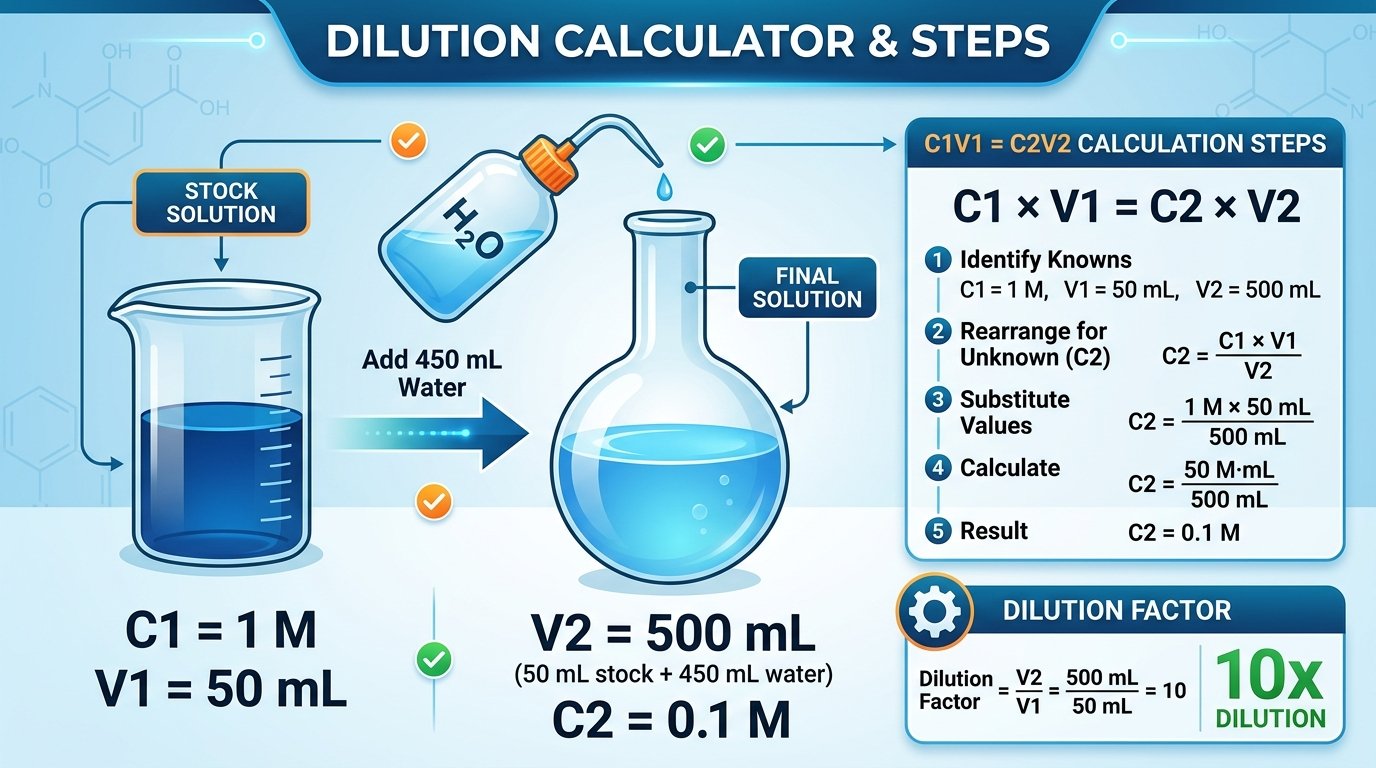
C1V1 = C2V2. To make 500 mL of 0.1 M from a 1 M stock take V1 = 0.1 × 500 ÷ 1 = 50 mL of stock and add 450 mL of solvent (dilution factor 10). Units must match on both sides, the volume you add is V2 − V1, and volumes under about 2 µL should be replaced by an intermediate dilution. The dilution calculator above applies all of this and shows the working.
📑 Table of Contents (click to expand)
- What Is a Dilution Calculator?
- How to Use the Dilution Calculator
- The Five Modes Explained
- The C1V1 = C2V2 Formula and Where It Comes From
- Worked Example: 500 mL of 0.1 M From 1 M
- “Dilute To” Versus “Add”: The Most Common Error
- Dilution Factors, 1 : X Notation and X-Fold Stocks
- More Worked Examples
- Converting mg/mL Stocks to Molar Targets
- Percent, ppm and Other Units in Dilution
- Mixing Two Solutions and Alligation
- Planning a Calibration Series
- Pipetting Limits and Intermediate Dilutions
- Reference Table: Common Stocks and Working Strengths
- Visualising a Dilution
- Who Uses a Dilution Calculator
- Full Walkthrough: Preparing a Drug Treatment for Cells
- A Short History of Dilution and Standard Solutions
- Limits and Assumptions
- Practice Problems With Answers
- Tips for Accurate Results
- Common Mistakes
- How This Dilution Calculator Is Different
- Where the Numbers Come From
- Checklist
- Frequently Asked Questions
- 10 Facts Worth Knowing
- Final Thoughts
What Is a Dilution Calculator?
Dilution is the process of lowering the concentration of a solution by adding more solvent. The dissolved substance — the moles of salt, the milligrams of drug, the grams of acid — stays exactly the same; only the volume it is spread through grows. A dilution calculator is a tool that uses this conservation of solute to work out the volumes and concentrations involved, so that you never have to guess or re-derive the algebra at the bench.
The central equation is C1V1 = C2V2, where C1 and V1 are the concentration and volume of the stock you take and C2 and V2 are the concentration and volume of the solution you make. Any three of the four fix the fourth. In practice the questions come in many disguises — “how much 5 M NaCl for 150 mM?”, “what does 1 : 200 mean?”, “how many µL of a 10 mg/mL stock give 50 µM?”, “what strength do I get if I mix these two bottles?” — and a good dilution calculator handles all of them without making you convert units by hand first.
Four ways people describe the same dilution
Concentrations: 1 M → 0.1 M
Dilution factor: 10-fold, or 1 : 10
Volumes: 1 part stock + 9 parts solvent (e.g. 100 µL + 900 µL)
Percent of stock: 10 % (v/v) stock in the final solution. The dilution calculator reports all four so that whichever your protocol uses, you can check it.
This dilution calculator goes further than a single equation: it tracks unit families so that a molar stock cannot be silently mixed with a mass target, it converts between mg/mL and molar with the molar mass of any formula, and it warns when a calculated volume is too small for an ordinary pipette.
How to Use the Dilution Calculator
- Pick the mode. C1V1 = C2V2 for ordinary stock-to-working problems; Dilution factor when the protocol says 1 : X or NX; Mass ↔ molar when the stock is in mg/mL and the target in µM (or the reverse); Mix two solutions for blending or alligation; Standards for a calibration series.
- Enter the known values with their units. The dilution calculator accepts M, mM, µM, nM, mg/mL, µg/mL, ng/mL, %, ppm and X, and volumes in L, mL or µL. Leave the quantity you want blank (or select it in the “solve for” box).
- Add a formula or molar mass when converting between mass and molar units —
NaCl,C6H12O6,CuSO4·5H2Oor simply58.44. - Press Calculate. The main answer appears in blue, then the solvent volume, the dilution factor, the step-by-step working, a table and a bar chart of stock versus solvent.
- Copy, download, print or share from the toolbar. Each mode has its own Reset, and the last ten results are kept in the history box until you press Clear All.
The example chips load the classic cases — 1 M to 0.1 M, 10X to 1X, a 1 : 10 series, 10 mg/mL NaCl to 2 mM, 70 % ethanol from 95 %, a 1000 ppm stock into six standards — so you can see what the dilution calculator produces before typing your own numbers.
The Five Modes Explained
Mode 1 — C1V1 = C2V2. The workhorse. Give any three of stock concentration, stock volume, final concentration and final volume; the dilution calculator returns the fourth, the solvent to add and the dilution factor. Units are converted inside their family (molar, mass, percent, X) and a mismatch between families is refused rather than silently ignored.
Mode 2 — Dilution factor. Enter a factor as 10, 1 : 10, 10X or 10-fold and the volume you want; the tool gives parts of stock and diluent, or works backwards from two concentrations to the factor. Useful for buffers sold as 10X and 50X and for protocols written as “dilute 1 : 500”.
Mode 3 — Mass ↔ molar. A 10 mg/mL stock of a compound with molar mass 342.3 g/mol is 29.2 mM; to reach 50 µM in 2 mL you need 3.42 µL. The dilution calculator does the molar-mass step from any formula and then applies C1V1 = C2V2.
Mode 4 — Mix two solutions. Blend 200 mL of 0.5 M with 300 mL of 0.1 M and get 0.26 M; or ask what proportions of a 95 % and a 0 % (water) stock give 70 % and get the alligation answer 368 : 132. Assumes volumes are additive, which is close for dilute aqueous solutions.
Mode 5 — Standards series. List the target concentrations, the volume of each standard and the stock; the dilution calculator prints a table of stock and diluent volumes for every level, the total stock consumed and a flag for any volume below the pipetting limit.
The C1V1 = C2V2 Formula and Where It Comes From
Concentration is amount of solute per volume of solution: C = n / V. Rearranged, n = C × V. When you dilute, the solute amount n is unchanged, so the product C × V before must equal the product after:
C1 × V1 = C2 × V2
V1 = C2V2 / C1 · C2 = C1V1 / V2 · solvent = V2 − V1 · dilution factor DF = C1/C2 = V2/V1
Because the equation is a ratio, any concentration unit works as long as it is the same on both sides — molarity, mg/mL, percent, ppm, even “X”. What does not work is mixing families: a stock in mg/mL and a target in µM need the molar mass first, and a percent w/w stock needs its density before it can be treated as w/v. The dilution calculator enforces these distinctions so that the equation is only ever applied where it is valid.
The equation also assumes the solute is not lost or created. It fails if the solute reacts with the solvent, precipitates, evaporates or adsorbs to the container; it says nothing about pH, which changes non-linearly on dilution of weak acids and bases; and it ignores the small volume contraction when concentrated solutions are mixed. Those limits are discussed further down.
Worked Example: 500 mL of 0.1 M From 1 M
Suppose a protocol needs 500 mL of 0.1 M Tris and the shelf holds a 1 M stock. In the dilution calculator, choose mode 1, enter C1 = 1 M, C2 = 0.1 M, V2 = 500 mL, and solve for V1.
- Write the equation: 1 M × V1 = 0.1 M × 500 mL.
- Solve: V1 = 0.1 × 500 ÷ 1 = 50 mL of stock.
- Solvent: 500 − 50 = 450 mL. Dilution factor 1 ÷ 0.1 = 10.
- Check: 50 mL × 1 mol/L = 0.05 mol; 0.05 mol ÷ 0.5 L = 0.1 M. ✓
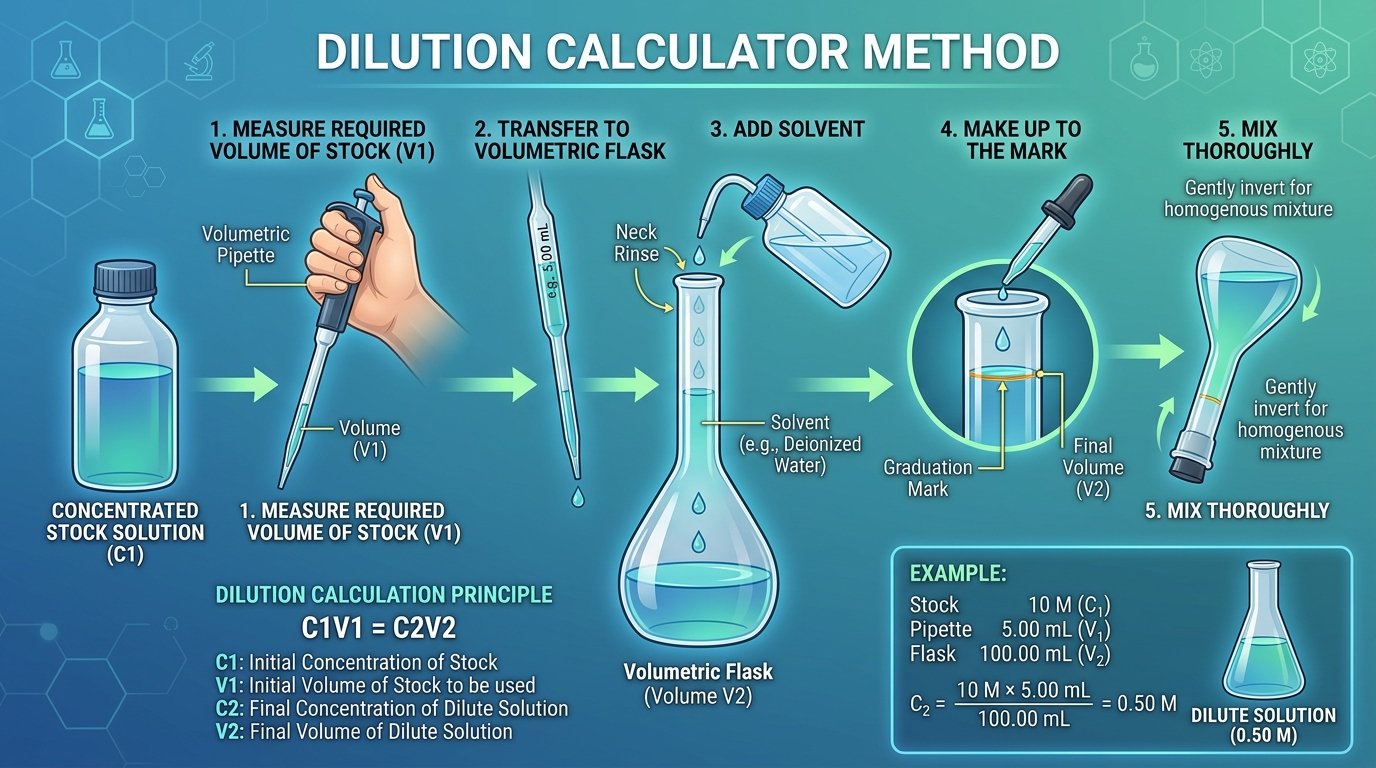
At the bench: measure 50 mL of stock into a 500 mL volumetric flask (or graduated cylinder for routine work), add water to about 450 mL, mix, then make up to the 500 mL mark. Do not add exactly 450 mL of water to the stock in a beaker and call it done; the mark is the guarantee that V2 really is 500 mL. The dilution calculator prints this procedure and a label line under every result.
Notice that the pH of Tris buffers drifts on dilution (roughly 0.1 unit per 10-fold), so a diluted Tris stock should be re-checked if pH matters. That is chemistry, not arithmetic, and no dilution calculator can see it — but the tool’s notes remind you.
“Dilute To” Versus “Add”: The Most Common Error
“Dilute 50 mL of stock to 500 mL” and “add 500 mL of water to 50 mL of stock” are different instructions. The first gives 500 mL total and a factor of 10; the second gives 550 mL and a factor of 11 — a 9 % error in every concentration downstream. Protocols are written both ways, often carelessly, and the difference is the single most frequent reason calibration curves come out with the wrong slope.
The dilution calculator always reports V2 as the final total volume and the solvent as V2 − V1. If you know the protocol meant “add”, enter the stock volume and the solvent volume as parts in mode 2, or add them to get V2 first. Either way, decide which convention the author used before pipetting.
| Instruction | Final volume | Dilution factor |
|---|---|---|
| Dilute 1 mL to 10 mL | 10 mL | 10 |
| Add 9 mL to 1 mL | 10 mL | 10 |
| Add 10 mL to 1 mL | 11 mL | 11 |
| 1 : 10 (chemistry usage) | 10 parts | 10 |
| 1 + 9 (some clinical labs) | 10 parts | 10 |
Dilution Factors, 1 : X Notation and X-Fold Stocks
The dilution factor is C1/C2, or equivalently V2/V1: the number of times the solution has been “spread out”. A 1 : 10 dilution has a factor of 10 and contains 1 part stock in 10 parts total; a 10X buffer is a stock ten times stronger than the working (1X) strength, so it is used at 1 : 10. Factors multiply across steps: 1 : 10 followed by 1 : 20 is 1 : 200.
Ambiguity creeps in with the colon. In chemistry and molecular biology “1 : 10” almost always means 1 in 10 total (factor 10). In some microbiology and clinical contexts it has been used to mean 1 part plus 10 parts (factor 11). The dilution calculator follows the chemistry convention — 1 : X means a factor of X — and prints the parts explicitly so the intent is unambiguous on your record.
Percent of stock is a fourth way of saying the same thing: 1 : 10 is 10 % stock, 1 : 200 is 0.5 % stock. For very large factors (1 : 104 and beyond) the stock volume becomes unmeasurably small — 0.1 µL in 1 mL — and the answer is a two-step or serial dilution, which our serial dilution calculator plans in detail.
More Worked Examples
Example 1 — 1X TBE from 10X, 1 L
C1 = 10X, C2 = 1X, V2 = 1000 mL. V1 = 1 × 1000 ÷ 10 = 100 mL of 10X + 900 mL water.
Example 2 — 50 µM from a 10 mM drug stock, 2 mL
Convert to the same unit: 10 mM = 10 000 µM. V1 = 50 × 2000 µL ÷ 10 000 = 10 µL of stock + 1990 µL medium (1 : 200; 0.5 % solvent carried over).
Example 3 — 2 mM NaCl from a 10 mg/mL stock, 50 mL
10 mg/mL ÷ 58.44 g/mol = 0.1711 M = 171.1 mM. V1 = 2 × 50 ÷ 171.1 = 0.584 mL (584 µL); dilution factor 85.6. The dilution calculator’s mode 3 does the molar mass step automatically.
Example 4 — 500 mL of 70 % ethanol from 95 %
V1 = 70 × 500 ÷ 95 = 368.4 mL of 95 % + 131.6 mL water (made up to the mark — ethanol and water contract on mixing, so “add 131.6 mL” would be slightly off).
Example 5 — What did I make?
25 mL of 3 M HCl diluted to 400 mL: C2 = 3 × 25 ÷ 400 = 0.1875 M. Always add acid to water.
Converting mg/mL Stocks to Molar Targets
Suppliers ship many reagents as mass concentrations (10 mg/mL antibiotic, 1 mg/mL protein, 20 % glucose) while assays are designed in molar units (100 µg/mL, 50 µM, 25 mM). The link is the molar mass M: molarity = (mg/mL) ÷ M × 1000 mM, and mg/mL = M × molarity in mol/L.
The dilution calculator parses any formula — including hydrates such as CuSO4·5H2O — with IUPAC 2021 atomic weights, or accepts a numeric molar mass, then converts the stock and applies C1V1 = C2V2. It also reports the result in the other family, so a 2 mM NaCl solution is shown as 0.117 mg/mL and 0.0117 % w/v alongside.
Two cautions. First, hydrates: 1 mg/mL of CuSO4·5H2O is 4.0 mM copper, not 6.3 mM — use the hydrate’s molar mass when the label names the hydrate. Second, salts of drugs and peptides: the molar mass on the vial usually includes the counter-ion (hydrochloride, trifluoroacetate), and the “free base” molar mass is smaller. Use the vial’s value for moles of the material weighed.
Percent, ppm and Other Units in Dilution
Percent solutions dilute exactly like molar ones as long as the percent type does not change: 10 % w/v to 2 % w/v is a factor of 5, 250 mL of 2 % needs 50 mL of 10 %. The trap is w/w versus w/v. A 37 % w/w HCl stock (density 1.19 g/mL) is 44 % w/v and 12.1 M; treating 37 % as w/v underestimates the stock by 16 %. Our w/v solution calculator converts between the three percent conventions with density.
Parts-per units are mass ratios and dilute the same way: a 1000 ppm certified stock to 5 ppm is a factor of 200, so 100 mL of standard needs 0.5 mL of stock. Because ppm and mg/L are interchangeable in dilute water, the dilution calculator treats them as one family. The ppm to ppb converter handles the cross-unit cases.
“X” units (10X, 50X) are pure ratios — a 10X stock is 10 times 1X whatever 1X happens to be — so they can only be diluted against other X values. The dilution calculator keeps X in its own family for that reason.
Mixing Two Solutions and Alligation
When two solutions of the same solute are combined, the solute amounts add and the volumes (approximately) add: Cmix = (C1V1 + C2V2) / (V1 + V2). Mixing 200 mL of 0.5 M with 300 mL of 0.1 M gives (100 + 30) mmol in 500 mL = 0.26 M.
The reverse question — in what ratio should I mix a strong and a weak solution to get a target — is alligation, an old pharmacy method that the dilution calculator performs in mode 4. For a target Ct between Chigh and Clow, the volume ratio is (Ct − Clow) : (Chigh − Ct). To make 70 % ethanol from 95 % and water: (70 − 0) : (95 − 70) = 70 : 25 = 2.8 : 1, i.e. 368 mL of 95 % per 500 mL. Setting the weak solution to zero concentration turns alligation back into an ordinary dilution.
Volume additivity is the approximation here. Ethanol–water contracts by up to 3.5 %; concentrated acids heat and shrink; most dilute aqueous salt solutions behave well within 0.1 %. When accuracy matters, mix, cool, then make up to a mark.
Planning a Calibration Series
A calibration curve needs several standards spanning the expected range — typically five or six points plus a blank. Each is a separate C1V1 = C2V2 problem from the same stock, and the standards mode of the dilution calculator solves them together, prints a table of stock and diluent volumes, sums the stock consumed and flags any volume below the pipetting limit.
For a 1000 ppm stock and 50 mL standards at 1, 2, 5, 10, 20 and 50 ppm, the stock volumes are 0.05, 0.1, 0.25, 0.5, 1.0 and 2.5 mL (4.4 mL in total). The 50 µL needed for the 1 ppm level is on the edge of good practice with an ordinary 100 µL pipette, so the tool suggests an intermediate 100 ppm stock — from which the low standards need 0.5–5 mL.
Good series design: space the points so the highest is at or above the top of the sample range, keep every stock volume above about 50 µL (or use an intermediate), make each standard independently from the stock rather than serially where possible (errors do not compound), and record the actual volumes rather than the nominal ones.
Pipetting Limits and Intermediate Dilutions
A calculated volume is only useful if it can be dispensed. Air-displacement pipettes are accurate to about ±1 % at the top of their range but ±5–10 % or worse near the bottom, and nothing below 0.5 µL is trustworthy. The dilution calculator flags stock volumes under 10 µL, warns strongly under 2 µL, and refuses to pretend that 0.1 µL is a real number.
The fix is an intermediate dilution: instead of 0.2 µL of a 10 mM stock into 2 mL (1 : 10 000), first dilute 10 µL to 1 mL (1 : 100, 100 µM), then take 20 µL of that into 2 mL (1 : 100 again). Two easily measured volumes replace one impossible one, and the combined factor is the same. The precision of the two-step route is also better, as our serial dilution calculator quantifies.
Rules of thumb
• Keep every pipetted volume within 10–100 % of the pipette’s nominal range.
• Prefer volumes ≥ 10 µL; never rely on < 2 µL.
• For factors above ~1000, use two or more steps.
• Reverse-pipette viscous stocks (glycerol, 10X buffers, detergents).
Reference Table: Common Stocks and Working Strengths
| Reagent | Stock | Working | Factor | Per litre |
|---|---|---|---|---|
| Tris-HCl | 1 M | 50 mM | 20 | 50 mL |
| NaCl | 5 M | 150 mM | 33.3 | 30 mL |
| EDTA pH 8 | 0.5 M | 1 mM | 500 | 2 mL |
| Ampicillin | 100 mg/mL | 100 µg/mL | 1000 | 1 mL |
| TBE / TAE | 10X / 50X | 1X | 10 / 50 | 100 / 20 mL |
| SDS | 10 % | 0.1 % | 100 | 10 mL |
| HCl (conc.) | 12.1 M | 1 M | 12.1 | 82.8 mL |
| Ethanol | 95 % | 70 % | 1.36 | 737 mL |
| Drug in DMSO | 10 mM | 10 µM | 1000 | 1 mL (0.1 % DMSO) |
Every row is a single line in the dilution calculator; the “per litre” column is V1 for V2 = 1000 mL.
Visualising a Dilution
Picture 1 L of 1 M solution as a box holding 1 mole of solute. Pour it into a 10 L tank and top up with water: the same mole now occupies ten times the space, so each litre holds 0.1 mol — 0.1 M. Nothing was added or removed except water; the “amount” is conserved and the “concentration” fell by the same factor the volume rose. That picture is C1V1 = C2V2.
The bar chart under each result in the dilution calculator draws the final solution as stock plus solvent. For a factor of 10 the stock bar is one-tenth of the total; for 1 : 1000 it is a sliver, which is exactly the visual cue that an intermediate step is needed. For the standards mode the chart shows every level’s stock volume side by side, so an outlier — a level needing far less than the others — stands out immediately.
Colour is a good mental check as well: a 1 : 10 dilution of a coloured solution looks noticeably paler, 1 : 100 is faint, 1 : 1000 usually colourless. If a “1 : 10” still looks as dark as the stock, something went wrong.
Who Uses a Dilution Calculator
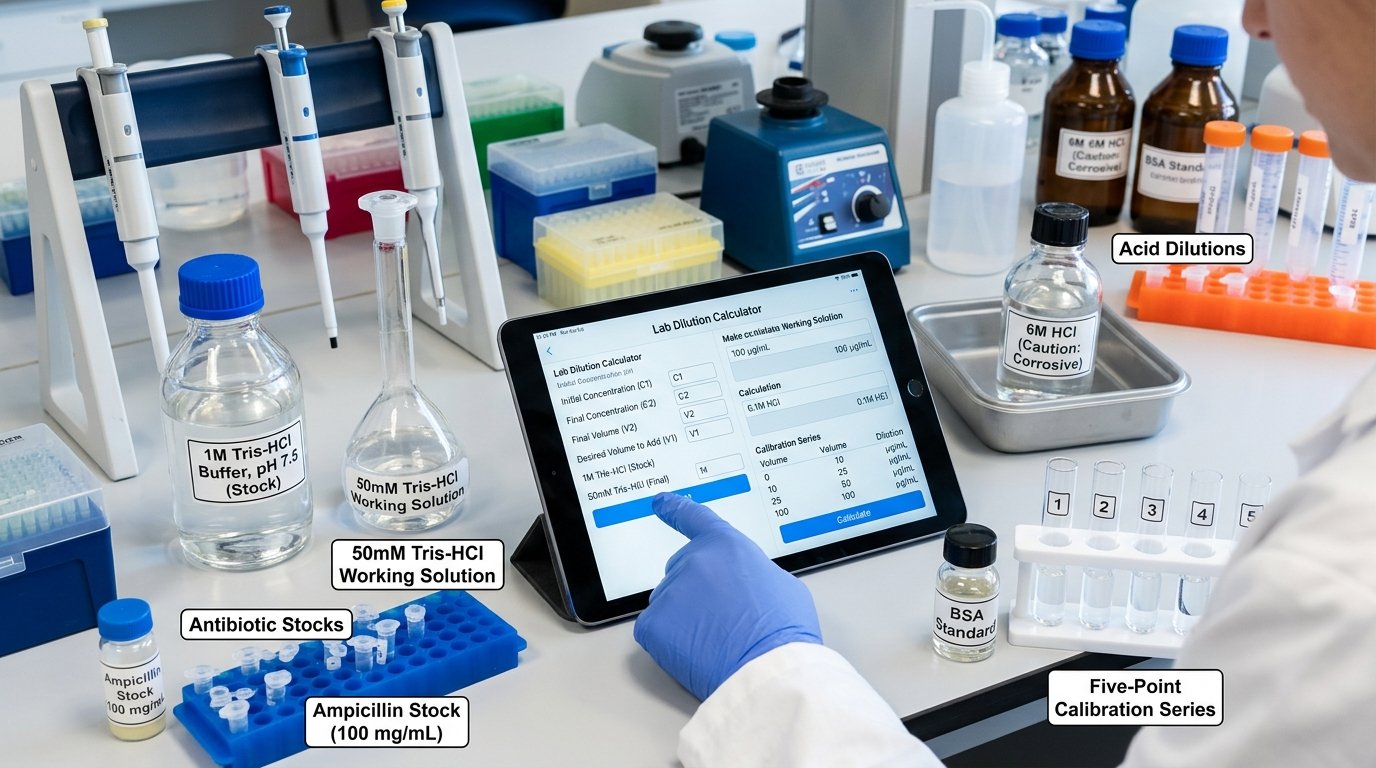
Molecular biologists make working buffers from 10X and 50X stocks and antibiotic media from 1000X stocks every day. Cell biologists and pharmacologists dilute DMSO drug stocks into medium and must keep the solvent under 0.1–0.5 %. Analytical chemists prepare calibration standards from certified 1000 ppm solutions. Clinical laboratories dilute out-of-range samples back into the assay window and multiply results by the factor. Pharmacists and nurses reconstitute and dilute injectables to a prescribed strength. Teachers and students meet C1V1 = C2V2 in every general chemistry course.
Each group has its own vocabulary — molar, X, %, mg/mL, 1 : X — and the dilution calculator was built to accept all of them rather than force one. The step-by-step output serves the student who must show working and the analyst who must document a preparation equally well; the copy, CSV and print buttons feed the notebook or the LIMS.
Full Walkthrough: Preparing a Drug Treatment for Cells
A cell-culture experiment needs six wells treated with 10 µM compound in 2 mL of medium each, plus vehicle controls, from a 10 mM stock in DMSO, with final DMSO ≤ 0.1 %.
- Single-well arithmetic. Dilution factor 10 mM / 10 µM = 1000; V1 = 2000 µL / 1000 = 2 µL per well. DMSO = 2 / 2000 = 0.1 % — exactly at the limit. The dilution calculator flags 2 µL as marginal.
- Master mix instead. Six wells + 15 % overage = 13.8 mL of treated medium. V1 = 13 800 / 1000 = 13.8 µL of stock into 13.786 mL medium. One comfortable pipetting step, same 0.1 % DMSO.
- Vehicle control. 13.8 µL of plain DMSO into the same volume of medium, so the controls see the identical solvent exposure.
- Record. Copy the dilution calculator output — stock lot, 13.8 µL into 13.786 mL, 1 : 1000, 0.1 % DMSO — into the notebook.
If the protocol had required 1 µM, the single-well volume would have been 0.2 µL; the answer is an intermediate 1 : 10 dilution of the stock in medium (1 mM, 10 % DMSO) followed by 1 : 1000 into the wells (0.01 % DMSO) — which the serial dilution calculator lays out step by step.
A Short History of Dilution and Standard Solutions
Quantitative dilution is as old as quantitative analysis. Gay-Lussac’s volumetric methods of the 1820s relied on standard solutions of known strength made by weighing and diluting to a mark, and the graduated volumetric flask — the piece of glass that makes “dilute to” possible — dates from the same period. Mohr’s 1855 textbook on titrimetry fixed the practice of preparing normal solutions by dilution of concentrated stocks.
Alligation, the mixing method behind mode 4, is far older: it appears in medieval arithmetic texts for blending metals and wines and remained a staple of pharmacy examinations into the twentieth century. Serial dilution entered microbiology with Koch and Pasteur, and entered immunology as the “titre” — the highest dilution still giving a reaction.
Today the arithmetic is trivial for a dilution calculator; what has not changed is the physical discipline — volumetric glassware at the right temperature, calibrated pipettes, mixing to homogeneity, and clear records of which convention was used.
Limits and Assumptions
- Conservation of solute. C1V1 = C2V2 fails if the solute reacts, precipitates, evaporates, adsorbs to plastic or is degraded by the diluent.
- Additive volumes. Assumed in mixing mode; true to within ~0.1 % for dilute aqueous solutions, off by several percent for alcohol–water and concentrated acids. Make up to a mark when it matters.
- Same percent basis. w/w stocks must be converted to w/v with density before dilution to a w/v target.
- Temperature. Volumetric glassware is calibrated at 20 °C; hot or cold solutions give wrong volumes.
- pH and activity. Diluting a buffer changes its pH and ionic strength non-linearly; the dilution calculator reports concentration only.
- Pipetting reality. The warnings are heuristics for standard air-displacement pipettes; positive-displacement or robotic systems have different limits.
Practice Problems With Answers
Try these by hand, then check with the dilution calculator.
- How much 5 M NaCl is needed for 250 mL of 150 mM? Answer: 7.5 mL.
- What is the dilution factor from 2 M to 40 mM? Answer: 50.
- 25 mL of 6 M HCl is diluted to 300 mL. Concentration? Answer: 0.5 M.
- You need 1 L of 1X from a 50X stock. Volumes? Answer: 20 mL stock + 980 mL water.
- A 10 mg/mL glucose stock (M = 180.16) to 5 mM, 100 mL. Stock volume? Answer: 9.01 mL.
- Mix 100 mL of 0.8 M with 400 mL of 0.2 M. Result? Answer: 0.32 M.
- Make 200 mL of 40 % glycerol from 80 % and water. Answer: 100 mL of each.
- 1000 ppm stock to a 2 ppm standard, 100 mL. Stock? Answer: 0.2 mL.
- 10 mM stock to 1 µM in 1 mL: single-step volume, and a better route? Answer: 0.1 µL — use 1 : 100 then 1 : 100.
- “Add 4 mL of water to 1 mL of stock” — factor? Answer: 5 (1 mL in 5 mL total).
Tips for Accurate Results
- Write the four quantities with units before touching a pipette; the dilution calculator’s table is a good template.
- Convert to one unit within the family first (mM and µM, mL and µL) — most arithmetic errors are factor-of-1000 slips.
- Dilute to volume in volumetric glassware for standards; “add” is acceptable only for rough working solutions.
- Pre-wet the pipette tip, pipette slowly, and reverse-pipette viscous or volatile stocks.
- Keep stock volumes above 10 µL; use intermediates for big factors.
- Mix thoroughly — invert a volumetric flask 15–20 times; dense stocks layer at the bottom.
- Label every solution with concentration, solvent, date and the factor from the stock.
- Save the dilution calculator’s CSV with the batch record so a colleague can reproduce the preparation.
Common Mistakes
- Mixing unit families — mg/mL against µM without the molar mass. The dilution calculator refuses; do the same by hand.
- Adding V2 of solvent instead of V2 − V1. A 10 % error on a 1 : 10, more on smaller factors.
- Reading 1 : 10 as 1 + 10. Check the convention of the protocol’s author.
- Treating w/w as w/v for concentrated acids and bases.
- Using the anhydrous molar mass when the hydrate was weighed, or the free-base mass when the salt was weighed.
- Pipetting 0.5 µL and believing the result.
- Forgetting the solvent carry-over — DMSO, ethanol or acid from the stock ends up in the working solution.
- Diluting hot or cold solutions in 20 °C glassware.
How This Dilution Calculator Is Different
| Feature | This dilution calculator | Typical online calculator |
|---|---|---|
| Solves for any of C1, V1, C2, V2 in molar, mass, %, ppm or X | ✓ | One fixed layout |
| Refuses to mix unit families silently | ✓ | Often converts wrongly |
| mg/mL ↔ molar with any formula (IUPAC 2021 weights, hydrates) | ✓ | ✗ |
| Dilution factor in 1 : X, X-fold and percent-of-stock | ✓ | One notation |
| Mixing two solutions and alligation | ✓ | ✗ |
| Multi-point calibration series with total stock | ✓ | ✗ |
| Pipetting-limit warnings and intermediate-step advice | ✓ | ✗ |
| Steps, table, chart, copy, CSV, print, share, history, per-mode Reset | ✓ | Number only |
Most online tools stop at one C1V1 = C2V2 box. This dilution calculator adds the unit handling, the molar-mass step, the mixing and standards modes and the practical warnings that turn an equation into a bench procedure.
The dilution calculator belongs to the same family as the site’s other free tools: molecular weight calculator, atomic mass calculator, formula weight calculator, molarity calculator, stoichiometry calculator, exact mass calculator, grams to moles calculator, molar mass of hydrates calculator, average molecular weight of a mixture, number average molecular weight, weight average molecular weight, polydispersity index, monoisotopic mass calculator, average vs monoisotopic mass, isotopic mass calculator, freezing point depression, boiling point elevation, osmotic pressure calculator, vapor density, molar mass from gas density, equivalent weight calculator, viscosity molecular weight, van der Waals equation, empirical formula calculator, molecular formula calculator, percent composition calculator, combustion analysis calculator, degree of unsaturation calculator, oxidation number calculator, formal charge calculator, limiting reactant calculator, theoretical yield calculator, percent yield calculator, atom economy calculator, chemical equation balancer, molality calculator, normality calculator, mole fraction calculator, ppm to ppb converter, serial dilution calculator, solution preparation calculator, w/v solution calculator, ionic strength calculator, osmolarity calculator, peptide reconstitution calculator, stock solution calculator, Beer Lambert law calculator, protein concentration A280 calculator.
Where the Numbers Come From
The dilution calculator uses exact ratio arithmetic for C1V1 = C2V2, IUPAC 2021 standard atomic weights for molar masses, and published conventions for dilution notation:
- OpenStax Chemistry via LibreTexts — Molarity: definition of molarity and the dilution equation C1V1 = C2V2 with worked examples.
- IUPAC Gold Book — amount concentration: the formal definition of concentration as amount of substance divided by volume, the quantity conserved in every dilution.
- CIAAW — Standard Atomic Weights: the atomic weights behind every molar mass used in the mass-to-molar mode.
- Wikipedia — Dilution (equation): the dilution equation, dilution factor and serial dilution conventions.
Found an error? Our corrections policy explains how we handle reports; contact us or read about the site.
Checklist
☐ All four quantities written with units; three known, one unknown
☐ Same unit family on both sides (molar, mass, %, ppm or X)
☐ Molar mass applied (hydrate/salt form correct) when crossing families
☐ w/w converted to w/v with density for concentrated reagents
☐ Solvent volume = V2 − V1, not V2
☐ 1 : X read as a factor of X (checked against the protocol)
☐ Stock volume ≥ 10 µL, or intermediate dilution planned
☐ Made up to the mark at ~20 °C and mixed thoroughly
☐ Solvent carry-over (DMSO, ethanol, acid) within limits
☐ Label and record: concentration, factor, date, initials
Frequently Asked Questions
What is the formula a dilution calculator uses?
C1V1 = C2V2: the concentration times volume of the stock equals the concentration times volume of the diluted solution, because the amount of solute does not change. Solve for whichever quantity is unknown; the solvent to add is V2 − V1.
How do I make 500 mL of 0.1 M from a 1 M stock?
V1 = 0.1 × 500 ÷ 1 = 50 mL of stock; add water to a final volume of 500 mL (about 450 mL). The dilution factor is 10.
What does a 1 : 10 dilution mean?
One part stock in ten parts total — for example 1 mL of stock made up to 10 mL, or 100 µL + 900 µL. The dilution factor is 10 and the concentration falls to one-tenth. Some clinical texts use 1 : 10 to mean 1 + 10 (factor 11); check the convention.
Can I use the dilution calculator with mg/mL and µM?
Yes — enter the formula or molar mass. A 10 mg/mL stock of a 342.3 g/mol compound is 29.2 mM, and 50 µM in 2 mL needs 3.42 µL of it. Without the molar mass the two units cannot be compared.
How much 10X buffer do I need for 1 litre of 1X?
100 mL of 10X plus 900 mL of water. In general V1 = V2 / X, so a 50X stock needs 20 mL per litre.
What is the difference between dilution factor and dilution ratio?
The dilution factor is total volume divided by stock volume (10 for 1 mL in 10 mL). A dilution ratio in the strict sense is stock to diluent (1 : 9 for the same solution). Most chemistry protocols write 1 : 10 and mean the factor; the calculator follows that usage and prints the parts explicitly.
Why does the tool warn me about small volumes?
Below about 10 µL ordinary pipettes lose accuracy and below 2 µL the error can exceed 10 %. For large dilution factors make an intermediate dilution (for example 1 : 100 then 1 : 100) instead of one 1 : 10 000 step.
How do I dilute 95 % ethanol to 70 %?
V1 = 70 × V2 ÷ 95, so 500 mL of 70 % needs 368 mL of 95 % made up to 500 mL with water. Ethanol and water contract on mixing, so make up to the mark rather than adding exactly 132 mL.
What concentration do I get by mixing two solutions?
C = (C1V1 + C2V2) / (V1 + V2). Mixing 200 mL of 0.5 M with 300 mL of 0.1 M gives 0.26 M, assuming the volumes add.
Is my data stored anywhere?
No. The dilution calculator runs entirely in your browser; the history box uses your own local storage and Clear All empties it.
10 Facts Worth Knowing
- A 1 : 10 dilution repeated six times reaches one part per million; twelve times reaches one part per trillion.
- Homeopathic “30C” preparations are thirty successive 1 : 100 dilutions — a factor of 1060, far beyond Avogadro’s number, so no original molecule remains.
- Concentrated sulfuric acid releases so much heat on dilution that adding water to acid can boil and spit; always add acid to water.
- Ethanol and water shrink by about 3.5 % when mixed 1 : 1 by volume — 50 mL + 50 mL gives roughly 96.5 mL.
- The volumetric flask’s single graduation mark is calibrated “to contain” at 20 °C; a pipette’s marks are calibrated “to deliver”.
- Class A 1 L volumetric flasks are certified to ±0.3 mL — 0.03 % — better than most pipettes at any volume.
- A 10 mM DMSO stock diluted 1 : 1000 leaves 0.1 % DMSO in the medium, the usual ceiling for cell assays.
- Certified 1000 mg/L standards are made gravimetrically, not volumetrically, to reach ±0.2 % uncertainty.
- The word “titre” in immunology is simply the reciprocal of the last dilution that still gives a positive result.
- Alligation, the mixing arithmetic in mode 4, was taught to apprentice apothecaries for five centuries before calculators existed.
Final Thoughts
Dilution is one equation and a great deal of care. C1V1 = C2V2 gives the numbers; matching units, diluting to the mark, keeping volumes measurable and recording the convention give a solution that is actually what the label says.
Use the dilution calculator above for stock-to-working problems, factors, mass-to-molar conversions, mixtures and calibration series — and read the working it prints until the equation is second nature.
Written by
Ahmad Raza, M.Phil. Chemistry ✓ Verified Expert
Ahmad has taught general and analytical chemistry for over a decade and builds the calculators on this site. He tests every tool — including this dilution calculator — against textbook problems and bench preparations before it goes live, and he answers reader questions personally.