
Exact Mass Calculator
Monoisotopic (exact) mass from any formula, electron-corrected m/z for eleven ESI adducts, exact isotope-pattern prediction and ppm mass error — the complete companion for high-resolution mass spectrometry, with every step of the working shown.
✓ Trusted by chemists, MS facilities & studentsExact (Monoisotopic) Mass
Enter a chemical formula — get the monoisotopic mass (most-abundant isotopes: ¹²C = 12 exactly), the average mass, the nominal mass and the mass defect. Parentheses and hydrates work: Al2(SO4)3, CuSO4·5H2O.
m/z & ESI Adducts
Your spectrometer sees ions, not neutrals. Get electron-corrected m/z for [M+H]⁺, [M+Na]⁺, [M+K]⁺, [M+NH4]⁺, [M+2H]²⁺, [2M+H]⁺, [M−H]⁻, [M+Cl]⁻, [M+HCOO]⁻ and more — [M+H]⁺ adds a proton (1.007276 Da), not a hydrogen atom.
Isotope Pattern Prediction
Exact convolution of natural isotope distributions — see M, M+1, M+2… relative intensities. Try Cl/Br compounds for the classic M+2 signatures (Br₂ gives the 51 : 100 : 49 triplet).
ppm Mass Error
ppm = (measured − theoretical) ÷ theoretical × 10⁶. Under 5 ppm is the common journal criterion for formula confirmation; get the theoretical m/z from the Adducts mode first.
Compare Exact Masses
Two or three formulas side by side — monoisotopic, average, nominal and mass defect, with pairwise differences in mDa. Same nominal mass? Only exact mass can tell them apart.
🕘 Recent calculations
- No calculations yet — your last 10 results will appear here.
Isotopic masses: CODATA/AME & NIST · monoisotopic = most-abundant isotope of each element · ion m/z electron-corrected · Free tool by molecularweightcalculator.org
An exact mass calculator answers the question every mass spectrometrist asks a dozen times a day: what should this molecule weigh, to four decimal places? Type C8H10N4O2 (caffeine) and it returns 194.0804 Da — the monoisotopic mass — plus the [M+H]⁺ ion at m/z 195.0877, the isotope pattern, and the ppm error against whatever your instrument measured.
The free exact mass calculator above is a complete high-resolution mass spectrometry (HRMS) companion: monoisotopic and average mass from any formula, m/z values for eleven common ESI adducts (electron-corrected, the detail most tools get wrong), predicted isotope patterns from exact convolution, ppm/mDa mass error with honest verdicts, and side-by-side formula comparison for those “same nominal mass” puzzles. Every mode has its own ↺ Reset, and every result exports as CSV, TXT, print or share.
In this guide I’ll explain what exact mass really is (and why it is not the molecular weight on the bottle), show you how to use every mode of the exact mass calculator, decode adducts and isotope patterns, and walk through the calculations journals demand in every HRMS report. Let’s dive in.
🔑 KEY TAKEAWAY
An exact mass calculator computes the monoisotopic mass of a molecule — the sum of the masses of the most abundant isotope of each element (¹²C = 12 exactly, ¹H = 1.007825, ¹⁶O = 15.994915) — which is the mass a high-resolution mass spectrometer actually detects. It differs from the average molecular weight used for weighing. The calculator on this page also converts exact mass into m/z values for ESI adducts like [M+H]⁺ and [M−H]⁻, predicts isotope patterns, and computes ppm mass error, using CODATA/AME isotopic masses.
📑 Table of Contents (click to expand)
- What Is an Exact Mass Calculator?
- How to Use This Exact Mass Calculator
- The 5 Modes Explained
- Monoisotopic vs Average Mass
- Adducts and m/z: What Your Spectrometer Sees
- Reading Isotope Patterns
- ppm Error: The Accuracy Currency of HRMS
- Exact Masses of 10 Common Compounds
- Mass Defect & the Nitrogen Rule
- Who Uses an Exact Mass Calculator?
- One HRMS Report, Start to Finish
- A Short History of Exact Mass
- Exact Mass in the Real World
- Practice Problems With Answers
- Tips for Accurate Results
- Common Mistakes to Avoid
- What Makes This Tool Different
- Where the Data Comes From
- Quick HRMS Checklist
- Frequently Asked Questions
- Final Thoughts
What Is an Exact Mass Calculator?
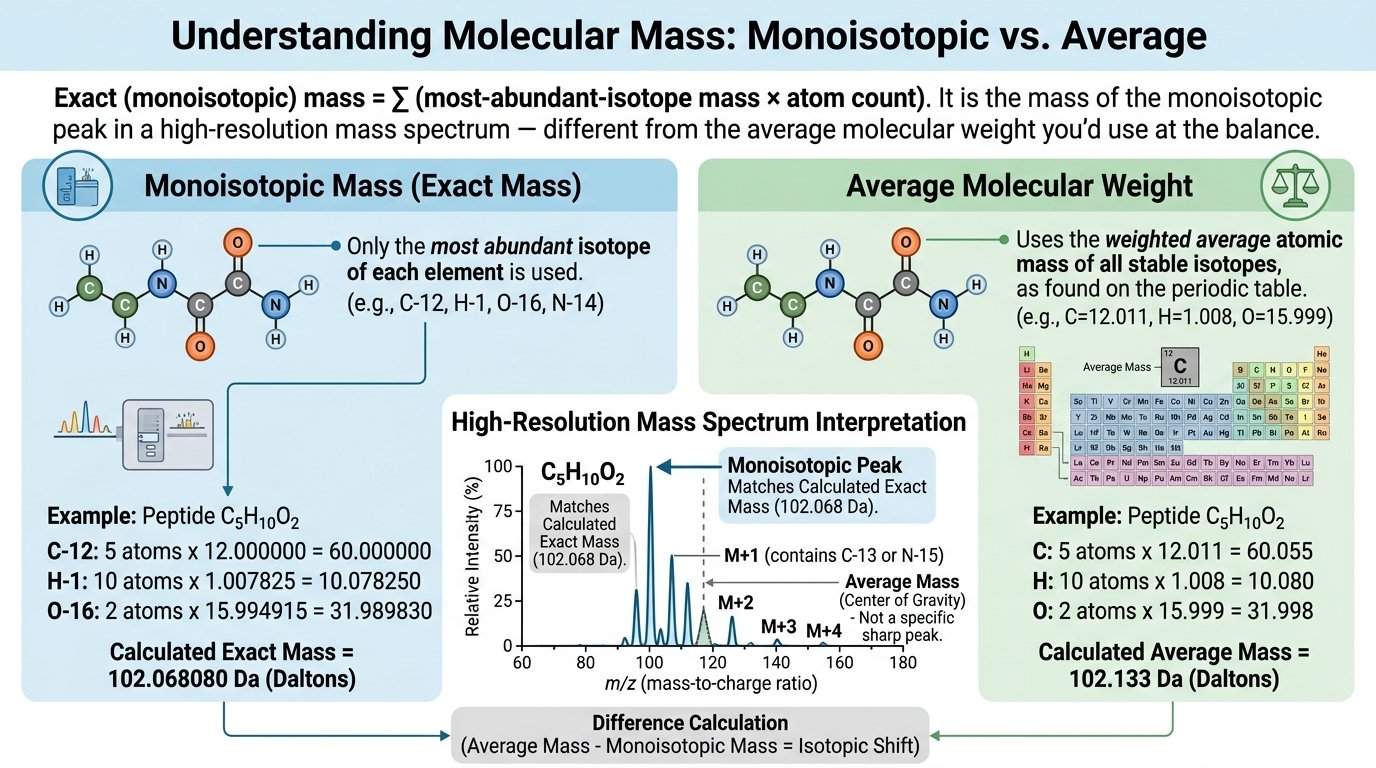
An exact mass calculator is an online tool that computes the monoisotopic mass of a molecule: the sum of the masses of the single most abundant isotope of every atom in the formula. Carbon counts as exactly 12 (the ¹²C definition), hydrogen as 1.007825, nitrogen as 14.003074, oxygen as 15.994915 — not the averaged atomic weights printed on the periodic table.
Why does this distinction exist? Because a mass spectrometer doesn’t see an “average” molecule. It sees individual ions, and the most intense peak of a small molecule is built entirely from the lightest, most abundant isotopes. That peak — the monoisotopic peak — is what high-resolution instruments measure to four or five decimal places, and it is the number journals require in every characterization: “HRMS (ESI) m/z calcd for C8H11N4O2 [M+H]⁺ 195.0877, found 195.0875.”
What makes this particular exact mass calculator a complete HRMS companion is that it doesn’t stop at the neutral mass. It converts to ion m/z for eleven common adducts with proper electron correction, predicts the full isotope envelope by exact convolution of natural isotope distributions across 60+ elements, and grades your measured-vs-calculated agreement in ppm — the entire pre- and post-acquisition workflow in one panel.
💡 Quick definition: Exact (monoisotopic) mass = Σ (most-abundant-isotope mass × atom count). It is the mass of the monoisotopic peak in a high-resolution mass spectrum — different from the average molecular weight you’d use at the balance. Our exact mass calculator computes both, plus the difference.
How to Use This Exact Mass Calculator
Using this free exact mass calculator takes seconds — no registration, any device:
- Pick a mode. Exact Mass, m/z & Adducts, Isotope Pattern, ppm Error or Compare Formulas — the pill tabs switch instantly.
- Type the formula. Standard notation with parentheses and hydrates: C8H10N4O2, Al2(SO4)3, CuSO4·5H2O. Example chips load caffeine, glucose, aspirin and more in one tap.
- Calculate. The answer box shows the headline number; below it come the step-by-step working, a data table and a bar graph.
- Export or reset. Copy, download CSV/TXT, print, share to WhatsApp/Facebook/X — then ↺ Reset for a clean slate. Your last ten results stay in history until you press Clear All.
All isotopic masses come from CODATA/AME evaluations, and the average masses agree with the IUPAC atomic weights used across our molecular weight calculator family — so exact and average numbers never contradict each other between tools.
The 5 Modes of Our Exact Mass Calculator Explained
🎯 Mode 1 — Exact Mass
The core of the exact mass calculator. Enter a formula and get four numbers at once: monoisotopic (exact) mass, average mass, nominal (integer) mass and mass defect — plus an element-by-element table showing each isotope mass and subtotal, and a bar graph of mass contributions. Caffeine returns 194.0804 Da exact against 194.1906 Da average: a 0.11 Da gap that matters enormously at high resolution.
⚡ Mode 2 — m/z & Adducts
Spectrometers detect ions, not neutrals. This mode converts the neutral exact mass into m/z for the adducts electrospray actually produces: [M+H]⁺, [M+Na]⁺, [M+K]⁺, [M+NH4]⁺, [M+2H]²⁺ and [2M+H]⁺ in positive mode; [M−H]⁻, [M+Cl]⁻, [M+HCOO]⁻, [M−2H]²⁻ and [2M−H]⁻ in negative. Crucially, the exact mass calculator adds a proton (1.007276 Da), not a hydrogen atom (1.007825 Da) — the electron correction most quick calculations forget.
📊 Mode 3 — Isotope Pattern
The exact mass calculator predicts the relative intensities of M, M+1, M+2… by exact convolution of every element’s natural isotope distribution. Chlorine and bromine compounds produce their unmistakable M+2 signatures — Br₂ gives the textbook 51 : 100 : 49 triplet — and matching a predicted pattern against a measured one is powerful confirmation of a formula.
🎚️ Mode 4 — ppm Error
The post-acquisition step of the exact mass calculator: enter calculated and found m/z, get the error in ppm and mDa with a verdict calibrated to real practice — sub-1 ppm outstanding, ≤3 excellent, ≤5 the common journal threshold, above 10 a sign of wrong assignment or drifting calibration.
⚖️ Mode 5 — Compare Formulas
Two or three formulas side by side in the exact mass calculator: monoisotopic, average, nominal and mass defect, with pairwise differences in mDa. Load the classic N₂ / CO / C₂H₄ chip — all nominal mass 28, separated only by exact mass — and see why high resolution changed chemistry.
Monoisotopic vs Average Mass: The Difference That Defines HRMS
Every element on the periodic table lists an average atomic weight — chlorine’s famous 35.45 reflects a natural blend of 75.8% ³⁵Cl and 24.2% ³⁷Cl. Averages are perfect for weighing powders, because a spatula of any compound contains trillions of molecules in exactly those natural proportions. That’s the arithmetic our atomic mass calculator and formula weight calculator for ionic compounds handle.
A mass spectrometer — and therefore an exact mass calculator — breaks that average apart. Each individual ion contains a specific set of isotopes, so the spectrum shows separate peaks: a molecule with one chlorine gives an M peak (with ³⁵Cl) and an M+2 peak (with ³⁷Cl) — never a single peak at the average. The monoisotopic peak, built entirely from most-abundant isotopes, is the sharpest, most reproducible reference point, which is why the exact mass calculator reports it as the headline number.
Exact (monoisotopic) mass = Σ most-abundant-isotope masses · Average mass = Σ abundance-weighted isotope masses
Rule of thumb: use average mass at the balance and in solution prep (molarity, dilutions — our molarity calculator lives on averages), and use exact mass at the spectrometer. For caffeine the two differ by 0.11 Da; for a 3 kDa peptide the monoisotopic peak sits about 2 Da below the average — confuse them and every assignment is off.
Adducts and m/z: What Your Spectrometer Actually Sees
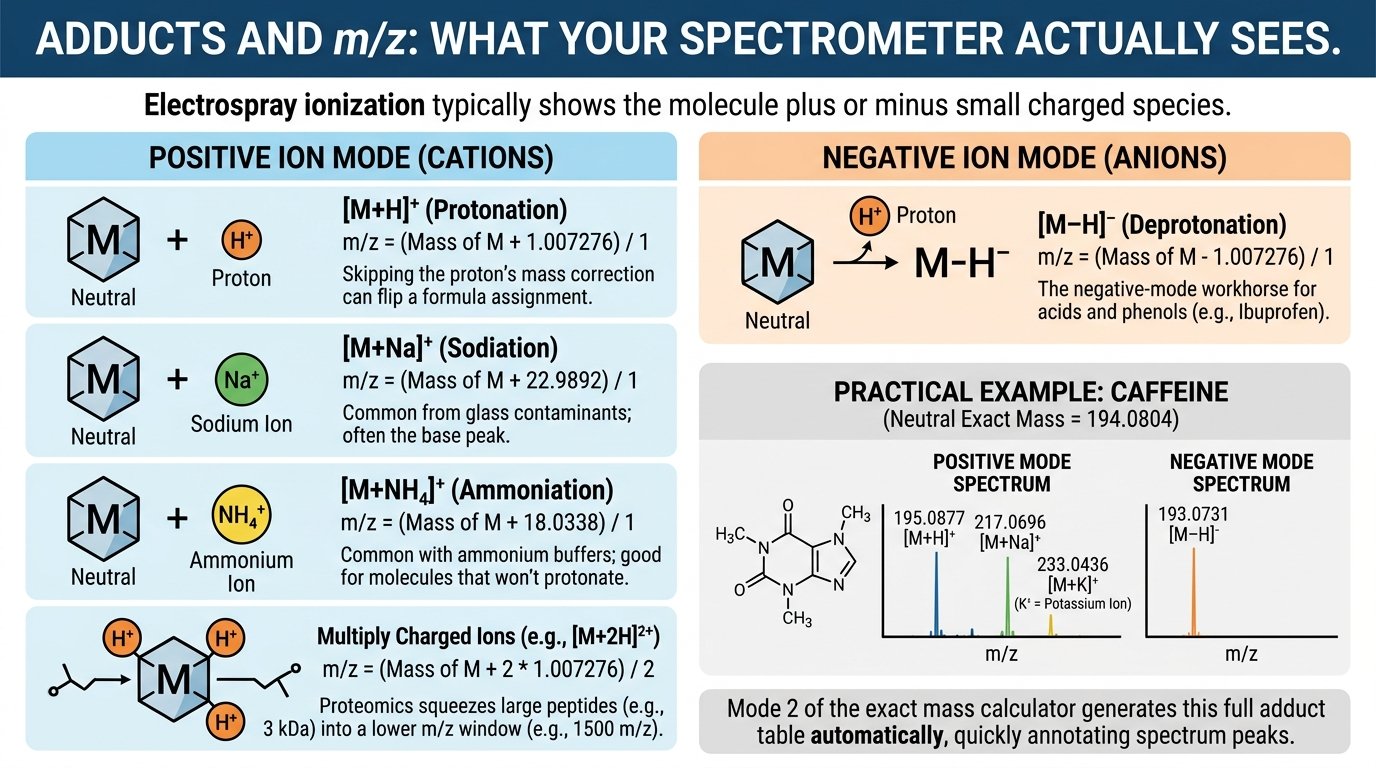
Electrospray ionization rarely shows you the bare molecule. It shows adducts — the molecule plus or minus small charged species — and translating between neutral exact mass and adduct m/z is daily bread for anyone running LC-MS:
- [M+H]⁺ = M + 1.007276. A proton, not a hydrogen atom: the ion has lost an electron’s worth of mass (0.000549 Da). At m/z 195 that electron is worth 2.8 ppm — larger than a good Orbitrap’s error budget, so skipping the correction can flip a formula assignment.
- [M+Na]⁺ = M + 22.9892. The sodium adduct that haunts every glass vial. If your “M+23” peak outruns your M+1, you’re seeing sodiation, not magic.
- [M+NH4]⁺ = M + 18.0338. Common with ammonium buffers; a lifesaver for compounds that won’t protonate.
- [M−H]⁻ = M − 1.007276. The negative-mode workhorse for acids and phenols — ibuprofen at 206.1307 Da appears at m/z 205.1234.
- Multiply charged ions: [M+2H]²⁺ appears at (M + 2.014553) ÷ 2 — how proteomics squeezes 3 kDa peptides into a 1500 m/z window.
Mode 2 of the exact mass calculator prints the full adduct table for both polarities at once, so you can annotate an entire spectrum from one input — caffeine gives 195.0877 / 217.0696 / 233.0436 in positive mode and 193.0731 in negative, and suddenly four mystery peaks have names.
Reading Isotope Patterns Like a Pro
The peaks flanking the monoisotopic peak aren’t noise — they’re a fingerprint. Every element contributes its natural isotope distribution, and the combined envelope is often enough to identify element composition at a glance:
- Carbon: each carbon adds ~1.1% to M+1 (from ¹³C). A molecule with an M+1 of 22% has roughly 20 carbons — a free carbon count hiding in every spectrum.
- Chlorine: one Cl gives an M+2 at ~32% of M; two Cl give ~10 : 6.5 : 1 patterns. Unmissable.
- Bromine: ⁷⁹Br/⁸¹Br are nearly 50:50, so one Br gives twin peaks and two Br the 51 : 100 : 49 triplet.
- Sulfur: a quiet 4.4% M+2 per S — subtle but diagnostic.
- Fluorine, iodine, phosphorus, sodium: monoisotopic elements — they add mass but no pattern, which is itself a clue.
Mode 3 of the exact mass calculator computes these envelopes by exact convolution — no approximation formulas — for anything up to 200 atoms, including polyisotopic metals like tin (ten natural isotopes!). Comparing the predicted pattern against your measured one is the cheapest formula confirmation in mass spectrometry: if intensities disagree, the assignment is wrong no matter how good the ppm looks.
ppm Error: The Accuracy Currency of HRMS
High-resolution instruments don’t report “right or wrong” — they report how close. The universal metric is parts-per-million error:
ppm error = (measured m/z − theoretical m/z) ÷ theoretical m/z × 10⁶
Example from the exact mass calculator: calculated [M+H]⁺ for caffeine is 195.0877; your instrument found 195.0880. The difference is +0.3 mDa, and 0.0003 ÷ 195.0877 × 10⁶ = +1.54 ppm — comfortably inside the ≤5 ppm criterion most journals and identification guidelines use. Modern Orbitraps and Q-TOFs with fresh calibration routinely deliver under 2 ppm; FT-ICR instruments go sub-ppm.
Two habits separate professionals from beginners here. First, compute the theoretical m/z of the ion, electron included — not the neutral. Second, remember that ppm is relative: 5 ppm is 1 mDa at m/z 200 but 5 mDa at m/z 1000, so small molecules are actually the harder test. Mode 4 of the exact mass calculator handles the arithmetic and gives a plain-language verdict, including the uncomfortable one: above 10 ppm, suspect the formula, not the instrument.
Why calibration decides your ppm
Mass accuracy is only as good as the last calibration. Time-of-flight analyzers drift with temperature; Orbitraps hold calibration longer but still benefit from a lock mass — a known background ion (the ubiquitous polysiloxane at 445.1200 is a favorite) that the software re-references every scan. Practical routine: calibrate at the start of a sequence, bracket important samples with a standard, and run your found-vs-calcd numbers through this exact mass calculator immediately, while re-running the sample is still cheap. If a whole batch shifts by the same +4 ppm, that’s drift — recalibrate and correct. If one compound alone sits at +12 ppm while its neighbors behave, that’s not drift; that’s a wrong formula begging to be caught before it reaches a reviewer.
⚗️ Pro workflow: Mode 1 for the neutral exact mass → Mode 2 for the adduct your spectrum actually shows → Mode 3 to confirm the isotope envelope → Mode 4 for the ppm verdict → Mode 5 when two candidate formulas fight over one peak. Five tabs, one confirmed assignment — and a ↺ Reset between compounds keeps every calcd value honest.
Exact Masses of 10 Common Compounds
Every row verified with the exact mass calculator above — bookmark this table for quick reference:
| Compound | Formula | Exact mass (Da) | [M+H]⁺ m/z |
|---|---|---|---|
| Water | H₂O | 18.0106 | 19.0178 |
| Ethanol | C₂H₆O | 46.0419 | 47.0491 |
| Paracetamol | C₈H₉NO₂ | 151.0633 | 152.0706 |
| Glucose | C₆H₁₂O₆ | 180.0634 | 181.0707 |
| Aspirin | C₉H₈O₄ | 180.0423 | 181.0495 |
| Caffeine | C₈H₁₀N₄O₂ | 194.0804 | 195.0877 |
| Ibuprofen | C₁₃H₁₈O₂ | 206.1307 | 207.1380 |
| Morphine | C₁₇H₁₉NO₃ | 285.1365 | 286.1438 |
| Testosterone | C₁₉H₂₈O₂ | 288.2089 | 289.2162 |
| Sucrose | C₁₂H₂₂O₁₁ | 342.1162 | 343.1235 |
Notice glucose and aspirin: both nominal mass 180, separated by 21.1 mDa of exact mass — trivially resolved by any modern HRMS instrument, indistinguishable on a unit-resolution quadrupole. That gap is the entire reason exact mass matters.
Mass Defect & the Nitrogen Rule: Two Free Clues
Mass defect
Exact masses from any exact mass calculator are never whole numbers (except ¹²C, by definition). The decimal part — the mass defect — encodes composition: hydrogen pushes it up (+0.00783 each), oxygen pulls it down (−0.00509 each), and halogens drag it strongly negative. Caffeine’s defect of +0.0804 is typical of CHNO molecules; a compound at nominal 300 with a defect near zero screams halogens or many oxygens. Petroleomics and PFAS screening are built entirely on sorting thousands of peaks by mass defect.
The nitrogen rule
A neutral organic molecule containing C, H, N, O, S, halogens has an odd nominal mass if it contains an odd number of nitrogens, and an even nominal mass for zero or an even number. Caffeine (4 N) sits at even 194; morphine (1 N) at odd 285. When the exact mass calculator gives you a candidate formula, the nitrogen rule is a two-second sanity check that eliminates half of all wrong guesses.
Who Uses an Exact Mass Calculator?
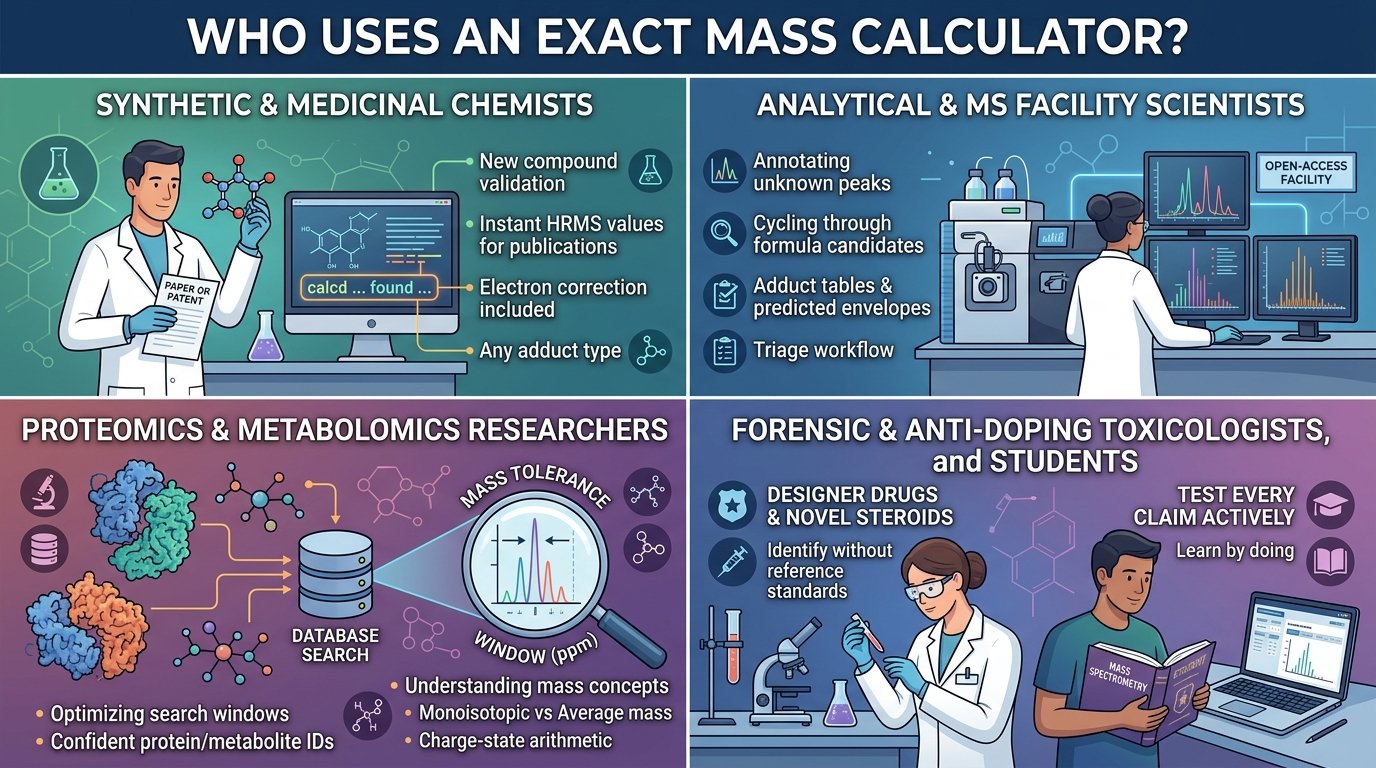
Synthetic and Medicinal Chemists
Every new compound needs an HRMS line in the paper or patent: “calcd … found …”. An exact mass calculator produces the calcd value in seconds, electron correction included, for whichever adduct the ionization gave.
Analytical & MS Facility Scientists
With an exact mass calculator open, annotating unknown peaks means cycling through candidate formulas, adducts and isotope patterns. Modes 2, 3 and 5 together — adduct table, predicted envelope, mDa-level comparison — are the triage workflow of every open-access facility.
Proteomics & Metabolomics Researchers
Database searches live and die on mass tolerance windows an exact mass calculator makes tangible. Understanding monoisotopic vs average mass, charge-state arithmetic and ppm windows — everything this exact mass calculator demonstrates interactively — is the difference between confident IDs and false positives.
Forensic & Anti-Doping Toxicologists, and Students
Designer drugs and novel steroids are identified by exact mass before any reference standard exists — testosterone’s 288.2089 is the same in every lab on Earth. And for students, mass spectrometry chapters finally make sense when a live exact mass calculator lets you test every claim as you read it.
One HRMS Report, Start to Finish
Here’s how a real characterization flows through the exact mass calculator. Scenario: you’ve synthesized a compound you believe is caffeine (C8H10N4O2); the Orbitrap shows a positive-mode peak at m/z 195.0880 with an M+1 about 10% of M.
- Mode 1 — exact mass: C8H10N4O2 → monoisotopic 194.0804 Da (average 194.1906, nominal 194 — even, consistent with 4 nitrogens by the nitrogen rule ✓).
- Mode 2 — adducts: [M+H]⁺ calcd 195.0877 — matches the observed peak region; the smaller peak at 217.07 is [M+Na]⁺, mystery solved.
- Mode 3 — isotope pattern: predicted M+1 ≈ 9.7% (eight carbons plus four nitrogens) — matches the observed ~10% ✓.
- Mode 4 — ppm error: 195.0877 vs 195.0880 → +1.54 ppm — excellent ✓.
- Write the journal line: HRMS (ESI) m/z calcd for C8H11N4O2 [M+H]⁺ 195.0877, found 195.0880 (+1.5 ppm).
Four modes of one exact mass calculator, one confirmed structure, under two minutes — and a ↺ Reset between compounds keeps the next characterization clean.
A Short History of Exact Mass
The numbers inside every modern exact mass calculator carry a century of Nobel-grade physics:
1913 — Thomson splits neon. J.J. Thomson’s parabola experiments showed neon producing two traces, at masses 20 and 22 — the first evidence that a stable element is a blend of isotopes, and the reason “average” atomic weights are averages at all.
1919 — Aston’s mass spectrograph. Francis Aston built the first true mass spectrograph, measured dozens of isotopes, and formulated the whole-number rule — isotope masses are nearly integers — earning the 1922 Nobel Prize in Chemistry.
1920s–30s — the defect becomes physics. Aston’s tiny deviations from whole numbers turned out to be nuclear binding energy via E = mc². The mass defect chemists use to classify compounds is literally the energy that holds nuclei together.
1950s–70s — high resolution arrives. Double-focusing sector instruments made formula assignment by exact mass routine; 1974 brought Fourier-transform ion cyclotron resonance (FT-ICR), the first sub-ppm technique.
2005 — the Orbitrap era. Alexander Makarov’s Orbitrap put FT-class resolving power on a benchtop, and “HRMS, <5 ppm” became a standard requirement in journals rather than a specialty. Today an exact mass calculator plus a benchtop instrument does what once required a national facility.
Exact Mass in the Real World
- Anti-doping laboratories screen athlete samples against exact-mass databases — a designer steroid’s formula betrays it at ±5 ppm even when no reference standard exists yet.
- Food safety: pesticide-residue monitoring runs LC-HRMS against exact-mass target lists of hundreds of compounds in a single injection.
- Pharmaceutical quality: an unknown 0.1% impurity peak gets a formula from its exact mass and isotope pattern before anyone attempts a synthesis of the suspect.
- Environmental science: PFAS “forever chemicals” are hunted by their strongly negative mass defects — fluorine’s signature — across thousands of peaks per water sample.
- Forensics: novel psychoactive substances are provisionally identified from exact mass and pattern alone, hours after seizure.
- Proteomics in the clinic: biomarker peptides are verified by monoisotopic mass at ppm tolerance — diagnostics riding on the fourth decimal place.
Practice Problems (Try Them, Then Check With the Calculator)
Paper first, exact mass calculator second — that is how the tool builds skill instead of replacing it. Answers hide under each problem.
Problem 1 — Monoisotopic mass of glucose, C₆H₁₂O₆?
Answer: 6 × 12 + 12 × 1.007825 + 6 × 15.994915 = 72 + 12.093900 + 95.969488 = 180.0634 Da (average: 180.156).
Problem 2 — [M+H]⁺ and [M+Na]⁺ for caffeine (M = 194.0804)?
Answer: [M+H]⁺ = 194.0804 + 1.007276 = 195.0877; [M+Na]⁺ = 194.0804 + 22.9892 = 217.0696. Note the proton (1.007276), not the H atom (1.007825).
Problem 3 — N₂, CO and C₂H₄ all have nominal mass 28. Order their exact masses.
Answer: CO 27.9949 < N₂ 28.0061 < C₂H₄ 28.0313. Spread over just 36 mDa — resolved by HRMS, hopeless at unit resolution. Mode 5 shows all three side by side.
Problem 4 — Sketch the isotope pattern of a compound containing two bromines.
Answer: Three peaks two mass units apart at roughly 51 : 100 : 49 (M : M+2 : M+4) — the binomial blend of ⁷⁹Br/⁸¹Br at ~50:50 abundance. Mode 3 with Br₂ reproduces it exactly.
Problem 5 — Calcd [M+H]⁺ 289.2162, found 289.2168. ppm error, and is it acceptable?
Answer: Δ = +0.6 mDa; 0.0006 ÷ 289.2162 × 10⁶ = +2.07 ppm — within the ≤5 ppm criterion, acceptable for publication.
Tips for Accurate Results Every Time
- Match the mass to the task: exact mass at the spectrometer, average mass at the balance. Mixing them is the field’s most common rookie error.
- Always compute the ion, not the neutral. [M+H]⁺ ≠ M + 1 and ≠ M + 1.00783; it’s M + 1.00728. The exact mass calculator’s adduct mode has the corrections built in.
- Check the isotope pattern, not just the ppm. A wrong formula can accidentally match within 2 ppm, but it can’t fake the M+1/M+2 envelope too.
- Apply the nitrogen rule before believing any candidate formula — odd nominal mass demands odd nitrogen count.
- Watch for sodium adducts when the “wrong” peak is 21.98 Da above your [M+H]⁺ — that’s Na replacing H, not a mystery impurity.
- Reset between compounds. A stale formula in the input box is the fastest route to reporting the wrong calcd value — one ↺ click prevents it.
5 Common Mistakes to Avoid
A decade of teaching instrumental analysis, and years of exact mass calculator support emails, produce five recurring errors:
- Using the bottle’s molecular weight for HRMS. The catalog MW is the average mass; your spectrometer measures monoisotopic. For caffeine that’s a 0.11 Da mistake — 550 ppm, catastrophic.
- Forgetting the electron. Adding 1.00783 (H atom) instead of 1.00728 (proton) for [M+H]⁺ injects a systematic +2.8 ppm at m/z 195. Sub-5-ppm work cannot absorb it.
- Reporting ppm against the measured value. The denominator is the theoretical m/z — a small but real difference examiners and reviewers notice.
- Ignoring charge state. A doubly charged ion at m/z 500.7 is a 999.4 Da molecule, not a 500.7 Da one. Isotope spacing of 0.5 Da is the giveaway.
- Trusting ppm alone for formula ID. At m/z 300, dozens of CHNOPS formulas fit within 5 ppm. Pattern match plus nitrogen rule plus chemical sense — then assign.
What Makes This Exact Mass Calculator Different?
| Feature | This Tool | Typical Exact Mass Tool |
|---|---|---|
| Monoisotopic + average + nominal + mass defect together | ✅ | Mono only |
| 11 ESI adducts, electron-corrected, both polarities | ✅ | Partial |
| Isotope pattern by exact convolution (60+ elements, Sn/Pt/Hg included) | ✅ | ❌ |
| ppm error with practice-calibrated verdicts | ✅ | ❌ |
| Formula comparison with mDa differences & same-nominal-mass flags | ✅ | ❌ |
| Hydrate & parentheses parsing (CuSO4·5H2O) | ✅ | Partial |
| Step-by-step working shown for every mode | ✅ | Answer only |
| One-click ↺ Reset per mode | ✅ | ❌ |
| Copy / CSV / TXT / print / share + history · free, no limits | ✅ | Varies |
The design goal: one exact mass calculator that carries a compound from formula to finished HRMS report line — calculation, adduct, pattern and error check in a single blue panel.
Where the Data Comes From
Isotopic masses and abundances in this free exact mass calculator follow the CODATA/AME atomic mass evaluations and NIST isotope compilations; average masses reproduce the standard atomic weights published by IUPAC and maintained by CIAAW. The proton and electron masses are CODATA values (1.007276 Da and 0.000549 Da).
Because the same element data underpins our molecular weight calculator, atomic mass calculator, formula weight calculator for ionic compounds and stoichiometry calculator, average and exact values never disagree between tools. For primary references, see the NIST Chemistry WebBook and Wikipedia’s monoisotopic mass article. Updates follow our Corrections Policy.
Quick HRMS Checklist: Exact Mass in 60 Seconds
- ✅ Monoisotopic ≠ average: spectrometer mass vs balance mass — pick the right one for the job.
- ✅ Ion arithmetic: [M+H]⁺ = M + 1.007276 (proton, electron-corrected); [M−H]⁻ = M − 1.007276.
- ✅ ppm error = Δm ÷ theoretical × 10⁶; ≤5 ppm is the standard acceptance window.
- ✅ Isotope pattern must match too — ppm alone never proves a formula.
- ✅ Nitrogen rule: odd nominal mass ⇒ odd number of nitrogens.
- ✅ Mass defect flags halogens (negative) and hydrogen-rich molecules (positive) at a glance.
- ✅ Charge state check: 0.5 Da isotope spacing means z = 2 — double the m/z math.
- ✅ Reset, then verify — every calcd value goes through the exact mass calculator above before it goes in the paper.
Frequently Asked Questions
What is an exact mass calculator?
An exact mass calculator is a free online tool that computes the monoisotopic mass of a molecule — the sum of the most-abundant-isotope masses of all its atoms — along with average mass, nominal mass, adduct m/z values, isotope patterns and ppm error. This exact mass calculator runs entirely in your browser for high-resolution mass spectrometry work.
What is the difference between exact mass and molecular weight?
Molecular weight (average mass) weights every isotope by natural abundance — right for weighing bulk material. Exact (monoisotopic) mass uses only the most abundant isotope of each element — right for mass spectrometry, where individual ions are detected. Caffeine: 194.19 average vs 194.0804 exact.
How do I calculate [M+H]+ from the exact mass?
Add the mass of a proton: m/z = M + 1.007276. Do not add 1.007825 (a hydrogen atom) — the ion is missing one electron (0.000549 Da), and at m/z 195 that difference equals 2.8 ppm.
What is a good ppm error in HRMS?
Under 5 ppm is the common acceptance criterion for formula confirmation in journals; well-calibrated Orbitrap and Q-TOF instruments routinely achieve 1–3 ppm, and FT-ICR goes below 1 ppm. Errors above 10 ppm usually mean a wrong formula or stale calibration.
How does the isotope pattern prediction work?
The calculator convolves the natural isotope distribution of every atom in the formula — an exact binned convolution, not an approximation — then normalizes the tallest peak to 100%. Cl and Br compounds show their classic M+2 signatures; each carbon adds about 1.1% to M+1.
What is the nitrogen rule?
For neutral organic molecules (C, H, N, O, S, halogens, P), an odd nominal mass implies an odd number of nitrogen atoms, and an even nominal mass implies zero or an even number. It’s a fast filter for candidate formulas.
Can it handle hydrates, parentheses and metals?
Yes — CuSO4·5H2O and Al2(SO4)3 parse correctly, and the isotope engine covers 60+ elements including polyisotopic metals like tin, platinum, mercury and lead.
What does the Reset button do?
Each mode’s ↺ Reset clears that panel’s inputs and results in one click, giving you a clean start for the next compound. Saved history stays until you press Clear All.
Is this exact mass calculator free?
Yes, this exact mass calculator is completely free — no registration, no usage limits. All five modes, exports, sharing and history work for everyone on any device, and results are computed in your browser for privacy.
Which mass should I use for solution preparation?
The average molecular weight — bulk material contains the natural isotope blend, so skip the exact mass calculator there. Use exact mass only for interpreting mass spectra. For solution work, pair the average mass with our molarity calculator.
10 Exact Mass Facts Worth Knowing
Favorites from a decade of teaching instrumental analysis — each checkable in seconds with the exact mass calculator above:
- Only one mass in chemistry is exact by definition: ¹²C = 12 Da, the anchor of the entire atomic mass scale since 1961.
- The electron is not optional: forgetting its 0.000549 Da in [M+H]⁺ adds a systematic 2.8 ppm at m/z 195 — bigger than a good Orbitrap’s error.
- Aston’s whole-number rule won a Nobel Prize (1922) — and its tiny violations turned out to be nuclear binding energy, E = mc² weighed on a mass spectrograph.
- Glucose and aspirin both weigh “180” — but 180.0634 vs 180.0423. The 21.1 mDa gap is child’s play for HRMS and invisible to a unit-resolution instrument.
- Each carbon adds ~1.1% to the M+1 peak — count the M+1 intensity and you’ve counted the carbons for free.
- Bromine compounds announce themselves: ⁷⁹Br/⁸¹Br at nearly 50:50 makes twin peaks no analyst can miss.
- Above ~1900 Da the monoisotopic peak stops being the tallest — for large peptides the isotope envelope’s summit shifts to M+1, M+2 and beyond as ¹³C incorporation becomes statistically inevitable.
- Fluorine is the PFAS detective: monoisotopic and mass-deficient, it drags exact masses far below integers — the signature environmental chemists filter thousands of peaks by.
- Tin holds the isotope record among stable elements: ten natural isotopes, producing gloriously complex patterns the pattern mode reproduces exactly.
- A modern benchtop Orbitrap resolves what national facilities once couldn’t: routine sub-2-ppm accuracy has made the exact mass calculator an everyday tool rather than a specialist’s luxury.
Trusted resources for going deeper
- IUPAC Periodic Table of Elements — official standard atomic weights.
- CIAAW — isotopic abundances and atomic weight evaluations.
- NIST Chemistry WebBook — reference spectra and data.
- Monoisotopic mass — Wikipedia — definitions and worked examples.
Final Thoughts: Bookmark This Exact Mass Calculator
Exact mass is where chemistry meets physics at the fourth decimal place — the difference between “a peak at 195” and “confirmed C8H11N4O2, +1.5 ppm.” Master the monoisotopic-vs-average distinction, the proton-not-hydrogen correction and the ≤5 ppm discipline, and mass spectra stop being noise and start being sentences. A fast, electron-corrected exact mass calculator that shows its working makes that fluency dramatically quicker to build.
The tool above carries the whole HRMS workflow: monoisotopic mass with mass defect, eleven ESI adducts in both polarities, exact isotope patterns for 60+ elements, ppm verdicts and formula comparison — with steps, graphs, exports, history and one-click resets, free and unlimited. Try the exact mass calculator with your next characterization; and for the rest of the chain, our molecular weight calculator, atomic mass calculator, formula weight calculator for ionic compounds, molarity calculator and stoichiometry calculator stand ready on the same data.
Found a bug, or want a feature — maybe peptide sequence input? Tell us via the contact page or read about this project. Several tools on this site began as user suggestions.
Written & Reviewed By
Ahmad Raza, M.Phil. Chemistry
Ahmad is a chemistry educator and science content developer with over 10 years of experience teaching analytical and physical chemistry. He builds free calculation tools that help students and lab professionals work faster and make fewer errors. When he’s not balancing equations, he’s usually grading titration reports.