
Molecular Weight by Boiling Point Elevation
The ebullioscopy toolkit: find the molar mass of an unknown from a measured ΔTb (M = Kb · w · 1000 ÷ ΔTb · W), predict how far any solute lifts a solvent’s boiling point, extract van ’t Hoff factors from real data, dose a solute to hit a target boiling point, and derive Kb itself from R · Tb² · M ÷ ΔHvap — all with every step shown.
✓ Trusted by students, teachers & lab professionalsMolar Mass of an Unknown from ΔTb (Ebullioscopy)
The headline experiment: dissolve a weighed sample, measure how far the boiling point rises, and the molar mass follows from M = i · Kb · wsolute · 1000 ÷ (ΔTb · wsolvent). Leave i blank for nonelectrolytes (i = 1).
ΔTb and the New Boiling Point from a Formula
Enter the solute’s formula and masses — the tool computes the molar mass (IUPAC 2021), molality, ΔTb = i · Kb · m, the new boiling point, and the freezing-point depression as a bonus. Parentheses and hydrates work.
Van ’t Hoff Factor from Measured Data
Electrolytes split into ions and raise the boiling point more than their molality suggests. From a measured ΔTb: i = ΔTb ÷ (Kb · m). Add the expected ion count n to get the apparent % dissociation α = (i − 1) ÷ (n − 1).
Dose for a Target Boiling Point — Grams Required
Work the law backwards: pick the boiling point you want, the solute and the solvent amount — the tool returns the required molality and grams: m = ΔTb ÷ (i · Kb), grams = m × kg × M. Try the pasta-water myth.
Kb from Thermodynamics (R · Tb² · M ÷ ΔHvap)
Where the constant comes from: Kb = R · Tb² · Msolvent ÷ ΔHvap, with Tb in kelvin, M in kg/mol and ΔHvap in J/mol. Enter any solvent’s data to derive its Kb, and optionally compare with the tabulated value.
🕘 Recent calculations
- No calculations yet — your last 10 results will appear here.
ΔTb = i · Kb · m · Kb/Kf constants: standard literature values · Molar masses: IUPAC 2021 · Free tool by molecularweightcalculator.org
The molecular weight boiling point elevation method is cryoscopy’s quieter twin — the same colligative law read from the hot end of the thermometer. Dissolve a weighed sample in a weighed solvent, measure how far the boiling point climbs, and the molecular weight follows from a single rearrangement: M = Kb × w × 1000 ÷ (ΔTb × W). Feed the tool above the textbook numbers — 1.28 g of an unknown in 50.0 g of benzene, a 0.505 °C rise — and 128.25 g/mol appears instantly, naphthalene to within a tenth of a percent, with every step written out.
The free calculator above covers the whole ebullioscopy workflow in five modes: molar mass of an unknown from a measured ΔTb, the elevation and new boiling point predicted from any solute formula, van ‘t Hoff factors extracted from real electrolyte data, solute doses computed backwards from a target boiling point, and the thermodynamic derivation of Kb itself from R, Tb, molar mass and the enthalpy of vaporization. Each mode has its own ↺ Reset button, and every result can be copied, downloaded, printed or shared.
In this guide I’ll explain why non-volatile solutes raise boiling points at all, derive the molecular weight boiling point elevation formula from ΔTb = i·Kb·m, tour the Kb constants that make carbon tetrachloride ten times more sensitive than water, walk through the worked examples every exam recycles, bust the pasta-water myth with actual numbers, and finish with practice problems and the mistakes that cost the most marks. Let’s begin.
🔑 KEY TAKEAWAY
Dissolving a non-volatile solute raises a solvent’s boiling point by ΔTb = i · Kb · m (Kb: water 0.512, benzene 2.53, carbon tetrachloride 5.03 °C·kg/mol; m = molality; i = van ‘t Hoff factor, 1 for nonelectrolytes). Rearranged, it delivers the molecular weight of an unknown: M = i · Kb · wsolute · 1000 ÷ (ΔTb · wsolvent). Example: 1.28 g in 50.0 g benzene with ΔTb = 0.505 °C → M = 2.53 × 1.28 × 1000 ÷ (0.505 × 50) = 128.25 g/mol. The calculator above runs all of it — both directions — with every step shown.
📑 Table of Contents (click to expand)
- What Is Boiling Point Elevation?
- How to Use This Calculator
- The Five Modes Explained
- The Formula (With the Box You Should Memorize)
- Why It Works: Vapor Pressure and Colligative Properties
- Electrolytes and the Van ‘t Hoff Factor
- Three Worked Examples, Step by Step
- Reference Table: Kb and Kf for 7 Solvents
- Running the Experiment Well
- Who Uses the Boiling Point Elevation Method?
- Full Lab Walkthrough: An Unknown in Benzene
- A Short History: Raoult, Beckmann & the Cottrell Pump
- Boiling Point Elevation in Everyday Life
- Practice Problems (With Answers)
- Tips for Fast, Error-Free Calculations
- 5 Common Mistakes to Avoid
- How This Calculator Is Different
- Where the Numbers Come From
- Exam Checklist
- Frequently Asked Questions
- 10 Ebullioscopy Facts Worth Knowing
What Is Boiling Point Elevation?
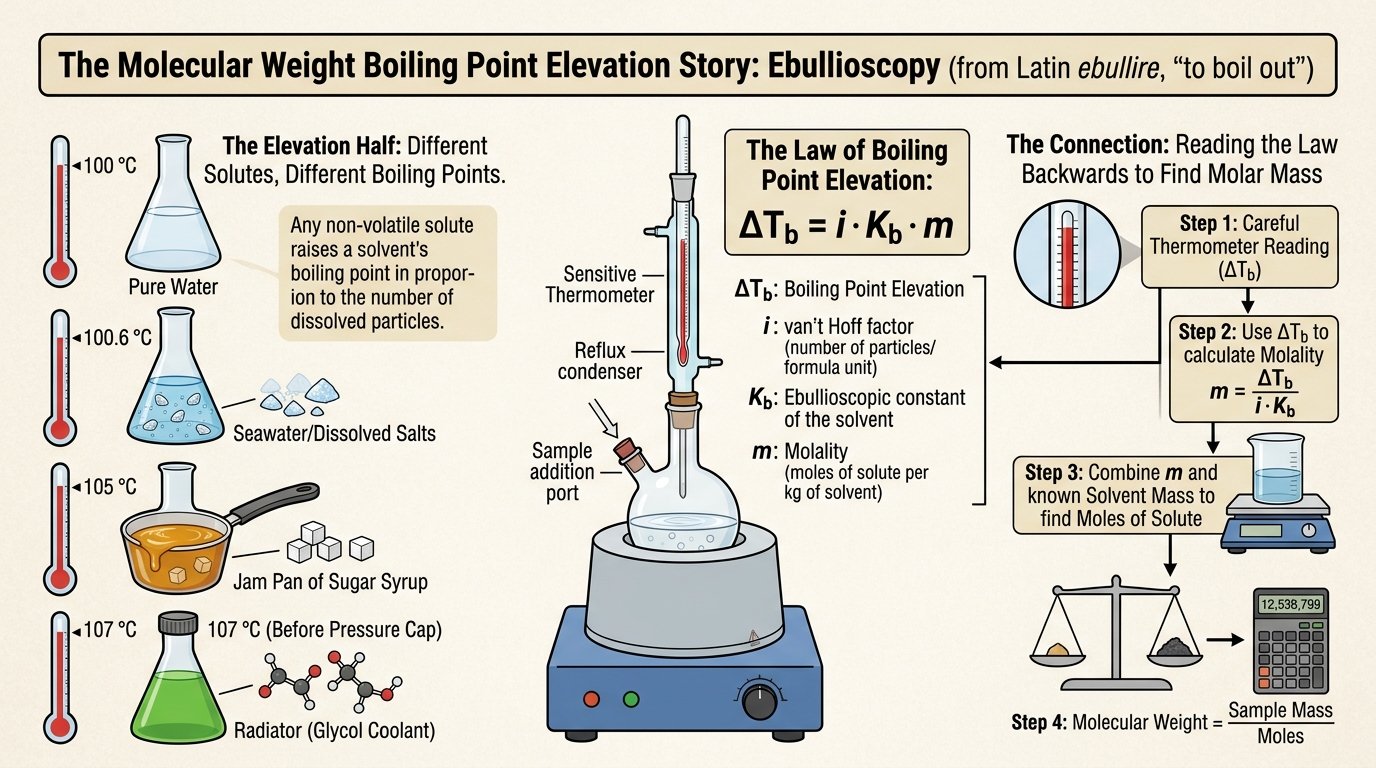
Every molecular weight boiling point elevation story starts with a plain fact: pure water boils at 100 °C at sea level. Seawater boils near 100.6 °C. A jam pan of sugar syrup happily sits at 105 °C, and a radiator full of glycol coolant tops 107 °C before the pressure cap even helps. The difference is dissolved particles: any non-volatile solute raises a solvent’s boiling point, and it does so in proportion to how many particles are dissolved — not what they are. This is the elevation half of the molecular weight boiling point elevation method, one of the four colligative properties, and it obeys a beautifully simple law: ΔTb = i · Kb · m, where m is the molality (moles of solute per kilogram of solvent), Kb is a constant belonging to the solvent, and i counts the particles each formula unit releases.
The molecular weight boiling point elevation connection comes from reading that law backwards. ΔTb tells you the molality; the molality and the solvent mass tell you the moles; and moles under a weighed sample tell you the molar mass. One careful thermometer reading — the whole molecular weight boiling point elevation trick — converts grams into a molecular weight, no mass spectrometer required.
Chemists call the technique ebullioscopy, from the Latin ebullire, “to boil out.” It sits beside cryoscopy in every physical chemistry syllabus because the two together teach three skills at once: molality (as opposed to the molarity our molarity calculator handles), colligative reasoning, and unit discipline. The calculator above runs the arithmetic in both directions — unknown to molar mass, and formula to predicted boiling point — with molar masses drawn from the same IUPAC data as our molecular weight calculator homepage.
How to Use This Calculator
Solving a molecular weight boiling point elevation problem takes under ten seconds:
- Pick a molecular weight boiling point elevation mode from the five tabs — Molar Mass from ΔTb, ΔTb & New BP, Van ‘t Hoff (i), Target BP Dose, or Kb from ΔHvap.
- Enter your data — sample and solvent masses with the measured ΔTb and Kb, or a solute formula with one of the seven built-in solvents. The preset chips load classic textbook setups in one click.
- Press the blue button (or hit Enter). The answer appears with the molality, the moles, a full data table and an animated comparison graph.
- Read the molecular weight boiling point elevation extras — the freezing-point bonus in Mode 2, the dissociation verdict in Mode 3, the percent-by-weight in Mode 4, or the derived-versus-tabulated Kb comparison in Mode 5.
- Copy, download or share the result — CSV, TXT, print, WhatsApp, Facebook or X — and press ↺ Reset to start the next problem clean.
Your last ten calculations are saved in the history panel under the tool (stored only in your own browser), and Clear All wipes them instantly. Nothing is sent to any server — the entire molecular weight boiling point elevation calculator runs on your device, which is also why it loads fast and works offline once the page is open.
The Five Modes Explained
🌡️ Mode 1 — Molar Mass from ΔTb
The headline molecular weight boiling point elevation experiment: sample mass, solvent mass, measured rise, Kb — and out comes the molar mass via M = i·Kb·w·1000 ÷ (ΔTb·W). The classic benzene unknown (1.28 g, 50.0 g, 0.505 °C) returns 128.25 g/mol with molality and moles alongside; the glucose preset (9.00 g in 100 g water, ΔTb 0.256 °C) lands on 180 g/mol exactly.
🔥 Mode 2 — ΔTb & the New Boiling Point
The forward molecular weight boiling point elevation direction: type a solute formula (parentheses and hydrates work), the masses, pick a solvent — the mode computes the molar mass from IUPAC 2021 atomic weights, the molality, ΔTb and the new boiling point, plus the freezing-point depression as a bonus. Ten grams of glucose in 100 g of water: ΔTb = 0.2842 °C, boils at 100.28 °C, freezes at −1.03 °C.
🧂 Mode 3 — Van ‘t Hoff Factor (i)
Electrolytes overshoot every molecular weight boiling point elevation prediction: 0.1 molal NaCl should lift water’s boiling point by 0.0512 °C as a nonelectrolyte, but measures about 0.0956 °C. This mode extracts i = ΔTb ÷ (Kb·m) = 1.867 and, given the expected ion count, the apparent dissociation (86.7%) — with a verdict explaining ion pairing.
🍲 Mode 4 — Target BP Dose
The molecular weight boiling point elevation law worked backwards: pick a target boiling point and the mode returns the required molality, grams and percent by weight. Lifting a kilogram of pasta water by a single degree takes 60 g of salt — four tablespoons, computed in two lines — and the mode refuses politely if you ask for a target below the solvent’s normal boiling point.
🧪 Mode 5 — Kb from ΔHvap
Where the constant comes from: Kb = R·Tb²·Msolvent ÷ ΔHvap. Enter a solvent’s boiling point, formula and enthalpy of vaporization and the mode derives Kb from first principles — 0.513 °C·kg/mol for water against the tabulated 0.512 — then compares, and shows what 0.1, 0.5 and 1 molal solutions would do. It is the molecular weight boiling point elevation method’s “why,” not just its “how.”
The Formula (With the Box You Should Memorize)
Every molecular weight boiling point elevation problem — no exceptions — is one of these three lines rearranged:
ΔTb = i · Kb · m (m = mol solute ÷ kg solvent)
M = i · Kb · wsolute · 1000 ÷ (ΔTb · wsolvent)
Kb = R · Tb² · Msolvent ÷ ΔHvap · new BP = BPpure + ΔTb · i = ΔTb ÷ (Kb · m)
Kb: water 0.512 · ethanol 1.22 · benzene 2.53 · chloroform 3.63 · CCl₄ 5.03 °C·kg/mol · i = 1 for nonelectrolytes
Two details in that molecular weight boiling point elevation box decide most marks. First, molality, not molarity: colligative laws count particles per kilogram of solvent, because kilograms don’t expand when the solution heats up. The 1000 in the molecular weight boiling point elevation formula is just the grams-to-kilograms conversion for the solvent mass. Second, ΔTb is added: the new boiling point is the pure solvent’s value plus ΔTb — the mirror image of the freezing side, where the shift is subtracted.
Notice also what the molecular weight boiling point elevation formula punishes: a small Kb. Water’s 0.512 means a 128 g/mol unknown at typical concentrations lifts the boiling point by barely a tenth of a degree — hard to read on an ordinary thermometer. Benzene’s 2.53 quintuples the signal, chloroform’s 3.63 does better still, and carbon tetrachloride’s 5.03 makes the rise ten times water’s, which is exactly why classical ebullioscopy leaned on organic solvents and why the third line in the box — the thermodynamic origin of Kb — matters. A solvent earns a big Kb by boiling hot, weighing a lot per mole and vaporizing cheaply.
Why It Works: Vapor Pressure and Colligative Properties
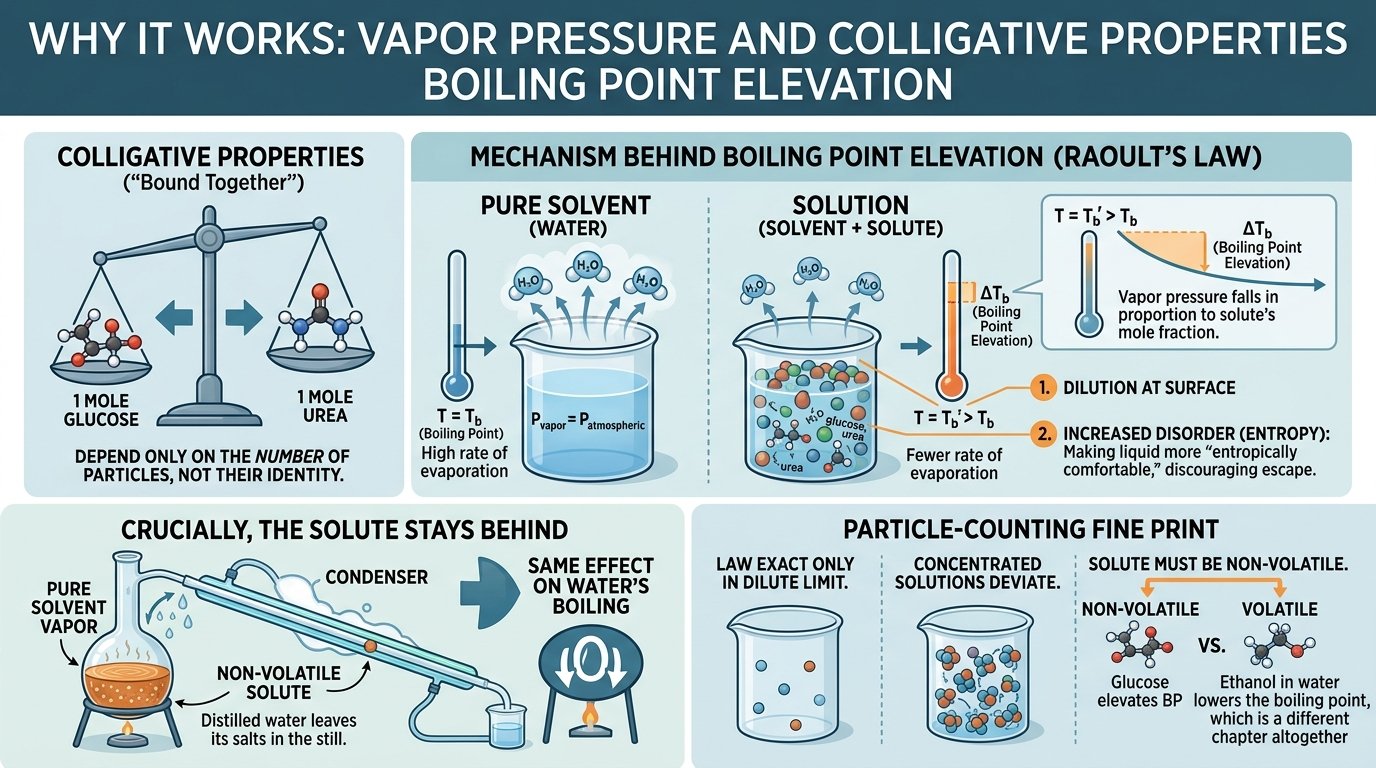
The molecular weight boiling point elevation method belongs to a family of four — vapor-pressure lowering, boiling-point elevation, freezing-point depression and osmotic pressure — called colligative properties, from the Latin colligatus, “bound together.” What binds them is indifference: they depend on the number of dissolved particles, not their identity. A mole of glucose and a mole of urea raise water’s boiling point identically, despite having nothing chemically in common.
The mechanism behind every molecular weight boiling point elevation measurement is Raoult’s law. A liquid boils when its vapor pressure equals the pressure above it. Non-volatile solute particles dilute the solvent at the surface and, more fundamentally, make the liquid more disordered — more entropically comfortable — so fewer solvent molecules escape into the vapor at any given temperature. The vapor pressure falls in proportion to the solute’s mole fraction, and the solution must be heated further before its vapor pressure climbs back to atmospheric. That extra heating is ΔTb. Crucially, the solute stays behind: the vapor that boils off is pure solvent, which is why a simmering syrup gets thicker and why distilled water leaves its salts in the still.
Particle-counting is also the molecular weight boiling point elevation fine print. The law is exact only in the dilute limit; concentrated solutions deviate as particles start interacting. The solute must be non-volatile — a volatile solute like ethanol in water contributes its own vapor and actually lowers the boiling point, which is a different chapter altogether. And “number of particles” is precisely where electrolytes cause drama — the subject of the next section, and the reason the i sits in front of every formula on this page. It’s the same headcount logic that runs our average molecular weight of mixture guide, applied to a thermometer instead of a mixture.
Electrolytes and the Van ‘t Hoff Factor
Run the baseline molecular weight boiling point elevation check: dissolve 0.1 mol of sucrose in a kilogram of water and the boiling point rises 0.0512 °C — exactly Kb × m. Dissolve 0.1 mol of NaCl and it rises about 0.0956 °C, nearly twice as much. The salt has split into Na⁺ and Cl⁻, and the thermometer counts both. The van ‘t Hoff factor i captures this: i = 1 for nonelectrolytes, approaching 2 for NaCl, 3 for CaCl₂, 4 for AlCl₃ — approaching, never quite reaching.
The shortfall is the interesting part of molecular weight boiling point elevation data. NaCl’s measured i of about 1.87 (not 2.00) at 0.1 molal doesn’t mean 13% of the salt failed to dissolve — it means oppositely charged ions occasionally travel as paired couples, momentarily counting as one particle. Ion pairing grows with concentration and with charge: CaCl₂ manages i ≈ 2.7 out of an ideal 3, and MgSO₄, with its doubly charged pair, limps along near 1.2. Mode 3 turns any measurement into i and an apparent dissociation percentage, with the verdict spelled out.
For molecular weight boiling point elevation work the practical rule is simple: determining an unknown’s molar mass assumes i = 1, so use nonelectrolyte solutes or non-dissociating solvents (benzene, chloroform). Conversely, if you already know the formula — say from our formula weight calculator — a measured ΔTb becomes a probe of how completely the compound dissociates. One law, two instruments. Just remember that ΔTb values are roughly a quarter the size of the matching ΔTf values in water, so the boiling side demands a better thermometer to reach the same precision in i.
Three Worked Examples, Step by Step
Example 1 — The classic molecular weight boiling point elevation problem
Step 1. Molality: m = ΔTb ÷ Kb = 0.505 ÷ 2.53 = 0.19960 mol/kg.
Step 2. Moles: n = 0.19960 × 0.0500 kg = 0.0099802 mol.
Step 3. Molar mass: M = 1.28 ÷ 0.0099802 = 128.25 g/mol — naphthalene (C₁₀H₈, 128.17).
Example 2 — Predicting a boiling point from a formula
Step 1. Moles: 10 ÷ 180.156 = 0.05551 mol; molality = 0.05551 ÷ 0.100 kg = 0.5551 mol/kg.
Step 2. ΔTb = 0.512 × 0.5551 = 0.2842 °C → the solution boils at 100.28 °C.
Bonus. ΔTf = 1.86 × 0.5551 = 1.032 °C → it freezes at −1.03 °C. Both ends move; freezing moves 3.6 times further.
Example 3 — An electrolyte’s van ‘t Hoff factor
Step 1. Ideal (i = 1) elevation: 0.512 × 0.100 = 0.0512 °C.
Step 2. i = 0.0956 ÷ 0.0512 = 1.867.
Step 3. Apparent dissociation: α = (1.867 − 1) ÷ (2 − 1) = 86.7% — the shortfall is ion pairing, not undissolved salt.
Run all three in the free calculator above and compare its printed steps with these — they match line for line, because the tool executes exactly this arithmetic at full precision.
Reference Table: Kb and Kf for 7 Solvents
The solvent sets the sensitivity of every molecular weight boiling point elevation measurement. These are the seven built into the calculator:
| Solvent | Kb (°C·kg/mol) | Boiling point (°C) | Kf (°C·kg/mol) | Freezing point (°C) |
|---|---|---|---|---|
| Water | 0.512 | 100.0 | 1.86 | 0.00 |
| Ethanol | 1.22 | 78.4 | 1.99 | −114.1 |
| Benzene | 2.53 | 80.1 | 5.12 | 5.50 |
| Cyclohexane | 2.79 | 80.7 | 20.0 | 6.50 |
| Acetic acid | 3.07 | 118.1 | 3.90 | 16.60 |
| Chloroform | 3.63 | 61.2 | 4.68 | −63.5 |
| Carbon tetrachloride | 5.03 | 76.7 | 29.8 | −22.9 |
Read the Kb column as the molecular weight boiling point elevation sensitivity dial. The same 0.1 molal solution moves water’s boiling point by 0.05 °C, benzene’s by 0.25, chloroform’s by 0.36 and carbon tetrachloride’s by half a degree — ten times water’s response. Note also that every solvent’s Kb is smaller than its Kf: boiling responds less than freezing, because the enthalpy of vaporization in Kb’s denominator dwarfs the enthalpy of fusion in Kf’s. Water is the extreme case — 40.65 kJ/mol to vaporize against 6.01 kJ/mol to melt — which is why its Kb is barely a quarter of its Kf. Hydrated solutes deserve care here too — dissolve CuSO₄·5H₂O and the water of crystallization joins the solvent; our molar mass of hydrates calculator covers that bookkeeping.
Running the Experiment Well
The arithmetic is the easy 10% of molecular weight boiling point elevation work — the measurement is where molecular weight boiling point elevation experiments earn their error bars, and the boiling side has traps the freezing side never sees:
- Measure the boiling liquid, not the vapor — the heart of molecular weight boiling point elevation technique. The vapor above a boiling solution is pure solvent and condenses on the bulb at the pure boiling point, erasing your signal. The Cottrell pump solves this by spraying the boiling solution over the thermometer continuously.
- Beat superheating — liquids routinely overshoot their true boiling point before bubbles nucleate; use boiling chips, a capillary bleed or a stirrer, and read the steady value, not the spike.
- Log the barometer — water’s boiling point shifts about 0.037 °C per mmHg, so an ordinary weather front can mimic a whole ΔTb. Always measure the pure solvent and the solution in the same session, and subtract.
- Use a Beckmann thermometer or a thermistor — the classical instrument resolves 0.001 °C over a 5-degree window; modern digital probes do the same without the mercury.
- Stay dilute — the law is a dilute-solution limit; keep molality below ~0.5 for water (higher in high-Kb solvents where signals are already big).
- Mind volatile, hygroscopic or associating solutes — a solute that co-distils lowers the boiling point instead, a solvent that absorbs moisture changes mass mid-run, and benzoic acid dimerizes in benzene so its apparent M doubles. Anomalous results are often chemistry, not error.
That dimerization footnote is a classic molecular weight boiling point elevation exam twist, shared with cryoscopy: carboxylic acids in benzene return roughly twice their formula weight because hydrogen-bonded pairs count as single particles. The thermometer never lies — it just counts particles you didn’t know you had.
Who Uses the Boiling Point Elevation Method?
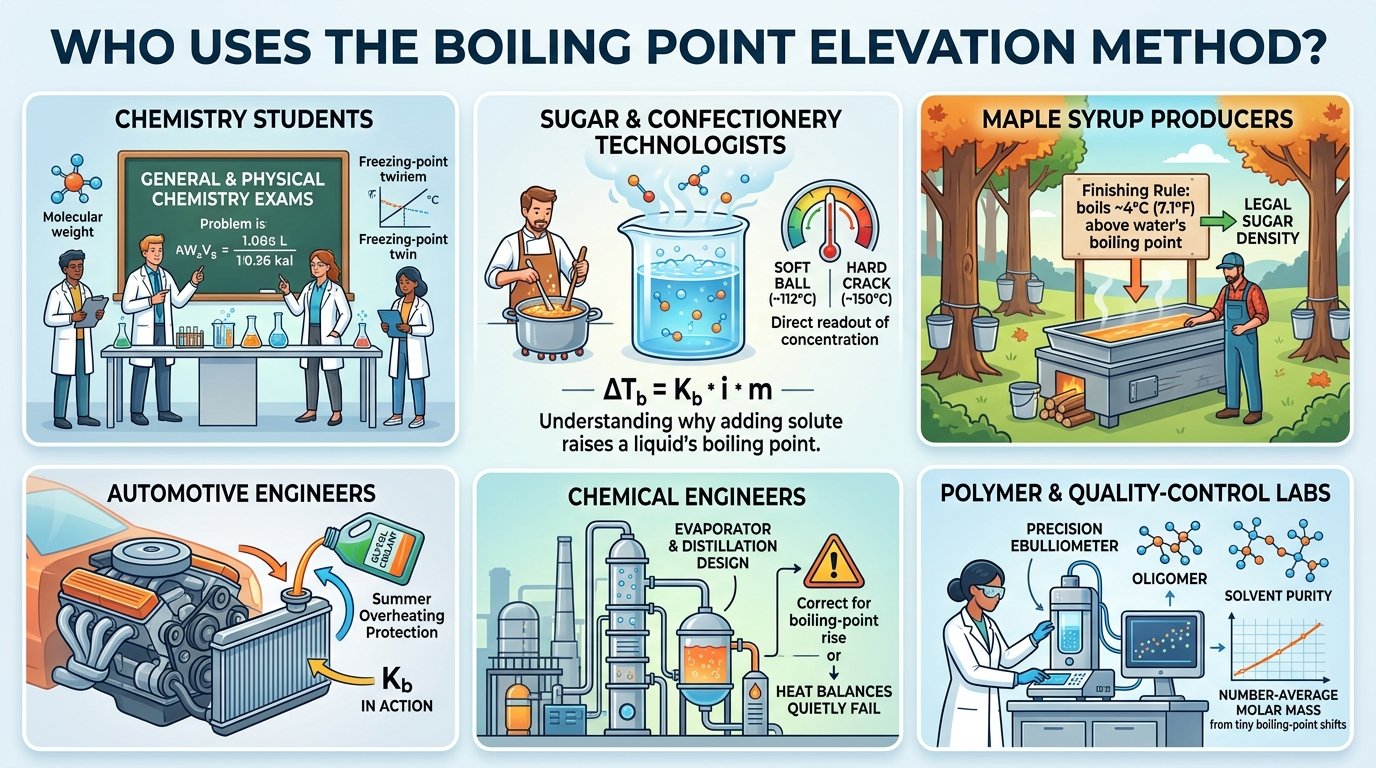
- Students — the molecular weight boiling point elevation problem is a guaranteed fixture of general and physical chemistry exams, usually paired with its freezing-point twin.
- Sugar and confectionery technologists — the boiling point of a syrup is a direct readout of its concentration, which is why candy thermometers are graduated in stages from “soft ball” (about 112 °C) to “hard crack” (about 150 °C).
- Maple syrup producers — the finishing rule is pure ebullioscopy: syrup is done when it boils about 4 °C (7.1 °F) above water’s boiling point that day, which corresponds to the legal sugar density.
- Automotive engineers — glycol coolant raises a radiator’s boiling point before the pressure cap adds its share; summer overheating protection is Kb in action.
- Chemical engineers — evaporator and distillation designers must correct for boiling-point rise at every stage, or their heat balances quietly fail.
- Polymer and quality-control labs — precision ebulliometers measure the purity of solvents and the number-average molar mass of oligomers from tiny boiling-point shifts.
For the reaction-side math these labs run next — yields, limiting reagents, conversions — our stoichiometry calculator and grams to moles calculator continue the workflow.
Full Lab Walkthrough: An Unknown in Benzene
Here’s a complete molecular weight boiling point elevation determination, exactly as the teaching lab runs it.
The task: a molecular weight boiling point elevation identification of an unknown organic solid believed to be either naphthalene (128.2), biphenyl (154.2) or anthracene (178.2).
- Calibrate. Boil 50.00 g of pure benzene in the Cottrell apparatus: steady reading 80.10 °C at today’s barometer, reproducible to ±0.01.
- Dissolve. Add 1.2800 g of the unknown; bring back to a steady boil with the thermometer bulb in the vapor space above the liquid; it reads 80.32 °C — ΔTb = 0.22 °C.
- Compute with the molecular weight boiling point elevation calculator. Mode 1: 1.28 g, 50.0 g, 0.22 °C, Kb 2.53 → m = 0.08696 mol/kg, n = 0.004348 mol, M = 294.4 g/mol… which matches none of the candidates.
- Diagnose. The bulb was in the vapor! Condensing pure benzene kept it cool, so most of the elevation went unrecorded. Restart the Cottrell pump so boiling solution bathes the bulb: steady reading 80.605 °C → ΔTb = 0.505 °C.
- Recompute. M = 2.53 × 1.28 × 1000 ÷ (0.505 × 50) = 128.25 g/mol — naphthalene, within 0.1% of 128.17.
- Cross-check. A quick cryoscopy run on the same solution (ΔTf 1.02 °C, Kf 5.12) returns 128.5 g/mol via our molecular weight freezing point depression tool. Confirmed; report printed from the toolbar.
The molecular weight boiling point elevation lesson the numbers teach: the arithmetic was never the risk — the misplaced thermometer was. Verify the setup, then trust the calculator.
A Short History: Raoult, Beckmann & the Cottrell Pump
The molecular weight boiling point elevation law grew out of vapor-pressure measurements rather than thermometers. In the 1880s François-Marie Raoult, working in Grenoble, showed that a dissolved substance lowers a solvent’s vapor pressure in proportion to its mole fraction — and since a liquid boils when its vapor pressure reaches atmospheric, a lowered vapor pressure necessarily meant a raised boiling point. The constant-per-mole regularity turned a curiosity into an instrument: if equal moles give equal elevations, then an unknown’s ΔTb reveals its moles, and hence its molecular weight.
Molecular weight boiling point elevation measurements then had to overcome their own physics. Ernst Beckmann’s differential thermometer of 1888 supplied the 0.001 °C resolution, and his ebullioscope became standard glassware, but superheating and the cold-vapor problem plagued results until Walter Landsberger’s 1898 trick of heating the solution with its own solvent vapor, and finally Frederick Cottrell’s 1919 pump, which lifts slugs of boiling liquid onto the thermometer bulb so it reads the true equilibrium temperature. Wojciech Świętosławski refined the design into precision ebulliometers in the 1920s and 1930s, and ebulliometry became a standard purity test for solvents. Van ‘t Hoff, meanwhile, folded the anomalous elevations of electrolytes into his theory of solutions — work that earned the first Nobel Prize in Chemistry in 1901. Mass spectrometry eventually took the crown for precision — the story our monoisotopic mass calculator tells — but the boiling point method still delivers molar masses with equipment a school owns, which is why it never left the syllabus.
Boiling Point Elevation in Everyday Life
Once the molecular weight boiling point elevation law is in your head, you start noticing it in kitchens, garages and factories:
- The pasta-water myth — a tablespoon of salt (about 17 g) in 4 liters of water is 0.073 molal; with i ≈ 1.9 that lifts the boiling point by 0.07 °C. You salt pasta water for flavor, not speed. Reaching a full extra degree takes 60 g per liter — Mode 4 shows the arithmetic.
- Car coolant — a 50:50 ethylene-glycol mix boils near 107 °C at atmospheric pressure, and the 15 psi radiator cap pushes that past 125 °C; the same jug protects against freezing in winter, both ends of the colligative law in one product.
- Candy and jam making — as water boils off a sugar syrup, its concentration and therefore its boiling point climb; the thermometer reading is the recipe. Jam sets around 104–105 °C, caramel begins past 160 °C.
- Maple syrup — sap is finished when it boils about 4 °C above water’s boiling point that morning; producers check water first because barometric pressure moves the baseline daily.
- Seawater — 3.5% salt raises the ocean’s boiling point to roughly 100.6 °C, which desalination engineers must budget for at every evaporator stage.
- Industrial evaporators — concentrated brines and sugar liquors show “boiling point rise” of several degrees; multiple-effect evaporators are designed around it.
- What is not elevation — pressure cookers raise water’s boiling point by pressure, and mountains lower it by thin air; neither is colligative, but both share the vapor-pressure logic.
Every bullet is the same molecular weight boiling point elevation law wearing different clothes — particles in a solvent, counted by a thermometer.
Practice Problems (With Answers)
Work each problem by hand first, then verify with the free calculator above. Answers are hidden until you click.
Problem 1 — 3.00 g of a nonelectrolyte in 100 g of water boils at 100.256 °C. Find M.
m = 0.256 ÷ 0.512 = 0.500 mol/kg → n = 0.0500 mol → M = 3.00 ÷ 0.0500 = 60.0 g/mol — consistent with urea.
Problem 2 — At what temperature does 34.2 g of sucrose (C₁₂H₂₂O₁₁) in 500 g of water boil?
M = 342.297 → 0.09991 mol → m = 0.19983 mol/kg → ΔTb = 0.512 × 0.19983 = 0.1023 °C → boils at 100.10 °C.
Problem 3 — 0.100 molal CaCl₂ in water measures ΔTb = 0.138 °C. Find i and the apparent dissociation.
i = 0.138 ÷ (0.512 × 0.100) = 2.695; α = (2.695 − 1) ÷ (3 − 1) = 84.8% — ion pairing accounts for the rest.
Problem 4 — How many grams of NaCl (i = 1.9) raise the boiling point of 1.00 kg of water by exactly 1.00 °C?
m = 1.00 ÷ (1.9 × 0.512) = 1.0280 mol/kg → n = 1.0280 mol → grams = 1.0280 × 58.44 = 60.07 g — about four tablespoons, for one degree.
Problem 5 — Derive Kb for water from Tb = 373.15 K, M = 18.015 g/mol and ΔHvap = 40.65 kJ/mol.
Kb = R·Tb²·M ÷ ΔHvap = 8.314 × 373.15² × 0.018015 ÷ 40650 = 0.513 °C·kg/mol — within 0.2% of the tabulated 0.512.
Tips for Fast, Error-Free Calculations
- ✅ Convert the solvent to kilograms first — the number-one molecular weight boiling point elevation habit: the 1000 in the formula exists only because solvent masses arrive in grams; do it explicitly and the units audit themselves.
- ✅ Add ΔTb, never subtract — it’s the size of the rise; the new boiling point is the pure value plus ΔTb, the opposite of the freezing side.
- ✅ Molality, never molarity — kilograms of solvent, not liters of solution; the whole law depends on it.
- ✅ Check i before you start — nonelectrolyte? i = 1 and vanishes. Salt? Count the ions and expect a little less (ion pairing).
- ✅ Sanity-check every molecular weight boiling point elevation result against a candidate formula — an ebullioscopic 128.3 g/mol with 2% error brackets 126–131; compare candidates before celebrating.
- ✅ Reset between problems — the ↺ Reset button on each mode keeps old inputs from contaminating the next calculation.
⚗️ Pro workflow: Mode 1 for any molecular weight boiling point elevation unknown → Mode 2 to predict a boiling point before mixing → Mode 3 when the solute is an electrolyte → Mode 4 to dose a syrup or coolant to a target temperature → Mode 5 to derive Kb for a solvent your table doesn’t list. Five tabs, one colligative law, zero unit slips.
5 Common Mistakes to Avoid
A decade of marking molecular weight boiling point elevation answers produces the same five errors on repeat:
- Using molarity instead of molality in molecular weight boiling point elevation work. Liters of solution ≠ kilograms of solvent; in dilute water they’re close enough to almost work, which makes the habit dangerous everywhere else.
- Forgetting the 1000. Solvent grams must become kilograms; omitting the factor makes every molar mass a thousand times too small — instantly recognizable, still endlessly submitted.
- Dropping the van ‘t Hoff factor. For NaCl solutions every prediction is nearly double without i — and conversely, using i on a nonelectrolyte halves it.
- Reading the thermometer in the vapor. The classic molecular weight boiling point elevation trap: the vapor is pure solvent and condenses on the bulb at the pure boiling point, so the measured ΔTb collapses and the molar mass balloons.
- Mixing up Kb and Kf, or the sign of the shift. Water’s Kb is 0.512, its Kf is 1.86; use the wrong one and the answer is off by a factor of 3.6. And ΔTb = 0.28 °C means the solution boils at 100.28 °C, not 99.72.
How This Calculator Is Different
| Feature | This calculator | Generic ΔTb tool | By hand |
|---|---|---|---|
| Molar mass from ΔTb (the inverse problem) | ✅ With molality & moles shown | ⚠️ Forward only | ✅ If units survive |
| Formula input (IUPAC 2021 masses) | ✅ Parentheses & hydrates | ❌ Numbers only | ⚠️ Separate lookup |
| Van ‘t Hoff factor & dissociation verdicts | ✅ i and α with interpretation | ❌ | ✅ If you know the trick |
| Target-boiling-point dose (inverse to grams) | ✅ With % w/w and validation | ❌ | ⚠️ Two rearrangements |
| Kb derived from thermodynamics | ✅ R·Tb²·M/ΔHvap, compared with tables | ❌ | ⚠️ Rare |
| Export & history | ✅ CSV/TXT/print/share + last 10 | ❌ Usually none | ❌ Notebook |
Related molecular weight boiling point elevation companions carry the theme onward: exact and isotope-level masses in the exact mass calculator, isotopic mass calculator and average vs monoisotopic mass guide — and the polymer-scale averages ebulliometry historically fed into, via the number average molecular weight polymer, weight average molecular weight polymer and polydispersity index calculator trilogy (ebullioscopy measures a number-average, incidentally — every particle votes once).
Where the Numbers Come From
The Kb and Kf constants built into this molecular weight boiling point elevation calculator are the standard literature values used by mainstream physical-chemistry texts (water 0.512/1.86, ethanol 1.22/1.99, benzene 2.53/5.12, cyclohexane 2.79/20.0, acetic acid 3.07/3.90, chloroform 3.63/4.68, carbon tetrachloride 5.03/29.8 °C·kg/mol). Molar masses computed from formulas use IUPAC 2021 standard atomic weights — the same 118-element dataset behind every tool on this site. The atomic mass calculator exposes that dataset element by element, and Mode 5 uses R = 8.314 J/mol·K with enthalpies of vaporization you supply from the NIST WebBook or your course sheet.
Molecular weight boiling point elevation textbooks differ slightly on some constants (water’s Kb appears as 0.51, 0.512 or 0.513 depending on the ΔHvap and rounding used) — if your course sheet specifies a value, type it directly into Modes 1 or 3. Spot a discrepancy worth checking? Our corrections policy explains how we verify and fix reports — usually within days.
Exam Checklist
☐ I can rearrange it to M = i·Kb·w·1000 ÷ (ΔTb·W) without notes.
☐ I know Kb for water (0.512) and benzene (2.53), and why Kb is always smaller than Kf for the same solvent.
☐ I can convert ΔTb into a new boiling point with the correct sign — added, not subtracted.
☐ I can compute a van ‘t Hoff factor from data and interpret i < n as ion pairing.
☐ I can explain why only non-volatile solutes raise the boiling point, and what a volatile solute does instead.
☐ I know the classic traps: thermometer in the vapor, superheating, barometric drift, molarity vs molality.
☐ I’ve verified my practice answers with the molecular weight boiling point elevation calculator above.
Frequently Asked Questions
How do you find molecular weight by boiling point elevation?
Dissolve a weighed sample (w grams) in a weighed solvent (W grams), measure the rise ΔTb, and apply M = Kb × w × 1000 ÷ (ΔTb × W). Example: 1.28 g in 50.0 g benzene with ΔTb = 0.505 °C gives M = 128.25 g/mol.
What is the boiling point elevation formula?
ΔTb = i · Kb · m, where m is molality (mol solute per kg solvent), Kb is the solvent’s ebullioscopic constant and i is the van ‘t Hoff factor (1 for nonelectrolytes). The new boiling point is the pure solvent’s plus ΔTb.
Why is Kb smaller than Kf for the same solvent?
Because Kb = R·Tb²·M ÷ ΔHvap while Kf = R·Tf²·M ÷ ΔHfus, and the enthalpy of vaporization is far larger than the enthalpy of fusion. For water, 40.65 kJ/mol against 6.01 kJ/mol outweighs the higher boiling temperature, giving Kb = 0.512 versus Kf = 1.86.
What is Kb for water?
0.512 °C·kg/mol — one mole of dissolved particles per kilogram of water raises the boiling point by 0.512 °C. Benzene’s is 2.53, chloroform’s 3.63 and carbon tetrachloride’s 5.03, which is why high-Kb solvents make more sensitive measurements.
Is this molecular weight boiling point elevation calculator free?
Yes, completely free — no registration, no daily limits. It runs entirely in your browser, and your history stays on your own device.
Does salt make pasta water boil faster?
No. A tablespoon of salt in 4 liters raises the boiling point by only about 0.07 °C, and a higher boiling point means the water needs slightly more heating, not less. Salt the water for taste; the physics is negligible.
What is the van ‘t Hoff factor?
The effective number of particles each formula unit releases: 1 for sugar, ~1.9 for NaCl, ~2.7 for CaCl₂ at ordinary concentrations. Measured i values fall short of the ideal ion count because of ion pairing; Mode 3 computes both i and the apparent dissociation.
Why must the solute be non-volatile?
Because the law assumes only the solvent contributes to the vapor. A volatile solute such as ethanol adds its own vapor pressure, so the mixture boils lower, not higher — that is a distillation problem governed by Raoult’s law for two volatile components, not a colligative one.
What is a Cottrell pump?
A glass device inside an ebulliometer that uses the boiling action itself to lift slugs of solution up a tube and pour them over the thermometer bulb. It keeps the bulb bathed in liquid at the true boiling temperature, defeating both superheating and the cold-vapor error.
Can boiling point elevation measure polymers?
Only small ones. A 100,000 g/mol polymer at practical concentrations produces elevations of a few ten-thousandths of a degree — unmeasurable. Precision ebulliometry handled oligomers up to a few thousand g/mol; large polymers went to osmometry and light scattering, which report the averages covered in our polymer calculators.
10 Ebullioscopy Facts Worth Knowing
- Raoult’s vapor-pressure law of the 1880s predicted boiling point elevation before anyone measured it precisely — the thermometers caught up with Beckmann in 1888.
- Van ‘t Hoff’s analysis of “anomalous” electrolyte data helped win the very first Nobel Prize in Chemistry, in 1901.
- Water’s boiling point drifts about 0.037 °C per mmHg of barometric pressure — a passing storm can fake a ΔTb, which is why the pure solvent is always run the same day.
- Kb = R·Tb²·M ÷ ΔHvap; combine it with Trouton’s rule (ΔHvap ÷ Tb ≈ 87 J/mol·K for ordinary liquids) and Kb ≈ 0.096 × Tb(K) × M(kg/mol) — heavy, high-boiling solvents win.
- Water breaks Trouton’s rule (about 109 J/mol·K, thanks to hydrogen bonding), which is part of why its Kb is so small.
- Carbon tetrachloride’s Kb of 5.03 is nearly ten times water’s; its Kf of 29.8 is sixteen times water’s.
- Maple syrup is legally finished at a boiling point about 4 °C above water’s — an ebullioscopic density test used in every sugar house.
- The Cottrell pump of 1919 has no moving parts: bubbles of boiling solvent do the lifting.
- Ebullioscopy yields a number-average molecular weight: every particle votes once, exactly like the polymer Mn our tools compute.
- Volatile solutes reverse the effect — 10% ethanol in water boils near 92 °C, not above 100.
🔗 Trusted external resources
Final Thoughts
The molecular weight boiling point elevation method is a rare thing in chemistry: a molecular measurement you can make with a flask, a heater and one careful thermometer. Behind it sit four small rules — molality not molarity, ΔTb added to the pure boiling point, the 1000 that converts grams to kilograms, and an i for every electrolyte — plus one piece of lab wisdom: keep the bulb in the boiling liquid. Master those, let the calculator above verify every line, and ebullioscopy becomes one of the most dependable places to score — in the exam hall and at the bench.
Bookmark this molecular weight boiling point elevation page for your next problem set or lab report, share it with a labmate before the colligative-properties practical, and explore the rest of our free chemistry tools — from the molecular weight calculator homepage to the molarity calculator for the solution-prep side. Questions or corrections? Reach us any time through the contact page — and you can read more about the site’s mission on our about page.
Written & Reviewed By
Ahmad Raza, M.Phil. Chemistry
Ahmad is a chemistry educator and science content developer with over 10 years of experience teaching analytical and physical chemistry. He builds free calculation tools that help students and lab professionals work faster and make fewer errors. When he’s not balancing equations, he’s usually grading titration reports.