
Polydispersity Index Calculator (PDI / Đ)
Calculate the polydispersity index (dispersity Đ = M_w ÷ Mₙ) of any polymer — from the two averages, from raw fraction data, or from the DP ratio — plus the DLS nanoparticle PDI = (σ ÷ d)². Every result comes with a plain-words verdict and the full working shown.
✓ Trusted by students, teachers & lab professionalsPDI from Mₙ & M_w (Đ = M_w ÷ Mₙ)
Enter any TWO of Mₙ, M_w and PDI — the third is solved instantly, with a plain-words verdict on your distribution. Đ = 1 means perfectly uniform chains; commercial polymers typically run Đ ≈ 1.5–3.
PDI from Chain Counts (Nᵢ and Mᵢ)
No averages yet? Enter 2–4 fractions (molar mass + moles of chains) and the calculator builds both averages first — Mₙ = ΣNᵢMᵢ ÷ ΣNᵢ and M_w = ΣNᵢMᵢ² ÷ ΣNᵢMᵢ — then divides them for the PDI.
PDI from Fraction Masses (wᵢ and Mᵢ)
With grams instead of counts: M_w = ΣwᵢMᵢ ÷ Σwᵢ and Mₙ = Σwᵢ ÷ Σ(wᵢ ÷ Mᵢ) — the PDI follows. Mass data spreads the two averages apart fast, so watch the verdict.
PDI from the DP Ratio (DP_w ÷ DPₙ)
The dispersity equals the ratio of the two degrees of polymerization: PDI = DP_w ÷ DPₙ. Add the repeat-unit formula (optional) and Mₙ and M_w come out too — IUPAC 2021 atomic masses.
Nanoparticle PDI from DLS (σ and d)
In dynamic light scattering the polydispersity index is dimensionless: PDI = (σ ÷ d)², from the mean particle diameter d and the standard deviation σ. Below 0.1 counts as monodisperse; above 0.4 is broad.
🕘 Recent calculations
- No calculations yet — your last 10 results will appear here.
Đ (PDI) = M_w ÷ Mₙ ≥ 1 · DLS PDI = (σ ÷ d)² · Atomic masses: IUPAC 2021 · Free tool by molecularweightcalculator.org
The polydispersity index calculator on this page answers the question every polymer report eventually asks: how broad is the chain-length distribution? Type Mₙ = 50,000 and M_w = 90,000 into the tool above and PDI = 1.8 appears instantly — with a plain-words verdict (“typical commercial breadth”), the full division written out, and a bar chart comparing the two averages.
The free polydispersity index calculator above computes PDI five different ways — from the two averages (solving whichever of the three values is missing), from raw chain counts, from fraction masses, from the DP_w ÷ DPₙ ratio, and even the dimensionless DLS nanoparticle PDI = (σ ÷ d)² that dominates drug-delivery and liposome work. Each of the five modes has its own ↺ Reset button, and every result can be copied, downloaded, printed or shared.
In this guide I’ll show you how to use every mode, derive the polydispersity index calculator math from first principles, hand you the interpretation chart that turns any PDI value into a mechanism diagnosis, untangle the polymer-PDI vs nanoparticle-PDI confusion that trips up half the literature, and finish with the practice problems examiners recycle every year. Let’s begin.
🔑 KEY TAKEAWAY
The polymer polydispersity index (IUPAC name: dispersity, Đ) is PDI = M_w ÷ Mₙ — always ≥ 1, with 1 meaning perfectly uniform chains. Read it as a mechanism fingerprint: ~1.0–1.1 living/anionic polymerization, ~1.5–2.0 controlled radical and ideal step-growth (Flory’s limit is exactly 2), 2–10+ conventional free-radical and polyolefins. It also equals DP_w ÷ DPₙ. The separate DLS nanoparticle PDI = (σ ÷ d)² runs 0–1, where < 0.1 is monodisperse and > 0.4 is broad. This polydispersity index calculator computes both kinds, with the verdict spelled out.
📑 Table of Contents (click to expand)
- What Is the Polydispersity Index (PDI)?
- How to Use This Polydispersity Index Calculator
- The Five Modes Explained
- The Formula (With the Box You Should Memorize)
- The Interpretation Chart: What Your PDI Value Means
- Polymer PDI vs Nanoparticle (DLS) PDI
- Three Worked Examples, Step by Step
- Typical PDI Values: 10 Polymerization Routes
- How PDI Is Measured in the Real World
- Who Uses the Polydispersity Index?
- Full Lab Walkthrough: A Liposome Batch by DLS
- A Short History: From PDI to Đ
- Polydispersity in Everyday Life
- Practice Problems (With Answers)
- Tips for Fast, Error-Free PDI Calculations
- 5 Common Mistakes to Avoid
- How This Calculator Is Different
- Where the Numbers Come From
- Exam Checklist
- Frequently Asked Questions
- 10 Polydispersity Facts Worth Knowing
What Is the Polydispersity Index (PDI)?
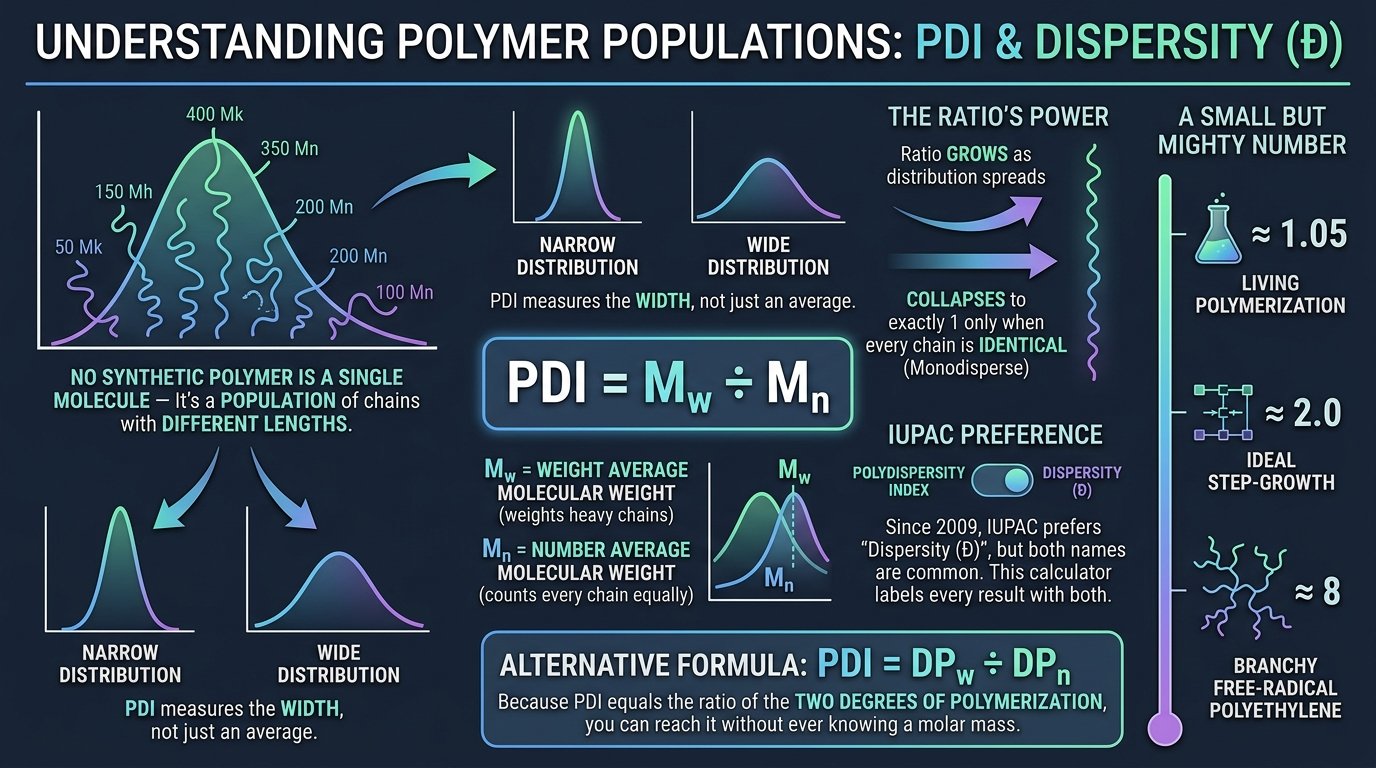
No synthetic polymer is a single molecule — it’s a population of chains with different lengths, and a population needs a width, not just an average. The number this polydispersity index calculator delivers is that width: PDI = M_w ÷ Mₙ, the ratio of the weight average molecular weight to the number average. Because M_w weights the heavy chains and Mₙ counts every chain equally, the ratio grows as the distribution spreads — and collapses to exactly 1 only when every chain is identical.
Since 2009 IUPAC has preferred the name dispersity with the symbol Đ (“D-stroke”) over “polydispersity index,” but the older term still dominates search bars, datasheets and half the literature — so this page, and the free polydispersity index calculator above, speak both dialects and label every result with both names.
The number is small but mighty: a PDI of 1.05 tells you the sample came from a living polymerization; 2.0 whispers ideal step-growth; 8 shouts branchy free-radical polyethylene. And because PDI also equals DP_w ÷ DPₙ — the ratio of the two degrees of polymerization — you can reach it in this polydispersity index calculator without ever knowing a molar mass. The two averages themselves have their own dedicated guides on this site: the number average molecular weight polymer post and the weight average molecular weight polymer post are this page’s two parents.
How to Use This Polydispersity Index Calculator
Using this polydispersity index calculator takes under ten seconds:
- Pick a mode from the polydispersity index calculator’s five tabs — PDI from Mₙ & M_w, PDI from Chain Counts, PDI from Masses, PDI from DP Ratio, or Nanoparticle PDI (DLS).
- Enter your data — any two of Mₙ/M_w/PDI, 2–4 fractions, the two DPs, or a mean diameter with its standard deviation. The preset chips load classic textbook cases in one click.
- Press the blue button (or hit Enter). The PDI appears with both averages where applicable, a step-by-step derivation, a summary table and an animated graph.
- Read the verdict — every result is graded in plain words, from “nearly monodisperse” to “very broad,” so you never have to guess what the number implies.
- Copy, download or share the result — CSV, TXT, print, WhatsApp, Facebook or X — and press ↺ Reset to start the next problem clean.
Every polydispersity index calculator result you compute is remembered too: your last ten calculations are saved in the history panel under the tool (stored only in your own browser), and Clear All wipes them instantly. Nothing is sent to any server — the entire polydispersity index calculator runs on your device, which is also why it loads fast and works offline once the page is open.
The Five Modes Explained
🎯 Mode 1 — PDI from Mₙ & M_w
The headline act of the polydispersity index calculator: enter any TWO of Mₙ, M_w and PDI, and the third is solved. Mₙ = 50,000 with M_w = 90,000 gives PDI = 1.8; Mₙ = 100,000 with PDI = 2.5 back-calculates M_w = 250,000. The moment a dataset implies PDI < 1 — mathematically impossible — the mode warns that the two averages are probably swapped.
📊 Mode 2 — PDI from Chain Counts
No averages yet? Feed the polydispersity index calculator the raw distribution — each fraction’s molar mass Mᵢ and chain count Nᵢ — and the mode builds Mₙ = ΣNᵢMᵢ ÷ ΣNᵢ and M_w = ΣNᵢMᵢ² ÷ ΣNᵢMᵢ first, then divides. The 1/2/2 textbook preset (10k/50k/100k) lands on PDI = 1.306.
⚖️ Mode 3 — PDI from Masses
When the polydispersity index calculator data arrives as grams: M_w = ΣwᵢMᵢ ÷ Σwᵢ and Mₙ = Σwᵢ ÷ Σ(wᵢ ÷ Mᵢ). A 50 g + 50 g blend of 10k and 100k chains shows why blending is dangerous for dispersity: just two components produce PDI = 3.025, because mass data drags Mₙ down while M_w barely moves.
🔗 Mode 4 — PDI from the DP Ratio
This polydispersity index calculator mode uses a lovely identity — the dispersity of the chain-length distribution equals the dispersity of the mass distribution: PDI = DP_w ÷ DPₙ. Enter both degrees of polymerization — DPₙ 50 and DP_w 99, the ideal step-growth pair at 98% conversion, gives PDI = 1.98 — and optionally add the repeat-unit formula to get Mₙ and M_w as a bonus, computed from IUPAC 2021 atomic masses.
🔬 Mode 5 — Nanoparticle PDI (DLS)
The other PDI. In dynamic light scattering the polydispersity index calculator works dimensionless: PDI = (σ ÷ d)², from the mean particle diameter and its standard deviation. A 100 nm liposome batch with σ = 25 nm scores 0.0625 — comfortably monodisperse — while σ = 65 nm would push it past the 0.4 “broad” line. The mode prints the full interpretation scale with every result.
The Formula (With the Box You Should Memorize)
Every polydispersity index calculator problem — polymer or nanoparticle — is built from three relationships:
PDI (Đ) = M_w ÷ Mₙ ≥ 1 (polymer dispersity)
PDI = DP_w ÷ DPₙ (same number, chain-length currency)
DLS PDI = (σ ÷ d)² (nanoparticles, 0–1 scale)
Đ = 1 means perfectly uniform. The DLS PDI is a different quantity that happens to share the name.
The first line is the polydispersity index calculator definition; the second follows immediately because both averages are just DP × M₀ in disguise, so the repeat-unit mass cancels in the ratio. The third line belongs to a different experiment entirely — the cumulant fit of a DLS autocorrelation function — and measures the squared relative width of a particle-size distribution rather than anything about molar masses.
The invariant to burn in: for polymers, M_w ≥ Mₙ always (Cauchy–Schwarz in disguise), so Đ ≥ 1 with no exceptions. There is one more beautiful identity worth knowing — the variance connection. The spread of the number distribution obeys σ² = Mₙ²(Đ − 1), so Đ − 1 is literally the squared relative width of the chain population. A PDI of 1.04 means the chains scatter about 20% around the mean; a PDI of 2 means the standard deviation equals the mean itself.
The Interpretation Chart: What Your PDI Value Means
A PDI value without context is half an answer. This is the chart this polydispersity index calculator’s verdicts are built on:
| PDI (Đ) range | Verdict | Typical origin |
|---|---|---|
| = 1.000 | Perfectly monodisperse | Proteins, DNA — biology only |
| 1.0 – 1.1 | Nearly monodisperse | Anionic/living polymerization, GPC standards |
| 1.1 – 1.5 | Narrow | Controlled radical (ATRP, RAFT), anionic blends |
| 1.5 – 2.0 | Moderately narrow | Ideal step-growth approaches exactly 2 (Flory) |
| 2 – 5 | Typical commercial | Free-radical PS, PVC, PMMA; Ziegler–Natta PP |
| 5 – 20+ | Very broad | LDPE (branching), multimodal blends, degraded samples |
| < 1 | Impossible | Swapped averages or a data error — recheck |
Two polydispersity index calculator subtleties. First, low is not automatically better: narrow-dispersity resins can be harder to process because they melt “all at once,” while a broad distribution’s short chains act as internal plasticizers — many extrusion grades are deliberately broadened. Second, the mechanism limits are theoretical anchors, not guarantees: Flory’s most-probable distribution gives Đ → 2 at full conversion for ideal step-growth, and the Poisson distribution of a perfect living polymerization gives Đ = 1 + 1/DPₙ, which is why long living chains approach 1 so closely.
Polymer PDI vs Nanoparticle (DLS) PDI
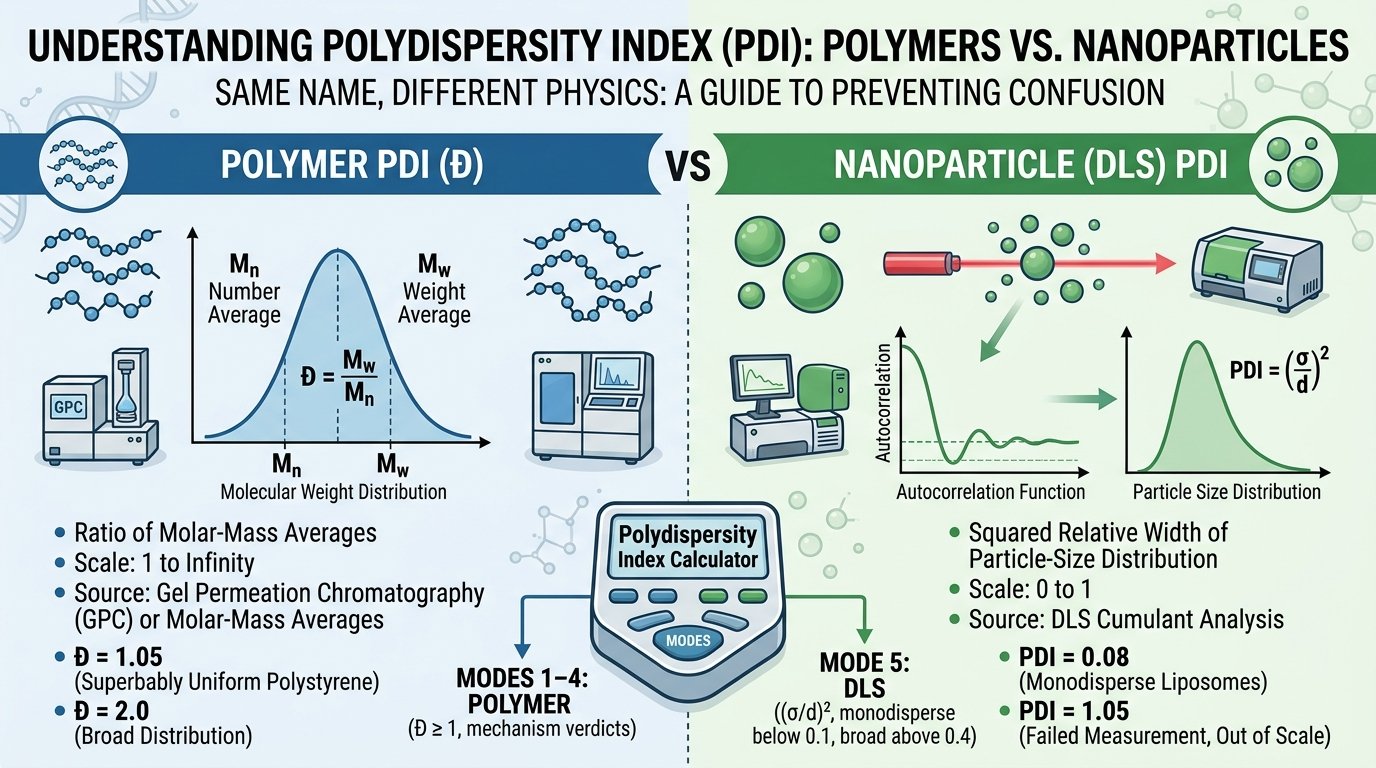
Here is the polydispersity index calculator confusion that derails half the cross-disciplinary conversations: two completely different quantities share the name “polydispersity index.” The polymer PDI is a ratio of molar-mass averages, lives on a 1-to-infinity scale, and comes from GPC or the two averages. The DLS PDI is the squared relative width of a particle-size distribution, lives on a 0-to-1 scale, and comes from the cumulant analysis of a light-scattering autocorrelation function.
The two polydispersity index calculator scales don’t translate. A polymer with Đ = 1.05 is superbly uniform; a nanoparticle batch with DLS PDI = 1.05 is a failed measurement. A liposome formulation bragging “PDI 0.08” is quoting the DLS kind; a polystyrene standard bragging “PDI 1.03” is quoting the polymer kind. Reviewers, examiners and regulatory templates (the FDA’s liposome guidance among them) expect you to know which one you’re reporting.
This polydispersity index calculator keeps them apart by design: Modes 1–4 speak polymer (Đ ≥ 1, mechanism verdicts), Mode 5 speaks DLS ((σ/d)², monodisperse below 0.1, broad above 0.4). Same name, different physics — and now, one tool that refuses to let you mix them up.
Three Worked Examples, Step by Step
Example 1 — The classic polydispersity index calculator problem
Step 1. PDI = M_w ÷ Mₙ = 90,000 ÷ 50,000 = 1.8.
Step 2. Interpret: 1.5–3 → typical commercial breadth, consistent with free-radical or step-growth chemistry.
Check. 1.8 ≥ 1 ✓ — the averages are in the right order.
Example 2 — Polydispersity index calculator on raw fractions
Step 1. Mₙ = 310,000 ÷ 5 = 62,000 g/mol.
Step 2. M_w = 2.51 × 10¹⁰ ÷ 310,000 = 80,967.74 g/mol.
Step 3. PDI = 80,967.74 ÷ 62,000 = 1.306 — narrow-ish, blend of few components.
Example 3 — DLS polydispersity index calculator run for liposomes
Step 1. Relative width: σ ÷ d = 25 ÷ 100 = 0.25.
Step 2. Square it: PDI = 0.25² = 0.0625.
Verdict. Below 0.1 → monodisperse — releases against a typical ≤ 0.3 liposome spec with room to spare.
Run all three in the free polydispersity index calculator above and compare its printed steps with these — they match line for line, because the tool executes exactly this arithmetic at full precision.
Typical PDI Values: 10 Polymerization Routes
These ten polydispersity index calculator scenarios cover most coursework and industrial resins — the dispersity each one stamps on its product is as characteristic as a fingerprint:
| Route / product | Typical PDI (Đ) | Why |
|---|---|---|
| Anionic (living) PS standards | 1.02 – 1.10 | All chains start together, none terminate |
| RAFT / ATRP acrylics | 1.1 – 1.4 | Controlled radical, some termination |
| Ideal step-growth polyester | → 2.0 | Flory’s most-probable distribution |
| Nylon-6,6 (industrial) | ~2 | Step-growth near full conversion |
| Free-radical PS, PMMA | 1.5 – 3 | Random initiation + termination |
| Suspension PVC | 2 – 3 | Radical kinetics, chain transfer |
| Ziegler–Natta HDPE / PP | 3 – 10 | Multiple catalyst site types |
| Metallocene PE | ~2 – 2.5 | Single-site catalyst narrows the spread |
| LDPE (high-pressure) | 5 – 20+ | Long-chain branching runs wild |
| Proteins / DNA | 1.000 | Sequence-defined — biology wins |
Read the table backwards and it becomes a diagnostic: hand a chemist nothing but a PDI value and they can usually name the mechanism. That’s why examiners love the number — and why the free polydispersity index calculator prints a mechanism-flavored verdict under every result.
How PDI Is Measured in the Real World
You never measure the polydispersity index calculator number directly — you measure a distribution or two averages, and the ratio follows:
- GPC/SEC — the workhorse: one injection yields the whole distribution, from which the software integrates Mₙ, M_w and their ratio. Watch for column-broadening, which artificially inflates low dispersities.
- Two-instrument combos — osmometry (Mₙ) plus static light scattering (M_w) gives an absolute Đ with no chromatography at all; this is how classic literature values were built.
- MALDI mass spectrometry — resolves individual chains for narrow, low-mass polymers, but systematically under-samples heavy chains, so its PDI skews low for broad samples.
- Rheology — the breadth of the melt relaxation spectrum tracks dispersity; polyolefin plants infer distribution changes from melt-flow ratios in real time.
- DLS cumulant analysis — for nanoparticles, the second cumulant of the autocorrelation decay divided by the first squared IS the DLS PDI; Mode 5 of the tool mirrors that (σ/d)² arithmetic.
Whichever route feeds this polydispersity index calculator, quote the method with the number: a GPC Đ of 1.08 and a MALDI Đ of 1.08 are not the same claim. The stoichiometry around sample prep — solution concentrations, dilutions — lives in our molarity calculator and grams to moles calculator.
Who Uses the Polydispersity Index?
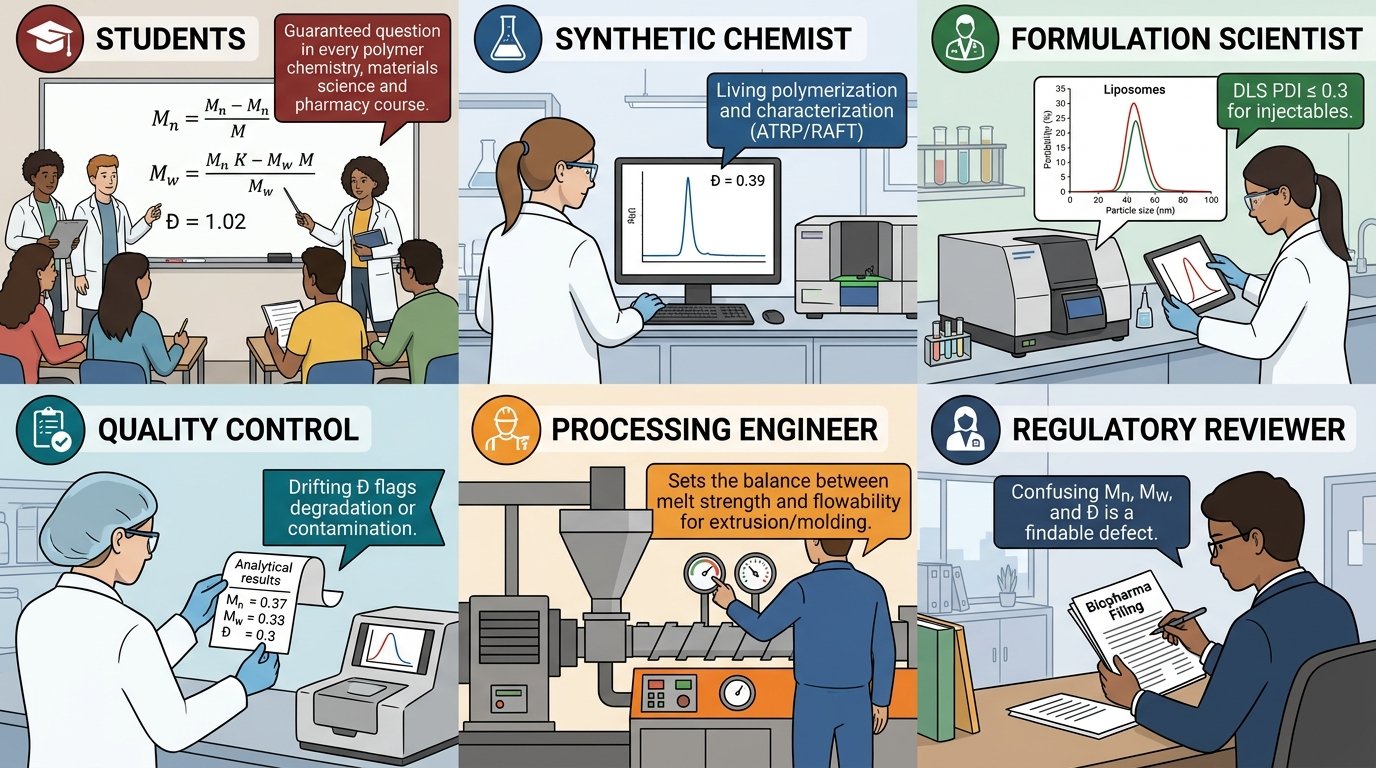
- Students — the polydispersity index calculator trio of Mₙ, M_w and Đ is a guaranteed question in every polymer chemistry, materials science and pharmacy course.
- Synthetic chemists — a living polymerization is only “living” if the polydispersity index calculator verdict says so; every ATRP/RAFT paper leads with its dispersity.
- Formulation scientists — liposomes, lipid nanoparticles and emulsions release against DLS PDI specs (typically ≤ 0.3 for injectables).
- Quality control labs — a drifting Đ at constant M_w flags degradation, contamination or a reactor upset before anything else does.
- Processing engineers — dispersity sets the balance between melt strength and flowability; extrusion and molding grades are specified by it.
- Regulatory reviewers — biopharma filings quote both kinds of polydispersity index calculator output, and confusing them in a dossier is a findable defect.
For the reaction math feeding these samples — conversions, yields, limiting reagents — our stoichiometry calculator covers the full workflow, and single-compound molar masses live in the molecular weight calculator on the homepage.
Full Lab Walkthrough: A Liposome Batch by DLS
Here’s a routine pharmaceutical determination solved with this polydispersity index calculator, exactly as a formulation lab runs it.
The task: a liposomal formulation must release at mean diameter 80–120 nm with DLS PDI ≤ 0.30.
- Dilute. The stock is diluted into filtered PBS until the count rate sits in the instrument’s sweet spot — multiple scattering ruins cumulant fits.
- Equilibrate and measure. Three runs at 25 °C; the instrument reports Z-average diameter 104 nm with σ ≈ 29 nm from the size distribution.
- Compute. Polydispersity index calculator Mode 5: d = 104, σ = 29 → σ/d = 0.2788 → PDI = 0.0777 — the tool grades it “monodisperse.”
- Cross-check. The instrument’s own cumulant PDI reads 0.081 — the (σ/d)² arithmetic and the cumulant fit agree within run-to-run noise.
- Release. 104 nm ∈ [80, 120] and 0.078 ≤ 0.30: the batch passes, and the printed report from the toolbar goes into the batch record.
- Trend it. The history panel keeps the last ten batches visible — a creeping PDI across batches is the earliest sign of vesicle aggregation.
Total polydispersity index calculator time: under a minute. The lab craft — clean dilution, dust-free cuvettes, temperature equilibration — is the part worth practicing, and it’s the part that decides the accuracy.
A Short History: From PDI to Đ
The idea that a polymer needs a width, not just a weight, followed straight from Hermann Staudinger’s 1920 macromolecule hypothesis (Nobel 1953): once chains were real and long, their statistical spread was inevitable. Wallace Carothers’ step-growth work at DuPont supplied the first quantitative handle, and Paul Flory (Nobel 1974) turned it into theory — his most-probable distribution pinned ideal step-growth at Đ → 2, while the Poisson statistics of a perfect living polymerization put Đ = 1 + 1/DPₙ, tantalizingly close to 1. Michael Szwarc’s 1956 discovery of living anionic polymerization made those near-unity dispersities a laboratory reality — and gave GPC its calibration standards.
The measurement side kept pace: Debye and Zimm’s light-scattering theory (1940s) delivered absolute M_w, membrane osmometry delivered Mₙ, and J.C. Moore’s gel permeation chromatography (1964) collapsed the whole distribution into one injection. The name itself is the newest part of the story: in 2009 IUPAC formally retired “polydispersity index” in favor of dispersity, symbol Đ — though search engines, spec sheets and DLS software keep the old name very much alive, which is exactly why this page carries both.
Polydispersity in Everyday Life
- Squeeze bottles vs cling film — same polyethylene family; the broad-Đ grade extrudes smoothly, the narrow one gives even, strong film.
- mRNA vaccines — lipid nanoparticle batches release on the DLS polydispersity index calculator number; uniform particles mean uniform dosing and shelf life.
- Paint that brushes well — a deliberately broadened binder distribution lets the short chains level the film while the long ones bind it.
- Chocolate-smooth shampoo — thickener polymers with tight dispersity give clean, non-stringy rheology.
- Recycled plastic’s rough edge — every extrusion pass broadens the distribution as chains scission unevenly; rising Đ is the recycler’s fatigue gauge.
- Instant noodle packets — multilayer films pair a narrow-Đ sealing layer with a broad-Đ stiff layer; the dispersity difference is the design.
- Marathon shoe foams — energy-return midsoles use narrow-dispersity block copolymers so every cell rebounds identically.
Each bullet is one polydispersity index calculator specification in disguise — exactly what this free calculator was built to make visible. And when the mixture is small molecules instead of chains, the same averaging logic lives in our average molecular weight of mixture guide.
Practice Problems (With Answers)
Work each problem by hand first, then verify with this free polydispersity index calculator. Answers are hidden until you click.
Problem 1 — GPC reports Mₙ = 50,000 and M_w = 90,000. Find the PDI and interpret it.
PDI = 90,000 ÷ 50,000 = 1.8 — typical commercial breadth (free-radical or step-growth territory).
Problem 2 — 1 mol of 10k + 2 mol of 50k + 2 mol of 100k chains. Find the PDI.
Mₙ = 62,000; M_w = 80,967.74 → PDI = 1.306.
Problem 3 — Equal 50 g portions of 10k and 100k polymer are blended. Find the PDI.
Mₙ = 18,181.82; M_w = 55,000 → PDI = 3.025 — two components are enough to go broad.
Problem 4 — An ideal step-growth polymer at 98% conversion has DPₙ = 50 and DP_w = 99. Find the PDI.
PDI = DP_w ÷ DPₙ = 99 ÷ 50 = 1.98 — right at Flory’s limit of 2, as theory predicts.
Problem 5 — A nanoparticle batch shows mean diameter 120 nm with σ = 30 nm. Find the DLS PDI.
PDI = (30 ÷ 120)² = 0.25² = 0.0625 — monodisperse, passes a ≤ 0.3 spec easily.
Tips for Fast, Error-Free PDI Calculations
- ✅ Identify which PDI you need — molar-mass dispersity (≥ 1) or DLS size PDI (0–1)? The two live in different modes for a reason.
- ✅ Range-check: a polymer PDI below 1 is impossible — it means the averages are swapped, and this polydispersity index calculator will say so.
- ✅ Keep the bigger number on top — M_w ÷ Mₙ and DP_w ÷ DPₙ, never the other way around.
- ✅ Match the method to the claim — a GPC dispersity and a MALDI dispersity of the same sample can legitimately differ; quote the technique.
- ✅ Use Đ − 1 as a width — the variance identity σ² = Mₙ²(Đ − 1) turns any dispersity into an intuitive relative spread.
- ✅ Reset, then verify — every answer goes through the polydispersity index calculator above; the ↺ Reset button between problems keeps old inputs from contaminating new ones.
⚗️ Pro workflow: Mode 1 when you already have the averages → Mode 2 or 3 when you’re starting from raw fractions → Mode 4 when the data is degrees of polymerization → Mode 5 the moment the sample is particles instead of chains. Five tabs, two kinds of PDI, zero polydispersity index calculator mix-ups.
5 Common Mistakes to Avoid
A decade of marking polymer papers, and years of polydispersity index calculator support emails, produce the same five errors on repeat:
- Mixing the two PDIs. Reporting a liposome batch at “PDI 1.2” (a fine polymer value, a failed DLS one) — or a polymer at “PDI 0.08” — is the field’s most common cross-disciplinary slip.
- Inverting the ratio. Mₙ ÷ M_w gives a number below 1 that looks impressively narrow and is simply wrong.
- Calling PDI 1.0 “achieved.” Real synthetic samples asymptote toward 1 (Poisson: 1 + 1/DPₙ) but never reach it — only sequence-defined biopolymers are truly monodisperse.
- Trusting a polydispersity index calculator input below ~1.05 from GPC. Column broadening adds apparent width; ultra-narrow standards routinely measure broader than they are.
- Assuming lower is always better. Processing often wants breadth — the short chains plasticize, the long ones carry strength; many extrusion grades are engineered broad on purpose.
How This Calculator Is Different
| Feature | This polydispersity index calculator | Generic PDI tool | By hand |
|---|---|---|---|
| Solves any of Mₙ/M_w/PDI | ✅ Enter any two | ⚠️ Usually one direction only | ✅ If you rearrange |
| Builds averages from raw fractions | ✅ Counts and masses modes | ❌ | ⚠️ Slow, error-prone |
| DP ratio route + repeat units | ✅ IUPAC 2021 formulas | ❌ Not offered | ⚠️ Manual M₀ lookup |
| DLS nanoparticle PDI mode | ✅ With interpretation scale | ❌ Wrong-PDI confusion | ⚠️ Which formula? |
| Plain-words verdict every run | ✅ Mechanism-flavored | ❌ Bare number | ⚠️ Chart needed |
| Export & history | ✅ CSV/TXT/print/share + last 10 | ❌ Usually none | ❌ Notebook |
Related tools on this site go deeper on the neighboring topics: repeat-unit and monomer masses live in the formula weight calculator and atomic mass calculator, isotope-accurate masses in the exact mass calculator, and crystal-water salts in the molar mass of hydrates calculator.
Where the Numbers Come From
Every repeat-unit mass behind this free polydispersity index calculator is drawn from the IUPAC 2021 standard atomic weights, maintained by the Commission on Isotopic Abundances and Atomic Weights (CIAAW) — the same 118-element dataset used across all tools on this site. The dispersity definitions follow current IUPAC recommendations (dispersity Đ, adopted 2009), the mechanism anchors trace to Flory’s and Szwarc’s classic results, and the DLS PDI scale follows the cumulant-analysis conventions used by mainstream instrument makers and the FDA’s liposome guidance.
Small differences against older textbooks (a few units in the last decimal of M₀ values) reflect IUPAC’s periodic revisions, not errors. If you ever spot a discrepancy worth checking, our corrections policy explains how we verify and fix reports — usually within days.
Exam Checklist
☐ I know the IUPAC name (dispersity, Đ) and when the rename happened (2009).
☐ I can compute PDI from raw fractions by building both averages first.
☐ I can use PDI = DP_w ÷ DPₙ and the Flory limit Đ → 2 for ideal step-growth.
☐ I know Poisson statistics give Đ = 1 + 1/DPₙ for living polymerization.
☐ I can match PDI ranges to mechanisms (living ~1.05, step-growth ~2, radical 2+).
☐ I can keep the polymer PDI and the DLS PDI = (σ/d)² apart.
☐ I’ve verified my practice answers with this polydispersity index calculator.
Frequently Asked Questions
What is the polydispersity index of a polymer?
PDI — the number this polydispersity index calculator solves for — equals M_w ÷ Mₙ, the ratio of the weight average to the number average molecular weight. It is always ≥ 1 and measures how broad the chain-length distribution is; 1 means perfectly uniform chains.
What is a good PDI value?
Depends on the goal: ~1.0–1.1 signals living/controlled polymerization, ~2 is the ideal step-growth limit, and 2–10+ is normal for free-radical polymers and polyolefins. For DLS nanoparticles, below 0.1 is monodisperse and injectable formulations typically require ≤ 0.3.
Can the polydispersity index be less than 1?
Not for polymers — M_w ≥ Mₙ is a mathematical certainty, so Đ ≥ 1 always. A computed value below 1 means the two averages were swapped, and the calculator warns you immediately. (The unrelated DLS PDI does live between 0 and 1.)
What is the difference between PDI and dispersity (Đ)?
Same quantity, two names: IUPAC replaced “polydispersity index” with “dispersity” (symbol Đ) in 2009. Datasheets, search engines and older literature still say PDI, so both terms remain in daily use.
Is this polydispersity index calculator free?
Yes, this polydispersity index calculator is completely free — no registration, no daily limits. It runs entirely in your browser, and your history stays on your own device.
How do I calculate PDI from the degree of polymerization?
PDI = DP_w ÷ DPₙ — the repeat-unit mass cancels in the ratio. The classic pair DPₙ = 50, DP_w = 99 (ideal step-growth at 98% conversion) gives PDI = 1.98. Mode 4 also returns Mₙ and M_w if you supply the repeat-unit formula.
How is the nanoparticle PDI from DLS calculated?
DLS PDI = (σ ÷ d)² — the squared relative width of the size distribution, equivalent to the cumulant-analysis definition. A 100 nm sample with σ = 25 nm gives (0.25)² = 0.0625. Below 0.1 is monodisperse; above 0.4 is broad.
Why does step-growth polymerization give PDI ≈ 2?
Flory’s most-probable distribution: when chains couple randomly, DPₙ = 1/(1−p) and DP_w = (1+p)/(1−p), so their ratio 1+p approaches exactly 2 as conversion p → 1.
Which methods measure the PDI?
GPC/SEC delivers Mₙ, M_w and Đ from one injection; combining osmometry (Mₙ) with light scattering (M_w) gives an absolute ratio; MALDI works for narrow low-mass samples; and DLS cumulant analysis yields the nanoparticle PDI.
Which atomic masses does the calculator use?
IUPAC 2021 standard atomic weights for all 118 elements, applied to every repeat-unit formula in the DP-ratio mode — the same dataset behind every tool on molecularweightcalculator.org.
10 Polydispersity Facts Worth Knowing
- The polydispersity index calculator symbol Đ is pronounced “D-stroke” — IUPAC chose it in 2009 partly because PDI was being confused with the DLS quantity of the same name.
- A perfect Poisson (living) polymerization at DPₙ = 1,000 has Đ = 1.001 — narrower than any GPC column can resolve.
- At the gel point of a crosslinking resin, Đ diverges to infinity: M_w blows up while Mₙ stays finite.
- Commercial “monodisperse” polystyrene GPC standards actually run Đ ≈ 1.02–1.06 — true unity belongs to biology alone.
- The variance identity σ² = Mₙ²(Đ − 1) turns dispersity into a literal width: Đ = 1.04 means about ±20% chain-length scatter.
- LDPE’s long-chain branching can push Đ past 20 — one resin spanning a 100-fold range of chain sizes.
- Blending two perfectly monodisperse polymers already creates dispersity — the 50/50 blend of 10k and 100k scores Đ = 3.025.
- Metallocene catalysis was a dispersity revolution: replacing multi-site Ziegler–Natta (Đ 3–10) with single-site chemistry (Đ ≈ 2) changed polyolefin films forever.
- The FDA’s liposome guidance treats DLS PDI as a critical quality attribute — a number this small can hold up a drug approval.
- Đ = 1 + 1/DPₙ means the shortest living polymers are the most disperse: a 10-unit oligomer can’t beat Đ = 1.1 even with perfect chemistry.
🔗 Trusted external resources
Final Thoughts
No polydispersity index calculator can replace understanding, but it can guarantee the arithmetic. The number a polydispersity index calculator returns is polymer science’s most information-dense figure: one division that names the mechanism, predicts the processing window, and — in its DLS incarnation — releases pharmaceutical batches. Keep the bigger average on top, keep the two PDIs apart, read the verdict, and let the calculator above verify every line.
Bookmark this polydispersity index calculator for your next problem set, GPC report or DLS release test, share it with a classmate before the materials exam, and explore the rest of our free chemistry tools — from the molecular weight calculator homepage to the stoichiometry calculator for full reaction math. Questions or corrections? Reach us any time through the contact page — and you can read more about the site’s mission on our about page.
Written & Reviewed By
Ahmad Raza, M.Phil. Chemistry
Ahmad is a chemistry educator and science content developer with over 10 years of experience teaching analytical and physical chemistry. He builds free calculation tools that help students and lab professionals work faster and make fewer errors. When he’s not balancing equations, he’s usually grading titration reports.