
Osmolarity Calculator
From mOsm/L of an IV bag to the tonicity of a cell-culture medium. This osmolarity calculator counts osmotically active particles for any solute (with realistic dissociation), sums multi-component fluids, predicts serum osmolality and the osmolar gap, converts between osmolarity and osmolality, and reports the osmotic pressure and freezing-point depression that go with it.
✓ Trusted by pharmacy, nursing, medical & life-science studentsOsmolarity of a Single Solute Solution
Osmolarity = molarity × number of particles (i). Enter the solute (formula or molar mass) and its concentration in M, mM, % w/v, g/L or mg/dL. The osmolarity calculator picks the ideal particle number from the formula and, for common salts, the practical osmotic coefficient too.
Osmolarity of an IV Fluid, Buffer or Culture Medium
One component per line: formula, amount, unit (units: M, mM, mEq/L with the ion charge handled automatically for simple salts, %, g/L, mg/dL). The osmolarity calculator adds every particle, classifies the fluid as hypo-, iso- or hypertonic (IV convention 250–375 mOsm/L isotonic; plasma 275–295) and flags peripheral-line limits.
Calculated Serum Osmolality and Osmolar Gap
Calculated osmolality = 2 × Na + glucose/18 + BUN/2.8 (mg/dL) or 2 Na + glucose + urea (mmol/L), with optional ethanol. Enter the labs and, if you have it, the measured osmolality; the osmolarity calculator returns the estimate, the osmolar gap and the standard interpretation.
How Much Solute for an Iso-osmotic (or Any Target) Solution?
Choose the solute, the target osmolarity (default 290 mOsm/L, plasma) and the volume; the osmolarity calculator gives the molarity, % w/v and grams needed. Add a background osmolarity from other ingredients (e.g. a drug already in the vial) and it computes the NaCl or glucose needed to make the mixture isotonic — the sodium-chloride-equivalent style adjustment.
Osmolarity ↔ Osmolality, Osmotic Pressure & Freezing Point
Osmolality (mOsm/kg water) = osmolarity (mOsm/L) ÷ (kg of water per litre of solution). Enter one value plus the solution density and the dissolved-solids content; the osmolarity calculator converts, then gives the osmotic pressure Π = cRT, the freezing-point depression (1.86 °C per Osm/kg) and the equivalent % NaCl.
🕘 Recent calculations
- No calculations yet — your last 10 results will appear here.
Formulas: osmolarity (Osm/L) = molarity × i (particles per formula unit; glucose 1, NaCl 2, CaCl₂ 3, Na₃PO₄ 4) · practical osmolarity = molarity × i × φ (osmotic coefficient; NaCl 0.93 at 0.15 M) · mOsm/L from % w/v = % × 10 × 1000 × i / M · osmolality (mOsm/kg H₂O) = osmolarity / (density − solids g/mL) · calculated serum osmolality = 2 Na + glucose/18 + BUN/2.8 (mg/dL) or 2 Na + glucose + urea (mmol/L); ethanol/4.6 (mg/dL) optional; osmolar gap = measured − calculated, normal < 10 · Π = cosm R T (R = 0.08206 L·atm/(mol·K)) · ΔTf = 1.86 °C × Osm/kg · tonicity classes (IV-fluid convention): hypotonic < 250, isotonic 250–375, hypertonic > 375 mOsm/L (plasma 275–295 mOsm/kg); peripheral IV usually ≤ 900 mOsm/L · IUPAC 2021 atomic weights.
An osmolarity calculator converts the concentration of a solution into the number of osmotically active particles it contains per litre — milliosmoles per litre, mOsm/L — which is what decides whether a fluid swells cells, shrinks them or leaves them alone. Glucose contributes one particle per molecule; sodium chloride two; calcium chloride three; and so 5 % dextrose (278 mOsm/L), 0.9 % saline (308 mOsm/L) and 3 % saline (1027 mOsm/L) behave very differently at the bedside even though all three are “just salt or sugar in water”.
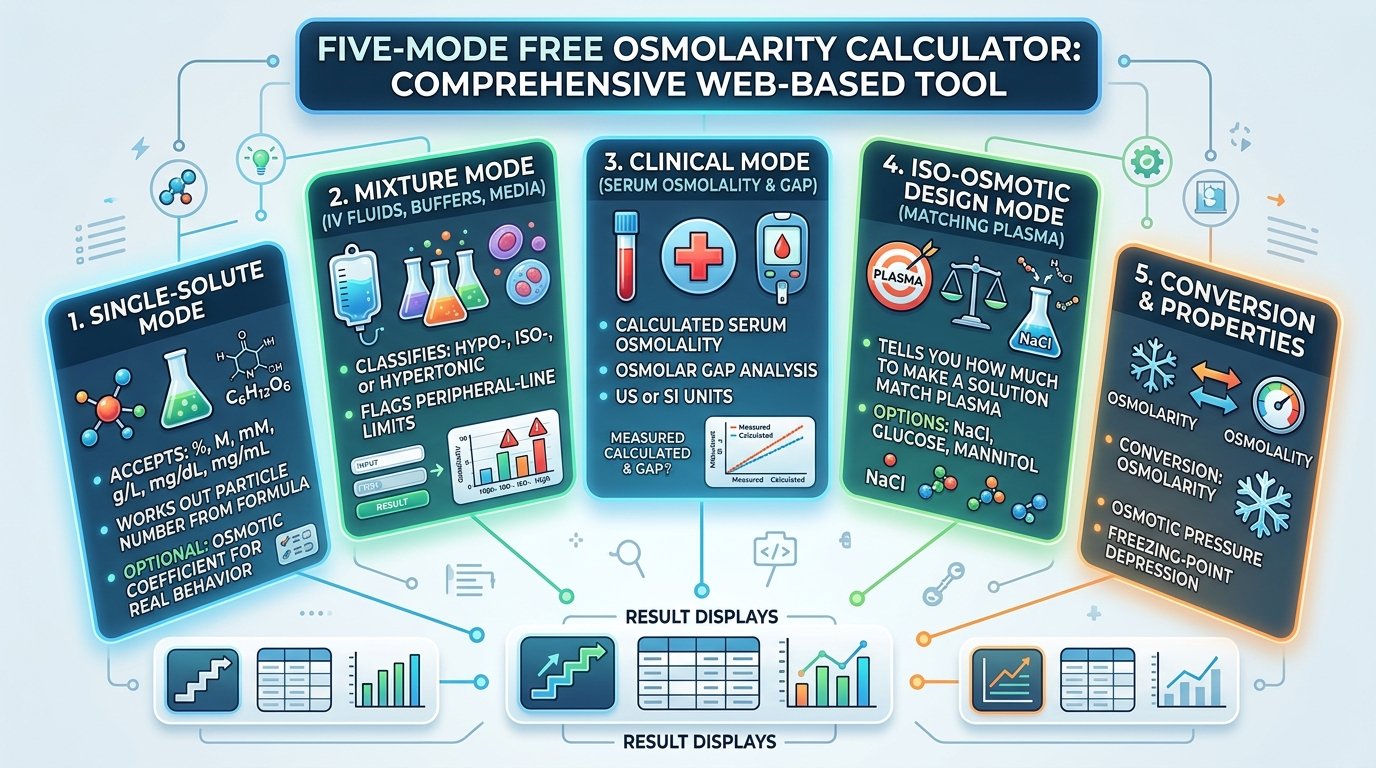
The free osmolarity calculator on this page has five modes: a single-solute mode that accepts %, M, mM, g/L, mg/dL or mg/mL and works out the particle number from any formula (with an optional osmotic coefficient for real behaviour); a mixture mode for IV fluids, buffers and culture media that classifies the result as hypo-, iso- or hypertonic and flags peripheral-line limits; a clinical mode for calculated serum osmolality and the osmolar gap in US or SI units; an iso-osmotic design mode that tells you how much NaCl, glucose or mannitol makes a solution match plasma; and a conversion mode between osmolarity and osmolality with osmotic pressure and freezing-point depression. Each result shows the steps, a table and a chart.
Below the tool you will find the definitions and the formulas, the difference between osmolarity, osmolality and tonicity, the particle counts for common solutes, the osmotic coefficient, IV fluid tables, the serum osmolality equation and what an osmolar gap means, culture-medium design, ten practice problems, a checklist and the questions readers ask most about the osmolarity calculator.
Key Takeaway
Osmolarity (mOsm/L) = molarity (mmol/L) × number of particles per formula unit. 0.9 % NaCl = 154 mmol/L × 2 = 308 mOsm/L; 5 % glucose = 278 mmol/L × 1 = 278 mOsm/L; 10 % CaCl2·2H2O = 680 × 3 = 2041 mOsm/L. Plasma is 275–295 mOsm/kg; calculated serum osmolality = 2 Na + glucose/18 + BUN/2.8 (mg/dL); an osmolar gap above 10 means unmeasured osmoles. The osmolarity calculator above applies all of these and shows the working.
📑 Table of Contents (click to expand)
- What Is an Osmolarity Calculator?
- How to Use the Osmolarity Calculator
- The Five Modes Explained
- The Formulas Behind the Osmolarity Calculator
- Worked Example: 0.9 % Sodium Chloride
- Particle Counts for Common Solutes
- IV Fluids: Osmolarity and Tonicity Classes
- More Worked Examples
- Calculated Serum Osmolality and the Osmolar Gap
- Osmolarity Versus Osmolality: Converting Between Them
- Designing Iso-osmotic Solutions
- Cell Culture Media and Buffers
- The Osmotic Coefficient: Ideal Versus Real
- Reference Table: Osmolality of Body Fluids and Solutions
- Visualising Osmolarity and Tonicity
- Who Uses an Osmolarity Calculator
- Full Walkthrough: Checking a Peripheral Infusion
- A Short History of Osmolarity
- Limits and Assumptions
- Practice Problems With Answers
- Tips for Accurate Results
- Common Mistakes
- How This Osmolarity Calculator Is Different
- Where the Numbers Come From
- Checklist
- Frequently Asked Questions
- 10 Facts Worth Knowing
- Final Thoughts
What Is an Osmolarity Calculator?
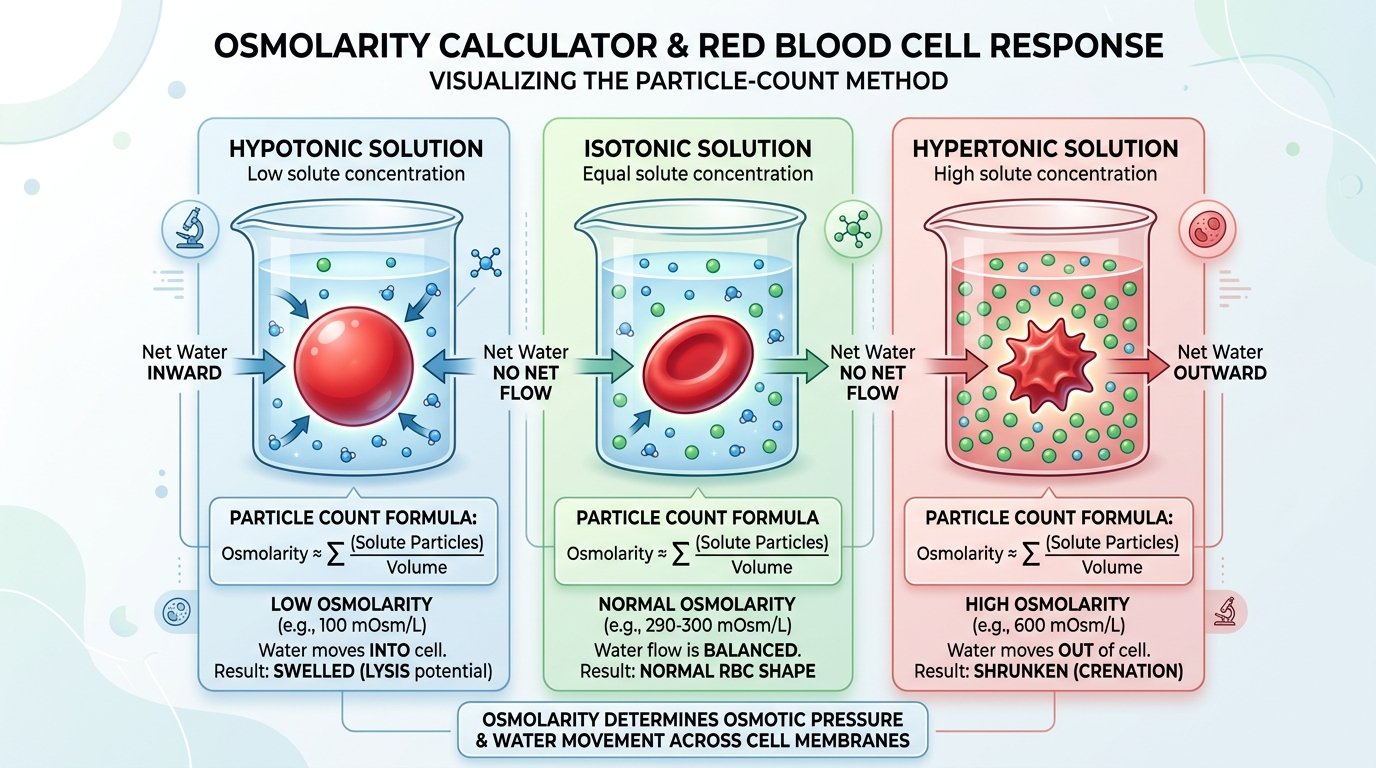
Osmosis is driven by the number of dissolved particles, not by their mass or identity: a litre of water with 300 millimoles of anything dissolved in it pulls water across a semipermeable membrane with the same force whether the anything is glucose, urea or sodium ions. Osmolarity counts those particles per litre of solution; osmolality counts them per kilogram of water. An osmolarity calculator takes an ordinary concentration — percent, molarity, mg/dL — and multiplies it by the number of particles each formula unit releases in solution, then adds the contributions of every component of a mixture.
The particle count is where chemistry enters the osmolarity calculator. Non-electrolytes (glucose, mannitol, urea, sucrose) give one particle per molecule. Strong electrolytes give as many as they have ions: NaCl and KCl two, CaCl2 and Na2SO4 three, Na3PO4 four. Weak electrolytes and zwitterions (HEPES, Tris base, amino acids at their isoelectric point) count as one. Real solutions fall a little short of these ideal numbers because ions pair and interact, which the osmotic coefficient φ captures: 0.9 % NaCl is 308 mOsm/L on paper and about 286 mOsm/kg on an osmometer.
Three words that are not synonyms
Osmolarity — osmoles per litre of solution (mOsm/L); what labels and the osmolarity calculator compute.
Osmolality — osmoles per kilogram of water (mOsm/kg); what osmometers measure and clinical labs report.
Tonicity — the effective osmolality: only particles that cannot cross the cell membrane count. D5W is iso-osmotic but hypotonic once its glucose is metabolised; urea adds osmolality but almost no tonicity.
How to Use the Osmolarity Calculator
- Pick the mode. Single solute for one substance; Mixture for IV fluids, buffers and media; Serum for the clinical calculation and gap; Iso-osmotic to design a solution; Convert for osmolarity ↔ osmolality, osmotic pressure and freezing point.
- Enter the solute as a formula (
NaCl,C6H12O6,CaCl2·2H2O,C6H14O6for mannitol) or a molar mass, and the concentration with its unit — %, M, mM, g/L, mg/dL, mg/mL or, in mixtures, mEq/L. - Choose ideal or practical counting. Ideal uses the exact particle number (what product labels state); practical applies the osmotic coefficient for common salts (closer to an osmometer).
- Press Calculate. The osmolarity calculator shows mOsm/L in blue, the molarity and particle count, the tonicity class, the osmotic pressure and freezing point, the steps, a table and a chart against common fluids.
- Copy, download, print or share; each mode has its own Reset and the history box keeps ten results.
The chips load normal saline, D5W, 3 % saline, 20 % mannitol, 8.4 % bicarbonate, Lactated Ringer’s, PBS, a DMEM-style medium, a normal serum panel, an HHS panel and a toxic-alcohol gap, so the osmolarity calculator’s output is visible before you type.
The Five Modes Explained
Mode 1 — Single solute. Any concentration unit, automatic particle counting from the formula (override with your own i if needed), ideal or φ-corrected, with tonicity class, osmotic pressure at 37 °C and freezing-point depression, plus a chart against ½NS, LR, plasma, NS and 3 % saline.
Mode 2 — Mixture. One line per component in any unit including mEq/L; per-component mOsm/L, total, tonicity, and peripheral-line guidance (< 600 mOsm/L comfortable, 600–900 irritant, > 900 central line).
Mode 3 — Serum osmolality. 2 Na + glucose/18 + BUN/2.8 (+ ethanol/4.6) in mg/dL, or 2 Na + glucose + urea (+ ethanol) in mmol/L; measured value in; osmolar gap out with interpretation, effective osmolality and glucose-corrected sodium when relevant.
Mode 4 — Iso-osmotic solution. Target (default 290 mOsm/L), solute, volume and any osmolarity already present (a drug, a buffer); the osmolarity calculator returns the mmol/L, % w/v and grams of NaCl, glucose, mannitol or any other adjuster.
Mode 5 — Osmolarity ↔ osmolality. Uses density and dissolved-solids content to find the kilograms of water per litre, then gives Π = cRT, ΔTf = 1.86 × Osm/kg and the NaCl-equivalent percent.
The Formulas Behind the Osmolarity Calculator
Osmolarity (mOsm/L) = molarity (mmol/L) × i [× φ for practical values]
From % w/v: mOsm/L = % × 10 × 1000 × i ÷ molar mass
From mg/dL: mmol/L = mg/dL × 10 ÷ molar mass
Osmolality (mOsm/kg) = osmolarity ÷ (kg water per litre) = osmolarity ÷ (density − solids g/mL)
Serum: Osm = 2 Na + glucose/18 + BUN/2.8 (mg/dL) or 2 Na + glucose + urea (mmol/L); gap = measured − calculated
Osmotic pressure: Π = cosm R T (0.308 Osm/L × 0.08206 × 310 K = 7.8 atm)
Freezing point: ΔTf = 1.86 °C × Osm/kg (plasma: −0.54 °C)
The molarity step in the osmolarity calculator uses the molar mass of the substance as labelled — the dihydrate for CaCl2·2H2O, the monohydrate for dextrose monohydrate (198.17 g/mol) if that is what the bag contains, which is why D5W is sometimes quoted as 252 rather than 278 mOsm/L. The osmolarity calculator uses whatever formula you type and states it in the output.
Worked Example: 0.9 % Sodium Chloride
- Molarity. 0.9 % w/v = 9 g/L; 9 ÷ 58.44 g/mol = 0.154 mol/L = 154 mmol/L.
- Particles. NaCl → Na+ + Cl−: i = 2.
- Osmolarity. 154 × 2 = 308 mOsm/L (the label value).
- Practical. φ = 0.93 at this concentration: 308 × 0.93 = 286 mOsm/kg (the osmometer value); freezing point −0.53 °C, essentially plasma’s.
- Class. Isotonic by the IV-fluid convention (250–375 mOsm/L); osmotic pressure 7.8 atm at 37 °C.
The apparent paradox the osmolarity calculator exposes — 308 on the bag, 286 in the osmometer, “isotonic” either way — is resolved by the osmotic coefficient: ions in a 0.15 M solution are not fully independent. Pharmacopoeias nevertheless call 0.9 % NaCl iso-osmotic with plasma because its freezing-point depression (−0.52 °C) matches serum’s, and that is the measurement that defined it. The osmolarity calculator reports both numbers so that the convention in use is clear.
Particle Counts for Common Solutes
| Solute | Formula | i (ideal) | φ (~0.15 M) | mOsm/L per 1 % w/v |
|---|---|---|---|---|
| Glucose | C6H12O6 | 1 | 1.01 | 55.5 |
| Mannitol | C6H14O6 | 1 | 1.00 | 54.9 |
| Urea | CH4N2O | 1 | 0.99 | 166.5 |
| Sodium chloride | NaCl | 2 | 0.93 | 342 |
| Potassium chloride | KCl | 2 | 0.92 | 268 |
| Sodium bicarbonate | NaHCO3 | 2 | 0.96 | 238 |
| Calcium chloride (dihydrate) | CaCl2·2H2O | 3 | 0.86 | 204 |
| Magnesium sulfate (heptahydrate) | MgSO4·7H2O | 2 | 0.58 | 81 |
| Sodium lactate | C3H5NaO3 | 2 | 0.93 | 178 |
| Trisodium citrate | Na3C6H5O7 | 4 | 0.70 | 155 |
The last column is the quickest mental osmolarity calculator: multiply by the percent strength. 0.9 % NaCl → 0.9 × 342 = 308; 5 % glucose → 5 × 55.5 = 278; 3 % NaCl → 1027; 20 % mannitol → 1098; 8.4 % NaHCO3 → 2000.
IV Fluids: Osmolarity and Tonicity Classes
| Fluid | Composition | mOsm/L | Class / note |
|---|---|---|---|
| 0.45 % NaCl (½NS) | 77 mM NaCl | 154 | Hypotonic |
| D5W | 5 % glucose | 252–278 | Iso-osmotic in the bag, hypotonic in the body |
| Lactated Ringer’s | Na 130, K 4, Ca 1.4, Cl 109, lactate 28 mM | 273 | Isotonic (slightly hypo-osmolar) |
| Plasma-Lyte / Normosol | Na 140, K 5, Mg 1.5, acetate, gluconate | 294 | Isotonic |
| 0.9 % NaCl (NS) | 154 mM NaCl | 308 | Isotonic |
| D5 ½NS | 5 % glucose + 77 mM NaCl | 406–432 | Hypertonic in bag, effectively hypotonic |
| D5NS | 5 % glucose + 154 mM NaCl | 560–586 | Hypertonic |
| 3 % NaCl | 513 mM NaCl | 1027 | Hypertonic; central line preferred |
| 20 % Mannitol | 1.10 M mannitol | 1098 | Hypertonic osmotic diuretic |
| 8.4 % NaHCO3 | 1 M NaHCO3 | 2000 | Hypertonic; dilute or central |
The IV-fluid convention classes 250–375 mOsm/L as isotonic, below 250 as hypotonic and above 375 as hypertonic; the osmolarity calculator uses these bands and notes that plasma itself is 275–295 mOsm/kg. Fluids above ~600 mOsm/L irritate peripheral veins and above ~900 are usually restricted to central access — the thresholds behind the tool’s line-selection notes.
More Worked Examples
Example 1 — Lactated Ringer’s
0.6 % NaCl (205 mOsm) + 0.03 % KCl (8) + 0.02 % CaCl2·2H2O (4) + 0.31 % sodium lactate (55) = 273 mOsm/L, isotonic.
Example 2 — NS + 20 mEq/L KCl
308 + 20 mmol/L × 2 = 348 mOsm/L; the osmolarity calculator’s mEq input handles the charge automatically.
Example 3 — Urea 40 mg/dL
40 mg/dL = 400 mg/L ÷ 60.06 = 6.66 mmol/L × 1 = 6.7 mOsm/L — the BUN/2.8 term in the serum formula (BUN 18.7 mg/dL).
Example 4 — 1X PBS
137 × 2 + 2.7 × 2 + 10 × 3 + 1.8 × 2 = 313 mOsm/L — iso-osmotic, as a wash buffer should be.
Example 5 — 10 mM Na3PO4
10 × 4 = 40 mOsm/L; a reminder that a phosphate buffer’s contribution depends on its protonation state (Na2HPO4 gives 3, NaH2PO4 gives 2 per formula unit).
Calculated Serum Osmolality and the Osmolar Gap
Plasma osmolality (275–295 mOsm/kg), the clinical mode of the osmolarity calculator, is dominated by sodium and its anions, glucose and urea. The standard estimate doubles the sodium to account for its counter-ions and adds glucose and urea converted to mmol/L:
Osmcalc = 2 × Na (mmol/L) + glucose (mg/dL)/18 + BUN (mg/dL)/2.8 [+ ethanol (mg/dL)/4.6]
SI: Osmcalc = 2 Na + glucose + urea (all mmol/L). Osmolar gap = Osmmeasured − Osmcalc; normal < 10.
For Na 140, glucose 90 and BUN 14 the osmolarity calculator gives 280 + 5 + 5 = 290 mOsm/kg. If the laboratory measures 290, the gap is zero. A gap above 10 means osmotically active substances the formula does not include — ethanol, methanol, ethylene glycol, isopropanol, propylene glycol, mannitol, glycine irrigant, or the ketones and lactate of severe acidosis — and is a standard screen in suspected poisoning. A normal gap does not exclude toxic alcohol ingestion once the parent alcohol has been metabolised to its (non-osmotic, acidic) products, which is why the gap is read together with the anion gap.
Effective osmolality (2 Na + glucose) omits urea, which crosses cell membranes and does not draw water; a value above 320 mOsm/kg defines the hyperosmolar hyperglycaemic state. The tool also reports the glucose-corrected sodium (add 1.6 mmol/L per 100 mg/dL of glucose above 100) when glucose is high. These are teaching and checking calculations; clinical decisions follow local protocols.
Osmolarity Versus Osmolality: Converting Between Them
Osmolarity divides by the volume of solution; osmolality divides by the mass of water; the osmolarity calculator converts between them. A litre of dilute saline contains 0.996 kg of water, so the two differ by 0.4 % and everyone ignores it. A litre of plasma contains only about 0.93 kg of water — the rest is 70 g of protein and 5 g of lipid — so plasma osmolality (mOsm/kg) exceeds its osmolarity (mOsm/L) by about 7 %, and in hyperlipidaemia or paraproteinaemia the difference grows (the origin of the old “pseudohyponatraemia” artefact with flame photometry).
The osmolarity calculator’s conversion mode takes the solution density and dissolved solids per litre, computes the kilograms of water per litre, and converts either way. It then gives the osmotic pressure (Π = cRT: 308 mOsm/L is 7.8 atm at 37 °C), the freezing-point depression (1.86 °C per Osm/kg: plasma −0.54 °C, which is what a freezing-point osmometer reads), the boiling-point elevation and the NaCl-equivalent percent. Osmometers report osmolality; product labels state osmolarity; the two agree closely for crystalloid fluids and diverge for protein- or lipid-rich ones. Our osmotic pressure calculator and freezing point depression tool treat the colligative side in detail.
Designing Iso-osmotic Solutions
Pharmacy, ophthalmology and cell culture all need solutions that match plasma, and mode 4 of the osmolarity calculator designs them or tears (about 290 mOsm/L). The requirement is simply that the total particle concentration reaches the target; the osmolarity calculator’s mode 4 divides the missing mOsm/L by the adjuster’s particle number and converts to mass. For water alone, 290 mOsm/L takes 145 mM NaCl (0.847 %) or 290 mM glucose (5.22 %) or 290 mM mannitol (5.28 %). For a drug solution that already contributes 120 mOsm/L, only 170 more are needed: 85 mM NaCl, 0.497 %, i.e. 0.50 g per 100 mL.
This is the arithmetic behind the sodium-chloride-equivalent method of pharmacy: each drug is assigned an “E value”, the grams of NaCl osmotically equivalent to one gram of drug, and the NaCl needed is 0.9 g per 100 mL minus Σ(grams of drug × E). The osmolarity calculator reaches the same answer from first principles for any adjuster, including non-electrolytes such as glucose for solutions where extra sodium is undesirable. Remember that iso-osmotic is not always isotonic: a boric acid solution can be iso-osmotic yet haemolytic because boric acid crosses red-cell membranes.
Cell Culture Media and Buffers
Mammalian cells tolerate roughly 260–350 mOsm/kg — a window worth checking in the osmolarity calculator — with most media formulated at 280–320. Every addition — HEPES, antibiotics, glucose, drug stocks, DMSO — adds osmolality, and a 25 mM HEPES supplement alone adds about 25–50 mOsm depending on how much is in the sodium-salt form. The osmolarity calculator’s mixture mode lets you sum a medium’s salts and glucose (a DMEM-style recipe comes to about 320 mOsm/L) and then test the effect of supplements before an osmometer tells you the cells are unhappy.
Insect and plant cells have their own ranges in the osmolarity calculator’s sense; bacterial media are often 400–500 mOsm/kg. Phosphate-buffered saline (about 310 mOsm/L) and Tris-buffered saline (about 330) are deliberately iso-osmotic so that washes do not shock cells, and hypotonic lysis buffers (10–20 mOsm/L) exploit the opposite. For the ionic side of the same recipes see the ionic strength calculator; for making them up, the solution preparation calculator and w/v solution calculator.
The Osmotic Coefficient: Ideal Versus Real
The ideal particle count in the osmolarity calculator assumes every ion moves independently. In reality ions attract each other, transiently pair and reduce the effective number of particles; the ratio of measured to ideal osmolality is the osmotic coefficient φ. For NaCl at physiological concentration φ = 0.93; KCl 0.92; CaCl2 0.86; MgSO4, a 2 : 2 salt with strong pairing, only 0.58; non-electrolytes are close to 1 (glucose 1.01, sucrose 1.02). φ drifts with concentration — NaCl falls to 0.92 at 0.5 M and rises again above 1 M.
Labels and most textbook problems use ideal counting; osmometers measure the real value; the osmolarity calculator offers both so that you can match whichever convention your context uses. The gap matters most for divalent salts: a 0.1 M MgSO4 solution is 200 mOsm/L ideally but only about 116 mOsm/kg measured, which is why magnesium sulfate infusions are less hypertonic than their label osmolarity suggests. Related non-ideality corrections for activity appear in the molality calculator and the van ‘t Hoff factor discussion in our boiling point elevation guide.
Reference Table: Osmolality of Body Fluids and Solutions
| Fluid | mOsm/kg | ΔTf (°C) | Note |
|---|---|---|---|
| Plasma | 275–295 | −0.52 to −0.55 | Reference for tonicity |
| Urine | 50–1200 | −0.09 to −2.2 | Concentrating ability |
| Tears | ~300 | −0.56 | Eye drops matched to this |
| Sweat | 80–185 | −0.15 to −0.34 | Hypotonic |
| Oral rehydration solution (WHO) | 245 | −0.46 | Reduced-osmolarity formula |
| Seawater | ~1000–1100 | −1.9 | Why drinking it dehydrates |
| Cell culture media | 280–320 | −0.52 to −0.60 | Tolerance ~260–350 |
| Cola / fruit juice | 600–750 | −1.1 to −1.4 | Hypertonic; sugar |
Each value converts to osmolarity and back in the osmolarity calculator’s conversion mode once the density and solids are known.
Visualising Osmolarity and Tonicity
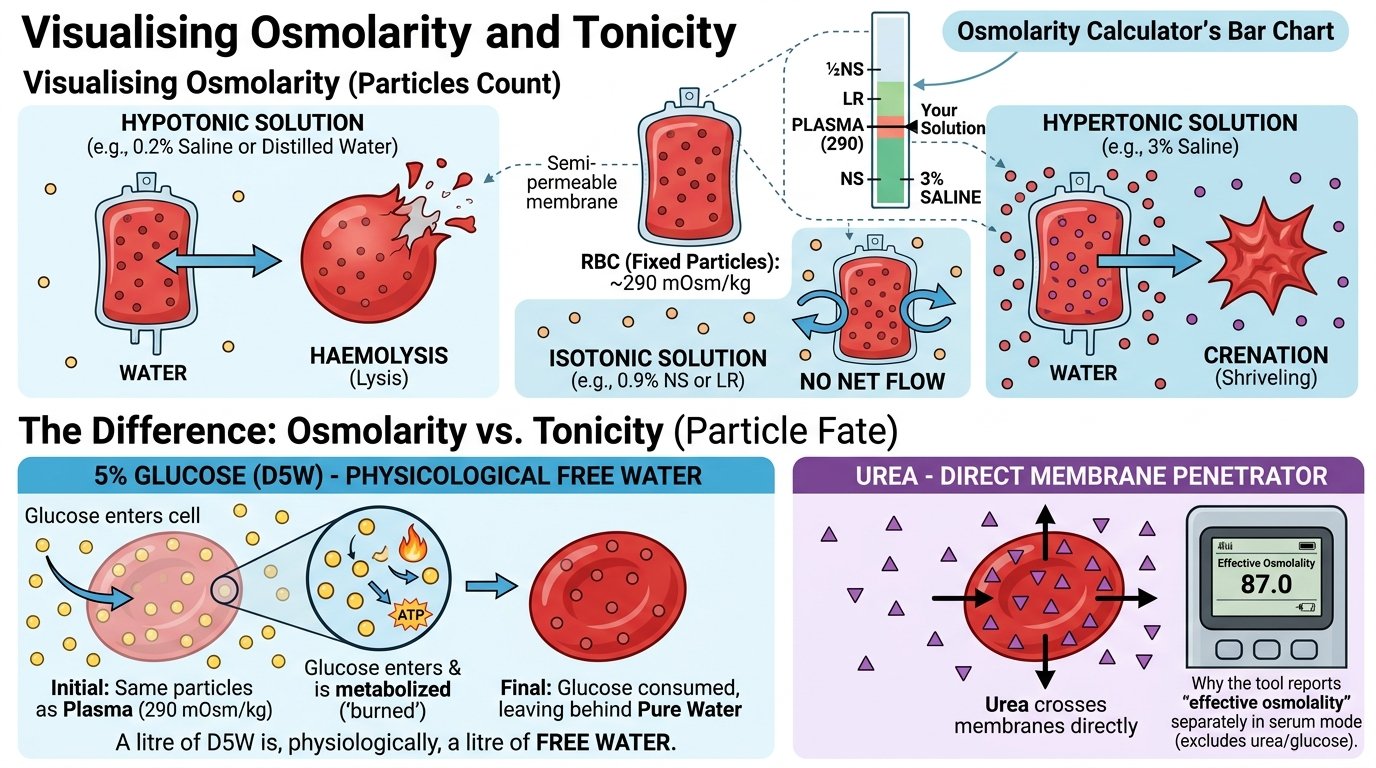
Picture the osmolarity calculator’s numbers as a red blood cell: a bag with a fixed number of particles inside — about 290 mOsm/kg worth. Put it in a solution with fewer particles outside and water flows in until the bag bursts (haemolysis in distilled water or 0.2 % saline); with more particles outside, water flows out and the cell crenates (3 % saline). Equal particle counts, no net flow. The osmolarity calculator’s bar chart places your solution among ½NS, LR, plasma, NS and 3 % saline so the comparison is immediate.
The second picture, which no osmolarity calculator can draw for you, is the difference between osmolarity and tonicity: 5 % glucose has the same particle count as plasma, so cells in it are initially unaffected — but glucose enters cells and is burned, leaving pure water behind. A litre of D5W is, physiologically, a litre of free water. Urea does the same by crossing membranes directly. That is why the tool reports “effective osmolality” separately in the serum mode.
Who Uses an Osmolarity Calculator
Nurses and physicians select IV fluids by tonicity and check whether a mixture can go through a peripheral line. Clinical chemists compute calculated osmolality and the osmolar gap. Pharmacists make iso-osmotic eye drops, nasal sprays and injections. Cell biologists keep media within the cells’ tolerance after supplements. Nutrition teams check parenteral nutrition osmolarity for line selection. Physiologists and students learn osmosis, tonicity and colligative properties with these numbers.
The osmolarity calculator was built to serve each group in its own units — %, mEq/L and mg/dL for the clinic, mM and formulas for the laboratory — and to show the working so the number can be checked and taught.
Full Walkthrough: Checking a Peripheral Infusion
An order calls for 1 L of D5 ½NS with 20 mEq/L KCl and 2 g of magnesium sulfate (as MgSO4·7H2O), to run peripherally. Is it suitable?
- Components (osmolarity calculator mixture mode). Glucose 5 % (278 mOsm/L); NaCl 0.45 % (154); KCl 20 mmol/L × 2 (40); MgSO4·7H2O 2 g/L = 8.1 mmol/L × 2 (16).
- Total. The osmolarity calculator’s mixture mode: 278 + 154 + 40 + 16 = 488 mOsm/L (ideal).
- Class. Hypertonic in the bag (above 375) but under the ~600 mOsm/L threshold for comfortable peripheral infusion; the tool notes “suitable for peripheral infusion”.
- Effective tonicity. Once glucose is metabolised the remaining electrolytes give 210 mOsm/L — the fluid is a net free-water source, appropriate for maintenance, inappropriate for resuscitation.
- Record. Copy the component table into the pharmacy check.
Had the order added a second 20 mEq of KCl and 10 % dextrose instead, the total would reach about 810 mOsm/L, into the irritant range where the tool recommends dilution or central access.
A Short History of Osmolarity
The science behind every osmolarity calculator began when osmosis was described by Nollet in 1748 and quantified by Pfeffer in 1877 with his copper-ferrocyanide membranes; van ‘t Hoff showed in 1887 that dilute solutions obey Π = cRT like an ideal gas, and Arrhenius’s dissociation theory the same year explained why salts gave “too much” pressure — the factor i. Hamburger’s haemolysis experiments in the 1890s established 0.9 % NaCl as iso-osmotic with blood. The osmole as a unit and the routine clinical measurement of serum osmolality by freezing-point depression arrived in the 1950s and 1960s, and the calculated-osmolality formulas and the osmolar gap followed as screens for toxic ingestions in the 1970s.
The reduced-osmolarity oral rehydration solution (245 mOsm/L, WHO 2002) and the ongoing debate over balanced crystalloids versus normal saline show that osmolarity remains a live clinical variable. An osmolarity calculator makes the arithmetic of that history available at the bedside and the bench.
Limits and Assumptions
- Ideal counting in the osmolarity calculator assumes complete dissociation and independent particles; the practical (φ) option corrects for common salts only.
- Tonicity is not osmolarity: permeant solutes (glucose after metabolism, urea, ethanol) add osmolality but little tonicity.
- Buffer speciation matters: enter phosphate and other buffers in the form present at the working pH.
- Serum formulas are estimates (±5–10 mOsm/kg); the gap’s normal range depends on the formula used.
- Osmolality conversion needs density and solids; defaults are for dilute fluids.
- Clinical outputs are for teaching and checking, not a substitute for local protocols.
Practice Problems With Answers
Work these by hand, then check with the osmolarity calculator.
- Osmolarity of 0.45 % NaCl? Answer: 154 mOsm/L.
- Osmolarity of 10 % glucose? Answer: 555 mOsm/L.
- Osmolarity of 0.1 M CaCl2? Answer: 300 mOsm/L.
- Serum: Na 130, glucose 600, BUN 40 mg/dL. Calculated osmolality? Answer: 260 + 33.3 + 14.3 = 308 mOsm/kg.
- Measured 345, calculated 289: gap? Answer: 56 — raised.
- Grams of NaCl per litre for 290 mOsm/L? Answer: 8.47 g.
- Grams of glucose per litre for 290 mOsm/L? Answer: 52.2 g.
- 308 mOsm/L saline: osmotic pressure at 37 °C? Answer: 7.8 atm.
- Freezing point of a 290 mOsm/kg solution? Answer: −0.54 °C.
- NS + 40 mEq/L KCl: osmolarity? Answer: 388 mOsm/L.
Tips for Accurate Results
- Convert to molarity first, then multiply by particles; the osmolarity calculator shows both steps.
- Use the formula on the label (hydrate, monohydrate dextrose) for the molar mass.
- Decide whether you need the label (ideal) or osmometer (practical) value and say which.
- For mixtures add mOsm/L component by component; mEq/L inputs need the ion’s charge.
- Separate osmolarity from tonicity when the solute is permeant.
- State which serum formula you used when reporting a gap.
- Check peripheral-line limits (~600/900 mOsm/L) for any additive-rich infusion.
- Verify culture media with an osmometer after supplements.
Common Mistakes
- Forgetting the particle number — treating NaCl as 154 mOsm/L; the osmolarity calculator shows i on every result.
- Using the anhydrous molar mass for a hydrated salt.
- Calling D5W isotonic physiologically.
- Mixing mg/dL and mmol/L in the serum formula.
- Counting mEq/L of a divalent ion as mmol/L.
- Treating a zwitterionic buffer as two particles.
- Confusing osmolarity (per L) with osmolality (per kg) in protein-rich samples.
- Assuming a normal osmolar gap excludes poisoning late after ingestion.
How This Osmolarity Calculator Is Different
| Feature | This osmolarity calculator | Typical online calculator |
|---|---|---|
| Any solute from %, M, mM, g/L, mg/dL or mg/mL with automatic particle count | ✓ | Fixed list |
| Ideal and osmotic-coefficient (practical) values | ✓ | Ideal only |
| Mixtures with mEq/L, tonicity class and line-selection notes | ✓ | ✗ |
| Serum osmolality in US or SI units, ethanol term, osmolar gap and effective osmolality | ✓ | Sometimes |
| Iso-osmotic design with background osmolarity | ✓ | ✗ |
| Osmolarity ↔ osmolality with density and solids; Π and ΔTf | ✓ | ✗ |
| Formula parser with IUPAC 2021 weights, hydrates | ✓ | ✗ |
| Steps, table, chart, copy, CSV, print, share, history, per-mode Reset | ✓ | Number only |
Most online tools compute one of these numbers. This osmolarity calculator links preparation, clinical estimation, formulation and physical chemistry in one place, with the particle counting done from the formula.
The osmolarity calculator belongs to the same family as the site’s other free tools: molecular weight calculator, atomic mass calculator, formula weight calculator, molarity calculator, stoichiometry calculator, exact mass calculator, grams to moles calculator, molar mass of hydrates calculator, average molecular weight of a mixture, number average molecular weight, weight average molecular weight, polydispersity index, monoisotopic mass calculator, average vs monoisotopic mass, isotopic mass calculator, freezing point depression, boiling point elevation, osmotic pressure calculator, vapor density, molar mass from gas density, equivalent weight calculator, viscosity molecular weight, van der Waals equation, empirical formula calculator, molecular formula calculator, percent composition calculator, combustion analysis calculator, degree of unsaturation calculator, oxidation number calculator, formal charge calculator, limiting reactant calculator, theoretical yield calculator, percent yield calculator, atom economy calculator, chemical equation balancer, molality calculator, normality calculator, mole fraction calculator, ppm to ppb converter, dilution calculator, serial dilution calculator, solution preparation calculator, w/v solution calculator, ionic strength calculator, peptide reconstitution calculator, stock solution calculator, Beer Lambert law calculator, protein concentration A280 calculator.
Where the Numbers Come From
The osmolarity calculator uses IUPAC 2021 atomic weights for molar masses, published osmotic coefficients for common salts, the standard clinical osmolality formulas, and R = 0.082057 L·atm/(mol·K) and Kf = 1.86 °C·kg/mol for water:
- IUPAC Gold Book — osmolality: the formal definition of osmolality and the osmotic coefficient.
- OpenStax Chemistry via LibreTexts — Colligative Properties: osmotic pressure, the van ‘t Hoff factor and freezing-point depression used in modes 1 and 5.
- StatPearls (NCBI Bookshelf) — Serum Osmolality: the calculated serum osmolality formulas, reference ranges and the osmolar gap.
- Wikipedia — Osmotic concentration: osmolarity vs osmolality, particle counting, plasma values and tonicity.
Found an error? Our corrections policy explains how we handle reports; contact us or read about the site.
Checklist
☐ Concentration converted to mmol/L with the labelled molar mass
☐ Particles per formula unit assigned (1 non-electrolyte, 2 NaCl, 3 CaCl2, 4 Na3PO4)
☐ Ideal (label) or practical (φ) convention chosen and stated
☐ Mixture components summed; mEq/L converted with charge
☐ Tonicity class assigned (hypo < 250, iso 250–375, hyper > 375 mOsm/L)
☐ Permeant solutes (glucose, urea) noted for effective tonicity
☐ Serum formula units consistent (mg/dL or mmol/L); gap = measured − calculated
☐ Iso-osmotic adjustment accounts for osmolarity already present
☐ Osmolality conversion uses density and solids for protein-rich fluids
☐ Peripheral-line limit checked for additive-rich infusions
Frequently Asked Questions
How do I calculate osmolarity?
Convert the concentration to mmol/L, then multiply by the number of particles each formula unit gives in solution. 0.9 % NaCl = 154 mmol/L × 2 = 308 mOsm/L; 5 % glucose = 278 mmol/L × 1 = 278 mOsm/L. For mixtures, add the components.
What is the difference between osmolarity and osmolality?
Osmolarity is osmoles per litre of solution; osmolality is osmoles per kilogram of water. For dilute fluids they differ by under 1 %; for plasma, which is about 7 % protein and lipid by volume, osmolality is about 7 % higher.
What is the osmolarity of normal saline and why is it called isotonic?
308 mOsm/L by particle counting (154 mmol/L × 2), or about 286 mOsm/kg measured because of the osmotic coefficient 0.93. It is called isotonic because its freezing-point depression matches plasma’s and red cells neither swell nor shrink in it.
What is the formula for calculated serum osmolality?
2 × Na (mmol/L) + glucose (mg/dL)/18 + BUN (mg/dL)/2.8, optionally + ethanol (mg/dL)/4.6. In SI units: 2 Na + glucose + urea, all in mmol/L. Normal is 275–295 mOsm/kg.
What does a raised osmolar gap mean?
Measured minus calculated osmolality above about 10 mOsm/kg means unmeasured osmoles are present — ethanol, methanol, ethylene glycol, isopropanol, propylene glycol, mannitol or the products of severe acidosis. It is a screen, not a diagnosis, and can be normal late after a toxic alcohol ingestion.
Is 5 % dextrose isotonic?
In the bag it is iso-osmotic (about 278 mOsm/L, or 252 with dextrose monohydrate). In the body the glucose is metabolised, leaving free water, so physiologically D5W is hypotonic and can lower serum sodium if given in excess.
How much NaCl makes a solution isotonic?
About 0.85–0.9 g per 100 mL for water alone (290 mOsm/L needs 145 mmol/L = 0.847 %). If the solution already contains other solutes, subtract their osmolarity first; the calculator’s iso-osmotic mode does this for any adjuster.
What osmolarity can be given through a peripheral vein?
Fluids up to about 600 mOsm/L are generally well tolerated peripherally; 600–900 are irritant and should be diluted or infused slowly; above about 900 mOsm/L central access is usually required. Local policies vary.
How do I convert osmolality to osmotic pressure?
Π = c R T with c in Osm/L: 0.290 × 0.08206 × 310 K = 7.4 atm at 37 °C for plasma; 0.9 % saline (0.308 Osm/L) gives 7.8 atm. The freezing-point depression is 1.86 °C per Osm/kg.
Is my data stored anywhere?
No. The osmolarity calculator runs entirely in your browser; the history box uses your own local storage and Clear All empties it.
10 Facts Worth Knowing
- Plasma’s osmotic pressure of about 7.4 atm would support a column of water 76 m high — but almost all of it is balanced across cell membranes.
- A 2 % NaCl solution has the same osmolarity as a 12 % glucose solution; particles, not grams, count.
- 0.9 % saline was chosen in 1896 from red-cell haemolysis experiments; it is 5 % more concentrated than plasma by particle count and slightly hyperchloraemic.
- A freezing-point osmometer detects 1 mOsm/kg as 0.00186 °C.
- Urea is 5 mOsm/kg of plasma but almost zero tonicity because it crosses cell membranes freely.
- Seawater at 1000 mOsm/kg is three times plasma; drinking a litre requires 1.5 L of urine to excrete the salt.
- Reduced-osmolarity ORS (245 mOsm/L) replaced the 311 mOsm/L formula in 2002 because it cut stool output and vomiting.
- Magnesium sulfate’s osmotic coefficient of 0.58 means a 1 M solution measures about 1160 mOsm/kg, not 2000.
- Hyperglycaemia of 1000 mg/dL adds 55 mOsm/kg and pulls enough water out of cells to lower serum sodium by 14 mmol/L.
- An osmolar gap of 1 mOsm/kg corresponds to roughly 4.6 mg/dL of ethanol, 3.2 mg/dL of methanol or 6.2 mg/dL of ethylene glycol.
Final Thoughts
Osmolarity is molarity times particles, summed over everything dissolved. That one rule ranks IV fluids, explains why a sugar bag and a salt bag with the same mass concentration act differently, underlies the serum osmolality estimate and its gap, and designs iso-osmotic solutions. Osmolality and tonicity are its two important cousins, and the distinctions matter at the bedside.
Use the osmolarity calculator above for single solutes, mixtures, serum estimates, iso-osmotic design and conversions — and read the particle count it prints until the multipliers are instinctive.
Written by
Ahmad Raza, M.Phil. Chemistry ✓ Verified Expert
Ahmad has taught general and analytical chemistry for over a decade and builds the calculators on this site. He tests every tool — including this osmolarity calculator — against textbook problems, product labels and published osmometry data before it goes live, and he answers reader questions personally.