
Ionic Strength Calculator
I = ½ Σ cizi², done properly. This ionic strength calculator dissociates any salt formula automatically, sums mixtures of electrolytes and buffers, returns Debye-Hückel and Davies activity coefficients, converts between ionic strength and salt concentration, and estimates the Debye length for colloids, proteins and electrochemistry.
✓ Trusted by biochemists, analytical chemists & studentsIonic Strength of a Single Electrolyte
Type a salt formula and its concentration. The ionic strength calculator works out the ions it releases (Na⁺, Cl⁻, Mg²⁺, SO₄²⁻, PO₄³⁻ …), their charges and the ½Σcz² sum. Give the concentration in mol/L (molar) or mol/kg (molal), or as g/L if you prefer.
Ionic Strength of a Mixture, Buffer or Medium
One component per line: formula, concentration, unit (M, mM, or g/L). Buffers can be entered as their salt forms (e.g. Na2HPO4 and KH2PO4 for PBS); for Tris-HCl enter the protonated fraction as TrisHCl. The ionic strength calculator lists every ion, its total concentration and its contribution to I.
Activity Coefficient from Ionic Strength
Given I (or a salt that sets it), the ionic strength calculator returns log γ for an ion of charge z by the Debye-Hückel limiting law, the extended law (with ion size å) and the Davies equation, then the activity a = γc. Use it to correct pH, pKa and solubility products.
How Much Salt for a Target Ionic Strength?
Working backwards: choose the salt, the ionic strength you need and the volume, and the ionic strength calculator gives the molarity and the grams to weigh (optionally on top of an existing background ionic strength).
Debye Length, Screening and the Kohlrausch Check
The Debye length κ⁻¹ = 0.304 / √I nm (water, 25 °C) tells you how far electrostatic interactions reach in a salt solution. Enter I (or a salt and concentration) and the ionic strength calculator gives κ⁻¹, the screening at chosen distances, and a rough relative-permittivity/temperature correction.
🕘 Recent calculations
- No calculations yet — your last 10 results will appear here.
Formulas: I = ½ Σ ci zi² (c in mol/L or mol/kg) · 1:1 salt I = c; 2:1 or 1:2 salt I = 3c; 2:2 salt I = 4c; 3:1 salt I = 6c; 3:2 salt (Al₂(SO₄)₃) I = 15c · Debye-Hückel limiting law log γ = −A z² √I; extended: log γ = −A z² √I / (1 + B å √I); Davies: log γ = −A z² [√I/(1+√I) − 0.3 I] · A = 0.509 (25 °C), B = 0.328 Å⁻¹ · Debye length κ⁻¹ = √(εrε₀kBT / (2 NA e² I·1000)) = 0.304/√I nm in water at 25 °C · salts are assumed fully dissociated; weak acids/bases contribute only their ionised fraction · IUPAC 2021 atomic weights.
An ionic strength calculator evaluates I = ½ Σ cizi² — the charge-weighted sum over every ion in a solution — which is the quantity that governs activity coefficients, Debye screening, protein solubility, enzyme kinetics, colloid stability and the position of every equilibrium measured in a real electrolyte rather than an ideal one. 0.1 M NaCl has I = 0.1 M, but 0.1 M MgSO4 has I = 0.4 M and 0.01 M Al2(SO4)3 has I = 0.15 M, because the squares of the charges count.
The free ionic strength calculator on this page has five modes: a single-salt mode that dissociates any formula automatically (NaCl, CaCl2, Na3PO4, (NH4)2SO4, K4Fe(CN)6, hydrates) and accepts molar, molal, g/L or percent input; a mixture mode for buffers, media and natural waters with a per-ion contribution table; an activity-coefficient mode with the Debye-Hückel limiting law, the extended law and the Davies equation; a target mode that tells you how much salt sets a given ionic strength; and a Debye-length mode for electrostatic screening. Every result shows the working, a table and a chart.
Below the tool you will find the definition and its derivation, the quick multipliers for each salt type, worked examples for PBS and seawater, the activity-coefficient equations and their ranges of validity, how ionic strength changes pKa, solubility and protein behaviour, the Debye length, ten practice problems, a checklist and the questions readers ask most about the ionic strength calculator.
Key Takeaway
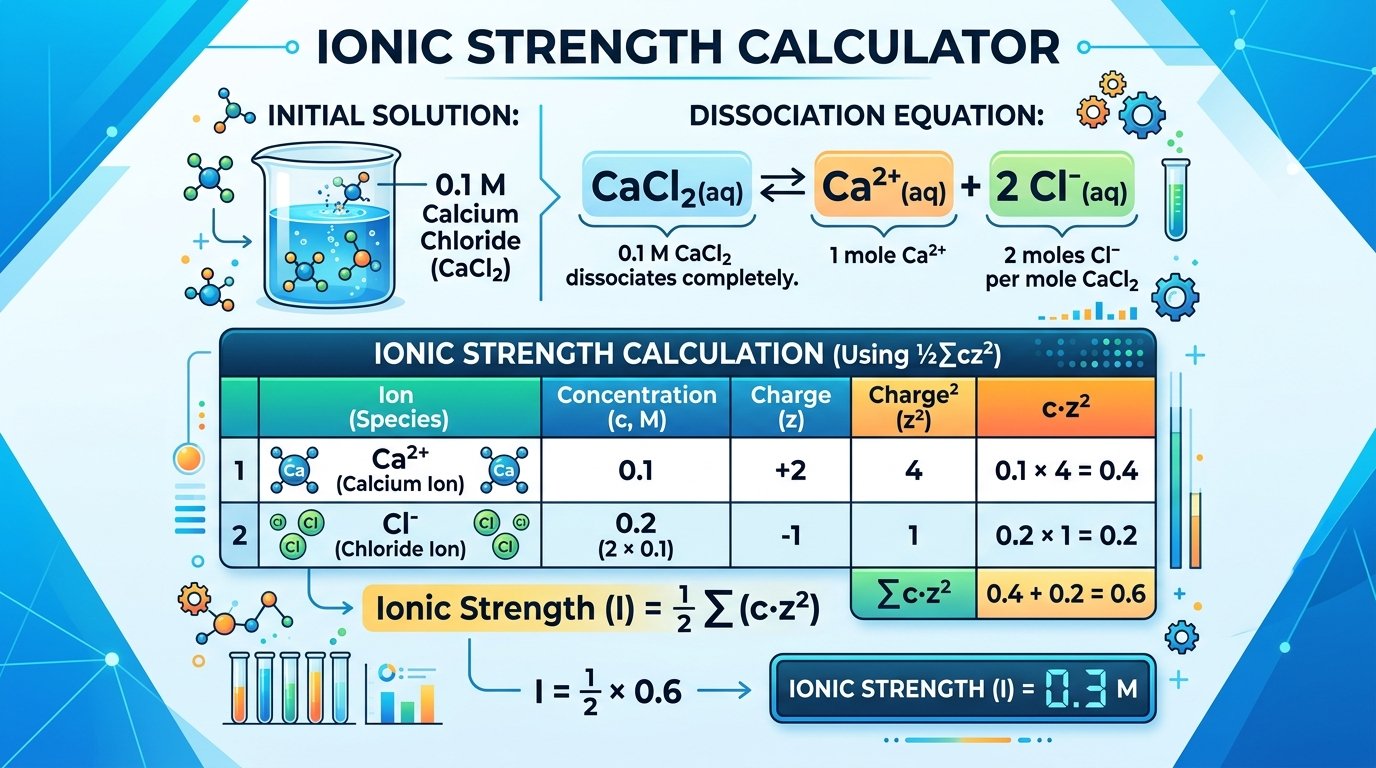
I = ½ Σ ci zi². For a 1 : 1 salt I equals the molarity; for 2 : 1 or 1 : 2 salts I = 3c; for 2 : 2 salts I = 4c; for 3 : 1 salts I = 6c. 0.1 M CaCl2 gives 0.1 × 4 + 0.2 × 1 = 0.6, halved = 0.3 M. Mixtures add. Phosphate-buffered saline is about 0.17 M; plasma about 0.15 M; seawater about 0.7 M. At I = 0.1 M a monovalent ion has γ ≈ 0.78 and the Debye length is 0.96 nm. The ionic strength calculator above computes all of these with the working.
📑 Table of Contents (click to expand)
- What Is an Ionic Strength Calculator?
- How to Use the Ionic Strength Calculator
- The Five Modes Explained
- The Formula and Its Derivation
- Quick Multipliers by Salt Type
- Worked Example: Phosphate-Buffered Saline
- More Worked Examples
- Activity Coefficients: Limiting, Extended and Davies
- How Ionic Strength Shifts pKa, Ksp and pH
- Proteins, Enzymes and Colloids
- The Debye Length and Electrostatic Screening
- Weak Electrolytes and Partial Dissociation
- Molar Versus Molal Ionic Strength
- Reference Table: Ionic Strength of Common Solutions
- Visualising Ionic Strength
- Who Uses an Ionic Strength Calculator
- Full Walkthrough: Setting a Constant Ionic Strength for Kinetics
- A Short History of Ionic Strength
- Limits and Assumptions
- Practice Problems With Answers
- Tips for Accurate Results
- Common Mistakes
- How This Ionic Strength Calculator Is Different
- Where the Numbers Come From
- Checklist
- Frequently Asked Questions
- 10 Facts Worth Knowing
- Final Thoughts
What Is an Ionic Strength Calculator?
Ionic strength, introduced by Lewis and Randall in 1921, is a measure of the total electrostatic environment in a solution. Each ion contributes its concentration multiplied by the square of its charge, the contributions are summed over all ions, and the total is halved so that a 1 : 1 electrolyte’s ionic strength equals its concentration. Because the charge is squared, divalent and trivalent ions dominate: a 10 mM solution of Al3+ counts nine times as much per ion as 10 mM Na+.
An ionic strength calculator does three jobs that are tedious by hand. It splits each salt formula into the correct ions with the correct stoichiometry and charges — the step where most mistakes happen; it sums over every component of a mixture, remembering that Na+ from NaCl and Na+ from Na2HPO4 go into one total; and it converts I into the quantities you actually need — activity coefficients, Debye length, the amount of salt required for a target.
Why chemists care
Equilibria — pKa, Ksp, complex stability and redox potentials shift with I because activities, not concentrations, appear in the true constants.
Proteins — salting-in, salting-out, ion-exchange binding and enzyme rates all track I.
Colloids and surfaces — the Debye length, and so the range of repulsion, scales as 1/√I.
Analysis — ion-selective electrodes, capillary electrophoresis and many kinetic studies require a fixed I set with an inert salt. The ionic strength calculator serves each of these.
How to Use the Ionic Strength Calculator
- Pick the mode. Single salt for one electrolyte; Mixture for buffers, media and waters; Activity coefficient when you already have I; Salt for a target I to set a background electrolyte; Debye length for screening distances.
- Type the formula exactly as the salt exists —
CaCl2,Na2SO4,(NH4)2SO4,MgSO4·7H2O,K4Fe(CN)6,CH3COONa. The ionic strength calculator recognises 30 cations and 40 anions including polyatomics; bare ions such asNa+orCl-are accepted in mixture mode. - Enter the concentration in mol/L, mmol/L, mol/kg (molal), g/L or % w/v; g/L and % are converted with the molar mass.
- Press Calculate. The dissociation, each ion’s concentration, z² and cz², the sum, I, the Davies mean activity coefficient and a per-ion bar chart appear, with the temperature-dependent Debye-Hückel A.
- Copy, download, print or share; each mode has its own Reset and the history box keeps the last ten results.
The chips load 0.1 M NaCl, MgSO4, CaCl2, Na3PO4 and Al2(SO4)3, PBS, TBS, seawater, plasma electrolytes and physiological Debye length, so the ionic strength calculator’s output is visible at once.
The Five Modes Explained
Mode 1 — Single salt. Automatic dissociation, the ½Σcz² table, the salt-type multiplier (1c, 3c, 4c, 6c, 15c …), the mean activity coefficient by Davies at your temperature, and notes for partially dissociating anions (HSO4−, HCO3−). Weak acids and bases are refused with an explanation, because their ionic strength depends on the degree of ionisation.
Mode 2 — Mixture. One line per component; ions are pooled across lines. Output: total per ion, share of I, source salts, the total I, γ for z = 1 and 2, the Debye length, and a charge-balance warning when bare ions are entered without counter-ions.
Mode 3 — Activity coefficient. Limiting law, extended law (with ion size å) and Davies for any charge and temperature; recommends which to trust at your I; converts a concentration into an activity and shows the pH shift for H+.
Mode 4 — Salt for a target I. Choose the salt, the target and the volume, optionally on top of an existing background; the ionic strength calculator returns the molarity and grams, and compares the molarity of alternative salts.
Mode 5 — Debye length. κ−1 from I, temperature and relative permittivity, with the screening at a chosen distance and the 10 % and 1 % decay distances.
The Formula and Its Derivation
I = ½ Σi ci zi²
ci in mol/L (or mol/kg for Im); zi the signed charge; the sum runs over every ionic species present
The factor ½ and the square in the ionic strength calculator’s formula are not arbitrary. In the Debye-Hückel theory the electrostatic potential around an ion is screened by the surrounding ion atmosphere, and the screening parameter κ² is proportional to Σ ni zi² e² / (ε kBT). The energy of an ion in its atmosphere depends on zi², and the concentration weighting by zi² falls out of the linearised Poisson-Boltzmann equation. Lewis and Randall had found empirically, before the theory, that activity coefficients in mixed electrolytes depend on this combination and not on the total salt concentration; the ½ simply normalises I to equal c for a 1 : 1 salt.
For a salt MpXq that dissociates completely, cM = p·c and cX = q·c, so I = ½ c (p zM² + q zX²). The ionic strength calculator reports this bracket as the salt’s multiplier: CaCl2 gives ½(1 × 4 + 2 × 1) = 3; Al2(SO4)3 gives ½(2 × 9 + 3 × 4) = 15. Electroneutrality (p zM = q |zX|) is checked while parsing, which is how the tool rejects an impossible formula.
Quick Multipliers by Salt Type
| Salt type | Examples | I / c | I for 0.1 M |
|---|---|---|---|
| 1 : 1 | NaCl, KNO3, NH4Cl, HCl, NaOAc | 1 | 0.1 M |
| 2 : 1 or 1 : 2 | CaCl2, MgCl2, Na2SO4, K2HPO4, (NH4)2SO4 | 3 | 0.3 M |
| 2 : 2 | MgSO4, CuSO4, ZnSO4, CaCO3(aq) | 4 | 0.4 M |
| 3 : 1 or 1 : 3 | AlCl3, FeCl3, Na3PO4, Na3citrate | 6 | 0.6 M |
| 3 : 2 | Al2(SO4)3, Fe2(SO4)3 | 15 | 1.5 M |
| 1 : 4 | K4Fe(CN)6 | 10 | 1.0 M |
These multipliers, the fastest mental ionic strength calculator, are what the tool prints as “I = 3 × c” and the like. Memorising the first four covers most laboratory salts; the tool covers the rest, including mixed-valence and hydrated formulas, without a lookup.
Worked Example: Phosphate-Buffered Saline
1X PBS is the standard test of any ionic strength calculator: 137 mM NaCl, 2.7 mM KCl, 10 mM Na2HPO4, 1.8 mM KH2PO4. In the ionic strength calculator’s mixture mode:
- Dissociate and pool. Na+ = 137 + 2 × 10 = 157 mM; K+ = 2.7 + 1.8 = 4.5 mM; Cl− = 137 + 2.7 = 139.7 mM; HPO42− = 10 mM; H2PO4− = 1.8 mM.
- cz². 157 + 4.5 + 139.7 + 10 × 4 + 1.8 = 343 mM.
- Halve. I = 171.5 mM ≈ 0.17 M.
- Consequences. γ(z = 1) ≈ 0.75, γ(z = 2) ≈ 0.32 (Davies, 25 °C); Debye length 0.74 nm.
The shortcut check: NaCl 137 × 1 + KCl 2.7 × 1 + Na2HPO4 10 × 3 + KH2PO4 1.8 × 1 = 171.5 mM — ionic strength is additive salt by salt, which is the fastest way to do mixtures by hand. Note that HPO42−, at only 10 mM, supplies 40 of the 343 mM of cz² because of its charge of 2; the ionic strength calculator’s chart makes that visible.
More Worked Examples
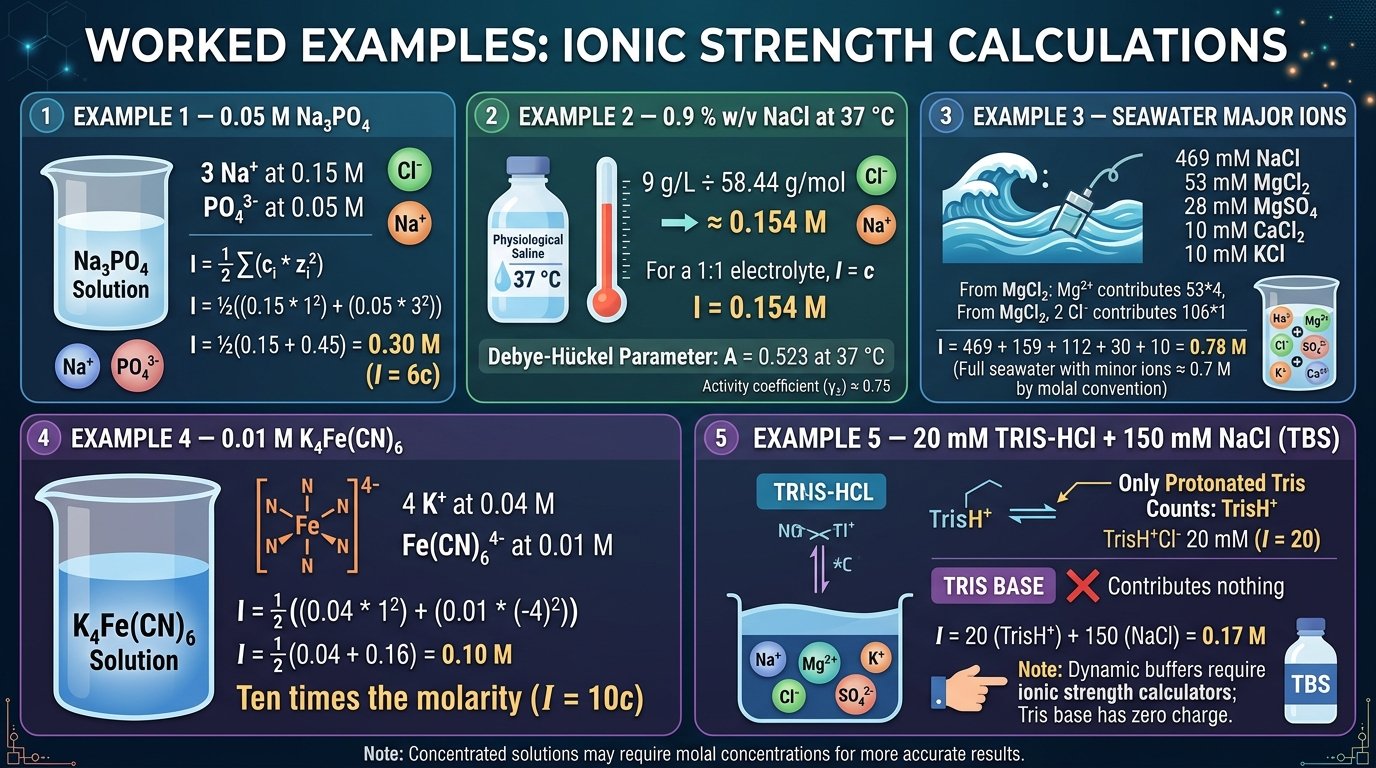
Example 1 — 0.05 M Na3PO4
3 Na+ at 0.15 M and PO43− at 0.05 M: ½(0.15 × 1 + 0.05 × 9) = 0.30 M (I = 6c).
Example 2 — 0.9 % w/v NaCl at 37 °C
9 g/L ÷ 58.44 = 0.154 M; I = 0.154 M; γ± ≈ 0.75 (A = 0.523 at 37 °C).
Example 3 — Seawater major ions
469 mM NaCl + 53 mM MgCl2 + 28 mM MgSO4 + 10 mM CaCl2 + 10 mM KCl: 469 + 159 + 112 + 30 + 10 = 0.78 M (full seawater with minor ions ≈ 0.7 M by the molal convention).
Example 4 — 0.01 M K4Fe(CN)6
4 K+ at 0.04 M and Fe(CN)64− at 0.01 M: ½(0.04 + 0.16) = 0.10 M — ten times the molarity.
Example 5 — 20 mM Tris-HCl + 150 mM NaCl (TBS)
Only the protonated Tris counts: TrisH+Cl− 20 mM (I = 20) + NaCl 150 = 0.17 M. Enter TrisHCl in the ionic strength calculator; Tris base contributes nothing.
Activity Coefficients: Limiting, Extended and Davies
The reason an ionic strength calculator is worth using is that I sets the activity coefficient γ, which converts a concentration into the effective concentration that appears in equilibrium constants: a = γc. Three equations cover the useful range.
Debye-Hückel limiting law (I < 0.001 M): log γ = −A z² √I
Extended Debye-Hückel (I < 0.1 M): log γ = −A z² √I / (1 + B å √I)
Davies equation (I < 0.5 M): log γ = −A z² [√I / (1 + √I) − 0.3 I]
A = 0.509 (25 °C), 0.492 (0 °C), 0.523 (37 °C) in water; B = 0.328 Å−1; å is the ion-size parameter (Na+ 4.5, Cl− 3.0, H+ 9.0, Ca2+ 6.0 Å)
At I = 0.1 M the three give γ = 0.69, 0.78 and 0.78 for a monovalent ion and 0.23, 0.40 and 0.37 for a divalent one — the limiting law is already 12 % off. The ionic strength calculator computes all three, recommends the appropriate one for your I, and warns above 0.5 M where none is reliable and Pitzer or SIT models are needed. For a mean activity coefficient of a salt, z² is replaced by |z+z−|, which is what mode 1 reports.
Temperature enters the ionic strength calculator through A (which contains εr−3/2 T−3/2); the tool adjusts A and B for the temperature you enter, so plasma at 37 °C and a cold-room buffer at 4 °C are treated correctly.
How Ionic Strength Shifts pKa, Ksp and pH
Thermodynamic constants are written in activities, and the ionic strength calculator supplies the corrections. Converting to the concentration constants you measure introduces activity coefficients that depend on I:
- Acids. pKa‘ = pKa + log(γHA/γA−) − log γH+. For acetic acid the apparent pKa falls from 4.76 at I = 0 to about 4.56 at I = 0.1 M; for phosphate’s second pKa (a 2−/1− pair) the shift is roughly 0.5 units at I = 0.1 M — the reason buffer tables are quoted at a stated ionic strength.
- Solubility products. Ksp‘ = Ksp / (γ+γ−): salts are more soluble in inert electrolyte (the “salt effect”); CaSO4 is about 2.5 times more soluble in 0.1 M NaCl than in pure water.
- pH. A pH meter measures hydrogen-ion activity; at I = 0.15 M γH+ ≈ 0.78, so pH = −log[H+] + 0.11 — concentration-based and activity-based pH differ by a tenth of a unit in physiological saline.
The activity mode of the ionic strength calculator gives the γ values for these corrections; for the equilibrium arithmetic itself our other tools help — the molarity calculator for concentrations, the molality calculator for the molal scale in which thermodynamic tables are written.
Proteins, Enzymes and Colloids
Biochemistry lives at I ≈ 0.1–0.2 M — the range the ionic strength calculator’s chips are built around — and moving away from it changes behaviour predictably. At low ionic strength electrostatic interactions are long-ranged: proteins bind strongly to ion-exchange resins, enzymes with charged substrates show altered Km, some proteins are less soluble (salting-in region), and DNA duplexes destabilise. As I rises, counter-ions screen charges: proteins elute from ion exchangers (typically at 0.2–0.5 M NaCl), at very high I (ammonium sulfate at 1–3 M, I = 3–9 M) they salt out, and colloids aggregate because the Debye length shrinks below the range of van der Waals attraction (the Schulze-Hardy rule: critical coagulation concentration scales as z−6).
The practical uses of the ionic strength calculator here are: matching the I of a buffer to a published protocol when the salt composition differs (TBS at 0.17 M versus PBS at 0.17 M are interchangeable in that respect; Tris alone at 20 mM is not); setting an ion-exchange gradient in terms of I rather than “% B”; and computing the I of an ammonium sulfate cut (1 M (NH4)2SO4 is I = 3 M). For the osmotic side of the same buffers see the osmolarity calculator, and for making them the solution preparation calculator.
The Debye Length and Electrostatic Screening
The Debye length κ−1, mode 5 of the ionic strength calculator, is the distance over which an ion’s electric field is screened by its atmosphere — the range of electrostatics in the solution. In water at 25 °C it is 0.304 / √I nanometres: 9.6 nm at 1 mM, 3.0 nm at 10 mM, 0.96 nm at 0.1 M, 0.78 nm at physiological 0.15 M and 0.30 nm at 1 M. The general formula is κ−1 = √(εrε0kBT / (2 NA e² × 1000 I)), and the ionic strength calculator evaluates it for any temperature and solvent permittivity.
Consequences: at physiological I two charges more than ~2 nm apart barely feel each other, which is why salt bridges on protein surfaces are weak and why electrophoretic mobility falls with buffer concentration. In low-salt water (1 mM) a charged colloid repels neighbours out to 10–30 nm and stays dispersed; add 0.1 M salt and the repulsion collapses to a nanometre and the particles flocculate. Mode 5 reports the fraction of the unscreened potential remaining at a distance of your choice (e−κr).
Weak Electrolytes and Partial Dissociation
An ionic strength calculator counts ions, not formula units. A 0.1 M acetic acid solution is only 1.3 % ionised, so its I is 1.3 mM, not 0.1 M; 0.1 M ammonia is likewise 1.3 mM. The ionic strength calculator therefore refuses weak acids and bases in single-salt mode and asks for the salt form (sodium acetate, ammonium chloride) or the ionised concentration entered as bare ions in mixture mode. For buffers, enter the acid and base components as their salts: a 0.1 M acetate buffer at pH 4.76 is 0.05 M CH3COONa (I = 0.05) plus 0.05 M CH3COOH (I ≈ 0).
Some strong-electrolyte anions are themselves weak acids: HSO4− (pKa 1.99) is significantly dissociated in dilute H2SO4, HCO3− and HPO42− are amphiprotic. The tool assumes the species as written and adds a note; for exact work compute the speciation at the actual pH first. Ion pairing at high concentration (MgSO4 is about 10 % paired at 0.1 M) also reduces the effective I slightly — another reason activity models beyond Davies are needed above 0.5 M.
Molar Versus Molal Ionic Strength
Thermodynamic data are tabulated on the molality scale, and the ionic strength calculator supports it: (mol per kg of solvent), and the ionic strength that goes with them is Im = ½ Σ mizi². For dilute aqueous solutions molar and molal concentrations differ by less than 1 % and the distinction is ignored; at 0.5 M NaCl the molality is 0.506 mol/kg, and at seawater strength (0.7 M) the molal I is about 3 % higher than the molar. The ionic strength calculator accepts mol/kg input and labels the result Im so that the scale used is recorded. The conversion between the two scales needs the solution density; the molality calculator handles it.
Reference Table: Ionic Strength of Common Solutions
| Solution | Composition | I (M) | γ (z=1) | Debye length |
|---|---|---|---|---|
| Pure water | 10−7 M H+/OH− | 10−7 | 1.00 | 960 nm |
| Tap water (typical) | ~3 mM salts | 0.005 | 0.93 | 4.3 nm |
| 20 mM Tris-HCl | TrisH+Cl− | 0.02 | 0.87 | 2.1 nm |
| 100 mM phosphate pH 7.2 | 50 mM each Na2HPO4/NaH2PO4 | 0.20 | 0.75 | 0.68 nm |
| Blood plasma | Na, K, Ca, Mg, Cl, HCO3 | 0.15–0.16 | 0.75 | 0.78 nm |
| PBS 1X | see worked example | 0.17 | 0.75 | 0.74 nm |
| Seawater | 35 ‰ salinity | 0.70 | ~0.7* | 0.36 nm |
| 1 M (NH4)2SO4 | salting-out step | 3.0 | n/a* | 0.18 nm |
*Above 0.5 M the Davies equation is unreliable and the ionic strength calculator says so; values are indicative. Every row can be reproduced in the ionic strength calculator’s mixture mode.
Visualising Ionic Strength
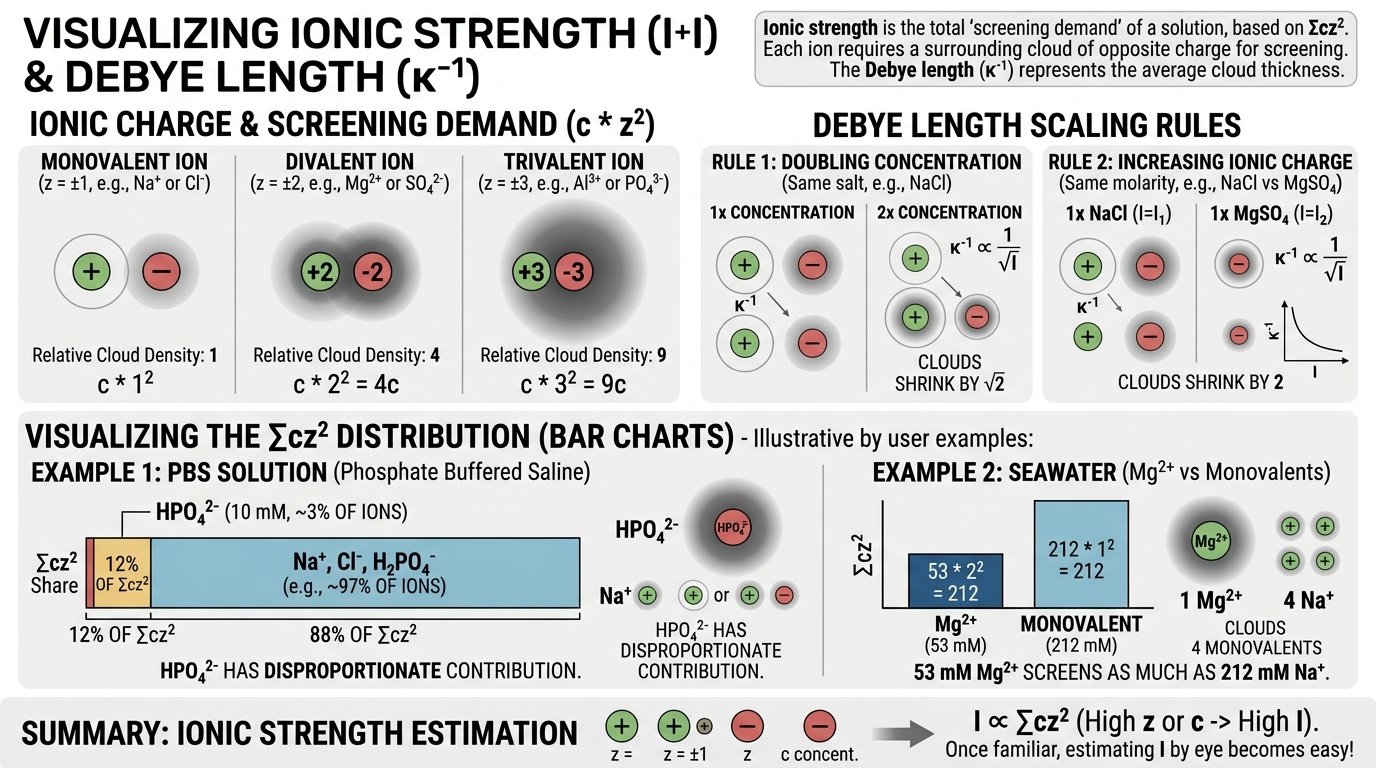
Imagine each ion the ionic strength calculator lists as a charge that must be screened by a cloud of opposite charge around it. A monovalent ion needs a small cloud; a divalent ion attracts a cloud four times as dense, a trivalent one nine times. Ionic strength is the total “screening demand” of the solution, and the Debye length is how thick the clouds are. Double the salt and the clouds shrink by √2; replace NaCl by MgSO4 at the same molarity and they shrink by 2.
The bar chart under each result in the ionic strength calculator shows each ion’s share of Σcz². In PBS the 10 mM of HPO42− takes 12 % of the total despite being 3 % of the ions; in seawater Mg2+ at 53 mM takes as much as 212 mM of a monovalent ion would. Once that pattern is familiar, estimating I by eye becomes easy.
Who Uses an Ionic Strength Calculator
Biochemists match buffer ionic strength between experiments and design ion-exchange gradients. Analytical chemists add ionic strength adjusters for ion-selective electrodes and correct equilibrium constants to I = 0. Physical and environmental chemists compute activity coefficients for speciation models of natural waters. Pharmaceutical scientists control I in dissolution and stability studies. Colloid and materials scientists predict stability through the Debye length. Students meet I = ½Σcz² in analytical chemistry and again in physical chemistry and biochemistry courses.
For each group the ionic strength calculator removes the same three sources of error — wrong stoichiometry, forgotten squares, and ions counted twice or not at all in a mixture — and supplies the γ and κ−1 values that are the reason for computing I in the first place.
Full Walkthrough: Setting a Constant Ionic Strength for Kinetics
An enzyme assay is to be run in 50 mM HEPES-NaOH pH 7.5 with substrate concentrations up to 10 mM (as the disodium salt), and the ionic strength must be held at 0.15 M across all substrate levels using KCl.
- Buffer contribution. Ionic strength calculator mixture mode: at pH 7.5 (pKa 7.5) half the HEPES is the sodium salt: 25 mM Na+HEPES− → I = 0.025 M. The zwitterionic half contributes nothing.
- Substrate contribution. Na2S (1 : 2 salt) at 10 mM → I = 0.030 M at the top level; 0 at zero substrate.
- KCl top-up. Mode 4 with background 0.055 M and target 0.15 M: 0.095 M KCl (7.08 g/L) for the highest substrate; 0.125 M KCl at zero substrate; interpolate for the intermediate levels. The ionic strength calculator gives the grams for each.
- Check. Mixture mode for the top level: HEPES-Na 25 mM + Na2S 10 mM + KCl 95 mM → I = 0.150 M. ✓
- Record. γ(z = 1) = 0.75, γ(z = 2) = 0.32 at 25 °C; Debye length 0.78 nm; export the table.
Without this correction the assay would run from I = 0.025 to 0.055 M, and any charged-substrate enzyme would show a Km that drifts with substrate concentration for purely electrostatic reasons.
A Short History of Ionic Strength
Gilbert N. Lewis and Merle Randall introduced the quantity every ionic strength calculator computes in 1921, in a paper on the activity coefficients of strong electrolytes, as the empirical variable on which γ depended in mixed solutions: “in dilute solutions the activity coefficient of a given strong electrolyte is the same in all solutions of the same ionic strength.” Two years later Debye and Hückel derived the limiting law from electrostatics, explaining both the square of the charge and the square root of I. Extensions followed — the ion-size term (Hückel 1925), Guggenheim’s specific-interaction terms (1935), Davies’s empirical −0.3I correction (1938, revised 1962) and Pitzer’s virial equations (1973) for concentrated brines.
The concept spread from electrochemistry into biochemistry through the work on protein solubility (Cohn, Edsall, Green in the 1930s–40s) and into colloid science through the DLVO theory (1941–48), which made the Debye length the central parameter of stability. A modern ionic strength calculator packages a century of that theory into a formula box.
Limits and Assumptions
- Complete dissociation is assumed by the ionic strength calculator for salts entered by formula; weak electrolytes must be entered as ions or salt forms.
- Speciation is not computed: HPO42−/H2PO4− and similar pairs are taken as written; adjust for pH if it matters.
- Ion pairing at high concentration lowers the true I (2 : 2 salts especially); not modelled.
- Activity equations: limiting law to 0.001 M, extended to 0.1 M, Davies to ~0.5 M; beyond that use Pitzer/SIT.
- Debye length uses the linearised Poisson-Boltzmann result; near highly charged surfaces it is qualitative.
- Molar vs molal scales differ by the solution density; the tool labels which you used.
Practice Problems With Answers
Work these by hand, then check with the ionic strength calculator.
- I of 0.2 M KNO3? Answer: 0.2 M.
- I of 0.05 M MgCl2? Answer: 0.15 M.
- I of 0.02 M CuSO4? Answer: 0.08 M.
- I of 0.1 M NaCl + 0.05 M Na2SO4? Answer: 0.25 M.
- I of 0.01 M FeCl3? Answer: 0.06 M.
- γ for Cl− at I = 0.01 M (Davies, 25 °C)? Answer: 0.90.
- KCl molarity for I = 0.3 M? Answer: 0.3 M (22.4 g/L).
- Na2SO4 molarity for I = 0.3 M? Answer: 0.1 M.
- Debye length at I = 0.01 M, 25 °C? Answer: 3.04 nm.
- I of 0.1 M acetic acid (1.3 % ionised)? Answer: 1.3 mM.
Tips for Accurate Results
- Write the dissociation before anything else; the ionic strength calculator shows it so you can check.
- Use the salt-type multiplier (1, 3, 4, 6, 15) as a sanity check on mixtures.
- Enter buffers as their actual salt forms at the working pH.
- Include the counter-ion of every adjustment (NaOH used to set pH adds Na+).
- Pick the activity equation by I: limiting < 0.001, extended < 0.1, Davies < 0.5 M.
- State the temperature; A changes 3 % between 25 and 37 °C.
- Use inert 1 : 1 salts (KCl, KNO3, NaClO4) to set a background I; the ionic strength calculator’s target mode gives the mass.
- Record I with every constant you measure.
Common Mistakes
- Forgetting to square the charge — CaCl2 becomes 0.2 instead of 0.3 M; the ionic strength calculator’s table shows z² explicitly.
- Forgetting the ½ — every answer doubled.
- Using the salt concentration for each ion instead of multiplying by its stoichiometric coefficient.
- Counting weak acids as fully ionised.
- Counting Tris base or HEPES zwitterion as ions.
- Double-counting Na+ in mixtures, or missing it from a second salt.
- Applying the limiting law at 0.1 M.
- Ignoring the counter-ion added when adjusting pH.
How This Ionic Strength Calculator Is Different
| Feature | This ionic strength calculator | Typical online calculator |
|---|---|---|
| Automatic dissociation of any salt formula (70 ions, polyatomics, hydrates, brackets) | ✓ | Manual ion entry |
| Mixtures with ions pooled across salts, per-ion share and source | ✓ | ✗ |
| Molar, molal, g/L and % w/v input with IUPAC 2021 molar masses | ✓ | mol/L only |
| Limiting, extended and Davies γ with temperature-dependent A and B | ✓ | One equation, 25 °C |
| Salt needed for a target I on top of a background | ✓ | ✗ |
| Debye length with screening at a chosen distance | ✓ | ✗ |
| Weak-electrolyte and partial-dissociation warnings | ✓ | ✗ |
| Steps, table, chart, copy, CSV, print, share, history, per-mode Reset | ✓ | Number only |
Most online tools ask you to type each ion, its charge and its concentration. This ionic strength calculator starts from the formula on the bottle and ends with the activity coefficient or Debye length you actually need.
The ionic strength calculator belongs to the same family as the site’s other free tools: molecular weight calculator, atomic mass calculator, formula weight calculator, molarity calculator, stoichiometry calculator, exact mass calculator, grams to moles calculator, molar mass of hydrates calculator, average molecular weight of a mixture, number average molecular weight, weight average molecular weight, polydispersity index, monoisotopic mass calculator, average vs monoisotopic mass, isotopic mass calculator, freezing point depression, boiling point elevation, osmotic pressure calculator, vapor density, molar mass from gas density, equivalent weight calculator, viscosity molecular weight, van der Waals equation, empirical formula calculator, molecular formula calculator, percent composition calculator, combustion analysis calculator, degree of unsaturation calculator, oxidation number calculator, formal charge calculator, limiting reactant calculator, theoretical yield calculator, percent yield calculator, atom economy calculator, chemical equation balancer, molality calculator, normality calculator, mole fraction calculator, ppm to ppb converter, dilution calculator, serial dilution calculator, solution preparation calculator, w/v solution calculator, osmolarity calculator, peptide reconstitution calculator, stock solution calculator, Beer Lambert law calculator, protein concentration A280 calculator.
Where the Numbers Come From
The ionic strength calculator uses the Lewis-Randall definition, the Debye-Hückel and Davies equations with temperature-dependent constants, physical constants from CODATA 2018 for the Debye length, and IUPAC 2021 atomic weights:
- IUPAC Gold Book — ionic strength: the definition I = ½ Σ mi zi² on the molality basis and the corresponding concentration basis.
- Harvey, Analytical Chemistry 2.1 via LibreTexts — Activity Effects: ionic strength, activity coefficients and the extended Debye-Hückel equation with ion-size parameters.
- CIAAW — Standard Atomic Weights: the atomic weights behind every molar mass used for g/L and % inputs.
- Wikipedia — Ionic strength: definition, examples for salt types, molar vs molal forms and the link to Debye length.
Found an error? Our corrections policy explains how we handle reports; contact us or read about the site.
Checklist
☐ Every salt dissociated with correct stoichiometry and charges
☐ Each ion’s concentration = salt concentration × coefficient
☐ Charges squared; sum halved
☐ Ions pooled across all components of a mixture
☐ Weak acids/bases entered as salt forms or ionised fraction
☐ Buffer counter-ions and pH-adjustment ions included
☐ Scale recorded: molar (Ic) or molal (Im)
☐ Activity equation chosen for the I range; temperature set
☐ Target-I salt chosen inert (KCl, KNO3, NaClO4)
☐ I reported alongside every constant or protocol
Frequently Asked Questions
What is the formula for ionic strength?
I = ½ Σ ci zi²: for each ion multiply its molar concentration by the square of its charge, add them all, and halve the total. For 0.1 M CaCl2: ½(0.1 × 4 + 0.2 × 1) = 0.3 M.
Why is the ionic strength of NaCl equal to its molarity?
Because both ions are singly charged: I = ½(c × 1 + c × 1) = c. Any 1 : 1 salt (KCl, NaNO3, NH4Cl) behaves the same way.
What is the ionic strength of 0.1 M MgSO4?
0.4 M. Mg2+ at 0.1 M contributes 0.1 × 4 and SO42− at 0.1 M contributes 0.1 × 4; the sum 0.8 halved is 0.4. A 2 : 2 salt always has I = 4c.
How do I calculate the ionic strength of a buffer like PBS?
Dissociate every component, pool each ion across all salts, then apply ½Σcz². For 1X PBS the result is about 0.17 M. Equivalently add each salt’s own I: NaCl 137 + KCl 2.7 + Na2HPO4 3 × 10 + KH2PO4 1.8 = 171.5 mM.
What is the ionic strength of blood plasma?
About 0.15–0.16 M, dominated by Na+ (140 mM) and Cl− (100 mM) with bicarbonate, potassium, calcium and magnesium; 0.15 M is the usual physiological value.
How does ionic strength affect activity coefficients?
γ falls as I rises, faster for higher charges: at I = 0.1 M a monovalent ion has γ ≈ 0.78 and a divalent ion ≈ 0.37 (Davies, 25 °C). Use the limiting law below 0.001 M, the extended law below 0.1 M and Davies below about 0.5 M.
Do weak acids contribute to ionic strength?
Only their ionised fraction. 0.1 M acetic acid is 1.3 % dissociated, so it contributes about 1.3 mM, not 0.1 M. Enter the salt form (sodium acetate) or the ionised concentration as bare ions.
What is the Debye length and how does it depend on ionic strength?
The distance over which electrostatic interactions are screened in solution: 0.304/√I nm in water at 25 °C — 9.6 nm at 1 mM, 0.96 nm at 0.1 M, 0.78 nm at 0.15 M. Higher I means shorter range.
How much KCl do I add to reach an ionic strength of 0.1 M?
KCl is a 1 : 1 salt, so 0.1 M KCl (7.46 g/L) gives I = 0.1 M on its own; subtract any background I already present and add only the difference. Mode 4 does this for any salt.
Is my data stored anywhere?
No. The ionic strength calculator runs entirely in your browser; the history box uses your own local storage and Clear All empties it.
10 Facts Worth Knowing
- Lewis and Randall coined “ionic strength” in 1921, two years before Debye and Hückel explained it.
- One mole of Al2(SO4)3 gives fifteen times the ionic strength of one mole of NaCl.
- Pure water has an ionic strength of 10−7 M and a Debye length of almost a micrometre.
- The Schulze-Hardy rule: the salt concentration that coagulates a colloid falls roughly as z−6, so Al3+ is about 700 times more effective than Na+.
- Seawater’s ionic strength (0.7 M) is why marine proteins and enzymes often need high salt to fold and work.
- The Davies equation’s −0.3 I term is purely empirical; it makes γ pass through a minimum near I = 0.5 M as real data do.
- pH meters read hydrogen-ion activity, so pH and −log[H+] differ by about 0.1 in physiological saline.
- Ammonium sulfate at 3 M has an ionic strength of 9 M — far outside any Debye-Hückel-type model.
- Ion-exchange chromatography elutes proteins by raising I; a 0–1 M NaCl gradient is a 0–1 M ionic strength gradient.
- Zwitterionic buffers (HEPES, MOPS, Tris base) add no ionic strength until they are titrated to their salt form.
Final Thoughts
Ionic strength is a weighted count of charge: concentration times charge squared, summed and halved. It is easy to state and easy to get wrong — a missed square or coefficient is a factor of two or three — and everything electrostatic in solution depends on it.
Use the ionic strength calculator above to dissociate salts correctly, sum mixtures, obtain activity coefficients and Debye lengths, and set background electrolytes — and report I alongside every constant you measure.
Written by
Ahmad Raza, M.Phil. Chemistry ✓ Verified Expert
Ahmad has taught general and analytical chemistry for over a decade and builds the calculators on this site. He tests every tool — including this ionic strength calculator — against textbook problems and published activity data before it goes live, and he answers reader questions personally.