
w/v Solution Calculator
Percent weight/volume made simple. This w/v solution calculator finds the grams of solute for any % w/v and volume, converts % w/v to molarity, mg/mL, g/L and ppm (and back), handles w/w and v/v with density, dilutes one percent solution to another, and solves dosing problems such as "how many mg in 5 mL of a 2 % solution".
✓ Trusted by nursing, pharmacy & laboratory studentsHow Many Grams for a % w/v Solution?
% w/v = grams of solute per 100 mL of solution. Choose what to find: the mass for a given % and volume, the % from a mass and volume, or the volume a mass will make at a given %. The w/v solution calculator also shows mg/mL, g/L and ppm.
Convert % w/v to Molarity (and Molarity to % w/v)
Molarity = % w/v × 10 ÷ molar mass; % w/v = M × molar mass ÷ 10. Enter the formula (or molar mass) and the value to convert; the w/v solution calculator also gives mM, mg/mL and, for ionic solutes, the mEq/L.
Convert Between % w/v, % w/w and % v/v
The three percent conventions differ by density. % w/v = % w/w × solution density; % v/v = % w/v ÷ solute density. Give the solution density (and the pure-solute density for v/v) and the w/v solution calculator converts all three, with the mass and volume in 100 mL.
Dilute a Percent Solution to a Lower Percent
C₁V₁ = C₂V₂ works for percent just as for molarity. Give the stock %, target % and the volume wanted; the w/v solution calculator returns the stock volume, the diluent, the dilution factor and the grams of solute in the final solution. Solve for the final volume instead if you know how much stock you have.
Dose in a Volume: mg in X mL of a % Solution
A 1 % w/v solution contains 10 mg/mL. Enter the % and either a volume (to get the dose it contains) or a dose (to get the volume to draw up). Ratio strengths like 1:1000 are accepted too. The w/v solution calculator shows the working nurses and pharmacists use.
🕘 Recent calculations
- No calculations yet — your last 10 results will appear here.
Formulas: % w/v = g solute / mL solution × 100 · grams = % × mL / 100 · 1 % w/v = 10 mg/mL = 10 g/L = 10 000 ppm · molarity = % w/v × 10 / M · % w/v = % w/w × solution density · % v/v = % w/v / pure-solute density · ratio 1 : X = 1 g in X mL = (100/X) % w/v (1:1000 = 0.1 % = 1 mg/mL) · dilution C1V1 = C2V2 · mEq/L = mmol/L × charge · hydrates: use the hydrate's molar mass when the label names the hydrate · IUPAC 2021 atomic weights.
A w/v solution calculator works with the percent weight-per-volume unit that pharmacy, nursing, microbiology and most teaching laboratories use every day: 0.9 % saline, 5 % dextrose, 2 % agarose, 1 % lidocaine, 10 % SDS. Percent w/v means grams of solute in 100 millilitres of finished solution, so 0.9 % saline is 0.9 g per 100 mL, 9 g per litre, 9 mg per mL — and the arithmetic of scaling, converting and dosing that follows from that single definition is what this tool automates.
The free w/v solution calculator on this page has five modes: grams, percent or volume for any % w/v solution with a purity correction; % w/v to molarity, millimolar, mg/mL and mEq/L for any chemical formula (and back from molarity to percent); conversion among % w/v, % w/w and % v/v using the solution and solute densities; dilution of one percent strength to another by C1V1 = C2V2; and dose-in-a-volume calculations for % and 1 : X ratio strengths — how many milligrams are in 5 mL of a 2 % solution, how many millilitres deliver 50 mg from a 1 % solution. Every result shows the working, a table and a chart.
Below the tool you will find the definition and its consequences, the 1 % = 10 mg/mL rule, the molarity link, the w/v–w/w–v/v distinction and why it matters for concentrated reagents, ratio strengths, clinical dosing examples, worked problems, a reference table of common percent solutions, ten practice questions, a checklist and the questions readers ask most about the w/v solution calculator.
Key Takeaway
% w/v = grams of solute per 100 mL of solution. grams = % × mL ÷ 100, so 500 mL of 0.9 % saline needs 4.5 g NaCl. 1 % w/v = 10 mg/mL = 10 g/L = 10 000 ppm. Molarity = % × 10 ÷ molar mass (0.9 % NaCl = 0.154 M). % w/v = % w/w × density, and 1 : 1000 = 0.1 % = 1 mg/mL. The w/v solution calculator above applies all of these and shows the steps.
📑 Table of Contents (click to expand)
- What Is a w/v Solution Calculator?
- How to Use the w/v Solution Calculator
- The Five Modes Explained
- The Definition and Its Consequences
- Worked Example: 500 mL of 0.9 % Saline
- From % w/v to Molarity and mEq
- w/v, w/w and v/v: Three Percents, One Density Apart
- More Worked Examples
- Ratio Strengths: 1 : 1000 and Friends
- Clinical Dosing: mg in a Volume
- Diluting Percent Solutions
- % w/v, ppm and mg/L
- Purity, Hydrates and Salt Forms in % w/v
- Reference Table: Common % w/v Solutions
- Visualising Percent w/v
- Who Uses a w/v Solution Calculator
- Full Walkthrough: A Percent Solution From Prescription to Bench
- A Short History of Percent Solutions
- Limits and Assumptions
- Practice Problems With Answers
- Tips for Accurate Results
- Common Mistakes
- How This w/v Solution Calculator Is Different
- Where the Numbers Come From
- Checklist
- Frequently Asked Questions
- 10 Facts Worth Knowing
- Final Thoughts
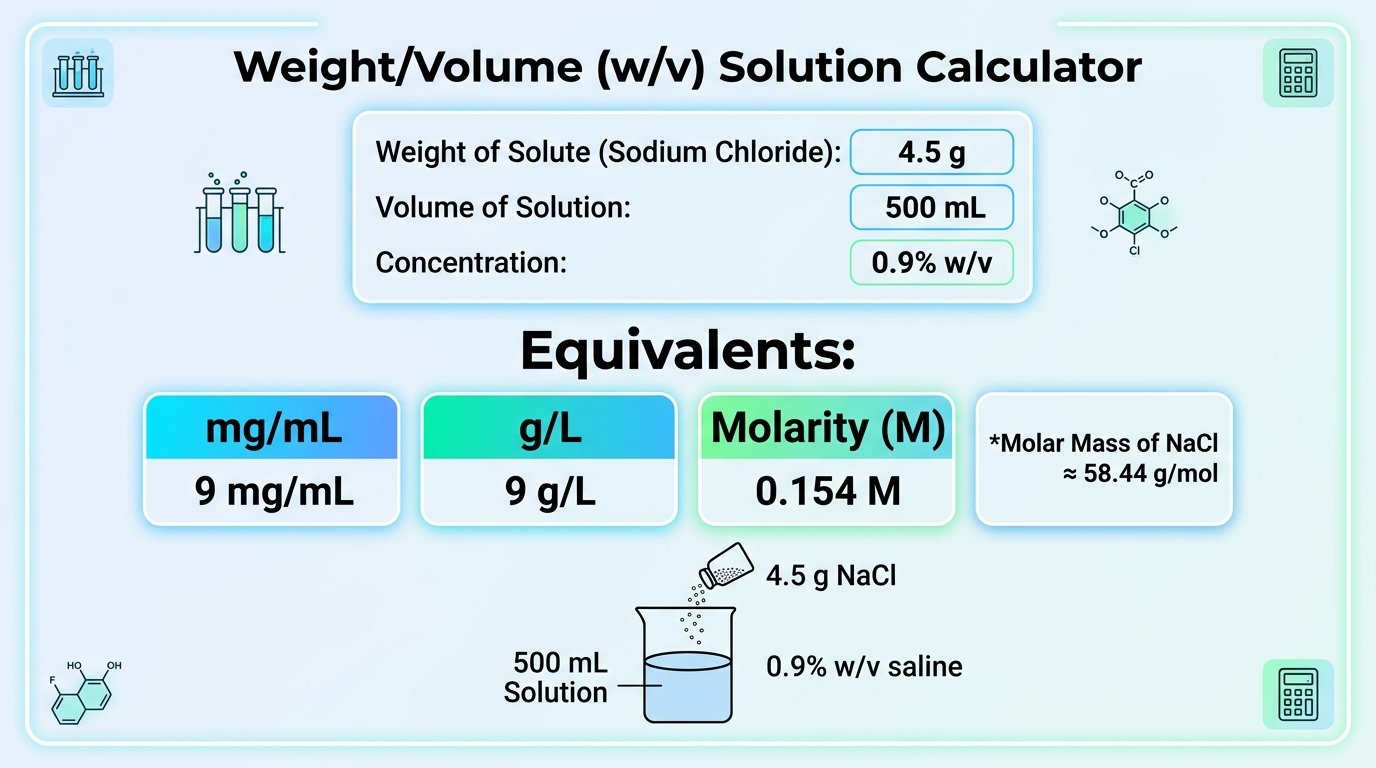
What Is a w/v Solution Calculator?
Percent weight per volume (% w/v, also written % m/v) is the mass of solute in grams contained in 100 mL of the final solution. It is a hybrid unit — mass over volume — and that hybrid nature is exactly why it is popular: solids are weighed and liquids are measured, so “grams per 100 mL” is the most natural recipe for dissolving a powder in water. A w/v solution calculator applies the definition in every direction: grams from percent and volume, percent from grams and volume, volume from grams and percent, and the conversions to molarity, mg/mL, ppm and the other percent conventions.
Because 100 mL is one-tenth of a litre, 1 % w/v is 10 g/L, which is 10 mg/mL, which is 10 000 ppm in dilute water. Those factors of ten are the whole of the unit’s arithmetic, and most mistakes are misplaced factors of ten. The w/v solution calculator prints all four equivalents for every result so that a slip is visible immediately.
The 1 % ladder
1 % w/v = 1 g / 100 mL = 10 g / L = 10 mg / mL = 1000 mg / 100 mL
0.1 % w/v = 1 mg / mL = 1 : 1000
0.01 % w/v = 100 µg / mL = 1 : 10 000
0.9 % w/v = 9 mg / mL = 0.154 M NaCl — the w/v solution calculator returns each rung.
How to Use the w/v Solution Calculator
- Pick the mode. Grams for a % w/v to prepare a solution or find its percent; % w/v ↔ molarity for molar or mEq conversions; w/v ↔ w/w ↔ v/v when a label uses a different percent basis; Dilute % to % for stock-to-working; Dose in a volume for mg-in-mL questions.
- Enter the known quantities. Percent, volume (mL, L or µL), mass (g, mg or kg) and, if the reagent is not pure, its assay. For molarity modes type a formula (
NaCl,C6H12O6,CaCl2·2H2O) or a molar mass. - Add density for w/w conversions (solution density) and v/v conversions (pure-solute density — 0.789 g/mL for ethanol).
- Press Calculate. The w/v solution calculator shows the answer in blue, its equivalents in mg/mL, g/L, ppm and molarity, the steps, a table and a chart for common volumes.
- Copy, download, print or share; each mode has its own Reset; the last ten results stay in the history.
The example chips load 0.9 % saline, 5 % dextrose, 2 % agarose, 15 % KCl to mEq, 37 % w/w HCl to w/v, a 10 % to 2 % dilution and 2 % lidocaine dosing, so the w/v solution calculator’s format is visible before you type.
The Five Modes Explained
Mode 1 — Grams for a % w/v. Solve for mass, percent or volume from the other two; correct for purity; get mg/mL, g/L and ppm. 12.5 g in 250 mL is 5 %; 25 g of solute makes 250 mL of 10 %.
Mode 2 — % w/v ↔ molarity. M = % × 10 ÷ molar mass. Also mg/mL and g/L inputs, mM output, and mEq/L when you give the ion charge: 0.9 % NaCl = 154 mmol/L = 154 mEq/L Na+; 15 % KCl = 2.01 M = 2 mEq/mL.
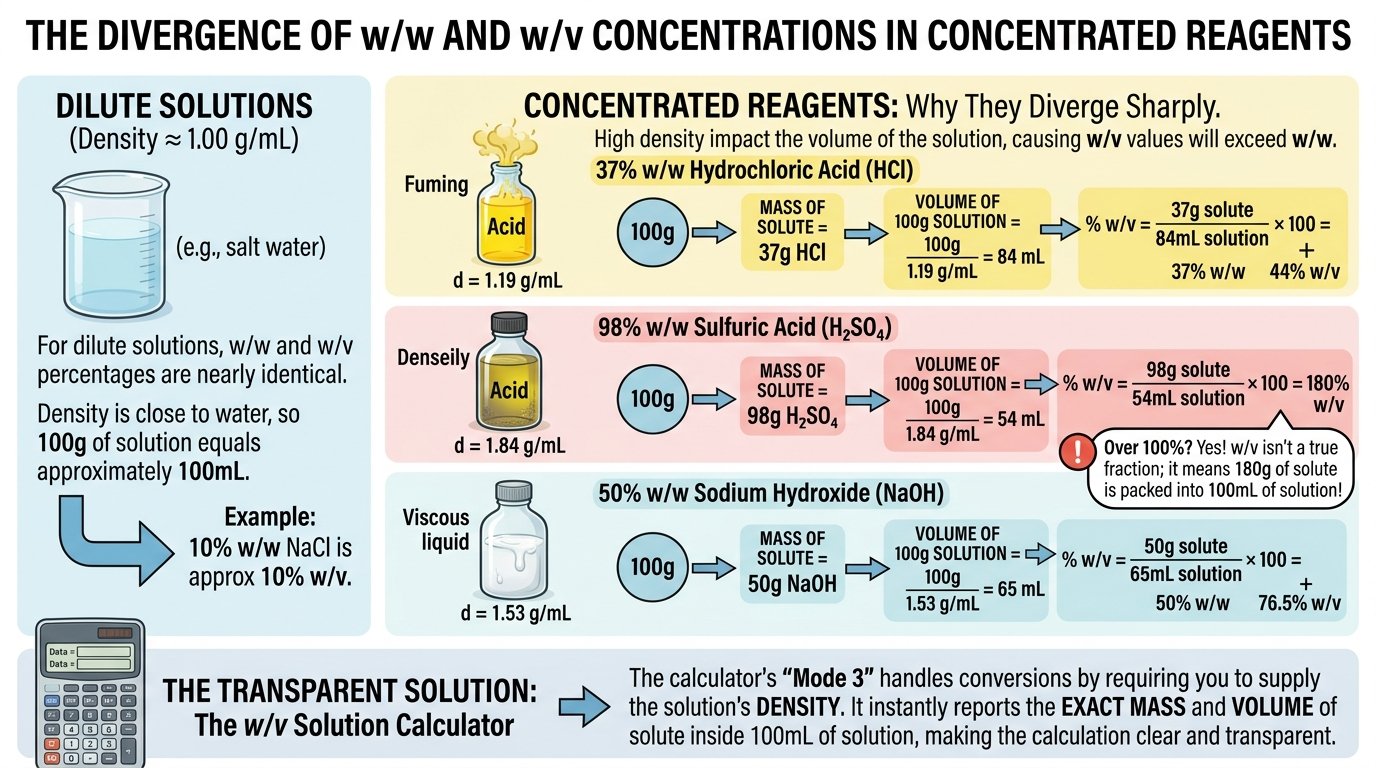
Mode 3 — w/v ↔ w/w ↔ v/v. % w/v = % w/w × solution density; % v/v = % w/v ÷ pure-solute density. 37 % w/w HCl at 1.19 g/mL is 44.0 % w/v; 70 % v/v ethanol is 55.2 % w/v and 63.6 % w/w. The w/v solution calculator shows the mass and volume inside 100 mL for each.
Mode 4 — Dilute % to %. C1V1 = C2V2 with percent as the unit: stock volume for a final volume, final volume from a stock volume, or the final percent after adding diluent. 250 mL of 2 % from 10 % takes 50 mL of stock.
Mode 5 — Dose in a volume. Converts % or 1 : X to mg/mL and then dose = mg/mL × mL or volume = dose ÷ mg/mL. 5 mL of 2 % lidocaine = 100 mg; 50 mg from a 1 % solution = 5 mL; 0.5 mL of 1 : 1000 adrenaline = 0.5 mg.
The Definition and Its Consequences
% w/v = mass of solute (g) ÷ volume of solution (mL) × 100
grams = % × mL / 100 · mL = grams × 100 / % · mg/mL = % × 10 · M = % × 10 / molar mass
Three consequences follow, and the w/v solution calculator is built around them. First, the volume is the solution, not the solvent, so the solid is dissolved and the solution made up to the mark; adding 100 mL of water to 5 g of glucose gives about 103 mL and a 4.85 % solution. Second, the unit is dimensionally odd (g/mL × 100 has units of g/mL, not a true percent), which is why IUPAC and the metrologists prefer g/L or kg/m³; in practice % w/v is universal in medicine and biology, and the w/v solution calculator always reports the g/L equivalent for formal use. Third, because it is mass over volume, it converts to molarity with a single division by molar mass, which % w/w cannot do without density.
A common source of confusion the w/v solution calculator cannot resolve for you is that percent solutions of liquids (ethanol, glycerol, acetic acid) are usually v/v, not w/v; the two differ by the solute density. When a protocol says “10 % glycerol” it almost always means v/v; “10 % SDS” means w/v. If in doubt, ask, and record the basis on the label.
Worked Example: 500 mL of 0.9 % Saline
- Definition. 0.9 % w/v = 0.9 g NaCl per 100 mL.
- Scale. grams = 0.9 × 500 ÷ 100 = 4.5 g.
- Equivalents. 9 mg/mL; 9 g/L; 9000 ppm; molarity 9 ÷ 58.44 = 0.154 M = 154 mmol/L Na+ and Cl−.
- Prepare. Weigh 4.5 g, dissolve in about 400 mL of water, make up to 500 mL, mix. For injection-grade saline, filter and autoclave.
The w/v solution calculator prints exactly this chain for any percent, and its chart shows the grams for 100, 250, 500 and 1000 mL (0.9, 2.25, 4.5, 9 g) so that scaling errors are obvious. Note that 0.9 % is 308 mOsm/L nominally, slightly above plasma, which is why it is called “normal” rather than “isotonic” in careful texts; our osmolarity calculator covers that side.
From % w/v to Molarity and mEq
Because % w/v is mass per volume, the w/v solution calculator can give molarity directly: g/L = % × 10, and mol/L = g/L ÷ molar mass. So molarity = % × 10 ÷ M. For 5 % glucose (M = 180.16): 5 × 10 ÷ 180.16 = 0.278 M. For 8.4 % sodium bicarbonate (M = 84.01): 1.00 M — the reason the 8.4 % ampoule is “1 mEq/mL”. For 10 % CaCl2·2H2O (M = 147.01): 0.680 M = 1.36 mEq/mL of calcium.
Milliequivalents count charge: mEq/L = mmol/L × charge per ion. 0.9 % NaCl gives 154 mEq/L of Na+; 15 % KCl gives 2012 mEq/L = 2.01 mEq/mL, so a 10 mL vial holds 20 mEq of potassium. The w/v solution calculator computes mEq when you enter the charge, and it uses the molar mass of the salt as written on the label — hydrated where the label says hydrated.
The reverse conversion in the w/v solution calculator is % = M × molar mass ÷ 10: 1 M NaOH is 4.0 % w/v; 0.3 M sucrose is 10.3 %. For the broader family of molar conversions see the molarity calculator, and for equivalents the normality calculator.
w/v, w/w and v/v: Three Percents, One Density Apart
| Unit | Meaning | Typical use | Convert to w/v |
|---|---|---|---|
| % w/v | g solute / 100 mL solution | Solids in water; drugs; media | — |
| % w/w | g solute / 100 g solution | Concentrated acids; ointments; food | × solution density |
| % v/v | mL solute / 100 mL solution | Alcohols; glycerol; liquid mixtures | × solute density |
For dilute aqueous solutions (density ≈ 1.00) the w/v solution calculator will show w/v and w/w agreeing within a percent or two and nobody notices. For concentrated reagents they diverge sharply: 37 % w/w HCl (d = 1.19) is 44 % w/v; 98 % w/w H2SO4 (d = 1.84) is 180 % w/v — a number over 100 that only makes sense once you remember w/v is not a true fraction; 50 % w/w NaOH (d = 1.53) is 76.5 % w/v. The w/v solution calculator’s mode 3 handles these with the density you supply, and reports the mass and volume of solute inside 100 mL so the conversion is transparent.
For liquids, v/v to w/v needs the pure-solute density: 70 % v/v ethanol contains 70 mL × 0.789 g/mL = 55.2 g per 100 mL, i.e. 55.2 % w/v, and dividing by the solution density (0.868) gives 63.6 % w/w. The solution preparation calculator uses the same conversions to turn bottled acids into molar solutions.
More Worked Examples
Example 1 — 2 % agarose gel, 50 mL
2 × 50 ÷ 100 = 1.0 g agarose in 50 mL of 1X TAE; microwave to dissolve, top up any evaporated water to 50 mL.
Example 2 — 12.5 g in 250 mL: what percent?
12.5 ÷ 250 × 100 = 5 % w/v = 50 mg/mL.
Example 3 — 3 % NaOH from 98 % pellets, 200 mL
3 × 200 ÷ 100 = 6.0 g pure; ÷ 0.98 = 6.12 g to weigh.
Example 4 — 10 % w/v sucrose (d 1.07) as w/w
10 g in 100 mL that weighs 107 g → 9.35 % w/w; molarity 100 ÷ 342.3 = 0.292 M.
Example 5 — 100 mL of 6 % bleach diluted to 0.5 %
V2 = 6 × 100 ÷ 0.5 = 1200 mL: add 1100 mL of water (factor 12).
Ratio Strengths: 1 : 1000 and Friends
Older pharmaceutical labels — still accepted by the w/v solution calculator — express strength as a ratio: 1 : 1000 means 1 g of drug in 1000 mL of solution. Converted, 1 : 1000 = 0.1 % w/v = 1 mg/mL; 1 : 10 000 = 0.01 % = 0.1 mg/mL = 100 µg/mL; 1 : 200 000 (adrenaline in local anaesthetic) = 5 µg/mL. The general rule is % w/v = 100 ÷ X and mg/mL = 1000 ÷ X.
The w/v solution calculator’s dosing mode accepts ratio strengths directly — type 1:1000 — and converts them to mg/mL before computing a dose or a volume. Because confusion between 1 : 1000 and 1 : 10 000 adrenaline has caused real harm, many regulators now require mg/mL labelling alongside or instead of ratios; the calculator shows both on every result.
| Ratio | % w/v | mg/mL | Example |
|---|---|---|---|
| 1 : 100 | 1 | 10 | 1 % lidocaine |
| 1 : 1000 | 0.1 | 1 | Adrenaline IM |
| 1 : 10 000 | 0.01 | 0.1 | Adrenaline IV |
| 1 : 200 000 | 0.0005 | 0.005 | Adrenaline with local anaesthetic |
| 1 : 5000 | 0.02 | 0.2 | Heparin lock flush (units differ) |
Clinical Dosing: mg in a Volume
The nurse’s and pharmacist’s daily use of a w/v solution calculator is “how much drug is in this volume” and “what volume gives this dose”. Both reduce to mg/mL = % × 10. Then dose (mg) = mg/mL × mL and volume (mL) = dose ÷ mg/mL.
- 2 % lidocaine = 20 mg/mL; 5 mL contains 100 mg; the 3 mg/kg ceiling for a 70 kg adult (210 mg) is 10.5 mL.
- 1 % solution = 10 mg/mL; 50 mg is 5 mL.
- 0.25 % bupivacaine = 2.5 mg/mL; 75 mg is 30 mL.
- 50 % dextrose = 500 mg/mL; a 50 mL ampoule holds 25 g of glucose.
- 8.4 % NaHCO3 = 84 mg/mL = 1 mmol/mL; 50 mL is 50 mmol.
The w/v solution calculator’s dosing mode does these with the dose unit of your choice (mg, g, µg) and warns when a computed volume is impractically small or large. It is a teaching and checking aid, not a substitute for institutional double-checks; always confirm the units on the vial.
Diluting Percent Solutions
Percent w/v dilutes exactly like molarity, which is why the w/v solution calculator has a dilution mode: because both are amount per volume: C1V1 = C2V2 with percent on both sides. 250 mL of 2 % from 10 % takes 2 × 250 ÷ 10 = 50 mL of stock plus 200 mL of diluent (factor 5). 1 L of 0.9 % saline from 23.4 % hypertonic saline takes 38.5 mL. 500 mL of 5 % dextrose from 50 % takes 50 mL.
The w/v solution calculator’s mode 4 solves for the stock volume, the final volume or the final percent, and reports the grams of solute in the final solution as a check (the solute is the same before and after). Two things it cannot know: whether the protocol’s “add X mL” means “add” or “make up to”, and whether the two solutions’ volumes are additive (fine for aqueous salt solutions, off by a few percent for alcohols). For general and multi-unit dilutions see the dilution calculator; for chained dilutions the serial dilution calculator.
% w/v, ppm and mg/L
In dilute aqueous solutions 1 ppm is 1 mg/L, a conversion the w/v solution calculator applies automatically, so 1 % w/v (10 g/L = 10 000 mg/L) is 10 000 ppm and 1 ppm is 0.0001 % w/v. Water-quality limits (10 mg/L nitrate-N, 0.015 mg/L lead) are therefore 0.001 % and 0.0000015 % — which is why nobody writes them in percent. The w/v solution calculator prints the ppm equivalent on every result, and the ppm to ppb converter handles the rest of the parts-per ladder, including the density correction for non-aqueous matrices.
Going the other way in the w/v solution calculator, a 1000 ppm certified standard is 0.1 % w/v = 1 mg/mL, and a 1 % w/v solution of a salt is a 10 000 ppm solution of the salt — but of the element only in proportion to its mass fraction. 1 % NaCl is 3934 ppm sodium (Na is 39.34 % of NaCl by mass), a point the percent composition calculator will confirm.
Purity, Hydrates and Salt Forms in % w/v
Percent w/v — in the w/v solution calculator as on the bottle — refers to the substance named on the label, so the reagent’s assay and form matter as much as they do for molar solutions. A 3 % NaOH solution from 98 % pellets needs 3.06 g per 100 mL, not 3.00; a “10 % CaCl2” made from the dihydrate contains only 7.5 % anhydrous calcium chloride unless the recipe says otherwise. The w/v solution calculator carries a purity field in the preparation mode and uses the molar mass of the formula exactly as typed — hydrate included — in the molarity mode, so the two conventions are kept honest.
Pharmaceutical labels sometimes state the salt (lidocaine hydrochloride 2 %) and sometimes the base; the difference for lidocaine is 13 % by mass. For clinical work the convention is fixed by the pharmacopoeia and the label is authoritative; for laboratory reagents, write which form you weighed.
Reference Table: Common % w/v Solutions
| Solution | % w/v | mg/mL | g per 500 mL | Molarity |
|---|---|---|---|---|
| Normal saline (NaCl) | 0.9 | 9 | 4.5 | 0.154 M |
| Half-normal saline | 0.45 | 4.5 | 2.25 | 0.077 M |
| Hypertonic saline | 3 | 30 | 15 | 0.513 M |
| D5W (glucose) | 5 | 50 | 25 | 0.278 M |
| D50W | 50 | 500 | 250 | 2.78 M |
| Sodium bicarbonate | 8.4 | 84 | 42 | 1.00 M |
| KCl concentrate | 15 | 150 | 75 | 2.01 M |
| Lidocaine | 2 | 20 | 10 | 0.074 M (HCl salt) |
| SDS stock | 10 | 100 | 50 | 0.347 M |
| Agarose gel | 1 | 10 | 5 | — |
Each row is one line in the w/v solution calculator; the molarities use the molar mass of the salt form on the label.
Visualising Percent w/v
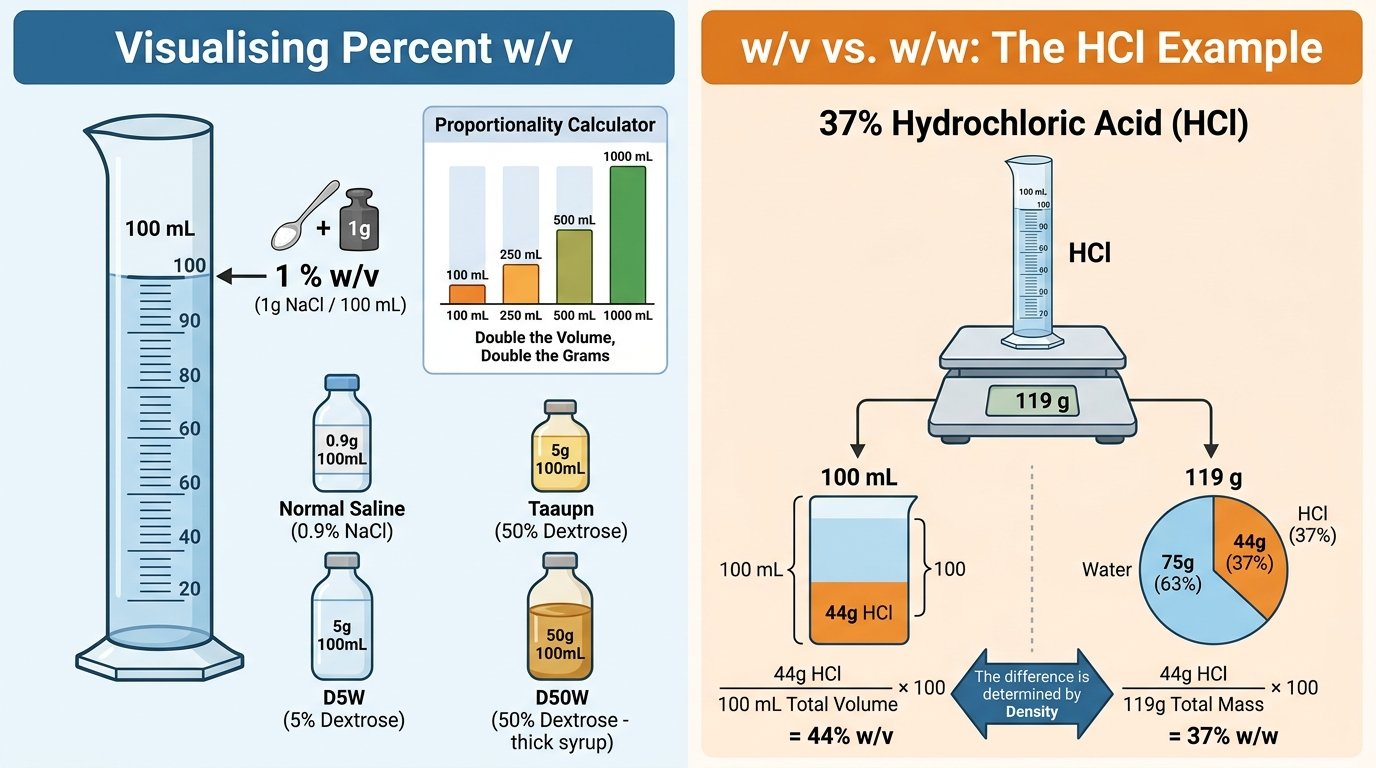
Picture a 100 mL measuring cylinder — the unit the w/v solution calculator is built on. One gram of table salt — roughly a quarter teaspoon — dissolved and made up to the 100 mL line is a 1 % w/v solution. Nine-tenths of that is normal saline; five times it is D5W’s sugar; fifty times it (50 g in 100 mL, a thick syrup) is D50W. The w/v solution calculator’s bar chart draws the grams for 100, 250, 500 and 1000 mL, and the proportionality — double the volume, double the grams — is the whole picture.
For the three percent conventions, picture the same 100 mL cylinder full of 37 % HCl: it weighs 119 g, of which 44 g is HCl (44 % w/v) and 37 % of its mass is HCl (37 % w/w). Same liquid, two numbers, one density apart.
Who Uses a w/v Solution Calculator
Nurses and pharmacists convert % and ratio strengths to mg/mL and doses every shift. Microbiologists and molecular biologists make percent media, agar, agarose and SDS solutions. Histologists prepare fixatives and stains in percent. Food and cosmetic technologists work in w/w and must convert to w/v for analysis. Clinical chemists convert percent to mmol/L and mEq/L. Chemistry students meet % w/v in the first laboratory course and w/v–w/w conversions in the second.
The w/v solution calculator is written for all of them: it accepts the units each group uses, reports the equivalents the others need, and shows the working so a result can be checked by a colleague or a supervisor.
Full Walkthrough: A Percent Solution From Prescription to Bench
A prescription asks for 200 mL of 0.5 % w/v chlorhexidine mouthwash, to be made from a 20 % w/v concentrate; the pharmacist also wants to know the mg per 15 mL dose.
- Amount of drug. w/v solution calculator mode 1: 0.5 × 200 ÷ 100 = 1.0 g in the final 200 mL.
- Volume of concentrate. Mode 4: V1 = 0.5 × 200 ÷ 20 = 5 mL of 20 %; make up to 200 mL with purified water (factor 40).
- Check. 5 mL × 200 mg/mL = 1000 mg. ✓
- Dose. Mode 5: 0.5 % = 5 mg/mL; 15 mL contains 75 mg.
- Label. Chlorhexidine gluconate 0.5 % w/v, 200 mL, 5 mg/mL; the w/v solution calculator’s output goes into the compounding record.
Had the concentrate been labelled 20 % w/w (density 1.06), mode 3 would first give 21.2 % w/v and the volume would fall to 4.72 mL — a 6 % difference that matters in compounding.
A Short History of Percent Solutions
Percent by weight, the oldest unit in the w/v solution calculator, is as old as commerce; percent by volume for spirits followed the hydrometer in the eighteenth century. The hybrid weight-in-volume convention grew up in pharmacy in the nineteenth century, when solids were weighed on apothecary scales and liquids dispensed in graduated measures, and the British and US pharmacopoeias formalised “% w/v” as grams per 100 mL. Normal saline at 0.9 % was introduced by Hartog Hamburger in the 1890s on the basis of red-cell haemolysis experiments.
Ratio strengths (1 : 1000) belong to the same era and persist on adrenaline ampoules despite repeated calls to replace them with mg/mL. IUPAC discourages all percent concentration units in favour of g/L and mol/L, but % w/v remains the working language of the clinic and the teaching lab, which is why a w/v solution calculator that translates freely between conventions is still needed.
Limits and Assumptions
- Volume means final solution volume in the w/v solution calculator; solutions must be made up to the mark.
- Density is required for w/w and v/v conversions; the calculator uses the value you supply.
- ppm equivalence (1 % = 10 000 ppm) assumes a dilute aqueous solution of density 1.
- Molarity uses the label’s molar mass (hydrate, salt) — enter the formula as written.
- Percent dilutions assume additive volumes.
- Dosing outputs are for teaching and checking, not a replacement for institutional verification.
Practice Problems With Answers
Work these by hand, then check with the w/v solution calculator.
- Grams of NaCl in 1.5 L of 0.9 %? Answer: 13.5 g.
- 20 g of glucose in 400 mL: % w/v? Answer: 5 %.
- mg/mL in a 0.25 % solution? Answer: 2.5 mg/mL.
- Molarity of 4 % w/v NaOH? Answer: 1.00 M.
- mEq/L of Ca2+ in 10 % CaCl2·2H2O? Answer: 1360 mEq/L (0.680 M × 2).
- % w/v of 30 % w/w H2O2, d 1.11? Answer: 33.3 %.
- Volume of 10 % stock for 250 mL of 2 %? Answer: 50 mL.
- mg in 3 mL of 1 : 1000? Answer: 3 mg.
- Volume of 2 % lidocaine for 140 mg? Answer: 7 mL.
- % v/v of a 55.2 % w/v ethanol solution (dEtOH 0.789)? Answer: 70 %.
Tips for Accurate Results
- Write “w/v”, “w/w” or “v/v” on every label and in every calculation; the w/v solution calculator shows the basis on each result.
- Use the 1 % = 10 mg/mL rule as a mental check on every w/v solution calculator dose result.
- Make up to volume; do not add the nominal volume of solvent.
- Correct for purity when the reagent is not ≥ 99 %.
- Use the hydrate’s molar mass for molarity when the label names the hydrate.
- Convert ratio strengths to mg/mL before doing anything else.
- For concentrated reagents, always convert w/w to w/v with the density before diluting.
- Keep the calculator’s CSV with the compounding or batch record.
Common Mistakes
- Percent of solvent, not solution — adding 100 mL of water to the solid; the w/v solution calculator’s procedure says make up to volume.
- Misplaced factor of 10 between %, mg/mL and g/L.
- w/w read as w/v for concentrated acids and bases.
- v/v read as w/v for alcohols and glycerol.
- 1 : 1000 confused with 1 : 10 000 — a tenfold dose error.
- Anhydrous molar mass used for a hydrated salt in a molarity conversion.
- mEq without the charge — divalent ions carry two.
- ppm equivalence in non-aqueous or dense matrices.
How This w/v Solution Calculator Is Different
| Feature | This w/v solution calculator | Typical online calculator |
|---|---|---|
| Grams, % or volume from the other two, with purity | ✓ | Grams only |
| mg/mL, g/L and ppm on every result | ✓ | ✗ |
| % w/v ↔ molarity, mM and mEq/L for any formula (IUPAC 2021 weights) | ✓ | ✗ |
| w/v ↔ w/w ↔ v/v with densities and mass/volume in 100 mL | ✓ | ✗ |
| Percent dilutions: stock volume, final volume or final % | ✓ | Sometimes |
| Dose in a volume for % and 1 : X ratio strengths | ✓ | ✗ |
| Worked steps, table and chart | ✓ | Number only |
| Copy, CSV, TXT, print, share, history, per-mode Reset | ✓ | Partial |
Most percent calculators do one multiplication. This w/v solution calculator covers the whole percent family — preparation, molarity, the three conventions, dilution and dosing — with the working shown.
The w/v solution calculator belongs to the same family as the site’s other free tools: molecular weight calculator, atomic mass calculator, formula weight calculator, molarity calculator, stoichiometry calculator, exact mass calculator, grams to moles calculator, molar mass of hydrates calculator, average molecular weight of a mixture, number average molecular weight, weight average molecular weight, polydispersity index, monoisotopic mass calculator, average vs monoisotopic mass, isotopic mass calculator, freezing point depression, boiling point elevation, osmotic pressure calculator, vapor density, molar mass from gas density, equivalent weight calculator, viscosity molecular weight, van der Waals equation, empirical formula calculator, molecular formula calculator, percent composition calculator, combustion analysis calculator, degree of unsaturation calculator, oxidation number calculator, formal charge calculator, limiting reactant calculator, theoretical yield calculator, percent yield calculator, atom economy calculator, chemical equation balancer, molality calculator, normality calculator, mole fraction calculator, ppm to ppb converter, dilution calculator, serial dilution calculator, solution preparation calculator, ionic strength calculator, osmolarity calculator, peptide reconstitution calculator, stock solution calculator, Beer Lambert law calculator, protein concentration A280 calculator.
Where the Numbers Come From
The w/v solution calculator uses the pharmacopoeial definition of % w/v, IUPAC 2021 atomic weights for molar masses, and the standard density relations between percent conventions:
- OpenStax Chemistry via LibreTexts — Other Units for Solution Concentrations: mass percent, volume percent, mass-volume percent, ppm and ppb with worked examples.
- OpenStax Chemistry via LibreTexts — Molarity: molarity and the dilution equation used in the molarity and dilution modes.
- CIAAW — Standard Atomic Weights: the atomic weights behind every molar mass on this site.
- Wikipedia — Mass concentration (chemistry): g/L, % w/v (m/v), their relation to molarity and density, and the IUPAC position.
Found an error? Our corrections policy explains how we handle reports; contact us or read about the site.
Checklist
☐ Basis identified on the label: w/v, w/w or v/v
☐ grams = % × mL ÷ 100; factor-of-10 check with mg/mL
☐ Solution made up to volume, not solvent added
☐ Purity applied for reagents below ~99 %
☐ Molar mass of the labelled form used for molarity and mEq
☐ Density used for w/w ↔ w/v; solute density for v/v
☐ Ratio strengths converted to mg/mL first
☐ Percent dilution: V1 = C2V2/C1, diluent = V2 − V1
☐ Dose = mg/mL × mL, double-checked against the vial
☐ Record exported with date and initials
Frequently Asked Questions
What does % w/v mean?
Grams of solute per 100 mL of finished solution. A 0.9 % w/v saline contains 0.9 g of NaCl in every 100 mL — 9 g per litre or 9 mg per mL.
How do I calculate grams for a % w/v solution?
grams = % × volume in mL ÷ 100. For 500 mL of 5 %: 5 × 500 ÷ 100 = 25 g. Dissolve and make up to 500 mL.
How many mg/mL is 1 % w/v?
10 mg/mL. 1 g per 100 mL = 1000 mg per 100 mL = 10 mg per mL. So 2 % is 20 mg/mL and 0.5 % is 5 mg/mL.
How do I convert % w/v to molarity?
Molarity = % × 10 ÷ molar mass. 0.9 % NaCl: 0.9 × 10 ÷ 58.44 = 0.154 M. 5 % glucose: 50 ÷ 180.16 = 0.278 M.
What is the difference between % w/v and % w/w?
% w/v is grams per 100 mL of solution; % w/w is grams per 100 g of solution. Multiply w/w by the solution density to get w/v: 37 % w/w HCl at 1.19 g/mL is 44 % w/v.
What is 1 : 1000 as a percent and in mg/mL?
1 g in 1000 mL = 0.1 % w/v = 1 mg/mL. 1 : 10 000 is 0.01 % = 0.1 mg/mL. In general % = 100 ÷ X and mg/mL = 1000 ÷ X.
How many milligrams are in 5 mL of a 2 % solution?
2 % = 20 mg/mL, so 5 mL contains 100 mg.
How do I dilute a 10 % solution to 2 %?
Use C1V1 = C2V2: for 250 mL of 2 % take 2 × 250 ÷ 10 = 50 mL of the 10 % and make up to 250 mL (200 mL diluent). The factor is 5.
Is % w/v the same as ppm?
Related: in dilute water 1 % w/v = 10 g/L = 10 000 mg/L = 10 000 ppm, so 1 ppm = 0.0001 % w/v. The equivalence assumes a density of 1 g/mL.
Is my data stored anywhere?
No. The w/v solution calculator runs entirely in your browser; the history box uses your own local storage and Clear All empties it.
10 Facts Worth Knowing
- % w/v is not a true percentage: 98 % w/w sulfuric acid is 180 % w/v because a litre of it weighs 1.84 kg.
- Normal saline was proposed by Hartog Hamburger in 1896 from haemolysis experiments; 0.9 % is slightly hyperosmolar to plasma.
- 1 % = 10 mg/mL is the single most useful conversion in a hospital; it turns any percent vial into a dose in seconds.
- A 50 % dextrose ampoule (50 mL) contains 25 g of glucose — 100 kcal.
- Adrenaline 1 : 1000 and 1 : 10 000 differ tenfold; regulators now require mg/mL on the label because of dosing errors.
- Agarose gels are quoted in % w/v but the volume is measured before heating; water lost in the microwave should be replaced.
- IUPAC recommends g/L instead of % w/v, but pharmacopoeias still define solutions in percent.
- 10 % SDS is close to its solubility limit at 20 °C and crystallises in a cold room.
- 15 % KCl contains 2 mEq/mL — undiluted injection is lethal, which is why the concentrate is dyed and stored separately.
- A 1 % w/v solution of any substance is 10 000 ppm of that substance in dilute water — but only its mass fraction as ppm of any element.
Final Thoughts
Percent weight per volume is grams in 100 millilitres of solution, and everything else — mg/mL, g/L, ppm, molarity, doses, dilutions — follows from factors of ten and the molar mass. Watch the basis (w/v, w/w, v/v), make up to volume, and keep the 1 % = 10 mg/mL rule in your head.
Use the w/v solution calculator above to prepare, convert, dilute and dose percent solutions with the working shown — and check any vial or protocol against it before you pipette.
Written by
Ahmad Raza, M.Phil. Chemistry ✓ Verified Expert
Ahmad has taught general and analytical chemistry for over a decade and builds the calculators on this site. He tests every tool — including this w/v solution calculator — against textbook problems, pharmacopoeial examples and bench preparations before it goes live, and he answers reader questions personally.