
Serial Dilution Calculator
Plan a whole dilution series in one click. This serial dilution calculator builds fold-series (1:2, 1:10, any factor), finds the step factor needed to reach a target, converts plate counts to CFU/mL, designs log-spaced dose-response series and shows how pipetting error compounds — with the concentration and transfer volumes for every tube.
✓ Trusted by microbiology, cell-culture & analytical labsBuild a Serial Dilution Series
Give the stock concentration, the dilution factor per step, the number of tubes and the volume in each tube. The serial dilution calculator returns the transfer volume, diluent per tube, concentration and cumulative dilution for every tube.
What Step Factor (or How Many Steps) Reaches a Target?
Enter the stock and the final concentration you want. Fix the number of steps and the serial dilution calculator finds the equal factor per step; or fix the factor and it finds how many steps are needed and the residual single dilution.
CFU/mL From a Plate Count
CFU/mL = colonies ÷ (volume plated in mL × total dilution). Enter the colony count, the tube it came from (10−n or a factor), the volume plated and, optionally, counts from a second tube or duplicate plates. The serial dilution calculator applies the 25–250 (or 30–300) countable-range rule.
Log-Spaced Dose-Response Series (IC₅₀ / EC₅₀ Plates)
Give the top and bottom concentrations and the number of points; the serial dilution calculator finds the constant factor, lists each concentration (and its log10), and adds the intermediate-stock recipe when the well volume and the final DMSO or vehicle limit are given.
How Pipetting Error Compounds Along a Series
Each transfer carries the relative uncertainty of two pipetted volumes; over n steps the relative errors add in quadrature. Enter the per-step volumes and pipette tolerances and the serial dilution calculator estimates the uncertainty in each tube — and compares a serial route with one big single dilution.
🕘 Recent calculations
- No calculations yet — your last 10 results will appear here.
Formulas: concentration in tube n = C0 / DFn · total dilution after n steps = DFn · transfer volume = tube volume / DF; diluent = tube volume − transfer · equal factor for n steps to a target: DF = (C0/Ctarget)1/n · CFU/mL = colonies / (mL plated × total dilution) · log-spaced series: factor = (top/bottom)1/(n−1) · relative error after n steps ≈ √n × per-step error (errors added in quadrature) · the last tube's transfer is discarded so all tubes hold equal volumes.
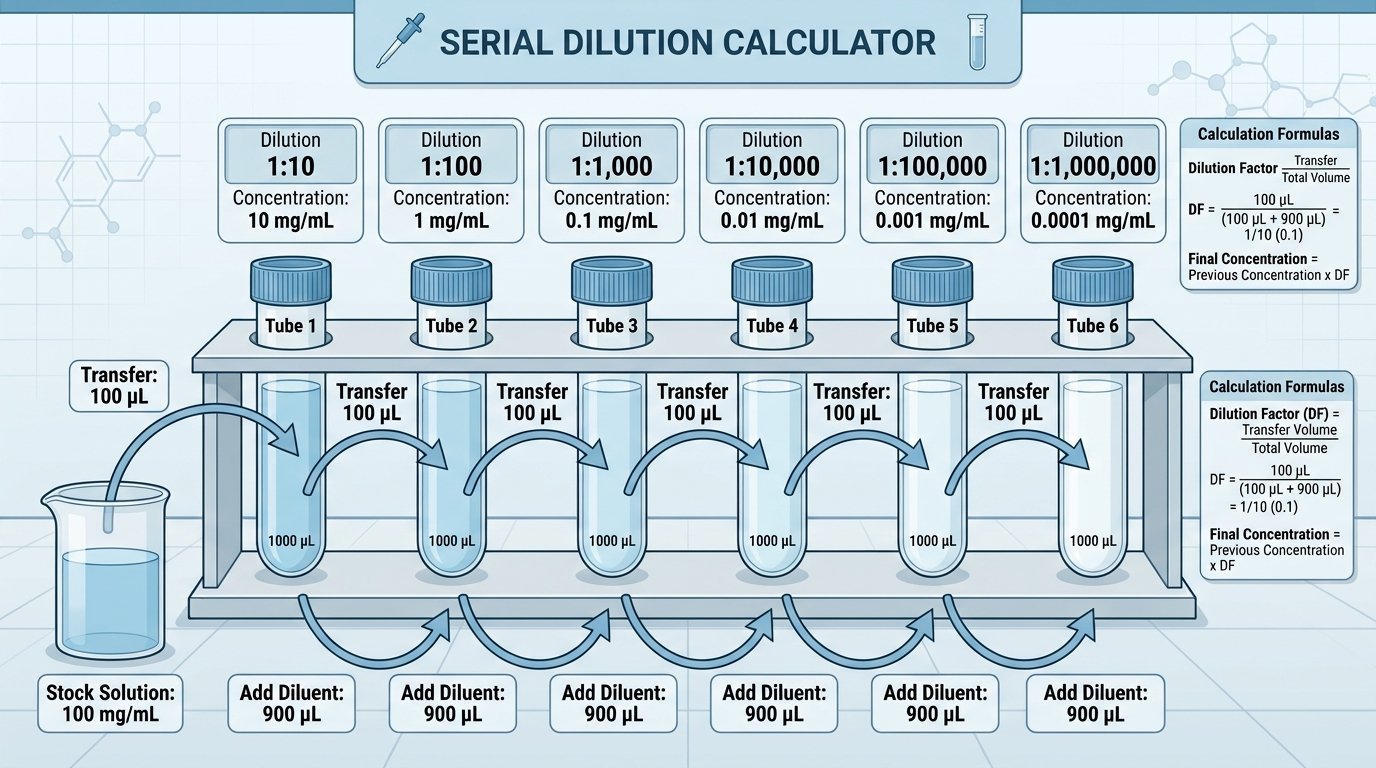
A serial dilution calculator plans a chain of dilutions in which each tube is made from the one before it, so that a modest, repeatable step — 1 : 10, 1 : 2, 1 : 3.16 — carried out several times reaches concentrations a single pipetting step never could. Six 1 : 10 steps take a 100 mg/mL stock to 0.0001 mg/mL; eight 1 : 2 steps turn a 1 mM solution into 3.9 µM; and the whole series is built from volumes a P200 or P1000 pipette handles comfortably.
The free serial dilution calculator on this page has five modes: a fold-series planner that lists every tube with its transfer and diluent volumes and total dilution; a target mode that finds the step factor or the number of steps needed to reach a given concentration; a plate-count mode that converts colonies into CFU/mL with a countable-range check; a dose-response designer that spaces points evenly in log concentration and checks the vehicle limit; and an error-propagation mode that shows why a serial route is often more precise than a single large dilution. Every result comes with steps, a table, a chart and export buttons.
Below the tool you will find what serial dilution is and why it exists, the arithmetic of fold factors and log units, how to choose between 1 : 10 and half-log series, the microbiology of CFU/mL and the 25–250 rule, dose-response design, error analysis, worked examples, ten practice problems, a bench checklist and the questions readers ask most about the serial dilution calculator.
Key Takeaway
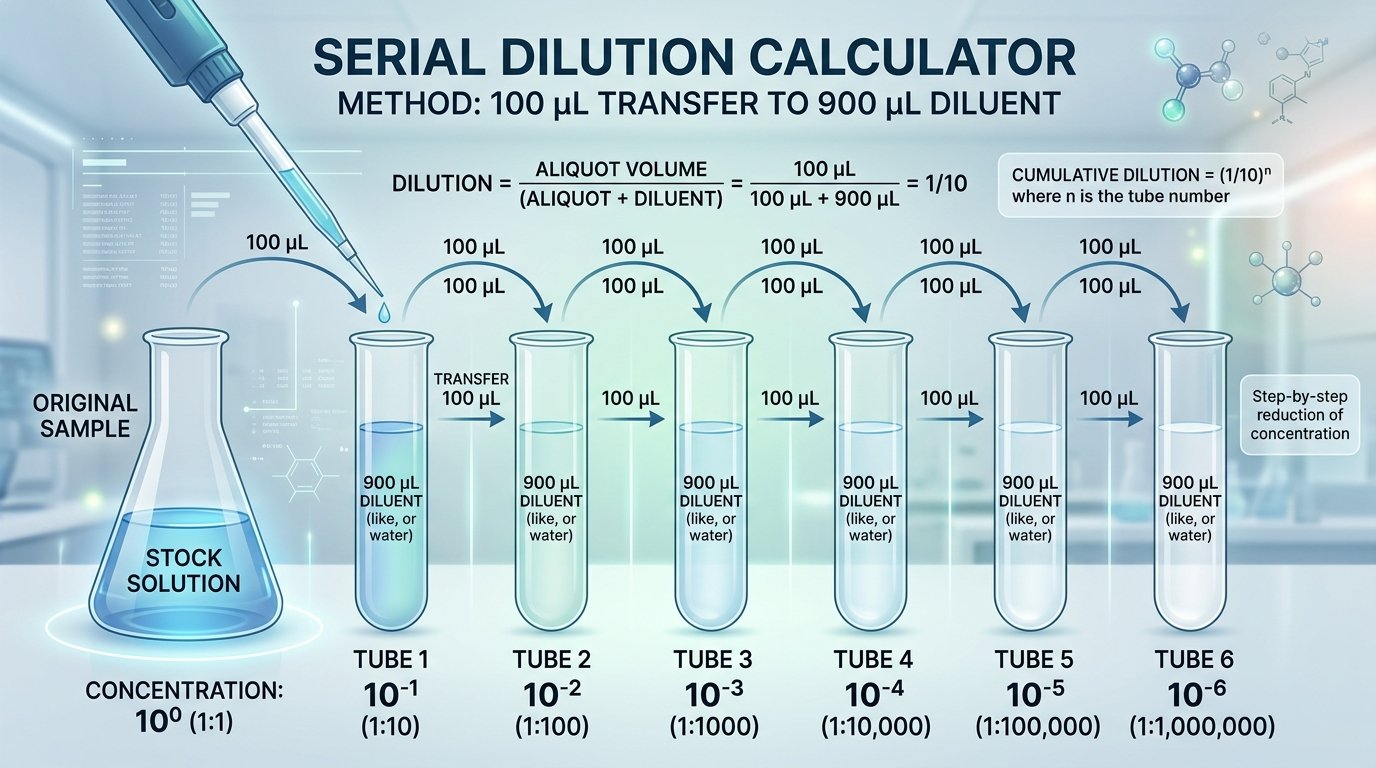
Total dilution = (step factor)number of steps. A 1 : 10 series of six tubes reaches 10−6; each tube takes 100 µL from the previous one into 900 µL of diluent. To hit a target, steps = log(total) / log(factor). For plate counts, CFU/mL = colonies ÷ (volume plated × dilution). The serial dilution calculator above does all of these and shows every tube.
📑 Table of Contents (click to expand)
- What Is a Serial Dilution Calculator?
- How to Use the Serial Dilution Calculator
- The Five Modes Explained
- The Arithmetic: Factors, Exponents and Log Units
- Worked Example: A Six-Tube 1 : 10 Series
- Choosing the Step Factor: 1 : 10, 1 : 2 or Half-Log?
- CFU/mL From Plate Counts
- More Worked Examples
- Designing a Dose-Response Series
- Error Propagation: Why Serial Can Be More Precise
- Carry-Over, Mixing and Tip Changes
- Units the Serial Dilution Calculator Accepts
- Serial Dilution in Microplates
- Reference Table: Cumulative Dilution by Step
- Visualising a Serial Dilution
- Who Uses a Serial Dilution Calculator
- Full Walkthrough: A Viable Count From Start to Finish
- A Short History of Serial Dilution
- Limits and Assumptions
- Practice Problems With Answers
- Tips for Accurate Results
- Common Mistakes
- How This Serial Dilution Calculator Is Different
- Where the Numbers Come From
- Checklist
- Frequently Asked Questions
- 10 Facts Worth Knowing
- Final Thoughts
What Is a Serial Dilution Calculator?
A serial dilution is a sequence of dilutions performed one after another, each using the previous dilution as its stock. If every step is the same factor f, then after n steps the total dilution is fn: three 1 : 10 steps give 1 : 1000, ten 1 : 2 steps give 1 : 1024. A serial dilution calculator turns those exponents into a tube-by-tube recipe — how much to transfer, how much diluent to have waiting, what concentration each tube ends up at — and solves the inverse problems: which factor or how many steps reach a target, and what original concentration a plate count implies.
Serial dilution — and therefore a serial dilution calculator — exists for three reasons. First, measurability: a 1 : 106 dilution in one step would mean pipetting 1 µL into a litre, or 0.001 µL into a millilitre; six 1 : 10 steps use 100 µL each time. Second, coverage: a series spans many orders of magnitude, which is exactly what a dose-response curve or a bacterial count needs when the answer could be anywhere between 103 and 109. Third, precision: the relative error of several moderate steps combined in quadrature is usually smaller than that of one extreme step, as mode 5 of the serial dilution calculator demonstrates.
Vocabulary
Step (fold) factor — the dilution at each tube, e.g. 10 for a 1 : 10 series.
Total (cumulative) dilution — the product of all steps, e.g. 10−4 after four 1 : 10 steps.
Log unit — a factor of 10; a half-log step is √10 = 3.16-fold.
Transfer volume — what is carried into the next tube; diluent — what is already there. Transfer + diluent = tube volume; factor = tube volume / transfer.
How to Use the Serial Dilution Calculator
- Choose the mode. Fold series when you know the factor and the number of tubes; Reach a target when you know where you must end up; CFU/mL for plate counts; Dose-response for a log-spaced assay series; Error to compare routes.
- Enter the stock concentration and unit — molar, mass, %, cells/mL, CFU/mL or X are all accepted — and the volume you want in each tube.
- Set the factor or the target. Factors can be typed as 10, 1 : 10 or 10-fold; targets as numbers or scientific notation (
1e-5). For plate counts, enter the dilution of the tube plated as 1e-5, 10^-5 or 1 : 100000. - Press Calculate. The serial dilution calculator prints the headline answer, then a table of every tube (transfer, diluent, concentration, cumulative dilution), a bar chart on a log scale and the total diluent needed.
- Copy, download, print or share from the toolbar; each mode has its own Reset and the last ten results stay in the history.
The example chips preload the standard cases: 1 : 10 × 6 from 100 mg/mL, 1 : 2 × 8 from 1 mM, 109 CFU/mL to countable plates, 142 colonies at 10−5, an 8-point 100 µM to 1 nM series, and four 1 : 10 steps versus one 1 : 10 000.
The Five Modes Explained
Mode 1 — Fold series. Stock, factor, number of tubes and tube volume in; a complete recipe out. For a 1 mL tube and a 1 : 10 factor the serial dilution calculator says: 100 µL transfer into 900 µL diluent, repeated; tube k is at 10−k of the stock; total diluent 900 µL × tubes.
Mode 2 — Reach a target. Either fix the number of steps and get the factor (10 mM to 10 nM in three steps needs 1 : 100 each), or fix a convenient factor and get the number of steps, with a residual final step when the total is not an exact power (1000 ppm to 0.5 ppm at 1 : 20 = two 1 : 20 steps plus a 1 : 5).
Mode 3 — CFU/mL from plate counts. Colonies, the dilution of the tube plated and the volume plated give CFU/mL; the tool flags counts outside 25–250 (or 30–300) as estimates, averages duplicate plates and scales to the whole sample.
Mode 4 — Dose-response series. Top and bottom concentrations and the number of points give the log-spaced factor (100 µM to 1 nM in 8 points = 5.18-fold, 0.714 log units); with a stock concentration, well volume and a vehicle limit it also designs the intermediate plate so DMSO stays constant across all wells.
Mode 5 — Error propagation. Given pipette and dispenser errors, the serial dilution calculator sums the per-step uncertainties in quadrature and compares the result with a single-step dilution of the same total factor — usually 2–3 times worse because it forces a tiny transfer volume.
The Arithmetic: Factors, Exponents and Log Units
If tube k is made by transferring Vt into diluent Vd, its factor is f = (Vt + Vd) / Vt and its concentration is Ck = Ck−1 / f. After n identical steps:
Cn = C0 / f n total dilution = f n
n = log(C0/Ctarget) / log f · f = (C0/Ctarget)1/n · log units = log10(total dilution)
Working in log units, as the serial dilution calculator does, makes series easy to reason about. A 1 : 10 step is one log unit; 1 : 3.16 is half a log; 1 : 2 is 0.301 log. A 106 total is six log units, so it needs 6 tenfold steps, 12 half-log steps or 20 twofold steps. When the target is not an exact power of the chosen factor, the serial dilution calculator rounds the number of full steps down and adds one smaller final step, so every tube in the series remains a round factor except the last.
The same arithmetic governs the reverse problem in microbiology: if the plate from the 10−5 tube grew 142 colonies from 0.1 mL, the original sample held 142 / (0.1 × 10⁻⁵) = 1.42 × 10⁸ CFU/mL.
Worked Example: A Six-Tube 1 : 10 Series
Stock: 100 mg/mL. Required: tubes at 10, 1, 0.1, 0.01, 0.001 and 0.0001 mg/mL, 1 mL each. In the serial dilution calculator choose mode 1 with factor 10, six tubes, 1000 µL per tube.
- Transfer volume = tube volume / factor = 1000 / 10 = 100 µL; diluent = 1000 − 100 = 900 µL.
- Dispense 900 µL of diluent into six labelled tubes.
- Tube 1: 100 µL of stock into tube 1, mix (vortex or pipette up and down ten times) → 10 mg/mL (10−1).
- Tube 2: 100 µL from tube 1 → 1 mg/mL (10−2), and so on to tube 6 at 0.0001 mg/mL (10−6).
- Change tips between tubes; discard 100 µL from the last tube if all tubes must hold exactly 900 µL.
Total diluent 5.4 mL, total stock consumed 100 µL. The serial dilution calculator’s table lists these numbers for every tube, and its chart shows the concentrations dropping one log per tube. Note the classic bookkeeping point: tube k contains 10−k of the stock, not 10−k of the previous tube.
Choosing the Step Factor: 1 : 10, 1 : 2 or Half-Log?
The best factor to enter in the serial dilution calculator depends on how finely the range must be sampled and how many tubes you can handle. Tenfold steps cover six logs in six tubes and are standard for plate counts and rough titres. Twofold steps (the classic microtitre “doubling dilution”) give fine resolution — 0.3 log per well — and 12 wells cover 3.6 logs, ideal for antibody titres and MIC determinations. Half-log steps (3.16-fold) are the pharmacologist’s compromise: 8 points cover 3.5 logs with enough density to define an EC50 curve well.
| Factor | Log per step | Steps for 106 | Transfer per 1 mL | Typical use |
|---|---|---|---|---|
| 1 : 2 | 0.301 | 20 | 500 µL | Titres, MIC, ELISA |
| 1 : 3.16 | 0.5 | 12 | 316 µL | Dose-response |
| 1 : 5 | 0.699 | 8.6 | 200 µL | Standards |
| 1 : 10 | 1 | 6 | 100 µL | Plate counts, screening |
| 1 : 100 | 2 | 3 | 10 µL | Fast, coarse |
Keep the transfer volume between about 20 µL and half the tube; the serial dilution calculator warns when a chosen factor pushes the transfer below 10 µL, where pipetting error rises sharply.
CFU/mL From Plate Counts
The viable count is the reason most biologists first meet serial dilution and reach for a serial dilution calculator. A culture at 108–109 cells/mL cannot be counted on a plate; diluted 10−5 to 10−7 and spread at 0.1 mL, it gives 30–300 separate colonies, each assumed to have grown from one colony-forming unit (CFU).
CFU/mL = colonies ÷ (volume plated in mL × total dilution of the tube plated)
142 colonies from 0.1 mL of the 10−5 tube: 142 / (0.1 × 10⁻⁵) = 1.42 × 10⁸ CFU/mL. The serial dilution calculator does this in mode 3, averages replicate plates, converts to log10 CFU/mL (8.15) and, if you enter the sample volume, gives the total CFU in the sample.
Only plates in the countable range are used: below about 25 colonies the Poisson counting error exceeds 20 %; above 250–300 colonies overlap and are under-counted (“TNTC”, too numerous to count). Report such plates as estimates only. The 25–250 convention comes from food microbiology (FDA BAM); 30–300 is common in clinical and teaching laboratories. The serial dilution calculator lets you pick either range and flags the count accordingly.
A common mistake is to use the volume transferred between tubes instead of the volume plated; another is to forget that the plate made from the 10−5 tube with 0.1 mL is effectively a 10−6 plate. The formula above handles both if the two inputs are entered correctly.
More Worked Examples
Example 1 — 10 mM to 10 nM in three steps
Total = 10 mM / 10 nM = 106; factor = (106)1/3 = 100 per step: 10 µL into 990 µL, three times. Tubes: 100 µM, 1 µM, 10 nM.
Example 2 — 1000 ppm to 0.5 ppm at 1 : 20
Total 2000 = 202 × 5, so the serial dilution calculator gives two 1 : 20 steps and a final 1 : 5 (500 µL + 9.5 mL twice, then 2 mL + 8 mL).
Example 3 — 36 colonies at 10−6, 1 mL pour plate
36 / (1 × 10⁻⁶) = 3.6 × 10⁷ CFU/mL (log 7.56), within the 30–300 range.
Example 4 — Doubling dilution of serum, 12 wells
50 µL serum + 50 µL buffer in well 1 (1 : 2), transfer 50 µL along the row: well 12 is 1 : 4096. If well 9 is the last positive, the titre is 512.
Example 5 — 2 × 10⁶ cells/mL to 5000 cells/mL
Total 400 = 202: two 1 : 20 steps (50 µL + 950 µL each) — more accurate than one 2.5 µL transfer.
Designing a Dose-Response Series
Dose-response curves are fitted in log concentration, which is why the serial dilution calculator spaces its points geometrically; so points should be spaced evenly on a log axis. For a top concentration Ctop, bottom Cbot and n points, the factor is (Ctop/Cbot)1/(n−1). Eight points from 100 µM to 1 nM span five log units, so the factor is 105/7 = 5.18 (0.714 log per point). The serial dilution calculator lists the eight concentrations and the volumes for a serial preparation.
The vehicle problem is the practical twist. If the top well is made by adding 10 mM DMSO stock 1 : 1000 (0.1 % DMSO) and the other wells are made by diluting the top well in medium, every lower well has less DMSO — the vehicle is confounded with dose. The correct design is to make the serial dilution in DMSO (or in a DMSO-matched intermediate plate) at 1000× the final concentrations, then add each 1 : 1000 to its well, so all wells carry 0.1 %. Mode 4 designs that intermediate plate: with a 10 mM stock, 100 µL wells and a 0.5 % limit, it gives the 200× intermediate series and the 0.5 µL-per-well problem it creates, and suggests the volumes that stay pipettable.
Include a zero (vehicle only) and, if possible, extend one point beyond the expected plateau at each end; an EC50 is only well defined when both asymptotes are sampled.
Error Propagation: Why Serial Can Be More Precise
Each step in a series — and each row in the serial dilution calculator’s table — has its own relative error, dominated by the transfer pipette (et) and the diluent dispenser (ed). For independent errors the relative error of the factor is √(et² + ed²) per step, and after n steps the total relative error is √n times that (plus the stock’s own uncertainty).
Four 1 : 10 steps at 1 % transfer and 0.6 % diluent error give √4 × 1.17 % ≈ 2.3 % total (about 2.1 % with the calculator’s defaults). One 1 : 10 000 step, by contrast, needs 0.1 µL in 1 mL, where the transfer error alone is 5 % or more. The serial dilution calculator’s mode 5 makes this comparison for any factors and errors, and it is the quantitative reason the tenfold series is the default in microbiology.
Errors also accumulate systematically if a pipette is biased: a tip that delivers 98 µL instead of 100 makes every tube 2 % low and the sixth tube 11 % low. Calibrate pipettes, use the same pipette and technique for every step, and prepare independent series when accuracy is critical.
Carry-Over, Mixing and Tip Changes
The serial dilution calculator’s arithmetic assumes each tube is homogeneous before the next transfer and that nothing extra is carried forward. Incomplete mixing is the largest single error in student series: the transferred 100 µL sits at the bottom of 900 µL of diluent, and if the next aliquot is drawn from the top it is nearly pure diluent. Vortex, or pipette up and down at least ten times, before every transfer.
Reusing a tip carries liquid on the outside of the tip and film inside it into the next tube. For a 1 : 10 series the effect is a few percent; for a 1 : 100 series it can double the concentration of the later tubes. Change tips at every step, or at minimum pre-rinse the tip in the destination tube. The serial dilution calculator’s step list includes the “mix, change tip” instruction after every tube for this reason.
Finally, remove the transfer volume from the last tube if all tubes must hold the same final volume, and never pipette from a tube that has already fed the next one without re-mixing it.
Units the Serial Dilution Calculator Accepts
Because a serial dilution only divides, the concentration unit rides along unchanged: molar (M, mM, µM, nM, pM), mass (mg/mL, µg/mL, ng/mL, % w/v, ppm), counts (cells/mL, CFU/mL, PFU/mL, copies/µL) and X-strengths all work. The serial dilution calculator displays sensible prefixes automatically — 1 mM after eight twofold steps becomes 3.91 µM, not 0.00391 mM — and reports the cumulative dilution as both a ratio (1 : 256) and log units (2.41).
Two unit conversions are sometimes needed before starting. A mass stock that must reach a molar target (10 mg/mL to 50 µM) needs the molar mass first — our dilution calculator does that conversion. And a percent w/w stock must be converted to w/v with density, which the w/v solution calculator handles.
Serial Dilution in Microplates
In a 96-well plate the series the serial dilution calculator plans runs along a row or down a column, usually as a doubling dilution: 100 µL of diluent in wells 2–12, 200 µL of sample in well 1, transfer 100 µL along the row, mixing by pipetting five to ten times, discard 100 µL from well 12. Well k is 1 : 2k−1; well 12 is 1 : 2048. Multichannel pipettes make eight rows at once, and the serial dilution calculator’s table maps directly onto the plate layout.
Edge wells evaporate faster and should hold blanks or be filled with buffer; reverse pipetting reduces bubble formation in viscous sera. For half-log series in 384-well plates the transfer is 1 : 3.16 — 31.6 µL into 68.4 µL for 100 µL wells — and acoustic dispensers can dispense directly from a source plate rather than serially, which removes carry-over entirely.
Reference Table: Cumulative Dilution by Step
| Step | 1 : 2 | 1 : 3.16 | 1 : 5 | 1 : 10 |
|---|---|---|---|---|
| 1 | 2 | 3.16 | 5 | 10 |
| 2 | 4 | 10 | 25 | 100 |
| 3 | 8 | 31.6 | 125 | 1000 |
| 4 | 16 | 100 | 625 | 104 |
| 6 | 64 | 1000 | 15 625 | 106 |
| 8 | 256 | 104 | 390 625 | 108 |
| 10 | 1024 | 105 | 9.8 × 10⁶ | 1010 |
| 12 | 4096 | 106 | 2.4 × 10⁸ | 1012 |
Any cell is fn; the serial dilution calculator computes it for non-integer factors and adds the residual step when a target falls between rows.
Visualising a Serial Dilution
On a linear axis a tenfold series from the serial dilution calculator is invisible after the second tube — 1, 0.1, 0.01 and everything else is a line at zero. On a log axis the same series is a staircase of equal steps, which is why the serial dilution calculator draws its charts in log concentration. A dose-response series designed correctly appears as evenly spaced bars; an incorrectly spaced one (say 100, 50, 10, 1, 0.1) shows unequal steps at a glance.
The classic teaching image is a row of tubes of coloured dye: dark, pale, faint, colourless, colourless, colourless. The eye can follow about three log units; instruments follow six or more; plate counts follow nine. Whatever the readout, the picture to keep is that each tube contains one-fth of its neighbour and f−k of the original.
Who Uses a Serial Dilution Calculator
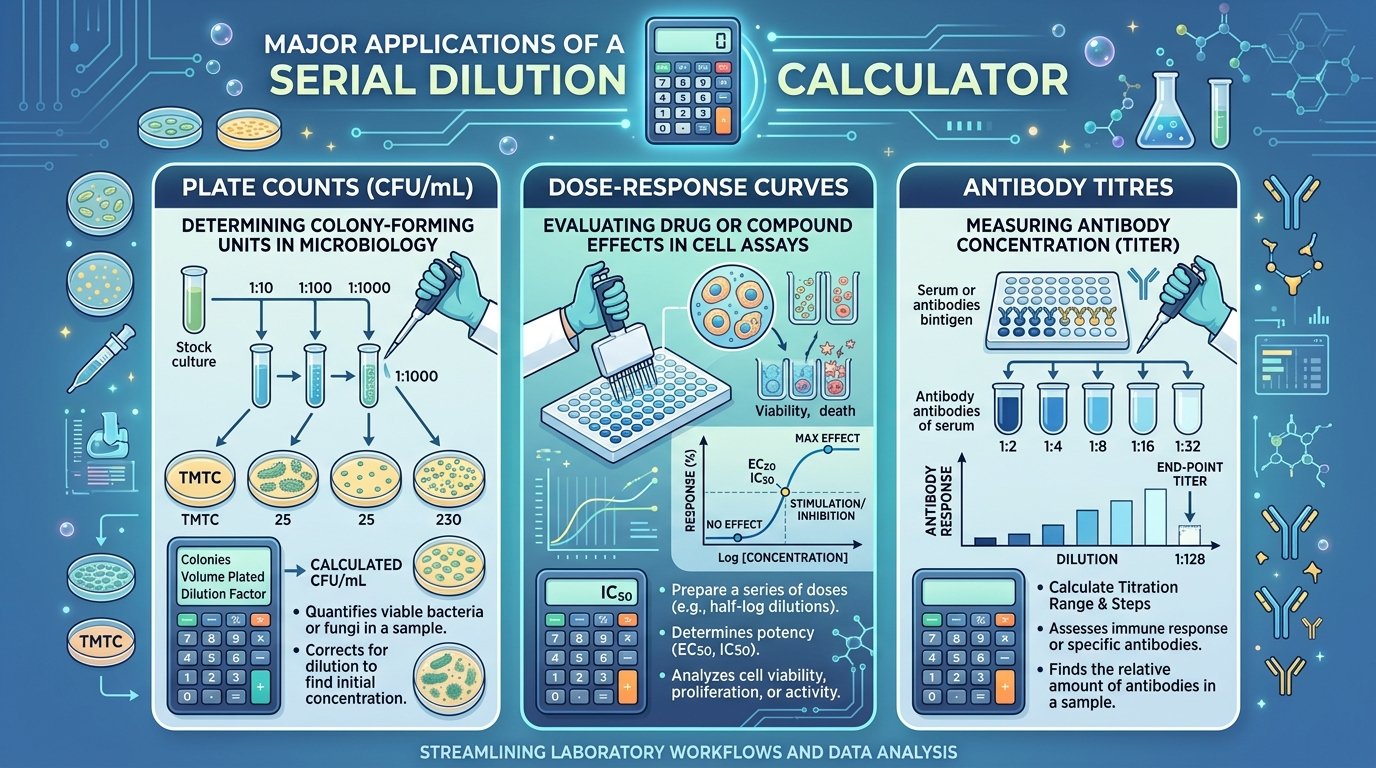
Microbiologists dilute cultures for viable counts and MIC assays. Virologists titrate stocks by plaque or TCID50 assays built on tenfold series. Immunologists report antibody titres from doubling dilutions. Pharmacologists and cell biologists design half-log dose-response plates. Analytical chemists prepare calibration standards spanning orders of magnitude and dilute samples into the instrument’s linear range. Molecular biologists dilute plasmids and primers, and make qPCR standard curves from tenfold series of a quantified template. Students meet all of these in practical classes.
The serial dilution calculator speaks each discipline’s dialect — log10 CFU/mL for the microbiologist, log units and vehicle percent for the pharmacologist, 1 : 2n titres for the immunologist — and exports a table that drops straight into a notebook or a plate map.
Full Walkthrough: A Viable Count From Start to Finish
An overnight E. coli culture is expected at roughly 109 CFU/mL. Plan and interpret a spread-plate count.
- Plan the series. Countable plates (25–250 colonies from 0.1 mL) need 250–2500 CFU/mL in the tube, i.e. dilutions around 10−6. The serial dilution calculator (mode 1: 109, factor 10, 8 tubes) shows tubes at 108 … 101 CFU/mL; plate 10−5, 10−6 and 10−7 in duplicate to bracket the estimate.
- Prepare. Eight tubes with 900 µL sterile saline; vortex the culture; 100 µL into tube 1, vortex, fresh tip, 100 µL into tube 2, and so on.
- Plate. 0.1 mL from tubes 5, 6 and 7 onto duplicate agar plates, spread, incubate.
- Count. 10−5: TNTC; 10−6: 142 and 138; 10−7: 12 and 15.
- Calculate. Mode 3: mean 140 colonies at 10−6, 0.1 mL → 140 / (0.1 × 10⁻⁶) = 1.4 × 10⁹ CFU/mL (log 9.15). The 10−7 plates (13.5 colonies, below range) give 1.35 × 10⁹ as an estimate — consistent.
- Report. 1.4 × 10⁹ CFU/mL, from duplicate plates in the countable range; copy the serial dilution calculator output into the notebook.
A Short History of Serial Dilution
Serial dilution — long before any serial dilution calculator — grew up with microbiology. Robert Koch’s plate technique of the 1880s required dilute inocula to obtain isolated colonies, and the tenfold series in sterile saline or peptone water became the standard within a decade. Paul Ehrlich used serial dilutions of antitoxin to define units of activity in the 1890s, giving immunology the titre. The most-probable-number method (McCrady, 1915) put statistics behind dilution-to-extinction counting.
In pharmacology the log-dose scale came from Gaddum and Clark in the 1920s and 1930s, whose sigmoid curves required doses spaced geometrically — the origin of today’s half-log series. The 96-well microtitre plate (Takátsy, 1950s) turned the doubling dilution into a multichannel routine, and acoustic dispensing in the 2000s finally made direct, non-serial dose plates practical. The serial dilution calculator inherits all of these conventions.
Limits and Assumptions
- Homogeneity. The serial dilution calculator assumes every tube is completely mixed before it feeds the next; otherwise the arithmetic is fiction.
- No carry-over. Tip changes or thorough rinsing are assumed.
- Additive volumes and no losses. Adsorption of dilute proteins or cells to plastic, and evaporation from small volumes, make the last tubes lower than calculated.
- Independent random errors in mode 5; a biased pipette produces a systematic drift that quadrature does not capture.
- Plate counts assume one colony per viable unit; clumps, chains and injured cells break this.
- Countable-range limits are conventions (25–250 or 30–300), not laws; follow the method your laboratory validates.
Practice Problems With Answers
Solve by hand, then verify with the serial dilution calculator.
- A 1 : 5 series of four tubes: total dilution? Answer: 625.
- How many 1 : 2 steps take 1 mM to below 10 µM? Answer: 7 (1 : 128 → 7.8 µM).
- Transfer and diluent for a 1 : 4 step in 2 mL tubes? Answer: 500 µL + 1500 µL.
- 85 colonies from 0.1 mL of the 10−4 tube: CFU/mL? Answer: 8.5 × 10⁶.
- Factor for a 6-point series from 10 µM to 10 nM? Answer: 103/5 = 3.98.
- Last positive well in a doubling series is well 8 (well 1 = 1 : 2): titre? Answer: 256.
- 108 cells/mL to 200 cells/mL using 1 : 10 steps: how many, plus residual? Answer: 5 × 1 : 10 then 1 : 5.
- Per-step error 1.5 %, six steps: total? Answer: ≈ 3.7 %.
- 12 colonies at 10−6, 0.1 mL: report? Answer: 1.2 × 10⁸ CFU/mL, estimated (below 25).
- Half-log series, 8 points, top 1 mM: bottom concentration? Answer: 1 mM / 3.167 = 0.316 µM.
Tips for Accurate Results
- Dispense all diluent tubes first, from one calibrated dispenser, before any transfers.
- Vortex or pipette-mix every tube; change tips every step.
- Keep transfers ≥ 20 µL; if the serial dilution calculator flags a smaller volume, enlarge the tubes or reduce the factor.
- Label tubes with the cumulative dilution (10−3), not the step number.
- Plate at least two dilutions in duplicate so one lands in the countable range.
- For dose-response, dilute in vehicle first, then into medium, so every well has the same solvent percent.
- Prepare independent series for critical standards rather than one long chain.
- Record actual volumes and lot numbers with the calculator’s CSV.
Common Mistakes
- Labelling tube k as 1 : f instead of 1 : fk.
- Using the transfer volume instead of the plated volume in CFU/mL.
- Counting TNTC or < 25 plates as if they were valid.
- Skipping the mix before the next transfer.
- One tip for the whole series.
- Linear spacing of a dose-response series (100, 80, 60 …) instead of log spacing.
- Vehicle drift — diluting the top well in medium so lower doses get less DMSO.
- Treating 1 : 2 twelve times as 1 : 24 instead of 1 : 4096.
How This Serial Dilution Calculator Is Different
| Feature | This serial dilution calculator | Typical online calculator |
|---|---|---|
| Fold series with per-tube transfer, diluent and cumulative dilution | ✓ | Final value only |
| Factor for n steps, or steps for a fixed factor with residual step | ✓ | ✗ |
| CFU/mL with countable-range check, replicates and log10 | ✓ | Rarely |
| Log-spaced dose-response design with vehicle-limit intermediate | ✓ | ✗ |
| Error propagation: serial vs single-step comparison | ✓ | ✗ |
| Any unit: molar, mass, %, cells, CFU, X; auto prefixes | ✓ | One unit |
| Pipetting warnings on small transfers | ✓ | ✗ |
| Steps, table, log chart, copy, CSV, print, share, history, per-mode Reset | ✓ | Number only |
Most serial dilution tools print the concentrations and stop. This serial dilution calculator adds the tube-by-tube recipe, the inverse problems, the microbiology and pharmacology conventions and an honest error analysis.
The serial dilution calculator belongs to the same family as the site’s other free tools: molecular weight calculator, atomic mass calculator, formula weight calculator, molarity calculator, stoichiometry calculator, exact mass calculator, grams to moles calculator, molar mass of hydrates calculator, average molecular weight of a mixture, number average molecular weight, weight average molecular weight, polydispersity index, monoisotopic mass calculator, average vs monoisotopic mass, isotopic mass calculator, freezing point depression, boiling point elevation, osmotic pressure calculator, vapor density, molar mass from gas density, equivalent weight calculator, viscosity molecular weight, van der Waals equation, empirical formula calculator, molecular formula calculator, percent composition calculator, combustion analysis calculator, degree of unsaturation calculator, oxidation number calculator, formal charge calculator, limiting reactant calculator, theoretical yield calculator, percent yield calculator, atom economy calculator, chemical equation balancer, molality calculator, normality calculator, mole fraction calculator, ppm to ppb converter, dilution calculator, solution preparation calculator, w/v solution calculator, ionic strength calculator, osmolarity calculator, peptide reconstitution calculator, stock solution calculator, Beer Lambert law calculator, protein concentration A280 calculator.
Where the Numbers Come From
The serial dilution calculator uses exact exponent arithmetic for cumulative dilutions, quadrature for error propagation and published counting conventions for plate counts:
- US FDA Bacteriological Analytical Manual — Chapter 3, Aerobic Plate Count: the 25–250 colony counting range, dilution scheme and CFU/mL reporting rules.
- OpenStax Chemistry via LibreTexts — Molarity: the dilution equation applied at each step of a series.
- CIAAW — Standard Atomic Weights: the atomic weights behind molar conversions on this site.
- Wikipedia — Serial dilution: fold notation, log dilutions and applications in microbiology, immunology and pharmacology.
Found an error? Our corrections policy explains how we handle reports; contact us or read about the site.
Checklist
☐ Step factor and number of tubes chosen; total = fn checked against target
☐ Transfer volume ≥ 20 µL and ≤ half the tube
☐ Diluent dispensed into all tubes before starting
☐ Mixed thoroughly and tip changed at every step
☐ Tubes labelled with cumulative dilution
☐ Plated volume (not transfer volume) used for CFU/mL
☐ Only 25–250 (or 30–300) colony plates used; others marked estimates
☐ Dose-response points evenly spaced in log; vehicle constant across wells
☐ Per-step errors realistic; serial vs single-step compared
☐ Table exported to notebook with lot numbers and date
Frequently Asked Questions
How does a serial dilution calculator work?
It multiplies the step factor by itself once per tube: total dilution = fn. From the tube volume it gives the transfer (volume ÷ f) and the diluent (the rest), and it runs the same arithmetic backwards to find the factor or number of steps for a target.
What is a 1 : 10 serial dilution?
A chain in which each tube is diluted tenfold from the previous one — for example 100 µL into 900 µL. After k tubes the dilution is 10−k: six tubes reach one part per million.
How do I calculate CFU/mL from a plate count?
CFU/mL = colonies ÷ (volume plated in mL × dilution of the tube plated). 142 colonies from 0.1 mL of the 10−5 tube = 142 / (0.1 × 10⁻⁵) = 1.42 × 10⁸ CFU/mL. Use only plates with 25–250 colonies.
How many steps do I need to go from 10 mM to 10 nM?
The total factor is 106. That is six 1 : 10 steps, three 1 : 100 steps, twelve half-log steps or about twenty 1 : 2 steps. The calculator’s target mode picks the factor for a chosen number of steps or vice versa.
Why is a serial dilution more accurate than a single big dilution?
Because each step uses a comfortable volume. Four 1 : 10 steps at about 1 % error each combine to roughly 2 % overall, whereas a single 1 : 10 000 dilution needs 0.1 µL in 1 mL, which cannot be pipetted to better than 5–10 %.
What is a half-log dilution?
A step factor of √10 = 3.16, so two steps make one tenfold dilution. It is the usual spacing for dose-response curves: eight half-log points cover 3.5 orders of magnitude.
How do I keep DMSO constant in a dose-response plate?
Make the serial dilution in DMSO (or a DMSO-matched intermediate plate) at, say, 1000× the final concentrations, then add each 1 : 1000 to its well. Diluting the top well in medium would give lower doses less DMSO. Mode 4 designs the intermediate plate.
What does TNTC mean?
Too numerous to count — more than about 250–300 colonies on a plate, where colonies merge and the count is unreliable. Count a higher dilution instead. Plates with fewer than 25 colonies are reported as estimates.
What is a doubling dilution and how is a titre read?
A 1 : 2 series, usually across a microplate row. The titre is the reciprocal of the last dilution that still gives a positive result: if well 9 (1 : 512) is the last positive, the titre is 512.
Is my data stored anywhere?
No. The serial dilution calculator runs entirely in your browser; the history box uses your own local storage and Clear All empties it.
10 Facts Worth Knowing
- Twenty 1 : 2 steps dilute a little more than a million-fold (220 = 1 048 576).
- A 1 : 10 series of 24 tubes would dilute a mole of anything to about half a molecule — Avogadro’s number is 6 × 10²³.
- The most-probable-number method estimates bacteria from which dilutions show growth at all — counting without counting colonies.
- The 25–250 rule keeps Poisson counting error below about 6 % at the low end.
- A half-log step, 3.162-fold, is √10; three steps of the cube root of 10 (2.154) also make one log.
- Plaque assays for viruses, TCID50 endpoints and antibody titres are all read from serial dilutions to extinction.
- A biased pipette delivering 2 % low makes tube 6 of a tenfold series 11 % low — systematic error compounds, random error only adds in quadrature.
- qPCR standard curves are tenfold series; a slope of −3.32 cycles per log means 100 % amplification efficiency.
- Homeopathic potencies are serial dilutions taken far past the point where any molecule remains.
- The 96-well plate’s 8 × 12 layout was designed around doubling dilutions across twelve columns.
Final Thoughts
Serial dilution is repeated division with discipline: choose a factor, keep the volumes measurable, mix, change tips and label by cumulative dilution. The exponent arithmetic then tells you exactly where every tube sits.
Use the serial dilution calculator above to plan fold series, reach targets, turn plate counts into CFU/mL, design log-spaced dose-response plates and compare routes for precision — and keep the table it prints beside the tubes.
Written by
Ahmad Raza, M.Phil. Chemistry ✓ Verified Expert
Ahmad has taught general and analytical chemistry for over a decade and builds the calculators on this site. He tests every tool — including this serial dilution calculator — against textbook problems and bench preparations before it goes live, and he answers reader questions personally.