
Molality Calculator
Molality (m) = moles of solute ÷ kilograms of solvent. Type a solute formula or molar mass with the masses and this molality calculator solves for molality, the mass of solute needed, or the mass of solvent, converts molarity to molality using the solution density, works in reverse from molality to molarity, mole fraction and mass percent, and predicts colligative properties (ΔTf, ΔTb) from the molality.
✓ Trusted by students, teachers & lab chemistsMolality from Mass of Solute and Mass of Solvent
Enter the solute (formula or molar mass), how much of it you have, and the mass of the solvent. The molality calculator converts the solute to moles and divides by the solvent mass in kilograms — never by the solution volume.
Mass of Solute (or Solvent) Needed for a Target Molality
Preparing a solution of known molality: give the target molality and either the solvent mass (to get the grams of solute to weigh out) or the solute amount (to get the solvent mass to add).
Convert Molarity to Molality (Needs the Solution Density)
Take 1 L of solution: mass = density × 1000 g; mass of solute = M × molar mass; mass of solvent = the difference. Molality = M ÷ (kg of solvent). The molality calculator shows all three numbers.
Molality to Molarity, Mole Fraction and Mass Percent
Start from a molality and get every other concentration unit for the same solution. Molarity needs the density; mole fraction needs the solvent's molar mass (water 18.015 by default); mass percent needs neither.
Colligative Properties from Molality
ΔTf = i · Kf · m and ΔTb = i · Kb · m. Pick the solvent (or type your own constants), give the molality or the masses, and set the van 't Hoff factor i (1 for molecular solutes, 2 for NaCl, 3 for CaCl2).
🕘 Recent calculations
- No calculations yet — your last 10 results will appear here.
Formulas: molality m = nsolute / kgsolvent · grams of solute = m × kgsolvent × M · molarity → molality: m = M / (1000·d − M·Msolute) × 1000 · molality → molarity: M = 1000·d·m / (1000 + m·Msolute) · mole fraction X = m / (m + 1000/Msolvent) · mass % = m·Msolute / (1000 + m·Msolute) × 100 · ΔTf = i·Kf·m, ΔTb = i·Kb·m · molality is temperature-independent because it uses mass, not volume · IUPAC 2021 atomic weights.
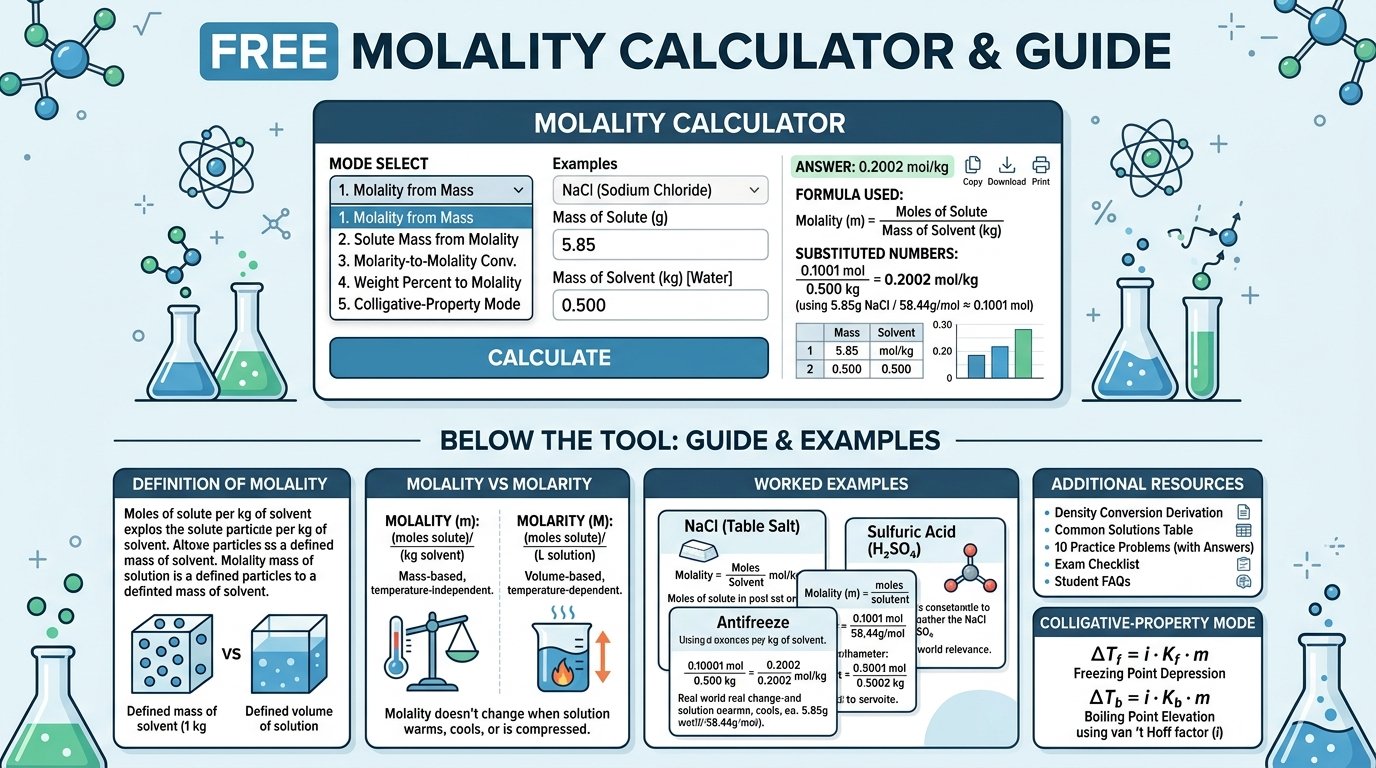
A molality calculator tells you how many moles of solute are dissolved in each kilogram of solvent — not per litre of solution, which is molarity, and not per kilogram of solution, which is a mass fraction. Dissolve 5.85 g of sodium chloride in 500 g of water and the molality is 0.1001 mol ÷ 0.500 kg = 0.2002 mol/kg. Because it is built from masses alone, molality does not change when the solution warms, cools or is compressed, which is exactly why every colligative-property formula is written in terms of it.
The free molality calculator on this page has five modes: molality from solute mass and solvent mass, solute mass needed for a target molality, molarity-to-molality conversion (and back) using the solution density, molality from a weight percent, and the colligative-property mode that turns a molality into a freezing point depression and a boiling point elevation with the van ‘t Hoff factor. Every answer comes with the formula, the substituted numbers, a table and a chart, and can be copied, downloaded or printed.
Below the tool you will find the definition, the formula and its units, worked examples for NaCl, sulfuric acid and antifreeze, a careful comparison of molality with molarity, the density conversion derived step by step, a reference table of common solutions, ten practice problems with answers, an exam checklist and the questions students ask most.
Key Takeaway
Molality (m) = moles of solute ÷ kilograms of solvent. Convert grams of solute to moles with its molar mass, convert grams of solvent to kilograms, divide. 5.85 g NaCl in 500 g water → 0.1001 mol ÷ 0.500 kg = 0.2002 mol/kg. Unlike molarity, molality is independent of temperature, so it is the concentration used for freezing point depression, boiling point elevation and osmotic calculations. The molality calculator above does the conversion and shows every step.
📑 Table of Contents (click to expand)
- What Is a Molality Calculator?
- How to Use the Molality Calculator
- The Five Modes Explained
- The Molality Formula and Its Units
- Worked Example: NaCl Step by Step
- Molality vs Molarity
- Converting Molarity to Molality With Density
- More Worked Examples
- Molality From Weight Percent
- Molality and Colligative Properties
- The van ‘t Hoff Factor
- Reference Table: Common Solutions
- Preparing a Solution of Known Molality
- Molality, Mole Fraction and Other Units
- Why Molality Ignores Temperature
- Who Uses a Molality Calculator
- Full Walkthrough: An Exam Problem
- A Short History of Molality
- Limits and Assumptions
- Practice Problems With Answers
- Tips for Accurate Results
- Common Mistakes
- How This Calculator Is Different
- Where the Numbers Come From
- Exam Checklist
- Frequently Asked Questions
- 10 Facts Worth Knowing
- Final Thoughts
What Is a Molality Calculator?
Molality is the amount of solute, in moles, divided by the mass of the solvent, in kilograms. IUPAC defines it exactly that way — “amount of entities of a solute divided by the mass of the solvent” — and gives it the symbol b or m and the unit mol/kg, which chemists read aloud as “molal”. A molality calculator is a tool that performs that division for you, after first converting the solute’s mass to moles and the solvent’s mass to kilograms.
The word solvent matters. In a 1 molal sugar solution there is 1 mol of sucrose (342.3 g) for every 1000 g of water; the solution itself weighs 1342.3 g. If you divided by the mass of the whole solution instead you would get 0.745 mol/kg — a different, wrong number. Half the errors in molality problems come from this single confusion, and a good molality calculator labels its input “mass of solvent” for that reason.
Why does anyone use molality when molarity is more common? Because mass does not depend on temperature. A litre of solution expands on warming, so its molarity drops, but the kilogram of solvent in it is still a kilogram. Every equation that describes how a solute changes a solvent’s freezing point, boiling point or vapour pressure is therefore written in molality, and a molality calculator is the first step of any such problem.
Three quantities that look alike
Molality (m) — mol solute per kg solvent. Temperature-independent.
Molarity (M) — mol solute per litre solution. Changes with temperature.
Mass fraction / wt % — g solute per 100 g solution. Temperature-independent but not in moles.
How to Use the Molality Calculator
- Choose a mode. Molality for the everyday question (grams of solute, grams of solvent); Solute Mass when you must prepare a solution; Molarity ↔ Molality when you have a molar concentration and a density; From Weight % for commercial reagents; Colligative to go from molality to ΔTf and ΔTb.
- Type the solute formula (NaCl, C12H22O11 as
C12H22O11, hydrates asCuSO4*5H2O) or type a molar mass directly if you already know it. The molality calculator parses the formula and looks up IUPAC 2021 atomic weights. - Enter the masses with their units — g, kg or mg for solute; g, kg or, for water, mL and L (converted at 1.000 g/mL unless you change the solvent density).
- Press Calculate. The molality appears in blue, followed by the moles of solute, the formula with numbers substituted, a table of every intermediate quantity and a bar chart.
- Export or reset. Copy, CSV, TXT, print and share buttons appear under every result; each mode has its own Reset; the last ten results stay in the history box.
The example chips (NaCl in water, glucose, ethylene glycol antifreeze, 18 M sulfuric acid) preload real problems so you can see the molality calculator’s output before typing your own.
The Five Modes Explained
| Mode | You enter | Formula used | You get |
|---|---|---|---|
| 1. Molality | Solute formula or M, solute mass, solvent mass | m = (g ÷ M) ÷ kgsolvent | mol/kg, moles, steps |
| 2. Solute Mass | Target molality, solvent mass, solute | g = m × kgsolvent × M | grams to weigh out |
| 3. Molarity ↔ Molality | M or m, solution density, solute | m = M ÷ (1000ρ − M·Mw) × 1000 | the other unit, kg solvent per L |
| 4. From Weight % | wt % solute, solute formula | m = (w ÷ M) ÷ ((100 − w) ÷ 1000) | mol/kg, mole fraction |
| 5. Colligative | Molality (or masses), i, solvent | ΔTf = i Kf m ; ΔTb = i Kb m | new freezing and boiling points |
All five modes of the molality calculator share the same formula parser and the same atomic-weight table, so a hydrate typed in mode 1 gives the same molar mass as in mode 4.
The Molality Formula and Its Units
m = nsolute ÷ msolvent (kg) with nsolute = masssolute (g) ÷ M (g/mol)
Putting the two together, the single line the molality calculator evaluates is
m (mol/kg) = [ masssolute (g) ÷ M (g/mol) ] ÷ [ masssolvent (g) ÷ 1000 ]
Units reported by the molality calculator: mol/kg, written “m” in older books and “mol kg−1” in modern ones. A 1 mol/kg solution is “one molal”. Note that the symbol m for molality is easily confused with m for mass, which is why IUPAC now prefers b; the molality calculator writes “mol/kg” in full to avoid any doubt.
Rearranged, the same formula gives the other two everyday questions: mass of solute = m × kg solvent × M (mode 2) and kg solvent = moles ÷ m. The molality calculator reports both directions with the numbers substituted so you can follow the algebra.
Worked Example: 5.85 g NaCl in 500 g Water, Step by Step
Step 1 — molar mass of NaCl. Na 22.990 + Cl 35.45 = 58.44 g/mol.
Step 2 — moles of solute. 5.85 g ÷ 58.44 g/mol = 0.1001 mol.
Step 3 — kilograms of solvent. 500 g ÷ 1000 = 0.500 kg.
Step 4 — divide. 0.1001 mol ÷ 0.500 kg = 0.2002 mol/kg.
That is the result the molality calculator prints for the first example chip. Two checks worth making: the answer has the units mol/kg (moles over kilograms), and it is about the size you expect — a tenth of a mole in half a kilogram is a fifth of a mole per kilogram.
For comparison, if you made the same 5.85 g of NaCl up to 500 mL of solution, the molarity would be 0.1001 mol ÷ 0.500 L = 0.2002 mol/L — numerically the same, but only because the solution is dilute and the density is close to 1 g/mL. The two numbers diverge as concentration rises, which is the subject of the next section.
Molality vs Molarity: The Difference That Matters
| Property | Molality (m) | Molarity (M) |
|---|---|---|
| Definition | mol solute / kg solvent | mol solute / L solution |
| Denominator | Solvent only, by mass | Whole solution, by volume |
| Temperature dependence | None | Yes — volume expands on heating |
| Needs density to convert | Yes, to reach molarity | Yes, to reach molality |
| How it is made | Weigh solute, weigh solvent, mix | Weigh solute, dilute to the mark |
| Used for | Colligative properties, thermodynamics, precise physical chemistry | Titrations, dilutions, most lab work |
| Dilute aqueous solution | m ≈ M because 1 L of solution ≈ 1 kg of water | |
The last row explains why students get away with confusing the two for so long. At 0.1 M the difference is under one percent. At 18 M sulfuric acid it is enormous: the molality calculator gives 240.95 mol/kg for 18.0 M H2SO4 of density 1.84 g/mL, because a litre of that acid contains only 74.7 g of water. If you need the molar side of the comparison, the molarity calculator is the companion tool.
Converting Molarity to Molality With Density
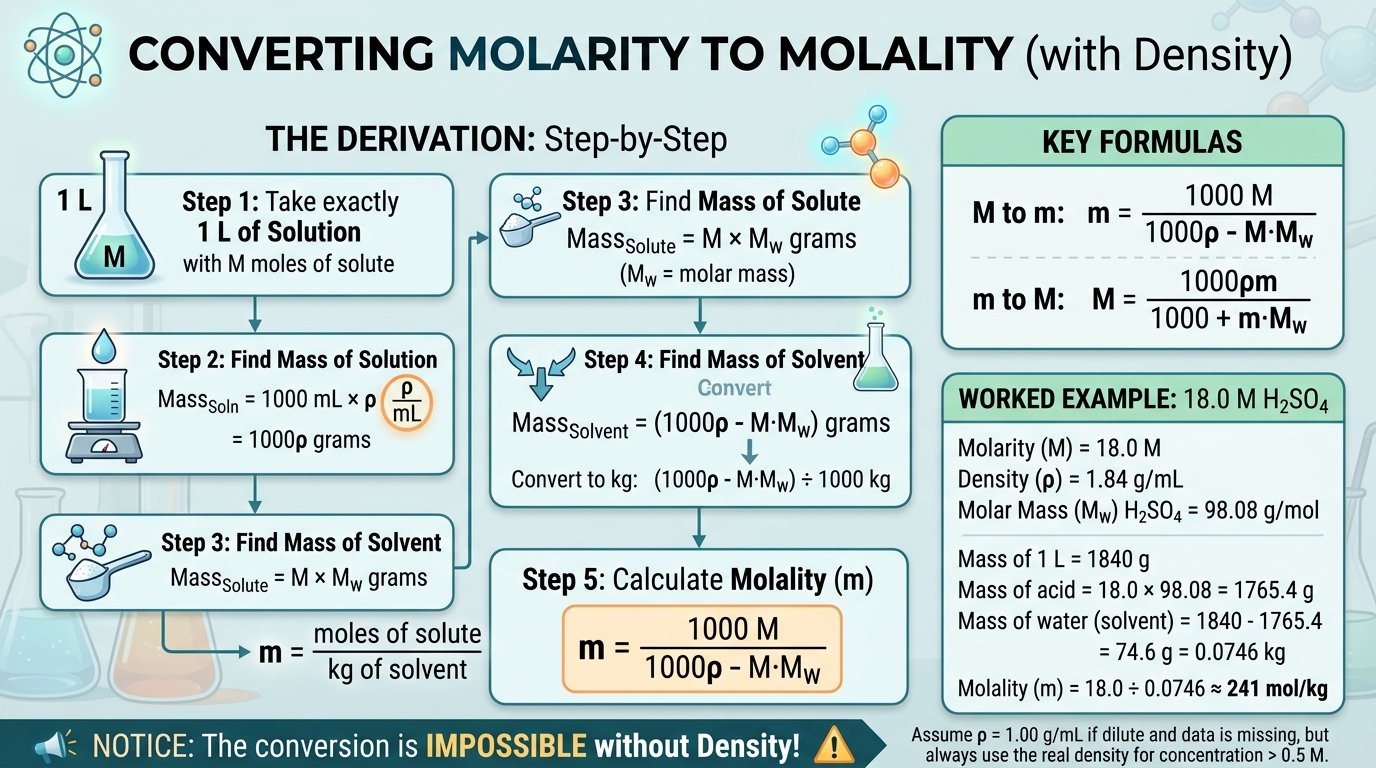
Mode 3 of the molality calculator is the one most people come for. The derivation is short and worth knowing, because it is a favourite exam question.
Take exactly 1 L of solution. It contains M moles of solute.
Mass of that litre = 1000 mL × ρ (g/mL) = 1000ρ grams.
Mass of solute in it = M × Mw grams (Mw = molar mass).
Mass of solvent = 1000ρ − M·Mw grams = (1000ρ − M·Mw) ÷ 1000 kg.
m = M ÷ [(1000ρ − M·Mw) ÷ 1000] = 1000 M ÷ (1000ρ − M·Mw)
Example — 18.0 M H2SO4, ρ = 1.84 g/mL. Mass of 1 L = 1840 g. Mass of acid = 18.0 × 98.08 = 1765.4 g. Mass of water = 74.6 g = 0.0746 kg. m = 18.0 ÷ 0.0746 = 241 mol/kg (the molality calculator shows 240.95). The reverse formula, molality to molarity, is M = 1000ρm ÷ (1000 + m·Mw), and the same mode handles it when you choose the other direction.
Notice that the conversion is impossible without the density. If a question gives molarity and asks for molality without a density, it either expects you to assume ρ = 1.00 g/mL (dilute aqueous) or it is missing data. The molality calculator defaults the density to 1.000 g/mL but you should always replace it with the real value for anything above about 0.5 M.
More Worked Examples
1. Antifreeze — 100 g ethylene glycol in 500 g water
C2H6O2, M = 62.07 g/mol. Moles = 100 ÷ 62.07 = 1.611 mol. Solvent 0.500 kg. m = 3.222 mol/kg. With Kf = 1.86 °C·kg/mol and i = 1, ΔTf = 5.99 °C, so the mixture freezes at −6.0 °C; ΔTb = 0.512 × 3.222 = 1.65 °C. The molality calculator’s mode 5 gives exactly these.
2. Glucose for an osmometer — 9.0 g C6H12O6 in 250 g water
M = 180.16 g/mol. Moles = 0.04996. Solvent 0.250 kg. m = 0.1998 mol/kg ≈ 0.200 molal.
3. Solute mass for a target — 0.50 mol/kg KNO3 in 750 g water
M = 101.10 g/mol. Grams = 0.50 × 0.750 × 101.10 = 37.91 g. Mode 2 of the molality calculator returns this with the formula g = m × kg × M written out.
4. A hydrate — 12.5 g CuSO4·5H2O in 200 g water
M = 249.69 g/mol. Moles = 0.05006. Strictly, the 4.51 g of water of crystallisation joins the solvent (204.5 g), so m = 0.05006 ÷ 0.2045 = 0.2448 mol/kg; ignoring it gives 0.2503. The molality calculator accepts the hydrate formula and reports the simple value; add the water of hydration to the solvent mass yourself when the question expects it. Our molar mass of hydrates calculator gives the water content.
5. Concentrated HCl — 37.0 wt %, ρ = 1.18 g/mL
From weight percent (mode 4): 37.0 g HCl ÷ 36.46 = 1.015 mol per 63.0 g water → m = 16.11 mol/kg. From density: molarity = 1.015 mol per (100 ÷ 1.18 = 84.7 mL) = 11.98 M, and mode 3 converts 11.98 M back to 16.1 mol/kg — a useful consistency check.
Molality From Weight Percent
Bottles of commercial acids and many stock solutions are labelled by mass percent, and the molality calculator accepts that label directly, not by molarity. Converting to molality is simpler than converting to molarity because no density is needed: take 100 g of solution, w grams are solute, (100 − w) grams are solvent.
m = (w ÷ Mw) ÷ [(100 − w) ÷ 1000] = 1000 w ÷ [Mw (100 − w)]
| Reagent | wt % | Mw (g/mol) | Molality (mol/kg) | Molarity (with ρ) |
|---|---|---|---|---|
| HCl | 37.0 | 36.46 | 16.1 | 12.0 (1.18) |
| H2SO4 | 98.0 | 98.08 | 499.6 | 18.4 (1.84) |
| HNO3 | 70.0 | 63.01 | 37.0 | 15.7 (1.42) |
| NH3 | 28.0 | 17.03 | 22.8 | 14.8 (0.90) |
| NaOH | 50.0 | 40.00 | 25.0 | 19.1 (1.53) |
| NaCl (seawater) | 3.5 | 58.44 | 0.62 | 0.61 (1.025) |
The 98 % sulfuric acid row shows how molality behaves as the solvent runs out: with only 2 g of water per 100 g the molality shoots to almost 500 mol/kg. That is not an error; it is a reminder that molality is a ratio to the solvent alone. The molality calculator’s mode 4 also reports the mole fraction, which stays sensibly between 0 and 1 (0.90 for that acid) — and our mole fraction calculator explores that unit in depth.
Molality and Colligative Properties
Colligative properties depend on how many solute particles are present, not on what they are, and they are all written in molality:
Freezing point depression: ΔTf = i · Kf · m
Boiling point elevation: ΔTb = i · Kb · m
Vapour pressure lowering: ΔP = Xsolute · P° (mole fraction, closely related to m)
Osmotic pressure: Π = i · M · R · T (molarity, but ≈ m for dilute solutions)
| Solvent | Tf (°C) | Kf (°C·kg/mol) | Tb (°C) | Kb (°C·kg/mol) |
|---|---|---|---|---|
| Water | 0.00 | 1.86 | 100.00 | 0.512 |
| Benzene | 5.5 | 5.12 | 80.1 | 2.53 |
| Cyclohexane | 6.5 | 20.0 | 80.7 | 2.79 |
| Camphor | 179 | 40.0 | 207 | 5.95 |
| Acetic acid | 16.6 | 3.90 | 118.1 | 3.07 |
| Ethanol | −114.6 | 1.99 | 78.4 | 1.22 |
Mode 5 of the molality calculator has these solvents built in. Reversing the logic — measuring ΔTf to find a molality and hence a molar mass — is the classic cryoscopic method, covered in full by the freezing point depression calculator, the boiling point elevation calculator and the osmotic pressure calculator.
The van ‘t Hoff Factor
An electrolyte splits into ions, and each ion counts as a particle in the molality calculator’s colligative mode. The van ‘t Hoff factor i is the number of particles per formula unit: 1 for sugar, 2 for NaCl, 3 for CaCl2, 4 for AlCl3. The effective colligative molality is i × m. So a 0.2002 mol/kg NaCl solution behaves like 0.400 mol/kg of particles and freezes at −0.745 °C, not −0.372 °C.
Real values are a little lower than the ideal integers because of ion pairing — NaCl at 0.1 mol/kg gives i ≈ 1.87, MgSO4 only 1.2 — and the molality calculator lets you type any decimal i so you can use measured values from a data table when precision matters.
Reference Table: Common Solutions in the Molality Calculator
| Solute | Mw (g/mol) | g per kg water for 1.00 mol/kg | i (ideal) | ΔTf at 1.00 mol/kg (°C) |
|---|---|---|---|---|
| Sucrose C12H22O11 | 342.30 | 342.30 | 1 | 1.86 |
| Glucose C6H12O6 | 180.16 | 180.16 | 1 | 1.86 |
| Urea CO(NH2)2 | 60.06 | 60.06 | 1 | 1.86 |
| Ethylene glycol C2H6O2 | 62.07 | 62.07 | 1 | 1.86 |
| Sodium chloride NaCl | 58.44 | 58.44 | 2 | 3.72 |
| Potassium nitrate KNO3 | 101.10 | 101.10 | 2 | 3.72 |
| Calcium chloride CaCl2 | 110.98 | 110.98 | 3 | 5.58 |
| Magnesium sulfate MgSO4 | 120.37 | 120.37 | 2 | 3.72 |
| Aluminium chloride AlCl3 | 133.34 | 133.34 | 4 | 7.44 |
| Sulfuric acid H2SO4 | 98.08 | 98.08 | 3 | 5.58 |
| Copper sulfate pentahydrate | 249.69 | 249.69 | 2 | 3.72 |
| Ethanol C2H5OH | 46.07 | 46.07 | 1 | 1.86 |
The third column is simply the molar mass — one mole per kilogram of water needs one molar mass of solute — and the last column is i × 1.86, the ideal freezing point depression. For any other molality or solvent, type the values into the molality calculator.
Preparing a Solution of Known Molality
Making a molal solution with the molality calculator’s help is easier than making a molar one because no volumetric flask is involved — only a balance.
- Use mode 2 of the molality calculator to find the solute mass: g = m × kg solvent × Mw. For 0.250 mol/kg NaCl in 400 g water: 0.250 × 0.400 × 58.44 = 5.844 g.
- Weigh the solute on an analytical balance.
- Weigh the solvent separately — 400.0 g of water, not 400 mL, unless you correct for density (at 20 °C, 400 mL of water is 399.3 g).
- Combine and dissolve completely. The volume of the final solution is irrelevant; the molality is fixed by the two masses.
- Label with the molality and the temperature is optional, because it does not matter.
This is the practical advantage of molality in physical chemistry: a solution made by mass on a cold morning is exactly the same concentration in a warm afternoon calorimeter.
Molality, Mole Fraction and Other Units
Because molality is defined per kilogram of solvent, converting it to mole fraction needs only the solvent’s molar mass:
Xsolute = m ÷ (m + 1000 ÷ Msolvent) (water: 1000 ÷ 18.015 = 55.51 mol/kg)
So a 1.00 mol/kg aqueous solution has Xsolute = 1 ÷ 56.51 = 0.0177, and the reverse, m = 1000 X ÷ [Msolvent (1 − X)], returns 1.00 mol/kg. The molality calculator reports the mole fraction alongside the molality in mode 4.
| From | To molality | Extra data needed |
|---|---|---|
| Molarity M | m = 1000M ÷ (1000ρ − M·Mw) | Solution density ρ |
| Weight % w | m = 1000w ÷ [Mw(100 − w)] | None |
| Mole fraction X | m = 1000X ÷ [Msolvent(1 − X)] | Solvent molar mass |
| ppm (mg/kg solution) | m ≈ ppm ÷ (1000 Mw) for dilute solutions | None (dilute) |
| Normality N | M = N ÷ neq, then as molarity | Equivalents per mole, ρ |
Each of those neighbouring units has its own tool on this site: the normality calculator, the ppm to ppb converter and the percent composition calculator.
Why Molality Ignores Temperature
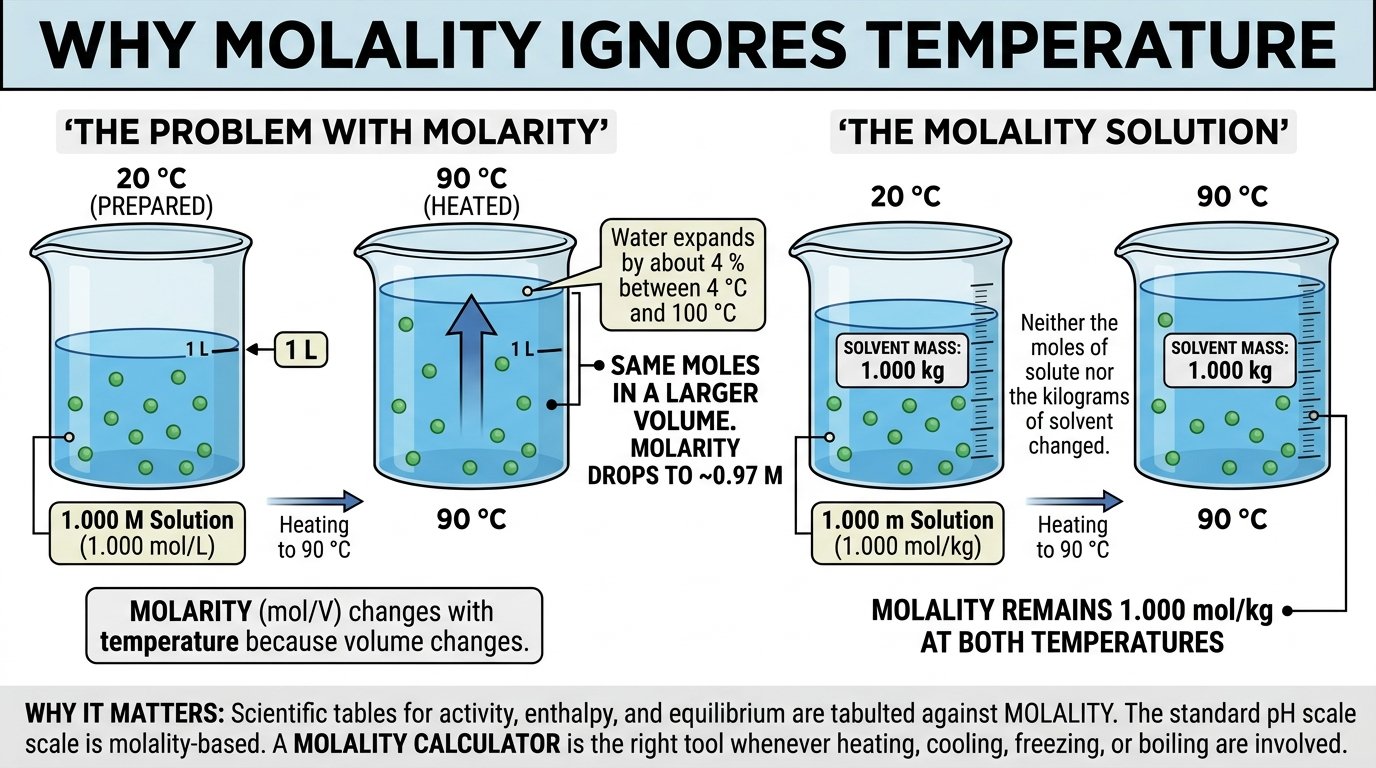
Water expands by about 4 % between 4 °C and 100 °C, a fact the molality calculator can safely ignore. A 1.000 M solution prepared at 20 °C is therefore roughly 0.97 M at 90 °C — the same moles in a larger volume. Its molality is 1.000 mol/kg at both temperatures because neither the moles of solute nor the kilograms of solvent changed.
That is why thermodynamic tables (activity coefficients, enthalpies of solution, equilibrium constants in solution) are tabulated against molality, why the definition of pH on the practical scale uses molality-based standards, and why the molality calculator, not the molarity calculator, is the right tool whenever a problem mentions heating, cooling, freezing or boiling.
Who Uses a Molality Calculator
- Students using a molality calculator while meeting solutions and colligative properties for the first time, where molality and molarity appear in the same chapter and are routinely confused.
- Physical chemists working with activity coefficients, ionic strength on the molal scale and electrolyte thermodynamics.
- Automotive and HVAC engineers specifying antifreeze and brine concentrations by their freezing point.
- Food scientists predicting freezing points of sugar solutions, ice cream mixes and brines.
- Analytical labs converting supplier molarities to molalities before high-temperature work.
- Oceanographers and geochemists, whose salinity data are on a mass basis.
Full Walkthrough: An Exam Problem
“A solution is prepared by dissolving 25.0 g of calcium chloride in 300 g of water. Calculate (a) the molality, (b) the freezing point of the solution assuming complete dissociation, (c) the molarity if the density of the solution is 1.06 g/mL.”
(a) M(CaCl2) = 40.078 + 2 × 35.45 = 110.98 g/mol. n = 25.0 ÷ 110.98 = 0.2253 mol. Solvent 0.300 kg. m = 0.751 mol/kg.
(b) i = 3. ΔTf = 3 × 1.86 × 0.751 = 4.19 °C. Freezing point = −4.19 °C.
(c) Total mass = 325.0 g; volume = 325.0 ÷ 1.06 = 306.6 mL = 0.3066 L. M = 0.2253 ÷ 0.3066 = 0.735 mol/L.
Cross-check with mode 3: 0.735 M, ρ 1.06, Mw 110.98 → m = 1000 × 0.735 ÷ (1060 − 81.6) = 0.751 mol/kg. ✓
Mode 1 of the molality calculator gives (a), mode 5 gives (b) with i = 3 and water selected, and mode 3 gives (c) — three clicks, each showing its working.
A Short History of Molality
The colligative laws that every molality calculator serves came first. François-Marie Raoult measured freezing point depressions through the 1880s and found them proportional to the number of dissolved molecules per mass of solvent; Jacobus van ‘t Hoff put the results on a thermodynamic footing in 1886–1887 and received the first Nobel Prize in Chemistry in 1901 partly for that work. The mass-based concentration those laws needed acquired its name early in the twentieth century, by analogy with “molar”, and G. N. Lewis’s activity concept (1907) cemented the molal scale in solution thermodynamics.
IUPAC formalised the definition — amount of solute per mass of solvent — and the unit mol/kg, and it now recommends the symbol b to avoid the clash with mass. The molality calculator follows that definition exactly.
Limits and Assumptions
- Solvent means solvent. The molality calculator divides by the solvent mass you enter. If a question gives the mass of the whole solution, subtract the solute first.
- Volumes of water are converted at 1.000 g/mL unless you change the solvent density. At 25 °C water is 0.997 g/mL; the difference is 0.3 %.
- Colligative formulas are ideal. ΔT = i K m holds well below about 0.5 mol/kg; above that, ion pairing and non-ideality lower the real effect. Use a measured i for precision.
- Hydrates release water. The water of crystallisation becomes solvent; add it to the solvent mass when the problem expects that level of rigour.
- Density conversions need the solution density, not the solvent density. Using 1.00 for a concentrated acid gives a wildly wrong molality.
Practice Problems With Answers
Work each one, then confirm with the molality calculator.
1. 10.0 g of NaOH in 250 g of water. Molality?
Show answer
10.0 ÷ 40.00 = 0.250 mol; ÷ 0.250 kg = 1.00 mol/kg.
2. 34.2 g sucrose (342.3 g/mol) in 200 g water.
Show answer
0.0999 mol ÷ 0.200 kg = 0.500 mol/kg.
3. How many grams of KCl (74.55 g/mol) make a 0.400 mol/kg solution in 600 g water?
Show answer
0.400 × 0.600 × 74.55 = 17.9 g.
4. 2.00 M NaOH has a density of 1.08 g/mL. Molality?
Show answer
1 L = 1080 g; NaOH = 80.0 g; water = 1000 g. m = 2.00 ÷ 1.000 = 2.00 mol/kg (a coincidence of this density).
5. 6.0 M HCl, density 1.10 g/mL. Molality?
Show answer
1100 g − 6.0 × 36.46 = 881 g water. m = 6.0 ÷ 0.881 = 6.81 mol/kg.
6. A 10.0 wt % glucose solution. Molality?
Show answer
10.0 ÷ 180.16 = 0.0555 mol per 90.0 g water. m = 0.617 mol/kg.
7. Freezing point of 0.300 mol/kg MgCl2(aq), ideal i?
Show answer
i = 3. ΔTf = 3 × 1.86 × 0.300 = 1.67 °C. Tf = −1.67 °C.
8. 5.00 g of an unknown non-electrolyte in 100 g benzene lowers the freezing point by 1.28 °C. Molality and molar mass?
Show answer
m = 1.28 ÷ 5.12 = 0.250 mol/kg; moles = 0.0250; M = 5.00 ÷ 0.0250 = 200 g/mol.
9. Mole fraction of solute in a 2.00 mol/kg aqueous solution?
Show answer
X = 2.00 ÷ (2.00 + 55.51) = 0.0348.
10. Convert 1.50 mol/kg NaCl (ρ = 1.058 g/mL) to molarity.
Show answer
Per kg water: 1.50 mol = 87.7 g; solution 1087.7 g; volume 1028 mL. M = 1.50 ÷ 1.028 = 1.46 mol/L.
Tips for Accurate Results
- Read the denominator before opening the molality calculator. “Dissolved in 500 g of water” is solvent mass; “to make 500 g of solution” is not.
- Use four significant figures in the molar mass — the molality calculator uses IUPAC 2021 values, so quote them rather than 58.5 or 98.
- Convert grams to kilograms before dividing. Forgetting the factor 1000 gives an answer a thousand times too small.
- For density conversions, write down the mass of 1 L first. Everything else follows.
- State the van ‘t Hoff factor in any colligative answer, and say whether it is ideal or measured.
- Sanity-check against molarity in dilute solution: m and M should be within a few percent.
Common Mistakes
| Mistake | Effect | Fix |
|---|---|---|
| Dividing by mass of solution | Molality too low | Subtract solute mass first |
| Dividing by litres instead of kilograms | You computed molarity | Use solvent mass |
| Forgetting g → kg | 1000× too small | Divide solvent grams by 1000 |
| Using solvent density for a molarity conversion | Large error for concentrated solutions | Use the solution density |
| i = 1 for an electrolyte | ΔTf too small | Count ions per formula unit |
| Rounded molar mass (58.5, 98) | Answer off in the third figure | Use the molality calculator’s IUPAC values |
How This Molality Calculator Is Different
| Feature | This molality calculator | Typical online tool |
|---|---|---|
| Formula parser with IUPAC 2021 atomic weights | ✓ | Molar mass typed by hand |
| Molarity ↔ molality with density, both directions | ✓ | Sometimes |
| Weight-percent input with mole fraction output | ✓ | ✗ |
| Freezing and boiling point with six solvents and any i | ✓ | ✗ |
| Step-by-step working, table and chart | ✓ | Number only |
| Copy, CSV, TXT, print, share, history, per-mode Reset | ✓ | Partial |
| Free, no sign-up, runs in the browser | ✓ | Varies |
The molality calculator sits alongside the other concentration and formula tools on this site: the molecular weight calculator, atomic mass calculator, formula weight calculator, grams to moles calculator, stoichiometry calculator, chemical equation balancer, limiting reactant calculator, theoretical yield calculator, percent yield calculator, atom economy calculator, equivalent weight calculator, exact mass calculator, monoisotopic mass calculator, isotopic mass calculator, average vs monoisotopic mass, empirical formula calculator, molecular formula calculator, combustion analysis calculator, degree of unsaturation calculator, oxidation number calculator, formal charge calculator, vapor density calculator, molar mass from gas density, van der Waals equation calculator, and the polymer set — average molecular weight of a mixture, number average, weight average, polydispersity index and viscosity molecular weight.
Where the Numbers Come From
The molality calculator uses IUPAC 2021 standard atomic weights for every molar mass, the definition of molality from the IUPAC Gold Book, and the cryoscopic and ebullioscopic constants quoted in standard general-chemistry references:
- IUPAC Gold Book — molality: “amount of entities of a solute divided by the mass of the solvent” (Green Book, 2nd ed., p. 42).
- OpenStax Chemistry via LibreTexts — Colligative Properties: molality, Kf and Kb tables, van ‘t Hoff factor.
- CIAAW — Standard Atomic Weights: the atomic weights behind every molar mass on this site.
- Wikipedia — Molality: history, unit conversions and the relation to molarity and mole fraction.
Found an error? Our corrections policy explains how we handle reports; contact us or read about the site.
Exam Checklist
☐ Identified the solvent mass (not solution mass, not volume)
☐ Molar mass from a reliable table, 4 significant figures
☐ Grams of solute → moles
☐ Grams of solvent → kilograms (÷ 1000)
☐ Divided moles by kilograms; units mol/kg written
☐ For M ↔ m: used solution density, mass of 1 L computed
☐ For colligative: correct K, correct i, sign of ΔT right
☐ Answer sanity-checked against molarity if dilute
☐ Significant figures match the data
Frequently Asked Questions
What is the formula for molality?
Molality = moles of solute ÷ kilograms of solvent. Moles come from grams ÷ molar mass; kilograms come from grams of solvent ÷ 1000. The unit is mol/kg.
What is the difference between molality and molarity?
Molality is moles per kilogram of solvent and does not change with temperature; molarity is moles per litre of solution and falls as the solution expands on heating. They are nearly equal only for dilute aqueous solutions.
How do I convert molarity to molality?
You need the solution density. Take 1 L: mass = 1000ρ g; subtract the solute mass (M × molar mass) to get the solvent mass in grams; divide M by that mass in kilograms. Mode 3 of the molality calculator does this in one step.
Why is molality used for freezing point depression?
Because the freezing point changes with temperature by definition, and molality is the only concentration unit that stays constant while the temperature changes. ΔTf = i Kf m.
What is the molality of pure water?
As a solvent it has no molality, but water contains 1000 ÷ 18.015 = 55.51 mol per kilogram of itself — the “55.5 molal” figure that appears in mole-fraction conversions.
Can molality be greater than molarity?
Yes, and for aqueous solutions it almost always is, because a litre of solution contains less than a kilogram of water once the solute takes up space. 18 M sulfuric acid is about 241 mol/kg.
Does the molality calculator handle hydrates?
Yes: type CuSO4*5H2O and it uses the hydrate’s molar mass (249.69 g/mol). If your problem expects the water of crystallisation to be counted as solvent, add it to the solvent mass.
What is the van ‘t Hoff factor and where do I enter it?
It is the number of particles each formula unit produces in solution — 1 for sugar, 2 for NaCl, 3 for CaCl2. Mode 5 has an i field that accepts ideal integers or measured decimals.
How do I get molality from weight percent?
Take 100 g of solution: w g solute and (100 − w) g solvent. m = (w ÷ molar mass) ÷ ((100 − w) ÷ 1000). No density is needed. That is mode 4.
Is my data stored anywhere?
No. The molality calculator runs entirely in your browser; the history box uses your own local storage and Clear All empties it.
10 Facts Worth Knowing
- Pure water is 55.51 mol/kg in itself — the constant that links molality to mole fraction.
- Seawater is about 0.6 mol/kg in NaCl, which lowers its freezing point to roughly −1.9 °C.
- A 50/50 ethylene glycol–water antifreeze is about 16 mol/kg and protects to around −37 °C.
- The word “molal” was coined by analogy with “molar” in the early 1900s; IUPAC now prefers the symbol b to avoid confusion with mass.
- Kf for camphor (40 °C·kg/mol) is over twenty times that of water, which is why Rast’s method used camphor for molar masses.
- Concentrated (98 %) sulfuric acid is nearly 500 mol/kg because it is almost all solute.
- The molality of a solution does not change when it is heated, cooled, pressurised or moved to another planet.
- Raoult’s freezing point measurements in the 1880s were among the first reliable molar-mass methods for organic compounds.
- For dilute aqueous solutions, molality ≈ molarity ≈ ppm ÷ (1000 × molar mass).
- The molality calculator uses exact IUPAC 2021 atomic weights, so 5.85 g NaCl in 500 g water gives 0.2002 mol/kg, not 0.2000.
Final Thoughts
Molality is the simplest concentration unit to make and the most stable to use: two masses, one division, no volume, no temperature. Learn to spot the solvent mass in a question, keep the factor of 1000 in view, and remember that any conversion to or from molarity must go through the solution density.
Then let the molality calculator above handle the arithmetic — molar mass, moles, kilograms, density conversions and colligative properties — and check the steps it shows against your own working. That is the fastest way to make the unit second nature.
Written by
Ahmad Raza, M.Phil. Chemistry ✓ Verified Expert
Ahmad has taught general and physical chemistry for over a decade and builds the calculators on this site. He tests every tool — including this molality calculator — against textbook problems and published data before it goes live, and he answers reader questions personally.