
PPM to PPB Converter
1 ppm = 1000 ppb. This ppm to ppb converter switches instantly between ppm, ppb, ppt, percent, mg/L, µg/L, mg/kg and mole fractions, converts ppm to molarity (and back) for any solute, turns gas concentrations in ppm into mg/m³ at any temperature and pressure, builds dilution recipes from stock solutions, and compares a measured value with drinking-water and air-quality limits.
✓ Trusted by students, lab analysts & environmental engineersConvert Between ppm, ppb, ppt, Percent and Fractions
Enter a value in any unit and the ppm to ppb converter gives every other unit at once. These are pure ratios (parts per 106, 109, 1012), so the conversion is the same for mass/mass, volume/volume or mole/mole as long as the basis is consistent.
ppm / ppb ↔ mg/L, µg/L, mg/kg and Mass of Solute in a Sample
For dilute aqueous solutions 1 ppm = 1 mg/L = 1 mg/kg and 1 ppb = 1 µg/L (density 1.000 g/mL). Enter a different density for other liquids or soils, and give a sample size to get the absolute mass of the contaminant it contains.
ppm or ppb to Molarity (and Molarity to ppm)
Molarity = (mg/L ÷ 1000) ÷ molar mass. Give the solute formula so the molar mass is looked up; for an ion measured as the element (e.g. "nitrate as N") type the species you are reporting. The converter also gives the number of molecules or ions per litre.
Gases: ppm (by volume) ↔ mg/m³ and µg/m³
For gases ppm is a mole (volume) ratio, so the mass concentration depends on the molar mass, temperature and pressure: mg/m³ = ppm × M ÷ Vm, where Vm = 24.45 L/mol at 25 °C and 1 atm (22.41 at 0 °C, 24.06 at 20 °C).
Dilution Recipe (C₁V₁ = C₂V₂) and Limit Check
Work out how much stock (in ppm, ppb or mg/L) to pipette for a standard of lower concentration, or compare a measured concentration with a regulatory limit. Both concentrations may be in different units.
🕘 Recent calculations
- No calculations yet — your last 10 results will appear here.
Formulas: 1 ppm = 1000 ppb = 106 ppt = 10−4 % = 10−6 as a fraction · 1 % = 10 000 ppm · aqueous: ppm (w/w) × density (g/mL) = mg/L; ppb × density = µg/L · molarity = mg/L ÷ 1000 ÷ M · gas: mg/m³ = ppm × M ÷ Vm, Vm = RT/P = 24.45 L/mol at 25 °C, 101.325 kPa · dilution C1V1 = C2V2 · ppm, ppb and ppt are dimensionless ratios and must always state the basis (mass, volume or moles) · "ppt" here means parts per trillion, not parts per thousand · IUPAC 2021 atomic weights.
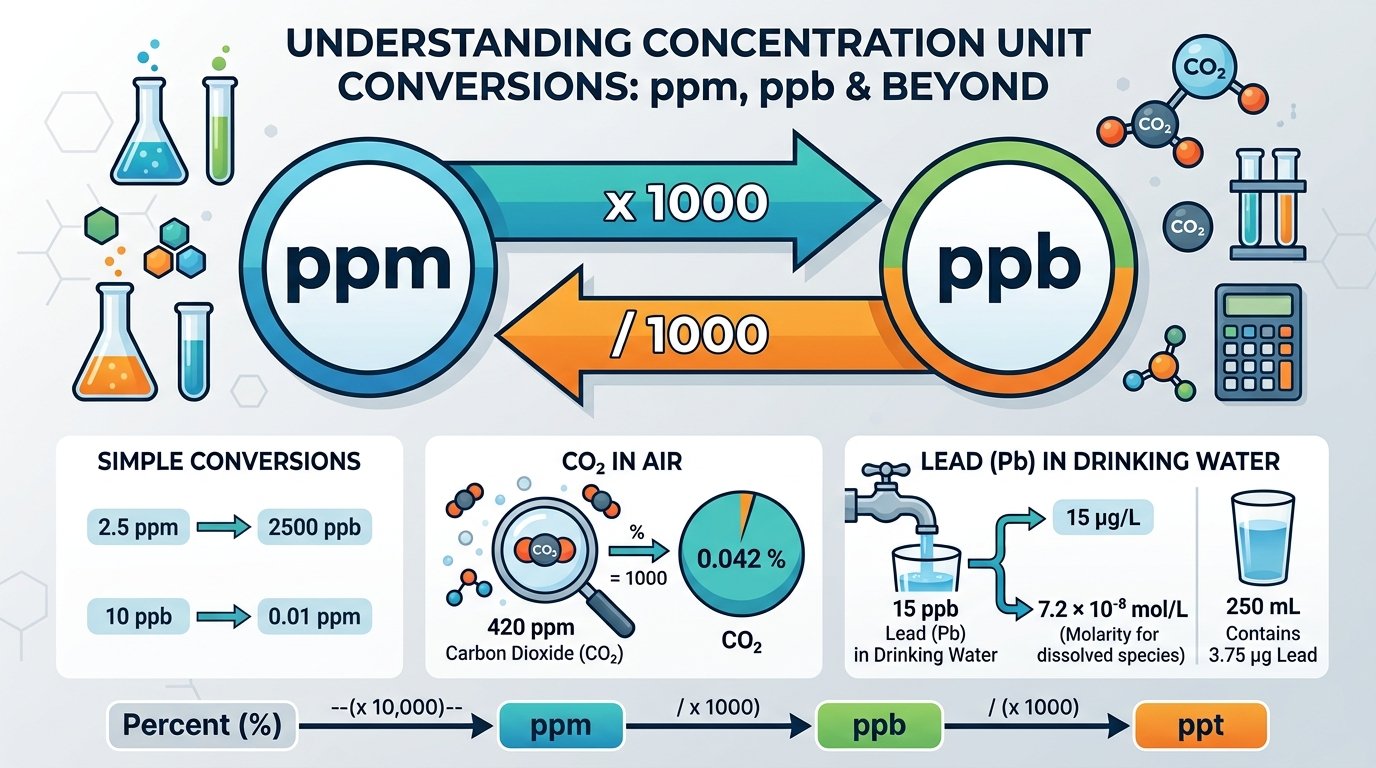
A ppm to ppb converter moves a concentration between parts per million and parts per billion — a factor of exactly 1000 — and, done properly, between every neighbouring unit as well: parts per trillion, percent, mg/L, µg/L, molarity for a dissolved species and mg/m³ for a gas. 2.5 ppm is 2500 ppb; 10 ppb is 0.01 ppm; 420 ppm of carbon dioxide is 0.042 % of the air; and 15 ppb of lead in drinking water is 15 µg/L, 7.2 × 10⁻⁸ mol/L, or 3.75 µg in a 250 mL glass.
The free ppm to ppb converter on this page has five modes: a pure ratio converter (ppm, ppb, ppt, ppq, percent, per mille, fraction), a solution converter that links ppm and ppb to mg/L and µg/L through density and gives the mass of contaminant in a sample, a molarity converter for any chemical formula, a gas converter between ppm(v) and mg/m³ at any temperature and pressure, and a dilution and regulatory-limit checker. Every result shows the formula and the substituted numbers, and can be copied, downloaded, printed or shared.
Below the tool you will find what ppm and ppb actually mean, the conversion factors in one table, the mass/volume subtlety that trips up water analysis, the molar-volume formula for air pollutants, worked examples for lead, fluoride, ozone and carbon monoxide, a reference table of drinking-water and air-quality limits, ten practice problems, an exam checklist and the questions people ask most.
Key Takeaway
1 ppm = 1000 ppb = 1,000,000 ppt = 0.0001 %. To go from ppm to ppb multiply by 1000; from ppb to ppm divide by 1000. In dilute water 1 ppm = 1 mg/L and 1 ppb = 1 µg/L. For gases, ppm is by volume and mg/m³ = ppm × M ÷ 24.45 at 25 °C and 1 atm. The ppm to ppb converter above applies all of these and shows the working.
📑 Table of Contents (click to expand)
- What Is a PPM to PPB Converter?
- How to Use the PPM to PPB Converter
- The Five Modes Explained
- Conversion Factors in One Table
- Worked Example: 2.5 ppm to ppb
- What PPM and PPB Really Mean
- PPM, mg/L and Density in Water
- More Worked Examples
- PPM to Molarity
- Gases: ppm(v) to mg/m³
- PPM, Percent and Per Mille
- Reference Table: Limits and Typical Levels
- Dilution: Making Standards From a Stock
- Comparing a Result With a Limit
- Visualising Parts per Million and Billion
- Who Uses a PPM to PPB Converter
- Full Walkthrough: A Lab Report
- A Short History of Parts-per Notation
- Limits and Assumptions
- Practice Problems With Answers
- Tips for Accurate Results
- Common Mistakes
- How This Converter Is Different
- Where the Numbers Come From
- Checklist
- Frequently Asked Questions
- 10 Facts Worth Knowing
- Final Thoughts
What Is a PPM to PPB Converter?
Parts per million (ppm) and parts per billion (ppb) — the two units in the name of every ppm to ppb converter — are ways of writing very small fractions. One part per million is one unit of something in a million units of the whole — 10−6; one part per billion is one in a thousand million — 10−9. Because 10−6 ÷ 10−9 = 1000, the two units differ by exactly one thousand, and a ppm to ppb converter at its simplest just multiplies or divides by that factor.
The complications come from the word “part”. In water analysis the parts are masses (mg of solute per kg of solution), and since a litre of dilute water weighs a kilogram, 1 ppm becomes 1 mg/L. In air quality the parts are volumes or moles (a ppm of ozone is one molecule of O3 per million molecules of air), so converting to a mass concentration needs the gas’s molar mass and the molar volume. In chemistry you may need moles per litre instead. A useful ppm to ppb converter therefore handles all of these, and states which basis it is using.
This ppm to ppb converter does. It keeps the ratio conversions exact, applies density only where density belongs, uses IUPAC 2021 atomic weights for any formula you type, and computes the molar volume of a gas from the temperature and pressure you give rather than assuming 24.45 L/mol.
The ladder of parts-per units
Percent (%) — parts per hundred, 10−2
Per mille (‰) — parts per thousand, 10−3
ppm — parts per million, 10−6
ppb — parts per billion, 10−9
ppt — parts per trillion, 10−12
ppq — parts per quadrillion, 10−15. Each rung is a factor of 1000 below the last (except % → ‰, which is 10).
How to Use the PPM to PPB Converter
- Choose the mode that matches your question. Ratio for pure ppm ↔ ppb ↔ % conversions; Solution when mg/L, µg/L or the mass in a sample is wanted; Molarity when you have a formula and need mol/L; Gas for ppm(v) ↔ mg/m³; Dilution & Limit to make a standard or compare a result with a regulation.
- Type the value and pick its unit from the drop-down. The ppm to ppb converter accepts decimals and scientific notation (
2.5e-3). - Add the extra data the mode needs — density for solutions (default 1.000 g/mL), a chemical formula for molarity and gas modes (
Pb,NaCl,O3,NO2), temperature and pressure for gases (default 25 °C, 101.325 kPa). - Press Convert. The main answer appears in blue, the other units beneath it, then the steps, a table and a chart.
- Copy, download, print or share from the toolbar. Each mode has its own Reset; the last ten results stay in the history box.
The example chips load the cases people search for most — 2.5 ppm to ppb, 15 ppb lead in a glass of water, 9 ppm CO to mg/m³, 70 ppb ozone to µg/m³, diluting a 1000 ppm stock — so the ppm to ppb converter’s output is visible before you type anything.
The Five Modes Explained
| Mode | Units handled | Extra input | Key formula |
|---|---|---|---|
| 1. Ratio | ppm, ppb, ppt, ppq, %, ‰, fraction | none | ppb = ppm × 1000 |
| 2. Solution | ppm, ppb, ppt, mg/L, µg/L, ng/L, g/L, % w/w | density, sample size | mg/L = ppm × ρ(g/mL) |
| 3. Molarity | ppm, ppb, ppt ↔ M, mM, µM, nM | formula or molar mass, density | M = ppm × ρ ÷ (1000 × Mw) |
| 4. Gas | ppm(v), ppb(v) ↔ mg/m³, µg/m³ | formula, T, P | mg/m³ = ppm × Mw ÷ Vm |
| 5. Dilution & Limit | any two concentrations in any units | final volume (dilution) | C1V1 = C2V2; ratio to limit |
Modes 2 to 5 accept mixed units on purpose — a result in µg/L can be compared directly with a limit in ppb, because the ppm to ppb converter normalises both before comparing.
Conversion Factors in One Table
| From ↓ To → | % | ppm | ppb | ppt | fraction |
|---|---|---|---|---|---|
| 1 % | 1 | 10,000 | 107 | 1010 | 0.01 |
| 1 ppm | 0.0001 | 1 | 1000 | 106 | 10−6 |
| 1 ppb | 10−7 | 0.001 | 1 | 1000 | 10−9 |
| 1 ppt | 10−10 | 10−6 | 0.001 | 1 | 10−12 |
Read across a row to convert, exactly as the ppm to ppb converter does internally. The two you will use most: ppm × 1000 = ppb and ppb ÷ 1000 = ppm. The ppm to ppb converter’s first mode is this table made interactive, with ppq and per mille added.
Worked Example: 2.5 ppm to ppb, Step by Step
Step 1 — write the definitions. 1 ppm = 10−6; 1 ppb = 10−9.
Step 2 — form the factor. 1 ppm ÷ 1 ppb = 10−6 ÷ 10−9 = 103 = 1000.
Step 3 — multiply. 2.5 ppm × 1000 = 2500 ppb.
Step 4 — the other units for free. 2.5 ppm = 0.00025 % = 2,500,000 ppt = a fraction of 2.5 × 10−6 = 1 part in 400,000.
That last line is what the ppm to ppb converter prints beneath the main answer, and the “1 in N” form is often the most intuitive way to explain a trace level to a non-specialist.
What PPM and PPB Really Mean
A parts-per figure — the input to any ppm to ppb converter — is a ratio of like quantities, and it is only fully defined when you say which quantities. The three bases in common use:
| Basis | Written | 1 ppm means | Used for |
|---|---|---|---|
| Mass / mass | ppm (w/w), mg/kg | 1 mg of solute in 1 kg of sample | Soils, foods, solids, water (≈ mg/L) |
| Mass / volume | mg/L, µg/L | 1 mg of solute in 1 L of solution | Water and wastewater analysis |
| Volume / volume (= mole / mole) | ppm(v), ppmv, µmol/mol | 1 molecule per million molecules of gas | Air quality, atmospheric science, gas mixtures |
For dilute aqueous solutions the first two coincide because 1 L weighs 1 kg; for gases only the third makes sense, and it is really a mole fraction × 106 (see the mole fraction calculator). The ppm to ppb converter keeps these separate: mode 2 is mass-based, mode 4 is volume-based, and neither will silently mix them. IUPAC discourages parts-per notation altogether in favour of explicit units such as mg/kg and µmol/mol, precisely because of this ambiguity — but ppm and ppb are so entrenched that being able to convert them correctly is a basic skill.
PPM, mg/L and Density in Water
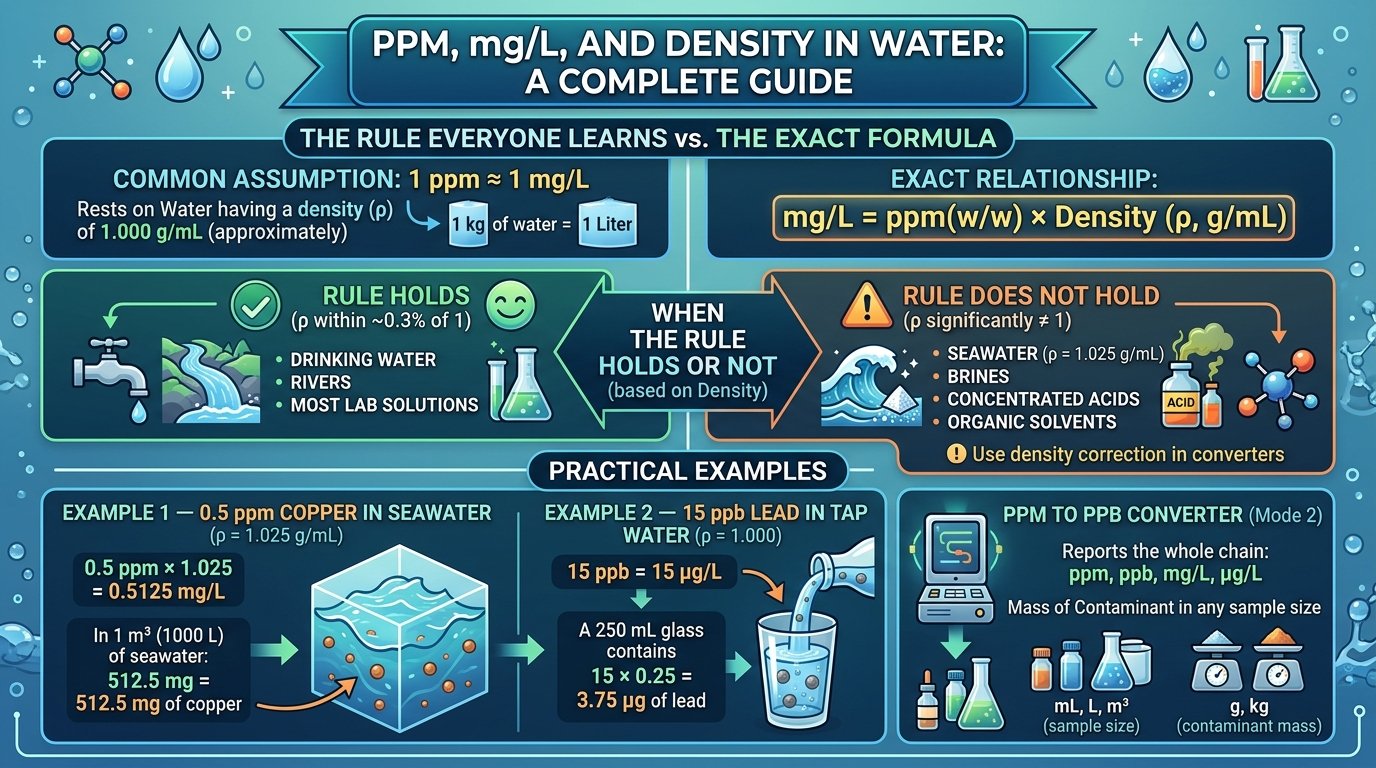
The rule everyone learns is 1 ppm = 1 mg/L. It rests on water having a density of 1.000 g/mL, so that 1 kg of solution occupies 1 L. Exactly: mg/L = ppm(w/w) × ρ (g/mL). For drinking water, rivers and most lab solutions ρ is within 0.3 % of 1 and the rule holds. For seawater (1.025 g/mL), brines, concentrated acids or organic solvents it does not, and the ppm to ppb converter’s density field is there to correct it.
Example — 0.5 ppm copper in seawater (ρ = 1.025 g/mL): 0.5 × 1.025 = 0.5125 mg/L. In 1 m³ (1000 L) of seawater that is 512.5 mg of copper.
Example — 15 ppb lead in tap water (ρ = 1.000): 15 µg/L. A 250 mL glass contains 15 × 0.25 = 3.75 µg of lead.
Mode 2 of the ppm to ppb converter reports the whole chain — ppm, ppb, mg/L, µg/L — and the mass of contaminant in whatever sample size you enter, in mL, L, m³, g or kg.
More Worked Examples
1. Fluoride in drinking water — 0.7 mg/L
0.7 mg/L = 0.7 ppm = 700 ppb. As molarity: 0.7 ÷ 18.998 ÷ 1000 = 3.68 × 10⁻⁵ M = 36.8 µM. A 2 L bottle contains 1.4 mg of fluoride.
2. Arsenic result — 12 µg/L against a 10 ppb limit
12 µg/L = 12 ppb. Ratio to limit 1.2, so the sample exceeds the limit by 20 %. Mode 5 of the ppm to ppb converter gives the verdict and the margin.
3. Carbon monoxide — 9 ppm (8-hour standard) to mg/m³
M(CO) = 28.01 g/mol; Vm at 25 °C, 101.325 kPa = 24.465 L/mol. 9 × 28.01 ÷ 24.465 = 10.3 mg/m³.
4. Nitrogen dioxide — 40 µg/m³ (annual guideline) to ppb
M(NO2) = 46.01. ppb = 40 × 24.465 ÷ 46.01 = 21.3 ppb. Mode 4 in the reverse direction.
5. Chlorine in a pool — 2 % w/w? No — 2 ppm
A pool at 2 ppm free chlorine holds 2 mg/L; a 50 m³ pool contains 100 g of Cl2 equivalent. Had someone entered 2 % by mistake, the ppm to ppb converter would show 20,000 ppm, 10,000 times too much — a good illustration of why the units matter.
PPM to Molarity
Chemists often need moles per litre, so the ppm to ppb converter includes a molarity mode. Since 1 ppm (w/w) in water is 1 mg/L = 10−3 g/L, dividing by the molar mass gives mol/L:
M (mol/L) = ppm × ρ (g/mL) ÷ (1000 × Mw)
ppm = M × Mw × 1000 ÷ ρ (for ppb, multiply by another 1000)
| Species | Mw (g/mol) | Concentration | Molarity |
|---|---|---|---|
| NaCl | 58.44 | 50 ppm | 8.56 × 10⁻⁴ M (0.856 mM) |
| Pb | 207.2 | 15 ppb | 7.24 × 10⁻⁸ M (72.4 nM) |
| NO3− | 62.00 | 45 ppm | 7.26 × 10⁻⁴ M |
| F− | 19.00 | 0.05 mM | 0.95 ppm = 950 ppb |
| Cu | 63.55 | 2 µM | 0.127 ppm = 127 ppb |
| Ca2+ (hardness) | 40.08 | 100 ppm | 2.50 × 10⁻³ M |
Mode 3 of the ppm to ppb converter takes a formula (or a molar mass), looks up IUPAC 2021 atomic weights and converts in either direction, with mM, µM and nM available so lead at 15 ppb reads as a sensible 72.4 nM rather than a string of zeros. The molarity calculator continues from there for dilutions and solution preparation.
Gases: ppm(v) to mg/m³
Air-quality limits appear in both ppm (or ppb) by volume and mg/m³ (or µg/m³) — the reason a ppm to ppb converter needs a gas mode — and the conversion between them depends on the gas and on the conditions. One ppm(v) is one mole of pollutant per 106 moles of air; multiply by the molar mass to get grams, and divide by the molar volume to get grams per cubic metre:
mg/m³ = ppm(v) × Mw ÷ Vm with Vm = RT ÷ P
Vm = 24.465 L/mol at 25 °C and 101.325 kPa; 22.414 L/mol at 0 °C; 24.055 L/mol at 20 °C
| Pollutant | Mw | 1 ppb = … µg/m³ (25 °C) | Typical limit | Converted |
|---|---|---|---|---|
| Ozone O3 | 48.00 | 1.96 | 70 ppb (8 h) | 137 µg/m³ |
| Nitrogen dioxide NO2 | 46.01 | 1.88 | 40 µg/m³ (annual) | 21.3 ppb |
| Sulfur dioxide SO2 | 64.06 | 2.62 | 75 ppb (1 h) | 196 µg/m³ |
| Carbon monoxide CO | 28.01 | 1.14 | 9 ppm (8 h) | 10.3 mg/m³ |
| Carbon dioxide CO2 | 44.01 | 1.80 | 1000 ppm (indoor comfort) | 1.80 g/m³ |
| Methane CH4 | 16.04 | 0.66 | 1.9 ppm (ambient) | 1.25 mg/m³ |
| Formaldehyde HCHO | 30.03 | 1.23 | 0.1 mg/m³ (30 min) | 81 ppb |
Two things to watch. First, the reference conditions: US EPA uses 25 °C, the EU and WHO generally 20 °C, and stack emissions are often quoted at 0 °C — a 9 % spread. Mode 4 of the ppm to ppb converter lets you set T and P explicitly and prints the Vm it used. Second, particulates (PM2.5, PM10) have no molar mass and are never expressed in ppm; they stay in µg/m³.
PPM, Percent and Per Mille
Because 1 % = 10,000 ppm, the crossover between percent and ppm is where most magnitude errors happen. A 0.1 % solution is 1000 ppm; a 3.5 % salinity is 35,000 ppm (35 ‰, the oceanographer’s unit); 420 ppm CO2 is 0.042 %. The ppm to ppb converter prints percent alongside every ratio result, and a per mille field is included because salinity, alcohol content and isotope ratios are still quoted in ‰.
% → ppm: multiply by 10,000 | ppm → %: divide by 10,000
‰ → ppm: multiply by 1000 | % → ‰: multiply by 10
% → ppb: multiply by 10,000,000
Mass percent of a compound within a formula (rather than within a mixture) is a different quantity handled by the percent composition calculator.
Reference Table: Limits and Typical Levels in the PPM to PPB Converter
| Substance / medium | Value as quoted | In ppm | In ppb | Note |
|---|---|---|---|---|
| Lead, drinking water (US action level) | 15 µg/L | 0.015 | 15 | WHO guideline 10 µg/L |
| Arsenic, drinking water | 10 µg/L | 0.010 | 10 | US MCL and WHO |
| Nitrate as N, drinking water | 10 mg/L | 10 | 10,000 | ≈ 45 mg/L as NO3− |
| Fluoride, drinking water | 4.0 mg/L (MCL); 0.7 recommended | 4.0 / 0.7 | 4000 / 700 | WHO 1.5 mg/L |
| Copper, drinking water | 1.3 mg/L | 1.3 | 1300 | Action level |
| Mercury, drinking water | 2 µg/L | 0.002 | 2 | 2000 ppt |
| Total dissolved solids, drinking water | 500 mg/L | 500 | 500,000 | Secondary (taste) standard |
| Seawater salinity | 35 ‰ | 35,000 | 3.5 × 10⁷ | 3.5 % |
| CO2, outdoor air (2026) | ≈ 425 ppm | 425 | 425,000 | 0.0425 % by volume |
| CO2, indoor comfort limit | 1000 ppm | 1000 | 106 | Workplace limit 5000 ppm |
| Ozone, ambient air | 70 ppb (8 h) | 0.070 | 70 | 137 µg/m³ |
| Methane, ambient air | ≈ 1.9 ppm | 1.9 | 1900 | 1.25 mg/m³ |
| Blood alcohol, legal limit (many countries) | 0.05 % w/v | 500 | 500,000 | = 0.5 g/L |
| Free chlorine, swimming pool | 1–3 mg/L | 1–3 | 1000–3000 | Drinking water max 4 mg/L |
Values in this ppm to ppb converter reference table are the widely published US EPA / WHO figures for orientation; always check the current regulation for your jurisdiction. Any row can be re-created in the ppm to ppb converter, and mode 5 compares your own result against it.
Dilution: Making Standards From a Stock
Calibration standards are made by diluting a certified stock, usually 1000 ppm (1000 mg/L), and a ppm to ppb converter that stops at ratios leaves that job half done. The dilution equation C1V1 = C2V2 gives the volume of stock, and the ppm to ppb converter’s mode 5 solves it with the two concentrations in any units:
100 mL of 5 ppm from 1000 ppm: V1 = 5 × 100 ÷ 1000 = 0.500 mL of stock, made up to 100 mL. Dilution factor 200.
500 mL of 50 ppb from 1000 ppm: V1 = 0.05 × 500 ÷ 1000 = 0.025 mL (25 µL). Dilution factor 20,000 — better done in two steps (1000 → 10 ppm → 50 ppb) so that each pipetted volume is measurable.
The converter flags dilution factors above about 1000 with a suggestion to use serial dilution, and refuses a “dilution” in which the target is more concentrated than the stock. The molar analogue is in the molarity calculator, and the equivalent-based one in the normality calculator.
Comparing a Result With a Limit
Laboratory results and regulatory limits rarely arrive in the same unit: the instrument reports µg/L, the regulation says ppb or mg/L, the client asks for percent of limit. The limit-check option in mode 5 of the ppm to ppb converter takes both numbers in whatever units they come in, converts them to a common basis and reports the ratio, the margin and a plain verdict.
| Result | Limit | Ratio | Verdict |
|---|---|---|---|
| 0.02 ppm lead | 15 ppb | 1.333 | Exceeds by 33 % |
| 12 µg/L arsenic | 10 ppb | 1.2 | Exceeds by 20 % |
| 8 mg/L nitrate-N | 10 ppm | 0.80 | Within limit (80 % of limit) |
| 0.35 % CO2 | 5000 ppm | 0.70 | Within limit (70 %) |
| 1.5 ppt dioxin-equivalent | 30 ppq | 50 | Exceeds 50-fold |
Visualising Parts per Million and Billion
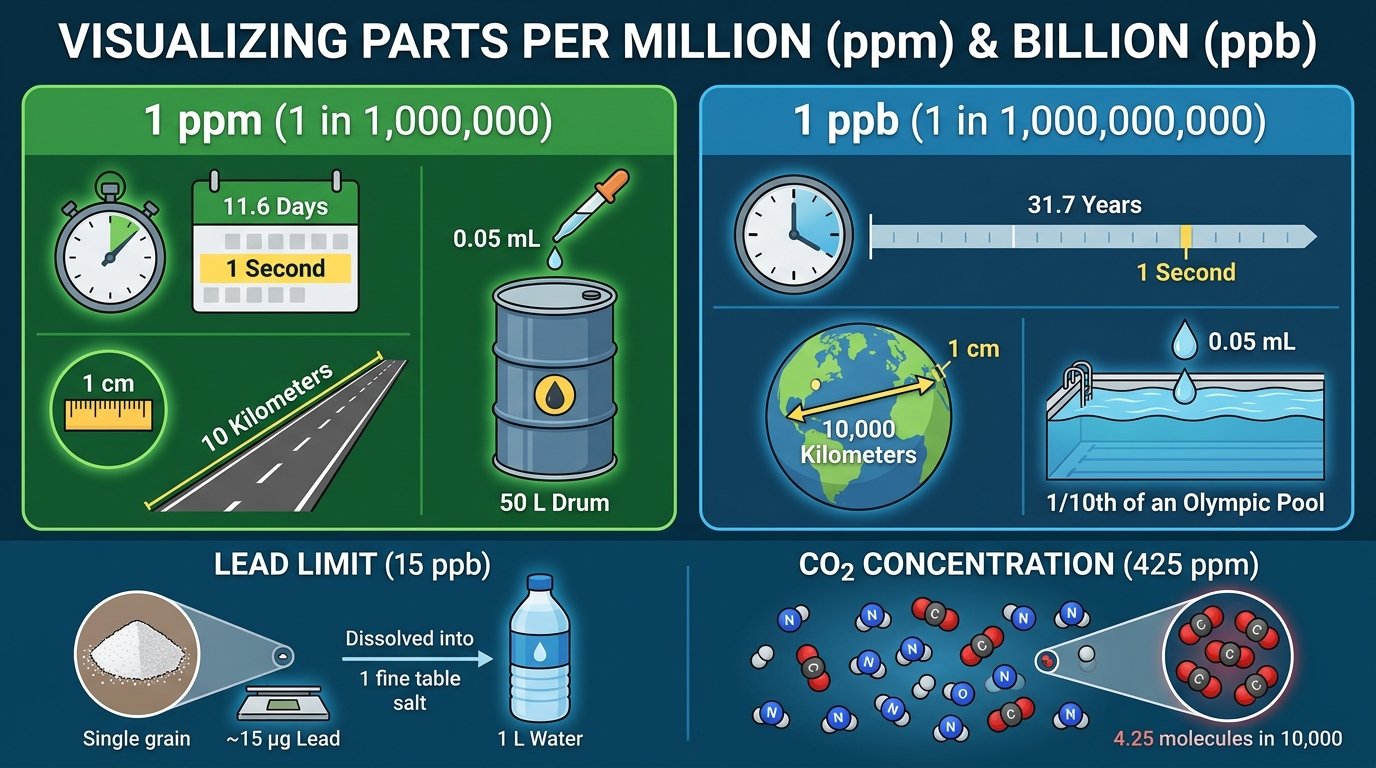
Numbers this small are hard to feel, even with a ppm to ppb converter in front of you. Some comparisons that make them concrete:
- 1 ppm is one second in 11.6 days, one centimetre in 10 kilometres, or one drop (0.05 mL) in a 50 L drum.
- 1 ppb is one second in 31.7 years, one centimetre in 10,000 kilometres (roughly Lahore to New York), or one drop in an Olympic swimming pool’s worth of water divided by ten.
- 1 ppt is one second in 31,700 years, or one grain of sugar in an Olympic pool.
- The 15 ppb lead limit is 15 µg in a litre — about the mass of a single grain of fine table salt, dissolved in a litre of water.
- 425 ppm CO2 means that of every 10,000 molecules in the air, a little over 4 are carbon dioxide.
The ppm to ppb converter’s “1 in N” output line is built for exactly this purpose.
Who Uses a PPM to PPB Converter
- Water-quality analysts using a ppm to ppb converter to turn instrument output (µg/L) to regulatory units and the reverse.
- Air-quality and occupational-hygiene professionals moving between ppm(v) and mg/m³ for gases and vapours.
- Environmental and analytical chemists preparing calibration standards from 1000 ppm stocks.
- Food and agriculture labs reporting pesticide, mycotoxin and heavy-metal residues in mg/kg and µg/kg.
- Pool, aquarium and hydroponics operators dosing chlorine, nutrients and trace elements.
- Students meeting concentration units for the first time and needing to see the factor of 1000 done properly.
Full Walkthrough: A Lab Report
“An ICP-MS analysis of a tap-water sample gives lead at 0.0215 mg/L. Report the result in ppb and in nmol/L, state whether it meets the 15 ppb action level, and calculate the lead ingested from 2.0 L of this water per day.”
ppb: 0.0215 mg/L = 21.5 µg/L = 21.5 ppb (ρ = 1.000).
Molarity: 21.5 µg/L ÷ 207.2 g/mol = 0.1038 µmol/L = 103.8 nmol/L.
Limit check: 21.5 ÷ 15 = 1.43 — exceeds the action level by 43 %.
Daily intake: 21.5 µg/L × 2.0 L = 43 µg of lead per day.
Mode 2 of the ppm to ppb converter gives the first and last lines, mode 3 the molarity, mode 5 the verdict — four numbers a report needs, each with its working printed.
A Short History of Parts-per Notation
Long before any ppm to ppb converter, “parts per million” entered chemistry in the nineteenth century as a natural extension of percent for water analyses that percent could not express legibly, and it was the working unit of sanitary chemistry by 1900. Parts per billion arrived with instruments that could see it: atomic absorption in the 1950s and 1960s, then gas chromatography with electron capture, and by the 1980s ICP-MS made parts per trillion routine. Each new decade of sensitivity added a rung to the ladder.
The ambiguity of “billion” (109 in modern usage everywhere, but 1012 in the older long-scale) and of the basis (mass, volume or moles) led IUPAC and the BIPM to recommend explicit units instead — mg/kg, µg/L, µmol/mol. The recommendation is sound and the notation persists anyway, which is why a careful ppm to ppb converter still matters.
Limits and Assumptions
- Mode 1 of the ppm to ppb converter is basis-free: it converts ratios only. Whether those ratios are by mass or by volume is up to you.
- Mode 2 assumes ppm is mass/mass and uses density to reach mass/volume. For a gas, use mode 4 instead.
- Mode 3 uses the density of the solution; for trace levels in water the default 1.000 g/mL is correct.
- Mode 4 assumes ideal-gas behaviour at the T and P you give. This is accurate for trace gases in air at ambient conditions.
- Ionic species: “ppm nitrate” may mean as NO3− or as N — a factor of 4.43. Enter the formula the result actually refers to.
- Regulatory values in the tables are for orientation; jurisdictions differ and limits change. Check the current source.
Practice Problems With Answers
Work each one, then confirm with the ppm to ppb converter.
1. Convert 0.35 ppm to ppb.
Show answer
0.35 × 1000 = 350 ppb.
2. Convert 4200 ppb to ppm and to percent.
Show answer
4200 ÷ 1000 = 4.2 ppm = 4.2 ÷ 10,000 = 0.00042 %.
3. A 1.5 % salt solution in ppm?
Show answer
1.5 × 10,000 = 15,000 ppm.
4. 8 µg of cadmium in a 400 mL water sample. Concentration in ppb?
Show answer
8 ÷ 0.400 = 20 µg/L = 20 ppb (limit 5 ppb — four times over).
5. 25 ppm Ca2+ as molarity.
Show answer
25 ÷ 40.08 ÷ 1000 = 6.24 × 10⁻⁴ M (0.624 mM).
6. 0.1 mM Zn2+ in ppm.
Show answer
0.1 × 10−3 × 65.38 × 1000 = 6.54 ppm.
7. 50 ppb SO2 at 25 °C in µg/m³.
Show answer
50 × 64.06 ÷ 24.465 = 131 µg/m³.
8. 100 µg/m³ ozone at 20 °C in ppb.
Show answer
Vm = 24.055. 100 × 24.055 ÷ 48.00 = 50.1 ppb.
9. Volume of 1000 ppm stock for 250 mL of 20 ppm.
Show answer
20 × 250 ÷ 1000 = 5.0 mL.
10. A soil has 350 mg/kg lead. In ppm, ppb and percent?
Show answer
mg/kg is ppm by mass: 350 ppm = 350,000 ppb = 0.035 %.
Tips for Accurate Results
- Name the basis. Write ppm (w/w), mg/L or ppm(v) on every ppm to ppb converter result — never bare “ppm” in a report.
- Count the zeros with powers of ten, not by eye. 10−6 ÷ 10−9 = 103.
- Use density only for mass ↔ volume, molar mass only for mass ↔ moles, molar volume only for gases.
- State T and P for gas conversions, and match the regulator’s reference conditions.
- Check “as N” vs “as NO3“, “as P” vs “as PO4“, “as CaCO3“ before converting nutrients or hardness.
- Serial-dilute anything beyond a factor of ~1000 so every pipetted volume is realistic.
Common Mistakes
| Mistake | Effect | Fix |
|---|---|---|
| Dividing by 1000 to go ppm → ppb (the classic ppm to ppb converter slip) | 106 too small | ppb is the smaller unit, so the number gets bigger: multiply |
| Treating % → ppm as × 1000 | 10× too small | 1 % = 10,000 ppm |
| Using 1 ppm = 1 mg/L for a gas | Meaningless number | Gases need Mw ÷ Vm |
| Using 22.4 L/mol at 25 °C | 9 % error | 24.45 L/mol at 25 °C, 24.06 at 20 °C |
| Ignoring density for seawater or brine | 2–20 % error | mg/L = ppm × ρ |
| Confusing nitrate-N with nitrate | Factor of 4.43 | Read the “as” in the method |
| ppt read as parts per thousand | 109 ambiguity | Write ‰ for per mille; ppt = per trillion |
How This PPM to PPB Converter Is Different
| Feature | This ppm to ppb converter | Typical online converter |
|---|---|---|
| ppm, ppb, ppt, ppq, %, ‰ and fraction in one view | ✓ | ppm ↔ ppb only |
| mg/L and µg/L with density; mass in a sample | ✓ | Assumes ρ = 1 |
| Molarity for any formula, IUPAC 2021 weights | ✓ | ✗ |
| Gas ppm(v) ↔ mg/m³ at any T and P | ✓ | Fixed 25 °C, if at all |
| Dilution recipe and limit check with mixed units | ✓ | ✗ |
| Step-by-step working, table and chart | ✓ | Number only |
| Copy, CSV, TXT, print, share, history, per-mode Reset | ✓ | Partial |
| Free, no sign-up, runs in the browser | ✓ | Varies |
The ppm to ppb converter belongs to the same family as the site’s other free tools: the molecular weight calculator, atomic mass calculator, formula weight calculator, grams to moles calculator, molality calculator, stoichiometry calculator, chemical equation balancer, limiting reactant calculator, theoretical yield calculator, percent yield calculator, atom economy calculator, equivalent weight calculator, molar mass of hydrates calculator, exact mass calculator, monoisotopic mass calculator, isotopic mass calculator, average vs monoisotopic mass, empirical formula calculator, molecular formula calculator, combustion analysis calculator, degree of unsaturation calculator, oxidation number calculator, formal charge calculator, freezing point depression, boiling point elevation, osmotic pressure, vapor density, molar mass from gas density, van der Waals equation, and the polymer tools — average molecular weight of a mixture, number average, weight average, polydispersity index and viscosity molecular weight.
Where the Numbers Come From
The ppm to ppb converter uses exact powers of ten for ratio conversions, IUPAC 2021 standard atomic weights for molar masses, R = 8.314462 J/(mol·K) for molar volumes, and published regulatory values for the reference tables:
- US EPA — National Primary Drinking Water Regulations: maximum contaminant levels and action levels for lead, arsenic, nitrate, fluoride and others.
- OpenStax Chemistry via LibreTexts — Other Units for Solution Concentrations: mass percent, ppm and ppb defined, with worked conversions.
- CIAAW — Standard Atomic Weights: the atomic weights behind every molar mass on this site.
- Wikipedia — Parts-per notation: definitions, mass/volume/mole bases, the long-scale ambiguity and the IUPAC position.
Found an error? Our corrections policy explains how we handle reports; contact us or read about the site.
Checklist
☐ Basis identified: mass/mass, mass/volume or volume/volume
☐ ppm → ppb: × 1000; ppb → ppm: ÷ 1000
☐ % → ppm: × 10,000
☐ Density applied only for mg/L in non-water matrices
☐ Correct formula (as N? as NO3? as CaCO3?) for molarity
☐ Gas: molar mass and Vm at the stated T and P
☐ Dilution factor realistic; serial dilution if > ~1000
☐ Result and limit in the same unit before comparing
☐ Unit written in full on the report
Frequently Asked Questions
How do I convert ppm to ppb?
Multiply by 1000. 1 ppm = 1000 ppb, so 2.5 ppm = 2500 ppb. To go the other way, divide by 1000: 10 ppb = 0.01 ppm.
Is 1 ppm the same as 1 mg/L?
For dilute aqueous solutions, yes, because 1 L of water weighs 1 kg and 1 mg/kg = 1 ppm. For seawater, brines or other solvents multiply by the density; for gases the relation does not apply at all.
What is 1 ppb in µg/L?
1 ppb = 1 µg/L in dilute water. So a 15 ppb lead limit is 15 µg/L, and a 250 mL glass at that level contains 3.75 µg of lead.
How many ppm is 1 percent?
10,000 ppm. Percent is parts per hundred and ppm is parts per million; 106 ÷ 102 = 104. So 0.1 % = 1000 ppm and 420 ppm = 0.042 %.
How do I convert ppm to molarity?
For a dilute aqueous solution, M = ppm ÷ (1000 × molar mass). 50 ppm NaCl = 50 ÷ (1000 × 58.44) = 8.56 × 10⁻⁴ mol/L. Mode 3 of the ppm to ppb converter does this for any formula.
How do I convert ppm to mg/m³ for a gas?
mg/m³ = ppm × molar mass ÷ molar volume. At 25 °C and 1 atm the molar volume is 24.45 L/mol, so 9 ppm CO = 9 × 28.01 ÷ 24.45 = 10.3 mg/m³. Mode 4 lets you set any temperature and pressure.
Does ppt mean parts per thousand or per trillion?
In analytical chemistry ppt means parts per trillion (10−12). Parts per thousand is written ‰ (per mille). The ppm to ppb converter uses ppt for trillion and offers ‰ separately.
Why does IUPAC discourage ppm and ppb?
Because they do not say whether the parts are by mass, volume or amount, and because “billion” has historically meant different numbers in different countries. Explicit units — mg/kg, µg/L, µmol/mol — are unambiguous. In practice ppm and ppb remain in universal use.
How much stock do I need for a 5 ppm standard?
C1V1 = C2V2. From a 1000 ppm stock, 100 mL of 5 ppm needs 5 × 100 ÷ 1000 = 0.500 mL of stock made up to 100 mL. Mode 5 gives the volumes and the dilution factor.
Is my data stored anywhere?
No. The ppm to ppb converter runs entirely in your browser; the history box uses your own local storage and Clear All empties it.
10 Facts Worth Knowing
- One ppb is one second in about 32 years.
- Atmospheric CO2 passed 300 ppm around 1910, 350 ppm in 1988 and 400 ppm in 2013; it is now above 420 ppm.
- The human nose detects hydrogen sulfide at about 0.5 ppb — lower than most instruments could until the 1970s.
- Modern ICP-MS routinely measures metals at parts per trillion, a billion times more dilute than percent.
- Seawater is 35,000 ppm dissolved salts but only 0.003 ppm (3 ppb) iron — iron is the limiting nutrient over much of the ocean.
- A ppm of a gas is a mole fraction of 10−6; converting it to mg/m³ changes with temperature, so regulators must specify the reference conditions.
- The 15 ppb lead action level corresponds to about 72 nanomoles per litre.
- “Parts per hundred” is just percent, and “parts per thousand” is per mille — the same ladder the ppm to ppb converter climbs.
- Gold in seawater is about 0.00001 ppb (10 ppq) — real, but never worth extracting.
- A 1000 ppm certified stock diluted 1 : 200 gives a 5 ppm standard; diluted 1 : 20,000 it gives 50 ppb, which is why serial dilution exists.
Final Thoughts
The arithmetic behind a ppm to ppb converter is a factor of a thousand; the chemistry is in knowing what the parts are. Keep mass, volume and moles separate, apply density, molar mass and molar volume only where each belongs, and write the unit in full on anything you report.
Use the ppm to ppb converter above to move between every parts-per unit, to reach mg/L, molarity and mg/m³ with the right factor, to make standards and to compare results with limits — and read the working it prints until the factors are second nature.
Written by
Ahmad Raza, M.Phil. Chemistry ✓ Verified Expert
Ahmad has taught general and analytical chemistry for over a decade and builds the calculators on this site. He tests every tool — including this ppm to ppb converter — against textbook problems and published data before it goes live, and he answers reader questions personally.