
Atom Economy Calculator
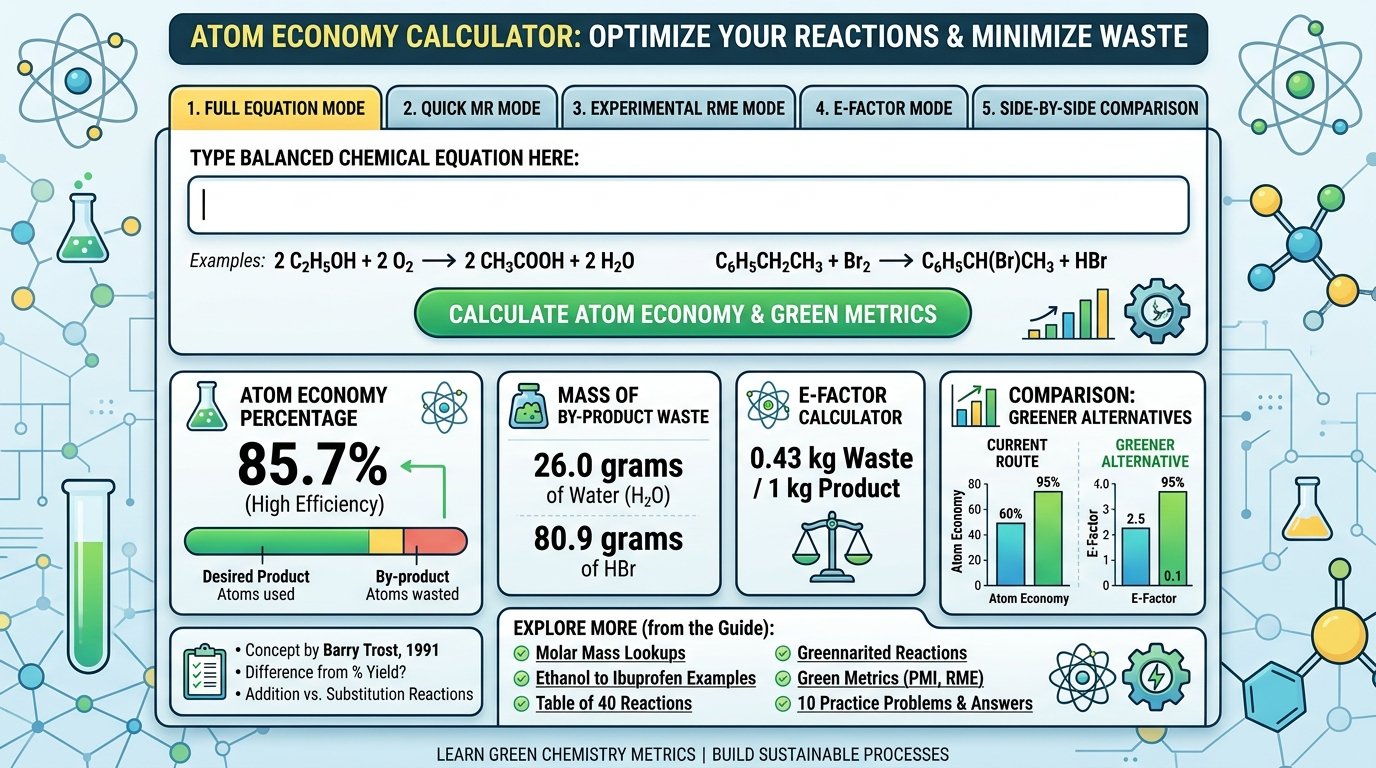
Atom economy = molar mass of the desired product ÷ total molar mass of all reactants × 100. Type any reaction and the calculator balances it, looks up every molar mass and reports the percent atom economy, the mass of atoms wasted as by-products, the E-factor, and how the reaction compares with a greener alternative. Includes the experimental atom economy (with percent yield) and a green-chemistry reaction-type guide.
✓ Trusted by students, teachers & green-chemistry researchersPercent Atom Economy of Any Balanced Reaction
Enter the equation (balanced or not) and the desired product. Every reactant and product is converted to a molar mass × coefficient, and atom economy = mass of desired product ÷ total mass of reactants × 100 (equal to the total mass of products, by conservation of mass). By-products are listed with their share of the waste.
Quick Atom Economy from Molar Masses and Coefficients
For exam questions that give the Mr values directly: enter the desired product's molar mass and coefficient, and the total molar mass of reactants (or list the reactant Mr × coefficient terms separated by + ).
Experimental Atom Economy: Combine Atom Economy with Percent Yield
Theoretical atom economy assumes 100% yield. Give the equation, the desired product, the mass of limiting reactant (or all reactant masses) used and the mass of product obtained, and the calculator reports percent yield, experimental atom economy = AE × yield, and the reaction mass efficiency (RME = mass of product ÷ total mass of reactants actually used).
E-Factor, Waste per Kilogram and Process Mass Intensity
From the equation alone the calculator gives the theoretical E-factor (kg by-product per kg product = (100 − AE)/AE). Add the actual masses of all inputs (reactants, solvents, reagents, work-up materials) and the mass of product to get the real E-factor and PMI used in industry.
Compare the Atom Economy of Two Routes to the Same Product
Enter two equations that make the same product (e.g. ethanol by hydration vs fermentation, ibuprofen by the Boots vs BHC route). The calculator reports both atom economies, the by-products and how much less waste the greener route makes per tonne.
🕘 Recent calculations
- No calculations yet — your last 10 results will appear here.
Formulas: % atom economy = (coef × M of desired product) / Σ(coef × M of reactants) × 100 · theoretical E-factor = (100 − AE)/AE kg waste per kg product · experimental atom economy = AE × % yield / 100 · reaction mass efficiency = mass of product / total mass of reactants used × 100 · real E-factor = (total input mass − product mass) / product mass · PMI = total input mass / product mass · addition and rearrangement reactions are 100% atom-economical; substitution and elimination are not · IUPAC 2021 atomic weights.
An atom economy calculator tells you what fraction of the atoms you put into a reaction end up in the product you want. Atom economy = molar mass of the desired product ÷ total molar mass of all reactants × 100, both weighted by the coefficients of the balanced equation. Type any reaction and the calculator balances it, looks up every molar mass, names the desired product and reports the percentage — along with the mass of by-product waste, the E-factor, and how the reaction compares with a greener alternative.
The free atom economy calculator above has five modes: atom economy from any equation, a quick mode from molar masses alone (for exam questions that give Mr values), an experimental mode that multiplies atom economy by percent yield and reports reaction mass efficiency, an E-factor mode that converts the percentage into kilograms of waste per kilogram of product, and a side-by-side comparison of two routes to the same product.
This guide explains the concept as Barry Trost framed it in 1991, how it differs from percent yield, why addition reactions score 100% and substitutions never do, worked examples from ethanol to ibuprofen, a table of forty reactions, the related green metrics (E-factor, PMI, reaction mass efficiency), ten practice problems and answers to the questions students ask.
Key Takeaway
% atom economy = (coefficient × M of desired product) ÷ Σ(coefficient × M of all reactants) × 100. It is fixed by the balanced equation, not by how well the reaction runs. Ethanol by hydration of ethene (C2H4 + H2O → C2H5OH) is 100%; by fermentation (C6H12O6 → 2C2H5OH + 2CO2) it is 92.14/180.16 = 51.1%. Additions and rearrangements are 100%; substitutions, eliminations and decompositions always waste mass.
📑 Table of Contents (click to expand)
- What Is Atom Economy?
- How to Use the Atom Economy Calculator
- The Five Modes Explained
- The Atom Economy Formula
- Worked Example: Iron From Haematite
- More Worked Examples
- Reaction Type Decides Atom Economy
- Atom Economy vs Percent Yield
- Experimental Atom Economy and Reaction Mass Efficiency
- Reference Table: 40 Reactions
- E-Factor and Process Mass Intensity
- Comparing Routes: Ethanol, Ibuprofen, Ethylene Oxide
- The Twelve Principles of Green Chemistry
- Why Catalysis Improves Atom Economy
- When By-Products Are Useful
- Who Uses an Atom Economy Calculator
- Full Walkthrough: An Exam Question
- A Short History of the Concept
- Limits: What Atom Economy Does Not Measure
- Practice Problems With Answers
- Tips for Accurate Results
- Common Mistakes
- How This Calculator Is Different
- Where the Numbers Come From
- Exam Checklist
- Frequently Asked Questions
- 10 Facts Worth Knowing
- Final Thoughts
What Is Atom Economy?
Atom economy (also called atom efficiency or atom utilisation) — the quantity every atom economy calculator reports — is the percentage of the total mass of reactants that is incorporated into the desired product, according to the balanced chemical equation. It was introduced by Barry Trost in 1991 as a way of judging synthetic methods by how many of their atoms are wasted, and it became the second of Anastas and Warner’s twelve principles of green chemistry: “synthetic methods should be designed to maximise the incorporation of all materials used in the process into the final product.”
The crucial point is that atom economy is a property of the equation, not of the experiment. It assumes every reactant is converted completely, so it is the ceiling on material efficiency even before yield, solvents and work-up are considered. A reaction with 100% atom economy produces no by-products at all; a reaction with 20% atom economy throws away four-fifths of the reactant mass no matter how skilfully it is run. An atom economy calculator therefore needs only the balanced equation and the molar masses — no experimental data — which is exactly why it is such a quick way to compare routes on paper.
Three sentences to remember
Atom economy is the mass of desired product as a percentage of the total mass of reactants in the balanced equation.
Percent yield is how much of the theoretical product you actually obtained.
A reaction can have a high yield and a poor atom economy, or vice versa; green chemistry wants both high.
How to Use the Atom Economy Calculator
- Type the equation (balanced or not):
Fe2O3 + CO -> Fe + CO2. The atom economy calculator balances it by the matrix method and shows the coefficients. - Name the desired product (
Fe). If you leave it blank the first product is used. - Click Calculate. The answer box shows the percentage with a grade (ideal / high / moderate / low), the mass of reactants that becomes product, the by-products and their share, and the theoretical E-factor.
- Read the steps. Balanced equation → coefficient × M for each reactant → coefficient × M for the product → division → mass-conservation check → a one-line interpretation of the reaction type.
- Use the table and chart. Every species is listed with its role, coefficient, molar mass and share of the reactant mass; the bar chart shows where the mass goes.
- Export. Copy, CSV, TXT, print or share. The last ten results stay in the history panel.
Mode 2 skips the formulas and takes molar masses directly — the format of most exam questions. Mode 3 adds your reactant masses and actual yield; Mode 4 scales waste to a production quantity; Mode 5 compares two equations. Each mode has a Reset button.
The Five Modes Explained
| Mode | You enter | You get | Best for |
|---|---|---|---|
| 1. From Equation | Equation + desired product | % atom economy, by-products, waste mass, E-factor, reaction-type note | Any reaction; homework; route screening |
| 2. From Molar Masses | M and coefficient of product; reactant terms (e.g. 159.69 + 3*28.01) | % atom economy, waste share | Exam questions giving Mr values |
| 3. Experimental | Equation, reactant masses used, product mass obtained | % yield, experimental atom economy (AE × yield), reaction mass efficiency | Lab reports, green-chemistry practicals |
| 4. E-Factor & Waste | Equation; optional total input and product masses; production scale | Theoretical and real E-factor, PMI, kg waste per tonne | Process and sustainability assessment |
| 5. Compare Two Routes | Two equations + common product | Both atom economies, by-products, waste saved per tonne | “Which route is greener?” questions |
The Atom Economy Formula
% atom economy = [cP × M(desired product)] ÷ [Σ ci × M(reactanti)] × 100
c = coefficient in the balanced equation, M = molar mass. Because mass is conserved, the denominator equals the total mass of all products, so an equivalent form is: desired product ÷ (desired product + all by-products) × 100.
Three consequences follow directly for anyone using an atom economy calculator. First, the coefficients matter: 2Fe in the product line means 2 × 55.845, not 55.845. Second, the answer does not depend on how much you actually use — grams, kilograms or tonnes cancel. Third, you must decide which product is “desired”; the atom economy of the same equation is different for each product (in CaCO3 → CaO + CO2 it is 56.0% for lime and 44.0% for carbon dioxide). The atom economy calculator asks for the desired product for exactly this reason.
A quick sanity check for any atom economy calculator result: the atom economies of all products of one equation sum to 100%. If yours do not, a coefficient or molar mass is wrong. All molar masses here come from the IUPAC 2021 table shared with the molecular weight calculator.
Worked Example: Iron From Haematite
Problem. The first question most students put to an atom economy calculator: calculate the atom economy for the extraction of iron in the blast furnace: Fe2O3 + 3CO → 2Fe + 3CO2.
1. Balanced equation. Fe2O3 + 3CO → 2Fe + 3CO2 ✓
2. Reactant mass per mole of reaction. 1 × 159.69 (Fe2O3) + 3 × 28.010 (CO) = 159.69 + 84.03 = 243.72 g.
3. Desired product mass. 2 × 55.845 (Fe) = 111.69 g.
4. Atom economy. 111.69 ÷ 243.72 × 100 = 45.8%.
5. Check. Products: 111.69 + 3 × 44.009 = 111.69 + 132.03 = 243.72 g = reactants. ✓ The other 54.2% (132.03 g per 243.72 g) leaves as CO2.
6. Meaning. For every tonne of iron, at least 1.18 tonnes of CO2 is unavoidable from the stoichiometry alone — before fuel is counted. The theoretical E-factor is (100 − 45.8)/45.8 = 1.18 kg waste per kg iron.
Click the “Blast furnace” chip in the atom economy calculator to see this working generated. Compare with reduction by hydrogen, Fe2O3 + 3H2 → 2Fe + 3H2O: 111.69 / (159.69 + 6.05) = 67.4%, with water instead of CO2 as the by-product — the basis of the “green steel” projects now under construction.
More Worked Examples
Example 2: Ethanol by two routes
Run both through the atom economy calculator. Hydration: C2H4 + H2O → C2H5OH. Reactants 28.05 + 18.02 = 46.07; product 46.07 → 100%. An addition reaction: every atom ends up in ethanol. Fermentation: C6H12O6 → 2C2H5OH + 2CO2. Reactant 180.16; product 2 × 46.07 = 92.14 → 51.1%, with 48.9% lost as CO2. Yet fermentation uses a renewable feedstock at 35 °C while hydration needs ethene from crude oil at 300 °C and 60 atm — atom economy is one criterion, not the verdict.
Example 3: Hydrogen by steam reforming
CH4 + H2O → CO + 3H2. Reactants 16.04 + 18.02 = 34.06; desired product 3 × 2.016 = 6.05 → 17.8%. Light products from heavy reactants always score badly in an atom economy calculator; 82% of the mass leaves as CO (later shifted to CO2).
Example 4: Titanium by the Kroll process
TiCl4 + 2Mg → Ti + 2MgCl2. Reactants 189.68 + 48.61 = 238.29; product 47.87 → 20.1%. The atom economy calculator shows that four-fifths of the mass becomes magnesium chloride (which is electrolysed back to Mg and Cl2 — recycling a by-product does not change the atom economy of the step, but it changes the process E-factor).
Example 5: Aspirin
C7H6O3 + C4H6O3 → C9H8O4 + CH3COOH. Reactants 138.12 + 102.09 = 240.21; product 180.16 → 75.0%; acetic acid (60.05, 25.0%) is the by-product. Using acetyl chloride instead (by-product HCl, 36.46) gives 180.16/214.65 = 83.9% in the atom economy calculator but a corrosive waste.
Example 6: The haloform reaction
C6H5COCH3 + 3NaOCl → C6H5COONa + CHCl3 + 2NaOH. Reactants 120.15 + 3 × 74.44 = 343.47; sodium benzoate 144.10 → 42.0%, with chloroform and sodium hydroxide as waste. A classic example of a reliable reaction with poor atom economy — the atom economy calculator grades it “low”.
Example 7: Exam style — molar masses given
“Calculate the atom economy for making Ti from TiCl4 (Mr 189.7) and Mg (24.3).” Product 47.9; reactants 189.7 + 2 × 24.3 = 238.3; 47.9/238.3 = 20.1%. This is Mode 2 of the atom economy calculator: type 47.9, coefficient 1, and 189.7 + 2*24.3.
Reaction Type Decides Atom Economy
| Reaction type | Atom economy | Why | Examples |
|---|---|---|---|
| Addition | 100% | Two molecules become one; no by-product | Hydration, hydrogenation, Diels–Alder, hydroformylation, polymerisation of alkenes |
| Rearrangement / isomerisation | 100% | Same atoms, new arrangement | Claisen rearrangement, Beckmann rearrangement, glucose → fructose |
| Substitution | < 100%, often 30–80% | The leaving group and the reagent’s counter-part become waste | SN2 with halides, esterification (water lost), Williamson ether synthesis |
| Elimination | < 100% | A small molecule is expelled | Dehydration of alcohols (~80%), Hofmann elimination, Wittig (triphenylphosphine oxide, often < 50%) |
| Decomposition / extraction | Fixed by the compound | Part of the starting material is by definition not the product | CaCO3 → CaO (56%), metal extraction (Fe 46%, Ti 20%) |
| Stoichiometric redox with heavy reagents | Often < 30% | Chromium, manganese or tin waste dominates the mass | Jones oxidation, KMnO4 oxidations, Sn/HCl reductions |
The pattern is the whole reason green chemists prefer additions and catalytic methods: a catalytic hydrogenation (100%) replaces a stoichiometric metal-hydride reduction that may score 30%. The atom economy calculator prints the reaction type in its interpretation line so the connection is visible for every equation you enter.
Atom Economy vs Percent Yield
| Aspect | Atom economy | Percent yield |
|---|---|---|
| What it measures | Fraction of reactant mass that can become the product, from the equation | Fraction of the theoretical product actually isolated |
| Depends on | Balanced equation and molar masses only | How the experiment was run |
| Can be changed by | Choosing a different reaction or reagent | Better conditions, technique, purification |
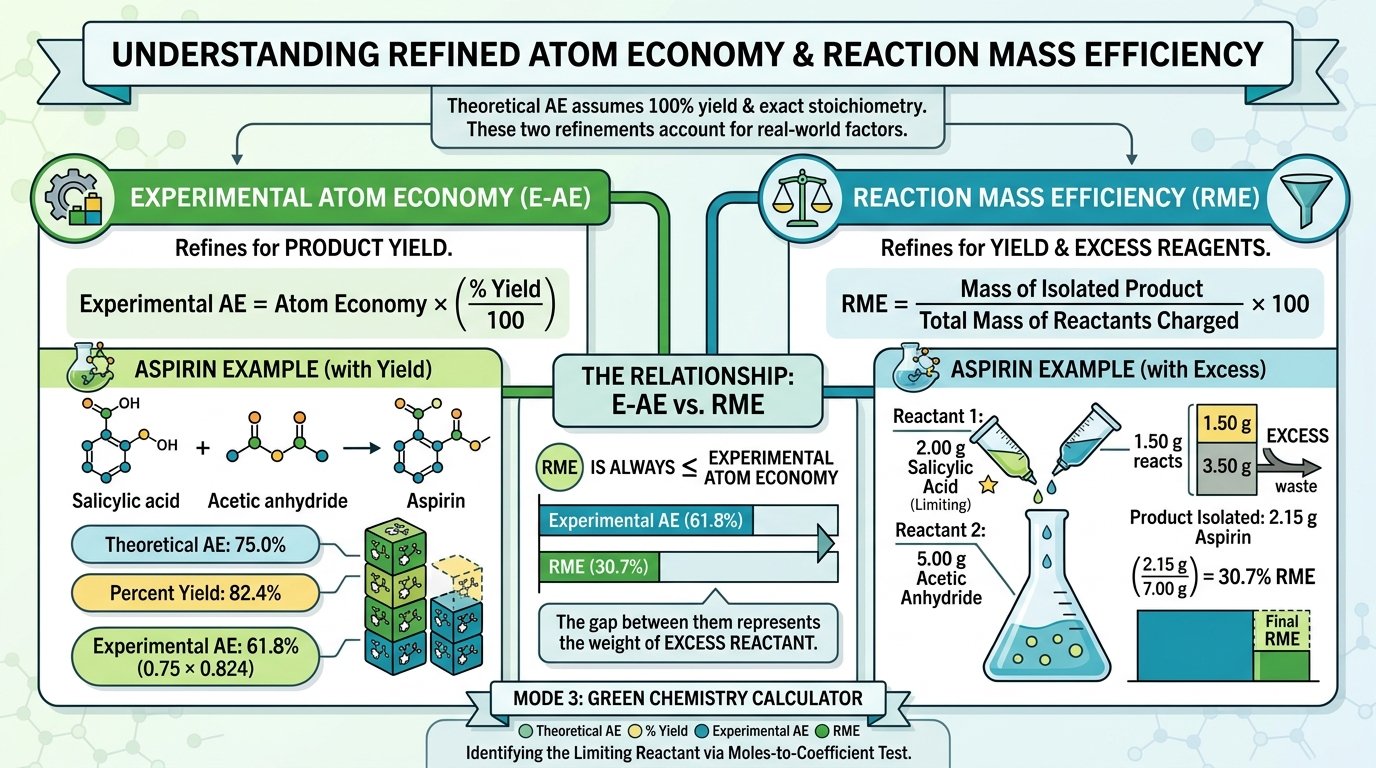
| Aspirin example | 75.0% (fixed) | 82.4% for a typical student run |
| Combined | Experimental atom economy = AE × yield = 0.750 × 0.824 = 61.8% of the reactant mass ends up as isolated aspirin | |
Students mix the two up because both are percentages of “efficiency”, and both are printed by the atom economy calculator in Mode 3. The cleanest test: if you could improve the number by being a better experimentalist, it is yield; if you could only improve it by changing the chemistry, it is atom economy. The percent yield calculator covers the experimental side; the atom economy calculator covers the equation side, and Mode 3 multiplies them.
Experimental Atom Economy and Reaction Mass Efficiency
Because theoretical atom economy assumes 100% yield and exact stoichiometric amounts, two refinements are built into the atom economy calculator:
Experimental atom economy = atom economy × (percent yield / 100). Aspirin at 75.0% AE and 82.4% yield: 61.8%.
Reaction mass efficiency (RME) = mass of isolated product ÷ total mass of reactants actually charged × 100. It penalises excess reagent as well as yield: 2.15 g aspirin from 2.00 g salicylic acid + 5.00 g anhydride = 2.15/7.00 = 30.7%, because 3.5 g of anhydride was excess.
RME is always ≤ experimental atom economy, and the gap between them is the excess reactant. Mode 3 of the atom economy calculator reports theoretical AE, percent yield, experimental AE and RME together, with the limiting reactant identified by the same moles-to-coefficient test the limiting reactant calculator uses.
Reference Table: 40 Reactions
All values from the atom economy calculator with IUPAC 2021 atomic weights. Desired product in bold in the equation column.
| # | Reaction (desired product in bold) | Type | Atom economy | Main by-product |
|---|---|---|---|---|
| 1 | C2H4 + H2O → C2H5OH | addition | 100% | none |
| 2 | C6H12O6 → 2C2H5OH + 2CO2 | decomposition | 51.1% | CO2 |
| 3 | Fe2O3 + 3CO → 2Fe + 3CO2 | extraction | 45.8% | CO2 |
| 4 | Fe2O3 + 3H2 → 2Fe + 3H2O | extraction | 67.4% | H2O |
| 5 | Fe2O3 + 2Al → 2Fe + Al2O3 | redox | 52.3% | Al2O3 |
| 6 | CH4 + H2O → CO + 3H2 | reforming | 17.8% | CO |
| 7 | 2H2O → 2H2 + O2 | electrolysis | 11.2% | O2 |
| 8 | TiCl4 + 2Mg → Ti + 2MgCl2 | extraction | 20.1% | MgCl2 |
| 9 | CaCO3 → CaO + CO2 | decomposition | 56.0% | CO2 |
| 10 | 2Na + Cl2 → 2NaCl | combination | 100% | none |
| 11 | N2 + 3H2 → 2NH3 | combination | 100% | none |
| 12 | CH3OH + CO → CH3COOH | carbonylation | 100% | none |
| 13 | C2H5OH + O2 → CH3COOH + H2O | oxidation | 76.9% | H2O |
| 14 | 2C2H4 + O2 → 2C2H4O | direct oxidation | 100% | none |
| 15 | C2H4 + Cl2 + Ca(OH)2 → C2H4O + CaCl2 + H2O | chlorohydrin | 25.5% | CaCl2 |
| 16 | C3H6 + H2O2 → C3H6O + H2O | HPPO epoxidation | 76.3% | H2O |
| 17 | C7H6O3 + C4H6O3 → C9H8O4 + CH3COOH | acylation | 75.0% | acetic acid |
| 18 | CH3COOH + C2H5OH → CH3COOC2H5 + H2O | esterification | 83.0% | H2O |
| 19 | C6H5NO2 + 3H2 → C6H5NH2 + 2H2O | catalytic reduction | 72.1% | H2O |
| 20 | C6H5NO2 + 3Fe + 6HCl → C6H5NH2 + 3FeCl2 + 2H2O | Béchamp reduction | 18.4% | FeCl2 |
| 21 | C6H6 + HNO3 → C6H5NO2 + H2O | substitution | 87.2% | H2O |
| 22 | C4H9OH + NaBr + H2SO4 → C4H9Br + NaHSO4 + H2O | substitution | 49.9% | NaHSO4 |
| 23 | C6H11OH → C6H10 + H2O | elimination | 82.0% | H2O |
| 24 | C6H5COCH3 + 3NaOCl → C6H5COONa + CHCl3 + 2NaOH | haloform | 42.0% | CHCl3 |
| 25 | Ibuprofen, Boots route (6 steps) | stoichiometric | ~40% | AlCl3 waste, salts |
| 26 | Ibuprofen, BHC route (3 steps) | catalytic | 77% (99% with acetic acid recovered) | acetic acid |
| 27 | CuO + H2 → Cu + H2O | reduction | 77.9% | H2O |
| 28 | 2CuO + C → 2Cu + CO2 | reduction | 74.3% | CO2 |
| 29 | 2Al2O3 → 4Al + 3O2 | electrolysis | 52.9% | O2 (as CO2 at the anode) |
| 30 | 2NaCl + 2H2O → 2NaOH + Cl2 + H2 | chlor-alkali | 52.3% | Cl2 (co-product, sold) |
| 31 | 2SO2 + O2 → 2SO3 | combination | 100% | none |
| 32 | C2H4 + H2 → C2H6 | hydrogenation | 100% | none |
| 33 | C4H6 + C2H4 → C6H10 | Diels–Alder | 100% | none |
| 34 | CH3Br + NaOH → CH3OH + NaBr | SN2 | 23.7% | NaBr |
| 35 | C6H5CHO + Ph3P=CH2 → C6H5CH=CH2 + Ph3PO | Wittig | 27.2% | Ph3PO |
| 36 | Mg + 2HCl → MgCl2 + H2 | displacement | 2.1% | MgCl2 |
| 37 | Zn + CuSO4 → ZnSO4 + Cu | displacement | 28.3% | ZnSO4 |
| 38 | 2KClO3 → 2KCl + 3O2 | decomposition | 39.2% | KCl |
| 39 | CO2 + 3H2 → CH3OH + H2O | hydrogenation | 64.0% | H2O |
| 40 | n C2H4 → (C2H4)n | addition polymerisation | 100% | none |
E-Factor and Process Mass Intensity
Roger Sheldon’s E-factor turns the atom economy calculator’s percentage into something a plant manager can weigh: kilograms of waste per kilogram of product. From the equation alone, the theoretical E-factor is (100 − AE)/AE — 1.18 for blast-furnace iron, 3.97 for Kroll titanium, 0 for any 100% addition. The real E-factor includes everything else that leaves the process as waste: solvents, excess reagents, work-up salts, yield losses. Process mass intensity (PMI) is the same idea counted from the input side: total mass of all materials ÷ mass of product, so PMI = E + 1.
| Industry sector (Sheldon) | Annual product (t) | E-factor (kg waste / kg product) |
|---|---|---|
| Oil refining | 106–108 | < 0.1 |
| Bulk chemicals | 104–106 | < 1–5 |
| Fine chemicals | 102–104 | 5–50 |
| Pharmaceuticals | 10–103 | 25–100+ |
Mode 4 of the atom economy calculator reports the theoretical E-factor from the equation, scales the by-product mass to any production quantity (1000 kg of aniline by catalytic hydrogenation → 387 kg of water; by the old iron/HCl Béchamp route → 4.4 tonnes of iron salts), and, if you enter the real input and output masses, the real E-factor and PMI. The gap between theoretical and real is where solvent recycling and reagent choice make their difference.
Comparing Routes: Ethanol, Ibuprofen, Ethylene Oxide
Ibuprofen is the textbook atom economy calculator case. The original Boots synthesis (1960s) took six stoichiometric steps — Friedel–Crafts acylation with AlCl3, a Darzens reaction, hydroxylamine, dehydration, hydrolysis — with an overall atom economy of about 40%; most of the mass of every reagent ended up as aluminium waste and salts. The BHC (Boots–Hoechst–Celanese) process introduced in 1992 uses three catalytic steps (HF-catalysed acylation, Raney-nickel hydrogenation, palladium-catalysed carbonylation) with 77% atom economy, rising to 99% when the acetic acid by-product is recovered. It won a Presidential Green Chemistry Challenge Award in 1997 and makes a large share of the world’s ibuprofen.
Ethylene oxide: the chlorohydrin route (C2H4 + Cl2 + Ca(OH)2 → C2H4O + CaCl2 + H2O) has 25.5% atom economy and a mountain of calcium chloride; direct silver-catalysed oxidation (2C2H4 + O2 → 2C2H4O) is 100% and replaced it worldwide. Propylene oxide is following the same path with the HPPO process (H2O2 oxidant, water by-product, 76%). Acetic acid: the Cativa/Monsanto carbonylation of methanol is 100%, versus 77% for ethanol oxidation. Mode 5 of the atom economy calculator sets any two of these side by side and reports the by-product saved per tonne.
The Twelve Principles of Green Chemistry
Atom economy — the metric behind this atom economy calculator — is principle 2 of the twelve set out by Paul Anastas and John Warner in 1998. The others put it in context: 1 prevention of waste; 3 less hazardous syntheses; 4 safer products; 5 safer solvents; 6 energy efficiency; 7 renewable feedstocks; 8 fewer derivatisations (protecting groups cost atoms); 9 catalysis over stoichiometric reagents; 10 design for degradation; 11 real-time analysis; 12 inherently safer chemistry. Principles 8 and 9 are really atom economy in disguise: every protecting group added and removed, and every stoichiometric reagent, adds mass to the denominator without adding it to the product. An atom economy calculator is the quickest way to see the cost of a protecting-group strategy before it is tried.
Why Catalysis Improves Atom Economy
A catalyst does not appear in the balanced equation, so it does not appear in the atom economy calculator’s denominator. Replacing a stoichiometric reagent with a catalytic one therefore removes an entire term. Reducing nitrobenzene with iron and hydrochloric acid (Béchamp) has an atom economy of 18.4% because three moles of iron and six of HCl become FeCl2 waste; catalytic hydrogenation over nickel gives 72.1% with water as the only by-product. Oxidising an alcohol with chromic acid (Jones) puts chromium salts in the denominator; catalytic aerobic oxidation with O2 puts only water in the by-products. The atom economy calculator ignores catalysts automatically when you leave them out of the equation, which is correct — but remember to include any reagent that is genuinely consumed.
When By-Products Are Useful
An atom economy calculator counts every non-desired product as waste, but industry often sells or recycles them. In the chlor-alkali process (2NaCl + 2H2O → 2NaOH + Cl2 + H2) the “by-product” chlorine is worth as much as the sodium hydroxide; the atom economy is 52% for NaOH, 46% for Cl2, and effectively 100% for the plant because everything is sold. Kroll magnesium chloride is electrolysed back to magnesium. Acetic acid from aspirin manufacture is recovered. A low atom economy is therefore a warning, not a verdict: the question that follows is whether the by-product has a use. The atom economy calculator lists every by-product with its mass share so that this judgement can be made explicitly.
Who Uses an Atom Economy Calculator
🎓 GCSE, A-level and IB students
Atom economy is a named specification point; exam questions give molar masses and ask for the percentage and a comparison of routes.
🌿 Green-chemistry courses
Experimental atom economy, RME and E-factor for lab practicals.
🔬 Synthetic chemists
Screening routes on paper before committing to the bench.
🏭 Process development
PMI targets, waste-disposal costing, sustainability reporting.
📊 Sustainability analysts
Stoichiometric CO2 floors for metals, cement and hydrogen.
📚 Teachers
Generating comparison tables and model answers.
Full Walkthrough: An Exam Question
Question. A standard atom economy calculator exam item: ethanol can be made by fermentation of glucose or by hydration of ethene. (a) Calculate the atom economy of each route. (b) Explain why the route with the lower atom economy may still be preferred. (Mr: glucose 180, ethanol 46, CO2 44, ethene 28, water 18.)
(a) Fermentation. C6H12O6 → 2C2H5OH + 2CO2. Desired product 2 × 46 = 92; reactants 180. Atom economy = 92/180 × 100 = 51.1%.
Hydration. C2H4 + H2O → C2H5OH. Desired product 46; reactants 28 + 18 = 46. Atom economy = 100%.
(b) Fermentation uses a renewable feedstock (sugar cane, maize) at low temperature and pressure (about 35 °C, 1 atm) with a biological catalyst, and the CO2 can be captured; hydration uses ethene from non-renewable crude oil at about 300 °C and 60–70 atm with a phosphoric acid catalyst. Atom economy is only one criterion; energy use, feedstock sustainability, yield per pass and product purity all count.
Check with the tool. Mode 5 of the atom economy calculator with both equations and product C2H5OH returns 100% vs 51.1% and 957 kg of CO2 per tonne of fermentation ethanol.
A Short History of the Concept
The idea behind every atom economy calculator dates from 1991, when Barry Trost of Stanford published “The Atom Economy — A Search for Synthetic Efficiency” in Science in 1991, arguing that synthetic chemists judged reactions by yield and selectivity while ignoring how many atoms of the reagents were thrown away. Roger Sheldon, working at DSM in the Netherlands, had introduced the E-factor a year earlier from the industrial side, after tabulating the tonnes of waste per tonne of product across sectors. Paul Anastas and John Warner codified both ideas in Green Chemistry: Theory and Practice (1998) as principles 1 and 2 of twelve. Trost received the Presidential Green Chemistry Challenge Award in 1998 for the concept; the BHC ibuprofen process (1997) and later Pfizer’s sertraline redesign (2002) became the standard industrial illustrations. Reaction mass efficiency and process mass intensity followed from GlaxoSmithKline and the ACS Green Chemistry Institute Pharmaceutical Roundtable in the 2000s. An atom economy calculator now reproduces in a click what Trost tabulated by hand.
Limits: What Atom Economy Does Not Measure
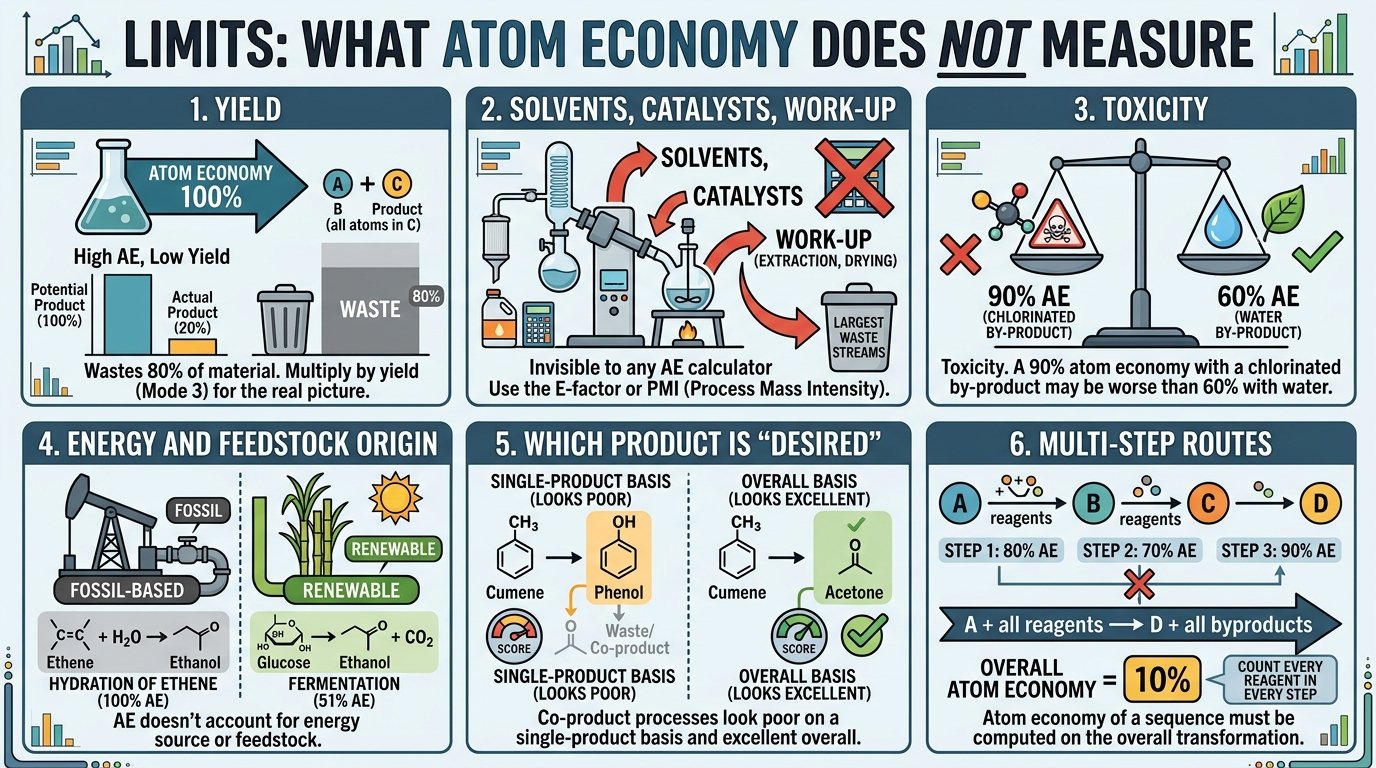
- Yield. An atom economy calculator can report 100% for a reaction that runs at 20% yield and wastes 80% of the material. Multiply by yield (Mode 3) for the real picture.
- Solvents, catalysts, work-up. These are usually the largest waste streams, invisible to any atom economy calculator, in fine-chemical processes and never appear in the equation. Use the E-factor or PMI.
- Toxicity. A 90% atom economy with a chlorinated by-product may be worse than 60% with water.
- Energy and feedstock origin. Hydration of ethene is 100% atom-economical and fossil-based; fermentation is 51% and renewable.
- Which product is “desired”. Co-product processes (chlor-alkali, cumene → phenol + acetone) look poor on a single-product basis and excellent overall.
- Multi-step routes. Atom economy of a sequence must be computed on the overall transformation, counting every reagent in every step, not averaged over steps.
Practice Problems With Answers
Work each one, then check with the atom economy calculator (IUPAC 2021 molar masses).
1. Atom economy of CaO from CaCO3 → CaO + CO2?
Answer: 56.08/100.09 = 56.0%.
2. Atom economy of H2 from CH4 + H2O → CO + 3H2?
Answer: 6.05/34.06 = 17.8%.
3. Atom economy of Ti from TiCl4 + 2Mg → Ti + 2MgCl2?
Answer: 47.87/238.29 = 20.1%.
4. Atom economy of aspirin from salicylic acid + acetic anhydride?
Answer: 180.16/240.21 = 75.0%.
5. Compare Fe from Fe2O3 by CO and by H2.
Answer: CO route 45.8%; H2 route 111.69/165.74 = 67.4%.
6. Why is C2H4 + H2O → C2H5OH 100% atom-economical?
Answer: It is an addition: the only product is the desired one, so product mass = reactant mass.
7. Theoretical E-factor for a reaction with 40% atom economy?
Answer: (100 − 40)/40 = 1.5 kg waste per kg product.
8. Experimental atom economy of aspirin at 75.0% AE and 82.4% yield?
Answer: 0.750 × 0.824 = 61.8%.
9. RME when 2.15 g aspirin is made from 2.00 g salicylic acid and 5.00 g anhydride?
Answer: 2.15/7.00 = 30.7%.
10. A route with 25% atom economy makes 1 tonne of product. Minimum by-product mass?
Answer: 3 tonnes (E = 75/25 = 3).
Tips for Accurate Results
- Balance first. Coefficients multiply molar masses; an unbalanced equation gives a wrong percentage even if every M is right. The atom economy calculator balances automatically and shows the coefficients.
- Name the desired product. The same equation has a different atom economy for each product, which is why the atom economy calculator asks.
- Include every consumed reagent (acids, bases, oxidants) in the atom economy calculator and exclude catalysts and solvents.
- Use the same molar-mass table throughout — the atomic mass calculator and this tool share IUPAC 2021 values.
- Check that product atom economies sum to 100%. If not, a coefficient or M is wrong.
- For multi-step routes, write the overall equation with all reagents from all steps and compute once.
- Quote yield alongside atom economy in any report; neither is meaningful alone.
Common Mistakes
| Mistake | Symptom | Fix |
|---|---|---|
| Forgetting coefficients | 55.85/243.72 = 22.9% instead of 45.8% for Fe | Multiply each M by its coefficient (the atom economy calculator does this automatically) |
| Dividing by the mass of products excluding the desired one | Percentages above 100% | Denominator = all reactants (= all products) |
| Confusing atom economy with yield | “Improved atom economy by better technique” | Atom economy is fixed by the equation |
| Including the catalyst | Atom economy too low | Catalysts are not reactants |
| Omitting a consumed reagent (e.g. the base) | Atom economy too high | Write the full equation |
| Using actual masses instead of molar masses | Result changes with scale or with excess reagent | Use coefficient × M; actual masses give RME, not AE |
| Averaging atom economies over steps | Overstated overall figure | Compute on the overall equation |
| Treating 100% atom economy as “green” by itself | Ignores energy, hazards, yield | Use with yield, E-factor and the other eleven principles |
How This Calculator Is Different
| Feature | This atom economy calculator | Typical online tools |
|---|---|---|
| Input | Any equation, auto-balanced, molar masses looked up | Two molar-mass numbers |
| Output | %, by-product breakdown, wasted mass, E-factor, reaction-type note, mass-conservation check | Percentage only |
| Green metrics | Experimental AE, RME, real E-factor, PMI, waste per tonne | Not available |
| Route comparison | Two equations side by side | Not available |
| Working and export | Every step; table; chart; copy, CSV, TXT, print, share, history | Final number |
Related tools: the percent yield calculator, theoretical yield calculator, limiting reactant calculator, stoichiometry calculator and grams to moles calculator complete the reaction arithmetic; the formal charge calculator and oxidation number calculator cover bonding and redox. Molar masses: atomic mass calculator, formula weight calculator, molar mass of hydrates calculator, exact mass calculator, monoisotopic mass calculator, isotopic mass calculator, average vs monoisotopic mass. Formulas from data: empirical formula, molecular formula, percent composition, combustion analysis, degree of unsaturation. Solutions and gases: molarity, equivalent weight, freezing point depression, boiling point elevation, osmotic pressure, vapor density, gas density, van der Waals. Polymers: average molecular weight of a mixture, number average, weight average, polydispersity index, viscosity.
Where the Numbers Come From
The atom economy calculator uses IUPAC 2021 standard atomic weights for molar masses. Definitions of atom economy, E-factor and the green-chemistry principles follow the primary literature and IUPAC:
- IUPAC Gold Book — atom economy: the formal definition.
- US EPA — Basics of Green Chemistry: the twelve principles, including atom economy as principle 2.
- CIAAW — Standard atomic weights: source of every molar mass used.
- Wikipedia — Atom economy: Trost’s concept with examples and its relationship to yield and E-factor.
Found an error? See our corrections policy, contact us, or read about the site.
Exam Checklist
☐ Equation balanced; desired product identified
☐ Coefficient × Mr for the desired product
☐ Coefficient × Mr summed over all reactants
☐ Divide, × 100, quote to 3 significant figures with the % sign (check against the atom economy calculator)
☐ State the by-product(s) and whether they are useful or waste
☐ If asked to compare routes: atom economy, yield, energy, feedstock, hazards
☐ Never say a better technique improved atom economy — that is yield
Frequently Asked Questions
How do you calculate atom economy?
Multiply the molar mass of the desired product by its coefficient, divide by the sum of (coefficient × molar mass) of all reactants in the balanced equation, and multiply by 100. The atom economy calculator balances the equation and looks up the molar masses for you.
What is the difference between atom economy and percent yield?
Atom economy (what an atom economy calculator reports) is fixed by the balanced equation and says how much reactant mass can become product at best. Percent yield says how much of the theoretical product you actually obtained in an experiment. Multiply them for the experimental atom economy.
Which reactions have 100% atom economy?
Addition reactions (hydration, hydrogenation, Diels–Alder, addition polymerisation), combination reactions and rearrangements — any reaction with a single product.
Can atom economy be more than 100%?
No. The desired product cannot weigh more than all the reactants. If you or an atom economy calculator get more than 100%, a coefficient or molar mass is wrong, or you divided by the by-products instead of the reactants.
Does the amount of reactant used affect atom economy?
No. The atom economy calculator uses only molar masses and coefficients, so the result is the same at any scale and does not depend on excess reagent. Reaction mass efficiency is the metric that does account for actual masses.
Why is a high atom economy important?
Less by-product means less raw material bought, less waste to treat or dispose of, lower cost and lower environmental impact. It is the second of the twelve principles of green chemistry.
What is the E-factor?
Kilograms of waste per kilogram of product. From the equation alone it equals (100 − atom economy)/atom economy; the real E-factor also counts solvents, excess reagents and yield losses. Mode 4 of the atom economy calculator reports both.
Do catalysts count in atom economy?
No. Catalysts are not consumed and do not appear in the balanced equation you give the atom economy calculator. Replacing a stoichiometric reagent with a catalyst is one of the main ways to raise atom economy.
Why might a route with lower atom economy still be chosen?
Renewable feedstock, lower energy use, safer reagents, higher yield, cheaper raw materials, or a saleable by-product can outweigh the atom economy calculator’s verdict. Fermentation ethanol (51%) versus ethene hydration (100%) is the standard example.
Is this atom economy calculator free?
Yes. It runs in your browser with no sign-up, works on mobile and stores the last ten calculations locally.
10 Facts Worth Knowing
- Barry Trost coined “atom economy” — and therefore, eventually, the atom economy calculator — in a 1991 Science paper and received the Presidential Green Chemistry Challenge Award for it in 1998.
- The BHC ibuprofen process raised atom economy from about 40% to 77% (99% with acetic acid recovery) and cut the route from six steps to three.
- Pharmaceutical manufacturing typically generates 25–100 kg of waste per kilogram of drug; oil refining generates less than 0.1 kg.
- Making hydrogen by electrolysis of water has an atom economy of only 11.2% for H2 — the oxygen is 88.8% of the mass.
- Every tonne of blast-furnace iron carries a stoichiometric minimum of 1.18 tonnes of CO2; hydrogen reduction replaces it with 0.48 tonnes of water.
- The Wittig reaction, indispensable in synthesis, typically has an atom economy below 30% because triphenylphosphine oxide (278 g/mol) is the by-product.
- Addition polymerisation of ethene to polyethylene is 100% atom-economical — one reason polyolefins are so cheap.
- The chlor-alkali process is only 52% atom-economical for NaOH, yet nearly waste-free because chlorine and hydrogen are both sold.
- Sheldon introduced the E-factor in 1992 after noticing that fine-chemical plants produced far more waste than product.
- Atom economy is calculated once for a reaction (one atom economy calculator run) and never changes; yield is measured every time and always does.
Final Thoughts
Atom economy asks a question that yield cannot: of all the atoms you bought, how many did you actually want? The answer is fixed the moment the equation is written, which makes it the fastest possible screen for a synthetic route — and the reason additions and catalytic methods dominate green chemistry. The atom economy calculator on this page balances the equation, weighs every species, names the by-products and converts the percentage into kilograms of waste, so that the comparison between two routes takes seconds. Pair it with the percent yield calculator and you have both halves of the efficiency story.
About the author
Ahmad Raza, M.Phil. Chemistry
Ahmad has taught general and analytical chemistry for over a decade and builds the calculators on this site. He writes every guide from the perspective of the student who has to get the exam question right, and cross-checks every number against IUPAC data. Reach him at contact@molecularweightcalculator.org.