
Percent Yield Calculator
Percent yield = actual yield ÷ theoretical yield × 100. Enter what you isolated and either the theoretical yield or the reaction and reactant amounts — the calculator balances the equation, finds the limiting reactant, computes the theoretical yield and reports the percent yield with every step. Also solves for the actual or theoretical yield, chains multi-step yields and computes percent recovery after purification.
✓ Trusted by students, teachers & lab chemistsPercent Yield from Actual and Theoretical Yield
Fill any two of the three linked quantities and the calculator solves the third. Grams and moles can be mixed if you give the product formula so the molar mass is looked up.
Percent Yield from the Reaction, Reactant Amounts and Actual Yield
Type the equation (balanced or not), the amount of each reactant (g, mg, kg, mol, mmol or mL + M, separated by semicolons or new lines), the product you isolated and how much. The calculator finds the limiting reactant, the theoretical yield and the percent yield.
Percent Yield from One Limiting Reactant and a Mole Ratio
When you already know the limiting reactant, skip the full equation: enter its formula, coefficient and amount, the product formula and coefficient, and the mass (or moles) you obtained.
Overall Percent Yield of a Multi-Step Synthesis
Enter the percent yield of each step (comma-separated) to get the overall yield, or enter a target overall yield and the number of steps to find the average yield each step must reach. Optionally give a starting amount and molar masses to convert to mass.
Percent Recovery after Purification and Purity-Corrected Yield
Percent recovery = mass recovered ÷ mass before purification × 100 (recrystallization, distillation, extraction). If the crude product had a known purity, the calculator also gives the yield of pure material and the overall yield when combined with the reaction's percent yield.
🕘 Recent calculations
- No calculations yet — your last 10 results will appear here.
Formulas: percent yield = actual yield / theoretical yield × 100 · theoretical yield = nlimiting × (coefproduct/coeflimiting) × Mproduct · limiting reactant = smallest n/coefficient · overall yield of n steps = product of fractional step yields · required per-step yield = (overall)1/n · percent recovery = recovered mass / initial mass × 100 · IUPAC 2021 atomic weights.
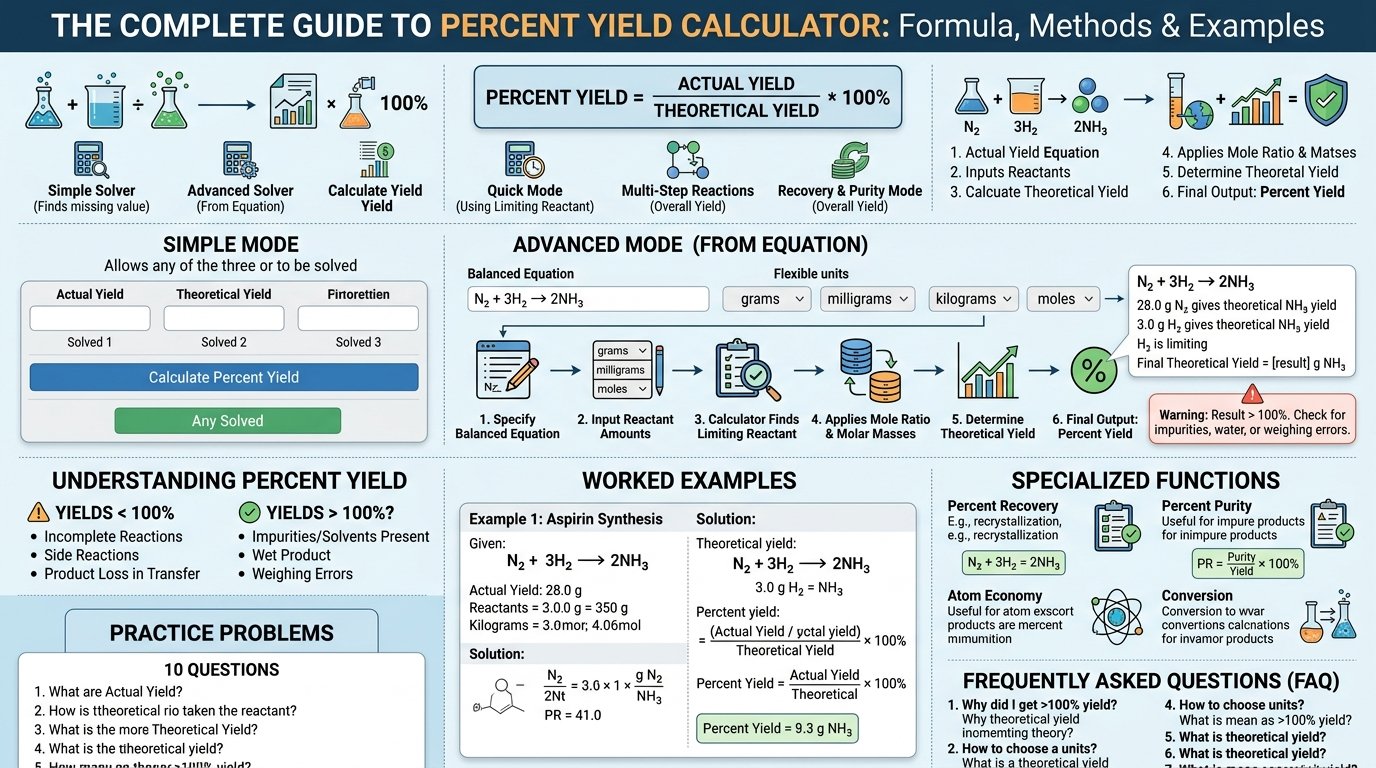
A percent yield calculator compares what a reaction actually produced with what it could have produced: percent yield = actual yield ÷ theoretical yield × 100. Type the two masses and it gives the percentage; type the balanced equation and the reactant amounts and it works out the theoretical yield for you first — limiting reactant, mole ratio, molar mass — then divides your actual yield by it, with every step shown and a warning if the result is impossibly above 100%.
The free percent yield calculator above has five modes: a simple solver that finds percent yield, actual yield or theoretical yield from the other two; a full solver from a chemical equation; a quick mode from one limiting reactant and a mole ratio; a multi-step mode for overall yield and the per-step yield needed to hit a target; and a percent recovery and purity mode for recrystallisations and impure products. Units mix freely — grams, milligrams, kilograms, moles and millimoles.
This guide explains the formula, why yields fall below 100% and what it means when they exceed it, worked examples from the aspirin lab to the Haber process, a reference table of solved problems, the difference between percent yield, percent recovery, atom economy and conversion, ten practice problems, and answers to the questions that come up most.
Key Takeaway
Percent yield = (actual yield ÷ theoretical yield) × 100, both in the same unit. The theoretical yield comes from the limiting reactant and the balanced equation; the actual yield is the mass of pure, dry product you weighed. 2.15 g of aspirin from a theoretical 2.61 g is 82.4%. A result above 100% means the product is wet or impure, or the theoretical yield was calculated from the wrong reactant.
📑 Table of Contents (click to expand)
- What Is Percent Yield?
- How to Use the Percent Yield Calculator
- The Five Modes Explained
- The Percent Yield Formula and Its Rearrangements
- Worked Example: Aspirin Step by Step
- More Worked Examples
- Getting the Theoretical Yield Right
- Why Percent Yield Is Below 100%
- Percent Yield Above 100%: What Went Wrong
- Reference Table: 30 Solved Problems
- Multi-Step Syntheses: Overall Yield
- Percent Recovery vs Percent Yield
- Purity-Corrected Yield
- Yield, Conversion, Selectivity and Atom Economy
- What Is a Good Percent Yield?
- Who Uses a Percent Yield Calculator
- Full Walkthrough: A Precipitation Lab
- A Short History of Reporting Yield
- Limits of the Number
- Practice Problems With Answers
- Tips for Accurate Results
- Common Mistakes
- How This Calculator Is Different
- Where the Numbers Come From
- Lab Report Checklist
- Frequently Asked Questions
- 10 Facts Worth Knowing
- Final Thoughts
What Is Percent Yield?
Percent yield — the quantity a percent yield calculator reports — is the efficiency of a chemical reaction expressed as a percentage: the amount of product actually obtained divided by the amount that stoichiometry says could have been obtained, times 100. The numerator is the actual yield — measured on a balance after the product has been isolated, purified and dried. The denominator is the theoretical yield — calculated from the limiting reactant and the balanced equation, assuming complete conversion and no losses.
The number matters because it is the one figure that summarises how well a preparation worked. A synthesis paper reports every step’s yield; a plant manager tracks yield batch by batch; an exam question gives you masses and asks for it. A percent yield calculator removes the arithmetic so the attention goes where it belongs — on whether the theoretical yield was computed from the right reactant and whether the actual yield was really pure product.
Percent yield is dimensionless: as long as actual and theoretical are in the same unit (both grams, both moles, both litres of gas) the ratio is the same. The percent yield calculator accepts mixed units and converts through the product’s molar mass, so 245 mg of actual product against 0.310 g theoretical comes out correctly as 79.0%.
The three quantities
Theoretical yield — maximum product from the limiting reactant: nlim × (coef ratio) × Mproduct.
Actual yield — the mass (or moles) of pure product isolated.
Percent yield — actual ÷ theoretical × 100. Always ≤ 100% for pure product.
How to Use the Percent Yield Calculator
- Pick what you know. If you already have the theoretical yield, use Mode 1: choose which of the three quantities to solve for, enter the other two (any units), click Calculate. If you have only the equation and the reactant amounts, use Mode 2.
- Mode 2 inputs. Type the equation (
C7H6O3 + C4H6O3 -> C9H8O4 + C2H4O2), the amount of each reactant (C7H6O3 2.0 g; C4H6O3 5.0 g), the product and the actual mass you obtained. The percent yield calculator balances the equation, finds the limiting reactant, computes the theoretical yield and then the percent yield. - Read the result. The answer box shows the percentage with a plain-language verdict (excellent, good, low, or “over 100% — wet or impure”); the steps show the moles, the limiting reactant, the theoretical yield and the division.
- Go further. Mode 4 chains steps for an overall yield; Mode 5 handles recrystallisation recovery and purity. Copy, download CSV/TXT, print or share; the last ten calculations stay in the history.
The Five Modes Explained
| Mode | You enter | You get | Best for |
|---|---|---|---|
| 1. Simple Solver | Any two of actual, theoretical, percent (g/mg/kg/mol/mmol) | The third, mass lost, verdict | Lab reports where theoretical yield is known |
| 2. From Equation | Equation, reactant amounts, product, actual yield | Limiting reactant, theoretical yield, percent yield, 6-step working | Exam problems, full lab write-ups |
| 3. One Reactant + Ratio | Limiting reactant mass or moles, coefficients, product formula, actual yield | Theoretical and percent yield | Quick checks when the limiting reactant is known |
| 4. Multi-Step | Per-step yields (or target overall and number of steps) | Overall yield, or required per-step yield; optional masses | Synthetic routes |
| 5. Recovery & Purity | Crude mass, recovered mass, optional purity and theoretical yield | Percent recovery, purity-corrected yield, overall yield | Recrystallisation, impure products |
The Percent Yield Formula and Its Rearrangements
% yield = (actual ÷ theoretical) × 100
actual = theoretical × (% yield ÷ 100) — expected mass at a known yield
theoretical = actual ÷ (% yield ÷ 100) — back-calculating the theoretical yield
All three forms of the percent yield calculator formula are the same equation, and Mode 1 of the percent yield calculator solves whichever is unknown. The second form is what you use to plan: a reaction known to run at 78% with a theoretical yield of 12.5 g should deliver 9.75 g. The third form appears in exam questions of the type “8.90 g of iron was obtained, an 86% yield; what was the theoretical yield?” — 8.90/0.86 = 10.35 g — and, combined with the stoichiometry, lets you back out how much reactant was used.
When the theoretical yield is not given, it must be calculated first, and that is where most of the work (and most of the errors) lie. See the theoretical yield calculator for that step in isolation; Mode 2 of the percent yield calculator does both steps together.
Worked Example: Aspirin Step by Step
Problem. The classic percent yield calculator question: 2.00 g of salicylic acid (C7H6O3) reacts with 5.00 g of acetic anhydride (C4H6O3). After recrystallisation and drying, 2.15 g of aspirin (C9H8O4) is obtained. Calculate the percent yield.
1. Balanced equation. C7H6O3 + C4H6O3 → C9H8O4 + CH3COOH (1 : 1 : 1 : 1).
2. Moles of reactants. Salicylic acid: 2.00 ÷ 138.12 = 0.01448 mol. Acetic anhydride: 5.00 ÷ 102.09 = 0.04898 mol.
3. Limiting reactant. Coefficients are equal, so the smaller mole amount limits: salicylic acid (0.01448 mol).
4. Theoretical yield. 0.01448 mol × (1/1) × 180.16 g/mol = 2.609 g aspirin.
5. Percent yield. 2.15 ÷ 2.609 × 100 = 82.4%.
6. Interpretation. Mass not recovered = 0.46 g — lost to incomplete reaction, solubility in the ice-water wash and transfer losses. A good undergraduate result.
Click the “Aspirin 2.15 g” chip in Mode 2 of the percent yield calculator to see exactly this working generated, or enter 2.15 and 2.61 in Mode 1 if the theoretical yield is already in your notebook.
More Worked Examples
Example 2: Thermite — 8.90 g of iron from 20.0 g Fe2O3 and 5.00 g Al
Fe2O3 + 2Al → Al2O3 + 2Fe. Al is limiting (0.1853/2 = 0.0927 < 0.1252); theoretical Fe = 0.1853 × 55.845 = 10.35 g; percent yield = 8.90/10.35 = 86.0%. Computing the theoretical yield from Fe2O3 instead (13.98 g) would give a spurious 63.7%, which is why the percent yield calculator always identifies the limiting reactant first.
Example 3: Haber process — 0.85 mol NH3 from 28.0 g N2 and 10.0 g H2
N2 limits (0.9995 mol); theoretical NH3 = 1.999 mol = 34.04 g; percent yield = 0.85/1.999 = 42.5%. Here actual and theoretical are both in moles — no conversion to grams is needed, though the percent yield calculator shows both.
Example 4: Thermal decomposition — 12.6 g CaO from 25.0 g CaCO3
CaCO3 → CaO + CO2. 25.0/100.09 = 0.2498 mol → 14.01 g CaO theoretical; 12.6/14.01 = 89.9%. The shortfall is usually undecomposed carbonate in the middle of the sample; the percent yield calculator reports the 1.41 g missing.
Example 5: Precipitation — 0.61 g AgCl from 25.0 mL of 0.200 M AgNO3 and 30.0 mL of 0.150 M NaCl
NaCl limits (4.50 mmol); theoretical AgCl = 4.50 × 143.32 = 0.645 g; 0.61/0.645 = 94.5%. Precipitations that are filtered carefully and dried to constant mass routinely reach 95–99%, and the percent yield calculator accepts the volumes and molarities directly.
Example 6: Gas evolution — 3.5 g O2 from 10.0 g KClO3
2KClO3 → 2KCl + 3O2. 0.08160 mol × 3/2 = 0.1224 mol = 3.916 g O2 theoretical; 3.5/3.916 = 89.4%. The 3/2 ratio is the step most often skipped; the percent yield calculator prints it.
Example 7: Solving backwards — what mass at 78%?
Set the percent yield calculator to solve for actual yield. Theoretical yield 12.5 g, expected yield 78%: actual = 12.5 × 0.78 = 9.75 g. This is the number you write on the pre-lab sheet as the expected result.
Getting the Theoretical Yield Right
Nine out of ten wrong answers from any percent yield calculator are wrong because the denominator typed into it was wrong. The theoretical yield must be computed from the limiting reactant: convert every reactant to moles, divide by its coefficient, and take the smallest quotient. Then multiply that quotient by the product’s coefficient and its molar mass. Three checks catch most errors:
- Did you balance? An unbalanced equation gives wrong mole ratios. Mode 2 of the percent yield calculator balances automatically and shows the coefficients.
- Did you use the limiting reactant? The reactant with the smaller mass is not necessarily limiting (28 g of N2 limits against 10 g of H2). The limiting reactant calculator covers this in depth.
- Did you use the product’s molar mass for the last step? Multiplying moles of product by the molar mass of the reactant is a common slip that gives a percent yield far from any sensible value.
Why Percent Yield Is Below 100%
| Cause | What happens | How to improve |
|---|---|---|
| Incomplete reaction / equilibrium | Limiting reactant not fully converted (esterification stops near 67%) | Longer time, excess of one reactant, remove a product |
| Side reactions | Reactant diverted to by-products (dinitration, elimination, polymerisation) | Lower temperature, better catalyst, controlled addition |
| Work-up losses | Product left in flask, on filter paper, dissolved in mother liquor or wash | Rinse with minimum cold solvent, scrape thoroughly |
| Purification losses | Recrystallisation typically discards 10–20% in the filtrate | Correct solvent volume, ice-bath cooling, second crop |
| Impure or wet reactants | Fewer moles of limiting reactant than the balance implied | Dry reagents; correct for assay purity |
| Volatile or gaseous product | Product escapes during heating or drying | Closed collection, gentle drying |
Percent Yield Above 100%: What Went Wrong
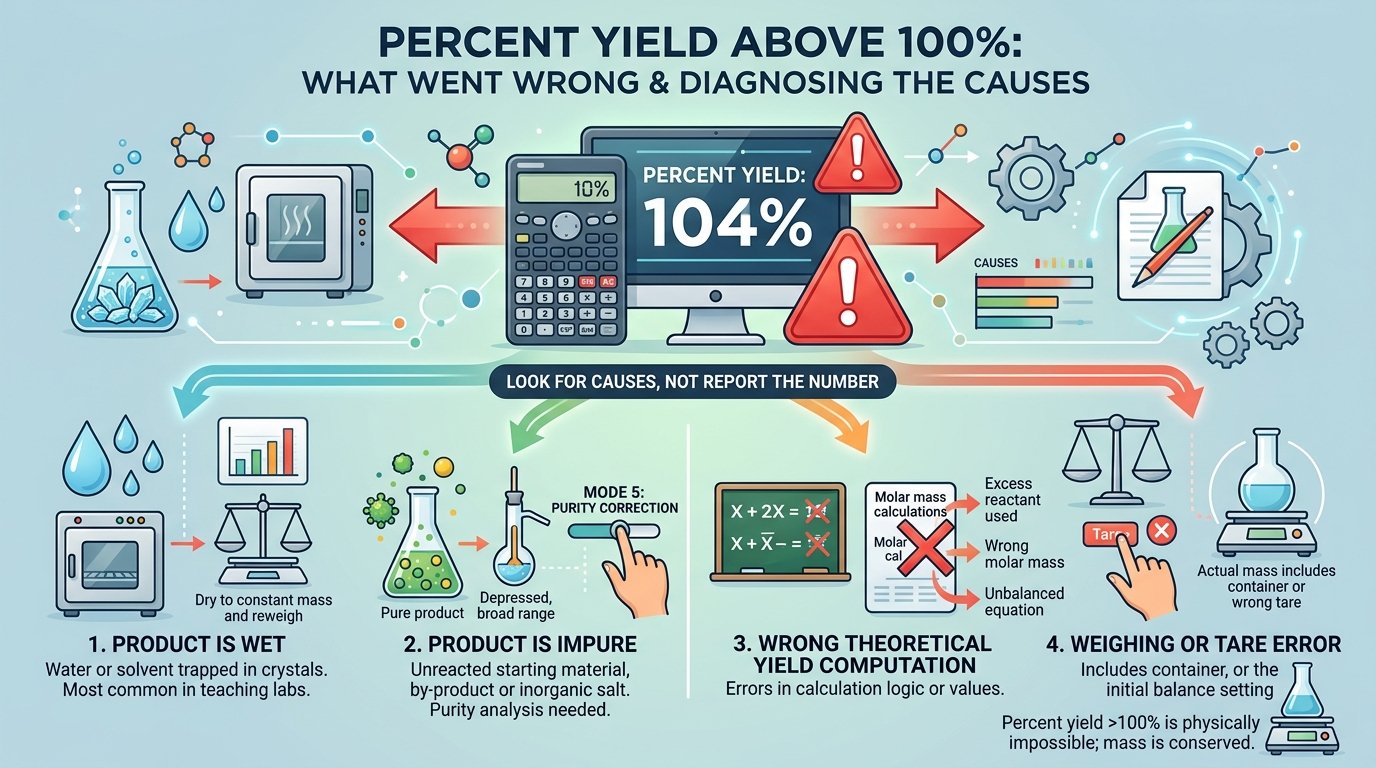
A percent yield over 100% — a result every percent yield calculator should flag — is physically impossible for pure product, because mass is conserved and the limiting reactant cannot give more than the stoichiometric amount. When the percent yield calculator reports 104% it flags the result, and one of four things is true:
- The product is wet. Water or solvent trapped in crystals is by far the most common cause in teaching labs. Dry to constant mass and reweigh.
- The product is impure. Unreacted starting material, by-product or inorganic salt was weighed along with it. A melting point will show a depressed, broad range. Mode 5 corrects the mass for a measured purity.
- The theoretical yield was computed wrongly — from the excess reactant, with an unbalanced equation, or with the wrong molar mass.
- The actual mass includes the container or the tare was wrong. It happens.
Occasionally a percent yield calculator result slightly above 100% is real within experimental error (a 99.5% reaction with a 1% weighing uncertainty). Anything above about 101% is a signal to look for one of the causes above rather than to report the number.
Reference Table: 30 Solved Problems
Every row was computed with the percent yield calculator using IUPAC 2021 atomic weights. Theoretical yields are from the limiting reactant; actual yields are typical laboratory values.
| # | Reaction and starting amounts | Product | Theoretical | Actual | % yield |
|---|---|---|---|---|---|
| 1 | Salicylic acid 2.00 g + Ac2O 5.00 g | aspirin | 2.609 g | 2.15 g | 82.4% |
| 2 | Fe2O3 20.0 g + Al 5.00 g | Fe | 10.35 g | 8.90 g | 86.0% |
| 3 | N2 28.0 g + H2 10.0 g | NH3 | 1.999 mol | 0.85 mol | 42.5% |
| 4 | CaCO3 25.0 g heated | CaO | 14.01 g | 12.6 g | 89.9% |
| 5 | AgNO3 25 mL 0.200 M + NaCl 30 mL 0.150 M | AgCl | 0.645 g | 0.61 g | 94.5% |
| 6 | KClO3 10.0 g heated | O2 | 3.916 g | 3.50 g | 89.4% |
| 7 | Zn 6.54 g + HCl 0.150 mol | H2 | 0.1512 g | 0.140 g | 92.6% |
| 8 | Cu 3.00 g + AgNO3 12.0 g | Ag | 7.62 g | 7.31 g | 95.9% |
| 9 | Pb(NO3)2 + KI, 50 mL 0.100 M each | PbI2 | 1.152 g | 1.10 g | 95.5% |
| 10 | Acetic acid 6.00 g + ethanol 4.60 g | ethyl acetate | 8.80 g | 5.80 g | 65.9% |
| 11 | Nitrobenzene 12.3 g + H2 excess | aniline | 9.31 g | 7.90 g | 84.9% |
| 12 | Benzene 10.0 g + HNO3 excess | nitrobenzene | 15.76 g | 13.4 g | 85.0% |
| 13 | Glucose 100 g fermented | ethanol | 51.1 g | 46.0 g | 90.0% |
| 14 | 1-Butanol 7.4 g + NaBr + H2SO4 excess | 1-bromobutane | 13.68 g | 9.60 g | 70.2% |
| 15 | Mg 1.00 g burned in air | MgO | 1.658 g | 1.60 g | 96.5% |
| 16 | Al 1.00 g → alum KAl(SO4)2·12H2O | alum | 17.58 g | 14.2 g | 80.8% |
| 17 | CuSO4·5H2O 5.00 g heated | CuSO4 | 3.196 g | 3.25 g | 101.7% ⚠ incomplete drying |
| 18 | NaHCO3 8.40 g heated | Na2CO3 | 5.30 g | 5.21 g | 98.3% |
| 19 | BaCl2 20 mL 0.50 M + Na2SO4 25 mL 0.30 M | BaSO4 | 1.750 g | 1.72 g | 98.3% |
| 20 | Cyclohexanol 10.0 g dehydrated | cyclohexene | 8.20 g | 5.9 g | 72.0% |
| 21 | Benzoic acid 2.00 g recrystallised | benzoic acid | 2.00 g (recovery) | 1.64 g | 82.0% recovery |
| 22 | Two-step: benzene → nitrobenzene (85%) → aniline (90%) | aniline | 11.92 g from 10 g | 9.12 g | 76.5% overall |
| 23 | Ten steps at 90% each | — | — | — | 34.9% overall |
| 24 | Target 50% overall in 5 steps | — | — | — | 87.1% per step needed |
| 25 | Theoretical 12.5 g at 78% expected | — | 12.5 g | 9.75 g expected | 78.0% |
| 26 | 8.90 g obtained at 86% | — | 10.35 g (back-calculated) | 8.90 g | 86.0% |
| 27 | 245 mg obtained, 0.310 g theoretical | — | 310 mg | 245 mg | 79.0% |
| 28 | Crude 5.00 g at 90% purity, 4.21 g recovered pure | — | 4.50 g pure in crude | 4.21 g | 93.6% of pure material |
| 29 | SiO2 100 g + C 50.0 g | SiC | 55.6 g | 50.1 g | 90.1% |
| 30 | TiCl4 100 g + Mg 30.0 g | Ti | 25.2 g | 23.9 g | 94.8% |
Multi-Step Syntheses: Overall Yield
When a product is made in several steps, the percent yield calculator switches to the overall yield, which is the product of the fractional yields of each step: 85% then 90% is 0.85 × 0.90 = 76.5%. Yields multiply, they do not average — which is why long linear routes are so punishing. Ten steps at 90% each leave 34.9%; twenty leave 12.2%.
Overall yield = y1 × y2 × … × yn (each as a fraction)
Required per-step yield for a target overall Y in n equal steps = Y1/n. For 50% in five steps: 0.501/5 = 87.1%.
Convergent routes: the overall yield is computed along the longest linear sequence, which is why convergent syntheses outperform linear ones.
Mode 4 of the percent yield calculator multiplies any list of step yields, optionally attaches masses (10.0 g benzene → 11.92 g theoretical aniline → 9.12 g at 76.5%), and solves the inverse question of what each step must achieve. It is the first thing a process chemist runs when deciding whether a route is worth developing.
Percent Recovery vs Percent Yield
Percent recovery, the other number a percent yield calculator is asked for, applies to a physical process — recrystallisation, extraction, distillation — in which no new substance is made: recovery = mass recovered ÷ mass started with × 100. Recrystallising 2.15 g of crude aspirin and isolating 1.72 g is an 80.0% recovery. Percent yield applies to a chemical reaction and is measured against the theoretical yield. The two chain together: an 82.4% reaction yield followed by an 80.0% recrystallisation recovery gives an overall isolated yield of 0.824 × 0.800 = 65.9% of the 2.61 g theoretical, i.e. 1.72 g.
Mode 5 of the percent yield calculator reports the recovery, and, if you give it the theoretical yield of the reaction, the overall yield after purification. In lab reports the two numbers should be stated separately: “crude yield 82%, recrystallised yield 66%”.
Purity-Corrected Yield
If the isolated product is not pure, the honest percent yield calculator answer is the mass of the pure compound it contains: corrected mass = isolated mass × purity fraction. 5.00 g of crude material assayed at 90% purity contains 4.50 g of product; if recrystallisation returns 4.21 g of pure material, the recovery is 84.2% of the crude mass but 93.6% of the pure compound that was there. Industrial yields are always quoted on an assay basis (“assay yield”) for this reason, and the percent yield calculator’s purity field does the correction. Note that purity corrections can only lower a yield — if a “corrected” yield goes above 100%, the theoretical yield is wrong.
Yield, Conversion, Selectivity and Atom Economy
| Metric | Definition | What it tells you |
|---|---|---|
| Percent yield | Product obtained ÷ theoretical product × 100 | Overall efficiency of reaction + isolation |
| Conversion | Reactant consumed ÷ reactant fed × 100 | How much starting material reacted (to anything) |
| Selectivity | Desired product ÷ reactant consumed (stoichiometric basis) × 100 | Fraction of reacted material that became the product you wanted |
| Atom economy | M(desired product) ÷ Σ M(reactants) × 100 from the balanced equation | How much reactant mass can end up in the product even at 100% yield |
Yield = conversion × selectivity (as fractions); a percent yield calculator reports the product of the two. A reaction can have 100% yield and terrible atom economy (a substitution that throws away a heavy leaving group) or 100% atom economy and a poor yield (an addition that stalls at equilibrium). Green chemists multiply the two: experimental atom economy = atom economy × yield. The atom economy calculator computes that side of the story.
What Is a Good Percent Yield?
It depends entirely on the reaction, so a percent yield calculator can only give broad bands. Simple precipitations and thermal decompositions run at 95–99%. Teaching-lab organic preparations (aspirin, esters, nitration) typically fall between 60 and 85%, and a report of 80% is good. Multi-step research syntheses average 70–90% per step. Equilibrium-limited reactions with 1:1 reactants stop where K says: Fischer esterification near 67%. Industrial processes that recycle unreacted feed report per-pass conversions of 15–30% but overall yields above 95%. In organic synthesis papers, anything below 50% invites scrutiny of the procedure; anything above 95% invites scrutiny of the purity. The verdict the percent yield calculator prints (excellent / good / moderate / low) uses these broad bands, but your instructor’s expectation for the specific experiment is the real benchmark.
Who Uses a Percent Yield Calculator
🎓 Students
Every stoichiometry exam and every synthesis lab report ends with a percent yield; the worked steps double as a model answer.
🔬 Research chemists
Yields for supporting information, multi-step overall yields for route comparison.
🏭 Process and QC chemists
Batch yield tracking, assay-corrected yields, deviation investigations.
💊 Pharmaceutical development
Cost of goods scales inversely with overall yield; the per-step target mode sets development goals.
📚 Teachers and TAs
Marking lab reports quickly and consistently; the reference table is a ready problem set.
🌿 Green-chemistry practitioners
Yield combined with atom economy and E-factor gives the full sustainability picture.
Full Walkthrough: A Precipitation Lab
Problem. A percent yield calculator problem with solutions: 20.0 mL of 0.500 M BaCl2 is added to 25.0 mL of 0.300 M Na2SO4. The BaSO4 precipitate is filtered, washed, dried and weighed: 1.72 g. Report the limiting reactant, theoretical yield and percent yield.
1. Equation. BaCl2 + Na2SO4 → BaSO4 + 2NaCl.
2. Moles. BaCl2: 0.500 × 0.0200 = 10.0 mmol. Na2SO4: 0.300 × 0.0250 = 7.50 mmol.
3. Limiting reactant. 1:1 coefficients → Na2SO4 (7.50 mmol) limits; 2.50 mmol BaCl2 remains in solution.
4. Theoretical yield. 7.50 mmol × 233.39 g/mol = 1.750 g BaSO4.
5. Percent yield. 1.72 ÷ 1.750 × 100 = 98.3%.
6. Report. “Sodium sulfate was limiting (7.50 mmol); theoretical yield of barium sulfate 1.75 g; isolated 1.72 g (98.3%). The 0.03 g shortfall is consistent with fines passing the filter.”
In the percent yield calculator: Mode 2 with BaCl2 20 mL 0.5 M; Na2SO4 25 mL 0.3 M, product BaSO4, actual 1.72.
A Short History of Reporting Yield
Long before any percent yield calculator, early chemists reported how much product they obtained, but not as a fraction of a theoretical maximum — there was no theoretical maximum until Lavoisier’s conservation of mass (1789), Proust’s law of definite proportions (1799) and Dalton’s atomic theory (1808) made stoichiometry possible. By the 1830s Liebig’s combustion analysis had fixed the formulas of hundreds of organic compounds, and Wöhler’s and Liebig’s preparations began to be described as giving a certain proportion “of the theory”. The phrase percent of theory was standard in German journals by the 1870s and in Fischer’s sugar work of the 1890s. In the twentieth century, Woodward and Corey made overall yield across dozens of steps a figure of merit, and in the 1990s Trost and Sheldon added atom economy and the E-factor to expose what yield alone hides. Today a percent yield calculator does in a click what those chemists did with log tables, but the number it reports means exactly what it meant to Fischer.
Limits of the Number
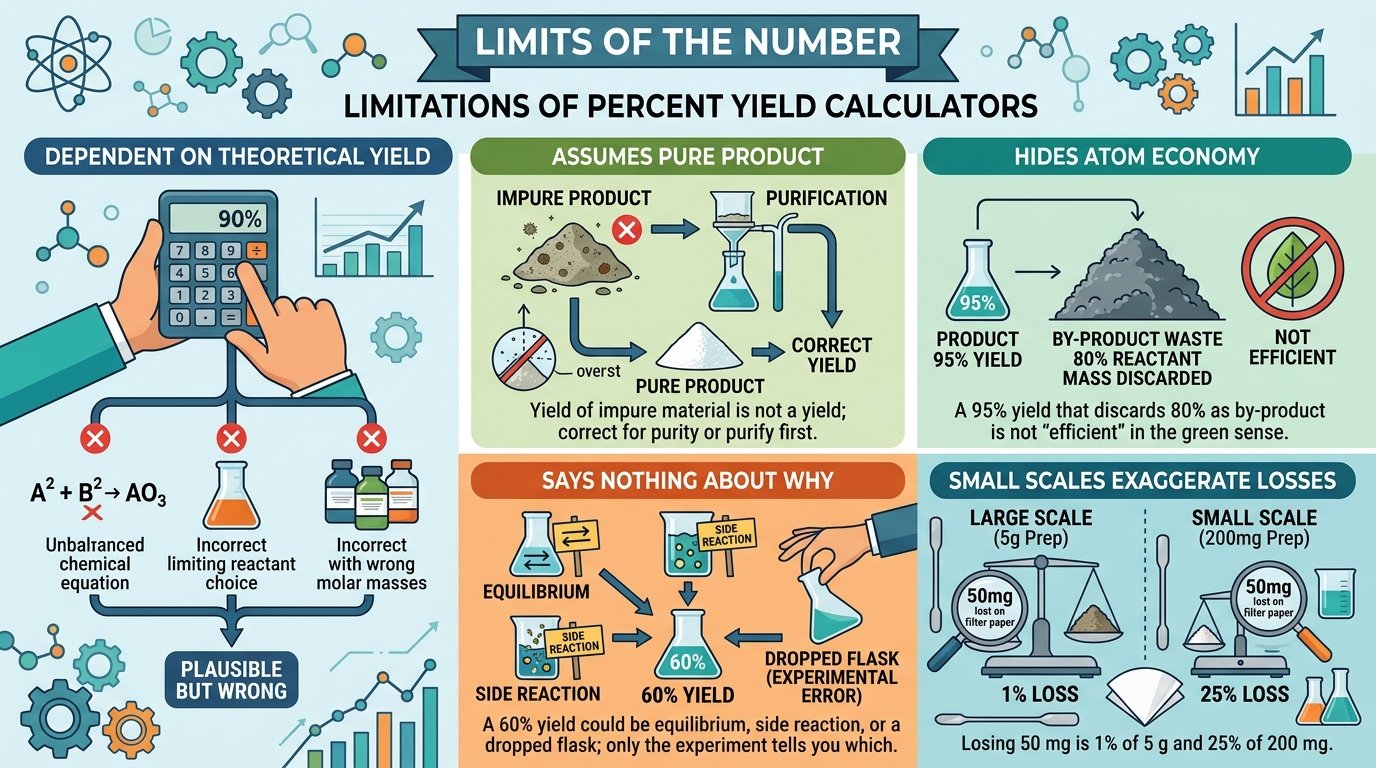
- A percent yield calculator is only as good as the theoretical yield. A wrong limiting reactant, unbalanced equation or wrong molar mass produces a wrong percentage that looks perfectly plausible.
- It assumes pure product. Yield of impure material is not a yield; correct for purity or purify first.
- The percent yield calculator hides atom economy. A 95% yield of a reaction that discards 80% of the reactant mass as by-product is not “efficient” in the green sense.
- It says nothing about why. A 60% yield could be equilibrium, side reaction or a dropped flask; only the experiment tells you which.
- Small scales exaggerate losses. Losing 50 mg on a filter paper is 1% of a 5 g preparation and 25% of a 200 mg one.
Practice Problems With Answers
Solve on paper, then check with the percent yield calculator.
1. Theoretical yield 2.61 g, actual 2.15 g. Percent yield?
Answer: 2.15/2.61 × 100 = 82.4%.
2. A reaction with theoretical yield 12.5 g runs at 78%. Expected actual mass?
Answer: 12.5 × 0.78 = 9.75 g.
3. 8.90 g of product represents an 86% yield. Theoretical yield?
Answer: 8.90/0.86 = 10.35 g.
4. 245 mg obtained, theoretical 0.310 g. Percent yield?
Answer: 0.245/0.310 = 79.0%.
5. 20.0 g Fe2O3 + 5.00 g Al give 8.90 g Fe. Percent yield?
Answer: Al limits; theoretical 10.35 g; 86.0%.
6. 28.0 g N2 + 10.0 g H2 give 0.85 mol NH3. Percent yield?
Answer: N2 limits; theoretical 1.999 mol; 42.5%.
7. 25.0 g CaCO3 gives 12.6 g CaO. Percent yield?
Answer: theoretical 14.01 g; 89.9%.
8. A three-step synthesis runs at 85%, 90% and 70%. Overall yield?
Answer: 0.85 × 0.90 × 0.70 = 53.6%.
9. What per-step yield gives 50% overall in five steps?
Answer: 0.501/5 = 87.1%.
10. 2.15 g crude aspirin is recrystallised to 1.72 g. Recovery? Overall yield if theoretical was 2.61 g?
Answer: recovery 80.0%; overall 1.72/2.61 = 65.9%.
Tips for Accurate Results
- Dry to constant mass before weighing the actual yield you enter in the percent yield calculator. Two weighings 15 minutes apart that agree within 1–2 mg mean the product is dry.
- Weigh on the same balance for reactants and product; tare properly.
- Compute the theoretical yield from the limiting reactant (Mode 2 of the percent yield calculator does this) and write the words “limiting reactant” in the report.
- Keep units consistent or let the percent yield calculator convert them — mg vs g errors are a factor of 1000.
- Report to three significant figures (82.4%, not 82.375%); balance precision rarely justifies more.
- State crude and purified yields separately, and the purity method (melting point, NMR, HPLC) if you claim a corrected yield.
- Use one atomic-weight table — this tool and the molecular weight calculator share IUPAC 2021 values.
Common Mistakes
| Mistake | Symptom | Fix |
|---|---|---|
| Dividing theoretical by actual | Yield > 100% (e.g. 121%) | Actual on top |
| Theoretical yield from the excess reactant | Yield too low | Find the limiting reactant first (the percent yield calculator does it in Mode 2) |
| Mixing grams and moles | Absurd percentage | Same unit top and bottom |
| Weighing wet product | Yield > 100% or suspiciously high | Dry to constant mass |
| Using reactant mass as theoretical yield | Yield unrelated to stoichiometry | Convert through moles and the product’s M |
| Averaging step yields | Overall yield overstated (87.5% instead of 76.5%) | Multiply the fractions |
| Calling recovery a yield | Recrystallisation reported as “80% yield” | Recovery for physical steps, yield for reactions |
| Hydrate molar mass ignored | Theoretical yield overstated | Use the formula of the salt as weighed |
How This Calculator Is Different
| Feature | This percent yield calculator | Typical online tools |
|---|---|---|
| Theoretical yield | Computed from the equation and reactant amounts (limiting reactant found automatically) | You must supply it |
| Units | g, mg, kg, mol, mmol mixed freely | Two numbers, same unit |
| Solve for | Percent, actual or theoretical | Percent only |
| Multi-step, recovery, purity | Dedicated modes | Not available |
| Over-100% handling | Flagged with likely causes | Silent |
| Working and export | Every step; copy, CSV, TXT, print, share, history | Final number |
Related tools: the theoretical yield calculator, limiting reactant calculator, atom economy calculator, stoichiometry calculator and grams to moles calculator cover the reaction arithmetic; the formal charge calculator and oxidation number calculator handle bonding and redox. Molar masses: atomic mass calculator, formula weight calculator, molar mass of hydrates calculator, exact mass calculator, monoisotopic mass calculator, isotopic mass calculator, average vs monoisotopic mass. Formulas from data: empirical formula, molecular formula, percent composition, combustion analysis, degree of unsaturation. Solutions and gases: molarity, equivalent weight, freezing point depression, boiling point elevation, osmotic pressure, vapor density, gas density, van der Waals. Polymers: average molecular weight of a mixture, number average, weight average, polydispersity index, viscosity.
Where the Numbers Come From
The percent yield calculator uses IUPAC 2021 standard atomic weights for molar masses. The definitions of yield and related metrics follow IUPAC and standard general-chemistry texts:
- IUPAC Gold Book — yield: the formal definition relative to the limiting reactant.
- LibreTexts / OpenStax Chemistry 4.4 — Reaction Yields: theoretical, actual and percent yield with examples.
- CIAAW — Standard atomic weights: source of every molar mass used.
- Wikipedia — Yield (chemistry): percent, overall and assay yield in context.
Found an error? See our corrections policy, contact us, or read about the site.
Lab Report Checklist
☐ Balanced equation written with coefficients
☐ Moles of every reactant; limiting reactant identified and named
☐ Theoretical yield = nlim × ratio × Mproduct, with units
☐ Actual yield of dry, pure product (constant mass)
☐ Percent yield = actual ÷ theoretical × 100, three significant figures (check with the percent yield calculator)
☐ Crude vs purified yield, and recovery, stated separately
☐ Brief explanation of where the losses occurred
Frequently Asked Questions
How do you calculate percent yield?
Divide the actual yield by the theoretical yield and multiply by 100, with both in the same unit. If the theoretical yield is not given, calculate it from the limiting reactant first; Mode 2 of the percent yield calculator does both.
What is the difference between percent yield and theoretical yield?
Theoretical yield is a mass (or moles) — the maximum product possible, the denominator in a percent yield calculator. Percent yield is a ratio — how much of that maximum you actually obtained, as a percentage.
Can percent yield be more than 100%?
Not for pure product. A value above 100% means the product is wet or impure, or the theoretical yield was calculated incorrectly (usually from the excess reactant). The percent yield calculator flags such results.
What is a good percent yield?
It depends on the reaction, and the percent yield calculator’s verdict uses broad bands: precipitations 95–99%, teaching-lab organic preparations 60–85%, research steps 70–90%, equilibrium-limited reactions often much lower. Judge against the expected value for that specific reaction.
Why is my percent yield so low?
Incomplete reaction or equilibrium, side reactions, losses during filtration, transfer and recrystallisation, or impure reactants. A theoretical yield computed from the wrong reactant also makes a good yield look low.
How do I calculate the overall yield of a multi-step synthesis?
Multiply the fractional yields of the steps: 85% and 90% give 0.85 × 0.90 = 76.5%. Do not average them. Mode 4 of the percent yield calculator handles any number of steps.
What is the difference between percent yield and percent recovery?
Percent yield is for a chemical reaction (against the theoretical yield); percent recovery, Mode 5 of the percent yield calculator, is for a physical purification such as recrystallisation (recovered mass ÷ starting mass). They multiply to give the overall isolated yield.
Can I use moles instead of grams?
Yes, as long as actual and theoretical are in the same unit; the ratio is identical. The percent yield calculator converts between g, mg, kg, mol and mmol using the product’s molar mass.
How is percent yield different from atom economy?
Percent yield (what a percent yield calculator reports) measures how much of the theoretical product you obtained; atom economy measures how much of the reactant mass could become the desired product even at 100% yield. A reaction can score high on one and low on the other.
Is this percent yield calculator free?
Yes. It runs in your browser with no sign-up, works on mobile and stores the last ten calculations locally.
10 Facts Worth Knowing
- Ten steps at 90% each give an overall yield of just 34.9%; twenty give 12.2%. Yields multiply — Mode 4 of the percent yield calculator shows it.
- Fischer esterification of equimolar acid and alcohol stops at about 67% because K ≈ 4; using a 10-fold excess of alcohol pushes it above 95%.
- The Haber process converts only about 15% of the feed per pass, yet the overall yield after recycling exceeds 97%.
- Industrial fermentation reaches 90–95% of the theoretical 51.1 g of ethanol per 100 g of glucose; the remainder becomes yeast and glycerol.
- The most common reason a percent yield calculator reports above 100% in undergraduate labs is water trapped in the crystals.
- Pharmaceutical process chemists distinguish isolated yield, assay yield (by HPLC before isolation) and in-process yield.
- Vitamin B12 was synthesised by Woodward and Eschenmoser in about 70 steps; the overall yield was well under 0.01%.
- The BHC ibuprofen process improved atom economy from about 40% to 77% while keeping high yields — a case where both metrics were needed.
- Reporting yield as “percent of theory” was standard in German chemistry journals by the 1870s.
- Losing 50 mg of product costs 1% on a 5 g scale but 25% on a 200 mg scale — small-scale yields are systematically lower.
Final Thoughts
Percent yield is one division, but the number on top must be pure, dry product and the number underneath must come from the limiting reactant and a balanced equation. Get those two right and the percentage means something; get either wrong and it is noise that looks like data. The percent yield calculator on this page checks both for you — it computes the theoretical yield from your equation, converts units, flags impossible results and chains steps — so that the number you write in your report is the one your reaction actually earned.
About the author
Ahmad Raza, M.Phil. Chemistry
Ahmad has taught general and analytical chemistry for over a decade and builds the calculators on this site. He writes every guide from the perspective of the student who has to get the exam question right, and cross-checks every number against IUPAC data. Reach him at contact@molecularweightcalculator.org.