
Percent Composition Calculator
Find the mass percent of every element in any compound from its formula, from laboratory masses, or the other way round — grams of an element in a given mass of compound, the percent of water of hydration or of a polyatomic ion, and the empirical formula hidden in a set of percentages. Every atomic weight, every product and every division is shown.
✓ Trusted by students, teachers & analytical labsPercent Composition from a Chemical Formula
Type any formula — brackets, nested groups, hydrates written with a dot and Unicode subscripts are all understood. The tool adds up the molar mass, then divides each element’s share (atoms × atomic weight) by that molar mass to give the mass percent of every element. Add a sample mass to see how many grams of each element it contains, and choose how many decimals you want.
Percent Composition from Laboratory Masses
The experimental route. Enter the mass of each element found in a sample (up to five elements) and, if you know it, the total sample mass. The tool divides each element mass by the total to give the mass percent, flags any mass that is unaccounted for, and — as a bonus — converts the masses to moles and shows the empirical formula they imply. Tick “remainder is oxygen” when oxygen was found by difference.
Grams of an Element in a Compound — or Compound Needed for a Target Mass of Element
Percent composition put to work. Direction 1: how many grams of iron are in 50.0 g of Fe2O3? Direction 2: how many grams of NaCl supply 10.0 g of sodium? The tool finds the mass fraction of the element from the formula, then multiplies or divides. Works in grams, kilograms or milligrams and also lists the mass of every other element in the same sample.
Percent of Water of Hydration, a Polyatomic Ion or Any Group in a Compound
Percent composition is not only about single elements. Enter the whole compound and the part you care about — H2O in a hydrate, SO4 in a sulfate, NH4 in an ammonium salt. For hydrates written with a dot the number of waters is read automatically; otherwise type how many times the part occurs (default 1). Add a sample mass to see how much water is driven off on heating and how much anhydrous residue remains.
Percent Composition → Empirical Formula (and Molecular Formula with a Molar Mass)
The reverse problem. Enter the mass percent of each element (up to five); the tool treats the percentages as grams in 100 g, converts to moles, divides by the smallest and multiplies until every ratio is a whole number — that is the empirical formula. Add the molar mass and it also finds n and the molecular formula. Choose “remainder is oxygen” when the question gives everything except oxygen.
🕘 Recent calculations
- No calculations yet — your last 10 results will appear here.
mass % of element = (atoms × atomic weight) ÷ molar mass × 100 · mass of element in a sample = sample mass × mass fraction · compound needed = element mass ÷ mass fraction · % water of hydration = n × 18.015 ÷ M(hydrate) × 100 · % → formula: % = g per 100 g → moles → ÷ smallest → whole numbers · Atomic weights: IUPAC 2021 (C 12.011, H 1.008, O 15.999, N 14.007, S 32.06, Na 22.990, Fe 55.845, Cu 63.546).
A percent composition calculator answers one of the first quantitative questions in chemistry: of the total mass of a compound, what fraction belongs to each element? Glucose, C6H12O6, is 40.00% carbon, 6.71% hydrogen and 53.28% oxygen by mass. Water is 11.19% hydrogen and 88.81% oxygen. Iron(III) oxide is 69.94% iron, which is why a 50.0 g lump of rust-red haematite holds only 34.97 g of metal. The arithmetic behind every one of those numbers is the same three-line routine — count the atoms, multiply by the atomic weights, divide by the molar mass — and it is the routine this page teaches and the free percent composition calculator above performs.
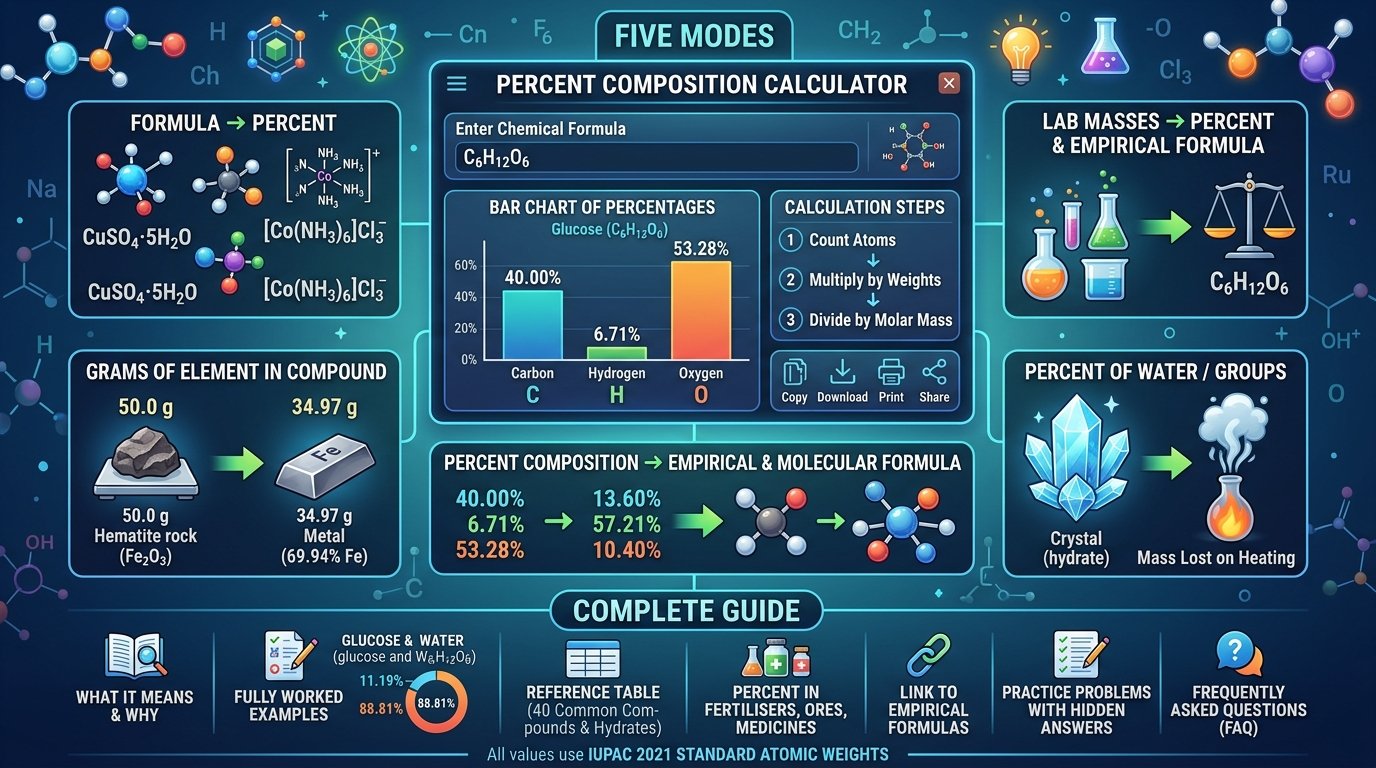
The percent composition calculator covers the whole family of problems in five modes: mass percent of every element from any chemical formula, including hydrates and bracketed groups; percent composition from laboratory masses, with oxygen by difference and the empirical formula the masses imply; grams of an element in a given mass of compound, or the mass of compound needed to deliver a target mass of element; the percent of water of hydration, a polyatomic ion or any group inside a compound, with the mass lost on heating; and the reverse problem, percent composition to empirical formula and, with a molar mass, molecular formula. Every mode shows its steps, draws a bar chart of the percentages and lets you copy, download, print or share the result.
Below the tool is a complete guide: what percent composition means and why it is independent of sample size, the formula and a fully worked glucose example, where the atomic weights come from, a reference table of forty common compounds, hydrates and the percent of water, percent composition in fertilisers, ores and medicines, the link to empirical formulas, ten practice problems with hidden answers and a set of frequently asked questions. All values use IUPAC 2021 standard atomic weights, the same numbers the percent composition calculator uses internally.
🔑 KEY TAKEAWAY
Percent composition is the mass percent of each element in a compound: % element = (number of atoms × atomic weight) ÷ molar mass of the compound × 100. For glucose C6H12O6 (180.156 g/mol): carbon 72.066 ÷ 180.156 = 40.00%, hydrogen 12.096 ÷ 180.156 = 6.71%, oxygen 95.994 ÷ 180.156 = 53.28%; the three add to 100%. The percentages are a property of the formula, not of the sample size, so 1 g and 1 tonne of glucose are both 40.00% carbon. From lab data, % element = mass of element ÷ total mass × 100. Multiply a sample mass by the mass fraction to get grams of an element; divide a target element mass by the fraction to get the compound needed. Percent composition to formula: treat % as grams per 100 g, convert to moles, divide by the smallest and round to whole numbers.
📑 Table of Contents (click to expand)
- What Is Percent Composition?
- How to Use This Percent Composition Calculator
- The Five Modes Explained
- The Formula and a Fully Worked Example
- Atomic Weights: Which Values to Use
- Worked Examples
- Reference Table: Percent Composition of 40 Common Compounds
- Hydrates and Percent Water
- Percent Composition from Laboratory Masses
- Grams of Element in a Compound (and the Reverse)
- From Percent Composition to Empirical and Molecular Formula
- Mass Percent vs Atom Percent vs Mole Fraction
- Who Uses a Percent Composition Calculator?
- Step-by-Step Walkthrough in the Tool
- A Short History: Proust and Definite Proportions
- Limitations and Sources of Error
- Practice Problems (With Answers)
- Tips for Accurate Results
- Common Mistakes
- How This Calculator Is Different
- Where the Numbers Come From
- Exam Checklist
- Frequently Asked Questions
- 10 Facts Worth Knowing
- Final Thoughts
What Is Percent Composition?
Percent composition (also called mass percent composition or percentage composition) is the mass of each element in a compound expressed as a percentage of the compound’s total mass. It is a set of numbers, one per element, that always adds up to 100%. Water is 11.19% H and 88.81% O; carbon dioxide is 27.29% C and 72.71% O; table salt is 39.34% Na and 60.66% Cl. IUPAC’s formal name for the underlying quantity is the mass fraction: the mass of a constituent divided by the total mass of all constituents. Percent composition is simply the mass fraction multiplied by 100.
Two features make percent composition so useful. First, it is a fixed property of a pure compound. Because a compound always contains the same elements in the same proportions by mass — Proust’s law of definite proportions — the percentages do not depend on where the sample came from or how much of it you have. A milligram of glucose and a truckload of glucose are both 40.00% carbon. Second, it is measurable. Long before anyone could count atoms — or use a percent composition calculator — chemists could weigh the elements recovered from a sample, and percent composition was the language in which they reported what a substance was made of. It still is: a combustion analyser gives C, H and N percentages, and a journal expects them to match the calculated values within 0.4%.
Percent composition sits between two other ideas. Behind it lies the chemical formula and the atomic weights, which fix the percentages. Ahead of it lies the empirical formula, which is what you recover when you run the calculation backwards from measured percentages. The percent composition calculator on this page moves in both directions, and the sections below explain each step.
How to Use This Percent Composition Calculator
Pick a mode with the pill tabs at the top of the percent composition calculator:
- From a Formula — type the formula (C6H12O6, CuSO4·5H2O, Ca3(PO4)2), optionally a sample mass in grams and the number of decimals you want. Press Calculate.
- From Sample Masses — enter the mass of each element found, the total sample mass if known, and whether the missing mass is oxygen. Grams or milligrams.
- Element ↔ Compound Mass — choose the direction, type the compound, the element and the mass. Grams, kilograms or milligrams.
- % Water / Ion / Group — enter the compound and the part (H2O, SO4, NH4); the count is read from the hydrate formula automatically or typed by you.
- % → Formula — enter the percentages and, if you have it, the molar mass.
Every mode of the percent composition calculator has example chips that fill the fields with a classic problem so you can see the expected answer, a Reset button that clears only that panel, and an Enter-key shortcut. Results appear in a highlighted answer box, followed by numbered steps, a table (atoms, atomic weight, mass per mole, mass %, atom %, grams in sample) and a bar chart. The toolbar copies the result as text, downloads CSV or TXT, prints a clean report or shares to WhatsApp, Facebook, X or the device’s native share sheet. The last ten calculations are kept in your browser (nothing is sent to a server) with a Clear All button.
The Five Modes Explained
Mode 1 — Percent composition from a formula
The core percent composition calculator problem. The parser handles brackets, nested groups, hydrates written with a dot or an asterisk, and Unicode subscripts; it rejects unbalanced brackets and unknown symbols with a clear message. The tool multiplies each element’s atom count by its IUPAC 2021 atomic weight, sums to the molar mass, and divides. You also get the atom percent (what fraction of the atoms, rather than the mass, each element supplies), the empirical formula if the formula you typed is a multiple of a simpler one, and the percent of water if the formula is a hydrate. A sample mass turns the percentages into grams.
Mode 2 — Percent composition from laboratory masses
The experimental route, the one exam questions love and the reason many people open a percent composition calculator: “a 2.500 g sample of a sugar was found to contain 1.000 g of carbon and 0.168 g of hydrogen, the rest being oxygen.” Enter the masses, tick oxygen by difference, and the tool reports 40.00% C, 6.72% H and 53.28% O. If you leave the total blank the percent composition calculator uses the sum of the element masses; if the elements do not add up to the total and you have not assigned the difference to oxygen, it reports the unaccounted percentage rather than silently normalising. As a bonus it converts the masses to moles and shows the empirical formula they imply.
Mode 3 — Grams of element in a compound, or compound needed for an element
Percent composition put to work. Direction one: how much iron is in 50.0 g of Fe2O3? Multiply by the mass fraction, 0.6994, to get 34.97 g. Direction two: how much NaCl supplies 10.0 g of sodium? Divide by the fraction, 0.3934, to get 25.42 g. The percent composition calculator handles both, lists the mass of every other element in the same sample, gives the moles of compound and of element, and works in g, kg or mg — so a 500 mg calcium carbonate tablet (200.2 mg Ca) and a tonne of fertiliser are the same button.
Mode 4 — Percent of water, a polyatomic ion or a group
Not every question is about a single element. The percent of water in a hydrate governs how much mass is lost on heating; the percent of sulfate or nitrate in a salt is what a fertiliser label or a water-treatment dose actually needs. Enter the compound and the part; for CuSO4·5H2O and H2O the percent composition calculator reads the 5 from the formula and reports 36.08% water, and with a 10.00 g sample it tells you 3.608 g is driven off and 6.392 g of anhydrous CuSO4 remains. It checks that the compound really contains the part you asked for, and rejects a count that is too high.
Mode 5 — Percent composition to empirical and molecular formula
The reverse calculation, which turns the percent composition calculator into a formula finder. Percentages are treated as grams in 100 g, converted to moles, divided by the smallest and multiplied by 2, 3, 4… until every ratio is a whole number within tolerance. 40.00% C, 6.71% H, 53.29% O gives CH2O; add the molar mass 180.16 g/mol and n = 6 gives C6H12O6. Oxygen by difference is an option, and if the percentages fall well short of 100% the percent composition calculator warns you before proceeding. For the full treatment of that problem, with combustion analysis and gas-density routes to the molar mass, see the dedicated empirical formula calculator and molecular formula calculator.
The Formula and a Fully Worked Example
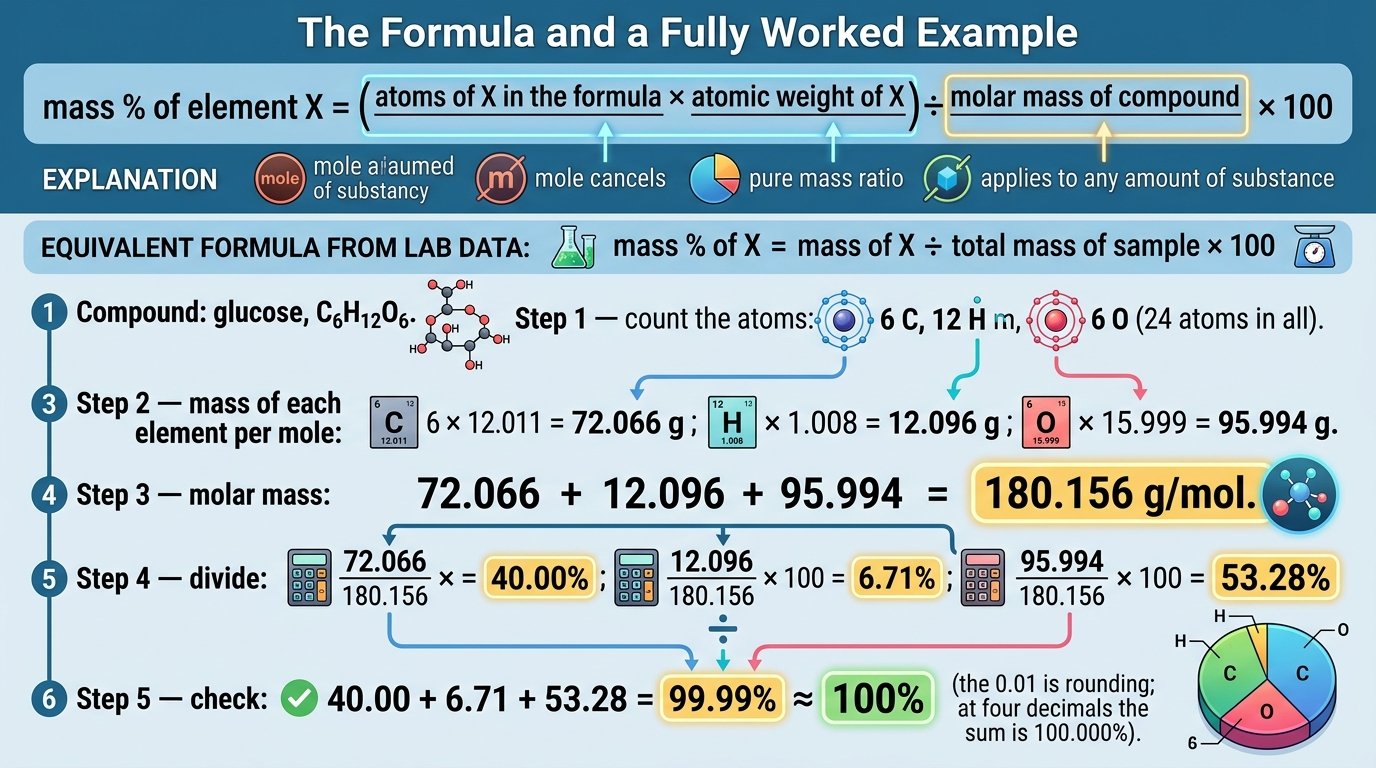
equivalently, from lab data: mass % of X = mass of X ÷ total mass of sample × 100
The numerator is the mass that element X contributes to one mole of the compound; the denominator is the mass of one mole of the whole compound. Because both are “per mole”, the mole cancels and what is left is a pure mass ratio — which is why the same percentages apply to any amount of substance. Here is the calculation for glucose, done at full precision so you can see where each digit comes from; the percent composition calculator reproduces exactly these steps.
Step 1 — count the atoms: 6 C, 12 H, 6 O (24 atoms in all).
Step 2 — mass of each element per mole: C 6 × 12.011 = 72.066 g; H 12 × 1.008 = 12.096 g; O 6 × 15.999 = 95.994 g.
Step 3 — molar mass: 72.066 + 12.096 + 95.994 = 180.156 g/mol.
Step 4 — divide: C 72.066 / 180.156 × 100 = 40.00%; H 12.096 / 180.156 × 100 = 6.71%; O 95.994 / 180.156 × 100 = 53.28%.
Step 5 — check: 40.00 + 6.71 + 53.28 = 99.99% ≈ 100% (the 0.01 is rounding; at four decimals the sum is 100.000%).
Three observations that any percent composition calculator result will confirm. Oxygen is the largest share by mass even though carbon and oxygen have the same number of atoms, because an oxygen atom is a third heavier than a carbon atom. Hydrogen is half of all the atoms but under 7% of the mass. And the percentages are identical for formaldehyde CH2O, acetic acid C2H4O2 and every other compound with the same 1 : 2 : 1 ratio, which is the reason percent composition alone can give you an empirical formula but never a molecular one.
Atomic Weights: Which Values to Use
Percent composition is only as good as the atomic weights that go into it. The percent composition calculator uses the IUPAC 2021 standard atomic weights — for elements published as an interval, the conventional single value: H 1.008, C 12.011, N 14.007, O 15.999, S 32.06, Cl 35.45, and for the rest four or five significant figures (Na 22.990, Mg 24.305, K 39.098, Ca 40.078, Fe 55.845, Cu 63.546). Those are the values in the CIAAW tables and in every current textbook. Full details, and the mass of any element, are in our atomic mass calculator.
Does precision matter in a percent composition calculator? Using whole numbers (C 12, H 1, O 16) gives glucose a molar mass of 180 and percentages of 40.00, 6.67 and 53.33 — carbon is unchanged, but hydrogen is off by 0.04 percentage points and oxygen by 0.05. That is small, yet it is larger than the 0.01% resolution most answers are reported to, and in an empirical-formula problem it can push a ratio from 1.50 to 1.49 and change the multiplier you choose. Use at least four significant figures and keep every digit until the final rounding. If you need exact isotopic masses rather than standard atomic weights — for mass spectrometry, say — use the exact mass calculator instead; percent composition by mass spectrometry is a different quantity.
Worked Examples
Example 1 — Urea, a nitrogen fertiliser (Mode 1)
Step 1: atoms — 1 C, 1 O, 2 N, 4 H.
Step 2: molar mass = 12.011 + 15.999 + 2(14.007) + 4(1.008) = 60.056 g/mol.
Step 3: % N = 28.014 / 60.056 × 100 = 46.65%; % C = 20.00%; % O = 26.64%; % H = 6.71%.
Meaning: urea carries the highest nitrogen content of any common solid fertiliser, which is why it dominates world agriculture. Ammonium nitrate is 35.00% N, ammonium sulfate 21.20% N, potassium nitrate 13.85% N.
Example 2 — Copper(II) sulfate pentahydrate (Modes 1 and 4)
Step 1: atoms — 1 Cu, 1 S, 9 O (4 + 5), 10 H.
Step 2: molar mass = 63.546 + 32.06 + 9(15.999) + 10(1.008) = 249.677 g/mol.
Step 3: % Cu = 63.546 / 249.677 × 100 = 25.45%; % S = 12.84%; % O = 57.67%; % H = 4.04%.
Step 4 (water): 5 × 18.015 = 90.075 g of water per mole; 90.075 / 249.677 × 100 = 36.08% water of hydration. Heating 10.00 g to constant mass drives off 3.608 g and leaves 6.392 g of white anhydrous CuSO4.
Example 3 — From lab masses: an oxide of magnesium (Mode 2)
Step 1: mass of oxygen = 0.403 − 0.243 = 0.160 g (by difference).
Step 2: % Mg = 0.243 / 0.403 × 100 = 60.30%; % O = 0.160 / 0.403 × 100 = 39.70%.
Step 3 (bonus): moles Mg = 0.243 / 24.305 = 0.01000; moles O = 0.160 / 15.999 = 0.01000; ratio 1 : 1 → empirical formula MgO. The theoretical percent composition of MgO is 60.30% Mg and 39.70% O, so the experiment agrees to the last digit.
Reference Table: Percent Composition of 40 Common Compounds
The compounds below appear in nearly every problem set, lab manual and product label. Molar masses and percentages were computed with IUPAC 2021 atomic weights — the same values the percent composition calculator uses — and rounded to two decimals; small apparent shortfalls from 100% are rounding. Use the table to check homework, to set your own problems or to test the tool.
| Compound | Formula | Molar mass (g/mol) | Percent composition by mass |
|---|---|---|---|
| Water | H2O | 18.015 | H 11.19, O 88.81 |
| Carbon dioxide | CO2 | 44.009 | C 27.29, O 72.71 |
| Ammonia | NH3 | 17.031 | N 82.24, H 17.76 |
| Methane | CH4 | 16.043 | C 74.87, H 25.13 |
| Hydrogen peroxide | H2O2 | 34.014 | H 5.93, O 94.07 |
| Sodium chloride | NaCl | 58.44 | Na 39.34, Cl 60.66 |
| Sodium hydroxide | NaOH | 39.997 | Na 57.48, O 40.00, H 2.52 |
| Sodium bicarbonate | NaHCO3 | 84.006 | Na 27.37, H 1.20, C 14.30, O 57.14 |
| Sodium carbonate | Na2CO3 | 105.988 | Na 43.38, C 11.33, O 45.29 |
| Sodium sulfate | Na2SO4 | 142.036 | Na 32.37, S 22.57, O 45.06 |
| Potassium chloride | KCl | 74.548 | K 52.45, Cl 47.55 |
| Potassium nitrate | KNO3 | 101.102 | K 38.67, N 13.85, O 47.47 |
| Potassium permanganate | KMnO4 | 158.032 | K 24.74, Mn 34.76, O 40.50 |
| Potassium dichromate | K2Cr2O7 | 294.181 | K 26.58, Cr 35.35, O 38.07 |
| Calcium carbonate | CaCO3 | 100.086 | Ca 40.04, C 12.00, O 47.96 |
| Calcium oxide | CaO | 56.077 | Ca 71.47, O 28.53 |
| Calcium hydroxide | Ca(OH)2 | 74.092 | Ca 54.09, O 43.19, H 2.72 |
| Calcium phosphate | Ca3(PO4)2 | 310.174 | Ca 38.76, P 19.97, O 41.26 |
| Magnesium oxide | MgO | 40.304 | Mg 60.30, O 39.70 |
| Magnesium chloride | MgCl2 | 95.205 | Mg 25.53, Cl 74.47 |
| Aluminium oxide | Al2O3 | 101.961 | Al 52.93, O 47.07 |
| Silicon dioxide | SiO2 | 60.083 | Si 46.74, O 53.26 |
| Iron(III) oxide (haematite) | Fe2O3 | 159.687 | Fe 69.94, O 30.06 |
| Iron(II,III) oxide (magnetite) | Fe3O4 | 231.531 | Fe 72.36, O 27.64 |
| Iron pyrite | FeS2 | 119.965 | Fe 46.55, S 53.45 |
| Copper(II) oxide | CuO | 79.545 | Cu 79.89, O 20.11 |
| Copper(II) sulfate (anhydrous) | CuSO4 | 159.602 | Cu 39.82, S 20.09, O 40.10 |
| Copper(II) sulfate pentahydrate | CuSO4·5H2O | 249.677 | Cu 25.45, S 12.84, O 57.67, H 4.04 |
| Zinc oxide | ZnO | 81.379 | Zn 80.34, O 19.66 |
| Silver nitrate | AgNO3 | 169.874 | Ag 63.50, N 8.25, O 28.25 |
| Barium sulfate | BaSO4 | 233.386 | Ba 58.84, S 13.74, O 27.42 |
| Sulfuric acid | H2SO4 | 98.072 | H 2.06, S 32.69, O 65.25 |
| Ammonium nitrate | NH4NO3 | 80.043 | N 35.00, H 5.04, O 59.96 |
| Ammonium sulfate | (NH4)2SO4 | 132.134 | N 21.20, H 6.10, S 24.26, O 48.43 |
| Urea | CO(NH2)2 | 60.056 | C 20.00, H 6.71, N 46.65, O 26.64 |
| Glucose | C6H12O6 | 180.156 | C 40.00, H 6.71, O 53.28 |
| Sucrose | C12H22O11 | 342.297 | C 42.11, H 6.48, O 51.41 |
| Ethanol | C2H5OH | 46.069 | C 52.14, H 13.13, O 34.73 |
| Aspirin | C9H8O4 | 180.159 | C 60.00, H 4.48, O 35.52 |
| Caffeine | C8H10N4O2 | 194.194 | C 49.48, H 5.19, N 28.85, O 16.48 |
Patterns worth noticing in the percent composition calculator output: glucose and acetic acid share exactly the same percentages because both are (CH2O)n; the anhydrous and hydrated copper sulfates differ by the 36.08% of water; and the three iron minerals rank magnetite (72.36% Fe) above haematite (69.94%) above pyrite (46.55%), which is the order in which a smelter values them. For the molar masses of ionic compounds, which are formula weights rather than molecular masses, see the formula weight calculator.
Hydrates and Percent Water
A hydrate is a crystalline salt that carries a fixed number of water molecules per formula unit, written after a dot: CuSO4·5H2O, MgSO4·7H2O, Na2CO3·10H2O. The water is part of the compound’s mass, so it is part of its percent composition, and a percent composition calculator must count it. Percent water = (n × 18.015) ÷ M(hydrate) × 100, where n is the number of waters. It is the number a gravimetric lab measures directly — weigh, heat to constant mass, weigh again — and one of the most common percent composition calculator questions.
| Hydrate | Common name | M (g/mol) | Water per mole (g) | % water |
|---|---|---|---|---|
| CuSO4·5H2O | blue vitriol | 249.677 | 90.075 | 36.08 |
| MgSO4·7H2O | Epsom salt | 246.466 | 126.105 | 51.17 |
| Na2CO3·10H2O | washing soda | 286.138 | 180.150 | 62.96 |
| CaSO4·2H2O | gypsum | 172.164 | 36.030 | 20.93 |
| FeSO4·7H2O | green vitriol | 278.006 | 126.105 | 45.36 |
| CoCl2·6H2O | cobalt chloride (humidity indicator) | 237.923 | 108.090 | 45.43 |
| BaCl2·2H2O | barium chloride dihydrate | 244.260 | 36.030 | 14.75 |
| KAl(SO4)2·12H2O | potash alum | 474.372 | 216.180 | 45.57 |
The percent-water figure is what a lab report is graded on, and it is also how the formula of an unknown hydrate is found: heat a weighed sample, find the percent lost, and compare with the values a percent composition calculator predicts for n = 1, 2, 3… The dedicated molar mass of hydrates calculator runs that comparison for you. One caution: some hydrates do not lose all their water at once. Gypsum heated gently loses only 1.5 of its 2 waters (15.70% of its mass) and becomes plaster of Paris, CaSO4·½H2O; the last half-water needs a higher temperature. If your percent lost is stubbornly below the calculated value, incomplete dehydration is the first thing to suspect.
Percent Composition from Laboratory Masses
When the compound is unknown there is no formula to start from; instead you have masses. A sample is weighed, decomposed or reacted, and the mass of each element (or of a compound that contains it) is recovered. The percent composition is then mass of element ÷ mass of sample × 100. Three practical points decide whether the numbers a percent composition calculator returns are right.
- Use the sample mass as the denominator, not the sum of what you found. If a 2.500 g sample yields 1.000 g C and 0.168 g H, dividing by 1.168 g would give nonsense; the rest of the sample (1.332 g) is oxygen or something else. The percent composition calculator reports the unaccounted mass explicitly, and assigns it to oxygen only when you ask.
- Oxygen is almost always found by difference. Combustion analysis measures C, H, N and S directly (as CO2, H2O, N2, SO2); oxygen is whatever is left. Any error in the other elements lands on oxygen, which is why oxygen percentages are the least reliable in a CHN report.
- Watch the units. Microanalysis works in milligrams; the tool accepts mg directly so you are not converting by hand. Percentages are unit-free, but the bonus mole calculation needs grams, and the tool handles that.
Worked quickly: the sugar sample above gives C 1.000/2.500 = 40.00%, H 0.168/2.500 = 6.72%, O 1.332/2.500 = 53.28%. Moles per sample: C 0.08326, H 0.1667, O 0.08326 → 1 : 2 : 1 → CH2O. The measured composition matches glucose’s calculated 40.00 / 6.71 / 53.28 within 0.01%, which is as good as a balance can do. When the recovered element comes wrapped in a compound — chloride weighed as AgCl, sulfate as BaSO4 — use Mode 3 of the percent composition calculator first to convert the precipitate mass into element mass (Cl is 24.74% of AgCl), then Mode 2 for the percentage. That two-step routine is the whole of classical gravimetric analysis.
Grams of Element in a Compound (and the Reverse)
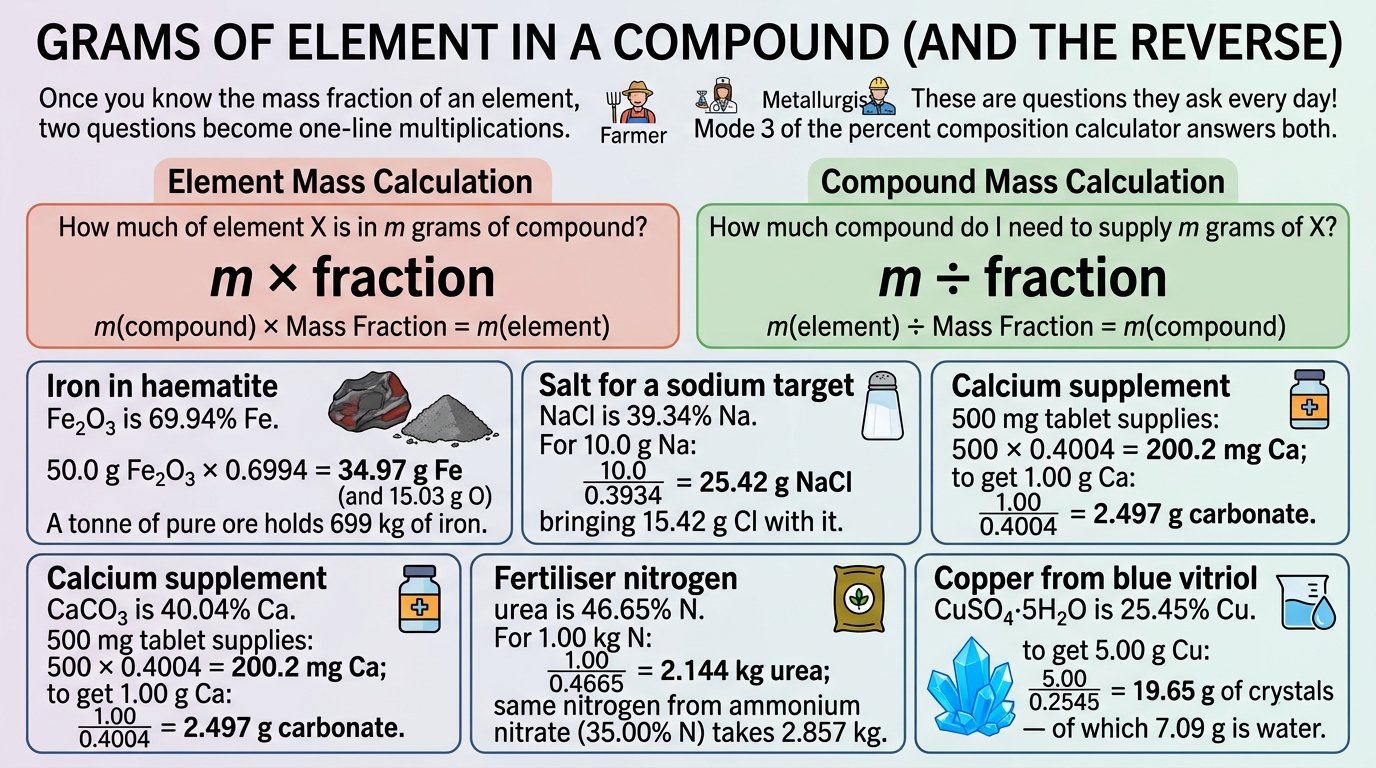
Once you know the mass fraction of an element, two questions become one-line multiplications. How much of element X is in m grams of compound? Answer: m × fraction. How much compound do I need to supply m grams of X? Answer: m ÷ fraction. These are the questions a farmer, a pharmacist, a metallurgist and a water-treatment engineer ask every day, and Mode 3 of the percent composition calculator answers both, in any mass unit, while listing the other elements that come along for the ride.
Salt for a sodium target: NaCl is 39.34% Na. To deliver 10.0 g Na you need 10.0 / 0.3934 = 25.42 g NaCl, bringing 15.42 g Cl with it.
Calcium supplement: CaCO3 is 40.04% Ca. A 500 mg tablet supplies 500 × 0.4004 = 200.2 mg Ca; to get 1.00 g of calcium you need 2.497 g of carbonate.
Fertiliser nitrogen: urea is 46.65% N. A hectare that needs 1.00 kg of N per dose gets it from 1.00 / 0.4665 = 2.144 kg urea; the same nitrogen from ammonium nitrate (35.00% N) takes 2.857 kg.
Copper from blue vitriol: CuSO4·5H2O is 25.45% Cu, so 5.00 g Cu needs 5.00 / 0.2545 = 19.65 g of crystals — of which 7.09 g is water.
Notice the direction of the error when the wrong compound is typed into a percent composition calculator. If you calculate a copper dose from anhydrous CuSO4 (39.82% Cu) but weigh out the pentahydrate, you deliver only 64% of the intended copper. Percent composition is where those mistakes are caught. For the next step — converting the grams into moles for a reaction — use the grams to moles calculator, and for the full reaction stoichiometry the stoichiometry calculator.
From Percent Composition to Empirical and Molecular Formula
Run the calculation backwards and percent composition becomes a formula. The trick is to imagine exactly 100 g of the compound, so that each percentage is a mass in grams; divide by atomic weights to get moles; divide by the smallest number of moles to get a ratio; and multiply by a small integer if the ratio is not whole. The result is the empirical formula — the simplest whole-number ratio — because percentages carry no information about the size of the molecule, which is why no percent composition calculator can return a molecular formula without a molar mass. Here is vitamin C, done the way Mode 5 of the percent composition calculator does it:
| Element | Mass % (= g per 100 g) | Moles | ÷ smallest | × 3 | Subscript |
|---|---|---|---|---|---|
| C | 40.92 | 40.92 / 12.011 = 3.407 | 1.000 | 3.00 | 3 |
| H | 4.58 | 4.58 / 1.008 = 4.544 | 1.334 | 4.00 | 4 |
| O | 54.50 | 54.50 / 15.999 = 3.406 | 1.000 | 3.00 | 3 |
Empirical formula C3H4O3, empirical formula mass 88.06 g/mol. With the molar mass 176.12 g/mol, n = 176.12 / 88.06 = 2.00, so the molecular formula is C6H8O6. The ratio 1.334 is the classic trap: it is not “about 1”, it is 4/3, and multiplying by 3 is the only honest way to make it whole. The percent composition calculator searches multipliers from 2 to 12 and tells you which one it used. Everything else about that reverse problem — combustion data, tolerance, what to do when n is not an integer — is covered on the empirical formula calculator and molecular formula calculator pages.
Mass Percent vs Atom Percent vs Mole Fraction
“Percent” needs a basis, and confusing bases is a classic error. Mass percent (what this page and every percent composition calculator mean by default) is mass of element over mass of compound. Atom percent is number of atoms of the element over total atoms in the formula. For glucose the two are strikingly different: hydrogen is 50.00% of the atoms (12 of 24) but 6.71% of the mass; oxygen is 25.00% of the atoms but 53.28% of the mass. The table in Mode 1 shows both columns side by side so the distinction is never hidden.
Mole fraction, which a percent composition calculator does not report, is the same idea as atom percent applied to mixtures: moles of one component over total moles. It matters in alloys, gas mixtures and solutions, where there is no single formula to divide by. In 18-karat gold that is 75% gold and 25% copper by mass, the gold is only 49% of the atoms, because a gold atom is three times heavier than a copper atom. Percent composition by mass and by mole tell different stories about the same material; know which one a label, a spec sheet or an exam question means. For mixtures and their average molar mass see the average molecular weight of a mixture tool, which accepts either basis.
Two related quantities are worth naming. Volume percent is used for gases and liquid mixtures (air is 20.9% oxygen by volume but 23.1% by mass). Percent yield and percent purity use percent composition as an input: the theoretical percent of an element sets the ceiling against which an analysed sample is compared, and the ratio of found to calculated is the purity.
Who Uses a Percent Composition Calculator?
- Students from first-year secondary chemistry to university analytical courses. Percent composition is examined at every level, usually paired with empirical formulas and hydrates.
- Teachers setting problems with clean numbers and checking the answer key against a percent composition calculator. The reference table and the example chips are built for this.
- Analytical chemists comparing a CHN result with the calculated composition of a proposed structure. The 0.4% agreement rule in journals is a percent composition test.
- Agronomists and fertiliser buyers converting between product mass and nutrient mass. Labels report P as % P2O5 (43.64% P) and K as % K2O (83.02% K), a convention that is pure percent composition.
- Metallurgists and geologists grading ores: the theoretical metal content of the mineral is the ceiling for any concentrate.
- Pharmacists and nutritionists translating a salt into its active element: elemental calcium in calcium carbonate, elemental iron in ferrous sulfate, elemental magnesium in Epsom salt.
- Environmental and water engineers dosing by ion rather than by compound — sulfate, nitrate, phosphate — where Mode 4 does the conversion.
Step-by-Step Walkthrough in the Tool
Suppose a lab manual asks: “A 5.000 g sample of an iron oxide is reduced in hydrogen and 3.497 g of iron remains. Find the percent composition and the formula of the oxide, and calculate how much iron a 250 g sample of the same oxide would yield.” Here is the whole problem in the percent composition calculator.
- Open From Sample Masses. Total sample mass 5.000, unit grams, missing mass → oxygen (by difference). Element 1 Fe, mass 3.497. Calculate.
- The answer box reads Fe 69.94%, O 30.06%; the small print shows oxygen by difference 1.503 g and the implied empirical formula Fe2O3. The steps show moles Fe 0.06262, O 0.09394, ratio 1 : 1.500, multiplied by 2.
- Switch to Element ↔ Compound Mass. Compound Fe2O3, element Fe, direction “element in a given mass of compound”, mass 250, unit g. Calculate: 174.9 g Fe, with 75.1 g O; 1.566 mol of oxide, 3.131 mol of iron.
- For the report, press Copy for the sentence, CSV for the table, or Print for a one-page summary. Both calculations sit in the history panel.
Total time in the percent composition calculator, under a minute; and every intermediate number is on the screen for the write-up. The same three-mode route (masses → percent → formula → grams) handles any gravimetric problem you are likely to meet.
A Short History: Proust and Definite Proportions
Percent composition is older than the atomic theory it now rests on. In the 1790s Joseph Proust, analysing copper carbonate from mines and from his own laboratory, found that natural and synthetic samples had exactly the same proportions of copper, carbon and oxygen by mass. Claude Berthollet disagreed, arguing that composition varied continuously with the conditions of preparation; the debate ran for eight years and Proust won it. His law of definite proportions — a compound always contains the same elements in the same ratio by mass — is the statement that percent composition is a constant of the compound, and it is the reason a percent composition calculator can exist at all.
John Dalton read Proust’s constant ratios as evidence for atoms of fixed weight combining in whole numbers, and turned percent composition into the first atomic weights: if water is 88.81% oxygen, and (as he wrongly assumed) one atom of each, then oxygen must weigh eight times hydrogen. The 8 became 16 when the formula was corrected to H2O, an early lesson that percentages alone do not fix a formula. Through the nineteenth century Berzelius, Dumas, Stas and finally Richards refined the atomic weights by ever more precise percent composition measurements; Richards’s Nobel Prize in 1914 was for exactly this work. Today the direction is reversed: the atomic weights are known to six or more figures, and percent composition is what a percent composition calculator computes from them.
Limitations and Sources of Error
- A percent composition calculator assumes a pure compound with a fixed formula. Mixtures, non-stoichiometric solids (wüstite is Fe0.95O, not FeO) and natural materials have compositions that vary; the calculated value is then a reference point, not a prediction.
- The percentages depend on the atomic weights chosen. Standard atomic weights are averages over terrestrial isotope abundances; an isotopically enriched sample, or a meteorite, has a different composition by mass. Isotopic questions belong to the isotopic mass calculator.
- Percent composition cannot distinguish isomers, or compounds with the same empirical formula. Glucose, fructose, acetic acid and formaldehyde all return 40.00 / 6.71 / 53.28; only a molar mass or a spectrum separates them.
- Experimental percentages carry experimental error. Incomplete dehydration, hygroscopic samples that pick up water on the balance, and oxygen by difference all bias the numbers. Agreement within 0.3–0.4% of calculated is the realistic standard; do not expect four matching decimals from a crucible experiment.
- The parser reads formulas literally. “CO” is carbon monoxide and “Co” is cobalt; capitalisation matters. A typed hydrate needs the dot: CuSO45H2O without it is read as CuSO45H2O.
Practice Problems (With Answers)
Work each problem by hand first, then verify with the free percent composition calculator above. Answers are hidden until you click.
Problem 1 — Find the percent composition of carbon dioxide, CO2.
M = 12.011 + 2(15.999) = 44.009 g/mol. C = 12.011/44.009 = 27.29%; O = 31.998/44.009 = 72.71%. Mode 1.
Problem 2 — What is the percent nitrogen in ammonium sulfate, (NH4)2SO4?
M = 2(14.007) + 8(1.008) + 32.06 + 4(15.999) = 132.134 g/mol. N = 28.014/132.134 = 21.20%. Mode 1; note the bracket doubles both N and H.
Problem 3 — How many grams of oxygen are in 18.0 g of glucose?
Glucose is 53.28% O, so 18.0 × 0.5328 = 9.59 g O (with 7.20 g C and 1.21 g H). Mode 1 with sample mass, or Mode 3.
Problem 4 — A 20.00 g sample of a zinc oxide is decomposed and 16.07 g of zinc remains. Find the percent composition.
O = 20.00 − 16.07 = 3.93 g. Zn = 16.07/20.00 = 80.35%; O = 19.65%. Moles Zn 0.2458, O 0.2456 → ZnO (calculated 80.34% Zn). Mode 2 with oxygen by difference.
Problem 5 — What percent of Epsom salt, MgSO4·7H2O, is water, and what mass remains when 5.000 g is heated to constant mass?
M = 246.466 g/mol; water 7 × 18.015 = 126.105 g/mol; 126.105/246.466 = 51.17%. Loss = 5.000 × 0.5117 = 2.558 g; residue 2.442 g of MgSO4. Mode 4.
Problem 6 — How many grams of calcium carbonate supply 1.00 g of calcium?
CaCO3 is 40.04% Ca (40.078/100.086). 1.00 / 0.4004 = 2.497 g CaCO3. Mode 3, direction 2.
Problem 7 — A compound is 69.94% Fe and 30.06% O. Find its empirical formula.
Per 100 g: Fe 69.94/55.845 = 1.252 mol; O 30.06/15.999 = 1.879 mol. Divide by 1.252: Fe 1.000, O 1.500. Multiply by 2: Fe2O3. Fe2O3. Mode 5.
Problem 8 — What percent of sodium sulfate, Na2SO4, is sulfate ion?
M = 142.036 g/mol; SO4 = 32.06 + 4(15.999) = 96.056 g/mol; 96.056/142.036 = 67.63% (Na 32.37%). Mode 4 with part SO4.
Problem 9 — Which fertiliser delivers more nitrogen per kilogram: urea CO(NH2)2 or ammonium nitrate NH4NO3? By how much?
Urea 46.65% N; ammonium nitrate 35.00% N. Urea delivers 466.5 g N per kg versus 350.0 g — 116.5 g more, a third again as much. Mode 1 twice, or the reference table.
Problem 10 — A compound is 40.92% C, 4.58% H and 54.50% O and has a molar mass of 176.1 g/mol. Find the empirical and molecular formulas.
Moles per 100 g: C 3.407, H 4.544, O 3.406 → 1 : 1.334 : 1 → ×3 → C3H4O3 (88.06 g/mol). n = 176.1/88.06 = 2.00 → C6H8O6, vitamin C. Mode 5 with molar mass.
Tips for Accurate Results
- Count atoms inside brackets carefully. Ca3(PO4)2 has 2 P and 8 O; (NH4)2SO4 has 2 N and 8 H. Miscounting a bracket is the single most common error, and the percent composition calculator’s atom table exists so you can check it.
- Include the water in a hydrate’s molar mass. The percent copper in CuSO4·5H2O is 25.45%, not the 39.82% of the anhydrous salt.
- Carry four significant figures in atomic weights and round only the final percentage. Rounding intermediate values is what makes a set of percentages sum to 99.8%.
- Check that the percentages from any percent composition calculator sum to 100. A total of 99.99 or 100.01 is rounding; a total of 97 means an element or an atom is missing.
- From lab data, divide by the sample mass. If the elements found do not add up to the sample, the gap is a real element (usually oxygen) or an error — either way it must be accounted for, not ignored.
- State the basis. Write “by mass” when there is any chance of confusion with atom percent or mole fraction.
- For the reverse problem, never round a ratio of 1.33, 1.50 or 1.25 to 1; multiply by 3, 2 or 4. The tool reports the multiplier it used.
Common Mistakes
| Mistake | What goes wrong | Fix |
|---|---|---|
| Using the atomic weight instead of atoms × atomic weight | Hydrogen in water comes out as 5.6% instead of 11.19% | Multiply by the subscript first; the table column “mass per mol” is that product |
| Dividing by the sum of the elements found rather than the sample mass | Percentages inflate; oxygen disappears entirely | Enter the sample mass; assign the difference to oxygen if that is what the method implies |
| Forgetting the water of hydration | Metal percentages too high by up to a factor of 1.6 | Type the hydrate with its dot; the tool counts the waters |
| Confusing mass percent with atom percent | “Glucose is 50% hydrogen” | Both are shown side by side; label your answer “by mass” |
| Misreading a bracket | Ca3(PO4)2 counted with 4 O instead of 8 | Check the atom count in Step 1 of the tool’s output |
| Lower-case or run-together symbols | “Co” for carbon monoxide, “NACL” for salt | Capital first letter, lower-case second: CO, NaCl |
| Rounding 1.33 or 1.5 to 1 in the reverse problem | Wrong empirical formula (CHO instead of C3H4O3) | Multiply by the smallest integer that makes all ratios whole |
| Applying the percent of the compound to a different compound | Dosing copper from anhydrous-salt figures while weighing the pentahydrate | Calculate for exactly the substance on the balance |
How This Calculator Is Different
| Feature | This calculator | Generic percent composition tool | By hand |
|---|---|---|---|
| Formula → mass % with every step | ✅ atoms, mass per mol, %, atom %, grams | ⚠️ percentages only | ✅ slow |
| Hydrates and brackets | ✅ dot notation, nested brackets, % water read automatically | ⚠️ often no hydrate support | ⚠️ error-prone |
| From lab masses with oxygen by difference | ✅ plus unaccounted-mass warning and implied formula | ❌ | ✅ |
| Grams of element ↔ grams of compound | ✅ both directions, g/kg/mg | ❌ | ✅ |
| % of a polyatomic ion or group | ✅ with containment check | ❌ | ✅ |
| % → empirical and molecular formula | ✅ multiplier search, molar mass optional | ⚠️ separate tool | ✅ |
| Bar chart, table, CSV/TXT, print, share, history, reset | ✅ | ❌ | ❌ |
| IUPAC 2021 atomic weights, full periodic table | ✅ | ⚠️ varies | ⚠️ depends on your table |
This percent composition calculator is one of a family of free tools on molecularweightcalculator.org. Start with the molecular weight calculator for any formula’s molar mass, the atomic mass calculator for individual elements and the formula weight calculator for salts. Percent composition leads naturally to the empirical formula calculator, the molecular formula calculator and the molar mass of hydrates calculator. For quantities, use the grams to moles calculator, the molarity calculator, the stoichiometry calculator and the equivalent weight calculator. For mixtures there is the average molecular weight of a mixture; for mass-spectrometry work the exact mass calculator, monoisotopic mass calculator, isotopic mass calculator and the guide to average vs monoisotopic mass. Molar mass from experiment is covered by the freezing point depression, boiling point elevation, osmotic pressure, vapour density, gas density and van der Waals equation calculators. Polymer chemists have the number average, weight average, polydispersity index and viscosity-average molecular weight tools.
Where the Numbers Come From
The atomic weights in this percent composition calculator are the IUPAC 2021 standard atomic weights as published by the Commission on Isotopic Abundances and Atomic Weights, using the conventional value for elements given as an interval: H 1.008, C 12.011, N 14.007, O 15.999, S 32.06, Cl 35.45, and five significant figures for the others (Na 22.990, Mg 24.305, K 39.098, Ca 40.078, Fe 55.845, Cu 63.546). The molar mass of water used for hydrates is 18.015 g/mol. The definition of percent composition as mass fraction × 100 follows the IUPAC Gold Book. Every example on this page was recomputed with these values; where a textbook quotes 40.0% or 40.00% for carbon in glucose the difference is rounding, not data.
If you spot a discrepancy worth checking, our corrections policy explains how reports are handled, and the contact page is the fastest route to us. More about the site and its author is on the about page.
Trusted external references for further percent composition calculator reading:
- IUPAC Gold Book — mass fraction (iupac.org): the formal definition behind percent composition
- IUPAC CIAAW — Standard Atomic Weights (ciaaw.org): the atomic weights used in every calculation on this page
- LibreTexts — Percent Composition and Empirical Formulas (libretexts.org): textbook treatment with worked examples
- Wikipedia — Mass fraction (chemistry) (wikipedia.org): overview, related quantities and conventions
Exam Checklist
☐ I can count atoms correctly in formulas with brackets and hydrates.
☐ I can compute a molar mass from atomic weights to four significant figures.
☐ I can find the mass percent of every element from a formula, with or without a percent composition calculator, and check that the total is 100%.
☐ I can find percent composition from lab masses, using the sample mass as the denominator and oxygen by difference.
☐ I can calculate the percent water in a hydrate and the mass lost on heating.
☐ I can convert between grams of compound and grams of an element in both directions.
☐ I can turn percent composition into an empirical formula, and with a molar mass into a molecular formula.
☐ I know the difference between mass percent, atom percent and mole fraction — the reason a percent composition calculator shows two percentage columns.
Frequently Asked Questions
What is percent composition?
Percent composition is the percentage by mass of each element in a compound. It is calculated as (atoms of the element × its atomic weight) ÷ molar mass of the compound × 100. Glucose C6H12O6 is 40.00% C, 6.71% H and 53.28% O; the percentages of all elements add to 100%.
How do I calculate percent composition from a formula?
Count the atoms of each element, multiply each count by the atomic weight, add the products to get the molar mass, then divide each element’s product by the molar mass and multiply by 100. For water: H 2 × 1.008 = 2.016; O 15.999; M = 18.015; % H = 2.016/18.015 × 100 = 11.19%; % O = 88.81%.
Why is percent composition the same for any sample size?
Because it is a ratio of two masses that scale together. Doubling the sample doubles both the mass of each element and the total mass, so the percentage is unchanged. This is the law of definite proportions: a pure compound always has the same composition by mass.
How do I find percent composition from experimental data?
Divide the mass of each element recovered by the mass of the original sample and multiply by 100. If a 2.500 g sample contains 1.000 g C and 0.168 g H, then C = 40.00% and H = 6.72%; the remaining 1.332 g (53.28%) is oxygen by difference. Always divide by the sample mass, not by the sum of the elements found.
How do I calculate the percent of water in a hydrate?
Percent water = (number of water molecules × 18.015) ÷ molar mass of the hydrate × 100. For CuSO4·5H2O: 5 × 18.015 = 90.075; M = 249.677; % water = 36.08%. Heating 10.00 g drives off 3.608 g of water and leaves 6.392 g of anhydrous CuSO4.
Can I get the chemical formula from percent composition?
You can get the empirical formula: treat the percentages as grams per 100 g, convert to moles, divide by the smallest and multiply to whole numbers. 40.00% C, 6.71% H, 53.29% O gives CH2O. To get the molecular formula you also need the molar mass: 180.16 ÷ 30.03 = 6, so glucose is C6H12O6.
What is the difference between mass percent and atom percent?
Mass percent divides masses; atom percent divides numbers of atoms. In glucose hydrogen is 12 of 24 atoms (50.00 atom %) but only 6.71% of the mass, because hydrogen atoms are light. Percent composition normally means mass percent; the calculator shows both columns.
How many grams of an element are in a given mass of compound?
Multiply the compound mass by the element’s mass fraction (percent ÷ 100). Fe2O3 is 69.94% iron, so 50.0 g contains 50.0 × 0.6994 = 34.97 g Fe. To find the compound needed for a target element mass, divide instead: 10.0 g Na needs 10.0 ÷ 0.3934 = 25.42 g NaCl.
Why don’t my percentages add up to exactly 100%?
A total of 99.99% or 100.01% is rounding of the individual percentages and is normal. A total several percent short means an element was left out, an atom was miscounted (often inside brackets) or, for lab data, part of the sample was not recovered. Compute at four decimals and round only at the end.
Which atomic weights does the calculator use?
The IUPAC 2021 standard atomic weights with conventional values for interval elements: H 1.008, C 12.011, N 14.007, O 15.999, S 32.06, Cl 35.45, plus the full periodic table to four or five significant figures. Using whole numbers (C 12, O 16) shifts glucose’s hydrogen from 6.71% to 6.67%.
10 Facts Worth Knowing
- Proust established the law of definite proportions with copper carbonate in 1797–1799; his long argument with Berthollet over whether composition could vary is the founding debate of percent composition.
- Dalton’s first table of atomic weights (1803) assigned oxygen a weight of about 7 relative to hydrogen because he assumed water was HO; the true percent composition (88.81% O) with the correct formula H2O gives 16.
- Hydrogen peroxide is 94.07% oxygen by mass — higher than water’s 88.81% — yet the two have identical atom percentages of hydrogen and oxygen only in the sense that both are 1 : 1 or 2 : 1; by mass, the extra oxygen atom dominates.
- Urea’s 46.65% nitrogen is the highest of any solid nitrogen fertiliser, which is why more than half of the world’s fertiliser nitrogen is applied as urea.
- Fertiliser labels still express phosphorus as % P2O5 (only 43.64% of which is P) and potassium as % K2O (83.02% K), a nineteenth-century oxide convention that has never been replaced.
- Magnetite (72.36% Fe) is the richest common iron ore; haematite follows at 69.94%. A concentrate can never exceed the mineral’s own percent composition.
- The percent composition of glucose, formaldehyde, acetic acid and lactic acid is identical — 40.00% C, 6.71% H, 53.28% O — because all are (CH2O)n.
- Washing soda, Na2CO3·10H2O, is 62.96% water by mass; a kilogram of the crystals contains less than 400 g of actual sodium carbonate.
- Journals generally accept a new compound’s elemental analysis only if the found percentages agree with the calculated ones within ±0.4%, a convention traced to Fritz Pregl’s microanalysis methods (Nobel Prize, 1923).
- Theodore Richards won the 1914 Nobel Prize in Chemistry for atomic-weight determinations made almost entirely by precise percent composition measurements of silver, chlorine and nitrogen compounds.
Final Thoughts
Percent composition is the simplest bridge between a formula on paper and a mass on a balance, and a percent composition calculator is the fastest way across it. Count the atoms, weigh them with the atomic weights, divide by the whole — and the same three steps, run forwards, tell you what a compound is made of, and run backwards, tell you what compound you have. Learn to count brackets and waters carefully, to keep four figures until the end, and to name the basis of every percentage, and the whole family of problems — hydrates, fertilisers, ores, tablets, CHN reports — reduces to a routine you can do in your head and confirm in seconds.
Bookmark this percent composition calculator page for your next problem set or lab report, share it with a classmate before the stoichiometry exam, and explore the rest of our free chemistry tools — from the molecular weight calculator homepage to the empirical formula calculator that takes over where the percentages end. If a result surprises you, read the steps: the reason is almost always in the atom count.
Written & Reviewed By
Ahmad Raza, M.Phil. Chemistry
Ahmad is a chemistry educator and science content developer with over 10 years of experience teaching analytical and physical chemistry. He builds free calculation tools that help students and lab professionals work faster and make fewer errors. When he’s not balancing equations, he’s usually grading titration reports.