
Empirical Formula Calculator
Turn percent composition, element masses or combustion data into the simplest whole-number formula — then the molecular formula from a molar mass, the percent composition of any formula, and the water of crystallization of a hydrate. Every mole ratio, every multiplier and every rounding decision is shown.
✓ Trusted by students, teachers & analytical labsEmpirical Formula from Percent Composition or Element Masses
Enter up to six elements with their mass percent (or the mass of each in grams — the tool treats them the same way, since only ratios matter). Each mass is divided by the atomic weight to get moles, every mole number is divided by the smallest, and the ratios are multiplied by the smallest integer (2, 3, 4 …) that makes them all whole numbers within your tolerance. Give the molar mass too and the molecular formula appears as a bonus.
Molecular Formula from the Empirical Formula and the Molar Mass
Type the empirical formula (brackets and hydrates are understood, e.g. CH₂O, NO₂, C₃H₄O₃) and the experimental molar mass from mass spectrometry, freezing-point depression, vapour density or any other method. The tool computes the empirical formula mass, divides it into the molar mass, rounds to the nearest integer n and multiplies every subscript by n — and warns you if the ratio is not close to a whole number.
Combustion Analysis: CO₂ and H₂O Masses → Empirical (and Molecular) Formula
A weighed sample of an organic compound is burned in excess oxygen; the CO₂ and H₂O are trapped and weighed. All the carbon ends up in CO₂ (12.011/44.009 of its mass) and all the hydrogen in H₂O (2.016/18.015). If the compound also contains nitrogen or sulfur, enter the N₂ or SO₂ collected; any mass not accounted for is taken as oxygen. Add the molar mass to get the molecular formula.
Percent Composition, Molar Mass and Empirical Formula of a Known Formula
The reverse problem. Type any formula — C₆H₁₂O₆, Ca(OH)₂, CuSO₄·5H₂O, (NH₄)₂SO₄ — and the tool parses it, computes the molar mass, the mass percent of every element, reduces the subscripts to the empirical formula and reports the whole-number ratio n between the two. Handy for checking an answer from Mode 1 or for building the percentages a problem should give.
Hydrate Formula: Water of Crystallization from Heating Data
A weighed hydrate is heated until the water is driven off and the anhydrous residue is weighed. Enter the anhydrous salt formula (or its molar mass), the hydrated mass and the anhydrous mass (or the mass of water lost); the tool finds moles of salt, moles of water, their ratio n, rounds it to the hydrate formula and reports the percent water — with a note if n is not close to an integer (incomplete drying, decomposition or a fractional hydrate).
🕘 Recent calculations
- No calculations yet — your last 10 results will appear here.
moles = mass ÷ atomic weight · ratio = moles ÷ smallest · multiply by 2, 3, 4 … until whole · n = molar mass ÷ empirical formula mass · C from CO₂: × 12.011/44.009 · H from H₂O: × 2.016/18.015 · Atomic weights: IUPAC 2021 conventional values (C 12.011, H 1.008, O 15.999, N 14.007, S 32.06, Cl 35.45).
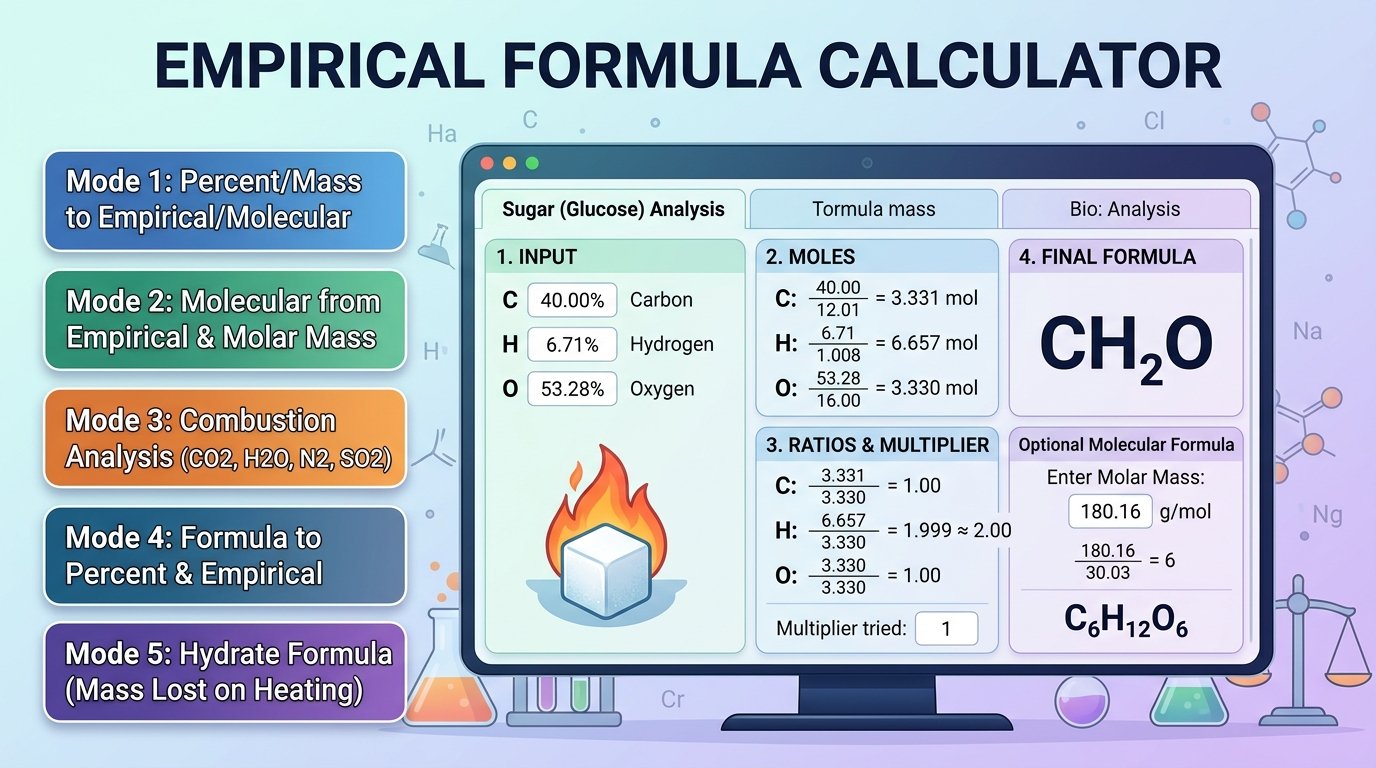
An empirical formula calculator turns the one thing a laboratory can actually measure about an unknown compound — how much of each element it contains — into the simplest whole-number ratio of atoms, and then, if you know the molar mass, into the true molecular formula. Burn a sugar and you get 40.00% carbon, 6.71% hydrogen and 53.28% oxygen. Divide each by its atomic mass, divide by the smallest, and 1 : 2 : 1 appears: CH2O. Multiply by six to match a molar mass of 180.16 g/mol and you have glucose, C6H12O6. That chain of four steps is the whole method, and it is the calculation every chemistry student meets in the first semester and every analytical chemist still performs when a new compound comes out of a flask.
The free empirical formula calculator above handles the entire topic in five modes: empirical formula from percent composition or element masses (with oxygen by difference and an optional jump to the molecular formula); molecular formula from an empirical formula and a molar mass; combustion analysis, where you enter the masses of CO2, H2O, N2 and SO2 collected; percent composition and empirical formula from any typed formula; and hydrate formulas from the mass lost on heating. Every mode prints the moles of each element, the raw ratios, the multiplier it tried, and the final formula with proper subscripts — so you can follow, check and copy the working rather than just the answer.
Below the tool sits a complete guide: what an empirical formula is and how it differs from a molecular formula, the four-step method with the decimal-to-whole-number rules that trip most people up, worked examples for glucose, iron oxide and caffeine, a reference table of common compounds, the chemistry of combustion analysis and hydrate heating, ten practice problems with hidden answers, and a frequently-asked-questions section. Everything on this page uses IUPAC 2021 standard atomic weights, the same values the empirical formula calculator uses internally.
🔑 KEY TAKEAWAY
The empirical formula is the simplest whole-number ratio of atoms in a compound; the molecular formula is the actual number of atoms per molecule and is always a whole-number multiple of it. To find the empirical formula: (1) assume 100 g so percentages become grams, (2) divide each mass by the element’s atomic mass to get moles, (3) divide every mole value by the smallest, (4) if a ratio ends in .5, .33, .67 or .25, multiply all of them by 2, 3, 3 or 4 until they are whole numbers. To reach the molecular formula, divide the molar mass by the empirical formula mass and multiply every subscript by that integer n. Glucose: 40.00% C, 6.71% H, 53.28% O → 3.330 : 6.657 : 3.330 mol → 1 : 2 : 1 → CH2O (30.03 g/mol); n = 180.16 / 30.03 = 6 → C6H12O6. The empirical formula calculator above performs all four steps, combustion analysis and hydrate formulas, and prints the working.
📑 Table of Contents (click to expand)
- What Is an Empirical Formula?
- How to Use This Empirical Formula Calculator
- The Five Modes Explained
- The Four-Step Method: Percent → Grams → Moles → Ratio
- Turning Decimal Ratios into Whole Numbers
- From Empirical Formula to Molecular Formula
- Worked Examples
- Reference Table: Percent Composition, Empirical and Molecular Formulas
- Combustion Analysis Explained
- Hydrate Formulas from Mass Loss
- Who Uses an Empirical Formula Calculator?
- Step-by-Step Walkthrough in the Tool
- A Short History of Elemental Analysis
- Limitations and Sources of Error
- Practice Problems (With Answers)
- Tips for Accurate Results
- Common Mistakes
- How This Calculator Is Different
- Where the Numbers Come From
- Exam Checklist
- Frequently Asked Questions
- 10 Facts Worth Knowing
- Final Thoughts
What Is an Empirical Formula?
The empirical formula of a compound is the simplest whole-number ratio of the atoms of each element in it. The word “empirical” is a reminder of where it comes from: experiment. When a chemist analyses an unknown substance, the instrument reports masses or percentages of elements, never a count of atoms per molecule. Converting those masses to moles gives the ratio of atoms, and the smallest set of whole numbers that expresses that ratio is the empirical formula. Hydrogen peroxide is 5.93% H and 94.07% O, which is one mole of H for every mole of O, so its empirical formula is HO — the first result most people try in an empirical formula calculator, and a useful one because it is so obviously not the molecule.
The molecular formula gives the actual number of atoms of each element in one molecule. Hydrogen peroxide molecules contain two H and two O, so the molecular formula is H2O2 — exactly twice the empirical formula. The molecular formula is always the empirical formula multiplied by a positive integer n, and n = 1 is allowed: water, ammonia, carbon dioxide and ethanol all have identical empirical and molecular formulas. To go from one to the other you need one extra piece of information, the molar mass, which comes from mass spectrometry, gas density, a colligative property or, in a textbook, is simply given.
Several different compounds can share one empirical formula. Formaldehyde (CH2O, 30.03 g/mol), acetic acid (C2H4O2, 60.05), lactic acid (C3H6O3, 90.08), ribose (C5H10O5, 150.13) and glucose (C6H12O6, 180.16) all analyse to 40.00% C, 6.71% H and 53.28% O. Elemental analysis cannot tell them apart; the molar mass can. Likewise acetylene C2H2, benzene C6H6 and styrene C8H8 are all “CH”.
For ionic and network solids the empirical formula is the only formula there is. Sodium chloride has no NaCl molecules, only a lattice with one Na+ per Cl−; silicon dioxide has no SiO2 molecules; iron(III) oxide is written Fe2O3 because that is the simplest ratio. Chemists call the mass of one such formula unit the formula weight, and our formula weight calculator handles those compounds specifically. An empirical formula calculator, meanwhile, is the tool for going the other way — from the measured composition back to the formula.
Three formulas for one compound
Empirical formula: simplest ratio, e.g. CH2O. Molecular formula: actual atoms per molecule, e.g. C6H12O6. Structural formula: how those atoms are connected, e.g. a six-membered ring with five hydroxyl groups. The empirical formula calculator on this page delivers the first two; the third needs spectroscopy.
How to Use This Empirical Formula Calculator
Choose a mode with the pill tabs across the top of the empirical formula calculator: EF from % / masses, Molecular formula, Combustion analysis, % composition or Hydrate. Every mode has example chips under its inputs; clicking one fills the boxes with a textbook problem so you can see the expected form of the input before typing your own.
- Enter the data you have. In Mode 1 type an element symbol and its percentage or mass on each row (up to six elements). Symbols are case-corrected, so “fe” becomes Fe. If oxygen was not measured, set “Oxygen” to by difference and the remainder to 100% (or to the sample mass) is assigned to O.
- Add the molar mass if you know it. The optional M box turns the empirical result into a molecular formula in the same run: the tool divides M by the empirical formula mass, rounds to the nearest integer, and warns if the quotient is not close to a whole number.
- Press Calculate. The headline shows the formula with real subscripts; beneath it the empirical formula mass, the multiplier n and the percentage back-check appear. The steps box lists moles of each element, the raw ratios, the integer multiplier tried and the reason it was chosen. A table repeats the numbers per element.
- Check the tolerance. The default tolerance (0.10 in Mode 1, 0.15 in Mode 2) decides how far a ratio may sit from a whole number before the tool tries a larger multiplier. Experimental data with ±0.3% errors sometimes needs 0.15; textbook data never does.
- Copy, download, print or share. The toolbar under the result copies the full working as text, downloads a CSV or TXT, prints a clean page, or shares via WhatsApp, Facebook, X or the native share sheet. The last twenty calculations stay in the history panel until you press Clear All.
Percentages do not have to sum to exactly 100; the empirical formula calculator normalises them and reports the total so you can see whether an element is missing. Masses in grams or milligrams work identically because only ratios matter — just keep every row in the same unit.
The Five Modes Explained
Mode 1 — Empirical formula from percent composition or masses
The classic empirical formula calculator problem. Enter each element and its percentage (or the mass recovered from a sample). The tool converts each entry to moles with IUPAC atomic weights, divides by the smallest, then searches multipliers from 1 to 12 for the first set that brings every ratio within tolerance of an integer. Optional oxygen-by-difference fills the gap when only C, H and N were determined, which is how most CHN analyses are reported. Add M and the molecular formula appears alongside.
Mode 2 — Molecular formula from empirical formula and molar mass
Type the empirical formula and the experimental molar mass. The empirical formula calculator computes the empirical formula mass, forms n = M / EFM, rounds it, and multiplies every subscript. It also checks that the formula you typed really is the simplest ratio; if you type C2H4O2 it will tell you that CH2O is the true empirical formula before continuing.
Mode 3 — Combustion analysis
Enter the sample mass and the masses of CO2, H2O and optionally N2 and SO2 collected, in grams or milligrams; this is the part of an empirical formula calculator that most competing tools leave out. The tool converts each product to the element it carries (all the carbon ends up in CO2, all the hydrogen in H2O), takes oxygen by difference if you ask it to, and runs the same ratio search. A mass-balance line shows whether the recovered elements exceed the sample mass, the commonest sign of a mis-typed value.
Mode 4 — Percent composition and empirical formula from a formula
The reverse calculation, and the mode that turns the empirical formula calculator into a checking tool. Type any formula — brackets, hydrates written with a dot or asterisk, Unicode subscripts pasted from a PDF all parse — and the tool returns the molar mass, the mass percent of every element, the empirical formula and n. Enter an optional sample mass and it also gives the grams of each element in that sample. This is the mode for checking a homework answer or preparing the theoretical values against which an analysis will be judged.
Mode 5 — Hydrate formula from mass loss
Enter the anhydrous salt (or just its molar mass), the mass before heating and either the residue mass or the water lost, and the empirical formula calculator treats the salt and the water as the two “elements” of the problem. The tool finds x in salt·xH2O from the mole ratio of water to salt, reports the percentage of water and compares it with the theoretical value for the rounded formula. It recognises hemihydrates such as CaSO4·½H2O, and it complements our dedicated molar mass of hydrates calculator, which works from the formula to the mass instead.
The Four-Step Method: Percent → Grams → Moles → Ratio
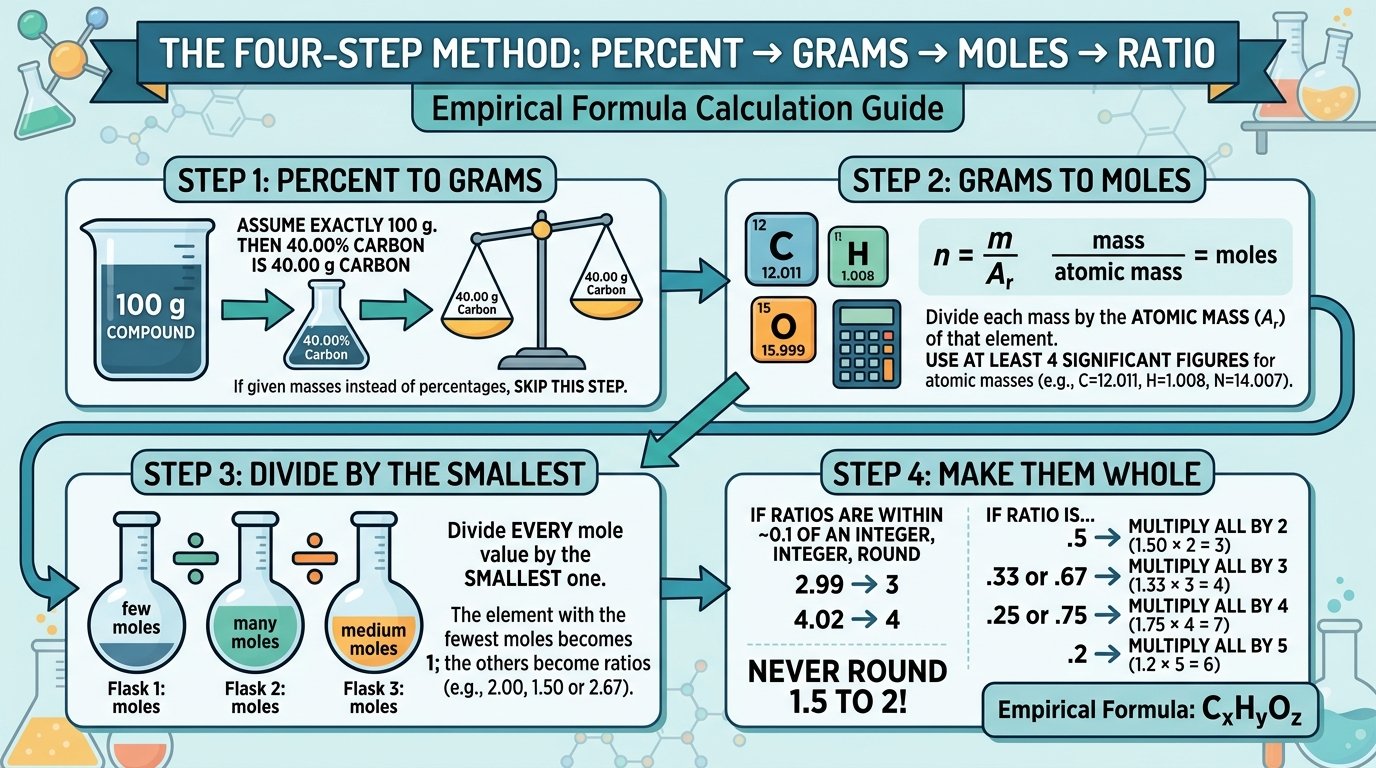
Every empirical formula calculation, whether done by hand, in a spreadsheet or by the empirical formula calculator above, is the same four steps. Learn them in this order and the problem type never changes, only the numbers.
Step 2 — Grams to moles. Divide each mass by the atomic mass of that element: n = m / Ar. Use at least four significant figures for the atomic masses (C 12.011, H 1.008, O 15.999, N 14.007, S 32.06).
Step 3 — Divide by the smallest. Divide every mole value by the smallest one. The element with the fewest moles becomes 1; the others become ratios such as 2.00, 1.50 or 2.67.
Step 4 — Make them whole. If all ratios are within about 0.1 of an integer, round. If one is 1.5 multiply all by 2; if 1.33 or 1.67 multiply by 3; if 1.25 or 1.75 multiply by 4; if 1.2 multiply by 5. Never round 1.5 to 2.
Why does the empirical formula calculator method work? The number of moles of an element is proportional to the number of its atoms, because a mole is a fixed count (6.02214076 × 10²³). Dividing masses by atomic masses therefore converts a mass ratio into an atom ratio; dividing by the smallest merely rescales it; and because atoms come in whole numbers, that ratio must be expressible with integers. The only judgement in the method is Step 4, and the next section makes it mechanical.
The mole conversion in Step 2 is the same operation performed by our grams to moles calculator; the difference here is that it is done for several elements at once and only the ratio is kept. If a textbook gives you moles directly, start at Step 3.
Turning Decimal Ratios into Whole Numbers
Step 4 is where marks are lost. After dividing by the smallest, the ratios are rarely perfect integers: experimental scatter and rounded atomic masses put them at 1.98 or 2.03, and genuine subscripts of 2 : 3 or 3 : 4 produce 1.50 or 1.33. The rule is simple: round only when every ratio is close to a whole number; otherwise multiply all ratios by the same small integer. The table below is the lookup the empirical formula calculator applies automatically.
| Ratio ends in | Fraction | Multiply all by | Example |
|---|---|---|---|
| .50 | ½ | 2 | Fe : O = 1 : 1.50 → 2 : 3 → Fe2O3 |
| .33 or .67 | ⅓ or ⅔ | 3 | C : H : O = 1 : 1.33 : 1 → 3 : 4 : 3 → C3H4O3 |
| .25 or .75 | ¼ or ¾ | 4 | C : H = 1.25 : 1 → 5 : 4 → C5H4 (naphthalene) |
| .20, .40, .60, .80 | fifths | 5 | P : O = 1 : 2.5 is ½, but 1 : 1.4 → 5 : 7 |
| .14, .29, .43, .57, .71, .86 | sevenths | 7 | Rare; check the data before accepting |
| within ±0.1 of an integer | — | 1 (just round) | 1.00 : 1.98 : 1.01 → CH2O |
The tool implements this as a search rather than a lookup: it multiplies the ratios by 1, 2, 3 … 12 in turn and stops at the first multiplier for which every ratio is within the tolerance of a whole number. That handles combinations the table does not list — a compound with 1.50 and 1.33 together needs ×6 — and it always prefers the smallest multiplier, which is what “simplest ratio” means. The steps box names the multiplier used and the worst deviation after rounding, so you can judge whether the data justify it.
Two habits protect you when working by hand. First, keep at least three decimal places in the mole values and the ratios; rounding 1.333 to 1.3 hides the ⅓ and rounding 1.48 to 1.5 invents one. Second, if a ratio sits at 1.4 or 1.6 with good textbook data, suspect an arithmetic slip — check that you divided by the atomic mass and not the molar mass of an element such as O2, the single most common error in this calculation.
From Empirical Formula to Molecular Formula
The molecular formula is (empirical formula)n, where n is a positive integer. Because mass is additive, the molar mass of the compound is n times the empirical formula mass (EFM), the mass of one empirical formula unit. Therefore:
For glucose, the first example in the empirical formula calculator above, the empirical formula CH2O has EFM = 12.011 + 2(1.008) + 15.999 = 30.026 g/mol. The molar mass is 180.156 g/mol, so n = 180.156 / 30.026 = 6.000 and the molecular formula is C6H12O6. For dinitrogen tetroxide, NO2 has EFM 46.005 and M = 92.01 gives n = 2 → N2O4. For phosphorus pentoxide, the empirical P2O5 (141.94) and M = 283.89 give n = 2 → P4O10, which is why the “pentoxide” name survives for a molecule with ten oxygens.
The quotient must come out close to a whole number; if it does not, either the molar mass is wrong or the formula you called empirical is not the simplest ratio. Mode 2 of the empirical formula calculator checks both: it re-reduces the formula you type and it flags any n further than 0.15 from an integer with a warning rather than silently rounding. A value of 3.3, for instance, is a clear sign that something upstream needs revisiting.
Where does the molar mass come from? In an exam it is given. In the laboratory it comes from a mass spectrometer (see our exact mass calculator and monoisotopic mass calculator for how the peak is interpreted), from gas density via molar mass from gas density or vapor density, or from a colligative property such as freezing point depression, boiling point elevation or osmotic pressure. Historically the combination of a combustion analysis with a Dumas vapour-density measurement was how the molecular formulas of most simple organic compounds were first fixed.
Worked Examples
Example 1 — Glucose from percent composition (Mode 1)
Step 1: In 100 g: 40.00 g C, 6.71 g H, 53.28 g O.
Step 2: C 40.00 / 12.011 = 3.3303 mol; H 6.71 / 1.008 = 6.6567 mol; O 53.28 / 15.999 = 3.3302 mol.
Step 3: Divide by 3.3302 → C 1.000, H 1.999, O 1.000.
Step 4: All within 0.01 of integers → CH2O; EFM = 30.026 g/mol.
Molecular: n = 180.16 / 30.026 = 6.00 → C6H12O6.
The empirical formula calculator reports exactly these intermediate values; the back-check line recomputes 40.00 / 6.71 / 53.28% from the final formula to confirm nothing was lost in rounding.
Example 2 — Iron oxide with a ½ ratio (Mode 1)
Moles: Fe 69.94 / 55.845 = 1.2524; O 30.06 / 15.999 = 1.8789.
Divide by smallest: Fe 1.000, O 1.500.
Whole numbers: 1.500 is ½ short of an integer → multiply both by 2 → Fe 2, O 3 → Fe2O3 (159.69 g/mol).
Check: Rounding 1.5 to 2 would have given FeO2, an oxide that does not exist; the empirical formula calculator never rounds a ratio that a small multiplier can make whole. The steps box shows “multiplied by 2 (max deviation 0.000)”.
Example 3 — Caffeine, four elements (Mode 1 with M)
Moles: C 4.1196; H 5.1488; N 2.0597; O 1.0301.
Divide by 1.0301: C 3.999, H 4.998, N 1.999, O 1.000 → C4H5N2O; EFM = 97.10 g/mol.
Molecular: n = 194.19 / 97.10 = 2.00 → C8H10N4O2.
Caffeine illustrates why the molar mass box in the empirical formula calculator is essential: C4H5N2O is a perfectly sensible-looking formula, and nothing in the percentages says it is only half a molecule. Theobromine (C7H8N4O2), the related alkaloid in chocolate, has a different empirical formula precisely because its ratio 7 : 8 : 4 : 2 cannot be halved.
Reference Table: Percent Composition, Empirical and Molecular Formulas
The compounds below appear in almost every textbook problem set. Percentages were computed with IUPAC 2021 atomic weights (C 12.011, H 1.008, N 14.007, O 15.999, S 32.06) — the same values the empirical formula calculator uses — and rounded to two decimals. Use them to test the tool, to set your own problems, or as target values for a laboratory analysis.
| Compound | Molecular formula | Empirical formula | n | M (g/mol) | Percent composition |
|---|---|---|---|---|---|
| Water | H2O | H2O | 1 | 18.015 | H 11.19, O 88.81 |
| Hydrogen peroxide | H2O2 | HO | 2 | 34.014 | H 5.93, O 94.07 |
| Carbon dioxide | CO2 | CO2 | 1 | 44.009 | C 27.29, O 72.71 |
| Methane | CH4 | CH4 | 1 | 16.043 | C 74.87, H 25.13 |
| Ethylene | C2H4 | CH2 | 2 | 28.054 | C 85.63, H 14.37 |
| Acetylene | C2H2 | CH | 2 | 26.038 | C 92.26, H 7.74 |
| Benzene | C6H6 | CH | 6 | 78.114 | C 92.26, H 7.74 |
| Butane | C4H10 | C2H5 | 2 | 58.124 | C 82.66, H 17.34 |
| Octane | C8H18 | C4H9 | 2 | 114.232 | C 84.12, H 15.88 |
| Naphthalene | C10H8 | C5H4 | 2 | 128.174 | C 93.71, H 6.29 |
| Formaldehyde | CH2O | CH2O | 1 | 30.026 | C 40.00, H 6.71, O 53.28 |
| Acetic acid | C2H4O2 | CH2O | 2 | 60.052 | C 40.00, H 6.71, O 53.28 |
| Glucose | C6H12O6 | CH2O | 6 | 180.156 | C 40.00, H 6.71, O 53.28 |
| Ethanol | C2H6O | C2H6O | 1 | 46.069 | C 52.14, H 13.13, O 34.73 |
| Ethylene glycol | C2H6O2 | CH3O | 2 | 62.068 | C 38.70, H 9.74, O 51.55 |
| Ethyl acetate | C4H8O2 | C2H4O | 2 | 88.106 | C 54.53, H 9.15, O 36.32 |
| Ascorbic acid (vitamin C) | C6H8O6 | C3H4O3 | 2 | 176.124 | C 40.92, H 4.58, O 54.50 |
| Aspirin | C9H8O4 | C9H8O4 | 1 | 180.159 | C 60.00, H 4.48, O 35.52 |
| Caffeine | C8H10N4O2 | C4H5N2O | 2 | 194.194 | C 49.48, H 5.19, N 28.85, O 16.48 |
| Nicotine | C10H14N2 | C5H7N | 2 | 162.236 | C 74.03, H 8.70, N 17.27 |
| Sucrose | C12H22O11 | C12H22O11 | 1 | 342.297 | C 42.11, H 6.48, O 51.41 |
| Dinitrogen tetroxide | N2O4 | NO2 | 2 | 92.010 | N 30.45, O 69.55 |
| Phosphorus(V) oxide | P4O10 | P2O5 | 2 | 283.886 | P 43.64, O 56.36 |
| Iron(III) oxide | Fe2O3 | Fe2O3 | — | 159.687 | Fe 69.94, O 30.06 |
| Sodium sulfate | Na2SO4 | Na2SO4 | — | 142.036 | Na 32.37, S 22.57, O 45.06 |
| Copper(II) sulfate pentahydrate | CuSO4·5H2O | — | — | 249.677 | Cu 25.45, S 12.84, O 57.67, H 4.04 (H2O 36.08) |
Two things stand out. First, five entries share CH2O and three share CH, so identical percentages really do occur for very different substances. Second, for ionic compounds and hydrates n is not meaningful because there is no molecule to count; the empirical formula is the formula. You can regenerate any row with Mode 4 of the empirical formula calculator, and any percent-composition row can be pushed back through Mode 1 to recover the formula in the second column.
Combustion Analysis Explained
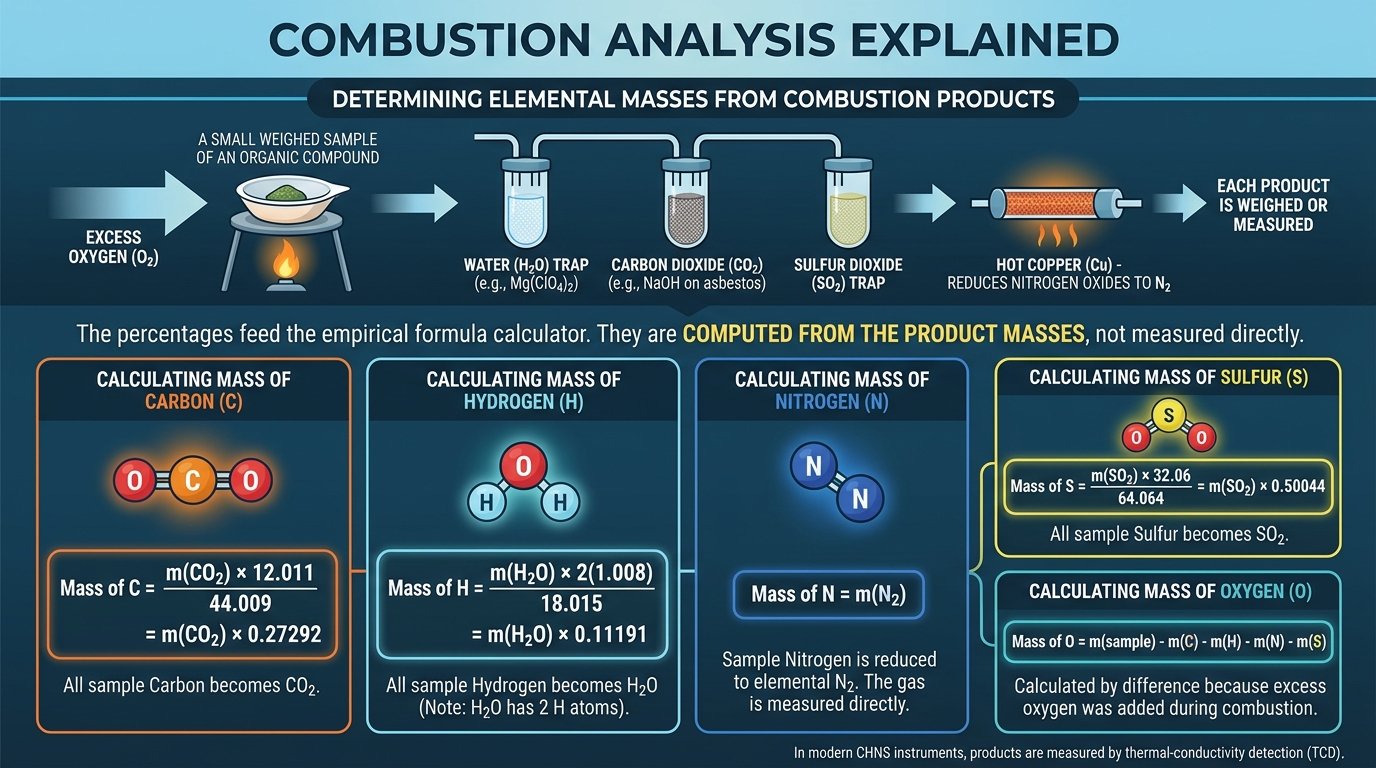
Most organic compounds are analysed by burning a weighed sample in excess oxygen. All the carbon becomes CO2, all the hydrogen becomes H2O, nitrogen is reduced to N2 over hot copper and sulfur becomes SO2. Each product is trapped and weighed (or, in modern CHNS instruments, measured by thermal-conductivity detection). The percentages that feed the empirical formula calculator are therefore not measured directly — they are computed from the product masses, and that conversion is the part students find hardest.
Mass of H = m(H2O) × 2(1.008) / 18.015 = m(H2O) × 0.11191
Mass of N = m(N2) (the gas is the element) | Mass of S = m(SO2) × 32.06 / 64.064 = m(SO2) × 0.50044
Mass of O = m(sample) − m(C) − m(H) − m(N) − m(S) (by difference, because the oxygen in CO2 and H2O came partly from the combustion gas)
Take 1.000 g of acetic acid burned to give 1.466 g CO2 and 0.600 g H2O. Carbon: 1.466 × 0.27292 = 0.4001 g. Hydrogen: 0.600 × 0.11191 = 0.0671 g. Oxygen by difference: 1.000 − 0.4001 − 0.0671 = 0.5328 g. Moles: C 0.03331, H 0.06661, O 0.03330 → 1 : 2 : 1 → CH2O; with M = 60.05 g/mol, n = 2 and the molecular formula is C2H4O2. Mode 3 of the empirical formula calculator prints each of those lines, and its mass-balance check would have refused the input if the carbon and hydrogen alone exceeded 1.000 g.
Two traps are worth naming, because no empirical formula calculator can catch them if the numbers you type already contain them. The oxygen in the products must never be counted as oxygen from the sample; oxygen is always taken by difference, and if the compound contains none (a hydrocarbon) the difference should be close to zero — the tool lets you switch oxygen off for exactly that case. And the sample mass matters even for a hydrocarbon: if 0.4000 g gives 1.2568 g CO2 and 0.5145 g H2O, the recovered C + H is 0.3430 + 0.0576 = 0.4006 g, which agrees with the sample within rounding and confirms that no oxygen is present. The ratio is 1 : 2, CH2, and M = 84.16 gives C6H12, cyclohexene or a hexene isomer.
Modern CHNS analysers work on 1–3 mg samples with a stated accuracy of about ±0.3% absolute in each element, which is why journals accept a computed formula when calculated and found percentages agree within that margin. At that precision a ratio of 1.45 cannot be distinguished from 1.50, so the tolerance setting in the tool, and honest reporting of the uncertainty, matter more with real data than with textbook numbers.
Hydrate Formulas from Mass Loss
A hydrate is a crystalline salt that incorporates a fixed number of water molecules per formula unit, written salt·xH2O. Heating drives the water off, and the mass lost tells you x. This is the empirical formula calculator problem in miniature: the “elements” are the anhydrous salt and water, the “atomic masses” are their molar masses, and x is the ratio of their moles.
Heat 2.500 g of blue copper(II) sulfate crystals until the mass is constant at 1.598 g of white powder. Water lost = 0.902 g = 0.05007 mol. Residue CuSO4 = 1.598 / 159.61 = 0.010012 mol. x = 0.05007 / 0.010012 = 5.00, so the formula is CuSO4·5H2O and the water content is 36.08%. For Epsom salt, 5.000 g leaving 2.442 g of MgSO4 gives x = 7.0; for washing soda, 2.861 g of crystals leaving 1.060 g of Na2CO3 gives x = 10. Mode 5 of the empirical formula calculator reports x to two decimals, rounds it, and shows the theoretical water percentage of the rounded formula so you can see how well the experiment agrees.
Gypsum is the classic exception: CaSO4·2H2O loses only three-quarters of its water at 150 °C to give the hemihydrate CaSO4·½H2O, plaster of Paris. If 1.000 g of plaster is heated strongly and leaves 0.938 g, x = (0.062 / 18.015) / (0.938 / 136.14) = 0.50; the tool recognises a result close to a half and reports ½ rather than forcing x to 0 or 1. Incomplete heating is the commonest laboratory error and always makes x too small; the checks in our hydrates guide explain how to confirm constant mass.
Who Uses an Empirical Formula Calculator?
- High-school and first-year students meet the calculation in the stoichiometry unit, usually alongside molarity and reaction stoichiometry. Every board exam from Cambridge IGCSE and A-level to AP Chemistry, IB, JEE and MDCAT includes at least one empirical or molecular formula question.
- Organic and medicinal chemists report CHN analyses for every new compound, with calculated and found percentages that must agree within 0.4%. Mode 4 gives the calculated line; Mode 1 confirms that the found values still round to the intended formula.
- Analytical and environmental laboratories running CHNS/O analysers on fuels, soils, polymers and biomass convert element percentages into C : H : O ratios to characterise coal rank, biochar quality and fuel oxygenate content.
- Materials scientists and geologists convert oxide weight percentages from XRF or microprobe analyses into mineral formulas — the same divide-by-atomic-mass method with more elements.
- Teachers generate problem sets in Mode 4 (formula → percentages) and check student answers in Mode 1 of the empirical formula calculator, with the working printed for marking schemes.
Whatever the field, the underlying arithmetic never changes, which is why a well-built empirical formula calculator can serve all of them with one set of atomic weights and one ratio-search routine.
Step-by-Step Walkthrough in the Tool
Suppose a compound of carbon, hydrogen and oxygen is found to contain 38.7% C and 9.7% H, and a separate freezing-point measurement gives M ≈ 62 g/mol. Here is how the empirical formula calculator handles it in under a minute.
- Open Mode 1. Type C and 38.7 on the first row, H and 9.7 on the second. Leave the third row empty.
- Set Oxygen to “by difference”. The tool assigns 100 − 38.7 − 9.7 = 51.6% to O and says so in the steps.
- Type 62.07 in the Molar mass box (or leave it blank to stop at the empirical formula).
- Press Calculate. Moles: C 3.222, H 9.623, O 3.225 → divided by 3.222: 1.000, 2.987, 1.001 → CH3O (EFM 31.03). n = 62.07 / 31.03 = 2.00 → C2H6O2, ethylene glycol.
- Read the back-check: 38.70% C, 9.74% H, 51.55% O from the final formula against 38.7 / 9.7 / 51.6 entered. Agreement within 0.1% confirms the assignment.
- Press Copy to paste the working into a lab notebook, or CSV to keep the per-element table. The calculation is also stored in the history strip with a timestamp.
Now switch the empirical formula calculator to Mode 4, type C2H6O2, and confirm 62.068 g/mol and the same percentages. Checking a forward result with the reverse calculation is a habit the tool makes cheap enough to keep.
A Short History of Elemental Analysis
Every empirical formula calculator rests on a law that is more than two centuries old. The idea that a compound has a fixed composition is Joseph Proust’s law of definite proportions (1797–1808), which Dalton’s atomic theory explained in 1808: if atoms combine in whole-number ratios, mass ratios must be fixed. Berzelius spent the following decade measuring those ratios for hundreds of compounds and, in 1813, introduced the letter symbols and subscripts we still use. Gay-Lussac and Thénard burned organic compounds with potassium chlorate in 1810, but it was Justus von Liebig’s five-bulb Kaliapparat of 1831 — which absorbed CO2 in potassium hydroxide so it could simply be weighed — that made carbon–hydrogen analysis routine and turned organic chemistry into a quantitative science.
Jean-Baptiste Dumas added nitrogen determination by combustion in 1833, and his vapour-density method supplied the molar masses that convert empirical formulas to molecular ones; Cannizzaro’s 1858 reconciliation of atomic weights removed the last ambiguity in the multipliers. Fritz Pregl won the 1923 Nobel Prize for shrinking the method to milligram samples, and automated CHN analysers appeared in the 1960s. The arithmetic performed by today’s empirical formula calculator is unchanged from Liebig’s: mass of product, mass of element, moles, ratio. Only the atomic weights have been refined — and even those, since IUPAC’s 2009 decision, are now given as intervals for elements such as carbon and hydrogen whose isotopic composition varies in nature.
Limitations and Sources of Error
The method is exact in principle; the errors that reach an empirical formula calculator come from the data and from the rounding decisions.
- Precision of the percentages. A ±0.3% absolute error in carbon changes a mole ratio by about 1%. For a formula with subscripts up to 10 that is still unambiguous; for a C30 natural product it is not, and mass spectrometry, not combustion, fixes the formula.
- Oxygen by difference accumulates every other error. If the sample was impure or damp, the “oxygen” absorbs the shortfall and the ratio shifts.
- Non-stoichiometric compounds. Wüstite is Fe0.95O, not FeO; many oxides, sulfides and alloys have genuinely fractional ratios. Forcing whole numbers there is wrong, and the tool’s warning about a large multiplier is the signal.
- The empirical formula is not the molecule. Without an independent molar mass it cannot distinguish acetylene from benzene. Nor does it say anything about structure: C2H6O is both ethanol and dimethyl ether.
- Atomic-weight choices. Using C = 12 and O = 16 shifts ratios by up to 0.1% — harmless in textbooks, visible against real data. The empirical formula calculator uses the IUPAC 2021 conventional values throughout.
- Hydrate heating. Some salts decompose before losing all their water (CuSO4 loses the fifth water only above 200 °C; MgCl2·6H2O hydrolyses), and hygroscopic residues regain mass on cooling in air. Both make x wrong in predictable directions.
Practice Problems (With Answers)
Work each problem by hand first, then verify with the free empirical formula calculator above. Answers are hidden until you click.
Problem 1 — A compound is 32.37% Na, 22.57% S and 45.06% O. Find its empirical formula.
Moles: Na 32.37 / 22.990 = 1.408; S 22.57 / 32.06 = 0.704; O 45.06 / 15.999 = 2.816. Divide by 0.704: Na 2.00, S 1.00, O 4.00 → Na2SO4, sodium sulfate (142.04 g/mol). Being ionic, this is also its only formula.
Problem 2 — A hydrocarbon is 85.63% C and 14.37% H and has a molar mass of 56.11 g/mol. Give the empirical and molecular formulas.
C 85.63 / 12.011 = 7.129; H 14.37 / 1.008 = 14.256; ratio 1 : 2.000 → CH2, EFM 14.027. n = 56.11 / 14.027 = 4.00 → C4H8 (a butene or cyclobutane). Note that CH2 itself is not a stable compound; the empirical formula need not correspond to any real molecule.
Problem 3 — 0.2500 g of an ester burns to give 0.4995 g CO2 and 0.2045 g H2O. Its molar mass is 88.1 g/mol. What is the molecular formula?
C: 0.4995 × 0.27292 = 0.13632 g = 0.011350 mol. H: 0.2045 × 0.11191 = 0.02289 g = 0.02270 mol. O by difference: 0.2500 − 0.13632 − 0.02289 = 0.09079 g = 0.005675 mol. Divide by 0.005675: C 2.00, H 4.00, O 1.00 → C2H4O (44.05). n = 88.1 / 44.05 = 2 → C4H8O2, consistent with ethyl acetate.
Problem 4 — Vitamin C is 40.92% C, 4.58% H and 54.50% O, M = 176.12 g/mol. Find both formulas.
Moles: C 3.407; H 4.544; O 3.406. Divide by 3.406: C 1.000, H 1.334, O 1.000. The 1.33 is ⅓ → multiply by 3 → C 3, H 4, O 3 → C3H4O3 (88.06). n = 176.12 / 88.06 = 2.00 → C6H8O6. Rounding 1.33 to 1 would have given CHO and n = 6.07 — the non-integer n is the giveaway.
Problem 5 — 3.664 g of hydrated barium chloride loses 0.540 g of water on heating. Find the formula of the hydrate (M of BaCl2 = 208.23 g/mol).
Residue = 3.664 − 0.540 = 3.124 g = 0.015003 mol BaCl2. Water = 0.540 / 18.015 = 0.02998 mol. x = 0.02998 / 0.015003 = 1.998 → 2 → BaCl2·2H2O (244.26 g/mol, 14.75% water). Enter it in Mode 5 with “water lost” selected.
Problem 6 — Nicotine is 74.03% C, 8.70% H and 17.27% N. Its molar mass is about 162 g/mol. Find the molecular formula.
Moles: C 6.164; H 8.631; N 1.233. Divide by 1.233: C 5.00, H 7.00, N 1.00 → C5H7N (81.12). n = 162 / 81.12 = 2.00 → C10H14N2.
Problem 7 — 1.500 g of a compound containing C, H, N and O gives 2.235 g CO2, 1.144 g H2O and 0.356 g N2 on combustion. M = 59.07 g/mol. Identify it.
C: 2.235 × 0.27292 = 0.6100 g (0.05079 mol). H: 1.144 × 0.11191 = 0.1280 g (0.1270 mol). N: 0.356 g (0.02542 mol). O: 1.500 − 0.6100 − 0.1280 − 0.356 = 0.4060 g (0.02538 mol). Divide by 0.02538: C 2.00, H 5.00, N 1.00, O 1.00 → C2H5NO (59.07) → n = 1, so the molecular formula is the same: acetamide.
Problem 8 — What are the percent composition and empirical formula of ammonium sulfate, (NH4)2SO4? How many grams of nitrogen are in 100 g?
M = 2(14.007) + 8(1.008) + 32.06 + 4(15.999) = 132.134 g/mol. N 21.20%, H 6.10%, S 24.26%, O 48.43%. The atom ratio N2H8SO4 has no common divisor, so the empirical formula is the formula itself. 100 g contains 21.20 g of nitrogen — the figure printed on fertiliser bags as “21-0-0”. Mode 4 with a 100 g sample mass reproduces all of this.
Problem 9 — An oxide of phosphorus is 43.64% P. Its vapour has a molar mass of 283.9 g/mol. Find the molecular formula.
O = 56.36%. Moles: P 43.64 / 30.974 = 1.409; O 56.36 / 15.999 = 3.523. Divide by 1.409: P 1.00, O 2.50 → ×2 → P2O5 (141.94). n = 283.9 / 141.94 = 2.00 → P4O10.
Problem 10 — 2.43 g of magnesium burns in air to form 4.03 g of oxide. Find the empirical formula.
Mass of O = 4.03 − 2.43 = 1.60 g. Moles: Mg 2.43 / 24.305 = 0.1000; O 1.60 / 15.999 = 0.1000. Ratio 1 : 1 → MgO. If the crucible lid was left off and some Mg3N2 formed, the apparent oxygen mass falls and the ratio drifts toward Mg1.1O — the standard discussion point in this school experiment.
Tips for Accurate Results
- Carry four significant figures in the atomic masses and at least three decimals in the mole values; round only at the very end.
- Divide by the smallest number of moles, not the smallest mass or the first element listed; the empirical formula calculator shows which element it chose.
- Before rounding a ratio, ask whether it is nearer to a half, a third or a quarter than to an integer; multiply the whole set, never a single element.
- Always back-check: compute the percent composition of the formula you obtained (Mode 4) and compare it with the data. A discrepancy above 0.5% means a slip.
- When percentages sum to less than 100 and oxygen was not reported, the missing mass is almost always oxygen — use the by-difference option rather than ignoring it.
- In combustion problems convert CO2 to C and H2O to H before doing anything else, and take oxygen by difference from the sample mass, never from the products.
- For molecular formulas, if n is not within 0.1 of an integer, recheck the molar mass; the empirical formula calculator flags this automatically.
- For hydrates, heat to constant mass (two successive weighings within 0.01 g) and cool in a desiccator, not in open air.
Common Mistakes
| Mistake | What happens | Fix |
|---|---|---|
| Rounding 1.5 to 2 (or 1.33 to 1) | Fe2O3 becomes FeO2; vitamin C becomes CHO | Multiply the whole ratio set by 2, 3 or 4 |
| Dividing by the molar mass of O2, H2 or N2 | Moles of that element halve; ratio doubles | Use the atomic mass of the element (O 15.999, not 31.998) |
| Using the percentage of CO2 as the percentage of C | Carbon overstated by a factor of 3.66 | Multiply m(CO2) by 12.011/44.009 first |
| Counting product oxygen as sample oxygen | Every hydrocarbon appears to contain oxygen | Oxygen by difference from the sample mass only |
| Stopping at the empirical formula when M is given | Half the marks lost; CH2O instead of C6H12O6 | Always compute n = M / EFM when a molar mass appears |
| Rounding mole values to one decimal too early | Genuine 1.33 looks like 1.3; genuine 1.48 looks like 1.5 | Keep three decimals until the final step |
| Writing the hydrate as salt·xH2O with x from mass ratio, not mole ratio | CuSO4·0.56H2O | Convert both water and salt to moles before dividing |
Every row in this table corresponds to a check built into the empirical formula calculator: it reduces formulas, it warns on non-integer n, it refuses combustion data whose carbon and hydrogen exceed the sample mass, and it never rounds a ratio that a small multiplier would make whole.
How This Calculator Is Different
| Feature | This calculator | Generic empirical formula tool | By hand |
|---|---|---|---|
| Percentages or masses, up to six elements, oxygen by difference | ✅ Any mix; symbols auto-corrected | ⚠️ Often percentages only, no O by difference | ✅ Slow |
| Integer-ratio search with named multiplier and deviation | ✅ ×1–12, adjustable tolerance, reason printed | ❌ Rounds silently | Error-prone |
| Molecular formula in the same run | ✅ Optional M box; warns on non-integer n | ⚠️ Separate page | ✅ |
| Combustion analysis with N and S, g or mg, mass-balance check | ✅ Built in | ❌ Rare | Very slow |
| Reverse mode: formula → % composition, EF and n; brackets and hydrates parse | ✅ Full periodic table | ⚠️ Sometimes | Slow |
| Hydrate x from mass loss, hemihydrates recognised | ✅ With theoretical % water back-check | ❌ | ✅ |
| Step-by-step working, per-element table, copy / CSV / TXT / print / share, history | ✅ All included, no sign-up | ❌ Final formula only | Your notebook |
| Readable by AI assistants and answer engines | ✅ Plain-text summary and structured data on the page | ❌ | — |
This empirical formula calculator is part of a family of free tools on molecularweightcalculator.org. Start with the molecular weight calculator and the atomic mass calculator for the masses that feed every ratio; use the formula weight calculator for ionic solids and the hydrates calculator for salt·xH2O masses; turn to the grams to moles, molarity, stoichiometry and equivalent weight pages for the rest of the mole concept; find molar masses experimentally with the freezing point depression, boiling point elevation, osmotic pressure, vapor density, gas density and van der Waals equation tools; read the mass-spectrometry side in the exact mass, monoisotopic mass, isotopic mass and average vs monoisotopic mass guides; and for mixtures and polymers see average molecular weight of a mixture, number average, weight average, polydispersity index and viscosity molecular weight.
Where the Numbers Come From
The atomic weights in this empirical formula calculator are the IUPAC 2021 standard atomic weights, using the conventional (abridged) value for elements whose weight is published as an interval: H 1.008, C 12.011, N 14.007, O 15.999, S 32.06, Cl 35.45 and so on, to five significant figures for the remaining elements. Molar masses of the combustion products follow directly (CO2 44.009, H2O 18.015, N2 28.014, SO2 64.064 g/mol). Reference compound percentages in the table above were computed from those same values, which is why the tool and the table agree to the last digit; other textbooks that use C = 12.01 and O = 16.00 will differ in the second decimal.
If you spot a discrepancy worth checking, our corrections policy explains how reports are handled, and the contact page is the fastest route to us. More about the site and its author is on the about page.
Trusted external references for further empirical formula calculator reading:
- IUPAC Gold Book — empirical formula (iupac.org): the authoritative definition
- IUPAC CIAAW — Standard Atomic Weights (ciaaw.org): the atomic weights used in every calculation on this page
- LibreTexts — Empirical Formulas from Analyses (libretexts.org): textbook treatment with combustion examples
- Wikipedia — Empirical formula (wikipedia.org): overview and history
Exam Checklist
☐ I can convert percentages to grams (assume 100 g), grams to moles (divide by atomic mass) and moles to the simplest ratio (divide by the smallest).
☐ I know that .5 → ×2, .33/.67 → ×3, .25/.75 → ×4 and that only ratios within about 0.1 of an integer may be rounded.
☐ I can compute n = M / EFM and multiply the subscripts, and I recognise a non-integer n as a warning — the same warning the empirical formula calculator prints.
☐ I can convert CO2 and H2O masses to C and H masses, take oxygen by difference and finish a combustion problem.
☐ I can find x in salt·xH2O from the mass before and after heating, using moles of water and moles of salt.
☐ I can go the other way: from a formula to its molar mass and percent composition, and back-check any empirical formula calculator result.
☐ I can name the main sources of error: rounding too early, wrong atomic mass, product oxygen counted as sample oxygen, incomplete heating.
Frequently Asked Questions
What is the difference between an empirical formula and a molecular formula?
The empirical formula is the simplest whole-number ratio of atoms (CH2O); the molecular formula is the actual number of atoms in one molecule (C6H12O6 for glucose). The molecular formula is always an integer multiple n of the empirical formula, and n can be 1 — for water, CO2 and ethanol the two are identical. Finding n requires the molar mass.
How do I calculate an empirical formula from percent composition?
Treat the percentages as grams in 100 g of compound, divide each by the element’s atomic mass to get moles, divide every result by the smallest, and if any ratio is not close to a whole number multiply all of them by 2, 3 or 4 until they are. For 40.00% C, 6.71% H, 53.28% O: 3.330 : 6.657 : 3.330 mol → 1 : 2 : 1 → CH2O. The empirical formula calculator above prints each of these steps.
How do I find the molecular formula from the empirical formula?
Compute the empirical formula mass (add the atomic masses of the empirical unit), divide the molar mass by it, round to the nearest integer n, and multiply every subscript by n. CH2O has EFM 30.03 g/mol; with M = 180.16 g/mol, n = 6 and the molecular formula is C6H12O6. If n is not close to a whole number, the molar mass or the empirical formula is wrong.
What do I do when the ratio comes out as 1.5 or 1.33?
Do not round it. A ratio of 1.5 means a 2 : 3 relationship, so multiply every ratio by 2; 1.33 or 1.67 means thirds, so multiply by 3; 1.25 or 1.75 means quarters, so multiply by 4. Fe : O = 1 : 1.5 gives Fe2O3, and C : H : O = 1 : 1.33 : 1 gives C3H4O3. Only ratios within about 0.1 of an integer should be rounded.
How does combustion analysis give an empirical formula?
All the carbon in the sample ends up as CO2 and all the hydrogen as H2O. Mass of C = m(CO2) × 12.011/44.009; mass of H = m(H2O) × 2.016/18.015; oxygen in the sample is the sample mass minus C, H and any N or S. Convert those masses to moles and proceed as usual. Mode 3 of the empirical formula calculator does the conversion and checks that the recovered elements do not exceed the sample mass.
Can two different compounds have the same empirical formula?
Yes, and it is common. Formaldehyde, acetic acid, lactic acid, ribose and glucose are all CH2O; acetylene, benzene and styrene are all CH; NO2 and N2O4 are both NO2. Elemental analysis alone cannot separate them; the molar mass, from mass spectrometry or a colligative property, does.
Why do the percentages not add up to exactly 100%?
Rounding of each percentage to two decimals, experimental error, or an element that was not determined. If the shortfall is a few tenths of a percent it is rounding and can be ignored; if it is several percent and oxygen was not measured, the difference is almost certainly oxygen. The empirical formula calculator normalises the entries and reports the total so you can decide which case applies.
How do I find the formula of a hydrate from heating data?
Subtract the residue mass from the initial mass to get the water lost; divide by 18.015 for moles of water; divide the residue mass by the molar mass of the anhydrous salt for moles of salt; x is the ratio. For 2.500 g of CuSO4·xH2O leaving 1.598 g: 0.902/18.015 = 0.05007 mol water, 1.598/159.61 = 0.01001 mol salt, x = 5.00 → CuSO4·5H2O. Mode 5 of the empirical formula calculator performs this in one step.
Is the empirical formula the same as the formula of an ionic compound?
Yes. Ionic and network solids have no molecules, so their formula is by definition the simplest ratio of ions or atoms: NaCl, CaCl2, Fe2O3, SiO2. The idea of a molecular formula and a multiplier n does not apply to them, and the mass of one formula unit is called the formula weight rather than the molecular weight.
Which atomic masses should I use, and does it matter?
Use at least four significant figures: C 12.011, H 1.008, O 15.999, N 14.007, S 32.06. Using C = 12 and O = 16 shifts a ratio by up to about 0.1%, which is harmless for textbook data but can push a real analysis over the ±0.4% acceptance limit journals apply. This empirical formula calculator uses the IUPAC 2021 conventional values for every element.
10 Facts Worth Knowing
- Liebig’s Kaliapparat of 1831 — five glass bulbs of potassium hydroxide that absorbed CO2 so it could be weighed — cut the time for a carbon–hydrogen analysis from days to under an hour and is still the logo of the American Chemical Society.
- Fritz Pregl received the 1923 Nobel Prize in Chemistry for micro-analysis: the same combustion method on 2–5 mg of sample, using a balance sensitive to a microgram.
- Benzene’s empirical formula, CH, was known for decades before Kekulé proposed the ring in 1865; the molecular formula C6H6 came from its vapour density.
- Five common substances — formaldehyde, acetic acid, lactic acid, ribose and glucose — analyse to exactly the same 40.00% C, 6.71% H and 53.28% O.
- The formula of glucose was one of the first to be established by combustion; Liebig’s assistant analysed grape sugar in the 1830s and obtained C6H12O6 only after the atomic weight of carbon was corrected from 6 to 12.
- Wüstite, the “FeO” of blast furnaces, is really Fe0.84–0.95O; non-stoichiometric compounds show that the whole-number rule is a property of molecules, not of all solids.
- Journals typically require calculated and found percentages to agree within 0.4% before a new compound’s formula is accepted — a rule that dates from Pregl’s era.
- Modern CHNS analysers burn the sample at about 1000 °C in a pulse of pure oxygen, separate the product gases on a chromatographic column and report all four elements in about ten minutes.
- IUPAC has published atomic weights of hydrogen, carbon, nitrogen, oxygen and sulfur as intervals since 2009 because their isotopic composition varies between natural sources; the single “conventional” values are what calculators use.
- Plaster of Paris, CaSO4·½H2O, is one of the few common compounds with a fractional hydrate number in its accepted formula — a half water per formula unit means one water per two calcium sulfates in the crystal.
Final Thoughts
The empirical formula is where measurement meets atomic theory, and an empirical formula calculator is only the arithmetic of that meeting made fast: a balance reading turns into a count of atoms through nothing more than division by atomic masses. The method has four steps and one judgement call, and once you have learned to recognise a ½ or a ⅓ in a ratio and to divide the molar mass by the empirical formula mass, every variant of the problem — percentages, masses, combustion products, hydrate heating — falls to the same routine.
Bookmark this empirical formula calculator page for your next problem set or analysis report, share it with a classmate before the stoichiometry exam, and explore the rest of our free chemistry tools — from the molecular weight calculator homepage to the molar mass of hydrates guide that completes the hydrate story. If a result surprises you, read the steps: the reason is almost always in the ratio.
Written & Reviewed By
Ahmad Raza, M.Phil. Chemistry
Ahmad is a chemistry educator and science content developer with over 10 years of experience teaching analytical and physical chemistry. He builds free calculation tools that help students and lab professionals work faster and make fewer errors. When he’s not balancing equations, he’s usually grading titration reports.