
Van der Waals Equation Calculator
Solve the real-gas equation (P + an²/V²)(V − nb) = nRT for any variable: pressure, molar volume and density (all three cubic roots), temperature or moles, the critical constants and Boyle temperature from a and b — with a 29-gas constant library, side-by-side ideal-gas comparison, the compressibility factor Z and every step shown.
✓ Trusted by students, teachers & engineersPressure of a Real Gas: P = nRT/(V − nb) − an²/V²
Pick a gas (a, b and the molar mass fill themselves in) or type your own constants, then enter the amount, the container volume and the temperature. The tool returns the van der Waals pressure next to the ideal-gas pressure, splits it into the repulsive term nRT/(V − nb) and the attractive correction an²/V², and reports the compressibility factor Z = PV/nRT.
Molar Volume & Density from P and T — the Cubic Solved
Rearranged for volume the van der Waals equation is a cubic, PVm³ − (Pb + RT)Vm² + aVm − ab = 0. The tool finds every real root (one above the critical temperature; three below it — liquid, unstable and vapour), shows the Newton–Raphson iterations from the ideal-gas starting guess, and reports Z, the density and, if you give the amount, the total volume.
Temperature from P, V, n — or Moles & Mass from P, V, T
Temperature is explicit: T = (P + an²/V²)(V − nb)/nR. Moles are not — n appears in a cubic — so the tool solves for the molar volume at your P and T and divides the container volume by it, then converts to mass with the molar mass. Both results are shown beside the ideal-gas answer so you can see how much the corrections matter.
a, b ↔ Critical Constants, Boyle Temperature & Molecular Size
From a and b the van der Waals model predicts the critical point, Tc = 8a/27Rb, Pc = a/27b², Vc = 3b (Zc = 3/8), the Boyle temperature TB = a/Rb, the inversion temperature 2a/Rb, and a molecular diameter from b = 4NA·(πd³/6). Run it backwards to obtain a and b from measured Tc and Pc: a = 27R²Tc²/64Pc, b = RTc/8Pc.
Compressibility Factor Z = PVm/RT — Sweep P or T, or Compare Gases
Z tells you how far a gas is from ideal: below 1 attraction wins, above 1 the excluded volume wins. Sweep pressure at fixed temperature (log-spaced points) to see the dip and rise, sweep temperature at fixed pressure to find where Z crosses 1 near the Boyle temperature, or compare eight common gases at one P and T.
🕘 Recent calculations
- No calculations yet — your last 10 results will appear here.
(P + an²/V²)(V − nb) = nRT · R = 0.083145 L·bar·mol⁻¹·K⁻¹ = 0.082057 L·atm·mol⁻¹·K⁻¹ · 1 L²·atm/mol² = 1.01325 L²·bar/mol² = 0.101325 Pa·m⁶/mol² · Tc = 8a/27Rb, Pc = a/27b², Vc = 3b · TB = a/Rb · Library a, b values are the CRC Handbook figures — other tables differ by a few percent.
A van der Waals equation calculator answers the question the ideal gas law cannot: what does a real gas do when its molecules are close enough to feel one another? Squeeze one mole of carbon dioxide into a one-litre flask at 0 °C and PV = nRT promises 22.7 bar. The gauge reads about 20.1 bar. The missing 2.6 bar is not experimental error — it is the attraction between CO2 molecules pulling them away from the walls, and in 1873 Johannes Diderik van der Waals wrote down the two-constant correction that predicts it: (P + an²/V²)(V − nb) = nRT.
The free van der Waals equation calculator above covers the whole topic in five modes: pressure from n, V and T with the repulsive and attractive terms shown separately; molar volume and density from P and T with every root of the cubic and the Newton–Raphson iterations that find them; temperature, or moles and mass, from the remaining variables; the critical constants, Boyle temperature and molecular size from a and b (or a and b from measured Tc and Pc); and a compressibility-factor explorer that sweeps pressure or temperature or lines up eight gases side by side. A 29-gas library fills the constants, seven pressure units and four volume units are converted automatically, and each answer sits next to its ideal-gas twin so the size of the correction is never in doubt.
In this guide I’ll explain what a and b physically mean, show where the equation comes from and how to solve it for each variable by hand, derive the critical point and the law of corresponding states, work through the examples every physical-chemistry exam recycles, review what the model gets right and wrong, and finish with practice problems, an exam checklist and the mistakes that cost the most marks. Let’s begin.
🔑 KEY TAKEAWAY
The van der Waals equation (P + an²/V²)(V − nb) = nRT corrects the ideal gas law for two facts about real molecules: they attract one another (the constant a, which lowers the pressure by an²/V²) and they occupy space (the constant b, the excluded volume per mole, which shrinks the free volume to V − nb). For pressure the equation is explicit: P = nRT/(V − nb) − an²/V²; for volume it is a cubic with one real root above the critical temperature and three below it. Its constants fix the critical point, Tc = 8a/27Rb and Pc = a/27b², and the Boyle temperature a/Rb. Example: 1 mol CO2 (a = 3.640 L²·bar/mol², b = 0.04267 L/mol) in 1.00 L at 273.15 K gives P = 23.72 − 3.64 = 20.08 bar against 22.71 bar for an ideal gas, a compressibility factor Z = 0.884. Our free van der Waals equation calculator solves every variable with the steps shown.
📑 Table of Contents (click to expand)
- What Is the Van der Waals Equation?
- How to Use This Calculator
- The Five Modes Explained
- The Formula, Its Rearrangements and the Box You Should Memorize
- What a and b Really Mean (and Their Units)
- Where the Equation Comes From: A Short Derivation
- Three Worked Examples, Step by Step
- Reference Table: Van der Waals Constants for Common Gases
- The Critical Point, Corresponding States and the Boyle Temperature
- The Compressibility Factor Z: Reading the Curves
- Who Uses a Van der Waals Equation Calculator?
- Full Walkthrough: Filling a Methane Cylinder
- A Short History: From Andrews’s Isotherms to the 1910 Nobel Prize
- What the Model Gets Wrong — and the Equations That Followed
- Practice Problems (With Answers)
- Tips for Fast, Error-Free Calculations
- 5 Common Mistakes to Avoid
- How This Calculator Is Different
- Where the Numbers Come From
- Exam Checklist
- Frequently Asked Questions
- 10 Real-Gas Facts Worth Knowing
What Is the Van der Waals Equation?
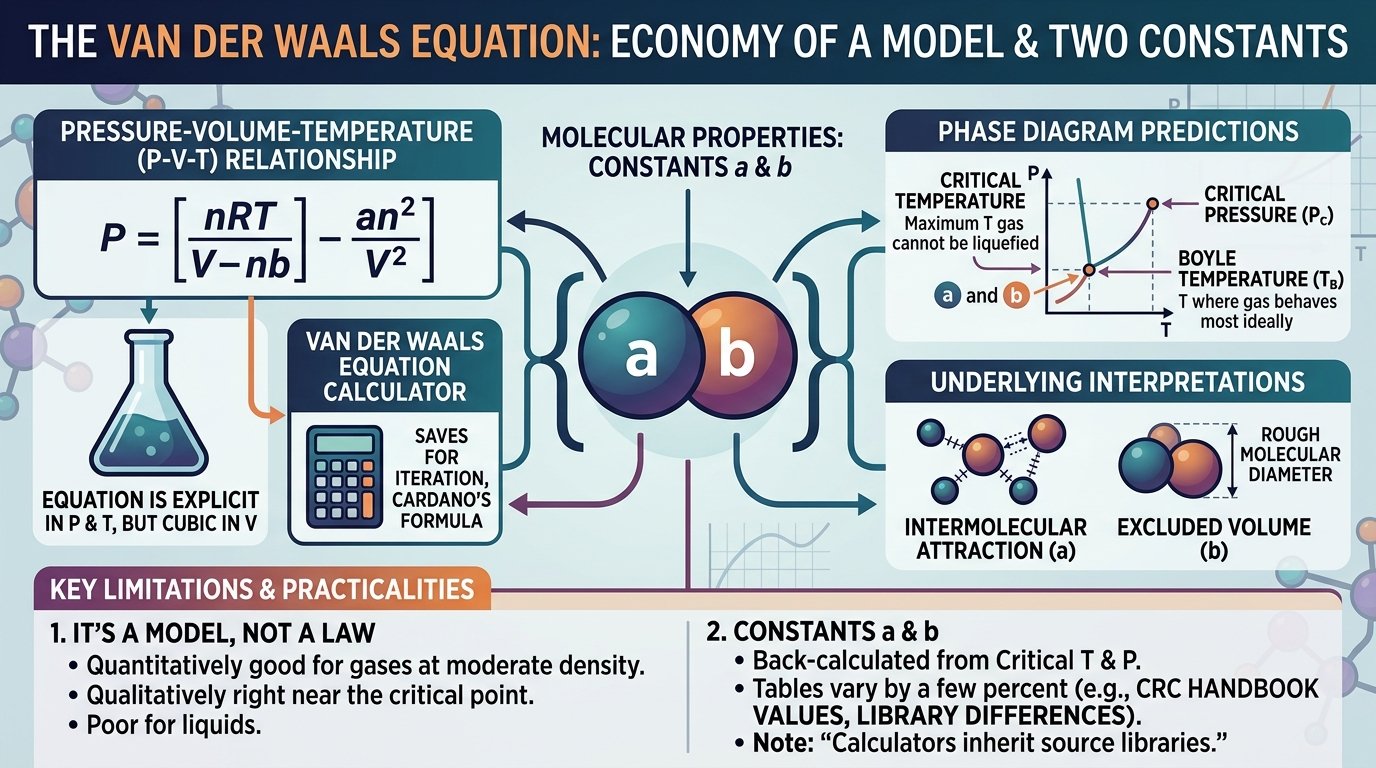
Before opening a van der Waals equation calculator it helps to see what the equation is for. The ideal gas law treats molecules as points that never interact. That is a fine approximation at low pressure and high temperature, where molecules are far apart and moving fast, and it fails in exactly the situations that matter industrially: compressed gases in cylinders, refrigerants near condensation, steam near the critical point, natural gas in a pipeline. The van der Waals equation is the simplest model that repairs both defects at once.
It keeps the shape of PV = nRT but corrects each side. The volume available to a molecule is not the whole container V but V minus the space the other molecules already occupy, nb, where b is the excluded volume per mole. And the pressure a gas exerts on the walls is less than the kinetic pressure inside it, because a molecule about to strike the wall is pulled back by its neighbours; the reduction is proportional to the square of the density, an²/V², where a measures the strength of the attraction. Put both corrections in and you have
Two things follow immediately. First, the equation is explicit in P and T but cubic in V, which is why a van der Waals equation calculator is genuinely useful: solving for volume by hand means either iterating or wrestling with Cardano’s formula. Second, because a and b are properties of the molecule, the same two numbers that fix the pressure in a flask also predict the temperature above which the gas cannot be liquefied, the pressure at that point, the temperature at which the gas behaves most ideally, and even a rough molecular diameter. One equation, two constants, a whole phase diagram — that economy is why the model has survived 150 years of better ones.
Two things worth being clear about from the start. First, the van der Waals equation is a model, not a law: it is quantitatively good for gases at moderate density, qualitatively right near the critical point, and poor for liquids. Second, the constants a and b are usually not measured directly but back-calculated from the critical temperature and pressure, so different tables disagree by a few percent and a van der Waals equation calculator inherits whichever set it uses. Our library takes the CRC Handbook values and lets you overwrite them.
How to Use This Calculator
The tool at the top of the page was built so that a van der Waals equation calculator question takes less time to solve than to read. Here is the workflow:
- Pick the mode that matches the unknown: pressure (Mode 1), molar volume or density (Mode 2), temperature or moles (Mode 3), the critical constants or a and b themselves (Mode 4), or the compressibility factor across a range of conditions (Mode 5).
- Choose the gas from the library and a, b and the molar mass fill themselves in — 29 gases from helium to benzene vapour. Or type your own constants; a can be entered in L²·bar/mol², L²·atm/mol², Pa·m⁶/mol² or L²·kPa/mol², and b in L/mol, m³/mol or cm³/mol.
- Enter the state variables in whatever units you have. Pressure in bar, atm, kPa, Pa, MPa, psi or torr; volume in L, mL, m³ or cm³; temperature in K, °C or °F; amount in moles or grams. The tool converts everything to bar, litres and kelvin internally.
- Press Calculate (or Enter). The headline result appears first, then the step-by-step derivation, a table of every intermediate quantity — excluded volume, repulsive and attractive terms, Z, the roots of the cubic — and a bar chart such as the real-gas pressure next to the ideal one.
- Read the warnings. If your state lies below the critical temperature at high pressure, the tool tells you the substance may be liquid or two-phase there; if the volume is smaller than nb it refuses, because the molecules would not fit.
- Export with Copy, CSV, TXT, Print or Share — and hit ↺ Reset before the next problem so stale inputs never contaminate a fresh calculation.
Your last ten results are stored in the history panel below the calculator (locally in your browser, nothing is uploaded). Clear All wipes it in one click. Click any preset chip to load a classic textbook example and see what a complete answer looks like.
The Five Modes Explained
Mode 1 — Pressure from n, V and T
The explicit case and the one most homework asks for. The tool computes the repulsive term nRT/(V − nb), the attractive term an²/V², their difference, the ideal-gas pressure for comparison, the percentage deviation and the compressibility factor Z = PV/nRT. Enter the amount as a mass and it divides by the molar mass first. A one-line verdict tells you whether attraction or excluded volume is winning.
Mode 2 — Molar Volume and Density from P and T
The cubic case. The tool expands the equation to PVm³ − (Pb + RT)Vm² + aVm − ab = 0, solves it exactly for all real roots, and separately shows the Newton–Raphson iterations from the ideal-gas starting guess so you can reproduce the answer with a hand calculator. Below the critical temperature it names the three roots — liquid, unstable, vapour — and reports the density of each; above it there is one. Give the amount and you get the total volume too.
Mode 3 — Temperature, or Moles and Mass
Temperature is explicit, T = (P + an²/V²)(V − nb)/nR, and the tool reports it in K, °C or °F beside the ideal-gas value. Moles are not explicit — n appears cubed — so the tool solves for the molar volume at your P and T and divides the container volume by it, then converts to mass. This is the mode for the practical question “how much gas is really in this cylinder?”
Mode 4 — Constants and the Critical Point
Forwards: from a and b to Tc = 8a/27Rb, Pc = a/27b², Vc = 3b, the Boyle temperature a/Rb, the inversion temperature 2a/Rb and a molecular diameter from b = 4NA(πd³/6). Backwards: from measured Tc and Pc to a = 27R²Tc²/64Pc and b = RTc/8Pc, which is how tabulated constants are actually produced.
Mode 5 — Compressibility-Factor Explorer
Z against pressure at fixed temperature (log-spaced points, so 1 to 1000 bar fits on one chart), Z against temperature at fixed pressure, or eight common gases compared at one state with their reduced temperature and pressure listed. It is the fastest way to see the dip below 1 caused by attraction and the rise above 1 caused by excluded volume, and to find the crossover near the Boyle temperature.
The Formula, Its Rearrangements and the Box You Should Memorize
Every van der Waals equation calculator problem this page can pose — no exceptions — is one of these lines rearranged:
Pressure (explicit): P = nRT/(V − nb) − an²/V²
Temperature (explicit): T = (P + an²/V²)(V − nb)/nR
Volume (cubic): PVm³ − (Pb + RT)Vm² + aVm − ab = 0
Compressibility factor: Z = PVm/RT (= 1 for an ideal gas)
Critical constants: Vc = 3b, Tc = 8a/27Rb, Pc = a/27b², Zc = 3/8
Constants from the critical point: a = 27R²Tc²/64Pc, b = RTc/8Pc
Boyle temperature: TB = a/Rb; low-pressure virial form: Z ≈ 1 + (b − a/RT)·P/RT
Three details in that van der Waals equation calculator box decide most marks. First, R must carry the same pressure and volume units as a and b: with a in L²·bar/mol² and b in L/mol use R = 0.083145 L·bar·mol−1·K−1; with a in L²·atm/mol² use 0.082057 L·atm·mol−1·K−1; in SI (Pa·m⁶/mol² and m³/mol) use 8.3145 J·mol−1·K−1. Second, the corrections scale differently with amount: the attraction term goes as n² and the excluded volume as n, which is why the per-mole form is cleaner — substitute Vm = V/n and both n’s vanish. Third, the cubic form is obtained by multiplying the per-mole equation through by Vm²/P and collecting powers; get the sign of the ab term wrong and every root is wrong.
For a quick sanity check on any pressure answer, remember that the two corrections pull in opposite directions. If V − nb is only slightly smaller than V (dilute gas), the attraction term wins and PvdW < Pideal. If the gas is compressed until nb is a sizeable fraction of V, the repulsive term explodes and PvdW > Pideal. A van der Waals equation calculator result that shows a compressed gas at 25% excluded volume with Z below 1 is almost certainly a unit slip.
What a and b Really Mean (and Their Units)
The two constants are where the physics of every van der Waals equation calculator lives, and reading them correctly is what separates a van der Waals equation calculator answer from a van der Waals equation calculator explanation.
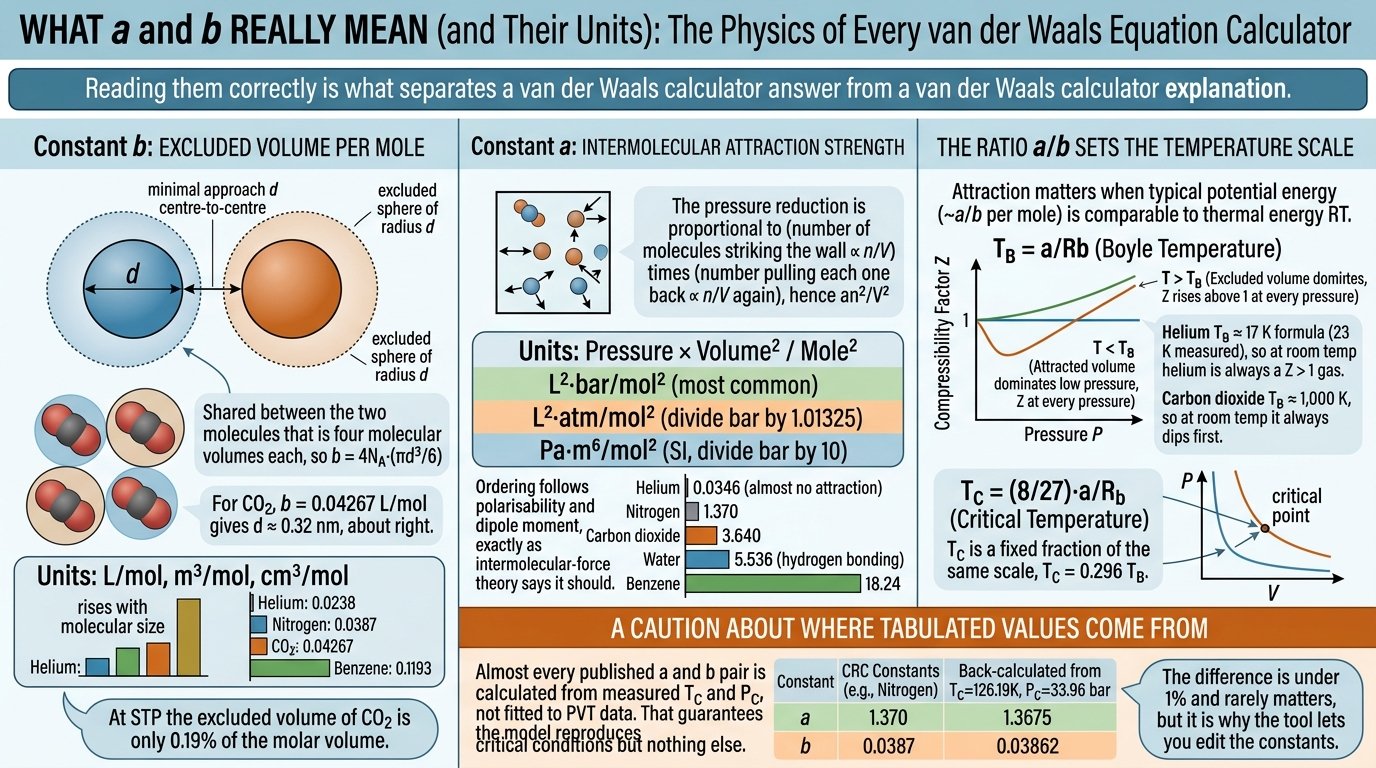
b is the excluded volume per mole. Two hard spheres of diameter d cannot approach closer than d centre-to-centre, so each pair excludes a sphere of radius d, volume (4/3)πd³ = 8 × (molecular volume). Shared between the two molecules that is four molecular volumes each, so b = 4NA·(πd³/6). For CO2, b = 0.04267 L/mol gives d ≈ 0.32 nm, about right. Because b is a volume, its units are L/mol (or m³/mol, cm³/mol), and it rises with molecular size: helium 0.0238, nitrogen 0.0387, benzene 0.1193 L/mol. At STP the excluded volume of CO2 is only 0.19% of the molar volume, which is why the ideal gas law works there.
a measures the strength of intermolecular attraction. The pressure reduction is proportional to the number of molecules striking the wall (∝ n/V) times the number pulling each one back (∝ n/V again), hence an²/V². Its units must therefore be pressure × volume² per mole²: L²·bar/mol² in most modern tables, L²·atm/mol² in older ones (divide the bar value by 1.01325), Pa·m⁶/mol² in SI (divide the L²·bar value by 10). Helium, with almost no attraction, has a = 0.0346; nitrogen 1.370; carbon dioxide 3.640; water, with hydrogen bonding, 5.536; benzene 18.24 L²·bar/mol². The ordering follows polarisability and dipole moment, exactly as intermolecular-force theory says it should.
The ratio a/b sets the temperature scale. Attraction matters when the typical potential energy of a pair, roughly a/b per mole, is comparable to the thermal energy RT. That is why the Boyle temperature is TB = a/Rb: below it attraction dominates the low-pressure behaviour and Z dips under 1; above it the excluded volume dominates and Z rises above 1 at every pressure. Helium’s Boyle temperature is about 17 K by this formula (23 K measured), so at room temperature helium is always a Z > 1 gas; carbon dioxide’s is about 1,000 K, so at room temperature it always dips first. In the van der Waals picture the critical temperature is a fixed fraction of the same scale, Tc = (8/27)·a/Rb = 0.296 TB.
A caution about where tabulated values come from. Almost every published a and b pair is calculated from measured Tc and Pc, not fitted to PVT data. That guarantees the model reproduces the critical temperature and pressure but nothing else, and it means a van der Waals equation calculator using CRC constants for nitrogen (a = 1.370, b = 0.0387) will give slightly different numbers from one using the constants back-calculated from Tc = 126.19 K and Pc = 33.96 bar (1.3675 and 0.03862). The difference is under 1% in a and b and rarely matters, but it is why the tool lets you edit the constants.
Where the Equation Comes From: A Short Derivation
Van der Waals’s original argument was kinetic and it is still the clearest way to understand what a van der Waals equation calculator is doing. Start from the ideal gas law for point particles, PV = nRT, and repair its two assumptions one at a time.
Finite size. If each mole of molecules makes a volume b unavailable to the others, the volume in which the molecules actually move is V − nb, and the kinetic pressure they would exert on the walls is Pkin = nRT/(V − nb). This is already an improvement: it says pressure rises faster than 1/V on compression and diverges as V → nb, which is what an incompressible fluid does.
Attraction. A molecule deep inside the gas is pulled equally in all directions. A molecule about to hit the wall has neighbours on one side only, so it is decelerated and delivers less momentum. The pressure defect is proportional to the number of molecules per unit volume hitting the wall (n/V) times the number per unit volume doing the pulling (n/V): Pmeasured = Pkin − a(n/V)². Rearranged, P + an²/V² = nRT/(V − nb), which is the equation.
A more modern route reaches the same result through statistical mechanics: treat the molecules as hard spheres with a weak long-range attraction, compute the partition function in the mean-field approximation, and the van der Waals equation drops out with a = −2πNA²∫u(r)r²dr over the attractive part of the pair potential and b = (2/3)πNAd³. That derivation exposes the model’s blind spot too: mean-field theory ignores the correlations between molecules that dominate near the critical point, which is why the van der Waals critical exponents are the classical ones and why Zc comes out at 0.375 instead of the observed 0.27–0.29.
The molar mass from gas density and vapor density pages on this site use the ideal gas law; when a vapour is dense enough for the corrections here to reach a few percent, the molar mass they return is off by the same few percent, and the compressibility factor from this van der Waals equation calculator is the correction to apply.
Three Worked Examples, Step by Step
Example 1 — The classic van der Waals equation calculator problem: pressure of CO2
Problem. 1.00 mol of carbon dioxide occupies 1.00 L at 273.15 K. Find the pressure from the van der Waals equation (a = 3.640 L²·bar/mol², b = 0.04267 L/mol) and compare with the ideal gas.
Step 1 — excluded volume. nb = 1.00 × 0.04267 = 0.04267 L, so V − nb = 0.95733 L; the molecules occupy 4.3% of the flask.
Step 2 — repulsive term. nRT/(V − nb) = 1.00 × 0.083145 × 273.15 / 0.95733 = 22.711 / 0.95733 = 23.723 bar.
Step 3 — attractive term. an²/V² = 3.640 × 1² / 1² = 3.640 bar.
Step 4 — pressure. P = 23.723 − 3.640 = 20.08 bar = 19.82 atm. The ideal gas law gives nRT/V = 22.71 bar, so the real gas is 11.6% below ideal and Z = 20.08/22.71 = 0.884. Attraction (−3.64 bar) beats excluded volume (+1.01 bar) by a wide margin, as it should for CO2 at a temperature below its Boyle temperature. Load the first preset chip and the van der Waals equation calculator reproduces every line.
Example 2 — Molar volume and density: CO2 at 100 bar and 350 K
Problem. Find the molar volume, compressibility factor and density of carbon dioxide at 100 bar and 350 K — the van der Waals equation calculator problem that cannot be done without iteration.
Step 1 — ideal-gas guess. Vm = RT/P = 0.083145 × 350 / 100 = 0.2910 L/mol.
Step 2 — the cubic. PVm³ − (Pb + RT)Vm² + aVm − ab = 0 becomes 100Vm³ − 33.368Vm² + 3.640Vm − 0.1553 = 0, since Pb + RT = 4.267 + 29.101 = 33.368 and ab = 0.1553.
Step 3 — Newton–Raphson. Starting from V0 = RT/P + b = 0.3337: the iterates run 0.2620, 0.2166, 0.1909, 0.1804, 0.17856, 0.178504 and stay there — eight steps to full precision. (A cruder approach, Vm = b + RT/(P + a/Vm²) iterated, converges to the same value but needs about 80 rounds, which is why the tool uses Newton.)
Step 4 — results. Vm = 0.1785 L/mol, 39% smaller than ideal; Z = 100 × 0.1785 / (0.083145 × 350) = 0.613; density = 44.009 / 0.1785 = 246.5 g/L. Since 350 K is above the critical temperature (304 K) there is only one real root. At Tr = 1.15 and Pr = 1.36 the gas is in the region where the van der Waals model is only semi-quantitative; measured Z for CO2 at this state is about 0.60, so the model is within a few percent here.
Example 3 — Backwards: constants from the critical point
Problem. Water has Tc = 647.10 K and Pc = 220.64 bar. Find a and b and the van der Waals estimate of Vc.
Step 1. a = 27R²Tc²/64Pc = 27 × 0.083145² × 647.10² / (64 × 220.64) = 5.535 L²·bar/mol² (the CRC table lists 5.536).
Step 2. b = RTc/8Pc = 0.083145 × 647.10 / (8 × 220.64) = 0.03048 L/mol (CRC: 0.03049).
Step 3. Vc = 3b = 0.0914 L/mol, against the measured 0.0559 L/mol. The 60% overestimate is the model’s best-known failure: the van der Waals equation forces Zc = PcVc/RTc = 0.375 on every fluid, whereas water’s real Zc is 0.229. Mode 4 of the van der Waals equation calculator does this conversion in either direction and prints the caveat with the result.
Reference Table: Van der Waals Constants for Common Gases
Keep this table beside you when checking a van der Waals equation calculator answer. The a and b values are those of the CRC Handbook of Chemistry and Physics; the critical temperatures and Boyle temperatures in the last two columns are the van der Waals predictions from those constants (Tc = 8a/27Rb, TB = a/Rb), which by construction match the measured Tc closely but overshoot the measured Boyle temperature by 25–35%.
| Gas | a (L²·bar/mol²) | b (L/mol) | Tc vdW (K) | Pc vdW (bar) | TB = a/Rb (K) |
|---|---|---|---|---|---|
| Helium, He | 0.0346 | 0.0238 | 5.2 | 2.3 | 17 |
| Hydrogen, H2 | 0.2476 | 0.02661 | 33.2 | 13.0 | 112 |
| Neon, Ne | 0.2135 | 0.01709 | 44.5 | 27.1 | 150 |
| Nitrogen, N2 | 1.370 | 0.0387 | 126.2 | 33.9 | 426 |
| Carbon monoxide, CO | 1.505 | 0.03985 | 134.6 | 35.1 | 454 |
| Argon, Ar | 1.355 | 0.03201 | 150.9 | 49.0 | 509 |
| Oxygen, O2 | 1.382 | 0.03186 | 154.6 | 50.4 | 522 |
| Methane, CH4 | 2.283 | 0.04278 | 190.2 | 46.2 | 642 |
| Ethylene, C2H4 | 4.612 | 0.0582 | 282.4 | 50.4 | 953 |
| Carbon dioxide, CO2 | 3.640 | 0.04267 | 304.0 | 74.0 | 1,026 |
| Ethane, C2H6 | 5.562 | 0.0638 | 310.7 | 50.6 | 1,049 |
| Hydrogen chloride, HCl | 3.716 | 0.04081 | 324.5 | 82.6 | 1,095 |
| Ammonia, NH3 | 4.225 | 0.0371 | 405.8 | 113.7 | 1,370 |
| Chlorine, Cl2 | 6.579 | 0.05622 | 417.0 | 77.1 | 1,407 |
| Sulfur dioxide, SO2 | 6.803 | 0.05636 | 430.2 | 79.3 | 1,452 |
| Water, H2O | 5.536 | 0.03049 | 647.0 | 220.6 | 2,184 |
Three van der Waals equation calculator patterns worth noticing. Small, symmetric, non-polar molecules (He, H2, Ne) have tiny a values and Boyle temperatures below room temperature, so at 25 °C they show Z > 1 at every pressure and warm on free expansion — the reason hydrogen must be pre-cooled before Joule–Thomson liquefaction. Molecules of similar size but rising polarity (N2 → CO → HCl) climb steadily in a. And water’s a is smaller than ethane’s despite its much stronger intermolecular forces, because a is fitted to the critical point and water’s tiny b (0.03049 L/mol, a small molecule) drags the product down — a reminder that a and b are model parameters first and molecular properties second.
The Critical Point, Corresponding States and the Boyle Temperature
Plot the pressure from a van der Waals equation calculator against molar volume at several temperatures and a striking thing happens. At high temperature each isotherm falls smoothly like an ideal gas. As the temperature drops the curves develop a wiggle, and at one particular temperature the wiggle flattens to a horizontal inflection: a single point where both (∂P/∂V)T and (∂²P/∂V²)T vanish. That is the critical point. Below it the isotherms cross the same pressure three times — the three roots of the cubic — and the substance can exist as a liquid and a vapour at once.
Solving the two derivative conditions for the per-mole equation P = RT/(Vm − b) − a/Vm² gives, after a few lines of algebra, Vc = 3b, Tc = 8a/27Rb and Pc = a/27b². Multiplying them together, the critical compressibility PcVc/RTc = 3/8 = 0.375 for every van der Waals gas. Real values cluster around 0.27–0.29 (argon 0.291, nitrogen 0.289, methane 0.286, CO2 0.274, water 0.229), which tells you at once that the model is too crude near the critical point and that back-calculated a and b cannot reproduce Vc.
Corresponding states. Divide P, Vm and T by their critical values to get the reduced variables Pr, Vr, Tr, substitute, and a and b cancel entirely: (Pr + 3/Vr²)(3Vr − 1) = 8Tr. Every van der Waals fluid obeys the same reduced equation, so two gases at the same reduced temperature and pressure have the same compressibility factor. This is the law of corresponding states, and it is the theoretical basis of the generalised Z charts engineers used for a century before computers. Mode 5’s gas comparison lists Tr and Pr for each gas precisely so you can see the law at work: nitrogen at 300 K and 100 bar (Tr = 2.38) and hydrogen at 300 K and 100 bar (Tr = 9.05) are not in corresponding states, and their Z values (0.963 and 1.073) differ accordingly.
The Boyle temperature. Expand Z in powers of pressure at low density and the first correction is Z ≈ 1 + (b − a/RT)P/RT. The bracket is the second virial coefficient B(T) = b − a/RT, and it vanishes when T = a/Rb. At that temperature the gas obeys Boyle’s law over the widest range of pressure, attraction and excluded volume cancelling to first order. For nitrogen the van der Waals estimate is 426 K against a measured 327 K; for helium 17 K against 23 K. The model gets the concept right and the number wrong by a third, the usual verdict.
Above about 2TB — the inversion temperature in the van der Waals model, 2a/Rb — the Joule–Thomson coefficient changes sign and a gas warms rather than cools on throttling. Hydrogen’s inversion temperature is roughly 200 K and helium’s about 40 K, which is why both must be pre-cooled with liquid nitrogen before the final expansion stage of a liquefier. Mode 4 of the van der Waals equation calculator reports Tc, TB and the inversion temperature together, so the whole temperature ladder of a gas is visible from two constants.
The Compressibility Factor Z: Reading the Curves
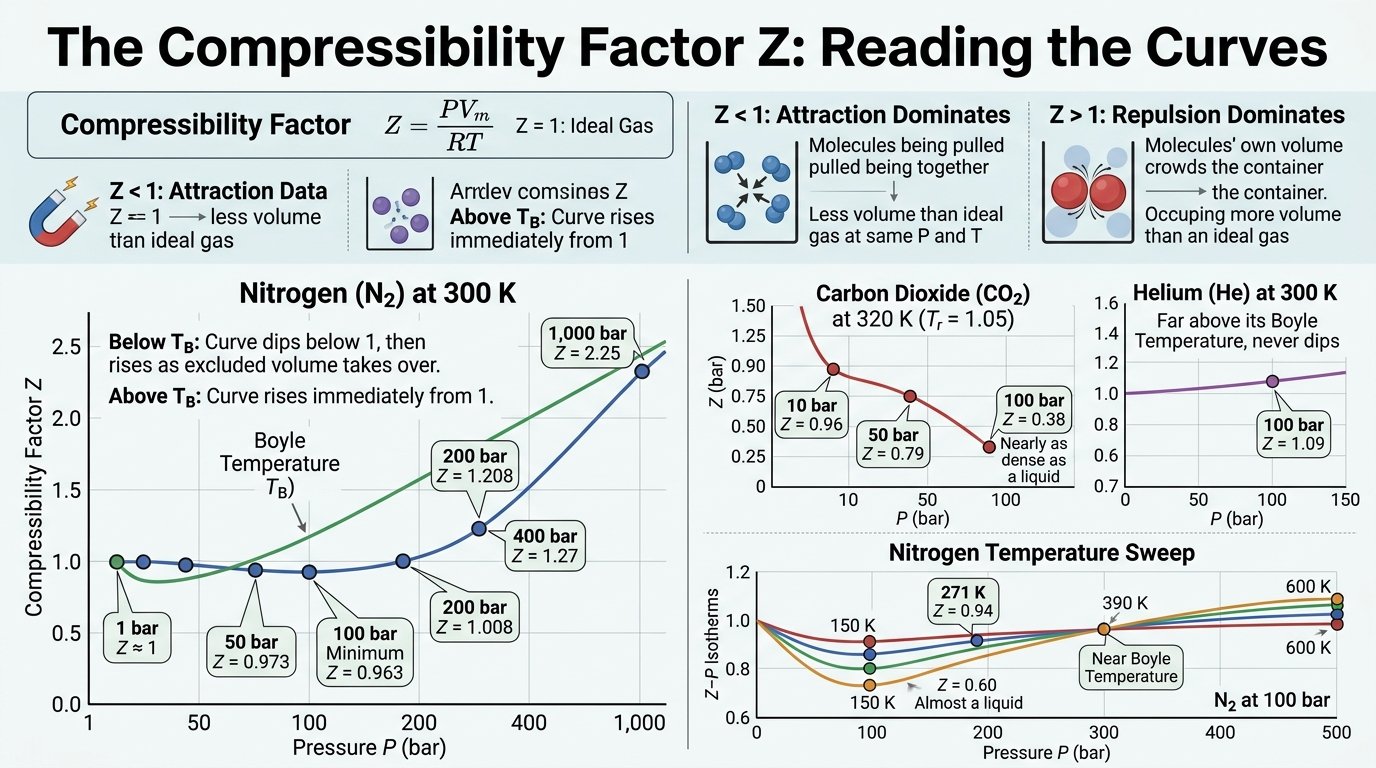
Z = PVm/RT collapses the whole van der Waals equation calculator story into one number. Z = 1 is ideal. Z < 1 means the gas occupies less volume than an ideal gas at the same P and T: attraction has pulled the molecules together. Z > 1 means it occupies more: the molecules’ own volume is crowding the container. Every isotherm in a Z–P plot at a temperature below TB therefore dips below 1 first, passes through a minimum, and then climbs above 1 as the excluded volume takes over; above TB the curve rises from 1 immediately.
Run the nitrogen preset in Mode 5 and the numbers make the picture concrete. At 300 K and 1 bar Z = 0.9994, essentially ideal. By 50 bar it is 0.973, by 100 bar 0.963 — the minimum — then 1.008 at 200 bar, 1.27 at 400 bar and 2.25 at 1,000 bar, where the gas takes up more than twice the ideal volume. Switch to CO2 at 320 K (Tr = 1.05) and the dip is dramatic: Z = 0.96 at 10 bar, 0.79 at 50 bar and 0.38 at 100 bar, where the fluid is nearly as dense as a liquid. Helium at 300 K, far above its Boyle temperature, never dips at all: Z = 1.09 at 100 bar.
The van der Waals equation calculator temperature sweep tells the other half. Nitrogen at 100 bar has Z = 0.60 at 150 K (barely above its critical temperature, almost a liquid), 0.94 at 271 K, crosses 1 near 390 K — close to the Boyle temperature, as the virial expansion says it should — and levels off near 1.03 by 600 K, never returning to unity because at 100 bar the excluded-volume term does not vanish however hot the gas becomes.
Z is also the practical correction factor. Any ideal-gas calculation — the moles in a cylinder, the density of a vapour, the volume of gas produced in a reaction — is fixed by inserting Z: PV = ZnRT. Our stoichiometry calculator and grams to moles calculator work in the ideal limit; when the gas phase in your problem sits at tens of bar, take Z from this van der Waals equation calculator and multiply. For methane at 200 bar and 298 K, Z = 0.82, so a cylinder holds 22% more gas than PV = nRT predicts — the difference between a correct and a dangerous fill.
Who Uses a Van der Waals Equation Calculator?
Students and teachers. The equation is compulsory in every physical-chemistry and thermodynamics course from first-year general chemistry to engineering thermodynamics, and it appears in board and entrance examinations worldwide — JEE and NEET in India, MDCAT and ECAT in Pakistan, A-level and IB chemistry, the GRE subject test and the American Chemical Society exams. A van der Waals equation calculator that shows every step is a marking scheme you can check yourself against.
Gas-cylinder and industrial-gas engineers. Filling a 50 L cylinder to 200 bar involves exactly the moles-from-P,V,T problem of Mode 3, and for methane, CO2 or nitrous oxide the ideal gas law is out by 10–40%. Industry uses more accurate equations of state for the final number, but the van der Waals estimate is the standard first check and the one that explains why the correction has the sign it does.
Chemical and process engineers. A van der Waals equation calculator is the first pass at compressor duty, pipeline capacity, relief-valve sizing and the design of CO2 capture and storage all begin with a real-gas equation of state. The cubic equations engineers actually use — Redlich–Kwong, Soave, Peng–Robinson — are direct descendants of van der Waals with the same two-parameter structure, and every process simulator solves the same cubic-in-V problem that Mode 2 shows step by step.
Cryogenic and refrigeration engineers. Whether a gas cools or warms on throttling — a van der Waals equation calculator question at heart — and at what temperature a refrigerant can be condensed by pressure alone, are questions about the inversion and critical temperatures that Mode 4 returns directly from a and b.
Researchers in physical chemistry and materials science. Supercritical CO2 extraction (above 304 K and 74 bar), gas adsorption and storage measurements, and high-pressure kinetics all require the density of a real gas at the working state, which is the Mode 2 result. For polymer solutions the companion pages on osmotic pressure show that the same virial-coefficient idea — a first-order correction proportional to concentration — underlies solution thermodynamics as much as gas thermodynamics.
Full Walkthrough: Filling a Methane Cylinder
The most useful van der Waals equation calculator problem is not a textbook exercise but a safety question. A 50.0 L steel cylinder is to be filled with methane to 200 bar at 25 °C. How many kilograms of gas does it hold, and by how much would the ideal gas law mislead you? Here is the complete workflow, with the numbers a good answer contains.
1. Fix the units. P = 200 bar, T = 298.15 K, V = 50.0 L. From the library, methane: a = 2.283 L²·bar/mol², b = 0.04278 L/mol, M = 16.043 g/mol. R = 0.083145 L·bar·mol−1·K−1.
2. Ideal-gas baseline. n = PV/RT = 200 × 50.0 / (0.083145 × 298.15) = 403.4 mol = 6.47 kg.
3. Recognise the cubic. n cannot be isolated, so solve for the molar volume: 200Vm³ − (200 × 0.04278 + 24.790)Vm² + 2.283Vm − 0.09767 = 0.
4. Iterate. Newton–Raphson from V0 = RT/P + b = 0.1667 L/mol converges in seven steps to Vm = 0.10170 L/mol. Check: Z = PVm/RT = 200 × 0.10170 / 24.790 = 0.8205, below 1 — attraction dominates at Tr = 1.57 and Pr = 4.3.
5. Moles and mass. n = V/Vm = 50.0 / 0.10170 = 491.6 mol; mass = 491.6 × 16.043 = 7,887 g = 7.89 kg. The cylinder really holds 21.9% more methane than the ideal-gas estimate. Density = 157.7 g/L.
6. Sanity checks. The excluded volume nb = 491.6 × 0.04278 = 21.0 L is 42% of the cylinder — large, so the answer is model-dependent; the measured Z of methane at this state is about 0.86, meaning the van der Waals figure overshoots the mass by roughly 5%. State the model and its expected accuracy in the report.
7. Report. “By the van der Waals equation (CRC constants), a 50.0 L cylinder at 200 bar and 25 °C contains 492 mol (7.89 kg) of methane, Z = 0.82; the ideal gas law underestimates the fill by 22%.” Mode 3 of the van der Waals equation calculator, third preset chip, produces all of this in one click.
Two van der Waals equation calculator habits make this bullet-proof. Always compute the ideal-gas answer first — it is the sanity check for everything after it, and the ratio of the two answers is Z. And always look at nb/V: below 5% the van der Waals answer is reliable to a percent or two; between 5% and 30% it is a good estimate; above that, quote it as an estimate and reach for a better equation of state or a measured Z chart.
A Short History: From Andrews’s Isotherms to the 1910 Nobel Prize
The van der Waals equation calculator you are using traces back to a schoolteacher’s doctoral thesis. Johannes Diderik van der Waals (1837–1923) taught secondary school in Deventer and The Hague and, lacking a classical education, could not formally enrol at Leiden until the rules changed in 1865. His 1873 dissertation, Over de Continuïteit van den Gas- en Vloeistoftoestand (“On the Continuity of the Gaseous and Liquid States”), set out to explain an experimental puzzle published four years earlier.
That puzzle — the one every van der Waals equation calculator still solves — was Thomas Andrews’s 1869 measurements on carbon dioxide. Andrews compressed CO2 at a series of temperatures and found that below 31 °C the gas condensed at a definite pressure, with the isotherm running flat during the transition, while above 31 °C no pressure however large would liquefy it. He named 31 °C the critical temperature and showed that gas and liquid were not different substances but the same fluid on either side of a continuous surface. Van der Waals’s equation, with its two constants, reproduced the whole surface qualitatively — the flat isotherms became the three-root region, the critical point became the horizontal inflection — and the constants themselves gave the critical temperature and pressure from molecular quantities.
James Clerk Maxwell reviewed the thesis in Nature in 1874, declared that the author’s name would “soon be among the foremost in molecular science,” and taught himself Dutch to read it properly. Maxwell also repaired its one obvious defect: inside the three-root region the van der Waals isotherm wiggles unphysically, and the real flat tie-line must be drawn so that the areas above and below it are equal — the Maxwell equal-area construction still used today.
Van der Waals went on to the law of corresponding states (1880), which guided James Dewar’s liquefaction of hydrogen (1898) and Heike Kamerlingh Onnes’s liquefaction of helium (1908); Kamerlingh Onnes said openly that he had planned the helium work from van der Waals’s theory. Van der Waals received the Nobel Prize in Physics in 1910 “for his work on the equation of state for gases and liquids.” Two of his insights outlived the equation itself: that the same intermolecular forces govern gases and liquids (the forces now carry his name), and that a mean-field model with a few parameters can organise an entire phase diagram.
What the Model Gets Wrong — and the Equations That Followed
A van der Waals equation calculator is honest only if it tells you where to stop trusting it. The model’s failures are well mapped.
The critical compressibility. Any van der Waals equation calculator gives Zc = 0.375 for every fluid, against measured 0.23–0.30. Consequently Vc = 3b overestimates the real critical volume by 25–60%, and constants fitted to Tc and Pc cannot reproduce liquid densities: the van der Waals liquid root for water at 100 °C gives 0.46 g/mL against the real 0.96 g/mL.
Temperature dependence of attraction. The a term is constant, but real attractive corrections weaken faster with temperature than 1/T. That is why the predicted Boyle temperature runs 25–35% high. Redlich and Kwong (1949) fixed this with an a/√T dependence and a modified volume term, cutting the errors in Z by half. Soave (1972) made a a function of reduced temperature and the acentric factor, and Peng and Robinson (1976) altered the volume term to bring liquid densities within a few percent. Every one of these is still a cubic in Vm with two size-and-attraction parameters — the van der Waals architecture with better plumbing — and all are solved by the same Newton iteration that Mode 2 displays.
Near the critical point. Mean-field theory predicts the coexistence curve to close as (Tc − T)1/2; real fluids close as (Tc − T)0.33. The difference is the physics of critical fluctuations, understood only in the 1970s through renormalisation-group theory, and no cubic equation captures it.
Mixtures. For gas mixtures a van der Waals equation calculator needs constants combined by mixing rules (amix = (Σxi√ai)², bmix = Σxibi are the simplest). The library entry for air uses effective values; for anything else, compute amix and bmix first and enter them as custom constants.
None of this diminishes the equation for the purposes it serves best: teaching why real gases deviate, estimating corrections of a few to a few tens of percent at moderate density, and supplying the critical constants and reduced variables that make generalised charts work. Used with its limits in view, a van der Waals equation calculator answers most real-gas questions to the accuracy the question deserves.
Practice Problems (With Answers)
Work each problem by hand first, then verify with the free van der Waals equation calculator above. Answers are hidden until you click.
Problem 1 — 2.00 mol of CO2 is held in a 5.00 L vessel at 300 K. Find the van der Waals pressure and the ideal-gas pressure (a = 3.640 L²·bar/mol², b = 0.04267 L/mol).
nb = 0.0853 L, so V − nb = 4.9147 L. Repulsive term: 2 × 0.083145 × 300 / 4.9147 = 10.151 bar. Attraction: 3.640 × 4 / 25 = 0.582 bar. P = 10.151 − 0.582 = 9.57 bar; ideal nRT/V = 9.98 bar; Z = 0.959. A 4% deviation at only 10 bar — CO2 is far from ideal even at modest pressure because its a is large and 300 K is well below its Boyle temperature.
Problem 2 — Find the molar volume, Z and density of nitrogen at 100 bar and 300 K (a = 1.370, b = 0.0387) by Newton–Raphson.
Ideal guess RT/P = 0.24943 L/mol; start Newton at RT/P + b = 0.2881. Iterates: 0.2528, 0.2415, 0.24032, 0.24030 — converged in four steps. Vm = 0.2403 L/mol, Z = 100 × 0.2403 / 24.943 = 0.963, density = 28.014 / 0.2403 = 116.6 g/L. This is the minimum of nitrogen’s Z–P curve at 300 K; the measured Z here is 0.984, so the model exaggerates the dip by about 2%.
Problem 3 — 0.500 mol of argon in a 0.250 L cell shows a pressure of 50.0 bar. What is the temperature by the van der Waals equation, and by the ideal gas law? (a = 1.355, b = 0.03201.)
Corrected pressure: 50.0 + 1.355 × 0.25 / 0.0625 = 55.42 bar. Free volume: 0.250 − 0.5 × 0.03201 = 0.2340 L. T = 55.42 × 0.2340 / (0.5 × 0.083145) = 311.9 K (38.8 °C). Ideal: PV/nR = 300.7 K. The real gas must be 11 K hotter to show the same pressure because attraction is removing 5.4 bar — a large effect at 2 mol/L.
Problem 4 — From methane’s constants (a = 2.283 L²·bar/mol², b = 0.04278 L/mol) predict Tc, Pc, Vc and the Boyle temperature, and compare with the measured Tc = 190.6 K, Pc = 46.0 bar, Vc = 0.0986 L/mol.
Tc = 8 × 2.283 / (27 × 0.083145 × 0.04278) = 190.2 K; Pc = 2.283 / (27 × 0.04278²) = 46.2 bar; Vc = 3b = 0.1283 L/mol; TB = a/Rb = 642 K (measured about 510 K). Tc and Pc agree because the constants were derived from them; Vc is 30% high because real Zc = 0.286, not 0.375.
Problem 5 — Nitrogen has Tc = 126.19 K and Pc = 33.96 bar. Calculate a and b, and explain why they differ slightly from the CRC values 1.370 and 0.0387.
a = 27 × 0.083145² × 126.19² / (64 × 33.96) = 1.3675 L²·bar/mol²; b = 0.083145 × 126.19 / (8 × 33.96) = 0.03862 L/mol. The CRC values were computed from slightly different critical data (older measurements, rounding of R); the 0.2% differences are typical of the scatter between published tables and change a pressure answer by far less than the model’s own error.
Tips for Fast, Error-Free Calculations
- ✅ Match R to a and b before anything else — the number-one van der Waals equation calculator habit. a in L²·bar/mol² and b in L/mol go with R = 0.083145; a in L²·atm/mol² with 0.082057; SI units with 8.3145. Mixing them is the commonest error on the planet.
- ✅ Compute the ideal-gas answer first. It is the reference for every van der Waals equation calculator deviation, the starting point for the Newton iteration and the sanity check for the final number; the ratio of the two answers is Z.
- ✅ Work per mole. Substitute Vm = V/n and the n’s disappear from both corrections; multiply back by n at the end. It halves the arithmetic and removes the n²-versus-n confusion.
- ✅ For volume, iterate — don’t expand. Vm = b + RT/(P + a/Vm²) with the ideal guess converges in two or three rounds when Z is near 1; use Newton (Mode 2 shows the derivative) when Z is far from 1, and always check which of three roots you have landed on below Tc.
- ✅ Look at nb/V. It tells you the regime instantly: under 5% the model is reliable, over 30% quote it as an estimate.
- ✅ Quote the constants with the answer. A van der Waals equation calculator result is only as reproducible as its a and b; state the source (CRC, or back-calculated from Tc and Pc).
- ✅ Reset between problems — the ↺ Reset button on each mode of the van der Waals equation calculator keeps an old temperature unit or a stale mass-vs-moles setting from contaminating a new calculation.
5 Common Mistakes to Avoid
A decade of marking van der Waals equation calculator answers produces the same five errors every year.
- Using a in L²·atm/mol² with R in L·bar/mol·K (or the reverse). The attraction term comes out 1.3% wrong — small enough to look plausible, large enough to lose the mark. Convert a first: multiply the atm value by 1.01325 to get bar.
- Forgetting that the attraction term scales as n². For 10 mol in 2 L the correction is a × 100/4 = 25a, not 5a. Working per mole avoids this entirely.
- Subtracting nb from the volume but then using the original V in the attraction term — or vice versa. The repulsive term uses V − nb; the attractive term uses V itself. They are different corrections to different quantities.
- Reporting the wrong root of the cubic. Below Tc the van der Waals equation calculator cubic has three real roots. The largest is the vapour, the smallest the liquid, the middle one is unphysical. A calculator that returns only “a” root, or an iteration started from the wrong guess, can hand you the liquid volume when you wanted the gas.
- Taking van der Waals equation calculator predictions of Vc, liquid density or the Boyle temperature as data. Tc and Pc are reproduced because the constants came from them; Vc is 25–60% high, liquid densities are about half the real value, and TB runs a third high. Quote these as model estimates.
How This Calculator Is Different
| Feature | This calculator | Generic van der Waals tool | By hand |
|---|---|---|---|
| Gas library (29 gases with a, b and molar mass) | ✅ One click, four a-units and three b-units converted | ⚠️ Usually you type a and b | Handbook lookup |
| Pressure split into repulsive and attractive terms, Z and deviation | ✅ Reported with every result | ❌ Final number only | ✅ Slow |
| Volume: all cubic roots named + Newton iterations shown | ✅ Liquid, unstable and vapour roots, densities of each | ❌ One root, often unlabelled | Very slow |
| Moles and mass from P, V, T (the cylinder problem) | ✅ With ideal-gas comparison | ❌ | Iteration required |
| Critical constants, Boyle and inversion T, molecular diameter, a & b from Tc, Pc | ✅ Both directions | ❌ | ✅ |
| Z explorer: P sweep, T sweep, 8-gas comparison with Tr, Pr | ✅ Charts and tables | ❌ | Spreadsheet |
| Units: 7 pressure, 4 volume, K/°C/°F, moles or grams | ✅ All converted internally | ⚠️ Usually atm and L only | Error-prone |
| Export & history | ✅ CSV/TXT/print/share + last 10 | ❌ Usually none | Notebook |
Related van der Waals equation calculator companions carry the gas-law theme onward. The ideal-gas side of every problem here lives in the molar mass from gas density and molecular weight from vapor density pages; the molar masses in the gas library come from the molecular weight calculator homepage and the atomic mass calculator; the colligative-property tools for freezing point depression and boiling point elevation are the solution-phase relatives of the virial correction; and the molarity calculator, equivalent weight calculator, exact mass calculator, formula weight calculator and molar mass of hydrates calculator cover the rest of the general-chemistry syllabus. For the polymer side of the site start with the polymer molecular weight viscosity guide, the number average molecular weight and polydispersity index pages, and the average molecular weight of a mixture tool that gives the effective molar mass of the gas mixtures whose amix and bmix you might enter here.
Where the Numbers Come From
The a and b values in this van der Waals equation calculator are those tabulated in the CRC Handbook of Chemistry and Physics (Weast, ed.), given in L²·bar/mol² and L/mol with automatic conversion to the other common units; molar masses use IUPAC standard atomic weights. R = 0.0831446 L·bar·mol−1·K−1 and NA = 6.02214076 × 10²³ mol−1 are the 2019 SI exact values. Critical constants quoted for comparison are NIST Chemistry WebBook values. Because most tabulated a and b pairs are derived from critical data, values from different handbooks differ by up to a few percent; the tool therefore lets you overwrite any constant, and Mode 4 recomputes a and b from whichever Tc and Pc you trust.
If you spot a discrepancy worth checking, our corrections policy explains how reports are handled, and the contact page is the fastest route to us. More about the site and its author is on the about page.
Trusted external references for further van der Waals equation calculator reading:
- IUPAC Gold Book — van der Waals equation of state (iupac.org)
- NIST Chemistry WebBook — Thermophysical Properties of Fluid Systems (nist.gov): measured Z, density and critical constants to test the model against
- Chemistry LibreTexts — Van der Waals Equation (chem.libretexts.org)
- Wikipedia — Van der Waals constants (data page) (wikipedia.org): the full CRC table for over 100 substances
Exam Checklist
☐ I can solve it explicitly for P and for T, and I know that solving for V gives a cubic with one or three real roots.
☐ I can iterate Vm = b + RT/(P + a/Vm²) or apply Newton–Raphson from the ideal-gas guess, and identify the gas root below Tc.
☐ I can derive Vc = 3b, Tc = 8a/27Rb, Pc = a/27b² from the two derivative conditions, and state Zc = 3/8.
☐ I can invert them to a = 27R²Tc²/64Pc and b = RTc/8Pc.
☐ I can define Z as the van der Waals equation calculator reports it, explain Z < 1 versus Z > 1, and sketch Z against P above and below the Boyle temperature a/Rb.
☐ I can state the reduced equation and the law of corresponding states, and list the model’s main failures (Zc, liquid density, TB).
☐ I’ve verified my practice answers with the van der Waals equation calculator above.
Frequently Asked Questions
What is the van der Waals equation and what do a and b represent?
It is the real-gas equation of state (P + an²/V²)(V − nb) = nRT. The constant a (L²·bar/mol²) measures intermolecular attraction, which lowers the pressure by an²/V²; the constant b (L/mol) is the excluded volume per mole, which reduces the space available to the molecules to V − nb. Both are characteristic of the gas: CO2 has a = 3.640 and b = 0.04267; helium a = 0.0346 and b = 0.0238.
How do I calculate pressure with the van der Waals equation?
Rearrange to P = nRT/(V − nb) − an²/V². For 1 mol CO2 in 1.00 L at 273.15 K: nRT/(V − nb) = 22.71/0.95733 = 23.72 bar, an²/V² = 3.64 bar, so P = 20.08 bar, against 22.71 bar for an ideal gas. Mode 1 of the van der Waals equation calculator shows exactly these steps.
How do I solve the van der Waals equation for volume?
It becomes a cubic, PVm³ − (Pb + RT)Vm² + aVm − ab = 0. Either iterate Vm = b + RT/(P + a/Vm²) starting from the ideal-gas value RT/P, or use Newton–Raphson, which converges in a handful of steps. Above the critical temperature there is one real root; below it there are three, and the largest is the gas volume. Mode 2 returns all roots and the iterations.
What are the units of the van der Waals constants?
a has units of pressure × volume² / mol² — L²·bar/mol² (CRC), L²·atm/mol² (older tables; multiply by 1.01325 to get bar) or Pa·m⁶/mol² (SI; multiply by 10 to get L²·bar/mol²). b has units of volume/mol: L/mol, m³/mol (×1000 to L/mol) or cm³/mol (÷1000). R must match: 0.083145 L·bar/mol·K, 0.082057 L·atm/mol·K or 8.3145 J/mol·K.
How are the critical constants related to a and b?
Tc = 8a/27Rb, Pc = a/27b² and Vc = 3b, so that Zc = 3/8 for every van der Waals gas. Inverted, a = 27R²Tc²/64Pc and b = RTc/8Pc — the way most tabulated constants are obtained. For CO2, a = 3.640 and b = 0.04267 give Tc = 304.0 K and Pc = 74.0 bar (measured 304.1 K, 73.8 bar).
What is the compressibility factor and when is Z less than or greater than 1?
Z = PV/nRT, equal to 1 for an ideal gas. Z < 1 when attraction dominates — moderate pressures at temperatures below the Boyle temperature a/Rb, e.g. CO2 at 320 K and 100 bar has Z = 0.38. Z > 1 when excluded volume dominates — very high pressure, or light gases such as H2 and He at any pressure above room temperature (helium at 300 K and 100 bar: Z = 1.09).
What is the Boyle temperature?
The temperature at which the second virial coefficient b − a/RT vanishes, TB = a/Rb, so that the gas obeys Boyle’s law over the widest pressure range. The van der Waals prediction for nitrogen is 426 K (measured 327 K) and for helium 17 K (measured 23 K) — right in concept, about a third high in value.
Why does the van der Waals equation give three volumes below the critical temperature?
Because a cubic can have three real roots. Below Tc the model isotherm wiggles, crossing a given pressure at three molar volumes: the smallest is the liquid, the largest the vapour, and the middle one lies on a branch where pressure would rise on expansion, which is mechanically unstable and never observed. Maxwell’s equal-area rule replaces the wiggle with the flat coexistence line seen experimentally.
How accurate is the van der Waals equation compared with the ideal gas law and modern equations?
At moderate density (nb/V below about 5%) it corrects most of the ideal-gas error and is usually within 1–3% of measured Z. Near the critical point and at liquid densities it is only qualitative: Zc comes out at 0.375 instead of 0.27–0.29 and liquid densities are about half the real values. Redlich–Kwong, Soave–Redlich–Kwong and Peng–Robinson keep the same cubic form with temperature-dependent a and are what engineers use for design.
Is this van der Waals equation calculator free, and does it work offline?
Yes — all five modes are free with no sign-up, no limits and no ads inside the tool. Every calculation runs in your browser, so once the page has loaded the calculator keeps working without a connection; history is stored locally and is never uploaded.
10 Real-Gas Facts Worth Knowing
- Van der Waals derived his equation in an 1873 doctoral thesis written while teaching secondary school; Maxwell learned Dutch to read it and predicted the author would be “among the foremost in molecular science.”
- The excluded volume b is four times the actual volume of the molecules, not equal to it — because two spheres of diameter d exclude a sphere of diameter 2d between them.
- At STP the molecules of CO2 occupy only 0.19% of the gas volume, and the attraction term is 0.7% of the pressure — which is why the ideal gas law works so well at atmospheric conditions.
- Every van der Waals gas has the same critical compressibility, Zc = 3/8; the fact that real gases cluster at 0.27–0.29 was one of the first quantitative signs that mean-field theory breaks down near a critical point.
- Helium’s van der Waals a is 100 times smaller than CO2‘s, giving a Boyle temperature near 17 K: at room temperature helium behaves as a gas of pure hard spheres with Z above 1 at every pressure.
- Hydrogen and helium warm when expanded through a valve at room temperature because they are above their Joule–Thomson inversion temperatures (≈ 2a/Rb); Dewar and Kamerlingh Onnes had to pre-cool them with liquid air to liquefy them.
- The law of corresponding states, which van der Waals published in 1880, means nitrogen at 300 K and 100 bar and argon at 359 K and 145 bar have the same Z — a fact engineers exploited in generalised compressibility charts for a century.
- Van der Waals’s isotherms below Tc predict a region where pressure rises on expansion; Maxwell’s 1875 equal-area construction converts this unphysical loop into the flat two-phase line, and the same construction is used in every modern cubic equation of state.
- A 50 L cylinder of methane at 200 bar and 25 °C holds about 7.9 kg of gas by the van der Waals equation, 22% more than the ideal gas law predicts — the kind of discrepancy that matters for both economics and safety.
- The Nobel Prize in Physics for 1910 cited “the equation of state for gases and liquids” — one of very few times a single equation has been named in a Nobel citation, and the reason the intermolecular forces themselves are now called van der Waals forces.
Final Thoughts
The van der Waals equation is a rare thing in physical chemistry: a model simple enough to write on a fingernail that nonetheless explains why gases condense, why there is a critical point, why some gases cool on expansion and others warm, and why a compressed cylinder holds more or less than the ideal gas law says. Behind (P + an²/V²)(V − nb) = nRT sit three small rules — match R to the units of a and b, remember which correction uses V and which uses V − nb, and iterate rather than expand when volume is the unknown — plus one piece of judgement: know from nb/V and T/Tc whether you are in the region where the model is quantitative or merely instructive.
Bookmark this van der Waals equation calculator page for your next problem set or cylinder calculation, share it with a classmate before the physical-chemistry exam, and explore the rest of our free chemistry tools — from the molecular weight calculator homepage to the molar mass from gas density guide that this page corrects. If a result surprises you, read the steps: the reason is almost always in the units.
Written & Reviewed By
Ahmad Raza, M.Phil. Chemistry
Ahmad is a chemistry educator and science content developer with over 10 years of experience teaching analytical and physical chemistry. He builds free calculation tools that help students and lab professionals work faster and make fewer errors. When he’s not balancing equations, he’s usually grading titration reports.