
Molecular Weight from Vapor Density
The classic gas-phase toolkit: turn a vapor density into a molar mass (M = 2 × VD), scale an empirical formula up to the molecular formula, predict the vapor density of any gas from its formula, reduce Victor Meyer or Dumas experiment data to a molar mass, and read the degree of dissociation from an abnormal vapor density — all with every step shown.
✓ Trusted by students, teachers & lab professionalsMolar Mass from a Vapor Density
Vapor density is the mass of a gas volume divided by the mass of the same volume of hydrogen at the same T and P — and since equal volumes hold equal molecules (Avogadro), M = 2 × VD. Pick the basis your number uses: relative to H₂, relative to air, or an absolute density in g/L.
Molecular Formula from an Empirical Formula and Vapor Density
The exam favourite: the empirical formula gives the ratio, the vapor density gives the size. M = 2 × VD, n = M ÷ (empirical formula mass), and the molecular formula is (empirical formula)n. You can also enter the molar mass directly.
Vapor Density of a Gas from Its Formula
Enter any formula — the tool computes the molar mass (IUPAC 2021), the vapor density on every common basis (H₂ textbook and exact, air), the absolute density at STP and at your own T and P, and tells you whether the gas sinks or rises in air.
Molar Mass from Victor Meyer or Dumas Data
The laboratory route to vapor density: a weighed volatile liquid is vaporized and the volume of vapor (or air it displaces) is measured at a known T and P. Then n = PV ÷ RT and M = mass ÷ n. If the gas was collected over water, enter the aqueous tension and it is subtracted from the total pressure.
Abnormal Vapor Density — Degree of Dissociation or Association
When a vapor dissociates (PCl₅ → PCl₃ + Cl₂) the particle count rises and the measured vapor density falls below the formula value D. For A → n particles: α = (D − d) ÷ ((n − 1) · d). For association (2 CH₃COOH → dimer) the density rises instead. Enter a formula to auto-fill D, or type D yourself.
🕘 Recent calculations
- No calculations yet — your last 10 results will appear here.
M = 2 × VD · air = 28.96 g/mol · molar volume at STP (0 °C, 1 atm) = 22.414 L · R = 0.082057 L·atm/(mol·K) · Molar masses: IUPAC 2021 · Free tool by molecularweightcalculator.org
The molecular weight vapor density relationship is the shortest formula in all of physical chemistry — M = 2 × VD — and it carries more history than any other. Before mass spectrometers, before X-ray crystallography, the way chemists weighed a molecule was to boil it, measure how much heavier its vapor was than hydrogen, and double the answer. That one trick sorted out the atomic weights in 1860, and it is still the first “find the molecular formula” method every chemistry student meets.
The free molecular weight vapor density calculator above handles the whole topic in five modes: molar mass from a vapor density on any basis (relative to hydrogen, relative to air, or an absolute density in grams per liter), the molecular formula from an empirical formula plus a vapor density, the vapor density of any gas predicted from its formula, molar mass reduced from Victor Meyer or Dumas experiment data, and the degree of dissociation or association hidden inside an abnormal vapor density. Every mode prints the working line by line, so you can copy it straight into an answer script.
In this guide I’ll explain where the factor of two comes from, derive the molecular weight vapor density formula from Avogadro’s law, show the three ways a density can be quoted (and how to convert between them), walk through the worked examples every exam recycles, and finish with practice problems and the mistakes that cost the most marks. Let’s begin.
🔑 KEY TAKEAWAY
Vapor density (VD) is the mass of a volume of gas divided by the mass of the same volume of hydrogen at the same temperature and pressure. Because equal volumes of gases contain equal numbers of molecules (Avogadro’s law), that ratio equals the ratio of molar masses: VD = M ÷ M(H₂) = M ÷ 2, so molecular weight = 2 × vapor density. A gas with VD = 32 has M = 64 g/mol (sulfur dioxide). Quoted relative to air, multiply by 28.96 instead; quoted as an absolute density in g/L at STP, multiply by 22.414 L/mol. When a vapor dissociates, the measured density drops below the formula value and the degree of dissociation is α = (D − d) ÷ ((n − 1) · d). Every molecular weight vapor density problem is one of those lines rearranged.
📑 Table of Contents (click to expand)
- What Is Vapor Density?
- How to Use This Calculator
- The Five Modes Explained
- The Molecular Weight Vapor Density Formula (With the Box You Should Memorize)
- Why It Works: Avogadro’s Law and Equal Volumes
- Hydrogen, Air or Grams per Liter: Three Ways to Quote a Density
- Three Worked Examples, Step by Step
- Reference Table: Vapor Densities of Common Gases
- Measuring Vapor Density in the Lab: Victor Meyer, Dumas and Regnault
- Who Uses the Vapor Density Method?
- Full Lab Walkthrough: An Unknown Volatile Liquid
- A Short History: Avogadro, Dumas, Cannizzaro & the Atomic-Weight Crisis
- Vapor Density in Everyday Life and Safety
- Practice Problems (With Answers)
- Tips for Fast, Error-Free Calculations
- 5 Common Mistakes to Avoid
- How This Calculator Is Different
- Where the Numbers Come From
- Exam Checklist
- Frequently Asked Questions
- 10 Vapor Density Facts Worth Knowing
What Is Vapor Density?
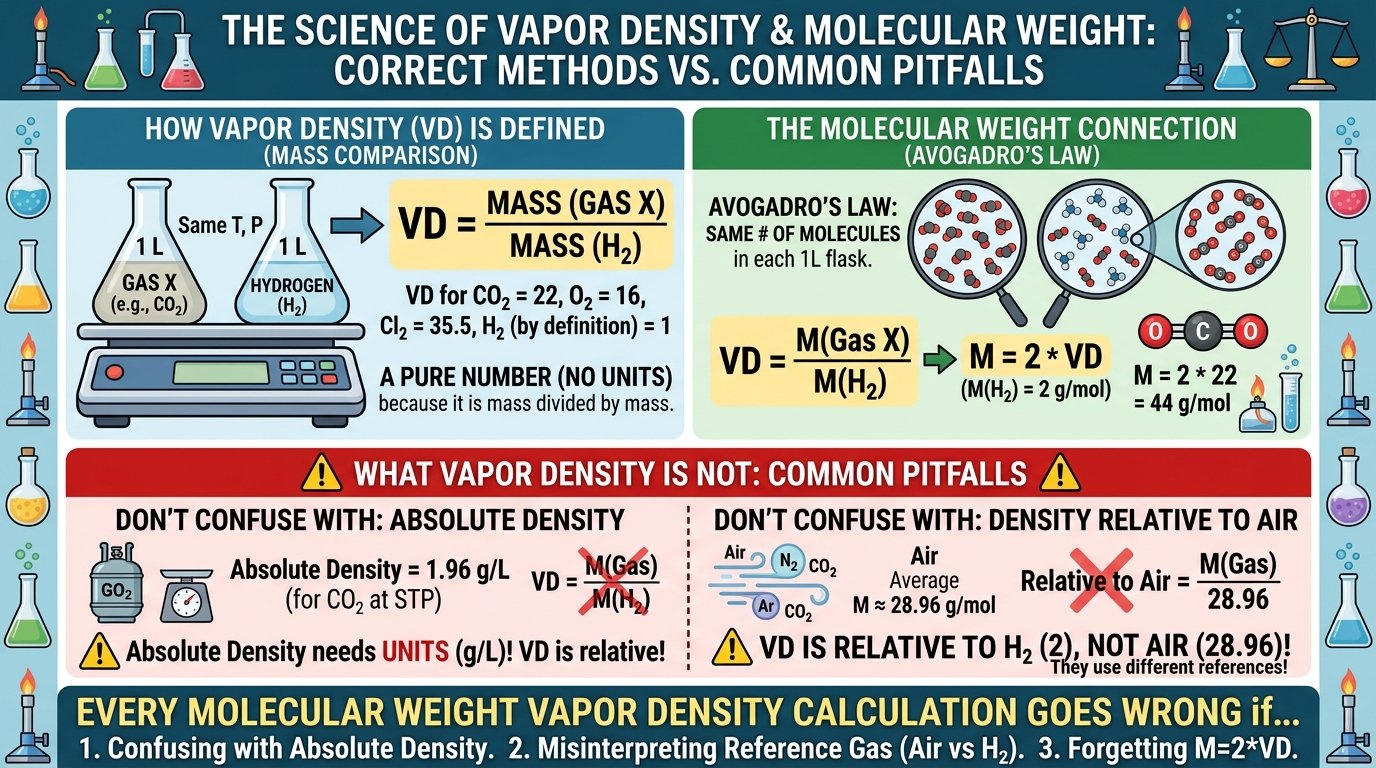
Every molecular weight vapor density problem starts with a comparison. Take a liter of some gas and a liter of hydrogen, both at the same temperature and pressure, and weigh them. The ratio of the two masses is the vapor density of the gas — a pure number, no units, because it is a mass divided by a mass. Carbon dioxide comes out at 22, oxygen at 16, chlorine at 35.5, and hydrogen itself, by definition, at 1.
The molecular weight vapor density connection is what makes that number useful. Avogadro’s law says the two liters contain the same number of molecules, so the mass ratio is really a ratio of molecular masses: VD = M ÷ M(H₂). Hydrogen is diatomic, its molar mass is 2 (2.016 to be exact), and therefore M = 2 × VD. That single line lets a density measured with a balance and a thermometer deliver the molecular weight of any substance you can turn into a gas — which, with a Bunsen burner, is most of organic chemistry.
Notice the two things vapor density is not. It is not an absolute density: 1.96 g/L is the density of CO₂ at STP, while 22 is its vapor density. And it is not the same as density relative to air, which safety data sheets quote and which uses 28.96 g/mol as the reference instead of 2. Every molecular weight vapor density calculation goes wrong if those three bases are mixed up, so the calculator above asks you to pick one before it does anything — a habit worth copying on paper. If the numbers you are converting come from a formula rather than a measurement, our molecular weight calculator homepage handles the molar mass side and this page handles the gas side.
How to Use This Calculator
The tool at the top of the page was built so that a molecular weight vapor density question takes less time to solve than to read. Here is the workflow:
- Pick the mode that matches your data: a bare vapor density (Mode 1), an empirical formula plus a vapor density (Mode 2), a gas formula (Mode 3), Victor Meyer or Dumas measurements (Mode 4), or a theoretical-versus-observed density pair (Mode 5).
- Enter the numbers — or click a preset chip to load a textbook example such as VD = 32, CH₂O with VD 30, or PCl₅ with an observed density of 62.
- Choose the basis in Mode 1: relative to H₂ (textbook ×2 or exact ×2.016), relative to air (×28.96), grams per liter at STP (×22.414), or grams per liter at your own temperature and pressure (M = ρRT/P).
- Press Calculate (or Enter). The headline result appears first, then the step-by-step derivation, a table of every derived quantity, and a bar chart.
- Read the extras: Mode 1 and Mode 4 suggest gases from a 28-gas library that fall within 1.5% of your molar mass; Mode 3 tells you whether the gas sinks or rises in air.
- Export with Copy, CSV, TXT, Print or Share — and hit ↺ Reset before the next problem so stale inputs never contaminate a fresh calculation.
Your last ten results are stored in the history panel below the calculator (locally in your browser, nothing is uploaded). Clear All wipes it in one click.
The Five Modes Explained
🎈 Mode 1 — VD → Molar Mass
The core molecular weight vapor density conversion. Type the number, choose what it is relative to, and the tool returns M together with the same gas expressed on every other basis — vapor density versus hydrogen, relative density versus air, and absolute density at STP and at 25 °C. A library lookup lists common gases within 1.5% of the result: VD 22 flags carbon dioxide, nitrous oxide and propane, which is a useful reminder that a vapor density alone identifies a molar mass, not a molecule.
🧩 Mode 2 — Molecular Formula
The exam classic. Enter an empirical formula (CH₂O) and a vapor density (30). The tool computes the empirical formula mass from IUPAC 2021 atomic weights (30.026), doubles the vapor density to get M (60), divides to get n (1.998 → 2), and writes out the molecular formula C₂H₄O₂ with its exact molar mass. A warning appears if n lands far from a whole number — the sign of a misread density or a wrong empirical formula. If you already have the molar mass from another method, switch the selector and enter it directly.
⚗️ Mode 3 — VD from Formula
The forward direction of the molecular weight vapor density relationship. Any formula — with parentheses, hydrates or the dot notation — becomes a molar mass, a vapor density (textbook and exact), a relative density versus air, and an absolute density at STP and at your own T and P. Butane comes out at 2.0 times the density of air and 2.59 g/L at STP; ammonia at 0.59 times air. The verdict line tells you whether a leak would pool at floor level or rise to the ceiling — the property that safety data sheets care about most.
🔬 Mode 4 — Victor Meyer / Dumas
The laboratory route to a molecular weight vapor density value. Enter the mass of liquid vaporized, the volume of vapor (or displaced air) in milliliters, the temperature, and the pressure in mmHg, atm or kPa. If the air was collected over water, add the aqueous tension and the tool subtracts it (Dalton’s law). Out come the moles of vapor from PV = nRT, the molar mass, the vapor density, the volume corrected to STP for the classical “22,414 mL” check, and a library suggestion when the molar mass matches a known gas.
⚖️ Mode 5 — Abnormal VD (α)
The molecular weight vapor density anomaly that puzzled chemists for a decade. When a vapor dissociates — PCl₅ into PCl₃ and Cl₂, N₂O₄ into two NO₂, NH₄Cl into NH₃ and HCl — more particles share the same mass, and the measured density d falls below the theoretical value D = M/2. The tool computes the degree of dissociation α = (D − d) ÷ ((n − 1)d), the equilibrium composition, and the observed average molar mass. Flip the selector to Association for acetic acid dimers, where the density rises above D instead.
The Molecular Weight Vapor Density Formula (With the Box You Should Memorize)
Every problem this page can pose — no exceptions — is one of these four lines rearranged:
VD = mass of V liters of gas ÷ mass of V liters of H₂ = M ÷ 2
M = 2 × VD · M = 28.96 × dair · M = ρSTP × 22.414
M = ρRT ÷ P · n = M ÷ (empirical formula mass) · α = (D − d) ÷ ((n − 1)·d)
R = 0.082057 L·atm/(mol·K) · 1 atm = 760 mmHg = 101.325 kPa · STP = 0 °C, 1 atm · M(H₂) = 2.016 · M(air) = 28.96
Two details in that molecular weight vapor density box decide most marks. First, the reference gas. “Vapor density” without qualification means relative to hydrogen and the factor is 2. A safety data sheet’s “vapour density (air = 1)” means relative to air and the factor is 28.96 — fourteen and a half times larger. Confuse them and every molecular weight vapor density answer is off by a factor of 14.5, an error so large it is usually spotted, but not before the marks are gone. Second, same temperature and pressure. The ratio is only meaningful when both gases are compared under identical conditions; that is exactly what makes the ratio independent of conditions, because both densities scale with P/T in the same way.
Notice also what the molecular weight vapor density formula does not contain: temperature. An absolute density in g/L changes with every degree — CO₂ is 1.96 g/L at 0 °C but 1.80 g/L at 25 °C — while its vapor density is 22 at both. That is the whole reason the 19th-century chemists preferred the relative number: it could be tabulated once and compared between laboratories that had no way of agreeing on a standard temperature. Only when you are handed an absolute density do you need R, T and P, and then the ideal-gas rearrangement M = ρRT/P does the work.
Why It Works: Avogadro’s Law and Equal Volumes
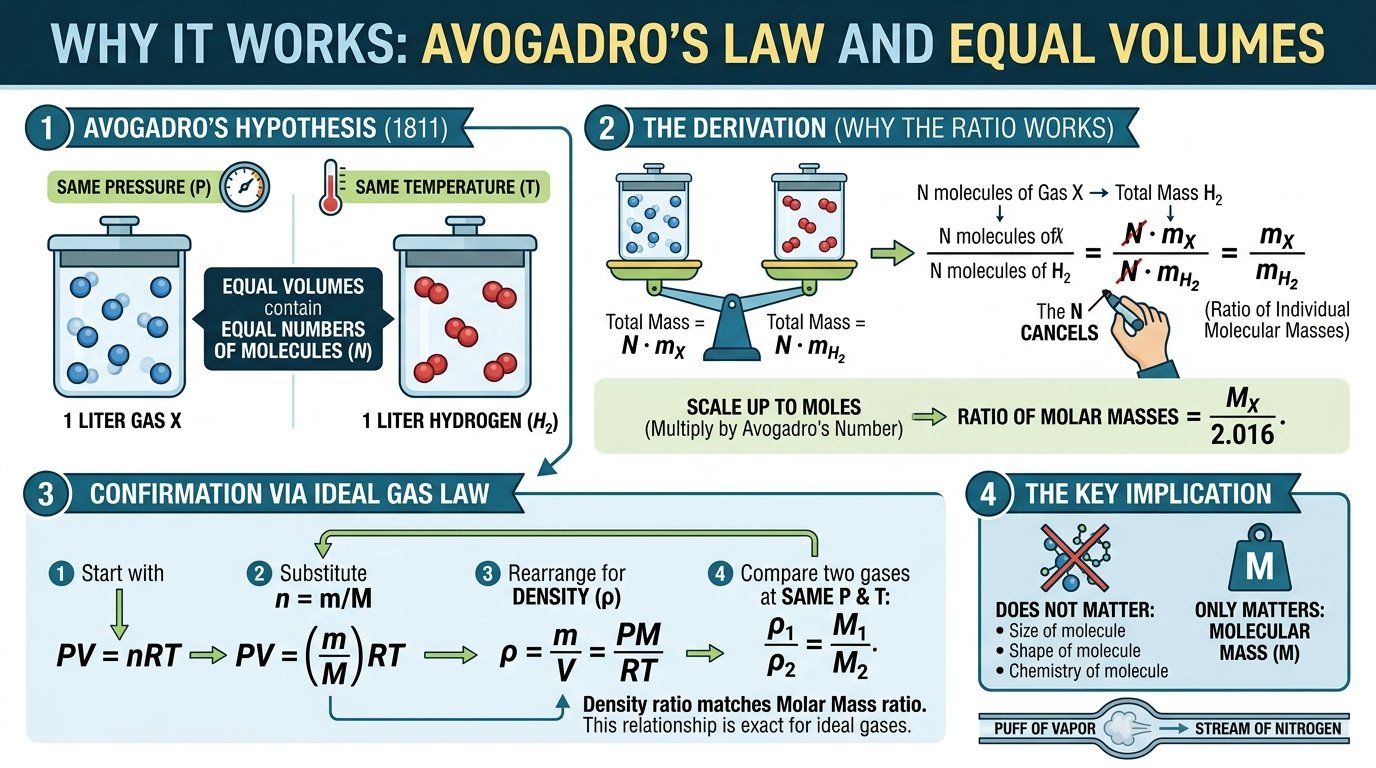
The factor of two is not a coincidence or a convention; it is Avogadro’s hypothesis in disguise. In 1811 Amedeo Avogadro proposed that equal volumes of all gases, at the same temperature and pressure, contain equal numbers of molecules. Take one liter of gas X holding N molecules of mass mX each, and one liter of hydrogen holding the same N molecules of mass mH₂ each. The mass ratio is (N·mX) ÷ (N·mH₂) — the N cancels — leaving mX ÷ mH₂, the ratio of the molecular masses. Multiply top and bottom by Avogadro’s number and it becomes the ratio of molar masses, MX ÷ 2.016.
That is why the molecular weight vapor density relationship is exact for ideal gases and very nearly exact for real ones at ordinary pressures. The ideal gas law gives the same result in one line: from PV = nRT with n = m/M, the density is ρ = PM/RT, so two gases at the same P and T have densities in the ratio of their molar masses. Nothing about the size, shape or chemistry of the molecule enters — only its mass. This is also why vapor density can be measured for a substance nobody has ever isolated in pure gaseous form: a puff of it in a stream of nitrogen, at known T and P, obeys the same law.
The historical hurdle was hydrogen itself. Avogadro’s argument only gives M = 2 × VD if hydrogen is diatomic, H₂. Dalton insisted the elements were monatomic, and on his assumption the factor would have been 1 and every molecular weight would have come out half its true value. It took Gay-Lussac’s combining volumes — two volumes of hydrogen plus one of oxygen giving two volumes of steam, which is only possible if the hydrogen molecule splits in two — and half a century of argument before Cannizzaro settled it. When you write M = 2 × VD you are quietly asserting that hydrogen is H₂; when a molecular weight vapor density measurement of a monatomic vapor like mercury gives 100 and therefore M = 200, you are confirming that mercury vapor is single atoms.
The same equal-volumes logic underpins the other gas-phase tools on this site: the stoichiometry calculator converts reacting volumes with it, and the grams to moles calculator is the n = m/M step pulled out on its own.
Hydrogen, Air or Grams per Liter: Three Ways to Quote a Density
Three different numbers describe the density of the same gas, and molecular weight vapor density questions are written in all three. Take carbon dioxide, M = 44.009 g/mol, as the running example.
Relative to hydrogen (the chemist’s vapor density). VD = 44.009 ÷ 2 = 22.0, or 21.83 if you use the exact 2.016. School and university problems mean this unless they say otherwise. It is dimensionless and independent of temperature and pressure.
Relative to air (the engineer’s relative density). d = 44.009 ÷ 28.96 = 1.52. This is the “vapour density (air = 1)” figure in Section 9 of every safety data sheet and in fire-safety codes, because what matters in a leak is whether the gas sinks below or floats above the air around it. Convert to the hydrogen basis by multiplying by 14.48, or straight to molar mass by multiplying by 28.96. Note that “air” here is dry air of average molar mass 28.96 g/mol — itself a molecular weight vapor density result, obtained from air’s density relative to hydrogen (14.48) long before its composition was fully known.
Absolute density in grams per liter. At STP (0 °C, 1 atm) one mole of ideal gas occupies 22.414 L, so ρ = 44.009 ÷ 22.414 = 1.964 g/L. At 25 °C and 1 atm the molar volume is 24.465 L and ρ = 1.799 g/L. This number changes with conditions, so it must always be quoted with its T and P; the calculator’s Mode 1 offers both the STP shortcut and the general M = ρRT/P route. A trap worth knowing: IUPAC redefined STP in 1982 as 0 °C and 1 bar, at which the molar volume is 22.711 L. Most textbooks and this page keep the older 1 atm convention; if your course uses 1 bar, use the T-and-P option with P = 0.98692 atm.
The molecular weight vapor density conversions are summarized in one line worth copying into your notes: M = 2 × VD(H₂) = 28.96 × d(air) = 22.414 × ρ(STP, g/L). Everything else on this page is a special case of it.
Three Worked Examples, Step by Step
Example 1 — The classic molecular weight vapor density problem
Problem: A compound has the empirical formula CH₂O and a vapor density of 30. Find its molecular formula.
Step 1 — Molar mass from the density: M = 2 × VD = 2 × 30 = 60 g/mol.
Step 2 — Empirical formula mass: CH₂O = 12.011 + 2(1.008) + 15.999 = 30.026 g/mol.
Step 3 — Multiplier: n = 60 ÷ 30.026 = 1.998 → n = 2.
Step 4 — Molecular formula: (CH₂O)₂ = C₂H₄O₂, molar mass 60.052 g/mol — acetic acid, or one of its isomers such as methyl formate. The vapor density fixes the size of the molecule; only chemistry can pick between the isomers.
Example 2 — Reducing a Victor Meyer measurement
Problem: 0.110 g of a volatile liquid displaces 27.5 mL of air measured at 27 °C and 750 mmHg. Find its molar mass and vapor density.
Step 1 — Units: P = 750 ÷ 760 = 0.98684 atm; T = 27 + 273.15 = 300.15 K; V = 0.0275 L.
Step 2 — Moles of vapor: n = PV ÷ RT = 0.98684 × 0.0275 ÷ (0.082057 × 300.15) = 1.1019 × 10⁻³ mol.
Step 3 — Molar mass: M = 0.110 ÷ 1.1019 × 10⁻³ = 99.83 g/mol; vapor density = 99.83 ÷ 2 = 49.9.
Classical check: V at STP = 27.5 × (750/760) × (273.15/300.15) = 24.70 mL; if 24.70 mL weighs 0.110 g, then 22,414 mL weighs 0.110 × 22,414 ÷ 24.70 = 99.8 g — the same answer by the route older textbooks use.
Example 3 — An abnormal molecular weight vapor density and the degree of dissociation
Problem: The vapor density of PCl₅ at a certain temperature is found to be 62. Calculate the degree of dissociation into PCl₃ and Cl₂.
Step 1 — Theoretical density: M(PCl₅) = 30.974 + 5(35.45) = 208.224 g/mol → D = 208.224 ÷ 2 = 104.11.
Step 2 — Particle bookkeeping: PCl₅ ⇌ PCl₃ + Cl₂; starting with 1 mol and fraction α dissociated, the mixture holds (1 − α) + α + α = 1 + α mol. Density is inversely proportional to moles, so D ÷ d = 1 + α.
Step 3 — Solve: α = (D − d) ÷ d = (104.11 − 62) ÷ 62 = 0.679, i.e. 67.9% dissociated.
Interpretation: The equilibrium vapor is 19.1 mol% PCl₅ and 80.9 mol% products, and its average molar mass is 2 × 62 = 124 g/mol — the “abnormal” molecular weight that once made chemists doubt Avogadro. Nothing is wrong with the law; the gas is simply a mixture.
Reference Table: Vapor Densities of Common Gases
Keep this table beside you when checking a molecular weight vapor density answer — a result that lands near one of these is usually right, and one that lands between them is a hint that the gas is a mixture or a vapor of a liquid. Molar masses use IUPAC 2021 atomic weights; densities are for the ideal gas at 0 °C and 1 atm.
| Gas | M (g/mol) | VD (H₂ = 1) | Relative to air | g/L at STP | In air it… |
|---|---|---|---|---|---|
| Hydrogen, H₂ | 2.016 | 1.00 | 0.070 | 0.0899 | rises fast |
| Helium, He | 4.003 | 2.00 | 0.138 | 0.1786 | rises fast |
| Methane, CH₄ | 16.043 | 8.02 | 0.554 | 0.7158 | rises |
| Ammonia, NH₃ | 17.031 | 8.52 | 0.588 | 0.7598 | rises |
| Water vapor, H₂O | 18.015 | 9.01 | 0.622 | 0.8037 | rises (humid air is lighter) |
| Carbon monoxide, CO | 28.010 | 14.01 | 0.967 | 1.2497 | mixes evenly |
| Nitrogen, N₂ | 28.014 | 14.01 | 0.967 | 1.2498 | mixes evenly |
| Dry air (reference) | 28.96 | 14.48 | 1.000 | 1.2920 | — |
| Oxygen, O₂ | 31.998 | 16.00 | 1.105 | 1.4276 | sinks slightly |
| Hydrogen sulfide, H₂S | 34.081 | 17.04 | 1.177 | 1.5205 | sinks (pits, sewers) |
| Argon, Ar | 39.95 | 19.98 | 1.379 | 1.7824 | sinks |
| Carbon dioxide, CO₂ | 44.009 | 22.00 | 1.520 | 1.9635 | sinks (cellars, Lake Nyos) |
| Propane, C₃H₈ | 44.097 | 22.05 | 1.523 | 1.9674 | sinks (LPG leaks pool) |
| Butane, C₄H₁₀ | 58.124 | 29.06 | 2.007 | 2.5932 | sinks |
| Sulfur dioxide, SO₂ | 64.066 | 32.03 | 2.212 | 2.8583 | sinks |
| Chlorine, Cl₂ | 70.90 | 35.45 | 2.448 | 3.1632 | sinks (trench warfare) |
| Benzene vapor, C₆H₆ | 78.114 | 39.06 | 2.697 | 3.4851 | sinks |
| Sulfur hexafluoride, SF₆ | 146.05 | 73.02 | 5.043 | 6.5160 | sinks (the “invisible boat” demo) |
| Mercury vapor, Hg | 200.59 | 100.3 | 6.926 | 8.9493 | sinks (monatomic) |
Two patterns are worth noticing. Carbon monoxide, nitrogen and ethylene all sit at VD 14, which is why a vapor density alone cannot tell them apart, and why a molecular weight vapor density result should always be paired with an empirical formula or a chemical test. And the “in air” column follows a simple rule: anything with a relative density beyond about 0.95–1.05 will stratify in still air, so the gases that kill in confined spaces — CO₂, H₂S, propane — are precisely the ones that pool where people stand. Molar masses for gases not in the table come straight from the atomic mass calculator or from Mode 3 above.
Measuring Vapor Density in the Lab: Victor Meyer, Dumas and Regnault
Three classical methods produced almost every molecular weight vapor density value in the older literature, and two of them are still run in teaching laboratories.
Dumas’ method (1826). A thin glass bulb with a drawn-out neck is weighed full of air, a few milliliters of the liquid are drawn in, and the bulb is held in a bath (boiling water for most organic liquids) until the liquid has boiled away and the bulb is full of vapor at the bath temperature and atmospheric pressure. The neck is sealed, the bulb is cooled and weighed, and finally opened under water to measure its volume. The mass of vapor is the sealed mass minus the mass of the bulb with air removed; M follows from PV = nRT. Dumas’ own results — including the notorious sulfur and phosphorus densities discussed below — were accurate to about 1%.
Victor Meyer’s method (1878). The preferred student method because it needs no vacuum and no sealing. A weighed sample in a tiny stoppered bottle is dropped into a long tube kept hot by a jacket of a boiling liquid; it vaporizes instantly and pushes an equal volume of air out of the top of the tube into a graduated tube over water. The displaced air is at room temperature and atmospheric pressure — not the jacket temperature — which is the single most common source of confusion. Since the vapor displaced an equal volume of air at the hot temperature, and that air is then measured cold, the volume measured is exactly the volume the vapor would occupy at room conditions. Because the gas is over water, the aqueous tension must be subtracted from the barometer reading; Mode 4 does this for you.
Regnault’s method. For substances that are already gases, a large glass globe of known volume is weighed evacuated and then filled with the gas at measured T and P; the mass difference divided by the volume is the absolute density, which the ideal gas law converts to M. Regnault’s precision globes gave the densities of oxygen, nitrogen and air that the 1860s atomic-weight tables relied upon, and a refinement of the same method led Rayleigh and Ramsay to argon in 1894 — because nitrogen from air was persistently 0.5% denser than nitrogen made from ammonia.
Whatever the apparatus, the molecular weight vapor density reduction is identical: dry pressure in atmospheres, volume in liters, temperature in kelvin, n = PV/RT, M = m/n. The osmotic pressure, freezing point depression and boiling point elevation methods cover the non-volatile solids the gas methods cannot reach; between the four of them, classical chemistry could weigh almost any molecule.
Who Uses the Vapor Density Method?
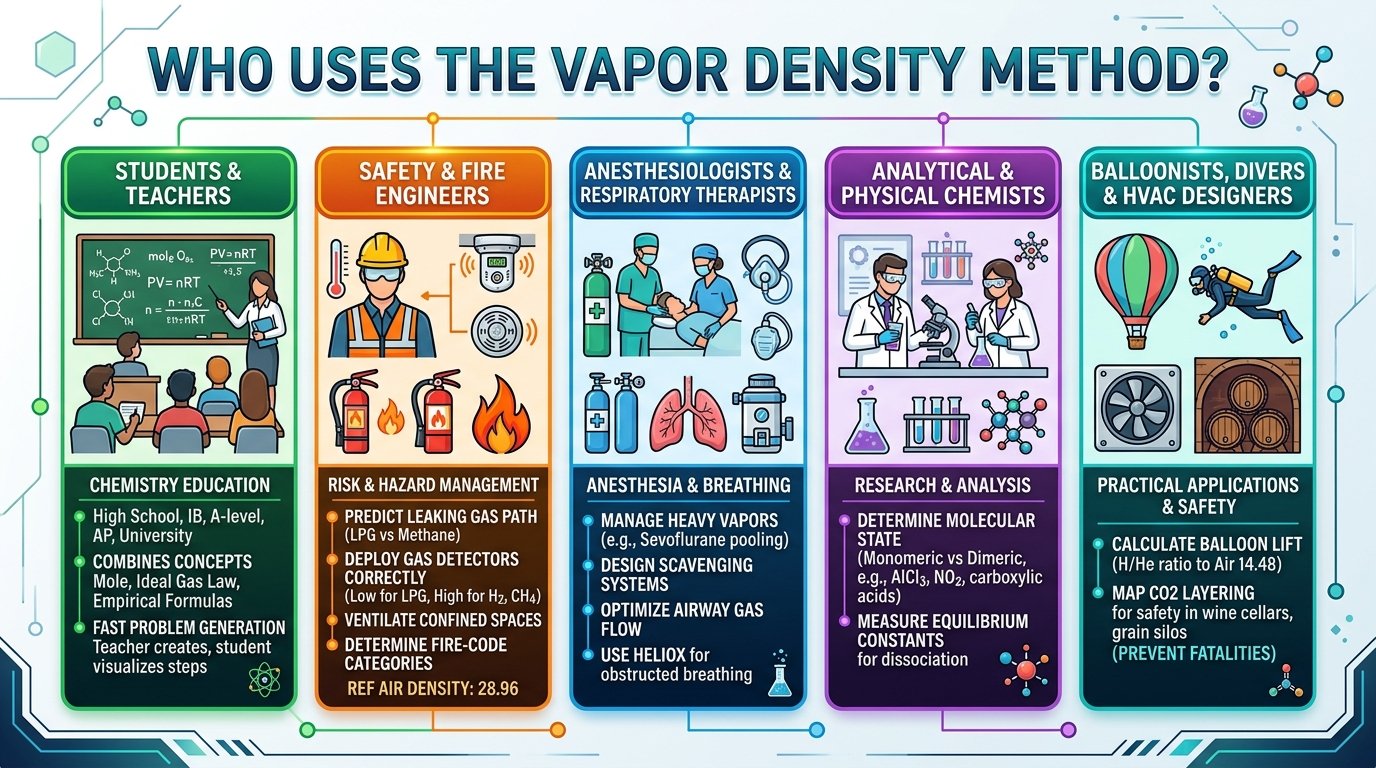
Students and teachers. Molecular weight vapor density questions appear in every high-school and first-year syllabus — CBSE, IB, A-level, AP and the university general-chemistry sequence — because they combine the mole concept, the ideal gas law and empirical formulas in a single problem. The calculator lets a teacher generate and check a fresh set of numbers in seconds and lets a student see the intermediate steps they are expected to write.
Safety and fire engineers. Relative vapor density against air decides where a leaking gas goes, so it governs where gas detectors are mounted (low for LPG, high for methane and hydrogen), how confined spaces are ventilated, and which fire-code category a flammable liquid falls into. Every safety data sheet lists it, and every molecular weight vapor density calculation in that world uses 28.96 as the reference.
Anesthesiologists and respiratory therapists. Anesthetic vapors are heavy — sevoflurane has a relative density near 6.9 — which matters for scavenging systems and for why waste gas pools at floor level in operating theatres. Gas density also sets flow behaviour in airways and is the reason heliox (helium–oxygen) eases breathing through obstructed airways.
Analytical and physical chemists. Vapor density is still the quickest way to determine whether a volatile compound is monomeric or dimeric in the gas phase (aluminium chloride, carboxylic acids, nitrogen dioxide), and abnormal densities remain a textbook route to equilibrium constants for dissociation reactions.
Balloonists, divers and HVAC designers use the same ratio under other names: the lift of a hydrogen or helium balloon is set by how far its vapor density falls below air’s 14.48, and the layering of CO₂ in wine cellars and grain silos is a molecular weight vapor density fact with a body count.
Full Lab Walkthrough: An Unknown Volatile Liquid
Suppose you are handed a clear liquid that boils near 80 °C, told its empirical formula is CH (from combustion analysis), and asked for the molecular formula. Here is the complete molecular weight vapor density workflow with realistic numbers.
- Prepare the Victor Meyer tube. Boil water in the outer jacket for ten minutes until air stops bubbling from the delivery tube — the inner tube must be at a steady temperature before you start, or the expanding air will be counted as vapor.
- Weigh the sample. Draw about 0.13 g of the liquid into a small stoppered bottle and weigh it to 0.1 mg: 0.1300 g.
- Drop and collect. Release the bottle into the hot tube; the stopper pops, the liquid flashes to vapor, and displaced air bubbles into the graduated tube over water. When bubbling stops, level the water inside and outside and read the volume: 42.0 mL.
- Record the conditions. Room temperature 25.0 °C, barometer 760 mmHg, aqueous tension of water at 25 °C = 23.8 mmHg. Dry pressure = 736.2 mmHg = 0.96868 atm.
- Compute the moles. n = PV ÷ RT = 0.96868 × 0.0420 ÷ (0.082057 × 298.15) = 1.663 × 10⁻³ mol.
- Compute M and VD. M = 0.1300 ÷ 1.663 × 10⁻³ = 78.2 g/mol; vapor density = 39.1.
- Find the molecular formula. Empirical mass of CH = 13.019; n = 78.2 ÷ 13.019 = 6.0 → C₆H₆, benzene (exact M 78.114, a 0.1% error).
- Sanity-check. Benzene boils at 80.1 °C, matching the observation; the library lookup in Mode 4 flags “Benzene vapour” at +0.08%. Report M = 78 ± 1 g/mol and the molecular formula C₆H₆.
Two lessons from the walkthrough. The aqueous-tension correction changed the answer by 3% — skip it and you would report 75.7 g/mol and n = 5.8, an uncomfortable distance from a whole number. And the empirical formula did the identifying; the vapor density only sized the molecule. Type “0.130, 42, 25, 760, aqueous tension 23.8” into Mode 4 of the molecular weight vapor density calculator to see the whole chain printed out.
A Short History: Avogadro, Dumas, Cannizzaro & the Atomic-Weight Crisis
The molecular weight vapor density method is the reason the periodic table exists in the form it does. In 1808 Gay-Lussac found that gases combine in simple volume ratios; in 1811 Avogadro explained why, with the equal-volumes hypothesis and the shocking corollary that hydrogen, oxygen and nitrogen are diatomic. Almost nobody believed him. Dalton rejected the idea that like atoms could bond to each other, Berzelius built his atomic-weight tables on other assumptions, and for fifty years chemists used a bewildering mix of formulas — water was written HO by some and H₂O by others, and a dozen different values circulated for the atomic weight of carbon.
Dumas’ 1826 vapor density method should have settled matters, but it produced puzzles. Sulfur vapor at 500 °C gave a density of 96, six times that expected for one atom; phosphorus gave 62, four times; mercury gave 100, exactly one atom’s worth. We now know these were S₆, P₄ and monatomic Hg — the method was reporting true molecular weights — but at the time the results seemed to contradict Avogadro’s rule that “all gases hold equal numbers of atoms,” and Dumas himself lost faith in it.
Then came the abnormal densities of Deville and Troost in the 1850s: ammonium chloride, phosphorus pentachloride and sulfuric acid vapor all showed molecular weights roughly half the expected value. Henri Sainte-Claire Deville introduced the word dissociation to explain them, and the molecular weight vapor density anomaly turned from a threat to the theory into a new tool for measuring equilibria. In 1858 Stanislao Cannizzaro published his Sketch of a Course of Chemical Philosophy, showing that if you take Avogadro seriously, tabulate the vapor densities of many compounds of an element, and find the smallest mass of that element in any of them, the atomic weights fall out uniquely. He distributed the pamphlet at the Karlsruhe Congress of 1860; Lothar Meyer said reading it made “the scales fall from my eyes,” and within a decade both he and Mendeleev had used the resulting atomic weights to build the periodic table.
Victor Meyer’s 1878 apparatus made the measurement fast enough for routine use, and for the next half-century vapor density was the standard way to establish molecular formulas of new volatile compounds. The mass spectrometer eventually took over — see our monoisotopic mass calculator and the average vs monoisotopic mass guide for the modern side — but every molecular formula in a 19th-century paper rests on M = 2 × VD.
Vapor Density in Everyday Life and Safety
Because the molecular weight vapor density ratio tells you whether a gas sinks or floats in air, it shows up in more everyday situations than any other gas property.
- Where the gas alarm goes. Natural gas (methane, 0.55× air) rises, so kitchen detectors go high on the wall; LPG (propane/butane, 1.5–2× air) sinks, so cylinder-fed kitchens need them near the floor. A detector mounted for the wrong gas will never trigger.
- Lake Nyos, 1986. Carbon dioxide (1.52× air) released from a volcanic lake in Cameroon flowed downhill as an invisible river and suffocated some 1,700 people in villages up to 25 km away — the deadliest demonstration of a molecular weight vapor density fact in history.
- Wine cellars, silos and manholes. Fermentation CO₂ and sewer H₂S (1.18× air) pool at the bottom of confined spaces; the “candle test” — a flame that dies near the floor — is a crude relative-density measurement that has saved lives for centuries.
- Balloons. A helium balloon (VD 2 against air’s 14.48) lifts about 1.1 g per liter at sea level; hydrogen (VD 1) lifts only 8% more, which is why the far safer helium won. Your voice deepening after a breath of SF₆ (VD 73) and squeaking after helium is the same density difference acting on sound speed.
- Petrol station warnings. Gasoline vapor has a relative density of 3–4, so it spreads along the ground toward ignition sources — the reason no-smoking zones extend far beyond the pump.
- Weather. Water vapor (VD 9) is lighter than dry air (14.48), so humid air is less dense than dry air at the same temperature — one reason moist air rises to form clouds, and why aircraft need longer runways on humid days.
- Operating theatres. Anesthetic vapors 5–7 times denser than air settle to the floor, which is why scavenging intakes are low and why staff exposure limits are written around floor-level sampling.
Practice Problems (With Answers)
Work each problem by hand first, then verify with the free molecular weight vapor density calculator above. Answers are hidden until you click.
Problem 1 — A gas has a vapor density of 22 relative to hydrogen. Find its molar mass and its density relative to air.
M = 2 × 22 = 44 g/mol; relative to air d = 44 ÷ 28.96 = 1.52, so it sinks. Candidates at 44: CO₂, N₂O and propane — a vapor density cannot distinguish them, so an extra test (lime water for CO₂, flammability for propane) is needed.
Problem 2 — A hydrocarbon has the empirical formula C₂H₅ and a vapor density of 29. What is its molecular formula?
M = 2 × 29 = 58 g/mol; empirical mass C₂H₅ = 2(12.011) + 5(1.008) = 29.062; n = 58 ÷ 29.062 = 1.996 → 2; molecular formula C₄H₁₀ (butane or 2-methylpropane), M = 58.124 g/mol.
Problem 3 — In a Victor Meyer experiment 0.240 g of a liquid displaced 45.0 mL of dry air at 17 °C and 745 mmHg. Find the molar mass.
P = 745 ÷ 760 = 0.98026 atm; T = 290.15 K; V = 0.0450 L. n = 0.98026 × 0.0450 ÷ (0.082057 × 290.15) = 1.853 × 10⁻³ mol; M = 0.240 ÷ 1.853 × 10⁻³ = 129.5 g/mol, vapor density 64.8. (A vapor density alone cannot name the liquid — the empirical formula from combustion analysis would decide.)
Problem 4 — A gas has an absolute density of 1.25 g/L at STP. Find its molar mass and vapor density, and suggest what it might be.
M = 1.25 × 22.414 = 28.0 g/mol; vapor density = 14.0. Nitrogen (28.014), carbon monoxide (28.010) and ethylene (28.054) all fit — three gases with the same molecular weight vapor density that only chemistry can separate.
Problem 5 — Iodine vapor at high temperature shows a vapor density of 100. What fraction of the I₂ molecules have dissociated into atoms?
D = M(I₂) ÷ 2 = 253.81 ÷ 2 = 126.9; I₂ ⇌ 2 I gives n = 2, so α = (D − d) ÷ d = (126.9 − 100) ÷ 100 = 0.269 — 26.9% dissociated. The observed average molar mass is 2 × 100 = 200 g/mol, between I₂ (253.8) and I (126.9).
Tips for Fast, Error-Free Calculations
- ✅ Write the reference gas next to every density — the number-one molecular weight vapor density habit. “VD 22 (H₂)” and “d 1.52 (air)” are the same gas; “22 (air)” would be a molar mass of 637.
- ✅ Use 2, not 2.016, unless the question says otherwise — exam answer keys are built on M = 2 × VD, and the 0.8% difference can push n away from a whole number if you mix conventions half-way through.
- ✅ Keep the three anchors in your head: air = 14.48 on the hydrogen scale, 22.414 L/mol at STP, and RT = 24.47 L·atm/mol at 25 °C. Most molecular weight vapor density conversions are one multiplication by one of those.
- ✅ Correct for water vapor whenever a gas was collected over water — subtract the aqueous tension before using the pressure. It is a 2–4% effect at room temperature and it always makes a molecular weight vapor density result come out too low if forgotten.
- ✅ Round n, then recompute M — after finding n = 1.998 → 2, report the molar mass of the molecular formula (60.052), not 2 × VD (60); the density measurement is the rough number, the formula mass is the exact one.
- ✅ Reset between problems — the ↺ Reset button on each mode of the molecular weight vapor density calculator keeps old inputs from contaminating the next calculation.
⚗️ Pro workflow: Mode 1 to turn any quoted density into a molar mass → Mode 2 to scale the empirical formula up to the molecular formula → Mode 3 to check the candidate’s predicted vapor density against the measurement → Mode 4 when the raw data are a Victor Meyer or Dumas experiment → Mode 5 the moment the observed density disagrees with the formula value. Copy the steps, paste them into your report, and Reset.
5 Common Mistakes to Avoid
A decade of marking molecular weight vapor density answers produces the same five errors on repeat:
- Using the air reference with the hydrogen factor. A relative density of 1.52 (air) multiplied by 2 gives 3.04 g/mol — lighter than helium. If a density is below about 8 and the gas is not hydrogen or helium, it is almost certainly on the air scale.
- Treating vapor density as g/L. Vapor density has no units. The classic molecular weight vapor density trap is to feed 22 into M = ρRT/P and report 538 g/mol; absolute densities of gases at ordinary conditions are a few grams per liter at most.
- Using the jacket temperature in a Victor Meyer calculation. The displaced air is measured at room temperature; using 100 °C instead of 25 °C understates n by 20% and overstates M by 25%.
- Forgetting that a vapor density gives a molar mass, not an identity. VD 14 is N₂, CO or C₂H₄; VD 22 is CO₂, N₂O or C₃H₈. State the molar mass, then use the empirical formula or a chemical test to name the gas.
- Getting the dissociation formula upside down. Dissociation lowers the density (d < D, α = (D − d)/((n − 1)d)); association raises it. If your α comes out negative, you have the wrong case — the molecular weight vapor density calculator refuses the calculation and tells you which way to switch.
How This Calculator Is Different
| Feature | This calculator | Generic VD tool | By hand |
|---|---|---|---|
| Five density bases (H₂ ×2, H₂ ×2.016, air, g/L STP, g/L at T & P) | ✅ All shown for every result | ⚠️ Usually ×2 only | Manual, error-prone |
| Gas-identity suggestions (28-gas library, ±1.5%) | ✅ With % deviation | ❌ | Table lookup |
| Empirical → molecular formula with n rounding check | ✅ Warns when n is not integral | ⚠️ Rarely | ✅ Slow |
| Formula input (IUPAC 2021 masses, parentheses, hydrates) | ✅ Any formula + sink/rise verdict | ❌ Numbers only | Periodic table needed |
| Victor Meyer / Dumas reduction with aqueous-tension correction | ✅ mmHg, atm, kPa; STP volume check | ❌ | ✅ Slow |
| Degree of dissociation & association from abnormal density | ✅ α, i, equilibrium composition | ❌ | Formula often inverted |
| Export & history | ✅ CSV/TXT/print/share + last 10 | ❌ Usually none | Notebook |
Related molecular weight vapor density companions carry the theme onward: exact and isotope-level masses in the exact mass calculator and isotopic mass calculator; ionic compounds in the formula weight calculator; water of crystallization in the molar mass of hydrates calculator; gas mixtures such as air itself in the average molecular weight of a mixture tool; and for polymers, where a single molecular weight does not exist, the number average, weight average and polydispersity index calculators.
Where the Numbers Come From
The constants built into this molecular weight vapor density calculator are the CODATA values: R = 0.082057366 L·atm/(mol·K), 1 atm = 101,325 Pa = 760 mmHg exactly, and a molar volume of 22.414 L at 0 °C and 1 atm (22.711 L at 1 bar if your syllabus uses the 1982 IUPAC definition of STP). The molar mass of dry air, 28.96 g/mol, is the standard-atmosphere composition average (78.08% N₂, 20.95% O₂, 0.93% Ar, 0.04% CO₂). Molar masses computed from formulas use the IUPAC 2021 conventional atomic weights, the same table behind every other tool on this site, so a molecular formula found here will agree to the last digit with the homepage calculator.
Molecular weight vapor density textbooks differ in one convention: whether the hydrogen reference is 2 or 2.016. The calculator offers both and labels which one it used in every step. If you spot a discrepancy worth checking, our corrections policy explains how reports are handled, and the contact page is the fastest way to reach us; more about the site and its author is on the about page.
Exam Checklist
☐ I can derive M = 2 × VD from Avogadro’s law and state that it assumes hydrogen is H₂.
☐ I know the three bases — H₂ (×2), air (×28.96), g/L at STP (×22.414) — and can convert between them.
☐ I can find a molecular formula from an empirical formula and a vapor density, rounding n to a whole number.
☐ I can reduce Victor Meyer or Dumas data with n = PV/RT, using room temperature and subtracting the aqueous tension.
☐ I can explain abnormal vapor densities and compute α = (D − d)/((n − 1)d) for dissociation and the association analogue.
☐ I know why Cannizzaro’s use of vapor densities fixed the atomic weights and enabled the periodic table.
☐ I’ve verified my practice answers with the molecular weight vapor density calculator above.
Frequently Asked Questions
How do you find molecular weight from vapor density?
Multiply the vapor density by 2: M = 2 × VD. Vapor density is the density of the gas relative to hydrogen at the same temperature and pressure, and since hydrogen’s molar mass is 2 (2.016 exactly), the molecular weight is double the vapor density. Example: VD 32 → M = 64 g/mol, sulfur dioxide. If the density was quoted relative to air, multiply by 28.96 instead; if it is an absolute density in g/L at STP, multiply by 22.414.
Why is molecular weight equal to twice the vapor density?
Because of Avogadro’s law: equal volumes of gases at the same T and P contain equal numbers of molecules, so the mass ratio of equal volumes equals the ratio of molecular masses. Vapor density = M(gas) ÷ M(H₂) = M ÷ 2, hence M = 2 × VD. The factor of two in the molecular weight vapor density formula is the molar mass of the diatomic hydrogen molecule, not an arbitrary constant.
Does vapor density have units?
No. It is a mass divided by a mass, so it is a pure number — CO₂ has a vapor density of 22 whether you work in grams, kilograms or pounds. Absolute gas density (1.96 g/L for CO₂ at STP) does have units and does change with temperature and pressure; vapor density does not. Any molecular weight vapor density answer that carries “g/L” has mixed the two up.
What is the difference between vapor density relative to hydrogen and relative to air?
Only the reference gas. Chemistry problems use hydrogen (M = 2), so M = 2 × VD. Safety data sheets and fire codes use air (M = 28.96), so M = 28.96 × d and the numbers are 14.48 times smaller: CO₂ is 22 on the hydrogen scale but 1.52 on the air scale. A relative density above 1 on the air scale means the gas sinks; below 1 it rises.
How do you find the molecular formula from vapor density?
Double the vapor density to get the molar mass, divide by the empirical formula mass to get a whole number n, and multiply every subscript in the empirical formula by n. Example: empirical formula CH₂O, vapor density 30 → M = 60 → n = 60 ÷ 30.03 = 2 → molecular formula C₂H₄O₂. Mode 2 of the calculator does this and warns you if n is not close to an integer.
What is abnormal vapor density?
A measured vapor density that disagrees with M ÷ 2 for the formula. If the vapor dissociates (PCl₅ → PCl₃ + Cl₂, NH₄Cl → NH₃ + HCl, N₂O₄ → 2 NO₂) there are more particles than formula units and the density is lower than expected; if molecules associate (acetic acid dimers, Al₂Cl₆) it is higher. The degree of dissociation follows from α = (D − d) ÷ ((n − 1) · d), where D is the theoretical and d the observed density and n is the number of particles each molecule splits into.
What is Victor Meyer’s method?
A laboratory method for the vapor density of a volatile liquid. A weighed sample is dropped into a heated tube; it vaporizes and pushes an equal volume of air out into a graduated tube over water. The displaced volume, measured at room temperature and barometric pressure (corrected for aqueous tension), gives the moles of vapor through n = PV/RT, and M = mass ÷ n. Mode 4 of the calculator reduces the data for you.
Why is the vapor density of ammonium chloride abnormal?
Because NH₄Cl does not exist as molecules in the gas phase — on heating it dissociates completely into NH₃ and HCl. The formula mass of 53.49 predicts a vapor density of 26.7, but the vapor contains two molecules for every formula unit, so the measured value is about 13.4, half the expected number. Plugging D = 26.7 and d = 13.4 into the dissociation formula gives α ≈ 1, confirming complete dissociation.
Does temperature affect vapor density?
Not for an ideal gas that does not react: both the gas and the hydrogen reference expand identically, so the ratio is constant. Absolute density does change (ρ = PM/RT), which is why g/L values must always carry their T and P. Vapor density only appears to change with temperature when the substance dissociates or associates — sulfur vapor drops from 128 (S₈) toward 32 (S₂) as it is heated — and that change is chemistry, not gas physics.
Is this molecular weight vapor density calculator free, and does it work on phones?
Yes on both counts. All five modes are free with no sign-up, the page is fully responsive, and calculations run in your browser, so nothing you type is sent to a server. Your last ten results are kept in local storage on your own device and can be wiped with Clear All.
10 Vapor Density Facts Worth Knowing
- Hydrogen’s vapor density is 1 by definition, so the molecular weight vapor density rule M = 2 × VD is really the statement that the H₂ molecule weighs 2.
- Air has a vapor density of 14.48 — the number that converts between the chemist’s hydrogen scale and the engineer’s air scale.
- Cannizzaro’s 1858 pamphlet fixed the atomic weights by comparing vapor densities of many compounds, and Mendeleev’s 1869 table was built on the result.
- Sulfur vapor’s density falls from about 128 near its boiling point to 32 above 800 °C as S₈ rings break down to S₂ — a molecule changing size in front of the balance.
- Mercury vapor has a vapor density of 100.3 = 200.59 ÷ 2, proving that mercury, like the noble gases, is monatomic in the gas phase.
- Rayleigh and Ramsay discovered argon in 1894 because atmospheric “nitrogen” was 0.5% denser than chemically made nitrogen — a molecular weight vapor density discrepancy that earned two Nobel Prizes.
- Graham’s law follows directly: the rate of effusion is inversely proportional to the square root of the vapor density, so hydrogen escapes a pinhole four times faster than oxygen.
- Humid air is lighter than dry air because water vapor (VD 9) displaces nitrogen and oxygen (VD 14–16) — one reason storms brew in moist, rising air.
- Ammonium chloride’s vapor density of 13.4 instead of 26.7 was one of the “anomalies” of the 1850s; it is fully explained by complete dissociation into NH₃ and HCl.
- The 1986 Lake Nyos disaster, in which a cloud of CO₂ 1.5 times denser than air flowed 25 km downhill, remains the starkest illustration of why relative vapor density belongs on every safety data sheet.
🔗 Trusted external resources
Final Thoughts
The molecular weight vapor density method is a rare thing in chemistry: a molecular measurement you can make with a balance, a thermometer and a barometer, whose theory fits in one line, and which once rebuilt the entire foundation of the subject. Behind M = 2 × VD sit four small rules — know your reference gas, compare at the same T and P, use room conditions and dry pressure for Victor Meyer data, and treat an abnormal density as chemistry rather than error — plus one piece of lab wisdom: a vapor density gives a molar mass, and it takes an empirical formula to turn that into a molecule. Master those, let the calculator above verify every line, and this topic becomes the easiest marks on the paper.
Bookmark this molecular weight vapor density page for your next problem set or lab report, share it with a labmate before the Victor Meyer practical, and explore the rest of our free chemistry tools — from the molecular weight calculator homepage to the molarity calculator for the solution side of the same mole concept.
Written & Reviewed By
Ahmad Raza, M.Phil. Chemistry
Ahmad is a chemistry educator and science content developer with over 10 years of experience teaching analytical and physical chemistry. He builds free calculation tools that help students and lab professionals work faster and make fewer errors. When he’s not balancing equations, he’s usually grading titration reports.