
Molar Mass of Hydrates Calculator
Calculate the molar mass of any hydrate like CuSO4·5H2O with IUPAC 2021 atomic masses — split into anhydrous salt + water of crystallization, get the percent water, find n from heating data, and convert hydrate ↔ anhydrous grams. Every step of the working shown.
✓ Trusted by students, teachers & lab professionalsMolar Mass of a Hydrate
molar mass of hydrate = anhydrous salt + n × 18.015 (water). Type the hydrate with a dot: CuSO4·5H2O — a period (CuSO4.5H2O) or star (CuSO4*5H2O) also works. Parentheses are supported.
Percent Water of Hydration
% water = (n × 18.015 ÷ molar mass of hydrate) × 100. The classic exam question — what fraction of the crystal's mass is locked-in water?
Find n — Water of Crystallization from Heating Data
Weigh the hydrate, heat to constant mass, weigh the anhydrous residue. n = moles of water lost ÷ moles of anhydrous salt. This tool does the whole lab calculation.
Hydrate ↔ Anhydrous Converter
How much anhydrous salt is inside your hydrate — or how much hydrate to weigh when a recipe asks for the anhydrous salt. Both directions, with the water mass shown.
Solution Prep: Grams of Hydrate for a Target Molarity
grams of hydrate = molarity × volume (L) × hydrate molar mass. Weighing the pentahydrate instead of the anhydrous salt? Use the hydrate's molar mass — this mode shows both numbers.
🕘 Recent calculations
- No calculations yet — your last 10 results will appear here.
Atomic masses: IUPAC 2021 · Water of crystallization: 18.015 g/mol per H₂O · Free tool by molecularweightcalculator.org
A molar mass of hydrates calculator answers the question that trips up more chemistry students than almost any other: what does CuSO₄·5H₂O actually weigh per mole? Type it into the tool above and you get 249.68 g/mol instantly — split into the anhydrous salt (159.602 g/mol) and the five water molecules (90.075 g/mol), with the percent water (36.08%) and every step of the addition written out.
The free molar mass of hydrates calculator above does far more than one sum. This molar mass of hydrates calculator computes the percent water of hydration for any hydrate, finds the mysterious n in MgSO₄·nH₂O from your own heating data, converts hydrate mass to anhydrous mass in both directions, and tells you the grams of hydrate to weigh for any solution recipe. Each of the five modes has its own ↺ Reset button, and every result can be copied, downloaded, printed or shared.
In this guide I’ll show you how to use every mode of the molar mass of hydrates calculator, teach the one formula behind every hydrate problem, walk through the classic crucible-and-Bunsen lab step by step, and hand you the practice problems that exams recycle every single year. Let’s begin.
🔑 KEY TAKEAWAY
A molar mass of hydrates calculator computes the molar mass of any hydrate using one formula: molar mass of hydrate = molar mass of anhydrous salt + n × 18.015 g/mol, where n is the number of water molecules written after the dot. For CuSO₄·5H₂O that’s 159.602 + 5 × 18.015 = 249.68 g/mol, of which 36.08% is water. The calculator on this page also finds n from heating data (n = moles of water lost ÷ moles of anhydrous residue), converts hydrate ↔ anhydrous grams, and computes solution-prep masses — all with IUPAC 2021 atomic masses.
📑 Table of Contents (click to expand)
- What Is a Molar Mass of Hydrates Calculator?
- How to Use This Molar Mass of Hydrates Calculator
- The Five Modes Explained
- The Hydrate Formula (With the Box You Should Memorize)
- What Are Hydrates — and How Are They Named?
- Water of Crystallization: Why 18.015 Runs the Show
- Three Worked Examples, Step by Step
- Molar Mass Table: 10 Common Hydrates
- Percent Water of Hydration, Properly Understood
- Who Uses a Molar Mass of Hydrates Calculator?
- Full Lab Walkthrough: Finding n for Copper Sulfate
- A Short History of Hydrates
- Hydrates in Everyday Life
- Practice Problems (With Answers)
- Tips for Fast, Error-Free Hydrate Calculations
- 5 Common Mistakes to Avoid
- How This Calculator Is Different
- Where the Numbers Come From
- Exam Checklist
- Frequently Asked Questions
- 10 Hydrate Facts Worth Knowing
What Is a Molar Mass of Hydrates Calculator?
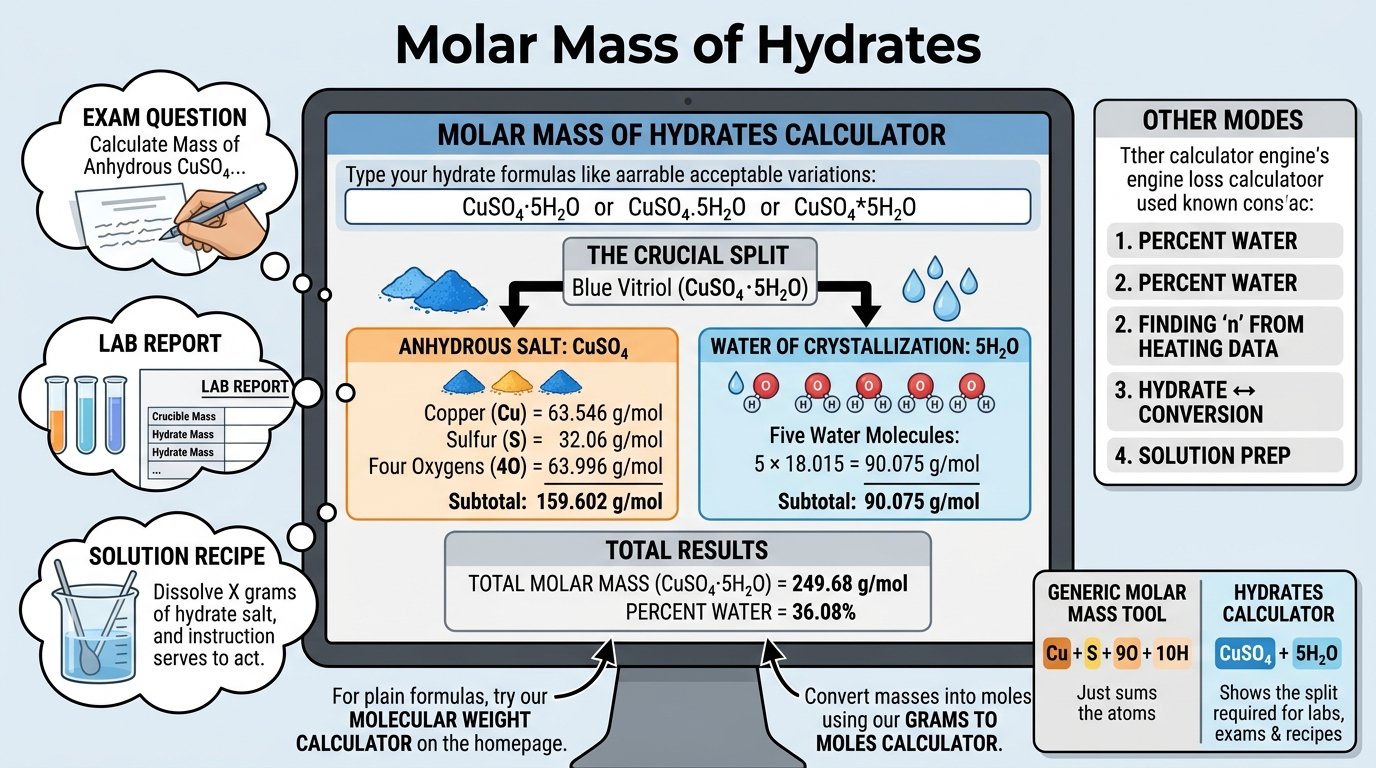
A molar mass of hydrates calculator is a tool that reads a hydrate formula — a salt with water molecules locked inside its crystal structure, written after a raised dot — and adds up two separate masses: the anhydrous salt and the water of crystallization. A generic molar mass tool can technically sum the same atoms, but a molar mass of hydrates calculator shows you the split, and the split is what every exam question, lab report and solution recipe actually asks about.
Take blue vitriol, CuSO₄·5H₂O. The anhydrous part contributes copper (63.546), sulfur (32.06) and four oxygens (63.996) for 159.602 g/mol. The five water molecules add 5 × 18.015 = 90.075 g/mol. Total: 249.68 g/mol — and 36.08% of every crystal you weigh is water. Type the formula with a dot, a period or a star (CuSO4·5H2O, CuSO4.5H2O or CuSO4*5H2O) and this molar mass of hydrates calculator accepts all three.
The same engine powers the other four modes: percent water, finding n from heating data, hydrate ↔ anhydrous conversion, and solution prep. If you want the plain (non-hydrate) version of this calculation, our molecular weight calculator on the homepage handles any formula, and the grams to moles calculator turns those masses into moles.
How to Use This Molar Mass of Hydrates Calculator
Using this molar mass of hydrates calculator takes under ten seconds:
- Pick a mode from the five tabs — Hydrate Molar Mass, % Water of Hydration, Find n, Hydrate ↔ Anhydrous, or Solution Prep.
- Type the hydrate formula with its dot: CuSO4·5H2O. A period (CuSO4.5H2O) or asterisk (CuSO4*5H2O) works too, and the quick-fill chips insert common hydrates in one click.
- Enter any masses or volumes the mode asks for — grams before and after heating for Find n, or molarity and volume for Solution Prep.
- Press the blue button (or hit Enter). The answer appears with the anhydrous/water split, a step-by-step derivation, a component table and an animated graph.
- Copy, download or share the result — CSV, TXT, print, WhatsApp, Facebook or X — and press ↺ Reset to start the next problem clean.
Your last ten calculations are saved in the history panel under the tool (stored only in your own browser), and Clear All wipes them instantly. Nothing is sent to any server — the entire molar mass of hydrates calculator runs on your device, which is also why it loads fast and works offline once the page is open.
The Five Modes Explained
💧 Mode 1 — Hydrate Molar Mass
The headline act of the molar mass of hydrates calculator. Enter the hydrate formula and get the total molar mass split into anhydrous salt + water, with an element-by-element table, the percent water, and a bar graph comparing the two parts. Parentheses work — Al₂(SO₄)₃·18H₂O parses correctly — and so does plaster of Paris written as (CaSO₄)₂·H₂O (290.283 g/mol).
📊 Mode 2 — % Water of Hydration
The classic exam question, answered by the molar mass of hydrates calculator in one click: % water = (n × 18.015 ÷ hydrate molar mass) × 100. Epsom salt, MgSO₄·7H₂O, comes out at 51.17% — more than half of what you weigh is water. The table shows the anhydrous and water contributions side by side, and the check row confirms the two percentages sum to 100.
🔥 Mode 3 — Find n (Heating Data)
The crucible lab, automated inside the molar mass of hydrates calculator. Enter the anhydrous residue formula and the two weighings — hydrate before heating, residue after — and the molar mass of hydrates calculator computes the water lost, the moles of each, the raw ratio and the rounded n, then writes out the full hydrate formula. If the ratio isn’t close to a whole number it warns you to re-heat to constant mass.
⚖️ Mode 4 — Hydrate ↔ Anhydrous
Both directions of the most practical question a molar mass of hydrates calculator gets asked. Have 10 g of CuSO₄·5H₂O? It contains 6.3923 g of anhydrous CuSO₄ and 3.6077 g of water. Need 5 g of anhydrous CuSO₄ but only have the pentahydrate on the shelf? Weigh 7.8219 g. The scale factor (hydrate ÷ anhydrous molar mass) is printed so you can reuse it.
🧪 Mode 5 — Solution Prep
grams of hydrate = molarity × volume (L) × hydrate molar mass — the molar mass of hydrates calculator does this chain in one press. For 250 mL of 0.1 M copper sulfate made from the pentahydrate: 0.025 mol × 249.677 = 6.2419 g — versus only 3.99 g if you had the anhydrous salt. Weighing the anhydrous recipe amount of a hydrate is the single most common way real solutions end up too dilute, and this mode makes that mistake impossible. For deeper concentration work, pair it with our molarity calculator.
The Hydrate Formula (With the Box You Should Memorize)
Every problem a molar mass of hydrates calculator solves — no exceptions — is built from three relationships:
Molar mass of hydrate = anhydrous salt + n × 18.015
% water = (n × 18.015 ÷ hydrate molar mass) × 100
n = moles of water lost ÷ moles of anhydrous salt
Cover the one you want. The other two rebuild it. That’s the whole chapter.
The dot in CuSO₄·5H₂O means addition, not multiplication. It says: this crystal contains one CuSO₄ unit plus five separate H₂O molecules, held in fixed positions in the lattice. So the molar mass is a sum — 159.602 + 90.075 — never a product. The molar mass of hydrates calculator applies exactly this reading, which is why typing the dot correctly matters and why the tool accepts three different dot symbols to keep your typing honest.
The units police themselves here too: g/mol + g/mol = g/mol, and a percent is grams over grams. If a hydrate answer ever comes out smaller than its anhydrous salt, the addition went backwards — a sanity check the calculator performs for you by displaying both parts explicitly.
What Are Hydrates — and How Are They Named?
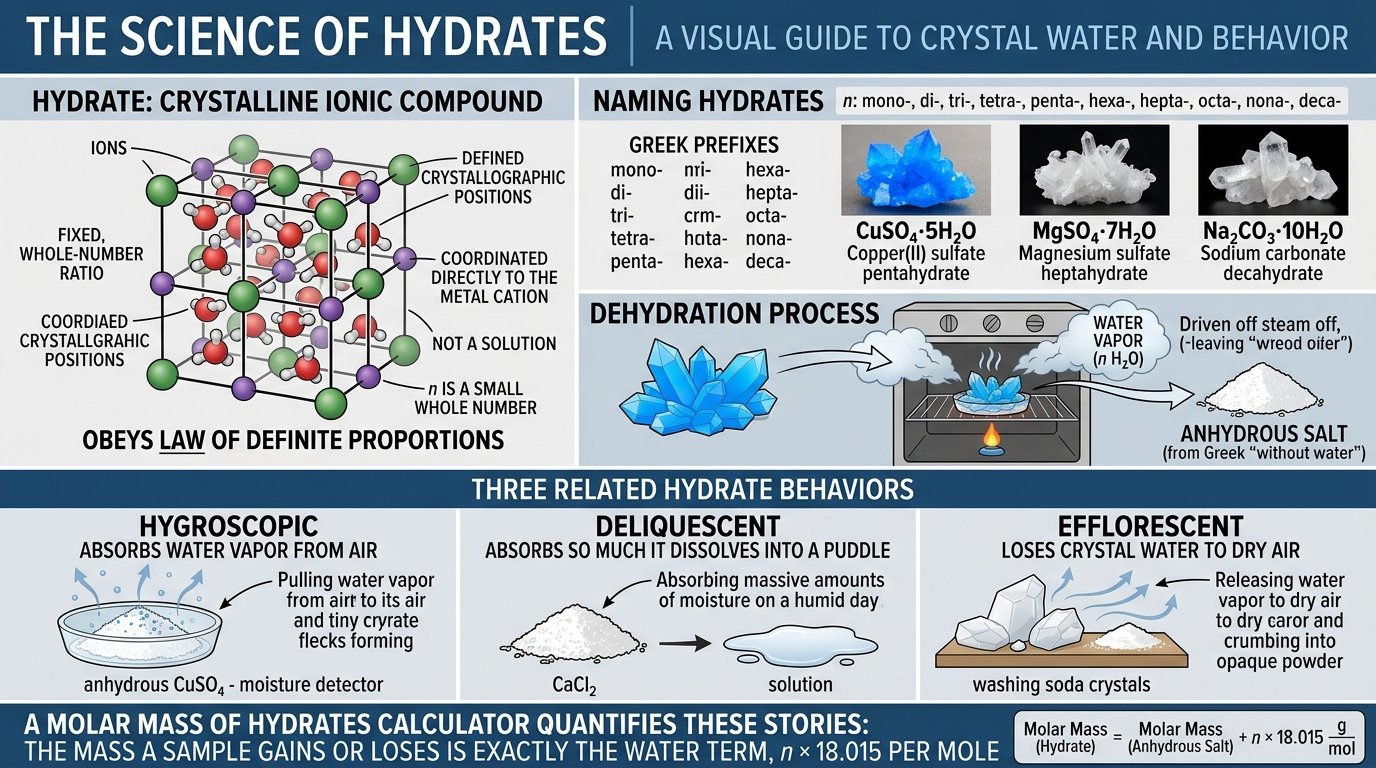
Before pushing more buttons on the molar mass of hydrates calculator, it’s worth being precise about the object itself. A hydrate is an ionic compound whose crystal lattice includes a fixed, whole-number ratio of water molecules. The water isn’t dampness and it isn’t a solution — each H₂O sits at a defined crystallographic position, often coordinated directly to the metal cation. That’s why hydrates obey the law of definite proportions just like any other compound, and why n is a small whole number you can determine by experiment.
The naming follows Greek prefixes for n: mono-, di-, tri-, tetra-, penta-, hexa-, hepta-, octa-, nona-, deca-. CuSO₄·5H₂O is copper(II) sulfate pentahydrate; MgSO₄·7H₂O is magnesium sulfate heptahydrate; Na₂CO₃·10H₂O is sodium carbonate decahydrate. Strip the water out — by heating, usually — and you have the anhydrous salt, from the Greek for “without water.”
Three related words are worth separating. A hygroscopic substance absorbs water vapor from air (anhydrous CuSO₄ does this eagerly, which makes it a moisture detector). A deliquescent substance absorbs so much that it dissolves itself into a puddle (CaCl₂ on a humid Lahore afternoon). An efflorescent hydrate does the opposite — it loses its crystal water to dry air, which is why washing soda crystals slowly crumble to powder on the shelf. A molar mass of hydrates calculator quantifies all three stories: the mass a sample gains or loses is exactly the water term, n × 18.015 per mole.
Water of Crystallization: Why 18.015 Runs the Show
Inside every molar mass of hydrates calculator, one constant does most of the work. Every water molecule contributes exactly the same mass: 2 × 1.008 (hydrogen) + 15.999 (oxygen) = 18.015 g/mol, on the IUPAC 2021 scale. Because the water term is always n × 18.015, hydrates with large n are dominated by their water. Washing soda is the extreme everyday case — at n = 10, water is 62.96% of the crystal. You could buy a kilogram and carry home 630 g of water.
This is also why the answers from a molar mass of hydrates calculator cluster in recognizable steps. Going from CuSO₄ (159.602) to the monohydrate adds 18.015; to the trihydrate, 54.045; to the pentahydrate, 90.075. If an exam answer for a hydrate differs from the anhydrous salt by something that isn’t a multiple of ~18, the n went wrong somewhere — a check the molar mass of hydrates calculator makes visible by printing the water subtotal on its own line.
One subtlety: the water of crystallization is chemically real but thermally fragile. Most hydrates release their water between 100 °C and 300 °C, some in distinct stages — CuSO₄·5H₂O sheds four waters by ~110 °C and holds the fifth until ~200 °C, because that last molecule is hydrogen-bonded to the sulfate rather than coordinated to copper. Heating “to constant mass” in the find-n lab exists precisely to make sure every stage has finished.
Three Worked Examples, Step by Step
Example 1 — Molar mass of CuSO₄·5H₂O
Step 2. Water part: 5 × 18.015 = 90.075 g/mol.
Step 3. Hydrate: 159.602 + 90.075 = 249.68 g/mol.
Bonus. % water = 90.075 ÷ 249.677 × 100 = 36.08%.
Example 2 — Percent water in Epsom salt, MgSO₄·7H₂O
Step 2. Water = 7 × 18.015 = 126.105 g/mol — already more than the salt!
Step 3. Hydrate = 120.361 + 126.105 = 246.47 g/mol.
Step 4. % water = 126.105 ÷ 246.466 × 100 = 51.17%.
Example 3 — Find n: 2.50 g of hydrated copper sulfate leaves 1.598 g on heating
Step 2. Moles of CuSO₄ = 1.598 ÷ 159.602 = 0.0100 mol.
Step 3. Moles of H₂O = 0.902 ÷ 18.015 = 0.0501 mol.
Step 4. n = 0.0501 ÷ 0.0100 = 5.001 ≈ 5 → the hydrate is CuSO₄·5H₂O.
Run all three in the free molar mass of hydrates calculator above and compare its printed steps with these — they match line for line, because the tool executes exactly this arithmetic with full-precision atomic masses from our atomic mass calculator dataset.
Molar Mass Table: 10 Common Hydrates
These ten hydrates cover the vast majority of textbook and lab work — and the vast majority of searches that bring people to a molar mass of hydrates calculator. Every value below was generated with the molar mass of hydrates calculator on this page:
| Hydrate | Common name | Anhydrous (g/mol) | Hydrate (g/mol) | % water |
|---|---|---|---|---|
| CuSO₄·5H₂O | Blue vitriol | 159.602 | 249.68 | 36.08% |
| MgSO₄·7H₂O | Epsom salt | 120.361 | 246.47 | 51.17% |
| Na₂CO₃·10H₂O | Washing soda | 105.988 | 286.14 | 62.96% |
| CaSO₄·2H₂O | Gypsum | 136.134 | 172.16 | 20.93% |
| FeSO₄·7H₂O | Green vitriol | 151.901 | 278.01 | 45.36% |
| Na₂S₂O₃·5H₂O | Photographer’s hypo | 158.097 | 248.17 | 36.30% |
| BaCl₂·2H₂O | — | 208.23 | 244.26 | 14.75% |
| ZnSO₄·7H₂O | White vitriol | 161.436 | 287.54 | 43.86% |
| CoCl₂·6H₂O | Humidity indicator | 129.833 | 237.92 | 45.43% |
| Na₂B₄O₇·10H₂O | Borax | 201.213 | 381.36 | 47.24% |
Notice the four-fold spread in percent water: barely a fifth of gypsum is water, but nearly two-thirds of washing soda is. The formula alone tells you almost nothing until the two molar masses enter the conversation — which is the whole reason a molar mass of hydrates calculator exists, and why this molar mass of hydrates calculator always prints the anhydrous and water subtotals beside every answer.
Percent Water of Hydration, Properly Understood
Percent water — Mode 2 of the molar mass of hydrates calculator — is more than an exam ritual — it’s the number that connects a hydrate’s formula to what a balance will actually read. If Epsom salt is 51.17% water, then a 100 g scoop delivers only 48.83 g of MgSO₄. Every dosing, pricing and purity decision involving a hydrate runs through this percentage.
It’s also the backbone of gravimetric analysis, one of chemistry’s oldest quantitative techniques. Because the theoretical percent water of a pure hydrate is fixed by its formula, comparing your measured mass loss against the theoretical value tests the sample’s identity and purity at once. A batch of “CuSO₄·5H₂O” whose molar mass of hydrates calculator prediction is 36.08% water but which loses only 30% on heating has either partially dehydrated in storage or was never the pentahydrate to begin with.
The reverse calculation appears in exams too: given a percent water, find n — a rearrangement every molar mass of hydrates calculator user should know. Rearranged, n = (%W × anhydrous molar mass) ÷ (18.015 × (100 − %W)). A salt XCl₂ with anhydrous mass 110.98 that is 24.51% water gives n = (24.51 × 110.98) ÷ (18.015 × 75.49) ≈ 2 — calcium chloride dihydrate. The molar mass of hydrates calculator handles the forward direction in Mode 2; for the reverse, compute the hydrate mass first and confirm with Mode 1.
Who Uses a Molar Mass of Hydrates Calculator?
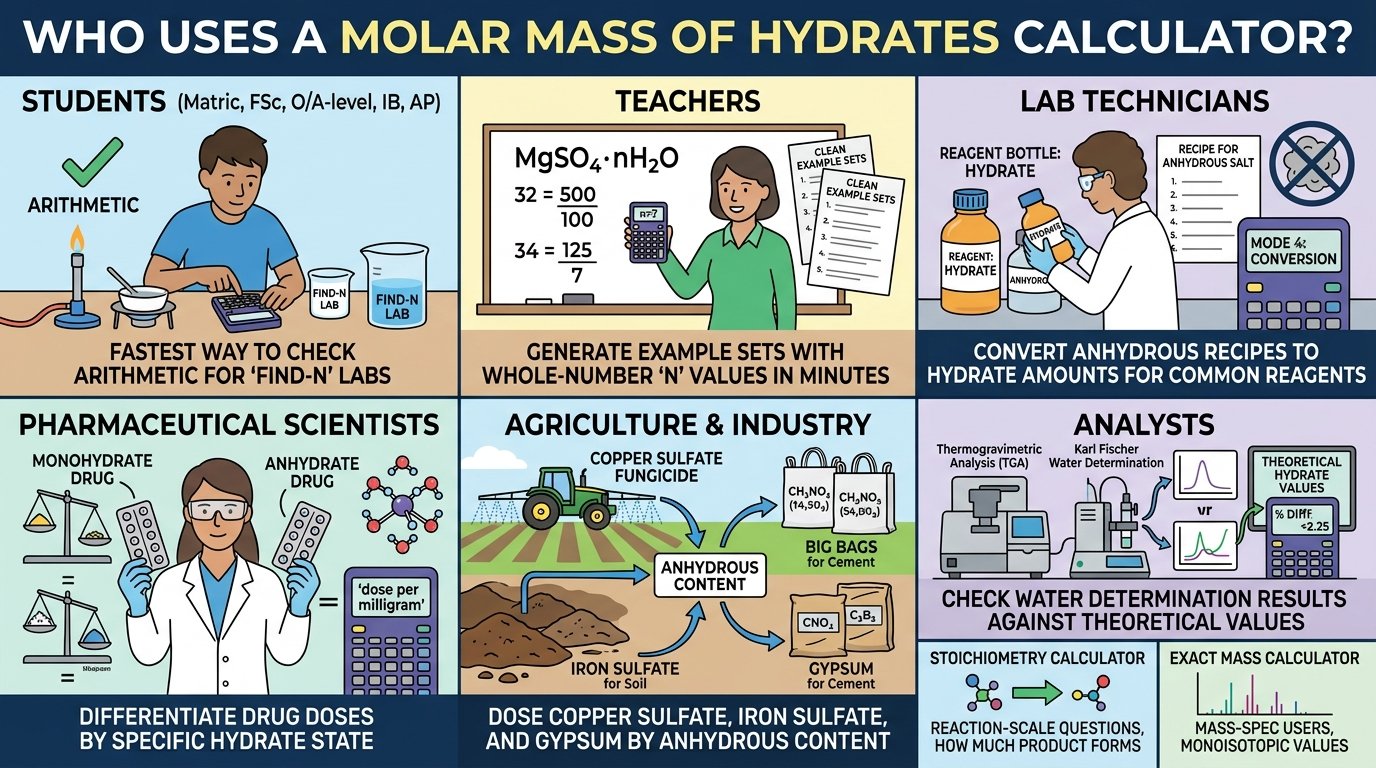
- Students — the hydrate chapter is a fixture of matric, FSc, O/A-level, IB and AP chemistry, and the find-n lab is one of the most-assessed practicals in the world — a molar mass of hydrates calculator is the fastest way to check its arithmetic.
- Teachers — with a molar mass of hydrates calculator open, generating clean example sets with whole-number n values takes minutes instead of an evening.
- Lab technicians — reagent bottles overwhelmingly contain hydrates (they’re more stable and less dusty), so every recipe written for anhydrous salts needs the conversion in Mode 4.
- Pharmaceutical scientists — drug substances are often specified as particular hydrates; a monohydrate and an anhydrate of the same drug differ in dose per milligram.
- Agriculture & industry — copper sulfate for fungicides, iron sulfate for soil, gypsum for cement: all traded as hydrates, all dosed by anhydrous content.
- Analysts — thermogravimetric and Karl Fischer water determinations are checked against theoretical hydrate values.
For the reaction-scale questions that usually follow — how much product forms from this much hydrate — our stoichiometry calculator picks up exactly where this tool leaves off, and mass-spec users can cross to the exact mass calculator for monoisotopic values.
Full Lab Walkthrough: Finding n for Copper Sulfate
Here’s the complete crucible experiment solved with this molar mass of hydrates calculator, exactly as you’d run it at the bench.
The task: a bottle labelled “hydrated copper(II) sulfate” has lost its formula label. Determine n in CuSO₄·nH₂O.
- Weigh the sample. Clean, dry crucible plus 2.50 g of the blue crystals. Record the hydrate mass before heating.
- Heat gently, then strongly. Blue fades to grey-white as water escapes. Stir with a glass rod to prevent spitting; avoid overheating past ~230 °C, which starts decomposing the sulfate itself.
- Cool in a desiccator and re-weigh. Hot residue grabs moisture straight back from air — cooling in the open ruins the result. First constant-mass reading: 1.598 g.
- Re-heat and re-weigh until constant. Two consecutive masses within 0.01 g means all the water is gone.
- Calculate. Switch the molar mass of hydrates calculator to Mode 3, enter CuSO4, 2.50 and 1.598. It reports: water lost 0.902 g; moles of CuSO₄ = 0.0100; moles of H₂O = 0.0501; n = 5.001 ≈ 5. The bottle was the pentahydrate, 249.68 g/mol.
- Verify backwards. Mode 2 says CuSO₄·5H₂O is 36.08% water; your measured loss was 0.902 ÷ 2.50 = 36.08%. The loop closes perfectly.
Total time in the molar mass of hydrates calculator: under a minute. The chemistry — careful heating, desiccator cooling, constant mass — is the part worth practicing, and it’s the part examiners actually mark.
A Short History of Hydrates
The compounds a modern molar mass of hydrates calculator handles have been known far longer than the concept of a molecule. Blue vitriol (CuSO₄·5H₂O), green vitriol (FeSO₄·7H₂O) and white vitriol (ZnSO₄·7H₂O) appear in alchemical texts over a thousand years old — the word “vitriol” comes from the Latin for glass, after their glassy crystals.
The scientific turn came around 1800. Joseph Proust’s law of definite proportions — every compound contains its elements in fixed ratios by mass — was hotly contested, and hydrates provided some of the cleanest evidence: heat a hydrate, and it always loses the same fraction of its mass. John Dalton’s atomic theory (1808) explained why: the crystal contains whole-number counts of water molecules, nothing in between. Through the 19th century, careful dehydration experiments — the ancestor of your crucible lab — became a standard tool for establishing formulas.
X-ray crystallography, from 1912 onward, finally showed where the water sits: coordinated to cations, hydrogen-bonded to anions, occupying defined lattice sites. And the 2019 SI redefinition fixed the mole itself to an exact Avogadro constant, making today’s hydrate arithmetic traceable from your two crucible weighings all the way down to fundamental constants.
Hydrates in Everyday Life
- Epsom salt baths — MgSO₄·7H₂O, 51.17% water. A “500 g” pack contains about 244 g of actual magnesium sulfate.
- Plaster of Paris — gypsum (CaSO₄·2H₂O) partially dehydrated to the hemihydrate; setting is simply rehydration, which is why a cast warms as it hardens.
- Washing soda — Na₂CO₃·10H₂O effloresces in dry air, crumbling to powder as it loses lattice water.
- Silica gel indicator beads — cobalt chloride turns from blue (anhydrous) to pink (CoCl₂·6H₂O) as it captures moisture, telling you the desiccant is spent.
- Blue vitriol fungicide — Bordeaux mixture for vines and orchards is dosed by copper content, so the 36.08% water in CuSO₄·5H₂O must be counted.
- Cement and concrete — gypsum added to clinker controls setting; curing concrete is a slow cascade of hydrate-forming reactions.
- Borax slime — the school-lab classic, Na₂B₄O₇·10H₂O, is nearly half water by mass before it ever touches the glue.
Each bullet is a mass-accounting exercise in disguise — exactly what this free molar mass of hydrates calculator was built to make effortless. Convert any of these masses onward to moles with our grams to moles calculator.
Practice Problems (With Answers)
Work each problem by hand first, then verify with the free molar mass of hydrates calculator above. Answers are hidden until you click.
Problem 1 — Calculate the molar mass of washing soda, Na₂CO₃·10H₂O.
Anhydrous Na₂CO₃ = 45.98 + 12.011 + 47.997 = 105.988 g/mol. Water = 10 × 18.015 = 180.15. Total = 286.14 g/mol — and 62.96% of it is water.
Problem 2 — What percent of CoCl₂·6H₂O is water?
Anhydrous CoCl₂ = 58.933 + 70.90 = 129.833 g/mol. Water = 6 × 18.015 = 108.09. Hydrate = 237.92 g/mol. % water = 108.09 ÷ 237.923 × 100 = 45.43%.
Problem 3 — 3.815 g of BaCl₂·nH₂O leaves 3.252 g of BaCl₂ after heating. Find n.
Water lost = 0.563 g. Moles BaCl₂ = 3.252 ÷ 208.23 = 0.01562. Moles H₂O = 0.563 ÷ 18.015 = 0.03125. n = 0.03125 ÷ 0.01562 = 2.00 → BaCl₂·2H₂O.
Problem 4 — How much anhydrous CuSO₄ is inside 25 g of CuSO₄·5H₂O?
25 ÷ 249.677 = 0.1001 mol of hydrate. Anhydrous mass = 0.1001 × 159.602 = 15.98 g; the other 9.02 g is crystal water.
Problem 5 — How many grams of FeSO₄·7H₂O for 500 mL of a 0.05 M iron(II) solution?
Moles = 0.05 × 0.5 = 0.025 mol. Hydrate molar mass = 278.006 g/mol. Mass = 0.025 × 278.006 = 6.95 g (the anhydrous salt would need only 3.80 g).
Tips for Fast, Error-Free Hydrate Calculations
- ✅ Memorize 18.015 — every hydrate problem multiplies it by n. (18.02 is fine at 4 significant figures; just be consistent.)
- ✅ Write the split first: anhydrous + n × 18.015, before touching a single atomic mass. Structure prevents omissions.
- ✅ Sanity-check against ~18n — the hydrate must exceed its anhydrous salt by a near-multiple of 18.
- ✅ In find-n labs, heat to constant mass — one heating cycle almost always leaves water behind and gives a low n.
- ✅ Cool in a desiccator — anhydrous residues are hygroscopic and re-gain mass within minutes in open air.
- ✅ Reset, then verify — every answer goes through the molar mass of hydrates calculator above; the ↺ Reset button between problems keeps old inputs from contaminating new ones.
⚗️ Pro workflow: Mode 1 to see the hydrate’s molar mass and split → Mode 2 when the question asks for percent water → Mode 3 for lab heating data → Mode 4 whenever a recipe and your reagent bottle disagree about water → Mode 5 when the hydrate is headed for a volumetric flask. Five tabs, one addition, zero water errors.
5 Common Mistakes to Avoid
A decade of marking hydrate questions, and years of molar mass of hydrates calculator support emails, produce the same five errors on repeat:
- Reading the dot as multiplication. CuSO₄·5H₂O is an addition of parts, not CuSO₄ × 5H₂O. The molar mass is 159.602 + 90.075, never a product.
- Forgetting to multiply water by n. Adding one 18.015 instead of five is the most common lost mark in the entire chapter.
- Weighing the anhydrous recipe amount of a hydrate. A 0.1 M copper sulfate recipe written for CuSO₄ needs 1.56× more mass if your bottle is the pentahydrate — Mode 4 exists for exactly this.
- Stopping the heating too early. Partial dehydration gives fractional n values like 3.6; the calculator’s warning flag tells you when your ratio is too far from a whole number.
- Capitalization typos. CO is carbon monoxide, Co is cobalt; writing COCl2·6H2O instead of CoCl2·6H2O changes the compound entirely. The parser flags unknown symbols instantly.
How This Calculator Is Different
| Feature | This molar mass of hydrates calculator | Generic molar mass tool | By hand |
|---|---|---|---|
| Anhydrous + water split shown | ✅ Always | ❌ Total only | ✅ If careful |
| % water of hydration | ✅ One click | ❌ Manual extra step | ⚠️ Slow |
| Find n from heating data | ✅ Built-in lab mode | ❌ Not offered | ⚠️ Error-prone |
| Hydrate ↔ anhydrous grams | ✅ Both directions | ❌ No | ⚠️ Slow |
| Step-by-step working shown | ✅ Every mode | ⚠️ Rarely | ✅ Yours |
| Export & history | ✅ CSV/TXT/print/share + last 10 | ❌ Usually none | ❌ Notebook |
Related tools on this site go deeper on the neighboring topics: the formula weight calculator for ionic compounds for the anhydrous salts themselves, and the molarity calculator for everything concentration-related after your hydrate dissolves.
Where the Numbers Come From
Every atomic mass in this free molar mass of hydrates calculator is drawn from the IUPAC 2021 standard atomic weights, maintained by the Commission on Isotopic Abundances and Atomic Weights (CIAAW) — the same 118-element dataset used across all tools on this site. Water of crystallization is counted at 18.015 g/mol per H₂O (2 × 1.008 + 15.999), and the mole itself rests on the exact Avogadro constant fixed by the 2019 SI redefinition, 6.02214076 × 10²³ mol⁻¹.
Small differences against older textbooks (a few units in the last decimal place) reflect IUPAC’s periodic revisions, not errors. If you ever spot a discrepancy worth checking, our corrections policy explains how we verify and fix reports — usually within days.
Exam Checklist
☐ I can compute a hydrate molar mass as anhydrous + n × 18.015.
☐ I can calculate % water of hydration and check that both percents sum to 100.
☐ I can find n from before/after heating masses via the mole ratio.
☐ I know why we heat to constant mass and cool in a desiccator.
☐ I can convert a recipe between anhydrous and hydrate masses.
☐ I can name hydrates with Greek prefixes (penta-, hepta-, deca-).
☐ I’ve verified my practice answers with the molar mass of hydrates calculator above.
Frequently Asked Questions
How do you calculate the molar mass of a hydrate?
Add the molar mass of the anhydrous salt to n × 18.015 g/mol, where n is the number of water molecules after the dot. For CuSO₄·5H₂O: 159.602 + 5 × 18.015 = 249.68 g/mol. This molar mass of hydrates calculator performs the split automatically and shows both subtotals.
What is the molar mass of CuSO₄·5H₂O?
249.68 g/mol (precisely 249.677 with IUPAC 2021 masses): anhydrous CuSO₄ contributes 159.602 g/mol and the five waters contribute 90.075 g/mol. The crystal is 36.08% water by mass.
What does the dot in a hydrate formula mean?
It means “together with” — the crystal contains the salt plus n loosely bound water molecules at fixed lattice positions. Mathematically you add the water’s mass; you never multiply the salt by it.
How do I find n from experimental data?
Weigh the hydrate, heat to constant mass, weigh the residue. Then n = (water lost ÷ 18.015) ÷ (residue ÷ anhydrous molar mass). Mode 3 of the calculator does the entire chain and rounds to the nearest whole number, warning you if the raw ratio looks off.
Is this molar mass of hydrates calculator free?
Yes, this molar mass of hydrates calculator is completely free — no registration, no daily limits. This molar mass of hydrates calculator runs entirely in your browser, and your history stays on your own device.
Can I type the formula with a period instead of the raised dot?
Yes. CuSO4·5H2O, CuSO4.5H2O and CuSO4*5H2O are all accepted — the parser treats ·, . and * identically, so you never need to hunt for the special character.
What is percent water of hydration?
The fraction of a hydrate’s mass contributed by its crystal water: (n × 18.015 ÷ hydrate molar mass) × 100. Epsom salt is 51.17% water; washing soda is 62.96%. It’s the key number for purity checks and gravimetric analysis.
What’s the difference between a hydrate and an anhydrous salt?
Same salt, different water content: the hydrate carries n water molecules per formula unit inside its crystal; the anhydrous form carries none. They differ in molar mass, color (blue vs white for copper sulfate), density and sometimes solubility behavior — but dissolve them in water and the resulting solutions are identical.
Why do I need to weigh more hydrate than anhydrous salt for the same solution?
Because part of every gram of hydrate is water, not salt. The scale factor is hydrate ÷ anhydrous molar mass — 1.5644× for CuSO₄·5H₂O — and Mode 4 of the calculator prints it for any hydrate so recipes convert in one step.
Which atomic masses does the calculator use?
IUPAC 2021 standard atomic weights for all 118 elements, with water of crystallization at 18.015 g/mol. The same dataset powers every tool on molecularweightcalculator.org, so results are consistent across the site.
10 Hydrate Facts Worth Knowing
- Copper sulfate’s famous blue color belongs to the water — anhydrous CuSO₄ is greyish white, and one drop of water snaps the blue back.
- Washing soda is nearly two-thirds water by mass (62.96%) — the highest of any common household chemical.
- Cobalt chloride paper (blue → pink) is a hydrate equilibrium used as a humidity test for over a century.
- A plaster cast warms noticeably as it sets — that’s the exothermic rehydration of calcium sulfate hemihydrate back to gypsum.
- CuSO₄·5H₂O loses its five waters in stages, keeping the last one to ~200 °C because it hydrogen-bonds to sulfate instead of copper.
- Opal is a natural hydrate — hydrated silica with up to ~20% water trapped in its structure.
- Methane “ice” on the ocean floor is a gas hydrate: water cages around gas molecules, holding more energy than all conventional gas reserves by some estimates.
- Efflorescent hydrates like washing soda can “weather” to powder on the shelf, losing crystal water to dry air with no heating at all.
- Anhydrous CaCl₂ is so deliquescent it’s sold as a room dehumidifier — it literally drinks the air.
- The vitriols (blue, green, white) were characterized by alchemists centuries before anyone knew what a water molecule was.
🔗 Trusted external resources
Final Thoughts
No molar mass of hydrates calculator can replace understanding, but it can guarantee the arithmetic. Hydrates look intimidating because of the dot — but behind the notation sits a single addition: anhydrous salt + n × 18.015. Master that, learn to run the mole ratio for n, and let a molar mass of hydrates calculator verify every line — and the most water-logged chapter of the mole concept becomes one of the most reliable places to score.
Bookmark this page for your next lab report, share it with a classmate before the practical exam, and explore the rest of our free chemistry tools — from the molecular weight calculator homepage to the stoichiometry calculator for full reaction math. Questions or corrections? Reach us any time through the contact page — and you can read more about the site’s mission on our about page.
Written & Reviewed By
Ahmad Raza, M.Phil. Chemistry
Ahmad is a chemistry educator and science content developer with over 10 years of experience teaching analytical and physical chemistry. He builds free calculation tools that help students and lab professionals work faster and make fewer errors. When he’s not balancing equations, he’s usually grading titration reports.