
Isotopic Mass Calculator
Exact isotopic masses and natural abundances for every stable isotope of 63 elements — look up an element’s isotopes, solve the classic weighted-average homework problem, predict a formula’s M / M+1 / M+2 isotope pattern, decode isotope notation like ¹³C, and calculate the mass shift of ¹³C / ¹⁵N / ²H / ¹⁸O labeled compounds.
✓ Trusted by students, teachers & lab professionalsAll Stable Isotopes of an Element
Enter an element symbol and get every stable isotope with its exact isotopic mass and natural abundance — plus the weighted average rebuilt from them, so you can see exactly where the periodic-table atomic weight comes from.
Weighted Average Atomic Mass from Isotopes
The classic homework problem: given each isotope’s mass and percent abundance, compute the average atomic mass = Σ(mass × abundance) ÷ Σ(abundance). Enter 2–4 isotopes; abundances may be % or fractions.
Isotopic Mass of a Formula — with the M+1 / M+2 Pattern
The monoisotopic mass from exact top-isotope masses, plus the predicted isotope-pattern intensities: M+1 (mostly ¹³C) and M+2 (¹⁸O, ³⁴S — and the giant Cl/Br signatures). Parentheses and hydrates work.
Single Isotope Lookup (Notation Decoder)
Enter a symbol and a mass number — like C and 13 for ¹³C — and get the exact isotopic mass, natural abundance, proton/neutron count and the mass defect (exact mass − mass number).
Isotope Labeling Shift (¹³C / ¹⁵N / ²H / ¹⁸O)
Stable-isotope labeling for SILAC, tracer and internal-standard work: pick the label, say how many atoms are replaced, and get the labeled monoisotopic mass and the total shift your spectrum will show.
🕘 Recent calculations
- No calculations yet — your last 10 results will appear here.
Isotopic masses: AME/CODATA · Abundances: IUPAC/CIAAW · Average atomic weights: IUPAC 2021 · Free tool by molecularweightcalculator.org
The isotopic mass calculator on this page answers the questions ordinary molecular-weight tools can’t: what does one specific isotope weigh, how abundant is it, and how do those isotopes add up to the numbers on the periodic table? Type Cl into the tool above and chlorine’s two stable isotopes appear instantly — ³⁵Cl at 34.96885 Da (75.76%) and ³⁷Cl at 36.96590 Da (24.24%) — with the weighted average rebuilt before your eyes: 35.4529, exactly the 35.45 printed on the wall chart.
The free isotopic mass calculator above covers the whole isotope story in five modes: every stable isotope of 63 elements with exact masses and abundances, the classic weighted-average homework solver, formula masses with predicted M+1/M+2 isotope-pattern intensities (including the unmistakable chlorine and bromine fingerprints), a notation decoder for symbols like ¹³C, and the labeling-shift calculator that SILAC and tracer studies live on. Each mode has its own ↺ Reset button, and every result can be copied, downloaded, printed or shared.
In this guide I’ll define isotopic mass properly, decode the A-Z notation, derive the weighted-average formula every exam demands, show how isotope patterns identify halogens at a glance, walk through tin’s astonishing ten stable isotopes, and finish with the practice problems chemistry courses recycle every year. Let’s begin.
🔑 KEY TAKEAWAY
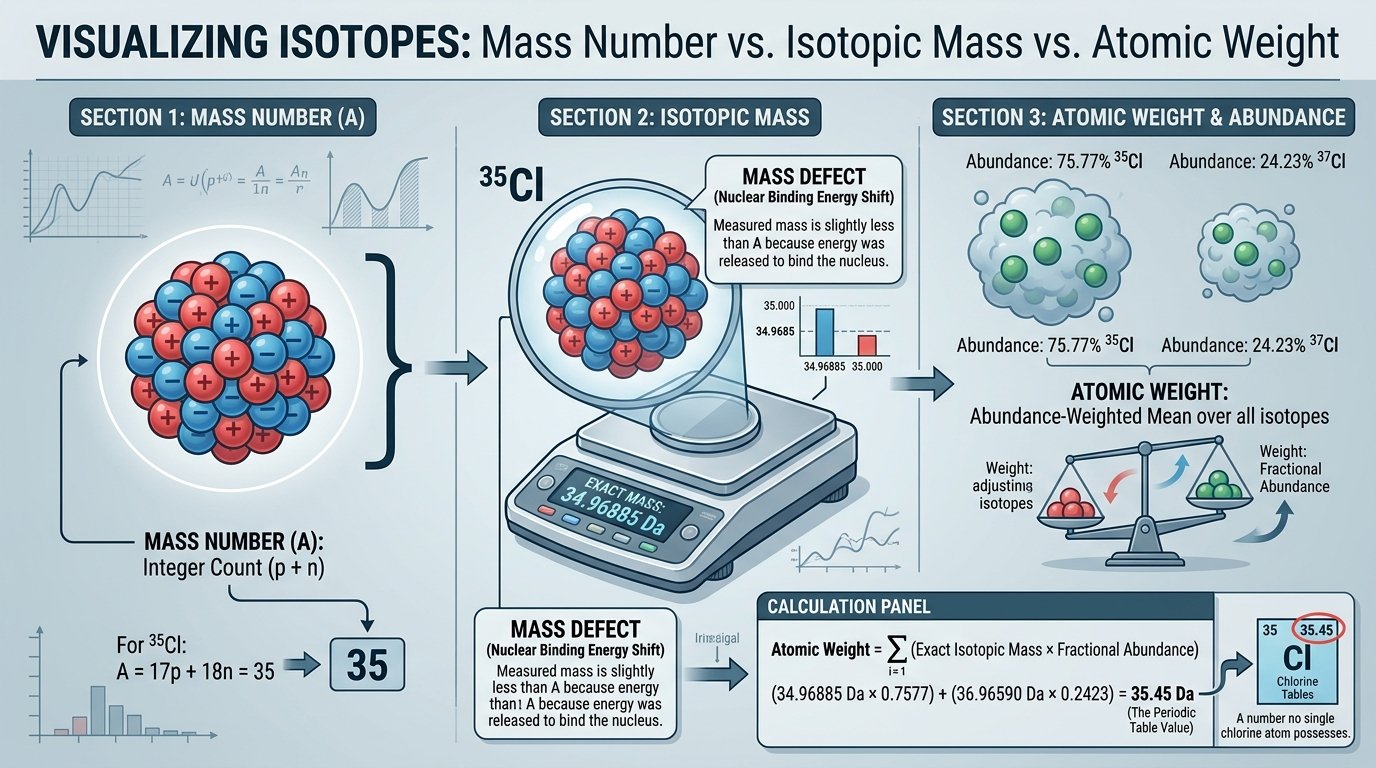
The isotopic mass is the exact mass of one specific isotope: ¹²C = 12 exactly, ¹³C = 13.00335 Da, ³⁵Cl = 34.96885 Da. Weight each isotopic mass by its natural abundance — average = Σ(mass × abundance) ÷ Σ(abundance) — and you get the periodic-table atomic weight: chlorine’s 34.96885 × 75.77% + 36.96590 × 24.23% = 35.45. This isotopic mass calculator lists every stable isotope of 63 elements, solves that weighted average, predicts M+1/M+2 isotope patterns and computes ¹³C/¹⁵N/²H/¹⁸O labeling shifts.
📑 Table of Contents (click to expand)
- What Is an Isotopic Mass?
- How to Use This Isotopic Mass Calculator
- The Five Modes Explained
- The Formula (With the Box You Should Memorize)
- Reading Isotope Notation: A, Z and the Mass Defect
- M+1 and M+2: Isotope Patterns as Fingerprints
- Three Worked Examples, Step by Step
- Reference Table: 10 Elements and Their Isotopes
- How Isotopic Masses Are Measured
- Who Uses an Isotopic Mass Calculator?
- Full Lab Walkthrough: Designing a ¹³C₆ Tracer Experiment
- A Short History: From Neon to the AME
- Isotopic Masses in Everyday Life
- Practice Problems (With Answers)
- Tips for Fast, Error-Free Calculations
- 5 Common Mistakes to Avoid
- How This Calculator Is Different
- Where the Numbers Come From
- Exam Checklist
- Frequently Asked Questions
- 10 Isotope Facts Worth Knowing
What Is an Isotopic Mass?
Isotopes — the atoms every isotopic mass calculator catalogs — are atoms of the same element with different neutron counts: same chemistry, different masses. The isotopic mass is the exact mass of one specific isotope, measured in daltons — ¹H is 1.00782503, ²H (deuterium) is 2.01410178, ¹²C is exactly 12 by definition. These are the atomic-scale “true weights,” and everything else in mass calculations is built from them.
Three related isotopic mass calculator quantities orbit this definition, and exams love to blur them. The mass number A is the integer count of protons plus neutrons — 35 for ³⁵Cl. The isotopic mass is the exact measured mass — 34.96885 Da for ³⁵Cl, close to but never exactly A, because nuclear binding energy shifts it (the mass defect). And the atomic weight is the abundance-weighted mean over all stable isotopes — 35.45 for chlorine, a number no single chlorine atom actually possesses.
An isotopic mass calculator keeps those three straight by showing them together: pick an element and see every stable isotope’s exact mass and abundance, then watch the weighted average assemble itself into the periodic-table value. It’s the missing layer between our atomic mass calculator (which works with the averages) and the monoisotopic mass calculator (which uses only each element’s most abundant isotope).
How to Use This Isotopic Mass Calculator
Using this isotopic mass calculator takes under ten seconds:
- Pick an isotopic mass calculator mode from the five tabs — Element Isotopes, Weighted Average, Formula & M+1/M+2, Isotope Lookup, or Labeling Shift.
- Enter your data — an element symbol like Cl, isotope masses with abundances, a formula like CHCl3, or a label count. The preset chips load classic examples in one click.
- Press the blue button (or hit Enter). The answer appears with a step-by-step breakdown, a full isotope table and an animated abundance graph.
- Read the isotopic mass calculator extras — the weighted average against the IUPAC value, the M+1/M+2 pattern your spectrum will show, or the exact mass shift of a ¹³C₆ label.
- Copy, download or share the result — CSV, TXT, print, WhatsApp, Facebook or X — and press ↺ Reset to start the next element clean.
Your last ten calculations are saved in the history panel under the tool (stored only in your own browser), and Clear All wipes them instantly. Nothing is sent to any server — the entire isotopic mass calculator runs on your device, which is also why it loads fast and works offline once the page is open.
The Five Modes Explained
🔬 Mode 1 — Element Isotopes
The reference desk of the isotopic mass calculator: enter a symbol and get every stable isotope with exact mass, abundance and its contribution to the average. Chlorine shows its famous 76/24 pair; tin unrolls all ten stable isotopes (the record); fluorine reveals itself as a monoisotopic element — 100% ¹⁹F, nothing to average.
⚖️ Mode 2 — Weighted Average from Isotopes
The isotopic mass calculator homework classic: given isotope masses and percent abundances, compute the average atomic mass. Enter 2–4 isotopes and the mode multiplies, sums and divides with every step shown — chlorine’s 34.96885 @ 75.77% + 36.96590 @ 24.23% → 35.4527. Abundances that don’t sum to 100 are flagged and normalized.
📊 Mode 3 — Formula & the M+1/M+2 Pattern
The isotopic mass calculator turns to molecules here: a formula’s isotopic (monoisotopic) mass from exact top-isotope masses, plus what no basic tool predicts: the isotope-pattern intensities. Glucose shows a modest M+1 of 6.9%; chloroform CHCl3 shows a giant M+2 near 96% — three chlorines waving at you from the spectrum before you’ve done any other analysis.
🎯 Mode 4 — Single Isotope Lookup
The isotopic mass calculator notation decoder: symbol + mass number → everything about that isotope. C-13 returns 13.00335 Da, 1.07% abundance, 6 protons + 7 neutrons, and the +0.00335 mass defect. Ask for C-14 and the mode correctly refuses — it’s radioactive, not part of the stable tables — listing the stable mass numbers instead.
🏷️ Mode 5 — Isotope Labeling Shift
The working scientist’s isotopic mass calculator mode: pick a label (¹³C, ¹⁵N, ²H or ¹⁸O), say how many atoms carry it, and get the labeled mass plus the shift. Uniformly labeled ¹³C₆-glucose lands at 186.0835 Da — 6.0201 Da above natural glucose — exactly the spacing SILAC pairs and tracer studies are designed around. The mode even refuses to label more atoms than the formula contains.
The Formula (With the Box You Should Memorize)
Every isotopic mass calculator problem — from homework to proteomics — is built on three relationships:
Average atomic mass = Σ (isotopic mass × abundance) ÷ Σ (abundance)
Mass number A = protons + neutrons · mass defect = isotopic mass − A
M+1 ≈ Σ n × (heavy-isotope abundance ÷ top abundance) — carbon gives ~1.1% per C
¹²C = 12 exactly (it defines the dalton) · ¹³C = 13.00335 · ³⁵Cl = 34.96885 · ³⁷Cl = 36.96590
The first isotopic mass calculator line is the exam formula. Notice it divides by Σ(abundance) rather than assuming 100 — that detail saves you when a problem gives abundances as fractions (0.7577) or as ratios that don’t quite total 100. The calculator’s Mode 2 applies the same guard automatically.
The second line explains why the isotopic mass calculator never returns whole numbers (except ¹²C, by decree): assembling protons and neutrons into a nucleus releases binding energy, and that energy is missing mass. The third line turns abundances into spectra — every carbon atom is a 1.07% lottery ticket for ¹³C, so a molecule with n carbons shows an M+1 peak of roughly 1.1 × n percent. Count carbons from a spectrum; it works.
Reading Isotope Notation: A, Z and the Mass Defect
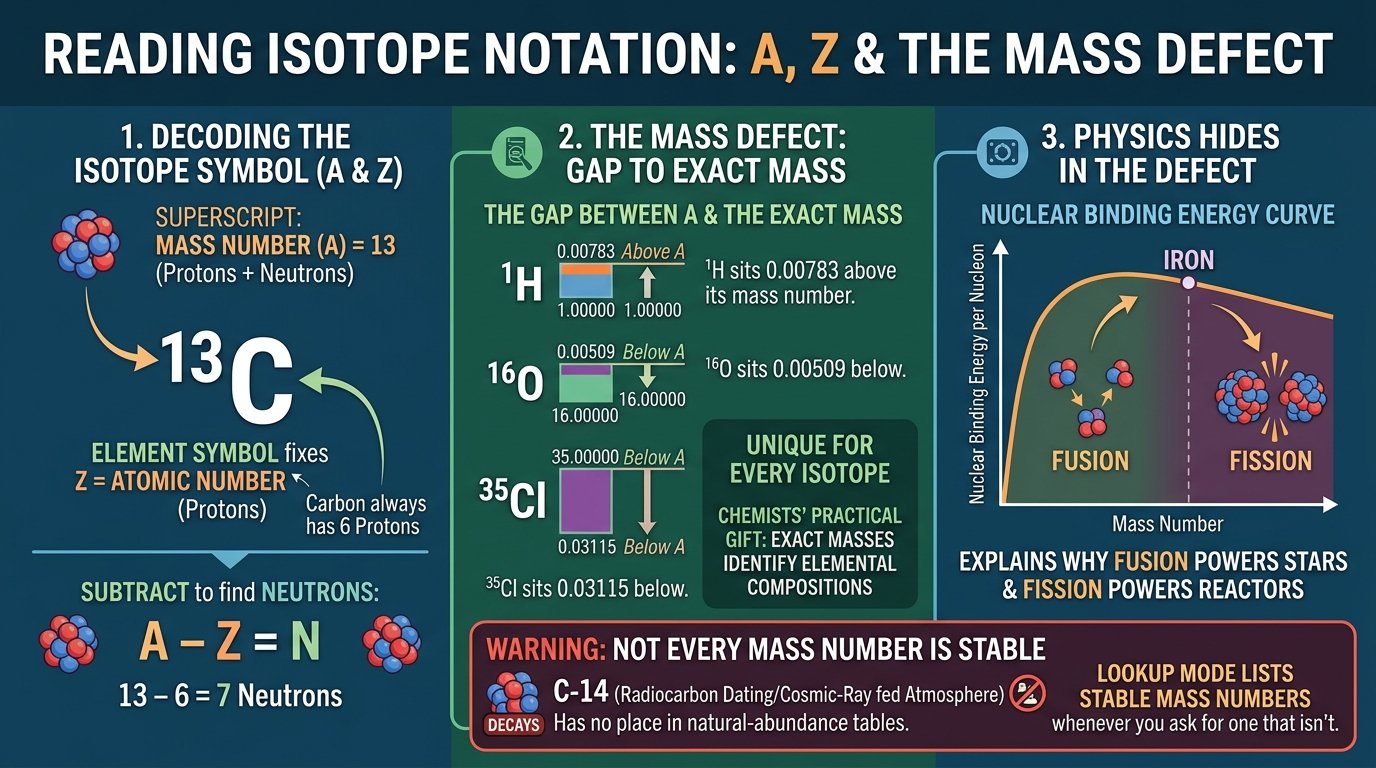
Isotope symbols pack three isotopic mass calculator inputs into two characters. In ¹³C the superscript is the mass number A = 13 (protons + neutrons). The element symbol itself fixes Z — carbon always has 6 protons; that’s what makes it carbon. Subtract and you have the neutrons: 13 − 6 = 7. Mode 4 of the isotopic mass calculator performs exactly this decoding, then adds the two quantities notation can’t show: the exact mass (13.00335 Da) and the natural abundance (1.07%).
The gap between A and the exact mass — the mass defect every isotopic mass calculator reports — is where the physics hides. ¹H sits 0.00783 above its mass number; ¹⁶O sits 0.00509 below; ³⁵Cl sits 0.03115 below. These deviations trace nuclear binding energy per nucleon, rising to a maximum near iron — the same curve that explains why fusion powers stars and fission powers reactors. Chemists get a practical gift from it: because every isotope’s defect is unique, exact masses identify elemental compositions, the principle our exact mass calculator post builds on.
One warning the notation (and no isotopic mass calculator shortcut) ever gives you: not every mass number is stable. C-14 exists — in radiocarbon dating labs and cosmic-ray-fed atmospheres — but it decays, so it has no place in natural-abundance tables. The lookup mode lists the stable mass numbers whenever you ask for one that isn’t.
M+1 and M+2: Isotope Patterns as Fingerprints
A mass spectrum never shows the single peak a basic isotopic mass calculator query might suggest — it shows a family. The main peak M contains only the most abundant isotopes; M+1 contains molecules with one heavy substitution one mass unit up (usually a single ¹³C); M+2 sits two units up (¹⁸O, ³⁴S — or a heavy halogen). The intensities of these companions are set entirely by the isotope abundances, which makes them readable fingerprints.
Two isotopic mass calculator rules cover most spectra. First, the carbon count: M+1 ≈ 1.1% × (number of carbons). A molecule showing M+1 at 11% of M has about ten carbons — information for free. Second, the halogen giveaway: chlorine’s ³⁷Cl is a massive 24.24%, so every chlorine contributes ~32% to M+2; bromine’s ⁷⁹Br/⁸¹Br pair is almost exactly 1:1, so one bromine makes M and M+2 nearly equal twins. Chloroform’s three chlorines push M+2 to ~96% of M — unmissable. Sulfur adds a quieter 4.4% per atom.
Mode 3 of the isotopic mass calculator computes these intensities from the underlying abundances for any formula, alongside the isotopic mass itself. It’s the fastest way to check whether that suspicious M+2 in your spectrum is a halogen shouting its presence — or just oxygen whispering.
Three Worked Examples, Step by Step
Example 1 — The classic isotopic mass calculator problem
Step 1. 34.96885 × 0.7577 = 26.4959.
Step 2. 36.96590 × 0.2423 = 8.9569.
Sum. 26.4959 + 8.9569 = 35.4527 — the 35.45 on every periodic table. No chlorine atom weighs this; it’s the population mean.
Example 2 — Decoding ¹³C completely
Step 1. A = 13; carbon means Z = 6 protons → 13 − 6 = 7 neutrons.
Step 2. Exact isotopic mass = 13.00335 Da; mass defect = +0.00335 Da.
Step 3. Abundance 1.07% — the source of every M+1 peak and the workhorse nucleus of ¹³C NMR.
Example 3 — From formula to isotope pattern
Step 1. Isotopic mass = 12 + 1.00783 + 3 × 34.96885 = 117.9144 Da.
Step 2. M+1: one carbon → ≈ 1.1%; M+2: three chlorines × (24.24 ÷ 75.76) → ≈ 96%.
Verdict. A near-equal M/M+2 doublet cascade — the textbook polychlorine signature, visible before any library search.
Run all three in the free isotopic mass calculator above and compare its printed steps with these — they match line for line, because the tool executes exactly this arithmetic at full precision.
Reference Table: 10 Elements and Their Isotopes
These ten elements cover most coursework and spectrum interpretation. All values match the isotopic mass calculator on this page:
| Element | Stable isotopes | Most abundant (mass, %) | Atomic weight |
|---|---|---|---|
| Hydrogen | 2 (¹H, ²H) | ¹H — 1.00783, 99.9885% | 1.008 |
| Boron | 2 (¹⁰B, ¹¹B) | ¹¹B — 11.00931, 80.1% | 10.81 |
| Carbon | 2 (¹²C, ¹³C) | ¹²C — 12 exactly, 98.93% | 12.011 |
| Nitrogen | 2 (¹⁴N, ¹⁵N) | ¹⁴N — 14.00307, 99.636% | 14.007 |
| Oxygen | 3 (¹⁶O, ¹⁷O, ¹⁸O) | ¹⁶O — 15.99491, 99.757% | 15.999 |
| Fluorine | 1 (¹⁹F) — monoisotopic | ¹⁹F — 18.99840, 100% | 18.998 |
| Sulfur | 4 (³²S, ³³S, ³⁴S, ³⁶S) | ³²S — 31.97207, 94.99% | 32.06 |
| Chlorine | 2 (³⁵Cl, ³⁷Cl) | ³⁵Cl — 34.96885, 75.76% | 35.45 |
| Bromine | 2 (⁷⁹Br, ⁸¹Br) | ⁷⁹Br — 78.91834, 50.69% | 79.904 |
| Tin | 10 — the record! | ¹²⁰Sn — 119.90220, 32.58% | 118.71 |
Three isotopic mass calculator rows repay a second look. Fluorine’s single isotope means fluorinated compounds add mass with zero pattern noise — one reason ¹⁹F is beloved in NMR and PET-adjacent chemistry. Bromine’s almost perfect 50:50 split makes brominated molecules instantly recognizable twins in any spectrum. And tin’s ten stable isotopes — a consequence of its “magic” proton number 50 — turn organotin spectra into small mountain ranges. For the everyday average-mass side of these elements, the formula weight calculator and molar mass of hydrates calculator carry on the story.
How Isotopic Masses Are Measured
The numbers inside every isotopic mass calculator come from a century of increasingly obsessive measurement:
- Mass spectrographs — Aston’s original instruments separated isotopes electromagnetically and measured their masses to 1 part in 10,000, enough to reveal the mass defect.
- Penning traps — today’s champions: a single ion circling in a magnetic field, its cyclotron frequency yielding masses to parts per trillion. The current ¹³C and ³⁵Cl values come from these.
- The Atomic Mass Evaluation (AME) — the global least-squares adjustment that reconciles thousands of measurements into one self-consistent table, updated every few years.
- Abundance surveys (IUPAC/CIAAW) — abundances vary slightly by source (ocean vs rock vs biology), so CIAAW publishes both representative values and, for some elements, intervals.
- Isotope-ratio MS — the specialist instruments that measure abundance variations to five decimal places, powering paleoclimate, forensics and food-authenticity work.
The isotopic mass calculator division of labor matters: masses are physics (fixed everywhere in the universe), abundances are geochemistry (slightly local). That’s why the calculator quotes masses to six decimals but abundances to fewer — and why atomic weights, which mix the two, carry the largest uncertainties of all.
Who Uses an Isotopic Mass Calculator?
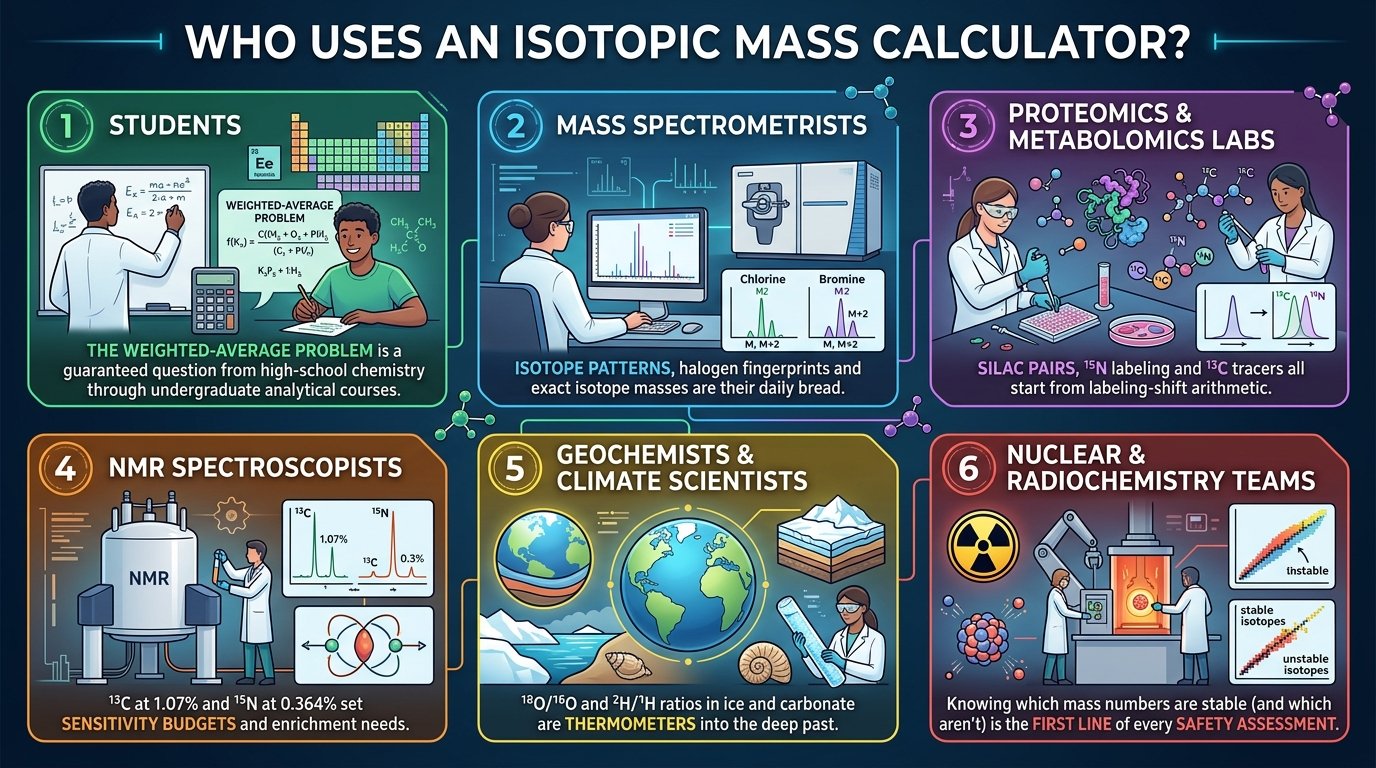
- Students — the weighted-average problem is a guaranteed question from high-school chemistry through undergraduate analytical courses.
- Mass spectrometrists — isotope patterns, halogen fingerprints and exact isotope masses are their daily bread.
- Proteomics & metabolomics labs — SILAC pairs, ¹⁵N labeling and ¹³C tracers all start from labeling-shift arithmetic.
- NMR spectroscopists — ¹³C at 1.07% and ¹⁵N at 0.364% set sensitivity budgets and enrichment needs.
- Geochemists & climate scientists — ¹⁸O/¹⁶O and ²H/¹H ratios in ice and carbonate are thermometers into the deep past.
- Nuclear & radiochemistry teams — knowing which mass numbers are stable (and which aren’t) is the first line of every safety assessment.
For the surrounding lab math — solution prep, conversions, reaction planning — our molarity calculator, grams to moles calculator and stoichiometry calculator pick up where the isotopes leave off.
Full Lab Walkthrough: Designing a ¹³C₆ Tracer Experiment
Here’s a metabolic-tracer design checked with this isotopic mass calculator, exactly as a metabolomics lab runs it.
The task: feed cells uniformly labeled ¹³C₆-glucose and follow the carbons into downstream metabolites by LC-MS. Before ordering the (expensive) label, verify the masses.
- Baseline in the isotopic mass calculator. Mode 3: natural glucose C6H12O6 → isotopic mass 180.0634 Da, M+1 ≈ 6.9%.
- Label. Mode 5: 6 × ¹³C on glucose → labeled mass 186.0835 Da, shift +6.0201 Da. The labeled [M−H]⁻ will sit at 185.0762 — far from any natural isotopologue.
- Check the spacing. The +6 shift is unambiguous: natural glucose’s isotope envelope dies out by M+3, so no overlap. A +1 or +2 label would have drowned in the natural M+1/M+2 — this is why uniform labels win.
- Downstream predictions. Pyruvate (C3) inherits 3 labeled carbons → +3.0101; citrate fragments show mixed +2/+4/+6 patterns that map the TCA cycle’s routes.
- Verify a real peak. Post-run, a metabolite shows a doublet 6.0201 Da apart — the labeled/unlabeled pair, confirming glucose-derived carbon. The printout goes in the notebook.
Total isotopic mass calculator time: three minutes — protecting an experiment that costs hundreds of dollars per gram of label.
A Short History: From Neon to the AME
Long before any isotopic mass calculator, isotopes were born as an anomaly. In 1913 Frederick Soddy coined the word (Greek: “same place”) for radioactive species that shared a chemical identity but differed in mass; the same year, J.J. Thomson bent neon ions through fields and caught two parabolas — masses 20 and 22 — on a photographic plate. His assistant Francis Aston built a better instrument, and by 1922 had shown that most elements are isotope mixtures, earning a Nobel Prize and establishing the whole-number rule with its crucial exception: masses are almost whole numbers, and the small deviations — mass defects — are nuclear binding energy made visible.
The next isotopic mass calculator prerequisite was the scale itself. Chemists defined atomic weights against natural oxygen (an isotope mixture); physicists used pure ¹⁶O — two subtly different mass units coexisting for thirty years. The 1961 compromise picked carbon-12 as exactly 12, unifying both camps and defining the dalton we still use. Since then the story has been precision: Penning traps measuring single ions to twelve significant figures, and the Atomic Mass Evaluation stitching every measurement into the consistent tables that power this isotopic mass calculator. Aston measured 212 isotopes in a lifetime; the AME now tracks over 3,000 — of which only 251 are stable.
Isotopic Masses in Everyday Life
- Radiocarbon dating — the ¹⁴C/¹²C ratio in anything once alive is a clock; museums and archaeology run on it.
- Ice-core climate records — the ¹⁸O/¹⁶O ratio in ancient ice tracks the temperature when the snow fell, 800,000 years back.
- Food fraud detection — honey, vanilla, olive oil and wine are authenticated by isotope ratios that betray geography and adulteration.
- Doping’s dark side-channel — synthetic testosterone carries a different ¹³C/¹²C signature than the body’s own; isotope-ratio MS catches what concentration tests miss.
- Medical breath tests — the ¹³C-urea breath test diagnoses H. pylori ulcer bacteria with a safe, stable label.
- Heavy water reactors — deuterium’s doubled mass (2.01410 vs 1.00783) changes neutron moderation enough to run reactors on natural uranium.
- Smoke detectors & date-stamped forgeries — isotope signatures date paintings, wines and documents to before or after the 1945–1963 bomb-pulse era.
Each bullet is an isotopic mass calculator run in disguise — the same masses and abundances this free isotopic mass calculator serves up on demand. And where mixtures rather than isotopes need averaging, our average molecular weight of mixture guide continues the theme.
Practice Problems (With Answers)
Work each problem by hand first, then verify with this free isotopic mass calculator. Answers are hidden until you click.
Problem 1 — Copper is ⁶³Cu (62.92960, 69.15%) and ⁶⁵Cu (64.92779, 30.85%). Find its atomic weight.
62.92960 × 0.6915 + 64.92779 × 0.3085 = 43.5158 + 20.0302 = 63.546 — the periodic-table value.
Problem 2 — Boron: ¹⁰B (10.01294) at 19.9% and ¹¹B (11.00931) at 80.1%. Average atomic mass?
10.01294 × 0.199 + 11.00931 × 0.801 = 1.9926 + 8.8185 = 10.811.
Problem 3 — How many protons and neutrons does ¹⁸O have, and what is its mass defect?
Z = 8 protons; N = 18 − 8 = 10 neutrons. Exact mass 17.99916 Da → mass defect = 17.99916 − 18 = −0.00084 Da.
Problem 4 — A spectrum shows M+1 at 8.8% of M. Roughly how many carbons does the molecule contain?
n ≈ 8.8 ÷ 1.1 = about 8 carbons — caffeine (C₈H₁₀N₄O₂) fits, and Mode 3 confirms M+1 ≈ 10.3% once nitrogen’s contribution is added.
Problem 5 — What mass shift does ¹⁵N₄ labeling give caffeine, and where does the labeled peak sit?
Shift = 4 × 0.99703 = +3.9881 Da; labeled mass = 194.0804 + 3.9881 = 198.0685 Da.
Tips for Fast, Error-Free Calculations
- ✅ Divide by Σ(abundance), always — the first isotopic mass calculator habit to build — it works whether the problem gives percentages, fractions or ratios that don’t total 100.
- ✅ Sanity-check against the mass numbers — a weighted average must land between the lightest and heaviest isotope, nearer the abundant one. Chlorine’s 35.45 sits properly close to 35.
- ✅ Memorize the big five isotopic masses — ¹H 1.00783, ¹²C 12, ¹⁴N 14.00307, ¹⁶O 15.99491, ³²S 31.97207 — they unlock most formula arithmetic.
- ✅ Use the isotopic mass calculator’s M+1 to count carbons and M+2 to find halogens — two free structure clues in every spectrum.
- ✅ Design labels with +3 or more spacing — natural envelopes reach M+2; a +1 label will drown. Uniform ¹³C₆ spacing is the gold standard.
- ✅ Reset between elements — the ↺ Reset button on each mode keeps old inputs from contaminating the next calculation.
⚗️ Pro workflow: Mode 1 to see an element’s isotopes → Mode 2 for any weighted-average homework → Mode 3 before interpreting a spectrum’s pattern → Mode 4 whenever notation like ⁸¹Br needs decoding → Mode 5 before ordering any isotope label. Five tabs, one isotope table, zero lookup errors.
5 Common Mistakes to Avoid
A decade of marking chemistry papers, and years of isotopic mass calculator support emails, produce the same five errors on repeat:
- Averaging the masses without weighting. (34.96885 + 36.96590) ÷ 2 = 35.97 is wrong — abundances are the whole point. Chlorine is 35.45 because ³⁵Cl dominates 3:1.
- Using the mass number as the mass. ³⁵Cl weighs 34.96885, not 35 — the 31 mDa defect is huge at instrument resolution and exam markers check for it.
- Forgetting that abundances might be fractions. Multiplying 34.96885 by 75.77 and dividing by 1 instead of 100 gives nonsense — divide by the abundance sum and the units sort themselves.
- Treating radioactive isotopes as part of the average. C-14 contributes nothing to carbon’s 12.011 — natural abundance tables include stable (and a few primordial) isotopes only.
- Confusing isotopic mass with monoisotopic mass. Isotopic mass belongs to one isotope of one element; monoisotopic mass is a whole molecule’s sum over top isotopes. Related — not interchangeable.
How This Calculator Is Different
| Feature | This isotopic mass calculator | Periodic-table site | By hand |
|---|---|---|---|
| Every stable isotope, exact masses | ✅ 63 elements, AME/CODATA data | ⚠️ Often rounded | ⚠️ Table lookup each time |
| Weighted-average solver with steps | ✅ 2–4 isotopes, normalization guard | ❌ | ✅ If careful |
| M+1 / M+2 pattern prediction | ✅ Any formula, halogen flags | ❌ | ⚠️ Error-prone |
| Notation decoder (protons/neutrons/defect) | ✅ With stability check | ⚠️ Scattered | ✅ Simple cases |
| ¹³C/¹⁵N/²H/¹⁸O labeling shifts | ✅ With atom-count validation | ❌ | ⚠️ Easy to slip |
| Export & history | ✅ CSV/TXT/print/share + last 10 | ❌ Usually none | ❌ Notebook |
Related isotopic mass calculator siblings continue the mass story from here: molecule-level exact masses in the monoisotopic mass calculator, the two-currencies comparison in average vs monoisotopic mass, and the polymer world’s own averages in the number average molecular weight polymer, weight average molecular weight polymer and polydispersity index calculator trilogy.
Where the Numbers Come From
Every isotopic mass behind this free isotopic mass calculator traces to the Atomic Mass Evaluation (AME) and CODATA constants — with ¹²C exactly 12 by definition of the unified atomic mass unit — and every natural abundance to IUPAC/CIAAW compilations, covering all stable isotopes of 63 elements. The average atomic weights shown for comparison use the IUPAC 2021 values, the same 118-element dataset behind every tool on this site, and the four labeling deltas are computed directly from the AME isotope masses.
Small differences against older textbooks (a few units in the last decimal, or abundance shifts like chlorine’s 75.77 → 75.76) reflect successive AME and CIAAW refinements, not errors. If you ever spot a discrepancy worth checking, our corrections policy explains how we verify and fix reports — usually within days.
Exam Checklist
☐ I can decode ¹³C into 6 protons, 7 neutrons, 13.00335 Da and 1.07% abundance.
☐ I can compute a weighted average: Σ(mass × abundance) ÷ Σ(abundance).
☐ I can sanity-check an average against the isotope masses that bracket it.
☐ I can estimate carbon count from M+1 (≈ 1.1% per C) and spot Cl/Br from M+2.
☐ I know why isotopic masses aren’t whole numbers (mass defect = binding energy).
☐ I know radioactive isotopes are excluded from natural-abundance averages.
☐ I’ve verified my practice answers with this isotopic mass calculator.
Frequently Asked Questions
What is an isotopic mass?
The exact mass of one specific isotope of an element, in daltons: ¹²C = 12 exactly, ¹³C = 13.00335, ³⁵Cl = 34.96885. It differs from the mass number (an integer) by the mass defect, and from the atomic weight (an abundance-weighted average over all stable isotopes).
How do I calculate average atomic mass from isotopic masses?
Multiply each isotopic mass by its abundance, add the products, and divide by the total abundance: chlorine = (34.96885 × 75.77 + 36.96590 × 24.23) ÷ 100 = 35.4527. Mode 2 shows every step.
Why is an isotopic mass not a whole number?
Nuclear binding energy: assembling protons and neutrons releases energy, and by E = mc² that energy is missing mass. Each isotope deviates from its integer mass number by its own characteristic mass defect — ¹H by +0.00783, ³⁵Cl by −0.03115.
What is the difference between isotopic mass and monoisotopic mass?
Isotopic mass describes one isotope of one element (¹³C = 13.00335). Monoisotopic mass is a whole molecule’s sum using each element’s most abundant isotope — glucose = 180.0634 Da. The second is built from the first.
Is this isotopic mass calculator free?
Yes, this isotopic mass calculator is completely free — no registration, no daily limits. It runs entirely in your browser, and your history stays on your own device.
Which element has the most stable isotopes?
Tin, with ten — a record owed to its “magic” proton number 50, which makes tin nuclei exceptionally stable. Enter Sn in Mode 1 to see all ten with masses and abundances.
What is a monoisotopic element?
An element with only one stable isotope — fluorine (¹⁹F), sodium, aluminium, phosphorus, manganese, iodine and gold are examples; there are 26 in total. Their atomic weights are simply their single isotopic mass, with no averaging.
How do M+1 and M+2 peaks reveal structure?
M+1 intensity ≈ 1.1% per carbon (from ¹³C), so it counts carbons. M+2 flags halogens: each chlorine adds ~32%, one bromine makes M+2 nearly equal to M. Chloroform’s M+2 reaches ~96% — an instant identification.
How much mass does ¹³C labeling add?
+1.00335 Da per labeled carbon (13.00335 − 12). Uniformly labeled ¹³C₆-glucose therefore sits +6.0201 Da above natural glucose, at 186.0835 Da — the spacing SILAC and tracer designs rely on. ¹⁵N adds +0.99703, ²H +1.00628, ¹⁸O +2.00424 per atom.
Which isotope data does the calculator use?
AME/CODATA exact isotope masses with IUPAC/CIAAW natural abundances for all stable isotopes of 63 elements, plus IUPAC 2021 atomic weights for comparison — the same datasets behind every tool on molecularweightcalculator.org.
10 Isotope Facts Worth Knowing
- Only 251 of the ~3,300 known isotopes are stable — the rest decay, some in nanoseconds, some over ages of the universe.
- Tin holds the stability record with ten stable isotopes; 26 elements make do with exactly one.
- The word “isotope” was suggested to Frederick Soddy over dinner — by Margaret Todd, a physician, in 1913.
- Deuterium is the only isotope with its own chemical symbol (D) and nearly double its sibling’s mass — the largest relative isotope gap in the table.
- Bromine’s two isotopes are so evenly split (50.69 / 49.31) that every brominated compound appears as near-twin peaks two mass units apart.
- Earth’s ocean water and Antarctic ice differ measurably in ¹⁸O content — the basis of 800,000-year climate reconstructions.
- Your body swaps ~2 grams of hydrogen for deuterium naturally; drinking moderate heavy water is harmless, though it famously tastes slightly sweet.
- The 1961 carbon-12 convention ended a 30-year standoff in which chemists’ and physicists’ “atomic weights” differed by 0.027%.
- Penning traps now measure isotopic masses to parts per trillion — equivalent to weighing a supertanker to the gram.
- The bomb-pulse ¹⁴C spike of 1945–1963 is so distinctive that forensic labs use it to date wine vintages, ivory and human tissue.
🔗 Trusted external resources
Final Thoughts
No isotopic mass calculator can replace understanding, but it can guarantee the arithmetic. Isotopes look like a bookkeeping nuisance until you see the pattern: exact masses are physics, abundances are statistics, and every quantity chemistry uses — atomic weights, monoisotopic masses, M+1 peaks, tracer shifts — is one weighted sum away from the isotope table. Master the weighted average, learn to read A and Z, keep radioactive isotopes out of your averages, and let the calculator above verify every line — and this chapter becomes one of the most reliable places to score, in the exam hall and at the bench.
Bookmark this isotopic mass calculator page for your next problem set or spectrum, share it with a labmate before they order an expensive label, and explore the rest of our free chemistry tools — from the molecular weight calculator homepage to the exact mass calculator for full isotope-pattern thinking. Questions or corrections? Reach us any time through the contact page — and you can read more about the site’s mission on our about page.
Written & Reviewed By
Ahmad Raza, M.Phil. Chemistry
Ahmad is a chemistry educator and science content developer with over 10 years of experience teaching analytical and physical chemistry. He builds free calculation tools that help students and lab professionals work faster and make fewer errors. When he’s not balancing equations, he’s usually grading titration reports.