
Monoisotopic Mass Calculator
Calculate the monoisotopic mass of any chemical formula or peptide sequence — the mass a high-resolution mass spectrometer actually reads — plus adduct m/z values ([M+H]⁺, [M+Na]⁺ and nine more), ppm mass-error checks and the nominal / monoisotopic / average trio. Exact isotope masses, every step shown.
✓ Trusted by students, teachers & lab professionalsMonoisotopic Mass from a Chemical Formula
The monoisotopic mass uses the lightest-major isotope of every element (¹H, ¹²C, ¹⁶O…) at its exact mass — the value your high-resolution MS peak should match. Parentheses and hydrates work: Cu(NO3)2, CuSO4·5H2O.
Monoisotopic Mass of a Peptide Sequence
Type the one-letter sequence (20 standard amino acids). Mass = Σ residue masses + H₂O for the free termini — with [M+H]⁺ and [M+2H]²⁺ for your MS run. Assumes unmodified, uncharged termini.
Adduct m/z for Mass Spectrometry
Your spectrum never shows the neutral molecule — it shows ions. Enter the formula, pick the adduct, and get the exact m/z (electron mass included), plus a table of all 11 common adducts.
ppm Mass Error (theoretical vs observed)
The universal accuracy currency of high-resolution MS: error (ppm) = (observed − theoretical) ÷ theoretical × 10⁶. The verdict tells you whether the match is publishable.
Nominal vs Monoisotopic vs Average Mass
One formula, three masses: nominal (integer isotope count), monoisotopic (exact lightest-major isotopes — MS peaks) and average (IUPAC 2021 atomic weights — weighing & stoichiometry). See how far apart they drift.
🕘 Recent calculations
- No calculations yet — your last 10 results will appear here.
Monoisotopic mass = Σ exact masses of the most abundant isotopes · Isotope masses: AME/CODATA · Average masses: IUPAC 2021 · Free tool by molecularweightcalculator.org
The monoisotopic mass calculator on this page computes the one mass that a high-resolution mass spectrometer actually reads: the sum of the exact masses of each element’s most abundant isotope. Type C6H12O6 into the tool above and 180.0634 Da appears instantly — with the average mass (180.156), the difference between them, the [M+H]⁺ your spectrum will show, and every isotope contribution written out line by line.
The free monoisotopic mass calculator above goes far beyond a single number. Five modes cover the full mass-spec workflow: monoisotopic mass from any chemical formula, peptide masses from one-letter sequences (residues + water, with the singly and doubly charged ions), adduct m/z for 11 common ESI ions, ppm mass-error checks with instrument-grade verdicts, and the nominal / monoisotopic / average trio side by side. Each mode has its own ↺ Reset button, and every result can be copied, downloaded, printed or shared.
In this guide I’ll show you how to use every mode, derive the monoisotopic mass calculator math from the isotope table up, explain why the monoisotopic and average masses drift apart as molecules grow, walk through the adduct arithmetic that turns neutral masses into spectrum peaks, and finish with the practice problems mass-spec courses recycle every year. Let’s begin.
🔑 KEY TAKEAWAY
The monoisotopic mass is the sum of the exact masses of the most abundant isotope of each element — ¹H = 1.00782503, ¹²C = 12 exactly, ¹⁴N = 14.00307400, ¹⁶O = 15.99491462. It is the mass of the first peak of a high-resolution MS isotope envelope: glucose C₆H₁₂O₆ = 180.0634 Da (average mass 180.156), caffeine C₈H₁₀N₄O₂ = 194.0804 with [M+H]⁺ at 195.0877. Use monoisotopic for spectra, average for weighing — and this monoisotopic mass calculator for both, plus peptides, adducts and ppm errors.
📑 Table of Contents (click to expand)
- What Is the Monoisotopic Mass?
- How to Use This Monoisotopic Mass Calculator
- The Five Modes Explained
- The Formula (With the Box You Should Memorize)
- Monoisotopic vs Average Mass: Why They Drift Apart
- The Mass Defect: Chemistry’s Hidden Fingerprint
- Three Worked Examples, Step by Step
- Reference Table: 10 Compounds, Three Masses Each
- The Instruments That Read Monoisotopic Masses
- Who Uses a Monoisotopic Mass Calculator?
- Full Lab Walkthrough: Identifying an Unknown by LC-MS
- A Short History: Aston to the Orbitrap
- Monoisotopic Masses in Everyday Life
- Practice Problems (With Answers)
- Tips for Fast, Error-Free Calculations
- 5 Common Mistakes to Avoid
- How This Calculator Is Different
- Where the Numbers Come From
- Exam Checklist
- Frequently Asked Questions
- 10 Mass-Spec Facts Worth Knowing
What Is the Monoisotopic Mass?
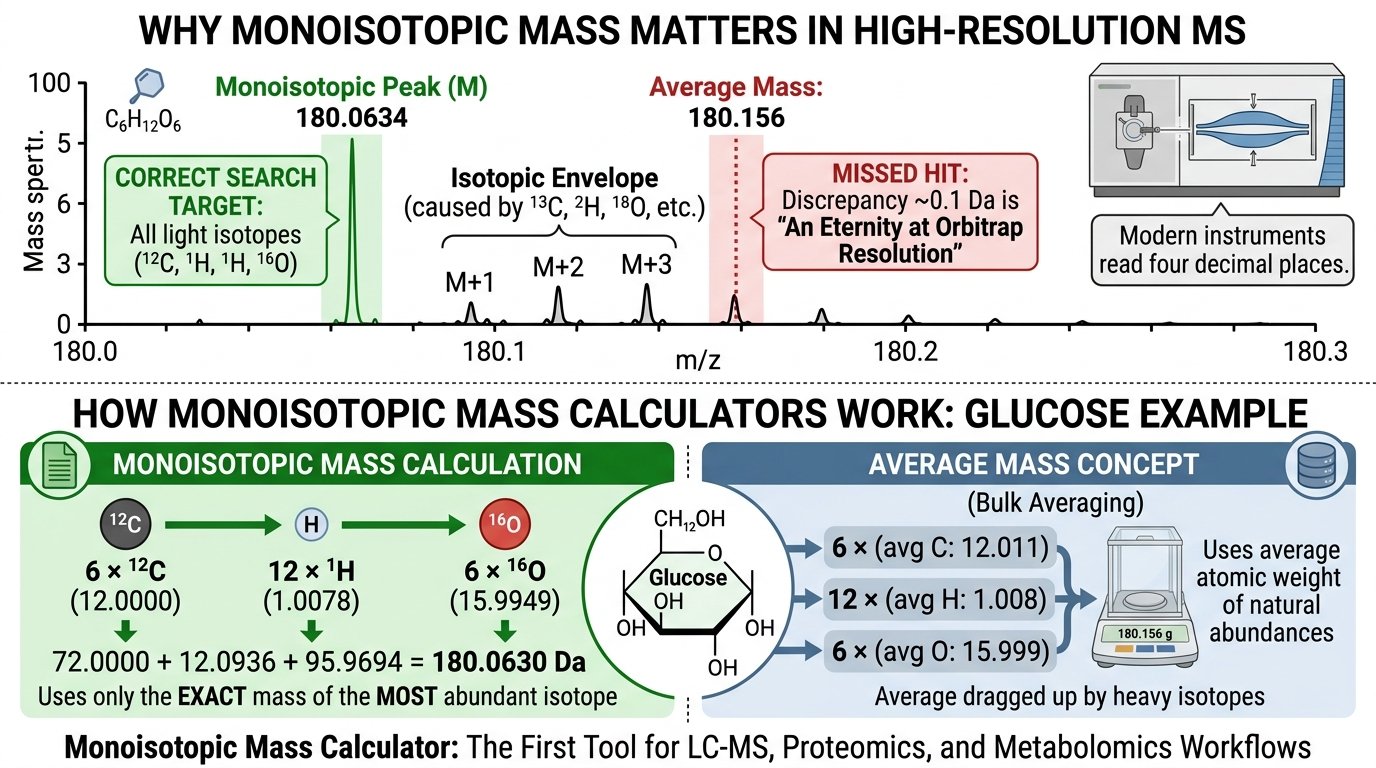
Every element on your bench is secretly a mixture. Natural carbon — the first element any monoisotopic mass calculator sums — is 98.93% ¹²C and 1.07% ¹³C; hydrogen carries a trace of deuterium; oxygen hides ¹⁷O and ¹⁸O. A balance averages over all of them — but a mass spectrometer doesn’t. It resolves each isotopic combination into its own peak, and the first peak of that envelope, the one where every atom is the most abundant isotope, carries the monoisotopic mass.
That’s the definition every monoisotopic mass calculator implements: monoisotopic mass = Σ (atom count × exact mass of the most abundant isotope). For organic molecules that means ¹H = 1.00782503, ¹²C = 12 exactly (it defines the scale), ¹⁴N = 14.00307400, ¹⁶O = 15.99491462, ³²S = 31.97207117. Run glucose through the monoisotopic mass calculator and it works out to 180.0634 Da — noticeably lighter than the 180.156 g/mol its average mass suggests, because the average is dragged up by the heavy isotopes the monoisotopic peak excludes.
Why does the distinction matter? Because modern instruments read four decimal places. If you search a high-resolution spectrum with an average mass, you’ll miss your own compound by a tenth of a dalton — an eternity at Orbitrap resolution. A monoisotopic mass calculator is therefore the first tool every LC-MS, proteomics and metabolomics workflow reaches for. A monoisotopic mass calculator’s isotope-aware sibling on this site, the exact mass calculator, digs deeper into full isotope patterns, while the everyday average-mass side lives in the molecular weight calculator on the homepage.
How to Use This Monoisotopic Mass Calculator
Using this monoisotopic mass calculator takes under ten seconds:
- Pick a mode from the five tabs — From Formula, Peptide Sequence, Adduct m/z, ppm Mass Error, or Nominal / Mono / Average.
- Enter your data — a formula like C8H10N4O2 (parentheses and hydrate dots work), a one-letter peptide sequence, or a theoretical-vs-observed m/z pair. The monoisotopic mass calculator’s preset chips load classic examples in one click.
- Press the blue button (or hit Enter). The mass appears with a step-by-step isotope breakdown, a contribution table and an animated comparison graph.
- Read the monoisotopic mass calculator’s extras — the [M+H]⁺ your spectrum will actually show, all 11 adducts at once, or the instrument-grade verdict on your ppm error.
- Copy, download or share the result — CSV, TXT, print, WhatsApp, Facebook or X — and press ↺ Reset to start the next compound clean.
Your last ten calculations are saved in the history panel under the tool (stored only in your own browser), and Clear All wipes them instantly. Nothing is sent to any server — the entire monoisotopic mass calculator runs on your device, which is also why it loads fast and works offline once the page is open.
The Five Modes Explained
🧪 Mode 1 — From Formula
The headline act of the monoisotopic mass calculator: type any formula and get the monoisotopic mass from exact top-isotope masses, with the average mass and their difference printed alongside. Caffeine C8H10N4O2 returns 194.0804 Da, each element’s contribution itemized — and the [M+H]⁺ preview (195.0877) already waiting for your spectrum.
🧬 Mode 2 — Peptide Sequence
Proteomics’ favorite monoisotopic mass calculator shortcut: type a one-letter sequence and the mode sums the 20 standard residue masses plus water for the free termini. PEPTIDE gives 799.3599 Da with [M+H]⁺ = 800.3672 and [M+2H]²⁺ = 400.6873 — the two ions every LC-MS/MS run hunts first. Invalid letters are caught instantly with the allowed alphabet spelled out.
🎯 Mode 3 — Adduct m/z
Spectra show ions, not molecules. This monoisotopic mass calculator mode applies any of 11 common adducts — [M+H]⁺, [M+Na]⁺, [M+K]⁺, [M+NH₄]⁺, [M+2H]²⁺, [2M+H]⁺, [M−H]⁻, [M+Cl]⁻, [M+HCOO]⁻, [M−2H]²⁻, [2M−H]⁻ — using the true proton mass (1.00727647) and accounting for the electron. The full 11-row table prints with every run, so the sodium adduct that “stole” your protonated peak is never a mystery again.
🔬 Mode 4 — ppm Mass Error
The accuracy currency every monoisotopic mass calculator must speak: error (ppm) = (observed − theoretical) ÷ theoretical × 10⁶. Enter both values and get Δm in daltons and millidaltons plus the ppm — graded against instrument reality: under 1 ppm is FT-ICR territory, under 3 ppm typical Orbitrap, under 5 ppm the usual formula-confirmation line, under 10 ppm TOF class.
⚖️ Mode 5 — Nominal / Mono / Average
One formula, three masses, three jobs — the monoisotopic mass calculator prints them together. Sucrose C12H22O11: nominal 342 (integer bookkeeping), monoisotopic 342.1162 (the MS peak), average 342.297 (the balance). The mode prints the mass defect and the isotope spread — and the golden rule about never mixing the currencies in one calculation.
The Formula (With the Box You Should Memorize)
Every monoisotopic mass calculator problem — no exceptions — is built from three relationships:
Monoisotopic mass = Σ nᵢ × m(most abundant isotope)ᵢ
¹H 1.00782503 · ¹²C 12 (exact) · ¹⁴N 14.00307400 · ¹⁶O 15.99491462 · ³²S 31.97207117
[M+H]⁺ = M + 1.00727647 · error (ppm) = Δm ÷ m × 10⁶
Monoisotopic for spectra · average for weighing · never mix the two.
Notice what the monoisotopic mass calculator’s second line quietly teaches: hydrogen weighs a little more than 1, oxygen a little less than 16. Those deviations from whole numbers are the mass defects born from nuclear binding energy, and they’re why exact masses identify formulas at all — every elemental composition produces a slightly different decimal signature.
The third line is the adduct arithmetic: ionization adds a proton (1.00727647 Da — not a hydrogen atom, because the electron stays behind), so caffeine’s neutral 194.0804 appears at m/z 195.0877 in positive mode. Multiply charges divide the scale: [M+2H]²⁺ sits at (M + 2 × 1.00727647) ÷ 2. That’s the whole monoisotopic mass calculator trick behind reading any ESI spectrum, and the monoisotopic mass calculator above runs it for eleven adducts at once.
Monoisotopic vs Average Mass: Why They Drift Apart
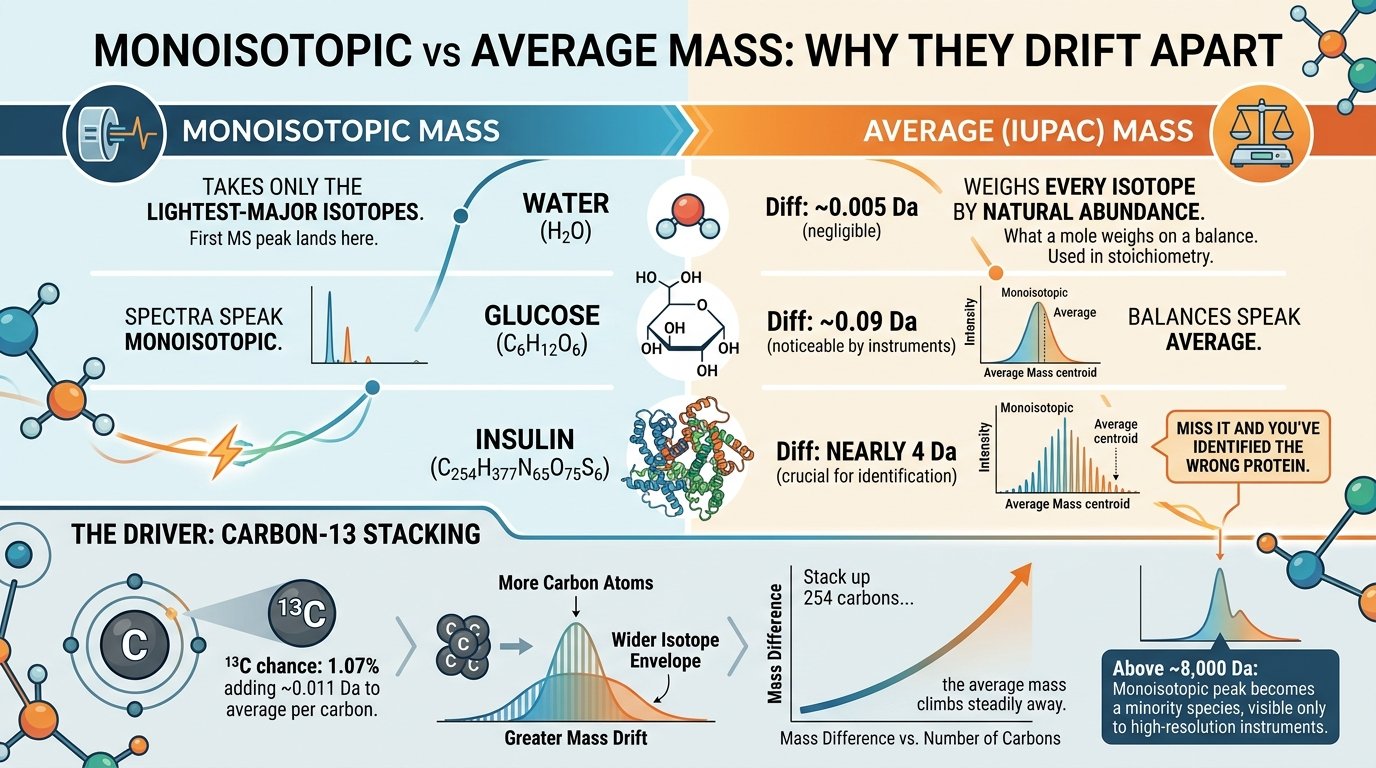
Here is the concept that decides half the marks in every mass-spec course. The average (IUPAC) mass weighs every isotope by its natural abundance — it’s what a mole of the compound weighs on a balance, and what all stoichiometry uses. The monoisotopic mass takes only the lightest-major isotopes — it’s where the first MS peak lands. For water the two differ by 0.005 Da; nobody cares. For glucose the gap is 0.09 Da; instruments notice. For insulin (C₂₅₄H₃₇₇N₆₅O₇₅S₆) it’s nearly 4 Da — miss it and you’ve identified the wrong protein.
The driver is mostly carbon: each carbon carries a 1.07% chance of being ¹³C, adding about 0.011 Da to the average per carbon atom. Stack up 254 carbons and the average mass climbs steadily away from the monoisotopic peak — while the isotope envelope broadens so much that above roughly 8,000 Da the monoisotopic peak itself becomes a minority species, visible only to high-resolution instruments.
The monoisotopic mass calculator working rule: spectra speak monoisotopic, balances speak average. Search databases and match peaks with the monoisotopic value; weigh reagents and compute molarity with the average from our grams to moles calculator and molarity calculator. Mode 5 of the monoisotopic mass calculator puts all three masses side by side precisely so the currencies never get mixed.
The Mass Defect: Chemistry’s Hidden Fingerprint
Subtract the nominal (integer) mass from what the monoisotopic mass calculator returns and you get the mass defect — glucose’s is +0.0634 Da. That decimal residue is pure physics: protons and neutrons give up binding energy when they assemble into nuclei, so every isotope’s exact mass deviates from a whole number by its own characteristic amount. Hydrogen is generous (+0.00783 each), oxygen slightly stingy (−0.00509 each), and the sum over a whole formula is as distinctive as a checksum.
That checksum is how high-resolution MS identifies compounds. An observed m/z of 195.0877 doesn’t just say “mass ≈ 195” — the .0877 narrows millions of candidate formulas down to a handful, and often to exactly one (protonated caffeine, C₈H₁₁N₄O₂⁺). Monoisotopic mass calculator software does this filtering automatically, but examiners love asking it manually — and the monoisotopic mass calculator above shows the defect explicitly in Mode 5 so you can build the intuition.
Two tricks neighboring the monoisotopic mass calculator are worth knowing. Nitrogen rule: an odd nominal mass for an even-electron neutral molecule implies an odd nitrogen count. And hydrogen-heavy lipids float high (large positive defects) while halogenated compounds sink low — mass-defect filtering separates entire compound classes before any chromatography. It’s the same exact-mass mindset our exact mass calculator post explores through full isotope patterns.
Three Worked Examples, Step by Step
Example 1 — The classic monoisotopic mass calculator problem
Step 1. C: 6 × 12.000000 = 72.000000.
Step 2. H: 12 × 1.00782503 = 12.093900.
Step 3. O: 6 × 15.99491462 = 95.969488.
Sum. Monoisotopic mass = 180.063388 Da ≈ 180.0634 (average: 180.156 — a 0.093 Da gap).
Example 2 — A peptide, residue by residue
Step 1. Residues: P 97.05276 + E 129.04259 + P 97.05276 + T 101.04768 + I 113.08406 + D 115.02694 + E 129.04259 = 781.34938.
Step 2. Add water for the termini: + 18.01056 → 799.35994 Da.
Step 3. Ions: [M+H]⁺ = 799.35994 + 1.00728 = 800.3672; [M+2H]²⁺ = 400.6873.
Example 3 — From spectrum peak to ppm verdict
Step 1. Δm = 195.0881 − 195.0877 = 0.0004 Da = 0.4 mDa.
Step 2. ppm = 0.0004 ÷ 195.0877 × 10⁶ = 2.05 ppm.
Verdict. Under 3 ppm — within Orbitrap specs; the identification stands.
Run all three in the free monoisotopic mass calculator above and compare its printed steps with these — they match line for line, because the tool executes exactly this arithmetic at full precision.
Reference Table: 10 Compounds, Three Masses Each
These ten compounds cover most coursework and method-development work. All values were generated with the monoisotopic mass calculator on this page:
| Compound | Formula | Monoisotopic (Da) | Average (g/mol) |
|---|---|---|---|
| Water | H₂O | 18.0106 | 18.015 |
| Glycine | C₂H₅NO₂ | 75.0320 | 75.07 |
| Glucose | C₆H₁₂O₆ | 180.0634 | 180.156 |
| Aspirin | C₉H₈O₄ | 180.0423 | 180.158 |
| Caffeine | C₈H₁₀N₄O₂ | 194.0804 | 194.19 |
| Testosterone | C₁₉H₂₈O₂ | 288.2089 | 288.42 |
| Penicillin G | C₁₆H₁₈N₂O₄S | 334.0987 | 334.39 |
| Sucrose | C₁₂H₂₂O₁₁ | 342.1162 | 342.297 |
| Cholesterol | C₂₇H₄₆O | 386.3549 | 386.65 |
| Oxytocin | C₄₃H₆₆N₁₂O₁₂S₂ | 1006.4365 | 1007.19 |
Watch the monoisotopic mass calculator’s gap column grow with size: 0.005 Da for water, 0.75 Da for oxytocin — and by insulin (C₂₅₄H₃₇₇N₆₅O₇₅S₆, mono 5729.60 vs average ~5733.5) the two masses have parted by almost four full daltons. Aspirin and glucose share the nominal mass 180 but differ decisively in the decimals — the mass defect doing its fingerprint job. Ionic and hydrated formulas belong to their own tools: the formula weight calculator and the molar mass of hydrates calculator.
The Instruments That Read Monoisotopic Masses
A monoisotopic mass calculator’s headline peak only exists if your instrument can resolve it from its ¹³C neighbors, one dalton (per charge) away:
- FT-ICR — the resolution king (10⁶+); sub-ppm accuracy, the instrument that turns mass defects into unambiguous formulas.
- Orbitrap — the workhorse of proteomics and metabolomics; routine 1–3 ppm accuracy at resolutions of 10⁴–10⁶.
- Q-TOF — fast, rugged, 5–10 ppm class; the standard for LC-MS screening and intact-protein work.
- Quadrupoles and ion traps — unit resolution only: they see nominal masses, which is why triple-quad methods quote integers.
- MALDI-TOF — the fingerprinting tool of microbiology and polymer labs; monoisotopic below ~3–5 kDa, average above, exactly where the envelope blurs.
The accuracy ladder explains the monoisotopic mass calculator’s ppm verdicts in Mode 4: an identification that’s off by 8 ppm is fine from a TOF and alarming from an Orbitrap. Always judge the error against the instrument that produced it — and remember that calibration drift, not physics, is the usual culprit when good compounds read badly.
Who Uses a Monoisotopic Mass Calculator?
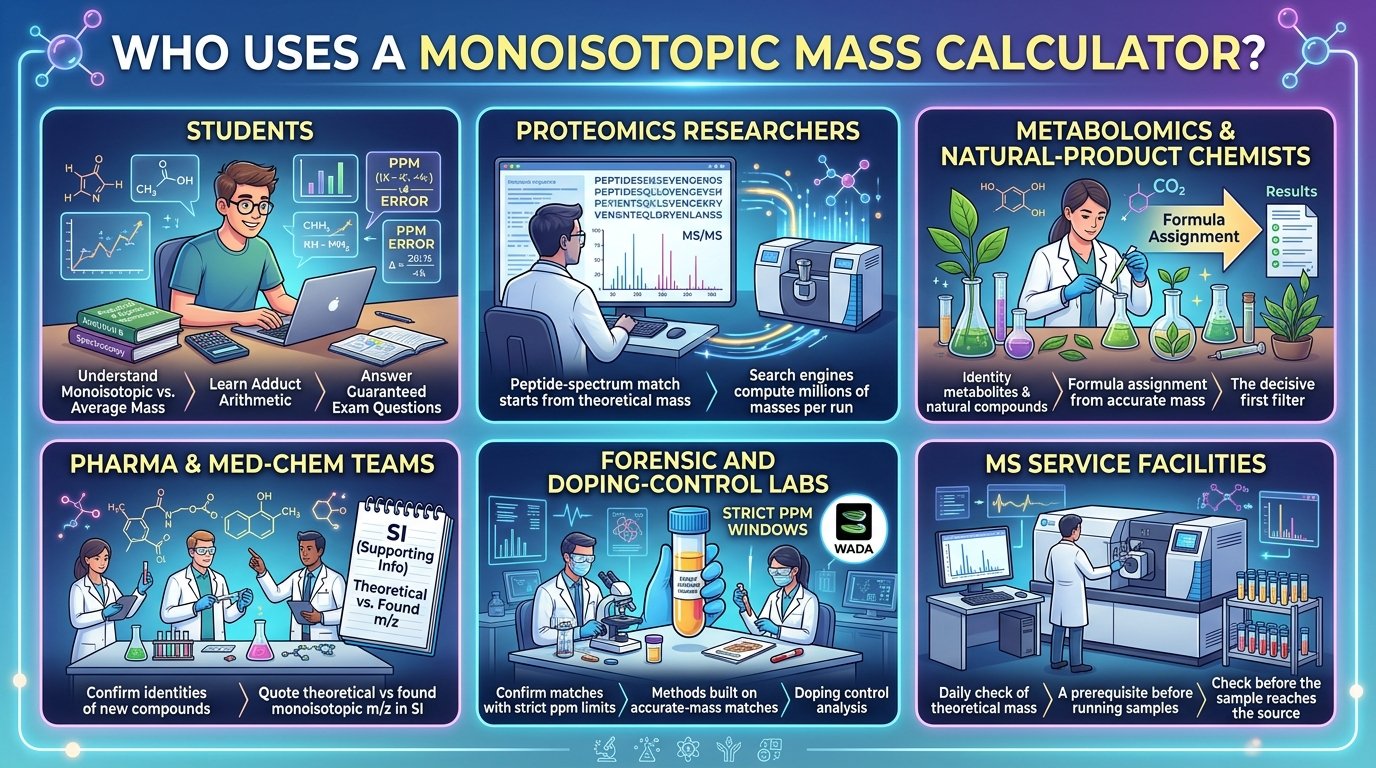
- Students — monoisotopic vs average, adduct arithmetic and ppm errors are guaranteed questions in every analytical and organic spectroscopy course.
- Proteomics researchers — every peptide-spectrum match starts from a theoretical monoisotopic mass; search engines compute millions of them per run.
- Metabolomics & natural-product chemists — formula assignment from accurate mass is the field’s first and most decisive filter.
- Pharma & med-chem teams — every new compound’s identity confirmation quotes theoretical vs found monoisotopic m/z in the SI section.
- Forensic and doping-control labs — confirmations demand accurate-mass matches within strict ppm windows; WADA methods are built on them.
- MS service facilities — the daily bread: check the theoretical mass before the sample ever reaches the source.
For the reaction math around these samples — yields, dilutions, limiting reagents — our stoichiometry calculator picks up where this tool leaves off, and element-level data lives in the atomic mass calculator.
Full Lab Walkthrough: Identifying an Unknown by LC-MS
Here’s a routine identification checked with this monoisotopic mass calculator, exactly as an analytical lab runs it.
The task: a QC sample shows an unexpected LC peak; the Orbitrap reads m/z 195.0881 in positive mode. Identify it.
- Hypothesize before the monoisotopic mass calculator. The retention time and UV spectrum suggest caffeine carry-over from a previous batch.
- Compute the theory. Mode 1: C8H10N4O2 → monoisotopic mass 194.0804 Da.
- Ionize on paper. Mode 3: [M+H]⁺ of C8H10N4O2 → theoretical m/z 195.0877.
- Grade the match. Mode 4: theoretical 195.0877 vs observed 195.0881 → Δm = 0.4 mDa = 2.05 ppm — within Orbitrap specs, verdict “very good.”
- Cross-check the adducts. The same run shows a companion peak at 217.0696 — exactly the [M+Na]⁺ the Mode 3 table predicted. Two ions, one story.
- Report. The printout from the toolbar — theoretical, observed, ppm — goes straight into the deviation report. Caffeine confirmed, cleaning procedure updated.
Total monoisotopic mass calculator time: under a minute. The chromatography and the calibration discipline are the parts worth practicing — the arithmetic is now the easy 10%.
A Short History: Aston to the Orbitrap
The whole story starts with a surprise: in 1919 Francis Aston’s mass spectrograph showed that neon is two isotopes, ²⁰Ne and ²²Ne — elements were mixtures, and the “atomic weight” on the wall chart was an average. Aston’s Nobel Prize (1922) came with a rule he called the whole-number rule and a subtle correction to it — the mass defect — that Arthur Eddington soon connected to nuclear binding energy and the power source of stars. The exact masses this monoisotopic mass calculator uses are direct descendants of Aston’s measurements, refined over a century into today’s Atomic Mass Evaluation (AME).
The scale itself was settled in 1961, when chemists and physicists finally agreed to define the unified atomic mass unit as exactly one-twelfth of ¹²C — the reason carbon-12 is exactly 12 in every table. The modern era arrived in bursts: John Fenn’s electrospray (Nobel 2002) let fragile biomolecules fly intact, Koichi Tanaka’s soft laser desorption did the same for proteins, and Alexander Makarov’s Orbitrap (2000) put ppm-level accuracy on ordinary lab benches. Today a proteomics search engine — a monoisotopic mass calculator at industrial scale — computes more monoisotopic masses in a minute than Aston’s generation measured in a lifetime — the arithmetic hasn’t changed, only the speed.
Monoisotopic Masses in Everyday Life
- Newborn screening — a heel-prick blood spot runs through MS/MS that matches amino-acid and acylcarnitine masses; dozens of metabolic disorders are caught in the first days of life.
- Doping control — every Olympic positive is an accurate-mass match: testosterone at 288.2089, clenbuterol, EPO fragments — all confirmed within ppm windows.
- Airport security swabs — trace detectors flag explosive residues by their exact masses in seconds.
- Pesticides in your tea — residue monitoring labs screen hundreds of compounds per run purely by monoisotopic m/z and retention time.
- Hospital microbiology — MALDI-TOF fingerprints identify bacterial species in minutes instead of days of culturing.
- Counterfeit medicine busts — a handheld or benchtop MS asks one question: does the pill contain the API’s exact mass or not?
- Art authentication — binder proteins and dyes give themselves away by peptide and pigment masses no forger can fake.
Each bullet is one monoisotopic mass calculator run in disguise — exactly what this free calculator was built to make visible. And when mixtures rather than single compounds are the question, the averaging story continues in our average molecular weight of mixture guide.
Practice Problems (With Answers)
Work each problem by hand first, then verify with this free monoisotopic mass calculator. Answers are hidden until you click.
Problem 1 — Calculate the monoisotopic mass of caffeine, C₈H₁₀N₄O₂.
8×12 + 10×1.00782503 + 4×14.00307400 + 2×15.99491462 = 96 + 10.07825 + 56.01230 + 31.98983 = 194.0804 Da.
Problem 2 — Where does glucose appear in negative-mode ESI as [M−H]⁻?
m/z = 180.063388 − 1.007276 = 179.0561.
Problem 3 — Find the monoisotopic mass and [M+H]⁺ of the peptide YGGFL (Leu-enkephalin).
Y 163.06333 + G 57.02146 + G 57.02146 + F 147.06841 + L 113.08406 + H₂O 18.01056 = 555.2693 Da; [M+H]⁺ = 556.2766.
Problem 4 — Theoretical [M+H]⁺ 334.1057 (penicillin G), observed 334.1071. Acceptable on a Q-TOF?
Δm = 1.4 mDa → ppm = 0.0014 ÷ 334.1057 × 10⁶ = 4.2 ppm — inside the 10 ppm TOF class and under the 5 ppm confirmation line: acceptable.
Problem 5 — Sucrose C₁₂H₂₂O₁₁: give the nominal, monoisotopic and average masses.
Nominal 342; monoisotopic 342.1162 Da; average 342.297 g/mol — three currencies, one molecule.
Tips for Fast, Error-Free Calculations
- ✅ Pick the right currency first — monoisotopic for spectra and database searches, average for weighing and stoichiometry. Never mix them in one equation.
- ✅ Add a proton, not a hydrogen — [M+H]⁺ adds 1.00728, not 1.00783; the 0.55 mDa electron matters at high resolution.
- ✅ Suspect sodium — a peak 21.982 Da above your expected [M+H]⁺ is [M+Na]⁺; the Mode 3 table catches it instantly.
- ✅ Check the charge state — isotope peaks 0.5 Da apart mean z = 2; multiply back before comparing to neutral masses.
- ✅ Judge ppm against the instrument — 8 ppm is fine from a TOF, a red flag from an Orbitrap, and grounds for recalibration from FT-ICR.
- ✅ Reset, then verify — every answer goes through the free monoisotopic mass calculator above; the ↺ Reset button between problems keeps old inputs from contaminating new ones.
⚗️ Pro workflow: Mode 1 for the neutral mass → Mode 3 to predict the ions before the run → Mode 4 to grade the match after it → Mode 2 whenever the analyte is a peptide → Mode 5 whenever a report needs all three mass types. Five tabs, one isotope table, zero mixed-up masses.
5 Common Mistakes to Avoid
A decade of marking spectroscopy papers, and years of monoisotopic mass calculator support emails, produce the same five errors on repeat:
- Searching spectra with average masses. The 0.09 Da gap at glucose scale is already 500 ppm — no database match survives it.
- Adding 1.00783 for protonation. That’s a hydrogen atom. Ionization adds a proton (1.00727647); the electron stays with the other fragment.
- Forgetting the water in peptides. Residue masses are dehydrated by construction — omit the terminal H₂O and every peptide comes out 18.011 Da light.
- Confusing monoisotopic with “lightest isotope.” It’s the most abundant isotope: for boron that’s ¹¹B (80%), not ¹⁰B — the lighter one loses.
- Quoting ppm without the instrument context. A bare “3 ppm” means nothing until you say Orbitrap or TOF — accuracy claims are instrument-relative.
How This Calculator Is Different
| Feature | This monoisotopic mass calculator | Generic MW tool | By hand |
|---|---|---|---|
| Exact top-isotope masses | ✅ AME/CODATA data, 63 stable elements | ❌ Average masses only | ⚠️ Table lookup each time |
| Peptide sequences | ✅ 20 residues + termini + ions | ❌ Not offered | ⚠️ Water-forgetting trap |
| Adduct m/z | ✅ 11 ions, electron included | ❌ | ⚠️ Proton vs H-atom trap |
| ppm error with verdicts | ✅ Instrument-graded | ❌ Bare number at best | ✅ If you know the brackets |
| Nominal / mono / average trio | ✅ Side by side + mass defect | ⚠️ One mass, unlabeled | ⚠️ Three computations |
| Export & history | ✅ CSV/TXT/print/share + last 10 | ❌ Usually none | ❌ Notebook |
Related tools on this site go deeper on the neighboring topics: full isotope-pattern thinking lives in the exact mass calculator, and the polymer-side mass averages — a completely different kind of averaging — are covered by the number average molecular weight polymer, weight average molecular weight polymer and polydispersity index calculator trilogy.
Where the Numbers Come From
Every isotope mass behind this free monoisotopic mass calculator traces to the Atomic Mass Evaluation (AME) and CODATA constants — ¹²C exactly 12 by definition of the unified atomic mass unit, the proton at 1.00727646688 Da, the electron at 0.00054858 Da — with isotopic abundances from IUPAC/CIAAW. The average masses shown alongside use the IUPAC 2021 standard atomic weights, the same 118-element dataset behind every tool on this site, and the 20 amino-acid residue masses follow the standard proteomics values used by mainstream search engines.
Small differences against older textbooks (a few units in the fifth decimal) reflect successive AME refinements, not errors. If you ever spot a discrepancy worth checking, our corrections policy explains how we verify and fix reports — usually within days.
Exam Checklist
☐ I know the big five: ¹H 1.00783, ¹²C 12, ¹⁴N 14.00307, ¹⁶O 15.99491, ³²S 31.97207.
☐ I can explain when to use monoisotopic vs average vs nominal mass.
☐ I can compute [M+H]⁺, [M−H]⁻ and [M+2H]²⁺ with the proton mass, not the H atom.
☐ I can build a peptide mass from residues + H₂O without forgetting the water.
☐ I can convert a Δm into ppm and judge it against the instrument class.
☐ I can use the mass defect to distinguish isobaric formulas like aspirin vs glucose.
☐ I’ve verified my practice answers with this monoisotopic mass calculator.
Frequently Asked Questions
What is the monoisotopic mass?
The sum of the exact masses of the most abundant isotope of each element in the formula — ¹H = 1.00782503, ¹²C = 12, ¹⁶O = 15.99491462, and so on. It corresponds to the first peak of a high-resolution mass spectrum’s isotope envelope.
What is the difference between monoisotopic and average mass?
Average mass weights every isotope by natural abundance (use it for weighing and stoichiometry); monoisotopic mass takes only the most abundant isotopes (use it for MS peaks). Glucose: 180.156 vs 180.0634 — the gap grows with molecular size.
Is monoisotopic mass the same as exact mass?
Nearly: “exact mass” is any mass computed from exact isotope masses, for whichever isotopic composition you specify. The monoisotopic mass is the specific exact mass where every atom is the most abundant isotope — the usual meaning in practice.
How do I calculate the monoisotopic mass of a peptide?
Sum the residue masses of the sequence and add one water (18.010565 Da) for the free termini. PEPTIDE = 781.34938 + 18.01056 = 799.3599 Da; [M+H]⁺ = 800.3672. Mode 2 does this from the one-letter code.
Is this monoisotopic mass calculator free?
Yes, this monoisotopic mass calculator is completely free — no registration, no daily limits. It runs entirely in your browser, and your history stays on your own device.
How do I calculate [M+H]⁺ from the monoisotopic mass?
Add the proton mass: m/z = M + 1.00727647. Caffeine (194.08038) appears at 195.0877. For [M+2H]²⁺ use (M + 2 × 1.00727647) ÷ 2. The electron mass is included automatically for metal adducts like [M+Na]⁺.
What is a good ppm mass error?
Instrument-relative: under 1 ppm FT-ICR, 1–3 ppm Orbitrap, up to ~10 ppm TOF class. The common formula-confirmation threshold in journals is 5 ppm. Mode 4 grades your value automatically.
What is the mass defect?
The difference between the monoisotopic mass and the nominal (integer) mass — glucose’s is +0.0634 Da. It comes from nuclear binding energy and acts as a formula fingerprint that high-resolution MS software uses for identification.
Why does my spectrum show a peak 22 Da above [M+H]⁺?
That’s [M+Na]⁺ — sodium adducts sit 21.9819 Da above the protonated ion and are ubiquitous in ESI. The Mode 3 table prints all 11 common adducts so companion peaks identify themselves.
Which isotope masses does the calculator use?
AME/CODATA exact isotope masses with IUPAC/CIAAW abundances for 63 stable elements, IUPAC 2021 atomic weights for the average-mass comparisons — the same datasets behind every tool on molecularweightcalculator.org.
10 Mass-Spec Facts Worth Knowing
- Carbon-12 is the only mass in chemistry that is exact by definition — the unified atomic mass unit is one-twelfth of it, fixed in 1961.
- Aston’s mass spectrograph revealed 212 of the 287 naturally occurring isotopes — one man, one instrument, most of the isotope table.
- The proton (1.00727647) and the hydrogen atom (1.00782503) differ by one electron — 0.55 mDa that modern instruments resolve with ease.
- Above roughly 8,000 Da the monoisotopic peak is no longer the tallest of the envelope — pure ¹²C molecules become a minority among their own isotopologues.
- Aspirin and glucose share nominal mass 180 but differ by 21 mDa in monoisotopic mass — trivially resolved by any Orbitrap.
- Leucine and isoleucine share the exact same monoisotopic mass (113.08406) — no mass accuracy can tell them apart; only fragmentation can.
- The nitrogen rule survives from 1950s spectrometry: an odd nominal mass for a neutral even-electron molecule means an odd number of nitrogens.
- One part-per-million at m/z 500 is 0.5 mDa — about half the mass of an electron, routinely measured on benchtop instruments.
- MALDI-TOF microbiology identifies a bacterial species in ~6 minutes from whole-cell protein fingerprints — culture plates take days.
- The Orbitrap was invented in 2000 by Alexander Makarov by trapping ions around a spindle electrode — the newest mass analyzer geometry in a century of MS.
🔗 Trusted external resources
Final Thoughts
No monoisotopic mass calculator can replace understanding, but it can guarantee the arithmetic. Accurate-mass work looks intimidating because the decimals matter — yet behind every identification sit four small rules: sum the top isotopes, add a proton (not an atom), keep the mass currencies separate, and judge ppm against the instrument. Master those, let the monoisotopic mass calculator above verify every line, and the mass-spec chapter becomes one of the most systematic places to score — in the exam hall and at the bench.
Bookmark this monoisotopic mass calculator page for your next LC-MS run or spectroscopy problem set, share it with a labmate before the instrument booking, and explore the rest of our free chemistry tools — from the molecular weight calculator homepage to the stoichiometry calculator for full reaction math. Questions or corrections? Reach us any time through the contact page — and you can read more about the site’s mission on our about page.
Written & Reviewed By
Ahmad Raza, M.Phil. Chemistry
Ahmad is a chemistry educator and science content developer with over 10 years of experience teaching analytical and physical chemistry. He builds free calculation tools that help students and lab professionals work faster and make fewer errors. When he’s not balancing equations, he’s usually grading titration reports.