
Weight Average Molecular Weight (Polymer)
Calculate the weight average molecular weight (M_w) of any polymer — from chain counts, fraction masses or degree of polymerization — with the number average (Mₙ), dispersity (Đ) and the z-averages (Mz, Mz+1) computed alongside. IUPAC 2021 atomic masses for every repeat unit. Every step of the working shown.
✓ Trusted by students, teachers & lab professionalsM_w from Chain Counts (Nᵢ and Mᵢ)
M_w = Σ NᵢMᵢ² ÷ Σ NᵢMᵢ — every chain weighted by the mass it carries, so heavy chains count for more. Enter 2–4 fractions: the molar mass of each fraction and how many moles (or chains) of it. Mₙ and Đ come free.
M_w from Fraction Masses (wᵢ and Mᵢ)
The weight average's natural habitat: M_w = Σ wᵢMᵢ ÷ Σ wᵢ — a simple mass-weighted mean, no mole conversion needed. Mₙ = Σ wᵢ ÷ Σ(wᵢ ÷ Mᵢ) and the dispersity come alongside.
Degree of Polymerization ↔ M_w
M_w = DP_w × M₀, where DP_w is the weight-average degree of polymerization and M₀ the repeat-unit molar mass from its formula (IUPAC 2021). Go either direction — chain length from M_w, or M_w from chain length.
Mz & Higher Averages (the full ladder)
One dataset, four averages: Mₙ ≤ M_w ≤ Mz ≤ Mz+1. Enter 2–4 fractions (Nᵢ and Mᵢ) and get the complete ladder — Mz = Σ NᵢMᵢ³ ÷ Σ NᵢMᵢ² governs sedimentation and melt elasticity.
Dispersity Solver (Đ = M_w ÷ Mₙ)
Enter any TWO of Mₙ, M_w and Đ — the third is solved instantly. Đ = 1 means perfectly uniform chains; commercial polymers typically run Đ ≈ 1.5–3.
🕘 Recent calculations
- No calculations yet — your last 10 results will appear here.
Atomic masses: IUPAC 2021 · M_w = ΣNᵢMᵢ² ÷ ΣNᵢMᵢ · Đ = M_w ÷ Mₙ ≥ 1 · Free tool by molecularweightcalculator.org
The weight average molecular weight polymer scientists write as M_w is the average that materials actually feel: every chain votes in proportion to the mass it carries, so the heavyweights dominate. Mix 1 mol of 10,000 g/mol chains with 2 mol of 50,000 and 2 mol of 100,000, load the fractions into the calculator above, and M_w = 80,967.74 g/mol appears instantly — alongside the number average (Mₙ = 62,000), the dispersity (Đ = 1.306), and every line of the working.
The free weight average molecular weight polymer calculator above computes M_w four different ways — from chain counts, from fraction masses, from the weight-average degree of polymerization, and as part of the full Mₙ–M_w–Mz–Mz+1 averages ladder — plus a fifth mode that solves the Đ = M_w ÷ Mₙ triangle from any two values. Each of the five modes has its own ↺ Reset button, and every result can be copied, downloaded, printed or shared.
In this guide I’ll show you how to use every mode, derive the weight average molecular weight polymer formula from first principles, explain why melt viscosity, strength and light scattering all follow M_w rather than Mₙ, climb the z-average ladder, and hand you the exact practice problems examiners recycle every year. Let’s begin.
🔑 KEY TAKEAWAY
The weight average molecular weight polymer formula is M_w = Σ NᵢMᵢ² ÷ Σ NᵢMᵢ — each chain weighted by the mass it contributes, so long chains count for more. With mass data it is simpler still: M_w = Σ wᵢMᵢ ÷ Σ wᵢ, a plain mass-weighted mean. M_w always sits at or above the number average Mₙ, their ratio Đ = M_w ÷ Mₙ measures distribution breadth, and mass-sensitive properties — melt viscosity, strength, light scattering — track M_w. The calculator on this page computes M_w with Mₙ, Đ, Mz and Mz+1 together.
📑 Table of Contents (click to expand)
- What Is the Weight Average Molecular Weight of a Polymer?
- How to Use This Weight Average Molecular Weight Polymer Calculator
- The Five Modes Explained
- The Formula (With the Box You Should Memorize)
- M_w vs Mₙ: The Distinction That Decides the Marks
- The Averages Ladder: Mz and Mz+1
- Three Worked Examples, Step by Step
- Repeat-Unit Table: 10 Common Polymers
- How M_w Is Measured in the Real World
- Who Uses the Weight Average Molecular Weight?
- Full Lab Walkthrough: A GPC Batch Release
- A Short History: Staudinger to Light Scattering to GPC
- Weight Average Molecular Weight in Everyday Life
- Practice Problems (With Answers)
- Tips for Fast, Error-Free M_w Calculations
- 5 Common Mistakes to Avoid
- How This Calculator Is Different
- Where the Numbers Come From
- Exam Checklist
- Frequently Asked Questions
- 10 Polymer Facts Worth Knowing
What Is the Weight Average Molecular Weight of a Polymer?
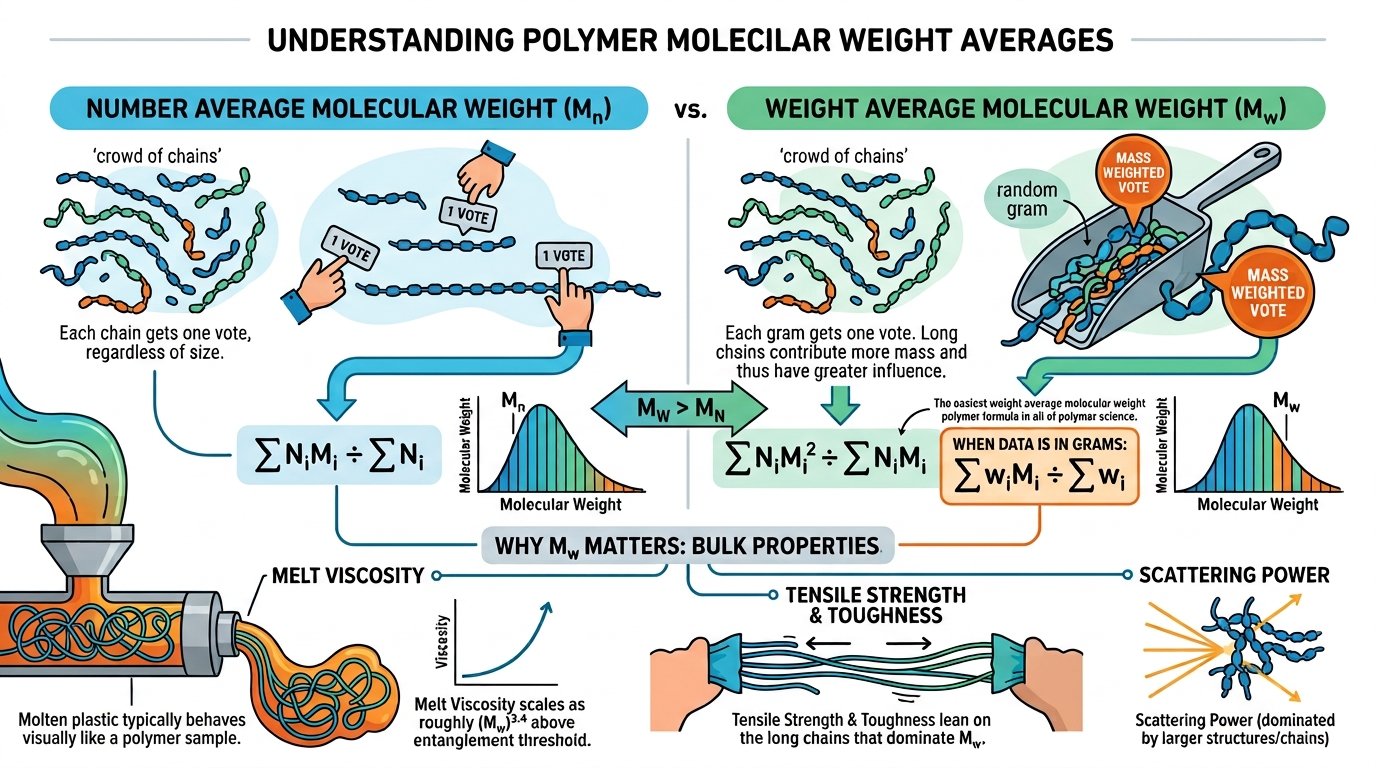
Every polymer sample is a crowd of chains with different lengths, so any molecular weight quoted for it must be an average — and there is more than one honest way to average. The number average asks each chain to vote once. The weight average molecular weight polymer value flips the ballot: each gram votes once, so a chain’s influence is proportional to the mass it contributes. Pick a random gram of the sample and ask how heavy the chain it belongs to is — that expectation is the weight average molecular weight polymer value, M_w.
Formally, M_w = Σ NᵢMᵢ² ÷ Σ NᵢMᵢ. The square in the numerator is not decoration: multiplying each fraction’s mass (NᵢMᵢ) by its molar mass (Mᵢ) once more is exactly what “weighting by mass” means. And because mass fractions wᵢ already carry that weighting, the same definition collapses to M_w = Σ wᵢMᵢ ÷ Σ wᵢ when the data arrives in grams — the easiest weight average molecular weight polymer formula in all of polymer science.
Why should you care about the mass-weighted view? Because most bulk properties do. Melt viscosity scales as roughly M_w to the power 3.4 above the entanglement threshold; tensile strength, toughness and scattering power all lean on the long chains that dominate M_w. A weight average molecular weight polymer calculator turns those distribution questions into a ten-second computation — and if your molecule is small and single, our molecular weight calculator on the homepage handles it the classical way.
How to Use This Weight Average Molecular Weight Polymer Calculator
Using this weight average molecular weight polymer calculator takes under ten seconds:
- Pick a mode from the weight average molecular weight polymer calculator’s five tabs — M_w from Chain Counts, M_w from Masses, DP ↔ M_w, Mz & Averages Ladder, or the Dispersity Solver.
- Enter your data — 2–4 fractions (Mᵢ with Nᵢ or wᵢ), a repeat-unit formula plus DP_w, or any two of Mₙ/M_w/Đ. The preset chips load classic textbook problems in one click.
- Press the blue button (or hit Enter). M_w appears with Mₙ and Đ where applicable, a step-by-step derivation, a fraction table and an animated graph.
- Read the extras — mass shares per fraction, the full averages ladder, and the distribution-breadth verdict for your dispersity.
- Copy, download or share the result — CSV, TXT, print, WhatsApp, Facebook or X — and press ↺ Reset to start the next problem clean.
Every weight average molecular weight polymer result you compute is remembered too: your last ten calculations are saved in the history panel under the tool (stored only in your own browser), and Clear All wipes them instantly. Nothing is sent to any server — the entire weight average molecular weight polymer calculator runs on your device, which is also why it loads fast and works offline once the page is open.
The Five Modes Explained
📈 Mode 1 — M_w from Chain Counts
The headline act of the weight average molecular weight polymer calculator: enter each fraction’s molar mass Mᵢ and its chain count Nᵢ, and get M_w = ΣNᵢMᵢ² ÷ ΣNᵢMᵢ — with Mₙ and Đ computed in the same pass, because every examiner asks for all three. The 1/2/2 textbook preset (10k/50k/100k) lands on M_w = 80,967.74 and Đ = 1.306.
⚖️ Mode 2 — M_w from Masses
The natural habitat of the weight average molecular weight polymer value. With grams as input, no mole conversion is needed: M_w = ΣwᵢMᵢ ÷ Σwᵢ, a plain weighted mean. A 50 g + 50 g blend of 10k and 100k chains gives M_w = 55,000 — exactly halfway, because each mass holds half the votes — while Mₙ collapses to 18,181.82. Same beaker, dispersity 3.025.
🔗 Mode 3 — DP ↔ M_w
Chains measured in repeat units turn the weight average molecular weight polymer equation into M_w = DP_w × M₀, where DP_w is the weight-average degree of polymerization. Type the repeat-unit formula (C2H4 for polyethylene, C8H8 for polystyrene) and the tool computes M₀ from IUPAC 2021 atomic masses, then converts in either direction. Polystyrene at DP_w 3000 is M_w = 312,456 g/mol; and DP_w ÷ DPₙ equals the dispersity exactly.
🪜 Mode 4 — Mz & Averages Ladder
One dataset, four averages: Mₙ ≤ M_w ≤ Mz ≤ Mz+1. Enter the fractions once and the mode computes the complete ladder — Mz = ΣNᵢMᵢ³ ÷ ΣNᵢMᵢ², the sedimentation average that governs melt elasticity, and Mz+1, which leans on the very heaviest tail. The 1/2/2 preset climbs 62,000 → 80,967.74 → 89,681.27 → 94,406.93.
🎯 Mode 5 — Dispersity Solver
The Đ = M_w ÷ Mₙ triangle: enter any two, the third is solved. M_w = 90,000 with Mₙ = 50,000 means Đ = 1.8 — typical commercial breadth. The mode grades your weight average molecular weight polymer distribution in plain words (nearly monodisperse, narrow, typical, very broad) and flags the physically impossible Đ < 1 the moment the two averages get swapped.
The Formula (With the Box You Should Memorize)
Every weight average molecular weight polymer problem — no exceptions — is built from three relationships:
M_w = Σ NᵢMᵢ² ÷ Σ NᵢMᵢ (mass-weighted mean)
M_w = Σ wᵢMᵢ ÷ Σ wᵢ (same thing, with mass data)
Đ = M_w ÷ Mₙ ≥ 1 (dispersity)
M_w weighs chains; Mₙ counts them. Đ = 1 only when every chain is identical.
Read the first line of the weight average molecular weight polymer formula as an election in which grams vote: NᵢMᵢ is the mass held by fraction i, and multiplying it by Mᵢ once more asks “how heavy is the chain this gram sits in?” With mass fractions wᵢ the weighting is already built in, so the second line needs no squares at all — substitute wᵢ = NᵢMᵢ into the first and it drops out in one step. No new physics, just a change of currency.
The units police themselves: both numerators are grams-times-molar-mass over grams, so M_w lands in g/mol, always between the lightest and heaviest fraction. The deeper invariant is the ordering M_w ≥ Mₙ — a mathematical fact (the Cauchy–Schwarz inequality in disguise), not an experimental one. Any dataset that violates it contains an error, and the weight average molecular weight polymer calculator above flags exactly that.
M_w vs Mₙ: The Distinction That Decides the Marks
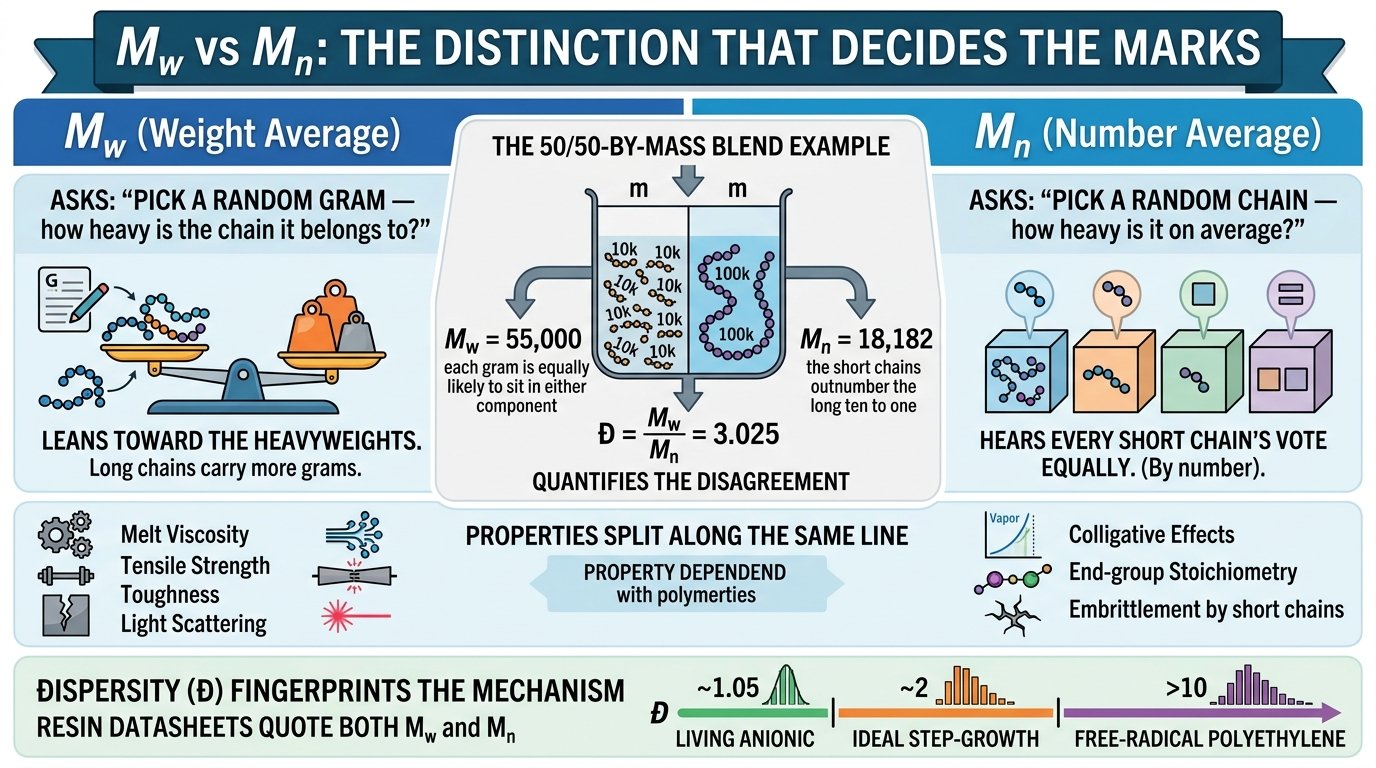
Here is the weight average molecular weight polymer concept that decides half the marks in every polymer chemistry paper. M_w asks “pick a random gram — how heavy is the chain it belongs to?” Mₙ asks “pick a random chain — how heavy is it on average?” Long chains carry more grams, so M_w always leans toward the heavyweights while Mₙ hears every short chain’s vote equally.
The 50/50-by-mass blend from Mode 2 makes it stark: equal masses of 10k and 100k chains give M_w = 55,000 (each gram is equally likely to sit in either component) but Mₙ = 18,182 (the short chains outnumber the long ten to one). Same beaker, two honest answers to two different questions — and their ratio, Đ = 3.025, quantifies the disagreement.
Properties split along the same line. Melt viscosity, tensile strength, toughness and light scattering follow M_w; colligative effects, end-group stoichiometry and embrittlement by short chains follow Mₙ. That’s why a resin datasheet quotes both the weight average molecular weight polymer figure and Mₙ, and why the dispersity between them fingerprints the polymerization mechanism: living anionic runs approach Đ = 1.05, ideal step-growth tends to Đ = 2, and free-radical polyethylene can spread past 10. We covered the chain-counting side of this story in depth in the number average molecular weight polymer guide — this page is its mass-weighted twin, and the same two-averages logic applies to small-molecule blends in the average molecular weight of mixture post.
The Averages Ladder: Mz and Mz+1
The weight average molecular weight polymer value is not the top of the ladder — it’s the second rung. Keep raising the power of Mᵢ in the numerator and denominator and you climb through the z-average, Mz = ΣNᵢMᵢ³ ÷ ΣNᵢMᵢ², to Mz+1 = ΣNᵢMᵢ⁴ ÷ ΣNᵢMᵢ³. Each rung weights the heavy chains more aggressively, so for any real distribution Mₙ ≤ M_w ≤ Mz ≤ Mz+1, with equality only when every chain is identical.
The rungs above the weight average molecular weight polymer average are not academic decoration. Mz comes straight out of sedimentation-equilibrium experiments in the ultracentrifuge (the “z” traces back to the German Zentrifuge) and correlates with melt elasticity and die swell — the annoying tendency of extruded plastic to fatten after leaving the die. Mz+1 is even more tail-sensitive and shows up in flexural stiffness correlations. A distribution’s shape lives in the spacing of the rungs: a long high-mass tail stretches Mz far above M_w even when Đ looks modest.
Mode 4 of the weight average molecular weight polymer calculator computes the whole ladder from one dataset. For the classic 1/2/2 mixture the rungs land at 62,000 / 80,967.74 / 89,681.27 / 94,406.93 g/mol — watch how each average steps closer to the 100,000 g/mol heavyweight fraction as the exponent climbs.
Three Worked Examples, Step by Step
Example 1 — The classic weight average molecular weight polymer mixture
Step 1. ΣNᵢMᵢ = 10,000 + 100,000 + 200,000 = 310,000 g.
Step 2. ΣNᵢMᵢ² = 1×10⁸ + 5×10⁹ + 2×10¹⁰ = 2.51 × 10¹⁰.
Step 3. M_w = 2.51 × 10¹⁰ ÷ 310,000 = 80,967.74 g/mol.
Step 4. Mₙ = 310,000 ÷ 5 = 62,000 → Đ = 80,967.74 ÷ 62,000 = 1.306.
Example 2 — Weight average molecular weight polymer from equal masses
Step 1. M_w = (50 × 10,000 + 50 × 100,000) ÷ 100 = 5,500,000 ÷ 100 = 55,000 g/mol.
Step 2. Chains: 0.005 + 0.0005 = 0.0055 mol → Mₙ = 100 ÷ 0.0055 = 18,181.82 g/mol.
Step 3. Đ = 55,000 ÷ 18,181.82 = 3.025.
Moral. With mass data, M_w is just the weighted mean — the squares are only needed for chain counts.
Example 3 — Polystyrene weight average molecular weight polymer from DP_w
Step 1. M₀ = 8 × 12.011 + 8 × 1.008 = 104.152 g/mol.
Step 2. M_w = DP_w × M₀ = 3,000 × 104.152 = 312,456 g/mol.
Check. Typical commercial polystyrene — right in the 100k–400k window.
Run all three in the free weight average molecular weight polymer calculator above and compare its printed steps with these — they match line for line, because the tool executes exactly this arithmetic at full precision.
Repeat-Unit Table: 10 Common Polymers
These ten polymers cover most weight average molecular weight polymer coursework and industry datasheets. Repeat-unit masses were generated with the weight average molecular weight polymer calculator on this page (Mode 3):
| Polymer | Repeat unit | M₀ (g/mol) | Typical M_w range |
|---|---|---|---|
| Polyethylene (PE) | C₂H₄ | 28.05 | 50k–500k (UHMWPE 3.5–7.5M) |
| Polypropylene (PP) | C₃H₆ | 42.08 | 200k–600k |
| Polystyrene (PS) | C₈H₈ | 104.15 | 200k–400k |
| PVC | C₂H₃Cl | 62.50 | 100k–260k |
| PET | C₁₀H₈O₄ | 192.17 | 30k–80k |
| PMMA (acrylic) | C₅H₈O₂ | 100.12 | 100k–350k |
| Nylon-6 | C₆H₁₁NO | 113.16 | 30k–80k |
| PTFE (Teflon) | C₂F₄ | 100.01 | 1M–10M+ |
| PLA | C₃H₄O₂ | 72.06 | 100k–300k |
| Polycarbonate (PC) | C₁₆H₁₄O₃ | 254.29 | 40k–100k |
Notice the ratios: because Đ > 1 for every real sample, the M_w windows here sit systematically above the Mₙ ranges of the same resins — for a free-radical polyethylene with Đ ≈ 5, M_w is five times Mₙ. The formula-to-M₀ arithmetic behind this table is the same one our formula weight calculator applies to ionic compounds, built on the same element data as the atomic mass calculator.
How M_w Is Measured in the Real World
Because the weight average molecular weight polymer definition is mass weighting, every measurement of M_w is secretly a mass-sensitive probe:
- Static light scattering — the gold standard. Scattering intensity is proportional to concentration × molar mass, so big chains shout loudest and the Zimm-plot extrapolation delivers an absolute M_w with no calibration standards.
- GPC/SEC — gel permeation chromatography separates chains by size and integrates the whole distribution at once: Mₙ, M_w, Mz and Đ from one injection. The industry default, calibrated against narrow standards (or made absolute with an in-line light-scattering detector).
- Viscometry — the Mark–Houwink relation [η] = K·Mᵃ yields the viscosity average Mv, which sits just below M_w; quick, cheap, and everywhere in QC.
- Sedimentation equilibrium — the analytical ultracentrifuge weighs chains through their sedimentation, reaching M_w and the z-averages beyond it.
- MALDI mass spectrometry — for narrow, lower-mass polymers, weighs individual chains directly (the exact-mass mindset of our exact mass calculator extended to macromolecules).
The complementary fact worth remembering: osmometry and end-group analysis measure Mₙ, not M_w, because they count particles instead of weighing them. Quoting which average your method delivers is half of good polymer reporting — and the weight average molecular weight polymer calculator above keeps every average clearly labeled at each step.
Who Uses the Weight Average Molecular Weight?
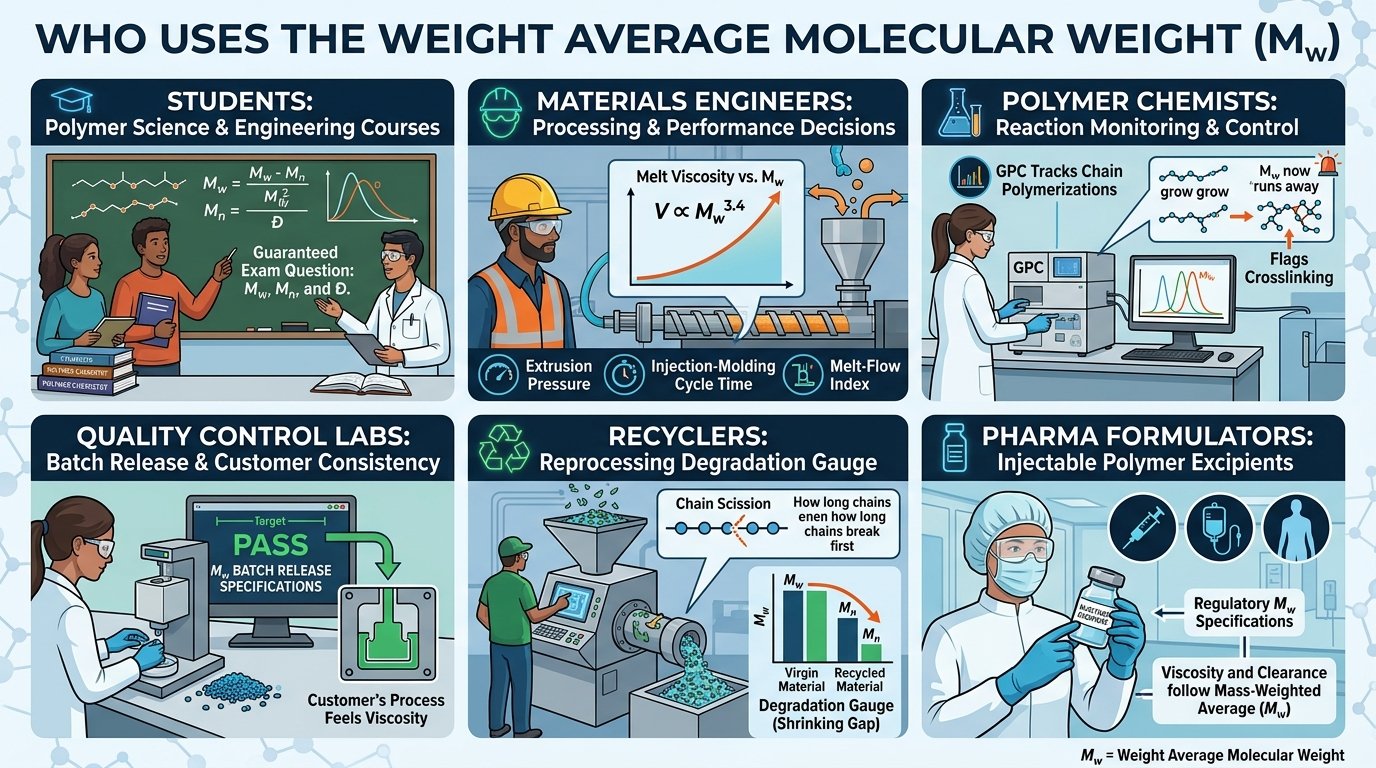
- Students — the weight average molecular weight polymer trio of M_w, Mₙ and Đ is a guaranteed question in every polymer chemistry, materials science and chemical engineering course.
- Materials engineers — melt viscosity scales as M_w³·⁴, so extrusion pressure, injection-molding cycle time and melt-flow index are all M_w decisions.
- Polymer chemists — reaction monitoring by GPC tracks M_w growth in chain polymerizations and flags crosslinking the moment M_w runs away.
- Quality control labs — batch release specs are typically written on M_w windows, because the customer’s process feels the melt viscosity, not the chain count.
- Recyclers — chain scission during reprocessing hits the longest chains hardest, so the weight average molecular weight polymer value drops faster than Mₙ; the shrinking gap is a degradation gauge.
- Pharma formulators — injectable polymer excipients carry regulatory M_w specifications because viscosity and clearance both follow the mass-weighted average.
For the small-molecule stoichiometry that surrounds polymer synthesis — initiator ratios, monomer feeds — our stoichiometry calculator picks up where this tool leaves off, and the grams to moles calculator handles the everyday conversions.
Full Lab Walkthrough: A GPC Batch Release
Here’s a routine industrial determination checked with this weight average molecular weight polymer calculator, exactly as a QC lab runs it.
The task: a polystyrene batch must show a weight average molecular weight polymer spec between 250,000 and 320,000 g/mol with Đ ≤ 2.6 before it ships.
- Dissolve and filter. 2 mg/mL of the resin in THF, filtered at 0.45 µm so gels don’t clog the columns.
- Inject and separate. The GPC columns sort chains by hydrodynamic size — biggest elute first — over a 30-minute run.
- Integrate the trace. The software slices the chromatogram, converts elution time to molar mass via the calibration curve, and sums the slices: this batch reports M_w = 287,000 and Mₙ = 121,600.
- Cross-check the ratio. Switch the calculator to Mode 5, enter both averages: Đ = 2.360 — inside the spec, typical free-radical breadth.
- Sanity-check the DP. Mode 3 with C8H8: M_w 287,000 ÷ 104.152 → DP_w ≈ 2,756 repeat units — a sensible commercial chain length.
- Release. The certificate quotes M_w, Mₙ, Đ and the trace; the customer’s extruder settings were written against exactly these numbers.
Total calculator time: under a minute. The chromatography — clean solvent, tight calibration, good columns — is the part worth practicing, and it’s the part that decides the accuracy.
A Short History: Staudinger to Light Scattering to GPC
A century ago the weight average molecular weight polymer concept had nothing to average: mainstream chemistry insisted rubber and cellulose were loose aggregates of small rings. Hermann Staudinger’s 1920 macromolecule hypothesis — vindicated by the 1953 Nobel Prize — made chains real, and their inevitable length spread made averages the only honest language. Viscosity, his favorite tool, turned out to track an average close to M_w, which is partly why the weight average molecular weight polymer spec became industry’s number.
The theory arrived in the 1940s: Peter Debye showed that the intensity of light scattered by a polymer solution is proportional to concentration times molar mass, and Bruno Zimm turned that into the double-extrapolation plot that still bears his name — an absolute, calibration-free M_w. Paul Flory (Nobel 1974) supplied the statistics, and with Walter Stockmayer proved the dramatic corollary: at the gel point of a crosslinking system, M_w diverges to infinity while Mₙ stays finite — the two averages don’t just differ, they can be infinitely far apart. Routine measurement arrived in 1964 when J.C. Moore of Dow published gel permeation chromatography, collapsing Mₙ, M_w, Mz and Đ into one 30-minute injection. The 2019 SI redefinition completed the chain of custody, fixing the Avogadro constant exactly.
Weight Average Molecular Weight in Everyday Life
- The 3.4 power law — melt viscosity scales as M_w³·⁴, so doubling M_w makes the melt about 10× harder to push: every injection-molded object was costed against this exponent.
- Plastic bags that don’t tear — film strength rides on the long chains that dominate the weight average molecular weight polymer value; a cheap bag and a tough one can share the same Mₙ.
- Hip replacements and bulletproof vests — UHMWPE at M_w 3.5–7.5 million, chains so long they can’t be melt-processed at all.
- Faded recycled plastic — each reprocessing pass scissors the longest chains first, so M_w (and toughness) drop before anything else changes.
- Paint that levels itself — coating rheology is tuned through the polymer’s M_w and its high-mass tail (that’s the Mz talking).
- Chewing gum vs bubble gum — different gum-base molecular weights: higher M_w stretches into bigger, stronger bubbles.
- 3D-printer filament — PLA grades differ mainly in M_w: too low strings and drips, too high won’t extrude at hobby-printer temperatures.
Each bullet is one weight average molecular weight polymer specification in disguise — exactly what this free calculator was built to make visible. The concentration side of polymer solutions belongs to our molarity calculator, and salts with crystal water have their own rules in the molar mass of hydrates calculator.
Practice Problems (With Answers)
Work each problem by hand first, then verify with this free weight average molecular weight polymer calculator. Answers are hidden until you click.
Problem 1 — 1 mol of 10k + 2 mol of 50k + 2 mol of 100k chains. Find M_w and Đ.
ΣNᵢMᵢ² = 2.51 × 10¹⁰; ΣNᵢMᵢ = 310,000 → M_w = 80,967.74 g/mol; with Mₙ = 62,000, Đ = 1.306.
Problem 2 — Equal 50 g portions of 10k and 100k polymer are blended. Find M_w.
M_w = (50 × 10,000 + 50 × 100,000) ÷ 100 = 55,000 g/mol (Mₙ = 18,181.82; Đ = 3.025).
Problem 3 — Polystyrene has DP_w = 3,000. What is its weight average molecular weight?
M₀(C₈H₈) = 104.152 g/mol → M_w = 3,000 × 104.152 = 312,456 g/mol.
Problem 4 — Equal chain counts of 10k and 100k. Find the full ladder Mₙ, M_w, Mz.
Mₙ = 55,000; M_w = 1.01 × 10¹⁰ ÷ 110,000 = 91,818.18; Mz = 1.001 × 10¹⁵ ÷ 1.01 × 10¹⁰ = 99,108.91 g/mol — each rung a step closer to 100k.
Problem 5 — A resin has Mₙ = 45,000 and Đ = 2.2. Find M_w.
M_w = Mₙ × Đ = 45,000 × 2.2 = 99,000 g/mol — typical free-radical or step-growth breadth.
Tips for Fast, Error-Free M_w Calculations
- ✅ Identify the data type first — chain counts (Nᵢ) need the squared formula; masses (wᵢ) need only the plain weighted mean. Swapping them is the classic error.
- ✅ Range-check: a weight average molecular weight polymer answer must land between the smallest and largest Mᵢ, and always at or above Mₙ.
- ✅ Remember the pull rule — M_w leans toward the heavy chains; if your answer sits below the midpoint of the components, something’s inverted.
- ✅ Compute Đ every time — it’s one division and it instantly grades your distribution (and catches swapped averages).
- ✅ For DP work, keep your subscripts straight — DP_w × M₀ gives M_w; DPₙ × M₀ gives Mₙ; the ratio of the two DPs is the dispersity.
- ✅ Reset, then verify — every answer goes through the weight average molecular weight polymer calculator above; the ↺ Reset button between problems keeps old inputs from contaminating new ones.
⚗️ Pro workflow: Mode 1 when the data is chain counts → Mode 2 when it’s grams → Mode 3 when chains are measured in repeat units → Mode 4 when the report needs the whole Mₙ–M_w–Mz–Mz+1 ladder → Mode 5 whenever two of Mₙ, M_w, Đ are known and the third isn’t. Five tabs, one weighting principle, zero weight average molecular weight polymer mix-ups.
5 Common Mistakes to Avoid
A decade of marking polymer papers, and years of weight average molecular weight polymer calculator support emails, produce the same five errors on repeat:
- Squaring when the data is already masses. ΣwᵢMᵢ² ÷ ΣwᵢMᵢ is Mz, not M_w. With mass data the weight average is the plain mean ΣwᵢMᵢ ÷ Σwᵢ — the squares belong to chain-count data only.
- Reporting M_w below Mₙ. Mathematically impossible — it always means the two averages got swapped somewhere. The calculator flags Đ < 1 instantly.
- Treating GPC numbers as absolute. Conventional GPC reports “polystyrene-equivalent” M_w; comparing it against a light-scattering value for a different polymer chemistry can be off by tens of percent.
- Confusing Mv with M_w. Viscometry’s Mark–Houwink average sits below M_w (a is usually 0.5–0.8); quoting it as M_w quietly biases every spec built on it.
- Predicting processing from Mₙ. Melt viscosity follows M_w³·⁴ — two resins with identical Mₙ but different tails can differ several-fold in the extruder.
How This Calculator Is Different
| Feature | This weight average molecular weight polymer calculator | Generic MW tool | By hand |
|---|---|---|---|
| M_w, Mₙ and Đ together | ✅ Every run | ❌ Single compounds only | ⚠️ Three separate passes |
| Counts AND masses accepted | ✅ Separate modes, right formula each | ❌ | ⚠️ Square-when-you-shouldn’t trap |
| Full Mz & Mz+1 ladder | ✅ Built-in mode | ❌ Not offered | ⚠️ Four hand computations |
| DP_w ↔ M_w with formula parser | ✅ IUPAC 2021 repeat units | ⚠️ Manual M₀ lookup | ⚠️ Slow |
| Step-by-step working shown | ✅ Every mode | ⚠️ Rarely | ✅ Yours |
| Export & history | ✅ CSV/TXT/print/share + last 10 | ❌ Usually none | ❌ Notebook |
Related tools on this site go deeper on the neighboring topics: the number average molecular weight polymer page covers the chain-counting twin of this average, and the average molecular weight of mixture guide applies the same logic to gases and solvent blends.
Where the Numbers Come From
Every repeat-unit mass behind this free weight average molecular weight polymer calculator is drawn from the IUPAC 2021 standard atomic weights, maintained by the Commission on Isotopic Abundances and Atomic Weights (CIAAW) — the same 118-element dataset used across all tools on this site. The M_w, Mₙ, Mz and Đ definitions follow current IUPAC recommendations (which since 2009 prefer “dispersity, Đ” over the older “polydispersity index”), and the mole itself rests on the exact Avogadro constant fixed by the 2019 SI redefinition, 6.02214076 × 10²³ mol⁻¹.
Small differences against older textbooks (a few units in the last decimal place of M₀ values) reflect IUPAC’s periodic revisions, not errors. If you ever spot a discrepancy worth checking, our corrections policy explains how we verify and fix reports — usually within days.
Exam Checklist
☐ I can compute M_w from masses via the plain weighted mean ΣwᵢMᵢ ÷ Σwᵢ.
☐ I can explain physically why M_w ≥ Mₙ for every real distribution.
☐ I can interpret dispersity Đ and match it to a polymerization mechanism.
☐ I can convert DP_w ↔ M_w with the correct repeat-unit mass.
☐ I can order the ladder Mₙ ≤ M_w ≤ Mz ≤ Mz+1 and say what Mz governs.
☐ I know which measurement methods give M_w and which give Mₙ.
☐ I’ve verified my practice answers with this weight average molecular weight polymer calculator.
Frequently Asked Questions
What is the weight average molecular weight of a polymer?
M_w — the weight average molecular weight polymer value — is the average in which each chain is weighted by the mass it contributes — pick a random gram and ask how heavy its chain is. Formula: M_w = ΣNᵢMᵢ² ÷ ΣNᵢMᵢ, or ΣwᵢMᵢ ÷ Σwᵢ with mass data.
How is the weight average molecular weight polymer formula applied with mass data?
No squares needed: M_w = Σ wᵢMᵢ ÷ Σ wᵢ. A 50 g + 50 g blend of 10,000 and 100,000 g/mol chains gives (500,000 + 5,000,000) ÷ 100 = 55,000 g/mol.
What is the difference between M_w and Mₙ?
M_w weighs chains (every gram one vote), so long chains dominate; Mₙ counts them (every chain one vote). M_w ≥ Mₙ always, and the gap — measured by Đ = M_w/Mₙ — describes how broad the distribution is.
Why do mechanical properties follow M_w instead of Mₙ?
Because strength, toughness and melt viscosity live in chain entanglements, and entanglements are made by the long chains that carry most of the mass. Melt viscosity scales as roughly M_w³·⁴ above the entanglement threshold.
Is this weight average molecular weight polymer calculator free?
Yes, this weight average molecular weight polymer calculator is completely free — no registration, no daily limits. It runs entirely in your browser, and your history stays on your own device.
What are Mz and Mz+1?
The next rungs of the averages ladder: Mz = ΣNᵢMᵢ³ ÷ ΣNᵢMᵢ² and Mz+1 = ΣNᵢMᵢ⁴ ÷ ΣNᵢMᵢ³. They weight the heaviest chains even more strongly than M_w and correlate with melt elasticity, die swell and sedimentation behavior.
Which experimental methods measure M_w?
Static light scattering (absolute, via the Zimm plot), GPC/SEC (whole distribution in one injection), sedimentation equilibrium, and — approximately — viscometry through the Mark–Houwink average Mv. Osmometry and end-group analysis measure Mₙ instead.
Can M_w be smaller than Mₙ?
No — M_w ≥ Mₙ is a mathematical certainty for any real distribution, so Đ ≥ 1 always. A computed Đ below 1 means the two averages were swapped, and the calculator warns you immediately.
How do I calculate M_w from the degree of polymerization?
M_w = DP_w × M₀, where DP_w is the weight-average degree of polymerization and M₀ the repeat-unit molar mass. Polystyrene (C₈H₈, 104.152 g/mol) at DP_w 3,000 gives M_w = 312,456 g/mol. Mode 3 computes M₀ from any formula automatically.
Which atomic masses does the calculator use?
IUPAC 2021 standard atomic weights for all 118 elements, applied to every repeat-unit formula — the same dataset behind every tool on molecularweightcalculator.org.
10 Polymer Facts Worth Knowing
- At the gel point of a crosslinking resin, M_w diverges to infinity while Mₙ stays finite — Flory and Stockmayer proved the two averages can be infinitely far apart.
- The “z” in Mz traces back to the German Zentrifuge — the ultracentrifuge experiments that first reached the higher averages.
- Light scattering measures M_w with no calibration at all: scattered intensity is simply proportional to concentration × molar mass.
- The 3.4 exponent tied to the weight average molecular weight polymer scale is one of polymer physics’ most universal numbers — doubling M_w multiplies melt viscosity by about 10.6 for nearly every entangled linear polymer.
- IUPAC formally retired the term “polydispersity index” in 2009; the modern symbol is Đ, pronounced “D-stroke”.
- DNA is the great exception — a monodisperse macromolecule where M_w = Mₙ exactly (Đ = 1).
- UHMWPE fibers (M_w up to 7.5 million) are, weight for weight, stronger than steel — and can’t be melt-extruded, precisely because of that M_w.
- Conventional GPC never weighs anything: it sorts chains by size and reports polystyrene-equivalent masses — which is why absolute light scattering detectors are bolted onto modern systems.
- One melt-recycling pass can cut M_w by 10–30% while barely moving Mₙ — scission is a lottery that long chains keep winning.
- The ratio DP_w ÷ DPₙ equals the dispersity Đ exactly — measure both DPs and you’ve measured the breadth of the whole distribution.
🔗 Trusted external resources
Final Thoughts
No weight average molecular weight polymer calculator can replace understanding, but it can guarantee the arithmetic. Polymer molecular weights look intimidating because they’re distributions — yet behind every distribution sit two honest questions: how many chains, and where does the mass live? Weigh with M_w, count with Mₙ, grade the spread with Đ, climb to Mz when the tail matters, and let the calculator above verify every line — and the chapter that introduces macromolecules becomes one of the most systematic places to score.
Bookmark this weight average molecular weight polymer calculator for your next problem set or GPC report, share it with a classmate before the materials exam, and explore the rest of our free chemistry tools — from the molecular weight calculator homepage to the stoichiometry calculator for full reaction math. Questions or corrections? Reach us any time through the contact page — and you can read more about the site’s mission on our about page.
Written & Reviewed By
Ahmad Raza, M.Phil. Chemistry
Ahmad is a chemistry educator and science content developer with over 10 years of experience teaching analytical and physical chemistry. He builds free calculation tools that help students and lab professionals work faster and make fewer errors. When he’s not balancing equations, he’s usually grading titration reports.