
Average Molecular Weight of Mixture
Calculate the average molecular weight of any mixture — from mole percent, mass percent or weighed masses — with IUPAC 2021 atomic masses. Solve two-component mixtures backwards from a target value, and get gas density at 0 °C and 25 °C with the relative density vs air. Every step of the working shown.
✓ Trusted by students, teachers & lab professionalsAverage Molecular Weight from Mole Percent
Mavg = Σ xᵢ Mᵢ — multiply each component's molecular weight by its mole fraction and add. Enter 2–4 components; percentages are normalized automatically if they don't sum to 100.
Average Molecular Weight from Mass Percent
Mavg = 1 ÷ Σ (wᵢ ÷ Mᵢ) — the harmonic mean that mass fractions demand. The tool also converts your mass percents into mole percents.
Average Molecular Weight from Weighed Masses
Mavg = total mass ÷ total moles. Weigh each component in grams — the tool converts every mass to moles and divides. The definition itself, in calculator form.
Two-Component Solver: Find the Fractions
The classic exam question in reverse — a mixture of A and B has a known average molecular weight; what are the mole fractions? xA = (Mavg − MB) ÷ (MA − MB).
Gas Mixture: Average MW, Density & vs-Air Ratio
For ideal-gas mixtures the mole percent equals the volume percent. Get the average molecular weight plus density at 0 °C and 25 °C (1 atm) and the relative density against air (28.96 g/mol) — will it rise or sink?
🕘 Recent calculations
- No calculations yet — your last 10 results will appear here.
Atomic masses: IUPAC 2021 · Molar volume: 22.414 L/mol (0 °C, 1 atm), 24.465 L/mol (25 °C, 1 atm) · Free tool by molecularweightcalculator.org
The average molecular weight of mixture is the single number that lets you treat a blend of different molecules as if it were one substance. Air is the famous example: it has no formula, yet every gas-law calculation on Earth uses 28.96 g/mol for it. Enter air’s composition into the calculator above and that exact number appears — with each gas’s contribution, the density at two temperatures, and every step of the weighted average written out.
The free average molecular weight of mixture calculator above computes the value three different ways — from mole percent, from mass percent, and from weighed grams — because mixtures arrive in all three currencies, and each one demands a different formula. It also solves the classic exam problem in reverse (given the average, find the fractions) and reports gas density with a rises-or-sinks verdict against air. Each of the five modes has its own ↺ Reset button, and every result can be copied, downloaded, printed or shared.
In this guide I’ll show you how to use every mode, derive the three formulas behind the average molecular weight of mixture, explain the mole-basis vs mass-basis trap that catches almost everyone, and hand you the practice problems that exams and engineering courses recycle every single year. Let’s begin.
🔑 KEY TAKEAWAY
The average molecular weight of mixture is total mass ÷ total moles. With mole fractions it’s the weighted mean Mavg = Σ xᵢMᵢ; with mass fractions it’s the harmonic mean Mavg = 1 ÷ Σ(wᵢ ÷ Mᵢ). For air (78.09% N₂, 20.95% O₂, 0.93% Ar, 0.03% CO₂ by moles) the result is 28.96 g/mol. The calculator on this page applies all three formulas with IUPAC 2021 atomic masses, solves two-component mixtures backwards from a target average, and converts the answer into gas density at 0 °C and 25 °C.
📑 Table of Contents (click to expand)
- What Is the Average Molecular Weight of Mixture?
- How to Use This Average Molecular Weight of Mixture Calculator
- The Five Modes Explained
- The Three Formulas (With the Box You Should Memorize)
- Mole Basis vs Mass Basis: The Trap
- Air = 28.96 g/mol: The Most Useful Average in Science
- Three Worked Examples, Step by Step
- Average Molecular Weight Table: 10 Common Mixtures
- From Average MW to Gas Density (and Why It Matters)
- Who Uses the Average Molecular Weight of Mixture?
- Full Walkthrough: A Boiler Flue Gas, Mode by Mode
- A Short History: From Vapor Density to Polymers
- Average Molecular Weight in Everyday Life
- Practice Problems (With Answers)
- Tips for Fast, Error-Free Mixture Calculations
- 5 Common Mistakes to Avoid
- How This Calculator Is Different
- Where the Numbers Come From
- Exam Checklist
- Frequently Asked Questions
- 10 Mixture Facts Worth Knowing
What Is the Average Molecular Weight of Mixture?
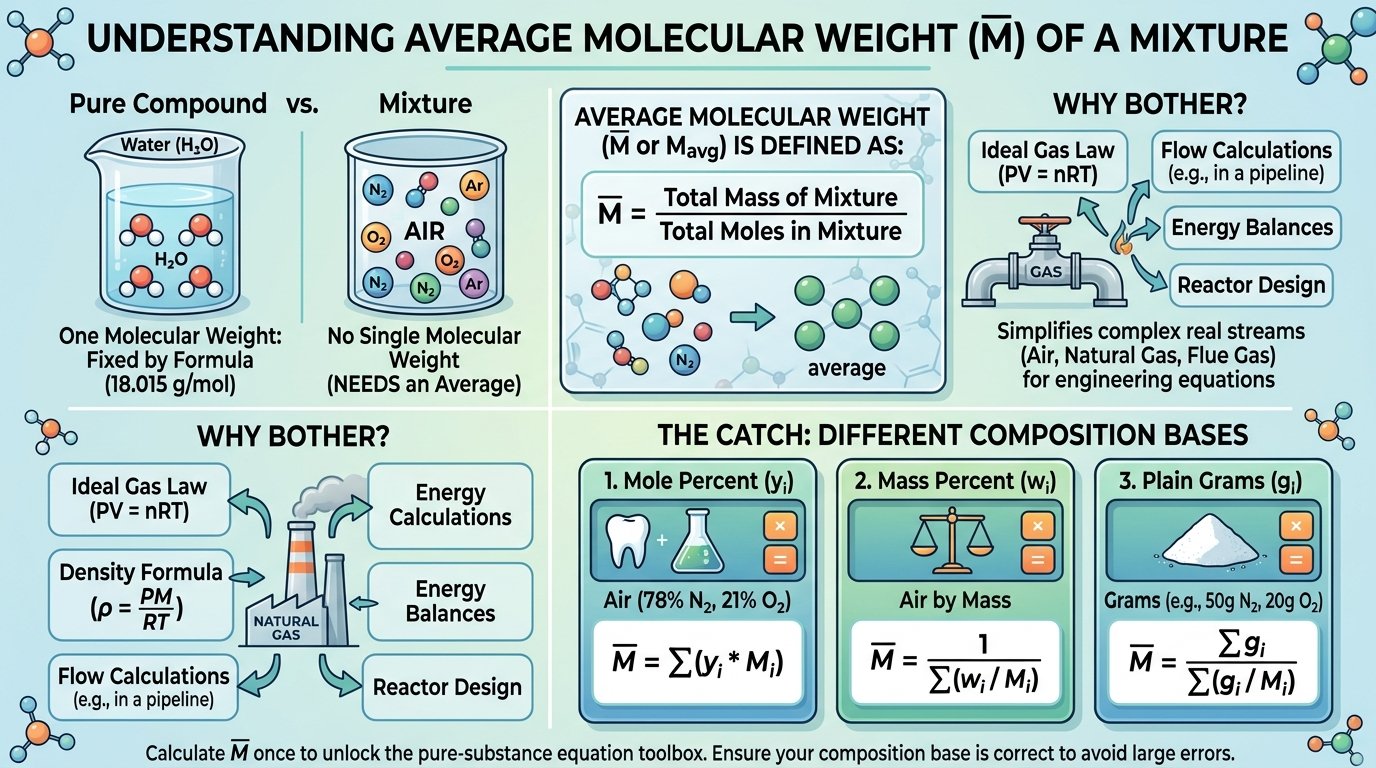
A pure compound has one molecular weight, fixed by its formula. A mixture has none — so chemistry invents one, and an average molecular weight of mixture calculator computes it. The average molecular weight of mixture (also called the mean molar mass, M̄ or Mavg) is defined as the total mass of the mixture divided by the total number of moles in it. It’s the molecular weight the mixture would have if all its different molecules were replaced by identical average ones.
Why bother? Because nearly every equation in chemistry and chemical engineering — the ideal gas law, density formulas, flow calculations, energy balances — wants a molar mass, and real streams are almost never pure. Combustion air, natural gas from a pipeline, flue gas up a stack, syngas in a reactor: each one gets a single Mavg so that PV = nRT and ρ = PM/RT keep working. Calculate the average molecular weight of mixture once, and the whole toolbox of pure-substance equations opens up for the blend.
The catch — and the reason this page exists — is that “average” means different arithmetic depending on whether your composition is in mole percent, mass percent or plain grams. Get the basis wrong and the answer can be off by a factor of two. The calculator above keeps the three bases in separate modes so the right formula is always applied, and our molecular weight calculator on the homepage supplies the pure-component values whenever you need them individually.
How to Use This Average Molecular Weight of Mixture Calculator
Using this average molecular weight of mixture calculator takes under ten seconds:
- Pick a mode from the five tabs — From Mole %, From Mass %, From Masses (g), Two-Component Solver, or Gas Mixture Properties.
- Enter 2–4 components — a chemical formula plus its percent or mass for each. The preset chips fill classic mixtures (🌍 Air, 🔥 Natural gas, ♻️ Biogas, ⚗️ Syngas) in one click.
- Don’t worry about the total — if your percents don’t sum to exactly 100, the tool normalizes them automatically and tells you it did.
- Press the blue button (or hit Enter). The average appears with each component’s contribution, a step-by-step derivation, a table and an animated graph.
- Copy, download or share the result — CSV, TXT, print, WhatsApp, Facebook or X — and press ↺ Reset to start the next mixture clean.
Your last ten calculations are saved in the history panel under the tool (stored only in your own browser), and Clear All wipes them instantly. Nothing is sent to any server — the entire average molecular weight of mixture calculator runs on your device, which is also why it loads fast and works offline once the page is open.
The Five Modes Explained
🧮 Mode 1 — From Mole %
The headline act of the average molecular weight of mixture calculator: Mavg = Σ xᵢMᵢ. Each component’s molecular weight is multiplied by its mole fraction and the products are added. Air’s four gases give 21.8761 + 6.7036 + 0.3715 + 0.0132 = 28.96 g/mol, and the bar graph shows instantly that nitrogen does three-quarters of the work.
⚖️ Mode 2 — From Mass %
The trap mode — and the reason an average molecular weight of mixture calculator earns its keep. Mass fractions need the harmonic mean, Mavg = 1 ÷ Σ(wᵢ ÷ Mᵢ). A 50/50 by mass water–ethanol blend averages 25.90 g/mol, not the 32.04 you’d get by naively averaging 18.015 and 46.069. The mode also converts your mass percents into mole percents as a free bonus.
🧪 Mode 3 — From Masses (g)
The definition itself: weigh each component, and the average molecular weight of mixture calculator computes moles for each, then divides total mass by total moles. 10 g of water plus 10 g of NaCl is 20 g and 0.7262 mol → 27.54 g/mol. This is the mode for lab notebooks, where compositions start as balance readings, and it pairs naturally with our grams to moles calculator.
🔍 Mode 4 — Two-Component Solver
Every exam’s favorite way to test the average molecular weight of mixture in reverse: a CH₄/C₂H₆ blend has an average molecular weight of 20 g/mol — find the fractions. Rearranging the weighted mean gives x = (Mavg − MB) ÷ (MA − MB) = 71.79% methane. The solver validates that your target actually lies between the two component weights (a mixture can never average outside its ingredients) and reports the answer on both mole and mass bases.
🌬️ Mode 5 — Gas Mixture Properties
The engineering payoff. After computing the average molecular weight of mixture for a gas blend, this mode divides by the molar volume to give density at 0 °C and 25 °C (1 atm), then compares against air’s 28.96 to deliver a plain-language verdict: biogas at 27.23 g/mol nearly floats level, LPG at 49.71 sinks and pools dangerously low, syngas at 15.01 rises. For ideal gases mol % equals vol %, so pipeline specs plug straight in.
The Three Formulas (With the Box You Should Memorize)
Every average molecular weight of mixture problem — no exceptions — is one of these three lines:
Mavg = Σ xᵢMᵢ (mole fractions)
Mavg = 1 ÷ Σ(wᵢ ÷ Mᵢ) (mass fractions)
Mavg = total mass ÷ total moles (the definition)
All three are the same statement in different currencies. Match the formula to your data’s basis.
Where do they come from? Start with the definition, Mavg = mtotal ÷ ntotal. If you know mole fractions, write the mass as Σ nᵢMᵢ and divide by ntotal: the weighted mean falls out. If you know mass fractions, take one gram of mixture: component i contributes wᵢ grams, which is wᵢ/Mᵢ moles; one gram divided by Σ(wᵢ/Mᵢ) moles is the harmonic mean. Same definition, two directions of approach.
The units police themselves throughout: g/mol in, g/mol out, and the average must land between the lightest and heaviest component — always. If your answer for a CH₄/CO₂ blend comes out above 44 or below 16, the basis got mixed up mid-calculation, which is precisely the error an average molecular weight of mixture calculator makes impossible.
Mole Basis vs Mass Basis: The Trap
Here is the mistake that fills red ink on every average molecular weight of mixture problem: applying the mole-fraction formula to mass fractions. The two averages differ whenever the components differ in weight, and the gap grows with the spread. Our 50/50 water–ethanol example makes it vivid:
- Naive (wrong) arithmetic mean: (18.015 + 46.069) ÷ 2 = 32.04 g/mol.
- Correct mass-basis average: 1 ÷ (0.5/18.015 + 0.5/46.069) = 25.90 g/mol.
Why is the correct answer lower? Because 50 g of water is 2.78 moles while 50 g of ethanol is only 1.09 moles — the light component dominates the mole count. On a mole basis this same mixture is 71.89% water, and running that through Σ xᵢMᵢ gives back exactly 25.90. The two formulas always agree with each other; they just refuse to be swapped.
The quick mental check: a mass-basis average is always pulled toward the lighter component, because light molecules pack more moles into each gram. When in doubt, convert everything to moles first — or let the average molecular weight of mixture calculator above do the bookkeeping, since Mode 2 prints the mole-percent conversion alongside the answer.
Air = 28.96 g/mol: The Most Useful Average in Science
No single number demonstrates why an average molecular weight of mixture calculator matters like dry air’s 28.96 g/mol (often quoted as 28.97 with slightly different compositions). The arithmetic takes four lines:
O₂: 0.2095 × 31.998 = 6.7036
Ar: 0.0093 × 39.95 = 0.3715
CO₂: 0.0003 × 44.009 = 0.0132
Total: 28.96 g/mol
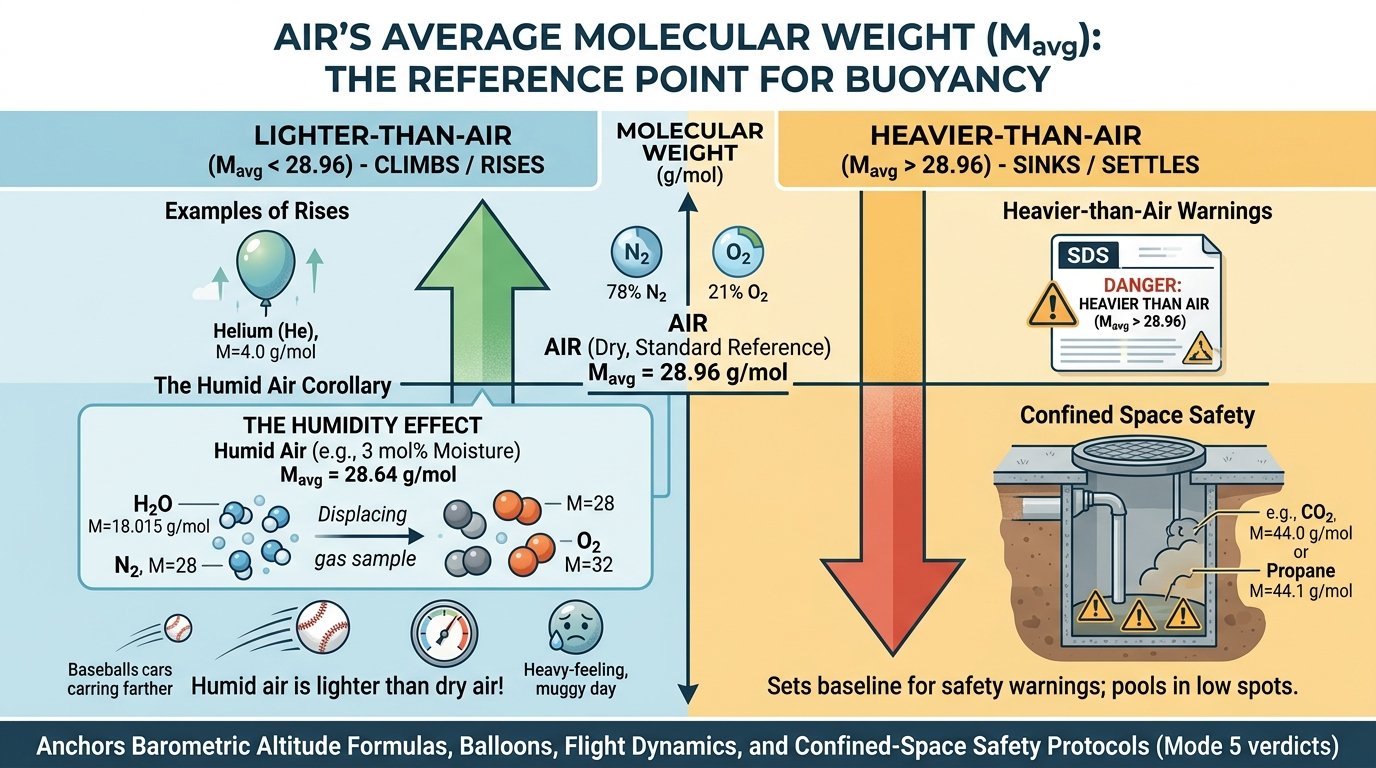
That one average molecular weight of mixture gives air’s density (1.2922 g/L at 0 °C, 1.1839 g/L at 25 °C), decides which balloons float, sets the baseline for every “heavier than air” gas warning on a safety data sheet, and anchors barometric altitude formulas. It’s also the reference in Mode 5’s rises-or-sinks verdict: any gas mixture with Mavg below 28.96 climbs, anything above it settles into low spots — the entire logic of confined-space safety in one comparison.
A lovely corollary: humid air is lighter than dry air. Water vapor’s 18.015 g/mol displaces heavier N₂ and O₂ molecules, dragging the average down — 3 mol% moisture brings air to 28.64 g/mol. That counterintuitive fact is why humid days feel heavy to us but read light on a barometer, and why baseballs carry farther in muggy weather.
Three Worked Examples, Step by Step
Example 1 — Natural gas on a mole basis
Step 1. Contributions: 0.85 × 16.043 = 13.6366; 0.10 × 30.07 = 3.0070; 0.03 × 44.097 = 1.3229; 0.02 × 28.014 = 0.5603.
Step 2. Sum: Mavg = 18.53 g/mol — well under air’s 28.96, which is why pipeline leaks rise to the ceiling.
Example 2 — 20 wt% brine on a mass basis
Step 1. w/M each: 0.20 ÷ 58.44 = 0.003422; 0.80 ÷ 18.015 = 0.044407 (per gram of mixture).
Step 2. Σ = 0.047830 mol/g → Mavg = 1 ÷ 0.047830 = 20.91 g/mol.
Check. Pulled toward water (18.015), the lighter and mole-dominant component — as the basis rule predicts.
Example 3 — Solve backwards: CH₄/C₂H₆ averaging 20 g/mol
Step 2. x × 16.043 + (1 − x) × 30.07 = 20.
Step 3. x = (20 − 30.07) ÷ (16.043 − 30.07) = 0.7179.
Answer. 71.79 mol% CH₄, 28.21 mol% C₂H₆ — and the check 0.7179 × 16.043 + 0.2821 × 30.07 = 20.00 ✓
Run all three in the free average molecular weight of mixture calculator above and compare its printed steps with these — they match line for line, because the tool executes exactly this arithmetic with full-precision atomic masses from our atomic mass calculator dataset.
Average Molecular Weight Table: 10 Common Mixtures
These ten mixtures cover most textbook, lab and engineering work — and most of the searches that bring people to an average molecular weight of mixture calculator. Every value below was generated with the average molecular weight of mixture calculator on this page (mole basis):
| Mixture | Composition (mol %) | Mavg (g/mol) | vs air |
|---|---|---|---|
| Dry air | 78.09 N₂ / 20.95 O₂ / 0.93 Ar / 0.03 CO₂ | 28.96 | 1.00× (reference) |
| Humid air (3% H₂O) | 97 air / 3 H₂O | 28.64 | 0.99× — lighter! |
| Natural gas | 85 CH₄ / 10 C₂H₆ / 3 C₃H₈ / 2 N₂ | 18.53 | 0.64× — rises |
| Biogas | 60 CH₄ / 40 CO₂ | 27.23 | 0.94× — barely rises |
| LPG | 60 C₃H₈ / 40 C₄H₁₀ | 49.71 | 1.72× — sinks, pools low |
| Syngas | 50 H₂ / 50 CO | 15.01 | 0.52× — rises fast |
| Producer gas | 50 N₂ / 25 CO / 15 H₂ / 10 CO₂ | 25.71 | 0.89× — rises |
| Ammonia synthesis feed | 75 H₂ / 25 N₂ | 8.52 | 0.29× — very light |
| Boiler flue gas | 76 N₂ / 12 CO₂ / 6 H₂O / 6 O₂ | 29.57 | 1.02× — near air |
| Stoichiometric CH₄–air | 9.5 CH₄ / 90.5 air | 27.74 | 0.96× — slightly light |
Notice the six-fold spread in the average molecular weight of mixture, from 8.52 to 49.71 g/mol — and that every value sits between its own lightest and heaviest component. Composition tells you almost nothing until the molecular weights enter the conversation, which is the whole reason an average molecular weight of mixture calculator exists, and why this average molecular weight of mixture calculator prints each component’s contribution beside every answer.
From Average MW to Gas Density (and Why It Matters)
For an ideal gas, density is ρ = PM ÷ RT — and for a mixture, the M in that formula is exactly the average molecular weight of mixture. That makes density the fastest real-world payoff of the average molecular weight of mixture. At 1 atm the arithmetic collapses to a division: ρ = Mavg ÷ 22.414 g/L at 0 °C, or Mavg ÷ 24.465 g/L at 25 °C. Air lands at 1.2922 and 1.1839 g/L respectively; biogas at 27.23 g/mol gives 1.2148 g/L at 0 °C.
The safety implications of the average molecular weight of mixture are immediate. Gases with Mavg above ~29 accumulate in pits, basements and tank bottoms: LPG (49.71) is the notorious example, which is why LPG detectors mount near the floor while natural-gas detectors (18.53) mount near the ceiling. Sewer work, grain silos and ship holds all carry confined-space rules built on this one comparison — the vs-air ratio that Mode 5 reports in plain words.
Engineers push the same average molecular weight of mixture further: stack draft in a boiler depends on the flue gas being hotter (and thus less dense) than ambient air; gas flow meters calibrated for one Mavg must be corrected when the composition drifts; and vent sizing, buoyancy of weather balloons and even the lift budget of an airship are all downstream of the average molecular weight of mixture. One weighted mean, an entire discipline of consequences.
Who Uses the Average Molecular Weight of Mixture?
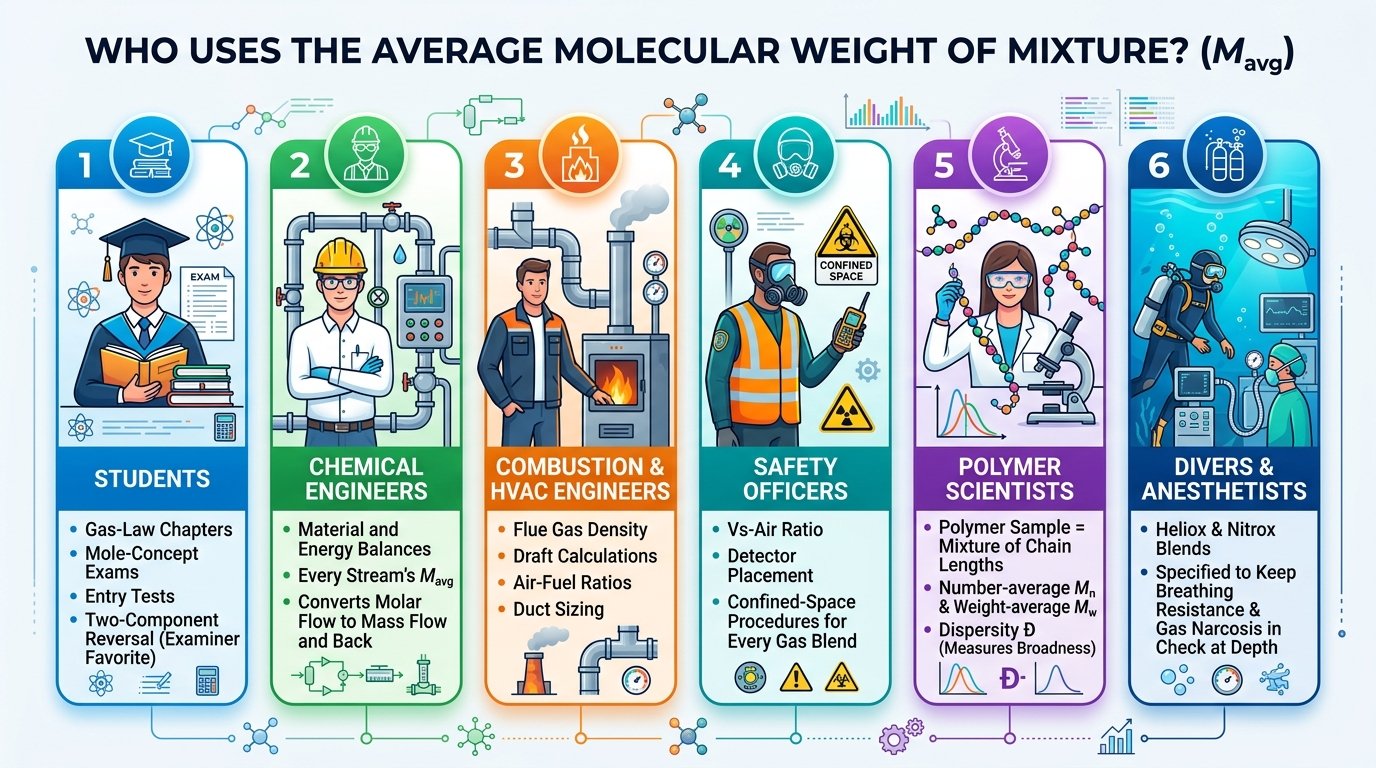
- Students — the mixture-average appears in gas-law chapters, mole-concept exams and every entry test; the two-component reversal is an examiner favorite.
- Chemical engineers — material and energy balances quote every stream’s Mavg; it converts molar flow to mass flow and back a hundred times per flowsheet.
- Combustion and HVAC engineers — flue gas density, draft calculations, air-fuel ratios and duct sizing all start from the mixture average.
- Safety officers — the vs-air ratio decides detector placement and confined-space procedures for every gas blend on site.
- Polymer scientists — a polymer sample is itself a mixture of chain lengths, described by the number-average Mₙ and weight-average M_w (their ratio, the dispersity Đ, measures how broad the blend is — the same mole-vs-mass logic from this page, applied to macromolecules).
- Divers and anesthetists — heliox and nitrox blends are specified so their average molecular weight keeps breathing resistance and gas narcosis in check at depth.
For the reaction math that usually surrounds these streams, our stoichiometry calculator picks up where this tool leaves off, and solution workers will want the molarity calculator for the concentration side.
Full Walkthrough: A Boiler Flue Gas, Mode by Mode
Here’s a complete engineering task solved with this free average molecular weight of mixture calculator, mode by mode.
The task: a natural-gas boiler’s flue analysis reads 76% N₂, 12% CO₂, 6% H₂O, 6% O₂ (mole basis). Find the average molecular weight, the stack gas density, and whether the plume is buoyant at ambient temperature.
- Mode 1 — the average. Enter the four components. Contributions: 21.2906 + 5.2811 + 1.0809 + 1.9199 → Mavg = 29.57 g/mol.
- Mode 5 — the density. The same composition returns 1.3192 g/L at 0 °C and 1.2087 g/L at 25 °C, with a vs-air ratio of 1.021× — at equal temperature, this flue gas is very slightly denser than air.
- Interpret. The plume rises anyway — but only because it leaves the stack hot. The 1.021× ratio warns the designer: if the gas cools to ambient before exiting (poor insulation, long horizontal runs), natural draft dies. This is why stack temperature specifications exist.
- Mode 3 — cross-check by mass. Take a 100-mol basis: 2129.06 g N₂ + 528.11 g CO₂ + 108.09 g H₂O + 191.99 g O₂ = 2957.25 g over 100 mol = 29.57 g/mol. The definition confirms the weighted mean. ✓
- Export. The CSV button drops the full component table into your report; history keeps the run for the next revision.
Total calculator time: under two minutes — and every number in the chain is traceable to IUPAC atomic masses.
A Short History: From Vapor Density to Polymers
The average molecular weight of mixture has a distinguished past: computing it was once how molecular weights themselves were measured. Amedeo Avogadro’s 1811 hypothesis — equal volumes of gas hold equal numbers of molecules — implied that weighing a known volume of vapor reveals its molar mass. Stanislao Cannizzaro’s famous 1858 course outline turned this into the method that finally untangled atomic weights, and Henri Victor Regnault’s precision gas-density measurements supplied the data. When the sample was a mixture, the method returned — without anyone asking — the mole-weighted average, and chemists learned to read purity from it: a vapor density that drifted between runs betrayed a blend.
The twentieth century made averages respectable objects in their own right. Hermann Staudinger’s macromolecular hypothesis (Nobel Prize 1953) forced chemistry to accept substances that are inherently mixtures — every polymer sample contains chains of many lengths, so its molecular weight can only ever be an average. The field then split the concept exactly as this page does: the number-average Mₙ (a mole-basis mean, measured by osmometry) versus the weight-average M_w (a mass-basis mean, measured by light scattering), with their ratio Đ = M_w/Mₙ quantifying the spread. The 2019 SI redefinition completed the story, fixing the Avogadro constant exactly and making every average on this page traceable to fundamental constants.
Average Molecular Weight in Everyday Life
- Helium balloons — 4.0026 vs air’s 28.96: the seven-fold gap is the entire lift. A hydrogen balloon (2.016) lifts only slightly better, at vastly more risk.
- LPG cylinder warnings — “store in ventilated areas at ground level”: at 49.71 g/mol, leaked LPG flows downstairs like invisible water.
- Natural gas detectors on the ceiling — 18.53 g/mol rises; the detector goes where the gas goes.
- Muggy-day baseballs — humid air’s lower average molecular weight of mixture (28.64 at 3% moisture) means less drag; home runs carry measurably farther.
- Scuba nitrox and heliox — enriched blends are engineered averages: heliox at 10 g/mol breathes far easier at depth than air’s 28.96.
- Party-trick voices — helium raises the speed of sound (light average MW → squeaky voice); sulfur hexafluoride (146 g/mol) does the opposite.
- Biogas plants — upgrading biogas (27.23) to biomethane means stripping CO₂ until the average approaches pure methane’s 16.04.
Each bullet is one average molecular weight of mixture in disguise — exactly what this free average molecular weight of mixture calculator was built to make effortless. For the pure-compound side of any of these numbers, the formula weight calculator has you covered.
Practice Problems (With Answers)
Work each problem by hand first, then verify with this free average molecular weight of mixture calculator. Answers are hidden until you click.
Problem 1 — A gas is 30 mol% O₂ and 70 mol% N₂. Find the average molecular weight.
0.30 × 31.998 + 0.70 × 28.014 = 9.5994 + 19.6098 = 29.21 g/mol — oxygen-enriched air, slightly heavier than the regular kind.
Problem 2 — A solution is 20% NaCl and 80% water by MASS. Find Mavg.
Harmonic mean: 1 ÷ (0.20/58.44 + 0.80/18.015) = 1 ÷ 0.047830 = 20.91 g/mol. The mole-fraction mistake (0.2 × 58.44 + 0.8 × 18.015 = 26.10) is 25% too high.
Problem 3 — A heliox breathing mix of He and O₂ must average 10 g/mol. Find the mole fractions.
x = (10 − 31.998) ÷ (4.0026 − 31.998) = 0.7858 → 78.58% He, 21.42% O₂ — conveniently close to air’s oxygen fraction, by design.
Problem 4 — 44 g of CO₂ is mixed with 28 g of N₂. Find the average molecular weight.
Moles: 44 ÷ 44.009 = 0.9998; 28 ÷ 28.014 = 0.9995. Total: 72 g ÷ 1.9993 mol = 36.01 g/mol — an equimolar blend lands halfway between 28 and 44.
Problem 5 — Biogas is 60% CH₄ / 40% CO₂. Find Mavg and its density at 0 °C, 1 atm.
0.60 × 16.043 + 0.40 × 44.009 = 9.6258 + 17.6036 = 27.23 g/mol; density = 27.229 ÷ 22.414 = 1.2148 g/L — 0.94× air, so it barely rises.
Tips for Fast, Error-Free Mixture Calculations
- ✅ Identify the basis first — mole %, mass %, or grams — before touching any formula. The basis chooses the math, not you.
- ✅ Range-check every answer: Mavg must fall between the lightest and heaviest component. Outside that window = basis error, guaranteed.
- ✅ Remember the pull rule — mass-basis averages lean toward the lighter component; mole-basis averages toward whichever fraction dominates.
- ✅ For gases, mol % = vol % — pipeline and stack analyses are volume-based, so they feed the mole formula directly.
- ✅ Keep 28.96 in your head — the instant vs-air comparison answers half of all practical gas questions by itself.
- ✅ Reset, then verify — every answer goes through the average molecular weight of mixture calculator above; the ↺ Reset button between problems keeps old inputs from contaminating new ones.
⚗️ Pro workflow: Mode 1 when the composition is in mole or volume percent → Mode 2 when it’s by weight → Mode 3 when it started on a balance → Mode 4 when the average is known and the fractions aren’t → Mode 5 when the mixture is a gas and you need density or the rises-or-sinks verdict. Five tabs, one weighted mean, zero basis errors.
5 Common Mistakes to Avoid
A decade of marking mixture problems, and years of average molecular weight of mixture calculator support emails, produce the same five errors on repeat:
- Using Σ xᵢMᵢ on mass fractions. The number-one error in the topic. Mass fractions demand the harmonic mean — for 50/50 water–ethanol the difference is 25.90 vs a wrong 32.04.
- Averaging the molecular weights themselves. (16 + 44) ÷ 2 is only correct for an exactly equimolar mixture — composition must weight the mean.
- Accepting an answer outside the component range. A CH₄/CO₂ blend can never average 50 g/mol; the calculator’s solver refuses such targets, and so should you.
- Forgetting that percents must be normalized. Feed 78 + 21 + 1.5 (= 100.5) into a hand calculation without renormalizing and every fraction is silently wrong; the tool normalizes automatically and says so.
- Capitalization typos. CO is carbon monoxide, Co is cobalt — in a mixture row the difference is 28.01 vs 58.93 g/mol. The parser flags unknown symbols instantly.
How This Calculator Is Different
| Feature | This average molecular weight of mixture calculator | Generic MW tool | By hand |
|---|---|---|---|
| Mole %, mass % and gram bases | ✅ Separate modes, right formula each | ❌ Single compounds only | ⚠️ Basis errors common |
| Auto-normalization of percents | ✅ With a note | ❌ | ⚠️ Often skipped |
| Two-component reverse solver | ✅ With range validation | ❌ Not offered | ⚠️ Algebra slips |
| Gas density & vs-air verdict | ✅ 0 °C and 25 °C | ❌ No | ⚠️ Extra steps |
| Step-by-step working shown | ✅ Every mode | ⚠️ Rarely | ✅ Yours |
| Export & history | ✅ CSV/TXT/print/share + last 10 | ❌ Usually none | ❌ Notebook |
Related tools on this site go deeper on the neighboring topics: the molar mass of hydrates calculator for salts that carry their own water, and the exact mass calculator for the monoisotopic values mass spectrometrists need.
Where the Numbers Come From
Every atomic mass behind this free average molecular weight of mixture calculator is drawn from the IUPAC 2021 standard atomic weights, maintained by the Commission on Isotopic Abundances and Atomic Weights (CIAAW) — the same 118-element dataset used across all tools on this site. Molar volumes are the ideal-gas values 22.414 L/mol (0 °C, 1 atm) and 24.465 L/mol (25 °C, 1 atm), the air reference is 28.9645 g/mol, and the mole itself rests on the exact Avogadro constant fixed by the 2019 SI redefinition, 6.02214076 × 10²³ mol⁻¹.
Small differences against older textbooks (a few units in the last decimal place) reflect IUPAC’s periodic revisions, not errors. If you ever spot a discrepancy worth checking, our corrections policy explains how we verify and fix reports — usually within days.
Exam Checklist
☐ I can apply Mavg = Σ xᵢMᵢ to mole-fraction data.
☐ I can apply Mavg = 1 ÷ Σ(wᵢ ÷ Mᵢ) to mass-fraction data — and explain why it differs.
☐ I can solve a two-component mixture backwards from a target average.
☐ I know air’s average molecular weight (28.96 g/mol) and can derive it.
☐ I can convert Mavg into gas density with ρ = PM ÷ RT.
☐ I can state why every answer must lie between the lightest and heaviest component.
☐ I’ve verified my practice answers with this average molecular weight of mixture calculator.
Frequently Asked Questions
What is the average molecular weight of mixture?
It’s the total mass of a mixture divided by the total moles in it — the molecular weight the blend would have if all its molecules were identical. With mole fractions it’s computed as Mavg = Σ xᵢMᵢ; air’s value is 28.96 g/mol.
What is the formula for the average molecular weight of a mixture?
Mole basis: Mavg = Σ xᵢMᵢ. Mass basis: Mavg = 1 ÷ Σ(wᵢ ÷ Mᵢ). From raw masses: Mavg = total mass ÷ total moles. All three agree — they’re one definition expressed for different data.
What is the average molecular weight of air?
28.96 g/mol for dry air (78.09% N₂, 20.95% O₂, 0.93% Ar, 0.03% CO₂ by moles); many references round to 28.97 with slightly different compositions. Humidity lowers it — 3 mol% water vapor gives 28.64 g/mol.
Why do mole percent and mass percent give different averages?
Because light molecules pack more moles into each gram. A 50/50 by-mass water–ethanol blend is 71.89/28.11 by moles, so the two bases weight the components differently. Use the formula that matches your data’s basis — the answers then agree exactly.
Is this average molecular weight of mixture calculator free?
Yes, this average molecular weight of mixture calculator is completely free — no registration, no daily limits. It runs entirely in your browser, and your history stays on your own device.
Can the average be outside the range of the components?
Never. A weighted mean of positive fractions must lie between the smallest and largest component molecular weight. The two-component solver enforces this and rejects impossible targets with a clear message.
Do my percentages have to add up to exactly 100?
No — the calculator normalizes whatever you enter and notes the original sum. Entering a 40/60 mixture as 4 and 6 gives the identical answer.
How is gas density calculated from the average molecular weight?
ρ = PM ÷ RT, which at 1 atm reduces to Mavg ÷ 22.414 g/L at 0 °C or Mavg ÷ 24.465 g/L at 25 °C. Mode 5 computes both and compares against air (28.96) to tell you whether the mixture rises or sinks.
What are number-average and weight-average molecular weights in polymers?
A polymer sample is a mixture of chain lengths, so it has two standard averages: Mₙ (number-average, a mole-basis mean) and M_w (weight-average, a mass-basis mean). Their ratio Đ = M_w/Mₙ, the dispersity, measures how broad the distribution is — Đ = 1 means all chains are identical.
Which atomic masses does the calculator use?
IUPAC 2021 standard atomic weights for all 118 elements — the same dataset behind every tool on molecularweightcalculator.org, so results are consistent across the site.
10 Mixture Facts Worth Knowing
- Air’s 28.96 g/mol was effectively known before anyone could name its components’ exact proportions — vapor-density work made the average measurable first.
- Humid air is lighter than dry air: every water molecule (18) evicts a nitrogen (28) or oxygen (32) from the same volume.
- The Hindenburg’s hydrogen (2.016) offered only about 8% more lift than helium (4.0026) — the average against air, not the ratio of the two gases, sets the buoyancy.
- Natural gas is odorless; the mercaptan added for smell is heavier than the gas itself and can lag behind a leak in still air.
- An SF₆-filled balloon (146.05 g/mol, 5× air) drops like a stone — the demonstration inverse of helium.
- Divers below ~60 m breathe heliox partly because a low average molecular weight of mixture cuts the work of pushing dense gas through airways.
- Venus’s CO₂ atmosphere averages ~43.5 g/mol — a balloon filled with Earth air would float there.
- Polymer dispersity Đ is the same mole-vs-mass story: M_w always exceeds Mₙ unless every chain is identical.
- The 22.414 L/mol molar volume is a mixture-independent constant — which is exactly why density scales linearly with average molecular weight.
- Cannizzaro’s 1858 pamphlet using vapor densities (and their averages) is often credited with rescuing the entire atomic-weight system at the Karlsruhe Congress of 1860.
🔗 Trusted external resources
Final Thoughts
No average molecular weight of mixture calculator can replace understanding, but it can guarantee the arithmetic. Every average molecular weight of mixture problem looks messy because a blend has no formula — yet behind every blend sits one honest number: total mass over total moles. Match the formula to your data’s basis, range-check the answer against the components, and let the calculator above verify every line — and the topic that feeds gas laws, energy balances and safety rules becomes one of the most dependable places to score.
Bookmark this page for your next problem set or plant calculation, share it with a classmate before the exam, and explore the rest of our free chemistry tools — from the molecular weight calculator homepage to the stoichiometry calculator for full reaction math. Questions or corrections? Reach us any time through the contact page — and you can read more about the site’s mission on our about page.
Written & Reviewed By
Ahmad Raza, M.Phil. Chemistry
Ahmad is a chemistry educator and science content developer with over 10 years of experience teaching analytical and physical chemistry. He builds free calculation tools that help students and lab professionals work faster and make fewer errors. When he’s not balancing equations, he’s usually grading titration reports.