
Grams to Moles Calculator
Convert grams to moles and moles to grams for any chemical formula with IUPAC 2021 atomic masses — plus molar mass with percent composition, Avogadro particle counts, and the grams you need for any solution. Every step of the working shown.
✓ Trusted by students, teachers & lab professionalsConvert Grams to Moles
moles = mass ÷ molar mass. Enter the formula and the mass — the molar mass is computed automatically from IUPAC 2021 atomic masses. Parentheses and hydrates work: Al2(SO4)3, CuSO4·5H2O.
Convert Moles to Grams
mass = moles × molar mass. The reverse conversion — how many grams do you need to weigh out for a given amount of substance?
Molar Mass & Percent Composition
The number every grams-to-moles conversion depends on — with an element-by-element breakdown and percent composition by mass.
Particles & Atoms (Avogadro's Number)
1 mol = 6.02214076 × 10²³ particles (exact, 2019 SI). Enter grams or moles — get formula units/molecules AND the total number of atoms.
Solution Prep: Grams for a Target Molarity
grams = molarity × volume (L) × molar mass. The lab classic — how many grams do you weigh out for 500 mL of 0.1 M NaCl?
🕘 Recent calculations
- No calculations yet — your last 10 results will appear here.
Atomic masses: IUPAC 2021 · Avogadro constant: 6.02214076 × 10²³ mol⁻¹ (exact) · Free tool by molecularweightcalculator.org
A grams to moles calculator answers the first question of almost every chemistry problem: how many moles is this? Type H2O and 10 grams, and it returns 0.5551 mol instantly — along with the molar mass it used (18.015 g/mol), the number of molecules (3.34 × 10²³), and every step of the division written out.
The free grams to moles calculator above converts in both directions — grams to moles and moles to grams — for any chemical formula, from NaCl to CuSO₄·5H₂O. It also computes molar mass with percent composition, counts molecules and atoms through the exact Avogadro constant, and tells you the grams to weigh out for any solution recipe. Each of the five modes has its own ↺ Reset button, and every result can be copied, downloaded, printed or shared.
In this guide I’ll show you how to use every mode of the grams to moles calculator, teach the one formula behind the entire conversion, explain why chemists count in moles at all, and hand you the practice problems that exams recycle every single year. Let’s begin.
🔑 KEY TAKEAWAY
A grams to moles calculator converts mass into amount of substance using one formula: moles = grams ÷ molar mass. The molar mass (g/mol) is computed automatically from IUPAC 2021 atomic masses — for water that’s 18.015 g/mol, so 10 g of H₂O = 10 ÷ 18.015 = 0.5551 mol. The calculator on this page also converts moles back to grams, shows percent composition, counts molecules with the exact Avogadro constant (6.02214076 × 10²³), and computes the grams needed for any molarity and volume.
📑 Table of Contents (click to expand)
- What Is a Grams to Moles Calculator?
- How to Use This Grams to Moles Calculator
- The 5 Modes Explained
- The One Formula You Need
- Why Chemists Count in Moles
- Molar Mass: The Conversion Factor
- Worked Examples, Step by Step
- 10 g of Common Compounds in Moles
- From Moles to Molecules: Avogadro’s Number
- Who Uses a Grams to Moles Calculator?
- One Lab Task, Start to Finish
- A Short History of the Mole
- Grams and Moles in Everyday Life
- Practice Problems With Answers
- Tips for Accurate Results
- Common Mistakes to Avoid
- What Makes This Tool Different
- Where the Data Comes From
- Quick Exam Checklist
- Frequently Asked Questions
- Final Thoughts
What Is a Grams to Moles Calculator?
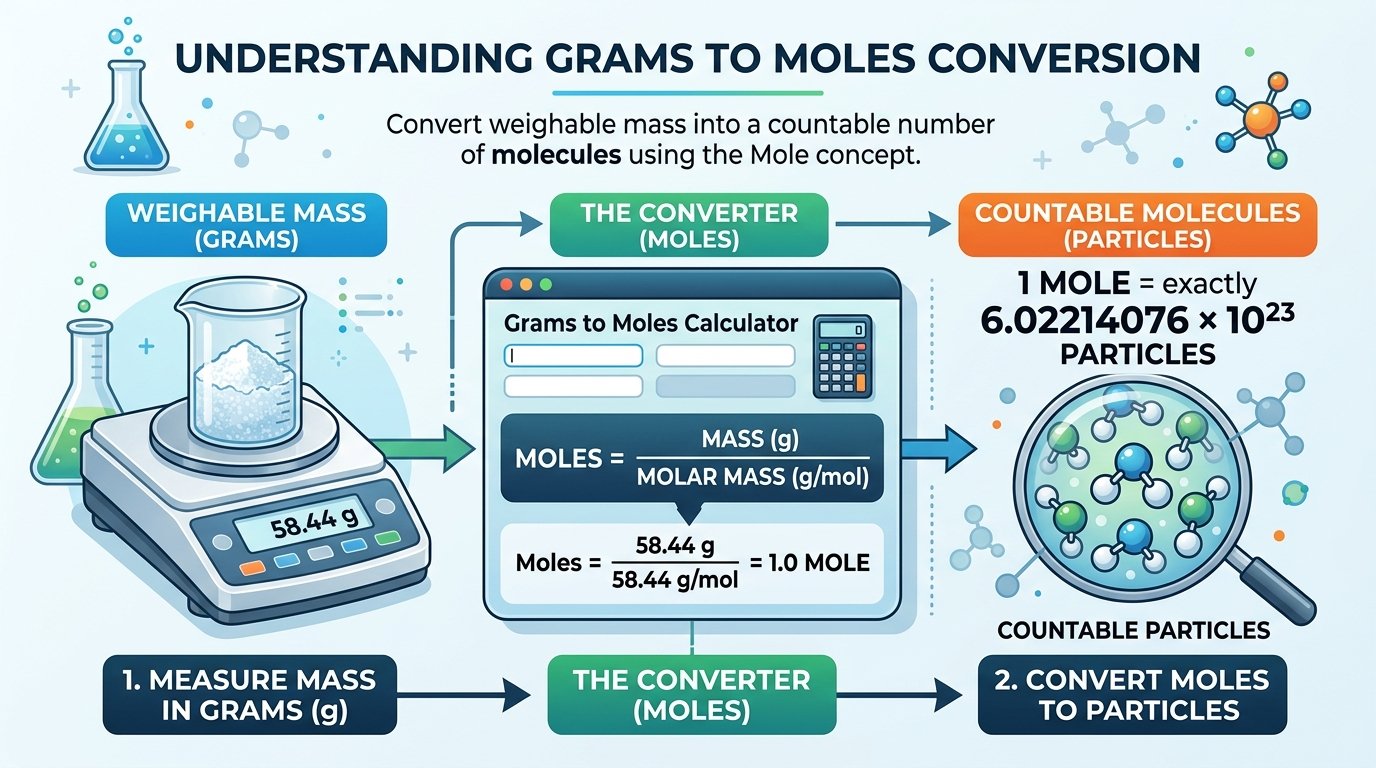
A grams to moles calculator is an online tool that converts a mass you can weigh on a balance into an amount of substance you can use in chemistry — moles. The bridge between the two is the molar mass: the mass of one mole of a compound in grams per mole, computed by adding up the atomic masses of every atom in the formula.
Why does this conversion matter so much? Because balances speak in grams but chemical equations speak in moles. The equation 2H₂ + O₂ → 2H₂O doesn’t say “2 grams of hydrogen react with 1 gram of oxygen” — it says two moles react with one mole. Every stoichiometry problem, every solution recipe, every yield calculation begins by translating grams into moles, and ends by translating back.
What makes this particular grams to moles calculator a complete converter is that it handles the whole family of mole conversions in one panel: g → mol and mol → g in both directions with mg/kg and mmol units, molar mass with percent composition, particle counts through the exact Avogadro constant, and the lab-bench favorite — grams to weigh out for a target molarity and volume.
💡 Quick definition: moles = grams ÷ molar mass (g/mol). One mole is exactly 6.02214076 × 10²³ particles — so converting grams to moles is really converting a weighable mass into a countable number of molecules. Our grams to moles calculator does both at once.
How to Use This Grams to Moles Calculator
Using this grams to moles calculator takes under ten seconds — no sign-up, any device:
- Pick a mode. Grams → Moles, Moles → Grams, Molar Mass, Particles & Atoms, or Solution Prep — the pill tabs switch instantly.
- Type the formula. Standard notation, capitalization matters (Co is cobalt, CO is carbon monoxide). Parentheses and hydrates work: Al2(SO4)3, CuSO4·5H2O. Example chips load water, salt, glucose and more in one tap.
- Enter the amount and unit. Mass in mg, g or kg; amount in mol or mmol; volume in mL or L — the tool converts units automatically.
- Calculate, export, reset. The answer box shows the headline result; below come the steps, an element-by-element table and a bar graph. Copy, download CSV/TXT, print, share to WhatsApp/Facebook/X — then ↺ Reset for the next problem. History keeps your last ten results.
Every atomic mass comes from the same IUPAC 2021 dataset that powers our molecular weight calculator and atomic mass calculator, so cross-checking between tools always agrees to the last digit.
The 5 Modes of Our Grams to Moles Calculator Explained
⚖️ Mode 1 — Grams → Moles
The headline act of the grams to moles calculator. Formula plus mass (mg, g or kg) in — moles out, with the molar mass shown, the millimole equivalent, the molecule count via Avogadro’s number, and a percent-composition table revealing where the mass actually sits. 10 g of water = 0.5551 mol; 58.44 g of NaCl = exactly 1 mol.
🔁 Mode 2 — Moles → Grams
The reverse trip through the grams to moles calculator, used every time a procedure says “take 0.25 mol”: mass = moles × molar mass. 0.25 mol of glucose = 45.039 g — the number your balance needs. Accepts mol or mmol, because real prep work lives in millimoles.
🧪 Mode 3 — Molar Mass
The conversion factor behind every grams to moles calculator, examined. Any formula returns its molar mass with an element-by-element breakdown — atoms, atomic mass, subtotal and percent of total mass — plus a bar graph of the composition. CuSO₄·5H₂O comes to 249.68 g/mol, and the table shows the five waters carrying 36% of it.
🔬 Mode 4 — Particles & Atoms
The mole made visible by the grams to moles calculator. Enter grams or moles and get formula units AND total atoms — 2 mol of H₂O is 1.204 × 10²⁴ molecules containing 3.613 × 10²⁴ atoms. The Avogadro constant used is the exact 2019 SI value, not an approximation.
💧 Mode 5 — Solution Prep
The bench favorite: grams = molarity × volume (L) × molar mass. Ask for 500 mL of 0.1 M NaCl and the grams to moles calculator says: weigh 2.922 g — with the moles, the unit conversion and a volumetric-flask tip included. For dilutions and concentration conversions afterwards, our molarity calculator picks up where this mode ends.
The One Formula You Need
Every conversion a grams to moles calculator performs — no exceptions — is one triangle of three quantities:
moles = grams ÷ molar mass · grams = moles × molar mass · molar mass = grams ÷ moles
Cover the quantity you want with your thumb and the triangle tells you what to do with the other two. Grams sit on top; moles and molar mass sit below. Want moles? Divide grams by molar mass. Want grams? Multiply moles by molar mass. Want the molar mass of a mystery compound? Divide the grams you weighed by the moles you measured — that’s actually how experimental molar masses are determined.
The units police themselves: g ÷ (g/mol) = mol, and mol × (g/mol) = g. If your units don’t cancel to what you wanted, you inverted the operation — the single most common error in this chapter, and one a grams to moles calculator makes impossible.
Elements vs compounds: one small trap
For a compound, the molar mass is the sum over the formula — no ambiguity. For an element, ask one question first: atoms or molecules? Iron is monatomic, so 10 g of Fe is 10 ÷ 55.845 = 0.1791 mol of iron atoms. But oxygen gas is diatomic: 10 g of O₂ is 10 ÷ 31.998 = 0.3125 mol of O₂ molecules (containing 0.625 mol of O atoms). Exams love this distinction, and the seven diatomic elements — H₂, N₂, O₂, F₂, Cl₂, Br₂, I₂ — are worth memorizing with the classic mnemonic “Have No Fear Of Ice Cold Beer.” Type the formula as it exists physically (O2, not O) and the grams to moles calculator handles the rest; the particles mode will even show you molecules and atoms side by side so the difference stops being abstract.
⚗️ Pro workflow: Mode 3 to see the molar mass and composition → Mode 1 to convert your weighed grams to moles → Mode 4 if the question asks for molecules or atoms → Mode 5 when the moles are destined for a flask. Four tabs, one mole concept, zero unit errors — and a ↺ Reset between problems keeps every entry honest.
Why Chemists Count in Moles at All
Atoms are absurdly small, so any workable sample contains an absurd number of them. A teaspoon of water holds more molecules than there are grains of sand on Earth. Counting them one by one is impossible — so chemists count them by weighing, the way a bank counts coins by putting them on a scale.
The mole — the unit at the heart of every grams to moles calculator — is the fixed “roll of coins”: exactly 6.02214076 × 10²³ particles. The genius of the definition is that one mole of any substance weighs its molar mass in grams. One mole of carbon-12 is about 12 g; one mole of water is 18.015 g; one mole of table salt is 58.44 g. Different masses, identical particle counts — which is exactly what reactions care about, because molecules react with molecules, not grams with grams.
That’s why the grams-to-moles conversion opens nearly every quantitative problem: our stoichiometry calculator converts grams to moles before touching any mole ratio, and every titration, yield and dilution calculation does the same silent first step. Master this one conversion and half the chemistry syllabus becomes arithmetic.
Molar Mass: The Conversion Factor Explained
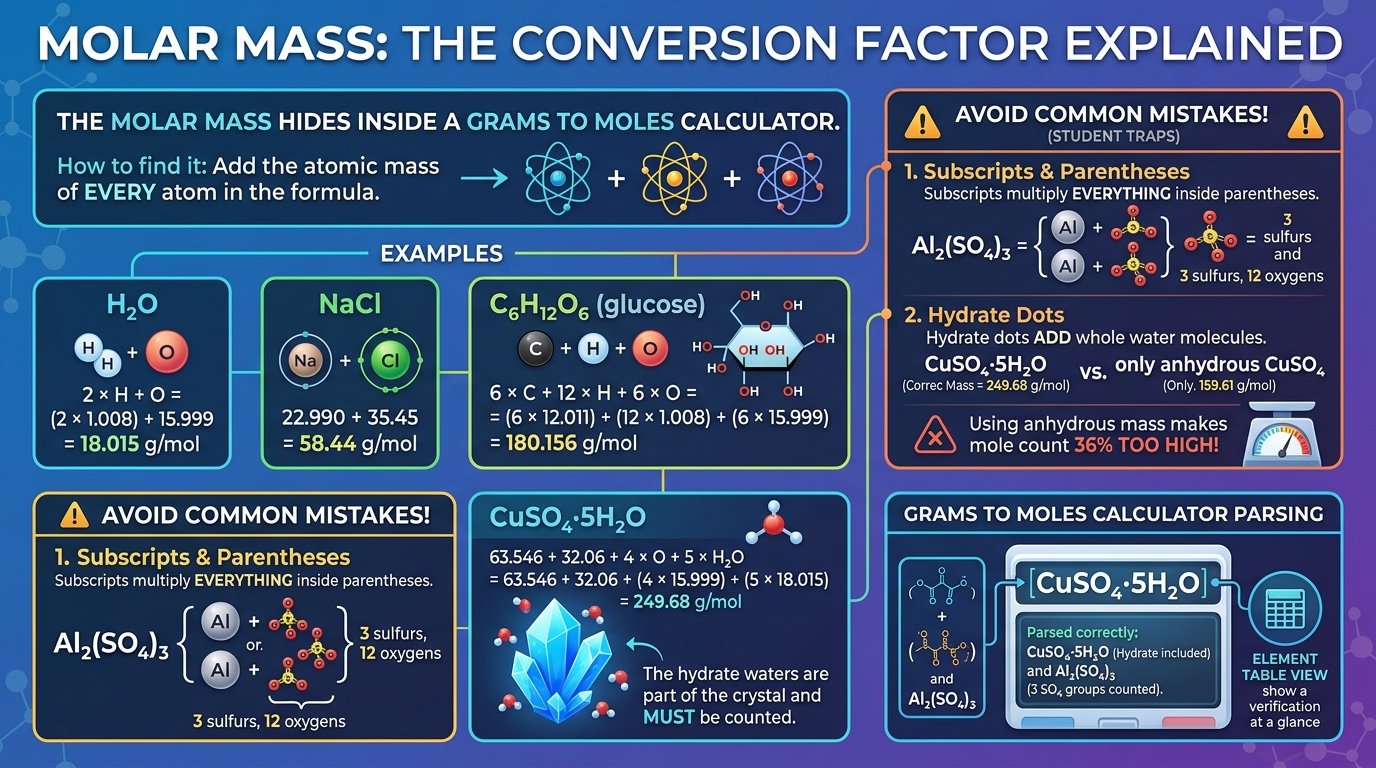
The molar mass is where all the chemistry inside a grams to moles calculator hides. To find it, add the atomic mass of every atom in the formula:
- H₂O: 2 × 1.008 + 15.999 = 18.015 g/mol
- NaCl: 22.990 + 35.45 = 58.44 g/mol
- C₆H₁₂O₆ (glucose): 6 × 12.011 + 12 × 1.008 + 6 × 15.999 = 180.156 g/mol
- CuSO₄·5H₂O: 63.546 + 32.06 + 4 × 15.999 + 5 × 18.015 = 249.68 g/mol — the hydrate waters are part of the crystal and MUST be counted.
Two details trip students constantly. First, subscripts multiply everything inside parentheses: Al2(SO4)3 contains three complete sulfate groups — 3 sulfurs and 12 oxygens. Second, hydrate dots add whole water molecules: weighing CuSO₄·5H₂O but using the anhydrous 159.61 g/mol makes every subsequent mole count 36% too high. The grams to moles calculator parses both correctly and shows the element table so you can verify at a glance. For the deeper theory of formula weights — ionic compounds, formula units and more — see our formula weight calculator for ionic compounds.
Worked Examples, Step by Step
Example 1 — Grams to moles: 10.0 g of water
- Molar mass: H₂O = 2 × 1.008 + 15.999 = 18.015 g/mol.
- Divide: 10.0 ÷ 18.015 = 0.5551 mol.
- Sense check: 10 g is a bit over half of 18 g, so a bit over half a mole ✓.
Example 2 — Moles to grams: 0.25 mol of glucose
- Molar mass: C₆H₁₂O₆ = 180.156 g/mol.
- Multiply: 0.25 × 180.156 = 45.039 g — the number you set the balance to.
Example 3 — The hydrate trap: 24.97 g of CuSO₄·5H₂O
- Correct molar mass (with the 5 waters): 249.68 g/mol → 24.97 ÷ 249.68 = 0.1000 mol ✓.
- Wrong molar mass (anhydrous 159.61): would give 0.1565 mol — a 56% error that would poison every later step. The blue crystals contain water; the formula must too.
Run all three in the free grams to moles calculator above and compare its printed steps against yours — a mismatch instantly shows which line went wrong.
10 g of Common Compounds — How Many Moles?
The same 10 grams is a very different number of moles depending on the compound — every row verified with the grams to moles calculator above:
| Compound | Formula | Molar mass (g/mol) | Moles in 10 g |
|---|---|---|---|
| Water | H₂O | 18.015 | 0.5551 |
| Ammonia | NH₃ | 17.031 | 0.5872 |
| Sodium hydroxide | NaOH | 39.997 | 0.2500 |
| Carbon dioxide | CO₂ | 44.009 | 0.2272 |
| Table salt | NaCl | 58.44 | 0.1711 |
| Sulfuric acid | H₂SO₄ | 98.08 | 0.1020 |
| Calcium carbonate | CaCO₃ | 100.09 | 0.0999 |
| Potassium permanganate | KMnO₄ | 158.03 | 0.0633 |
| Glucose | C₆H₁₂O₆ | 180.156 | 0.0555 |
| Copper sulfate pentahydrate | CuSO₄·5H₂O | 249.68 | 0.0401 |
Notice the fourteen-fold spread: 10 g of water is 0.56 mol, but 10 g of the blue copper hydrate is only 0.04 mol. Mass tells you almost nothing about amount until the molar mass enters the conversation — which is the whole reason a grams to moles calculator exists, and why this grams to moles calculator always prints the molar mass beside every answer.
From Moles to Molecules: Avogadro’s Number
Moles are ultimately a count in disguise, and sometimes you need the actual count:
particles = moles × 6.02214076 × 10²³ (exact, 2019 SI definition)
So the grams to moles calculator reports: 10 g of water = 0.5551 mol = 3.34 × 10²³ molecules — and since each H₂O holds three atoms, just over 10²⁴ atoms in two teaspoons of water. Mode 4 of the grams to moles calculator runs the whole chain (grams → moles → molecules → atoms) in one click and prints each hop separately.
Since the 2019 SI redefinition, Avogadro’s number is exact by definition — the mole is no longer tied to a physical lump of platinum-iridium or even to carbon-12, but to a fixed count. Weighing became counting, officially. For the story of how chemists pinned that number down, jump to the history section below.
Who Uses a Grams to Moles Calculator?
Students — matric, FSc, MDCAT, NEET, A-Levels, university
The mole concept is the gateway chapter: get it, and stoichiometry, solutions and gas laws open up; miss it, and everything after is fog. A grams to moles calculator that prints its steps is a tutor on call — verify each homework line, find exactly where a calculation diverged, and learn the rhythm by repetition.
Teachers and Tutors
With a grams to moles calculator open, generate clean example sets in minutes, project the percent-composition table to explain where a compound’s mass lives, and use the particle mode to make 10²³ feel real. The history panel keeps your last ten examples ready during a lesson.
Lab Professionals
A grams to moles calculator earns its bench space through solution prep: Mode 5 turns “500 mL of 0.1 M” into “weigh 2.922 g” instantly, hydrates handled correctly. The CSV export drops straight into a lab notebook, and the print view makes a tidy bench record.
Pharma, Food and Industry
Dosing active ingredients, scaling recipes, converting certificates of analysis — anywhere a specification says milligrams but the chemistry thinks in millimoles, this conversion runs in the background. A tablet of paracetamol (500 mg, molar mass 151.16) is 3.31 mmol — that’s a grams to moles calculation in the wild.

One Lab Task, Start to Finish
Here’s a complete bench task solved with this grams to moles calculator, mode by mode. Task: prepare 250 mL of 0.200 M potassium permanganate, and report how many KMnO₄ formula units the flask will contain.
- Mode 3 — molar mass: KMnO₄ = 39.098 + 54.938 + 4 × 15.999 = 158.03 g/mol (the table shows oxygen carrying 40.5% of the mass).
- Mode 5 — solution prep: 0.200 mol/L × 0.250 L = 0.0500 mol → 0.0500 × 158.03 = 7.902 g to weigh. Dissolve in ~200 mL, then fill to the mark.
- Mode 4 — particles: 0.0500 mol × 6.02214076 × 10²³ = 3.011 × 10²² formula units in the flask.
- Sanity check in Mode 1: 7.902 g ÷ 158.03 = 0.0500 mol ✓ — the loop closes.
Four modes of one grams to moles calculator, one flask, under two minutes — and a ↺ Reset between steps keeps every entry clean.
A Short History of the Mole
The conversion inside every modern grams to moles calculator took two centuries to build:
1811 — Avogadro’s hypothesis. Amedeo Avogadro proposed that equal volumes of gases contain equal numbers of particles — the first hint that counting molecules by bulk measurement was possible. His idea was largely ignored for half a century.
1860 — Karlsruhe. At the first international chemistry congress, Stanislao Cannizzaro used Avogadro’s principle to untangle atomic weights, giving chemistry a consistent mass scale at last.
1894 — the word “mole.” Wilhelm Ostwald coined Mol (from the Latin moles, “massive heap”) for the gram-molecular-weight of a substance — ironically, Ostwald was then still a skeptic of atoms.
1909 — counting the heap. Jean Perrin’s experiments on Brownian motion measured Avogadro’s number and settled the reality of atoms, earning the 1926 Nobel Prize. Perrin also proposed naming the constant after Avogadro.
1971 — SI base unit. The mole joined the metre, kilogram and second as a base unit of the SI, defined via 12 g of carbon-12.
2019 — the exact count. The SI redefinition fixed Avogadro’s constant at exactly 6.02214076 × 10²³ mol⁻¹. The mole is now a pure number of particles — and every conversion this grams to moles calculator performs rests on that exact count.
Grams and Moles in Everyday Life
- A paracetamol tablet (500 mg, molar mass 151.16 g/mol) delivers 3.31 mmol — dosing is pharmacology’s own grams to moles calculator moment, because receptors count molecules, not milligrams.
- A teaspoon of sugar (~4 g of sucrose, 342.30 g/mol) is 0.0117 mol — about 7 × 10²¹ molecules dissolving in your tea.
- A glass of water (250 g) is 13.9 mol — roughly 8.4 × 10²⁴ molecules, more than a million times Earth’s population, swallowed in ten seconds.
- ORS sachets list sodium in millimoles per liter precisely because rehydration chemistry runs on particle counts — the label is a moles calculation you drink.
- Fertilizer bags quote nitrogen percentages that agronomists convert to moles per hectare to match crop uptake — a field-scale grams to moles calculation.
- Baking soda in a recipe (5 g of NaHCO₃, 84.01 g/mol → 0.0595 mol) releases a predictable 0.0595 mol of CO₂ — about 1.45 liters of gas lifting your cake.
Practice Problems (Try Them, Then Check With the Calculator)
Paper first, grams to moles calculator second — that is how the tool builds skill instead of replacing it. Answers hide under each problem.
Problem 1 — How many moles are in 25.0 g of CaCO₃?
Answer: Molar mass = 40.078 + 12.011 + 3 × 15.999 = 100.09 g/mol. Moles = 25.0 ÷ 100.09 = 0.2498 mol.
Problem 2 — What mass is 0.75 mol of NaCl?
Answer: mass = 0.75 × 58.44 = 43.83 g. Mode 2 confirms with the same two steps.
Problem 3 — Molar mass of Al₂(SO₄)₃?
Answer: 2 × 26.982 + 3 × 32.06 + 12 × 15.999 = 53.964 + 96.18 + 191.988 = 342.13 g/mol. The parentheses multiply everything inside by 3.
Problem 4 — How many molecules are in 9.0 g of water?
Answer: 9.0 ÷ 18.015 = 0.4996 mol; × 6.02214076 × 10²³ = 3.01 × 10²³ molecules (and three times as many atoms). Mode 4 runs the whole chain.
Problem 5 — Grams of KMnO₄ for 250 mL of 0.200 M solution?
Answer: moles = 0.200 × 0.250 = 0.0500 mol; grams = 0.0500 × 158.03 = 7.90 g. Mode 5 prints the identical recipe.
Tips for Accurate Results Every Time
- Let the units decide the operation. g ÷ (g/mol) = mol. If the units don’t cancel, you inverted it — no memorization needed.
- Count the hydrate waters. CuSO₄·5H₂O is 249.68 g/mol, not 159.61. If the bottle says hydrate, the formula must too.
- Watch capitalization. Co is cobalt; CO is carbon monoxide — a one-letter typo changes the molar mass completely. The grams to moles calculator flags unknown symbols instantly.
- Convert units before dividing. 500 mg is 0.500 g; 2.5 kg is 2500 g. Mode 1’s unit menu does it for you — on paper, do it first, separately.
- Keep four decimals mid-chain, round at the end. Rounding the molar mass to 18 instead of 18.015 shifts a 10 g conversion by nearly 0.1%.
- Reset between problems. A stale formula in the box is the fastest route to a confident wrong answer — one ↺ click prevents it.
5 Common Mistakes to Avoid
A decade of marking mole-concept papers, and years of grams to moles calculator support emails, produce the same five errors on repeat:
- Multiplying when you should divide. “10 g of water × 18.015 = 180 mol” — the classic. Units would have screamed: g × g/mol is not mol. Grams ÷ molar mass, always.
- Using atomic instead of molecular mass. Converting 10 g of O₂ with 16 instead of 32 g/mol doubles the answer. Oxygen gas is diatomic; so are H₂, N₂, Cl₂ and friends.
- Ignoring parentheses. Reading Al2(SO4)3 as one sulfate instead of three loses 191 g/mol. Expand the formula mentally — or let the parser do it.
- Dropping the hydrate. Weighing the pentahydrate but calculating with the anhydrous mass inflates the mole count by 56%. Every downstream molarity inherits the error.
- Confusing moles with molarity. Moles measure amount; molarity measures concentration (mol per liter). This grams to moles calculator gives amounts — for concentrations, our molarity calculator is the right tool.
What Makes This Grams to Moles Calculator Different?
| Feature | This Tool | Typical Converter |
|---|---|---|
| Both directions: g → mol AND mol → g | ✅ | One way |
| mg/g/kg, mol/mmol and mL/L units built in | ✅ | ❌ |
| Hydrate & parentheses parsing (CuSO4·5H2O) | ✅ | Partial |
| Percent composition table + graph with every result | ✅ | ❌ |
| Molecules AND total atoms via exact Avogadro constant | ✅ | ❌ |
| Solution prep: grams for a target molarity & volume | ✅ | ❌ |
| Step-by-step working printed for every mode | ✅ | Answer only |
| One-click ↺ Reset per mode | ✅ | ❌ |
| Copy / CSV / TXT / print / share + history · free, no limits | ✅ | Varies |
The design goal: one grams to moles calculator that covers the entire mole-concept chapter — conversion, composition, counting and solution prep — in a single blue panel, with a record you can print, save or send to a lab partner.
Where the Data Comes From
Every atomic mass in this free grams to moles calculator is drawn from the standard atomic weights published by IUPAC and maintained by CIAAW (2021 values, all 118 elements). The Avogadro constant is the exact SI value fixed in the 2019 redefinition.
The same dataset powers our molecular weight calculator, atomic mass calculator, formula weight calculator for ionic compounds, stoichiometry calculator and exact mass calculator — so every tool on this site returns identical molar masses. For primary references, see the NIST Chemistry WebBook and Wikipedia’s mole (unit) article. Updates follow our Corrections Policy.
Quick Exam Checklist: Grams ↔ Moles in 60 Seconds
- ✅ moles = grams ÷ molar mass — and grams = moles × molar mass.
- ✅ Molar mass first: sum every atom’s IUPAC mass; parentheses multiply; hydrate waters count.
- ✅ Diatomic gases: O₂ is 32, not 16; N₂ is 28; H₂ is 2.016.
- ✅ Units before math: mg → g, kg → g, mL → L.
- ✅ Particles = moles × 6.02214076 × 10²³ (exact since 2019).
- ✅ Solution prep: grams = M × V(L) × molar mass.
- ✅ Sense check: mass smaller than one molar mass → less than one mole.
- ✅ Reset, then verify — every answer goes through the grams to moles calculator above before submitting.
Frequently Asked Questions
How do I convert grams to moles?
Divide the mass in grams by the compound’s molar mass in g/mol: moles = grams ÷ molar mass. For 10 g of water: 10 ÷ 18.015 = 0.5551 mol. This grams to moles calculator computes the molar mass automatically from the formula and shows both steps.
How do I convert moles back to grams?
Multiply: grams = moles × molar mass. 0.25 mol of glucose × 180.156 g/mol = 45.039 g. Mode 2 of the calculator does exactly this, with mol and mmol units.
What is molar mass and where does it come from?
Molar mass is the mass of one mole of a substance in g/mol, found by summing the IUPAC atomic masses of every atom in the formula — H₂O = 2 × 1.008 + 15.999 = 18.015 g/mol. It is numerically equal to the molecular weight.
Does the calculator handle hydrates like CuSO4·5H2O?
Yes — this grams to moles calculator reads the hydrate dot as five full water molecules, giving 249.68 g/mol instead of the anhydrous 159.61. Parentheses like Al2(SO4)3 are parsed correctly too.
How many molecules are in one mole?
Exactly 6.02214076 × 10²³ — Avogadro’s number, fixed as an exact value by the 2019 SI redefinition. Mode 4 converts grams or moles into molecules and total atoms in one click.
What is the difference between moles and molarity?
Moles measure amount of substance; molarity measures concentration — moles per liter of solution. A grams to moles calculator converts masses and amounts; for concentration and dilution problems, use our molarity calculator.
How many grams do I need for a solution of given molarity?
grams = molarity × volume in liters × molar mass. For 500 mL of 0.1 M NaCl: 0.1 × 0.5 × 58.44 = 2.922 g. Mode 5 prints this exact recipe with a volumetric-flask tip.
Why is capitalization important in formulas?
Element symbols are case-sensitive: Co is cobalt (58.933) but CO is carbon monoxide (28.010). The parser reads an uppercase letter as the start of a new element, so typos change the compound entirely — unknown symbols are flagged immediately.
What does the Reset button do?
Each mode’s ↺ Reset clears that panel’s inputs and results in one click — a clean slate for the next conversion. Your saved history stays until you press Clear All.
Is this grams to moles calculator free?
Yes, this grams to moles calculator is completely free — no registration, no daily limits. All five modes, exports, sharing and history work for everyone on any device, and calculations run in your browser for privacy.
10 Mole Facts Worth Knowing
Favorites from a decade of teaching the mole concept — each checkable in seconds with the grams to moles calculator above:
- Avogadro never knew “his” number. He proposed the equal-volumes principle in 1811; the constant was first measured decades after his death and named in his honor by Jean Perrin.
- Since 2019 the number is exact: 6.02214076 × 10²³ — not a measurement anymore, but a definition. Weighing officially became counting.
- A mole of water is a sip; a mole of sand grains would bury Pakistan under kilometers of sand. Same count, wildly different bulk — that’s molar mass at work.
- Chemists celebrate Mole Day every October 23 from 6:02 a.m. to 6:02 p.m. (10/23 at 6:02 — read the constant).
- One mole of marshmallows would cover Earth to a depth of about 100 km. The number only sounds abstract until you scale it.
- “Mole” comes from the Latin for “massive heap” — coined by Wilhelm Ostwald in 1894, who at the time didn’t even believe in atoms.
- The 12 g of carbon-12 era is over: the mole was tied to carbon-12 from 1971 to 2019; today it’s a pure count, and carbon-12’s molar mass is now measured, not defined.
- Your body converts moles daily: blood glucose is reported in mmol/L in most of the world — a normal fasting level of 5 mmol/L is 0.9 g per liter of blood.
- Perrin’s mole-counting won a Nobel Prize (1926) — measuring Avogadro’s number via Brownian motion finally silenced the last skeptics of atomic theory.
- The heaviest everyday conversion factor: among common lab chemicals, CuSO₄·5H₂O at 249.68 g/mol packs the biggest hydrate surprise — 36% of its mass is just water.
Trusted resources for going deeper
- IUPAC Periodic Table of Elements — official standard atomic weights.
- CIAAW — atomic weight evaluations behind every molar mass.
- NIST Chemistry WebBook — reference data for thousands of compounds.
- Mole (unit) — Wikipedia — history and the 2019 redefinition.
Final Thoughts: Bookmark This Grams to Moles Calculator
The grams-to-moles conversion is the quiet workhorse of chemistry — the first line of nearly every stoichiometry problem, solution recipe and dosage calculation ever written. Master the one-formula triangle (moles = grams ÷ molar mass), respect hydrates and parentheses, and let a grams to moles calculator verify every line — and the most feared chapter of the syllabus becomes pure routine. A fast, IUPAC-accurate grams to moles calculator that shows its working makes the routine effortless.
The tool above covers the whole chapter: grams ↔ moles both ways with real units, molar mass with percent composition, molecules and atoms via the exact Avogadro constant, and lab-ready solution prep — with steps, tables, graphs, exports, history and one-click resets, free and unlimited. Try this grams to moles calculator with tonight’s homework; and for the rest of the calculation chain, our molecular weight calculator, atomic mass calculator, formula weight calculator for ionic compounds, molarity calculator, stoichiometry calculator and exact mass calculator stand ready on the same data.
Found a bug, or want a feature — maybe gas volumes at STP? Tell us via the contact page or read about this project. Several tools on this site began as user suggestions.
Written & Reviewed By
Ahmad Raza, M.Phil. Chemistry
Ahmad is a chemistry educator and science content developer with over 10 years of experience teaching analytical and physical chemistry. He builds free calculation tools that help students and lab professionals work faster and make fewer errors. When he’s not balancing equations, he’s usually grading titration reports.
Pingback: Exact Mass Calculator: Monoisotopic Mass & Mass Defect
Pingback: Stoichiometry Calculator: 8 Powerful Free Features
Pingback: Molarity Calculator – Moles, Mass, Volume & Dilution
Pingback: Formula Weight Calculator for Ionic Compounds
Pingback: Atomic Mass Calculator: Exact Isotopic Average [100% Free]