
Molecular weight calculator: enter a chemical formula such as H2O, C6H12O6, Ca(OH)2 or CuSO4·5H2O to instantly compute molar mass in g/mol, atom counts, percent composition by mass, grams-to-moles conversion, solution preparation mass, batch comparison of up to 15 formulas, and per-element mass in a sample. Uses IUPAC standard atomic weights. Free, no registration.
🧪 Molecular Weight Calculator
Calculate molar mass, percent composition, grams ↔ moles, solution recipes & batch comparisons — with interactive tables and graphs, instantly.
✅ Trusted by Students, Teachers & Lab Professionals WorldwideMolecular Weight & Percent Composition
Enter a chemical formula — e.g. H2O, C6H12O6, Ca(OH)2, CuSO4·5H2O
Grams ↔ Moles Converter
Convert between mass and moles using the molar mass of any compound.
Molarity / Solution Preparation
Find how many grams of solute you need for a target molarity and volume.
Batch Compare (Multiple Formulas)
One formula per line (max 15) — compare molecular weights side by side with a graph.
Element Mass Finder
How many grams of each element are inside your sample? Enter formula + sample mass.
🕘 Recent Calculations Clear All
A molecular weight calculator is the fastest way to find the molar mass of any chemical compound without touching a periodic table. Type a formula like H2O or C6H12O6, press one button, and the answer appears in a fraction of a second — along with atom counts, percent composition, and a visual graph.
That’s exactly what the free tool above does. But it goes much further than the average molecular weight calculator you’ll find online. It converts grams to moles, plans laboratory solutions, compares up to fifteen compounds at once, and even tells you how many grams of each element are hiding inside your sample.
In this guide, I’ll show you how to use every feature, walk through hand calculations step by step, and answer the questions students and lab professionals ask me most often. Let’s dive in.
🔑 KEY TAKEAWAY
A molecular weight calculator is a free online tool that computes the molar mass of any chemical compound in g/mol by multiplying each element’s IUPAC atomic mass by its atom count and summing the results. The calculator on this page offers five modes — molecular weight with percent composition, grams-to-moles conversion, molarity solution preparation, batch comparison of up to 15 formulas, and element mass finding — with interactive tables, graphs, and one-click copy, CSV/TXT download, print and share options. It supports hydrates (CuSO4·5H2O), parentheses, brackets, and auto-corrects lowercase input.
📑 Table of Contents (click to expand)
- What Is a Molecular Weight Calculator?
- How to Use This Molecular Weight Calculator
- The 5 Modes Explained
- Why Molecular Weight Matters in Chemistry
- Molecular Weight vs Molar Mass vs Formula Weight
- How to Calculate Molecular Weight by Hand
- Molecular Weight Table of 25 Common Compounds
- Grams to Moles: The Conversion Everyone Gets Wrong
- Who Uses a Molecular Weight Calculator?
- Tips for Accurate Results
- Common Mistakes to Avoid
- What Makes This Tool Different
- Where the Atomic Weights Come From
- Percent Composition & Empirical Formulas
- Molar Mass of Gases
- Practice Problems With Answers
- Molecular Weight in Everyday Life
- Study Tips for Students
- Calculator vs Apps vs Periodic Table
- Best Practices Checklist
- Trusted Reference Resources
- Frequently Asked Questions
- Final Thoughts
What Is a Molecular Weight Calculator?
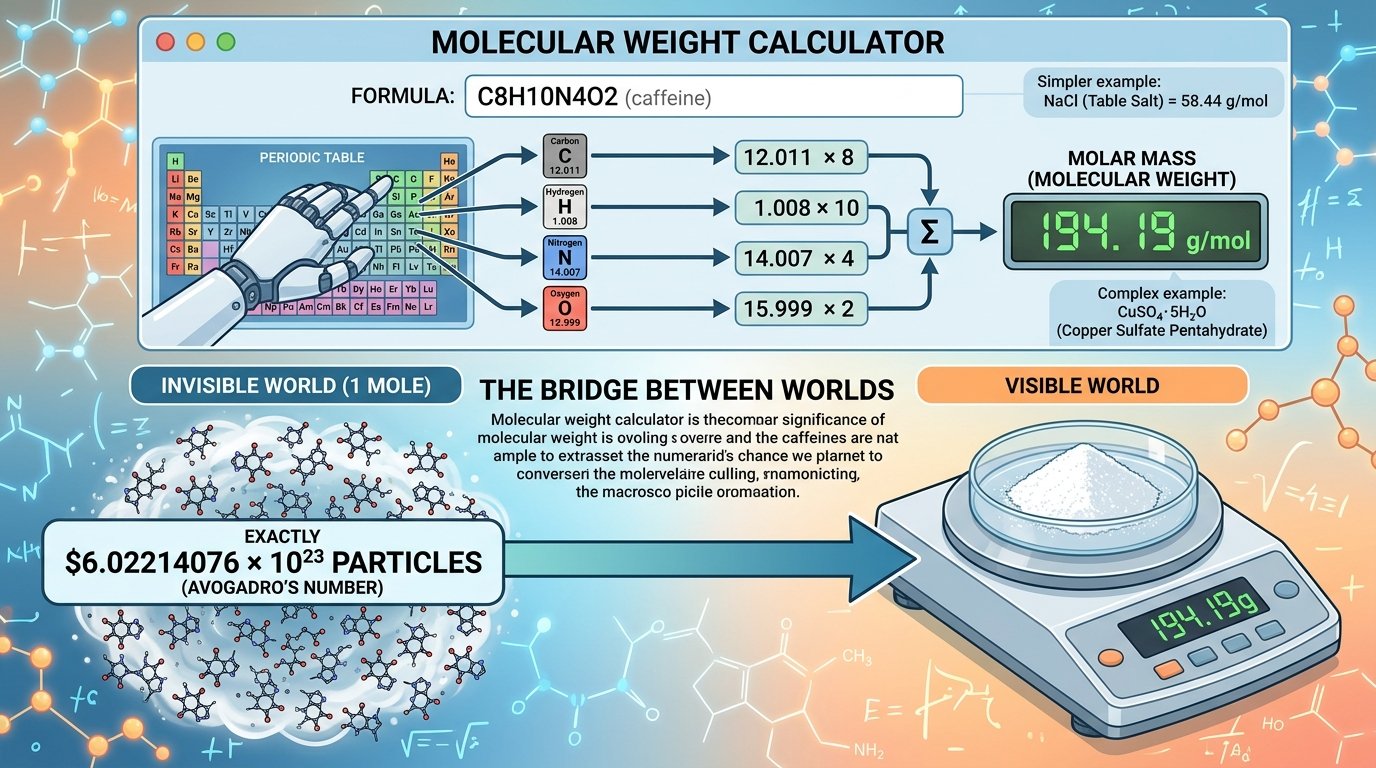
A molecular weight calculator is an online tool that reads a chemical formula, looks up the atomic mass of every element in it, multiplies each mass by the number of atoms, and adds everything together. The result is the molecular weight — also called molar mass — expressed in grams per mole (g/mol).
Take table salt, NaCl. Sodium weighs 22.990 u and chlorine weighs 35.45 u. Add them and you get 58.44 g/mol. Simple enough for two atoms. Now try doing that for caffeine (C8H10N4O2) or copper sulfate pentahydrate (CuSO4·5H2O) during a timed exam. That’s where a molecular weight calculator earns its keep.
One mole of any substance contains exactly 6.02214076 × 10²³ particles — Avogadro’s number. So when the calculator tells you glucose weighs 180.16 g/mol, it means 180.16 grams of glucose contains that unimaginably large number of molecules. This single idea connects the invisible world of atoms to the grams you can actually weigh on a balance.
💡 Quick definition: Molecular weight = the sum of (atomic mass × atom count) for every element in a formula. Our molecular weight calculator does this instantly using official IUPAC atomic masses.
How to Use This Molecular Weight Calculator
I designed the molecular weight calculator at the top of this page to work the way people actually think. No sign-ups, no ads blocking the input box, no “premium” upsell. Here’s the whole process:
- Pick a mode. The default tab handles standard molecular weight. Four more tabs cover conversions, solutions, batch comparison and element masses.
- Type your formula. Capitalization matters in chemistry — CO is carbon monoxide, Co is cobalt — but if you type h2so4 in a hurry, the smart auto-fix corrects it and tells you it did.
- Hit Calculate. You’ll get the molecular weight, a full element breakdown table, percent composition, and an animated bar graph.
- Use the results. Copy them to your clipboard, download a CSV for Excel, save a TXT file, print a clean report, or share straight to WhatsApp, Facebook or X.
The molecular weight calculator accepts parentheses like Ca(OH)2, square brackets like K4[Fe(CN)6], and hydrate dots written three ways: CuSO4·5H2O, CuSO4.5H2O or CuSO4*5H2O. It also remembers your last ten calculations, so you can re-run yesterday’s formula with one click.
If you work with solutions often, bookmark our dedicated molarity calculator as well — it expands on Mode 3 with dilution support.
The 5 Modes of Our Molecular Weight Calculator Explained
Most tools stop at one number. This molecular weight calculator is really five tools sharing one clean interface. Here’s what each mode does and when you’d reach for it.
⚖️ Mode 1 — Molecular Weight & Percent Composition
The classic. Enter any formula and get the total molar mass plus a table showing every element’s atom count, atomic mass, subtotal and mass percentage. The animated graph makes it obvious, for example, that oxygen carries 88.8% of water’s mass even though hydrogen has twice the atoms. Great for homework checks and stoichiometry prep.
🔄 Mode 2 — Grams ↔ Moles Converter
The bridge between the balance and the equation. Enter a formula and a mass, and the tool divides by molar mass to give moles — or multiply the other way. It even estimates the number of molecules using Avogadro’s constant. This is the conversion every general chemistry exam tests, and our grams to moles guide covers the theory in more depth.
🧫 Mode 3 — Molarity / Solution Preparation
Tell it “I need 250 mL of 0.5 M NaOH” and it answers with an actual recipe: weigh 5.0 g, dissolve, top up to volume. Behind the scenes it computes moles = M × V, then mass = moles × molar mass. Lab technicians use this mode more than any other, because it removes the arithmetic step where most solution-prep errors happen.
📊 Mode 4 — Batch Compare
Paste up to fifteen formulas, one per line, and get a sorted comparison table with a bar chart. Writing a report on sugars? Drop in glucose, fructose, sucrose and lactose and screenshot the graph. I haven’t seen another free molecular weight calculator offer side-by-side batch analysis like this.
🧬 Mode 5 — Element Mass Finder
Enter a formula and a sample mass, and the tool tells you how many grams of each element your sample contains. A 100 g bag of CaCO3? That’s 40.04 g of calcium, 12.0 g of carbon and 47.95 g of oxygen. Perfect for fertilizer analysis, nutrition chemistry and purity estimates.
Why Molecular Weight Matters in Chemistry
Chemical equations speak in moles, but every instrument in a lab speaks in grams. Molecular weight is the translator between the two languages, and almost nothing quantitative in chemistry works without it.
Consider a few everyday situations:
- Stoichiometry. “How many grams of oxygen react with 10 g of hydrogen?” You can’t answer without converting both to moles first.
- Solution preparation. Every buffer, reagent and titrant recipe starts with a molar mass lookup.
- Drug dosing. Pharmacologists convert between mg/L and µmol/L using molecular weight — a mistake here isn’t academic.
- Gas laws. PV = nRT needs moles, and moles need molar mass.
- Polymer and protein science. Molecular weight determines viscosity, strength, and how a protein migrates on an SDS-PAGE gel.
In short: if a calculation involves an amount of a chemical substance, a molecular weight calculator is usually the first tool you’ll open and the one you’ll come back to the most.
Molecular Weight vs Molar Mass vs Formula Weight
These three terms get mixed up constantly, and honestly, for day-to-day work the numbers come out identical. But the distinctions are worth knowing, especially if an exam question asks.
| Term | What It Describes | Unit | Typical Use |
|---|---|---|---|
| Molecular weight | Mass of one molecule relative to 1/12 of carbon-12 | u (dalton, Da) | Molecules — H2O, glucose, proteins |
| Molar mass | Mass of one mole (6.022 × 10²³ particles) of a substance | g/mol | All lab calculations |
| Formula weight | Same math, applied to ionic compounds that don’t form discrete molecules | u or g/mol | Salts — NaCl, CaCO3, KBr |
The subtle point: NaCl doesn’t exist as an individual “molecule” — it’s a crystal lattice of alternating ions — so purists say “formula weight” for salts. Numerically, though, a molecular weight calculator handles all three the same way, because the arithmetic is identical. You can read more on the formal definitions in this molar mass overview on Wikipedia.
How to Calculate Molecular Weight by Hand (Step by Step)
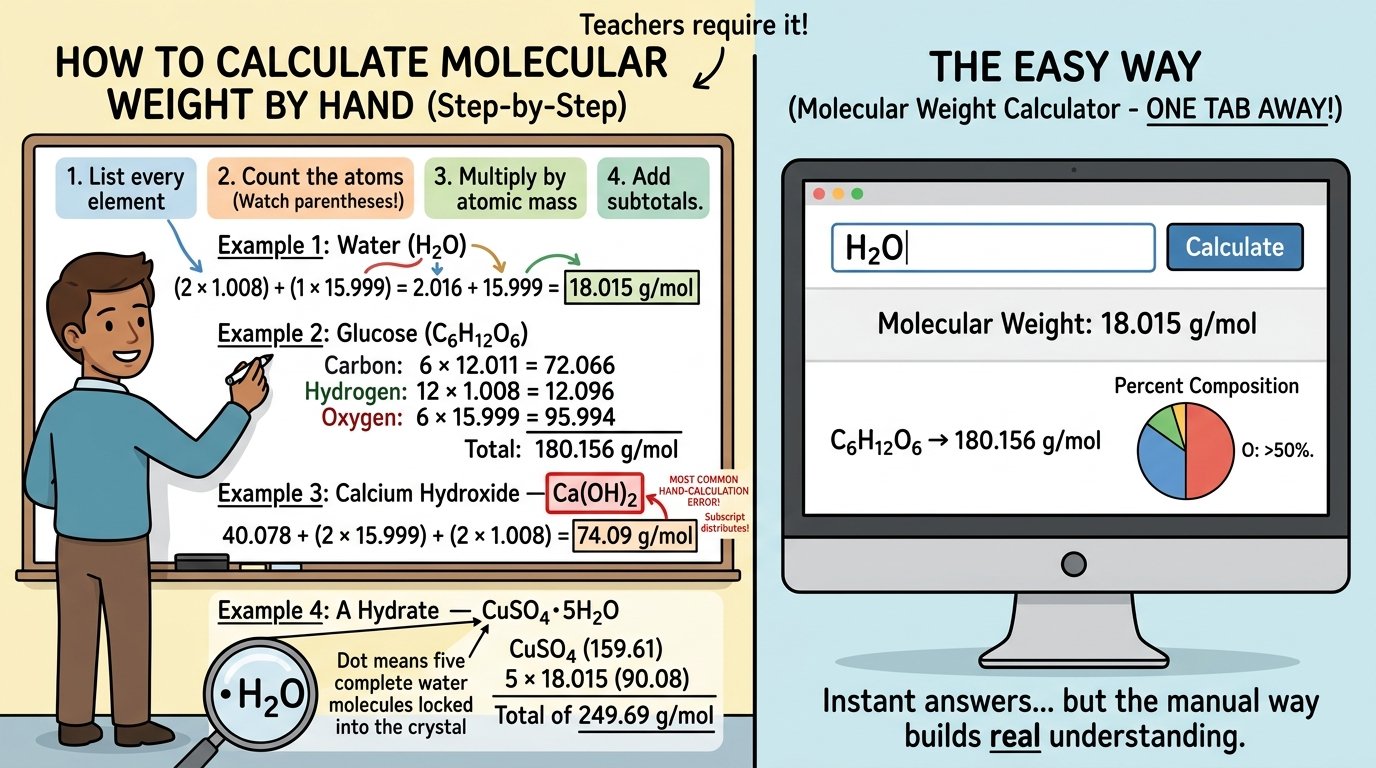
Even with a molecular weight calculator one tab away, you should be able to do this manually — teachers require it, and it builds real understanding. The method never changes:
Step 1: List every element in the formula.
Step 2: Count the atoms of each (watch the parentheses!).
Step 3: Multiply each count by that element’s atomic mass.
Step 4: Add all the subtotals. Done.
Example 1: Water (H2O)
Two hydrogens and one oxygen. So: (2 × 1.008) + (1 × 15.999) = 2.016 + 15.999 = 18.015 g/mol. Type H2O into the molecular weight calculator above and you’ll see the exact same figure.
Example 2: Glucose (C6H12O6)
Carbon: 6 × 12.011 = 72.066. Hydrogen: 12 × 1.008 = 12.096. Oxygen: 6 × 15.999 = 95.994. Total: 180.156 g/mol. Notice how oxygen contributes over half the mass — the percent composition graph shows this instantly.
Example 3: Calcium Hydroxide — Ca(OH)2
The subscript 2 outside the parentheses multiplies everything inside. So we have 1 Ca, 2 O, and 2 H: 40.078 + (2 × 15.999) + (2 × 1.008) = 74.09 g/mol. Forgetting to distribute that subscript is the single most common hand-calculation error I see.
Example 4: A Hydrate — CuSO4·5H2O
The dot means five complete water molecules are locked into the crystal. Calculate CuSO4 (159.61) and add 5 × 18.015 (90.08) for a total of 249.69 g/mol. Hydrates trip up almost everyone the first time; the molecular weight calculator above parses the dot notation automatically.
Molecular Weight Table of 25 Common Compounds
Bookmark this reference table. Every value below was generated with the molecular weight calculator on this page using IUPAC 2021 atomic masses, then rounded to two decimals.
| Compound | Formula | Molecular Weight (g/mol) |
|---|---|---|
| Water | H2O | 18.02 |
| Carbon dioxide | CO2 | 44.01 |
| Table salt | NaCl | 58.44 |
| Ammonia | NH3 | 17.03 |
| Methane | CH4 | 16.04 |
| Oxygen gas | O2 | 32.00 |
| Nitrogen gas | N2 | 28.01 |
| Sulfuric acid | H2SO4 | 98.08 |
| Hydrochloric acid | HCl | 36.46 |
| Nitric acid | HNO3 | 63.01 |
| Sodium hydroxide | NaOH | 40.00 |
| Potassium hydroxide | KOH | 56.11 |
| Calcium carbonate | CaCO3 | 100.09 |
| Glucose | C6H12O6 | 180.16 |
| Sucrose | C12H22O11 | 342.30 |
| Ethanol | C2H5OH | 46.07 |
| Acetic acid | CH3COOH | 60.05 |
| Aspirin | C9H8O4 | 180.16 |
| Caffeine | C8H10N4O2 | 194.19 |
| Ammonium sulfate | (NH4)2SO4 | 132.13 |
| Copper sulfate pentahydrate | CuSO4·5H2O | 249.68 |
| Iron(III) oxide | Fe2O3 | 159.69 |
| Aluminium sulfate | Al2(SO4)3 | 342.13 |
| Urea | CO(NH2)2 | 60.06 |
| Baking soda | NaHCO3 | 84.01 |
Need a compound that isn’t listed? Just scroll up and run it through the molecular weight calculator — it supports every element from hydrogen to oganesson.
Grams to Moles: The Conversion Everyone Gets Wrong
Here’s the thing about moles: the concept is simple, but under exam pressure people divide when they should multiply. Two formulas cover everything:
GRAMS → MOLES
moles = mass ÷ molar mass
MOLES → GRAMS
mass = moles × molar mass
A memory trick that works for my students: “grams are big, moles are small — so going to moles, you divide.” 90 grams of glucose (molar mass 180.16) is only 0.4996 mol. The number got smaller. If your answer got bigger going from grams to moles, you flipped the operation.
Worked example: how many moles are in 25 g of NaCl? Molar mass of NaCl = 58.44 g/mol. So 25 ÷ 58.44 = 0.4278 mol. Multiply by Avogadro’s number and you get about 2.58 × 10²³ formula units. Mode 2 of the molecular weight calculator shows all of this automatically, including the molecule count.
One warning: always compute moles with the full formula the substance actually has on your shelf. Weighing CuSO4·5H2O but using anhydrous CuSO4’s molar mass (159.61 instead of 249.68) makes every downstream number wrong by 36%. This is probably the most expensive routine mistake in teaching labs.
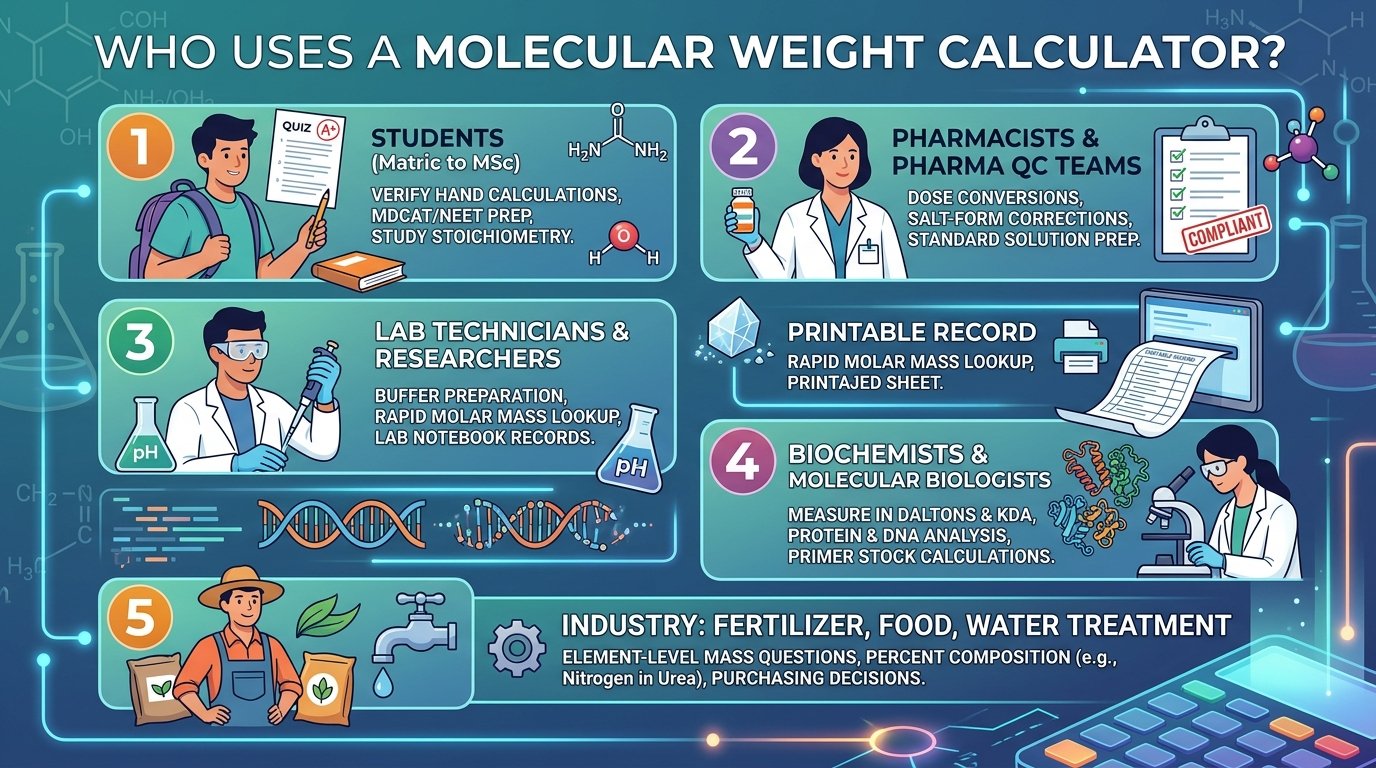
Who Uses a Molecular Weight Calculator?
Over the years I’ve watched this tool get used by a much wider crowd than I expected. A few of the regulars:
Students — from Matric to MSc
Homework, lab reports, MDCAT/NEET prep, board exams. A molecular weight calculator lets you verify hand calculations instantly, so you learn from mistakes in seconds instead of losing marks on Friday’s quiz. The percent composition table doubles as a stoichiometry study aid.
Pharmacists and Pharma QC Teams
Dose conversions between mass and molar units, salt-form corrections (a drug’s HCl salt weighs more than its free base), and preparation of standard solutions for assays. In pharma, molecular weight errors are compliance issues, not just wrong answers — which is why a verified molecular weight calculator is part of many standard operating procedures.
Laboratory Technicians and Researchers
Buffer prep is daily bread: 1 L of 0.1 M phosphate buffer means three molar mass lookups before you touch the balance. Mode 3 of this molecular weight calculator turns that into a ten-second job with a printable record for the lab notebook.
Biochemists and Molecular Biologists
Proteins and DNA are measured in daltons and kilodaltons — the same molecular weight concept at a bigger scale. A 50 kDa protein is simply a molecule weighing about 50,000 g/mol. Primer stock calculations, media recipes and reagent dilutions all lean on the same math this molecular weight calculator performs.
Industry: Fertilizer, Food, Water Treatment
What percentage of urea is nitrogen? (46.65% — Mode 1 tells you in one click.) How many grams of chlorine are in a kilo of bleaching powder? Element-level mass questions drive purchasing and quality decisions across entire industries.
Tips for Accurate Results Every Time
- Respect capitalization. “Co” is cobalt; “CO” is carbon monoxide. Our smart auto-fix helps, but always glance at the breakdown table to confirm the tool read your formula the way you meant it.
- Write hydrates completely. CuSO4·5H2O, not CuSO4 — if the bottle label mentions water, include it.
- Keep decimals until the end. Round only your final answer, not the atomic masses along the way. Rounding early can shift a result by a few tenths.
- Cross-check unusual compounds. For rare or novel structures, verify against a database like PubChem, which lists computed molecular weights for over 100 million compounds.
- Save your work. Use the molecular weight calculator’s CSV download for lab records — auditors and teachers both appreciate a paper trail.
5 Common Mistakes to Avoid
- Ignoring parentheses. In Al2(SO4)3 the subscript 3 multiplies the whole sulfate group: 3 S and 12 O, not 1 and 4.
- Dropping hydrate water. Worth repeating: 249.68 vs 159.61 g/mol for copper sulfate is a 36% error.
- Confusing atomic number with atomic mass. Sodium is element 11 but weighs 22.99 u. The periodic table lists both — grab the decimal one.
- Mixing up mL and L in molarity work. Molarity is moles per liter. Mode 3 handles the unit conversion for you, but hand calculations must divide mL by 1000 first.
- Using outdated atomic masses. IUPAC revises standard atomic weights periodically. Old textbooks may differ slightly from the current values this molecular weight calculator uses.
What Makes This Molecular Weight Calculator Different?
Fair question — a search brings up dozens of similar tools. Here’s an honest comparison of what you get here versus the typical alternative:
| Feature | This Tool | Typical Calculator |
|---|---|---|
| Basic molecular weight | ✅ | ✅ |
| 5 calculation modes in one interface | ✅ | ❌ |
| Animated percent composition graphs | ✅ | ❌ |
| Batch compare up to 15 formulas | ✅ | ❌ |
| Copy / CSV / TXT / print / share | ✅ | Copy only |
| Smart lowercase auto-fix (h2o → H2O) | ✅ | ❌ |
| Hydrate & bracket notation support | ✅ | Partial |
| Step-by-step working shown | ✅ | ❌ |
| Calculation history | ✅ | ❌ |
| Free, no sign-up, no limits | ✅ | Varies |
The goal was simple: build the molecular weight calculator I wished existed when I was teaching — one tool that follows a problem from “here’s a formula” all the way to “here’s the mass to weigh out,” with a record you can save.
Where the Atomic Weights Come From
Every result from this molecular weight calculator is built on the standard atomic weights published by IUPAC, the international body that maintains the official periodic table. For elements whose isotopic composition varies in nature (like lithium and chlorine), we use the conventional single values recommended for everyday calculation.
Why do atomic masses have decimals at all? Because natural elements are isotope mixtures. Chlorine is roughly 76% chlorine-35 and 24% chlorine-37, and the weighted average lands at 35.45 u. That average — not either whole number — is what belongs in your math.
If you need thermochemical or spectroscopic data alongside molar masses, the NIST Chemistry WebBook is the gold-standard free reference and pairs beautifully with this tool.
Percent Composition and Empirical Formulas Explained
Before this section, one note: any good molecular weight calculator should show percent composition automatically, and ours does. Percent composition answers a deceptively useful question: what fraction of a compound’s mass belongs to each element? Every time you run the molecular weight calculator in Mode 1, that table on the right side of the results is doing this math for you.
The formula is straightforward. For any element in a compound:
mass % = (atoms × atomic mass ÷ molecular weight) × 100
Take urea, CO(NH2)2, the world’s most-used nitrogen fertilizer. Its molecular weight is 60.06 g/mol, and nitrogen contributes 2 × 14.007 = 28.014 of that. Divide and multiply by 100: urea is 46.65% nitrogen. That single number is why urea dominates fertilizer markets — no common solid fertilizer packs more nitrogen per kilogram.
Percent composition also runs in reverse. If a lab analysis tells you an unknown compound is 40.0% carbon, 6.7% hydrogen and 53.3% oxygen, you can derive its empirical formula — the simplest whole-number atom ratio. Convert each percentage to moles (divide by atomic mass), then divide everything by the smallest result. Here that gives CH2O. The actual molecular formula is some multiple of it: formaldehyde (CH2O), acetic acid (C2H4O2) or glucose (C6H12O6) all share that empirical formula.
How do you pick between them? You need the experimental molecular weight. If mass spectrometry says the unknown weighs about 180 g/mol, divide by the empirical formula weight (30.03) to get 6 — so the molecular formula is C6H12O6. Check it in the molecular weight calculator above: 180.16 g/mol. Case closed. This exact workflow appears in nearly every first-year chemistry exam on the planet.
Molar Mass of Gases: Density and the Ideal Gas Law
Gases add a beautiful twist to this topic: molecular weight directly controls how dense a gas is and whether it rises or sinks in air. The ideal gas law rearranges to give gas density at any temperature and pressure:
density = (pressure × molar mass) ÷ (R × temperature)
Air behaves like a gas with an average molar mass of about 28.97 g/mol. Any gas lighter than that floats upward in air; anything heavier pools near the floor. A few examples worth knowing — all verifiable in seconds with the molecular weight calculator:
- Helium (He, 4.00 g/mol) — far lighter than air, which is why balloons rise and why it’s used in airships.
- Methane (CH4, 16.04 g/mol) — lighter than air, so natural gas leaks accumulate at ceiling level. Gas detectors in kitchens are mounted high for exactly this reason.
- Carbon dioxide (CO2, 44.01 g/mol) — heavier than air, which is why CO2 fire extinguishers blanket a fire and why the gas collects in unventilated cellars and wells.
- Propane (C3H8, 44.10 g/mol) — also heavier than air; leaked LPG sinks, so its detectors sit near the floor.
Chemists also flip this relationship to identify unknowns: measure a gas’s density, plug it into the equation, and out comes its molar mass. In the 1800s this technique — vapor density measurement — was one of the first reliable ways to determine molecular weight experimentally, decades before mass spectrometers existed.
Practice Problems (Try Them, Then Check With the Calculator)
Reading about molar mass is one thing; doing it is another. Work these five problems on paper, then verify each answer with the molecular weight calculator at the top of the page. Answers are hidden under each problem — no peeking until you’ve tried.
Problem 1 — Find the molecular weight of potassium permanganate, KMnO4.
Answer: K (39.098) + Mn (54.938) + 4 × O (63.996) = 158.03 g/mol. A classic titration reagent — you’ll weigh this out in almost every analytical chemistry course.
Problem 2 — How many moles are in 50 g of calcium carbonate, CaCO3?
Answer: Molar mass of CaCO3 = 100.09 g/mol, so 50 ÷ 100.09 = 0.4996 mol. The nearly-round molar mass of CaCO3 makes it a favorite in exam questions.
Problem 3 — What mass of NaOH is needed for 500 mL of a 0.2 M solution?
Answer: moles = 0.2 × 0.5 L = 0.1 mol; mass = 0.1 × 40.00 = 4.0 g. Mode 3 of the calculator reproduces this recipe, including the “dissolve then top up to volume” instruction.
Problem 4 — What percent of Epsom salt (MgSO4·7H2O) is water?
Answer: Total molar mass = 246.47 g/mol; the seven waters weigh 7 × 18.015 = 126.11. So water is 51.2% of the crystal’s mass — more than half! Hydrates really do matter.
Problem 5 — How many grams of nitrogen are in 250 g of ammonium nitrate, NH4NO3?
Answer: NH4NO3 = 80.04 g/mol, of which nitrogen is 28.014 (35.0%). So 250 × 0.350 = 87.5 g of nitrogen. Mode 5 (Element Mass Finder) solves this type in one step.
If you got all five right, congratulations — you understand this topic better than most. If a couple went sideways, re-read the hand-calculation section and try again. The mistakes you make in practice are the ones you won’t make in the exam.
Molecular Weight in Everyday Life
It’s easy to file molecular weight under “school stuff,” but the concept quietly shapes daily life in ways most people never notice.
Medicine labels. When a tablet says 500 mg of paracetamol (C8H9NO2, 151.16 g/mol), pharmacologists chose that dose knowing exactly how many molecules it delivers per kilogram of body weight. Generic and brand-name drugs are compared molecule-for-molecule using molar math.
Nutrition science. The sodium content on a food label comes from salt via molecular weight: NaCl is 39.34% sodium, so 2.5 g of salt equals roughly 1 g of sodium. Food scientists run this conversion — the same one Mode 5 of the molecular weight calculator performs — thousands of times a year.
Agriculture. Fertilizer bags advertise N-P-K percentages that are pure percent-composition arithmetic. A farmer comparing urea (46% N) against ammonium sulfate (21% N) is comparing molecular weights, whether they think of it that way or not.
Water treatment. Chlorination doses, water hardness expressed “as CaCO3,” and scale inhibitor calculations all lean on molar masses. Municipal plants document these numbers daily.
Party balloons and diving tanks. As covered in the gas section above, whether a gas floats, sinks, or is safe to breathe at depth ties directly back to its molar mass.
Once you start seeing molecular weight in the wild, you can’t unsee it. It’s one of the few pieces of school chemistry that genuinely follows you everywhere.
How Students Can Get the Most From This Molecular Weight Calculator
A calculator can either replace your thinking or sharpen it — the difference is how you use it. Here’s the routine I recommend to my own students:
- Solve first, verify second. Do every homework problem by hand, then check it with the molecular weight calculator. A wrong answer plus the tool’s step-by-step breakdown shows you exactly which element or subscript you fumbled.
- Use the graph to build intuition. Before calculating, guess which element dominates the compound’s mass. Then look at the percent composition bars. After twenty compounds, you’ll estimate molar masses in your head with surprising accuracy.
- Drill with batch mode. Paste in the ten compounds from this week’s chapter and study the comparison chart. Seeing that sucrose is almost exactly nineteen times heavier than water sticks in memory far better than two isolated numbers.
- Export your practice. Download the CSV after each session and keep a running spreadsheet. Reviewing fifty solved formulas the night before an exam beats re-reading the textbook chapter.
- Learn the ten classics by heart. H2O (18), CO2 (44), NaCl (58.44), NaOH (40), H2SO4 (98), HCl (36.46), NH3 (17), CaCO3 (100), O2 (32), glucose (180). Knowing these cold lets you sanity-check everything else instantly.
Used this way, a molecular weight calculator becomes a private tutor that never gets tired — and the skills stay with you long after the exam ends.
Molecular Weight Calculator vs Apps, Spreadsheets and the Periodic Table
People find molar masses in four main ways, and each has a place. Here’s my honest take after years of using all of them.
The printed periodic table is where everyone should start. It builds fundamentals, it’s allowed in most exams, and it never runs out of battery. Its weakness is speed and error rate — a 10-element formula means 10 lookups, 10 multiplications and one long addition, with a mistake possible at every step.
Spreadsheets work well for repetitive lab calculations, but you have to build and maintain the atomic mass table yourself, and one wrong cell reference silently corrupts every result after it. I’ve audited enough lab spreadsheets to be wary of them.
Mobile apps are convenient, but the good ones are paid, the free ones are ad-heavy, and most schools ban phones during tests and practicals anyway.
An online molecular weight calculator hits the sweet spot for daily work: zero setup, always-current atomic masses, works on any device with a browser, and — at least on this site — completely free with export options a spreadsheet user would expect. The molecular weight calculator above adds things none of the alternatives offer, like batch comparison graphs and automatic hydrate parsing.
My recommendation: learn with the periodic table, work with the molecular weight calculator, and keep a spreadsheet only for highly customized, repeated workflows. That combination covers everything from the first chemistry class to a professional QC lab. And whenever you need the underlying element data itself, our interactive periodic table page lists every atomic mass this tool uses.
Molecular Weight Calculator Best Practices Checklist
Print this or screenshot it — a 30-second pre-flight check that catches almost every molar mass error before it happens:
- ✅ Formula matches the bottle label — including any ·xH2O hydrate notation
- ✅ Capitalization verified in the element breakdown table (CO ≠ Co)
- ✅ Parentheses subscripts distributed — Al2(SO4)3 has 12 oxygens, not 4
- ✅ Units consistent — mL converted to L before any molarity math
- ✅ Rounded only at the end — full decimals carried through intermediate steps
- ✅ Sanity check passed — result compared against a known similar compound
- ✅ Record saved — CSV downloaded or report printed for the lab notebook
Trusted Reference Resources
This molecular weight calculator and article draw on the following authoritative sources — bookmark them for deeper study:
- IUPAC Periodic Table of Elements — the official source of standard atomic weights used in every calculation on this page.
- NIST Chemistry WebBook — free thermochemical, spectroscopic and molar mass data for tens of thousands of compounds.
- PubChem (NIH) — computed molecular weights and structures for 100+ million compounds; ideal for cross-checking unusual formulas.
- Molar Mass — Wikipedia — accessible overview of definitions, units and the mole concept.
- Our Interactive Periodic Table — every atomic mass this tool uses, in one place.
Frequently Asked Questions
What is a molecular weight calculator and how does it work?
It’s a tool that parses a chemical formula, multiplies each element’s official atomic mass by its atom count, and sums the results to give molar mass in g/mol. The one on this page also shows percent composition, graphs, and step-by-step working.
Is this molecular weight calculator free to use?
Yes — this molecular weight calculator is completely free, with no registration, no daily limits, and no locked “premium” modes. All five modes, downloads and sharing options are open to everyone.
Are molecular weight and molar mass the same thing?
Numerically yes, conceptually slightly different. Molecular weight describes one molecule in daltons (u); molar mass describes one mole of molecules in g/mol. The numbers are identical, so calculators treat them interchangeably.
How do I enter a hydrate like CuSO4·5H2O?
Type it with a middle dot, a period, or an asterisk — CuSO4·5H2O, CuSO4.5H2O and CuSO4*5H2O all work. The calculator adds the water molecules’ mass automatically (result: 249.68 g/mol).
Can this molecular weight calculator convert grams to moles?
Yes. Switch to the “Grams ↔ Moles” tab, enter your formula and mass, and it divides by molar mass for you — including an estimate of the number of molecules via Avogadro’s number.
Why does capitalization matter when I type a formula?
Element symbols are case-sensitive: CO means carbon + oxygen, while Co is the single element cobalt. If you type all lowercase, our smart auto-fix makes its best correction and flags it so you can verify.
How accurate are the results?
The tool uses current IUPAC standard atomic weights, giving results accurate to about four significant figures — more precision than any classroom or routine lab task requires. For isotope-specific work, use exact isotopic masses instead.
Does it work for proteins measured in kDa?
If you know the protein’s full molecular formula, yes — 1 kDa simply equals 1,000 g/mol. For sequence-based protein masses, a dedicated peptide mass tool is more practical, but the underlying unit is exactly what this calculator reports.
Can I use this molecular weight calculator on my phone?
Absolutely. The molecular weight calculator is fully responsive — tabs, tables and graphs adapt to any screen size, and the share buttons connect directly to WhatsApp and other apps on mobile.
How do I save or share my calculation?
Every result panel of the molecular weight calculator has one-click Copy, CSV download (opens in Excel), TXT download, a print-ready report, native device sharing, plus direct WhatsApp, Facebook and X buttons.
Final Thoughts: Bookmark This Molecular Weight Calculator
Molecular weight sits at the center of quantitative chemistry — every conversion, every solution, every dose calculation passes through it. Knowing how to compute it by hand makes you a better chemist; having a fast, trustworthy molecular weight calculator makes you a more productive one.
This molecular weight calculator gives you both: instant answers and the step-by-step working that shows where those answers come from. Five modes, interactive graphs, exportable results, zero cost. Try the molecular weight calculator with the compound you’re working on right now, and if it saves you time, share it with a classmate or colleague using the built-in share buttons.
Questions, feature requests, or a formula the parser couldn’t handle? Reach out through our contact page — I read every message, and several of the tool’s current features started as user suggestions. You can also learn more about this project on our about page.
Written & Reviewed By
Ahmad Raza, M.Phil. Chemistry
Ahmad is a chemistry educator and science content developer with over 10 years of experience teaching analytical and physical chemistry. He builds free calculation tools that help students and lab professionals work faster and make fewer errors. When he’s not writing about molar mass, he’s usually grading titration reports.