
Formula Weight Calculator for Ionic Compounds
Get the formula weight of any ionic compound instantly — NaCl, CaCl₂, Al₂(SO₄)₃, hydrates like CuSO₄·5H₂O — or build a compound from its ions with automatic charge balancing. IUPAC 2021 atomic masses, step-by-step working.
✓ Trusted by students, teachers & lab professionalsFormula Weight of an Ionic Compound
Type any formula — parentheses and hydrate dots supported (use · or . or *). Example: Al2(SO4)3 or CuSO4·5H2O
Build an Ionic Compound from Its Ions
Pick a cation and an anion — charges are balanced automatically (criss-cross method) and the formula weight is computed.
Percent Composition by Mass
See what fraction of an ionic compound's mass comes from each element.
Grams ↔ Moles Converter
Convert a weighed mass to moles (or moles to mass) using the compound's formula weight.
Compare Ionic Compounds
Enter up to 10 formulas (one per line) — sorted table plus a bar graph of formula weights.
🕘 Recent calculations
- No calculations yet — your last 10 results will appear here.
Atomic masses: IUPAC 2021 standard atomic weights · 1 mol = 6.02214076 × 10²³ formula units · Free tool by molecularweightcalculator.org
A formula weight calculator for ionic compounds turns the most repetitive job in chemistry — adding up atomic masses — into a one-second task. Type CaCl₂ and get 110.98 g/mol. Paste Al₂(SO₄)₃ and get 342.13 g/mol, with every element’s contribution broken down in a table. Even hydrates like CuSO₄·5H₂O parse correctly, water and all.
The free tool above does more than add masses, though. It builds ionic compounds from their ions with automatic charge balancing — pick Al³⁺ and SO₄²⁻ and watch it derive Al₂(SO₄)₃ by the criss-cross method — computes percent composition, converts grams to moles, and compares up to ten compounds on one graph.
In this guide, I’ll show you exactly how to use every mode of the formula weight calculator for ionic compounds, explain why chemists say “formula weight” instead of “molecular weight” for salts, and work through the hand calculations every exam expects you to know. Let’s begin.
🔑 KEY TAKEAWAY
A formula weight calculator for ionic compounds is a free online tool that computes the formula weight (formula mass) of any ionic compound in g/mol by summing IUPAC atomic masses — including formulas with parentheses and hydrates like CuSO₄·5H₂O. The calculator on this page adds four bonus modes: building compounds from 22 cations and 22 anions with automatic charge balancing, percent composition by mass, grams-to-moles conversion, and side-by-side comparison of up to ten compounds — all with step-by-step working, tables and graphs.
📑 Table of Contents (click to expand)
- What Is a Formula Weight Calculator for Ionic Compounds?
- How to Use This Calculator
- The 5 Modes Explained
- Formula Weight vs Molecular Weight vs Molar Mass
- Ionic or Covalent? How to Tell First
- How to Calculate Formula Weight by Hand
- Formula Weight Table of 25 Common Ionic Compounds
- Writing Ionic Formulas: The Criss-Cross Method
- Polyatomic Ions You Must Know
- Hydrates: The ·xH₂O Trap
- Who Uses a Formula Weight Calculator?
- From Formula Weight to Stoichiometry
- Preparing a Solution: Complete Walkthrough
- Practice Problems With Answers
- Tips for Accurate Results
- Common Mistakes to Avoid
- What Makes This Tool Different
- Where the Data Comes From
- Quick Exam Checklist
- Frequently Asked Questions
- 10 Formula Weight Facts Worth Knowing
- Final Thoughts
What Is a Formula Weight Calculator for Ionic Compounds?
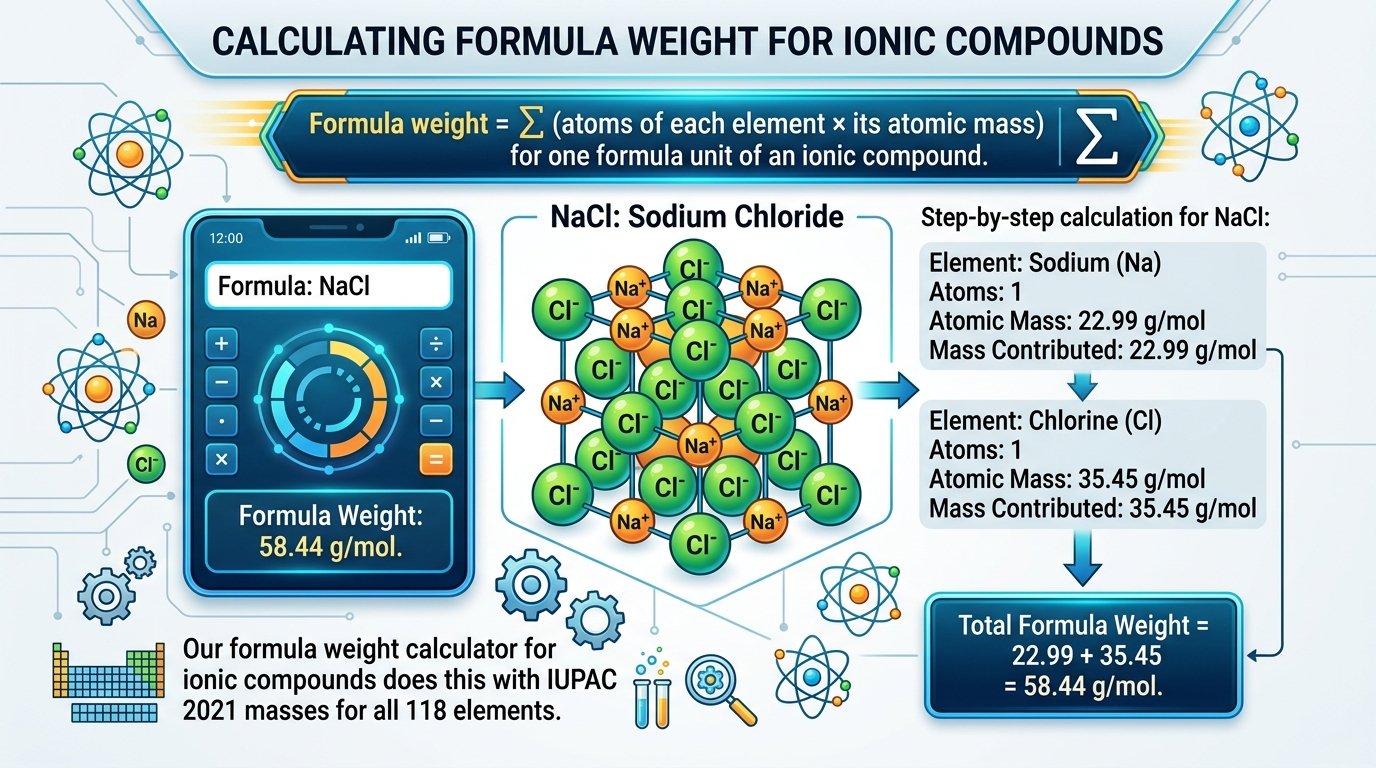
A formula weight calculator for ionic compounds is an online tool that computes the formula weight — the sum of the atomic masses of every atom in a compound’s formula unit — expressed in atomic mass units (u) or, equivalently, grams per mole.
The word “formula” matters. Ionic compounds like NaCl or CaCO₃ don’t exist as individual molecules; they form vast crystal lattices of alternating positive and negative ions. Since there’s no discrete molecule to weigh, chemists describe the smallest repeating ratio of ions — the formula unit — and call its mass the formula weight. It’s calculated exactly like molecular weight, but the terminology respects the chemistry.
A good formula weight calculator for ionic compounds must handle three things a basic adding tool often gets wrong: parentheses around polyatomic ions — the 3 in Al₂(SO₄)₃ multiplies everything inside; hydrate notation — the ·5H₂O in CuSO₄·5H₂O adds five whole water molecules; and case-sensitive symbols — Co is cobalt, CO is carbon monoxide. The tool above handles all three, then goes further with ion building, percent composition, mole conversion and comparison modes.
💡 Quick definition: Formula weight = Σ (atoms of each element × its atomic mass) for one formula unit of an ionic compound. NaCl: 22.99 + 35.45 = 58.44 g/mol. Our formula weight calculator for ionic compounds does this with IUPAC 2021 masses for all 118 elements.
How to Use This Formula Weight Calculator for Ionic Compounds
Using this formula weight calculator for ionic compounds takes four steps — no sign-up, works on any device:
- Pick a mode. The default tab computes formula weight from a typed formula. Other tabs build compounds from ions, find percent composition, convert grams ↔ moles, and compare compounds.
- Enter the formula. Type it exactly as written in your textbook: CaCl2, Al2(SO4)3, CuSO4·5H2O (a plain dot or * also works for hydrates). Or use the one-click example chips.
- Hit Calculate. The formula weight appears in a highlight box, followed by step-by-step working, a per-element table and an animated contribution graph.
- Export or share. Copy the answer, download CSV for Excel, save TXT, print a clean report, or share via WhatsApp, Facebook or X.
Your last ten calculations stay in the history panel, so re-checking yesterday’s homework takes one glance. And if you’re working with covalent molecules rather than salts, our molecular weight calculator covers the full range of molecular formulas, while the atomic mass calculator handles single elements and isotopes.
The 5 Modes of Our Formula Weight Calculator for Ionic Compounds
Most tools stop at one number. This formula weight calculator for ionic compounds is five instruments in one panel:
🧪 Mode 1 — Formula Weight
The core engine of the formula weight calculator for ionic compounds. Paste any ionic formula — simple salts, polyatomic parentheses, hydrates — and get the formula weight with a full element-by-element breakdown: atom counts, individual masses, contributions in g/mol and percent of total, plus an animated bar graph showing which element dominates the mass. The steps box shows the exact arithmetic your teacher wants on paper.
⚡ Mode 2 — Build from Ions
The mode students love most. Choose a cation from 22 options (Na⁺, Ca²⁺, Fe²⁺/Fe³⁺, NH₄⁺…) and an anion from 22 more (Cl⁻, SO₄²⁻, PO₄³⁻, NO₃⁻…). The tool balances the charges by the criss-cross method, writes the neutral formula — parentheses included where needed — names the compound, and computes its formula weight. Watching Al³⁺ + SO₄²⁻ become Al₂(SO₄)₃ step by step teaches the skill faster than any lecture.
📊 Mode 3 — Percent Composition
Enter a formula and see what fraction of the mass each element carries — essential for empirical formula problems, fertilizer grading and purity checks. CaCO₃? That’s 40.04% calcium, 12.00% carbon, 47.96% oxygen, each shown with its own bar.
⚖️ Mode 4 — Grams ↔ Moles
The lab-bench bridge of the formula weight calculator for ionic compounds. Enter a formula and an amount, and convert weighed grams into moles or required moles into grams — with the formula-unit count (× 6.022 × 10²³) thrown in. This is the calculation behind every solution you’ll ever prepare.
📋 Mode 5 — Compare Compounds
Paste up to ten formulas, one per line, and get a ranked table plus bar chart. Perfect for questions like “which chloride salt delivers the most chloride per gram?” — or for seeing instantly that Al₂(SO₄)₃ outweighs six formula units of NaCl. No other free formula weight calculator for ionic compounds I’ve tested offers batch comparison.
Formula Weight vs Molecular Weight vs Molar Mass
Three terms, one family — and knowing which one a formula weight calculator for ionic compounds reports (all three, really) starts with their distinctions:
| Term | Applies To | Counting Unit | Example |
|---|---|---|---|
| Formula weight | Ionic compounds (crystal lattices, no discrete molecules) | Formula unit | NaCl = 58.44 u |
| Molecular weight | Covalent compounds (real, discrete molecules) | Molecule | H₂O = 18.02 u |
| Molar mass | Both — the lab-scale umbrella term | Mole (6.022 × 10²³) | NaCl = 58.44 g/mol |
Here’s the honest secret: the arithmetic is identical for all three. Add up the atomic masses — done. The terminology just signals what kind of substance you’re describing. Sodium chloride crystals contain no “NaCl molecule” floating anywhere; the lattice extends in all directions, so we speak of formula units and formula weight. Water exists as genuine H₂O molecules, so molecular weight fits. Molar mass covers both once you scale up to moles. A formula weight calculator for ionic compounds and a molecular weight calculator therefore share the same math engine — the difference is scope, vocabulary and, in our case, the ion-building and hydrate features tuned for salts.
Ionic or Covalent? How to Tell Before You Calculate
Before reaching for a formula weight calculator for ionic compounds, it helps to confirm you’re actually holding an ionic compound. Three quick tests settle it in seconds:
- Metal + nonmetal → ionic. NaCl, CaBr₂, Fe₂O₃, ZnS — a metal on the left of the periodic table paired with a nonmetal on the right almost always means an ionic lattice. Calculate a formula weight.
- Nonmetal + nonmetal → covalent. H₂O, CO₂, NH₃, CH₄ — two nonmetals share electrons and form genuine molecules. Calculate a molecular weight (same math, different name — and our molecular weight calculator adds molecule-specific features).
- Contains a polyatomic ion → ionic. Spot NH₄⁺, NO₃⁻, SO₄²⁻, CO₃²⁻ or PO₄³⁻ anywhere in the formula and you’re in ionic territory, even when every element is a nonmetal — ammonium nitrate, NH₄NO₃, contains no metal at all yet is thoroughly ionic.
The behavior differences follow from the bonding: ionic compounds tend to be brittle crystalline solids with high melting points that conduct electricity when molten or dissolved; covalent compounds are often liquids or gases with low melting points that don’t conduct. For calculation purposes, though, remember the friendly secret from the previous section — the mass arithmetic never changes. What changes is the vocabulary (formula unit vs molecule) and the features you want in your tool: charge balancing, hydrate handling and ion libraries are what make a dedicated formula weight calculator for ionic compounds the right instrument for salts.
How to Calculate Formula Weight by Hand (4 Worked Examples)
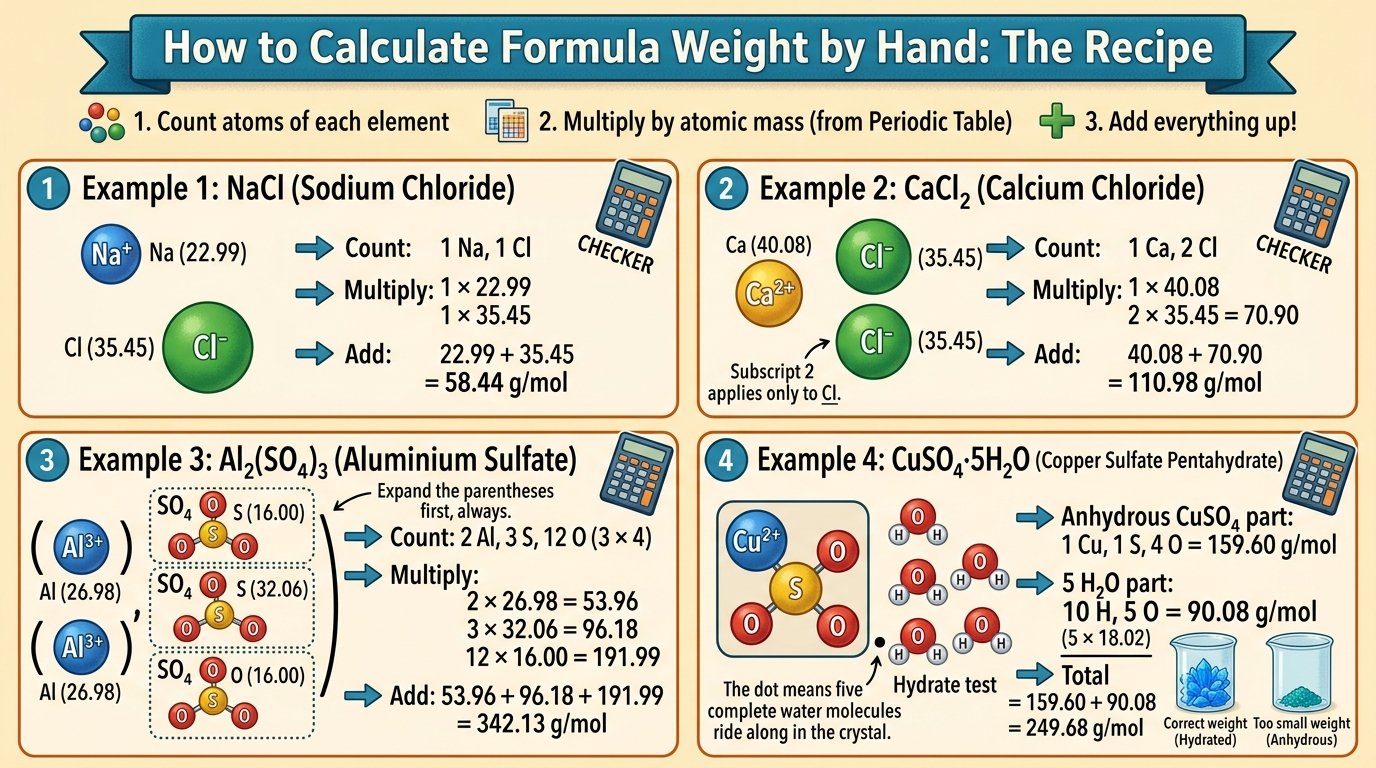
You should be able to do this on paper — the formula weight calculator for ionic compounds is your checker, not your crutch. The recipe: count each element’s atoms, multiply by atomic mass, add everything.
Example 1: NaCl (sodium chloride)
One Na (22.99) + one Cl (35.45) = 58.44 g/mol. The simplest case — one cation, one anion, no subscripts.
Example 2: CaCl₂ (calcium chloride)
One Ca (40.08) + two Cl (2 × 35.45 = 70.90) = 110.98 g/mol. The subscript 2 applies only to chlorine — the formula weight calculator for ionic compounds shows this as two separate Cl contributions. Note why the 2 is there: Ca²⁺ needs two Cl⁻ to balance charge — formula weights always start with a correctly balanced formula.
Example 3: Al₂(SO₄)₃ (aluminium sulfate)
The parentheses test. The subscript 3 multiplies the entire SO₄ group:
- Al: 2 × 26.98 = 53.96
- S: 3 × 32.06 = 96.18
- O: 3 × 4 = 12 atoms → 12 × 16.00 = 191.99
- Total = 342.13 g/mol
Most wrong answers here come from counting 4 oxygens instead of 12. Expand the parentheses first, always.
Example 4: CuSO₄·5H₂O (copper sulfate pentahydrate)
The hydrate test. The dot means five complete water molecules ride along in the crystal:
- CuSO₄: 63.55 + 32.06 + 4 × 16.00 = 159.60
- 5 H₂O: 5 × 18.02 = 90.08
- Total = 249.68 g/mol
Weigh out 159.60 g when the recipe meant 249.68 g of the blue crystals and your solution comes out 56% too concentrated — a real and common lab error. Type each example into the formula weight calculator for ionic compounds above and compare its steps with yours.
Formula Weight Table of 25 Common Ionic Compounds
Bookmark this reference from our formula weight calculator for ionic compounds — every value computed with the same IUPAC 2021 masses used by the formula weight calculator for ionic compounds above.
| Compound | Formula | Formula Weight (g/mol) |
|---|---|---|
| Sodium chloride | NaCl | 58.44 |
| Potassium chloride | KCl | 74.55 |
| Sodium hydroxide | NaOH | 40.00 |
| Potassium hydroxide | KOH | 56.11 |
| Calcium chloride | CaCl₂ | 110.98 |
| Calcium carbonate | CaCO₃ | 100.09 |
| Sodium carbonate | Na₂CO₃ | 105.99 |
| Sodium bicarbonate | NaHCO₃ | 84.01 |
| Magnesium sulfate | MgSO₄ | 120.36 |
| Magnesium oxide | MgO | 40.30 |
| Potassium nitrate | KNO₃ | 101.10 |
| Ammonium nitrate | NH₄NO₃ | 80.04 |
| Ammonium sulfate | (NH₄)₂SO₄ | 132.14 |
| Potassium sulfate | K₂SO₄ | 174.25 |
| Sodium sulfate | Na₂SO₄ | 142.04 |
| Aluminium oxide | Al₂O₃ | 101.96 |
| Aluminium sulfate | Al₂(SO₄)₃ | 342.13 |
| Iron(III) oxide | Fe₂O₃ | 159.69 |
| Copper(II) sulfate | CuSO₄ | 159.60 |
| Copper sulfate pentahydrate | CuSO₄·5H₂O | 249.68 |
| Zinc chloride | ZnCl₂ | 136.28 |
| Silver nitrate | AgNO₃ | 169.87 |
| Potassium permanganate | KMnO₄ | 158.03 |
| Barium chloride | BaCl₂ | 208.23 |
| Magnesium phosphate | Mg₃(PO₄)₂ | 262.86 |
Need a salt that isn’t here? Type it into the formula weight calculator for ionic compounds above — any combination of the 118 elements parses instantly.
Writing Ionic Formulas: The Criss-Cross Method
Mode 2 automates this, but you need it on paper too. Ionic formulas follow one iron rule: total positive charge must cancel total negative charge. The criss-cross shortcut gets you there:
- Write both ions with charges. Aluminium and sulfate: Al³⁺ and SO₄²⁻.
- Cross the charge numbers down as subscripts. The 3 from Al³⁺ becomes sulfate’s subscript; the 2 from SO₄²⁻ becomes aluminium’s: Al₂(SO₄)₃.
- Check for neutrality. 2 × (+3) = +6 and 3 × (−2) = −6. Balanced ✓
- Reduce if possible. Ca²⁺ + O²⁻ criss-crosses to Ca₂O₂ — reduce to the simplest ratio, CaO. (Formula units are always the smallest whole-number ratio.)
Two formatting rules complete the skill: put parentheses around a polyatomic ion only when its subscript exceeds one — (NH₄)₂SO₄ needs them, NH₄Cl doesn’t — and never write the charges in the final formula. Try any cation-anion pair in the formula weight calculator for ionic compounds and check its Step 2 against your criss-cross.
Polyatomic Ions You Must Know
Polyatomic ions — charged groups of atoms that travel as a unit — appear in most formulas you’ll type into a formula weight calculator for ionic compounds. These twelve cover 95% of coursework:
| Ion | Formula & Charge | Ion Mass (u) |
|---|---|---|
| Ammonium | NH₄⁺ | 18.04 |
| Hydroxide | OH⁻ | 17.01 |
| Nitrate | NO₃⁻ | 62.00 |
| Nitrite | NO₂⁻ | 46.01 |
| Sulfate | SO₄²⁻ | 96.06 |
| Sulfite | SO₃²⁻ | 80.06 |
| Carbonate | CO₃²⁻ | 60.01 |
| Bicarbonate | HCO₃⁻ | 61.02 |
| Phosphate | PO₄³⁻ | 94.97 |
| Acetate | C₂H₃O₂⁻ | 59.04 |
| Permanganate | MnO₄⁻ | 118.93 |
| Dichromate | Cr₂O₇²⁻ | 215.99 |
All twelve — plus ten more — are ready to combine in Mode 2 of the formula weight calculator for ionic compounds, so you can drill formula writing against instant feedback.
Hydrates: The ·xH₂O Trap Every Lab Worker Knows
Many ionic compounds trap water molecules inside their crystal structure in fixed ratios — these are hydrates, written with a raised dot: CuSO₄·5H₂O, Na₂CO₃·10H₂O, MgSO₄·7H₂O (Epsom salt), CaSO₄·2H₂O (gypsum).
The trap: the water counts toward the formula weight. Anhydrous CuSO₄ is 159.60 g/mol; the pentahydrate is 249.68 g/mol — 36% of the crystal’s mass is water. If a procedure calls for 0.1 mol of copper sulfate and your bottle contains the blue pentahydrate (it almost always does), you must weigh 24.97 g, not 15.96 g.
This single confusion probably ruins more student solutions than any other error, which is why hydrate support was non-negotiable when building this formula weight calculator for ionic compounds. Type the formula exactly as the bottle label prints it — dot and all (·, a period, or * all work) — and the tool includes every water molecule in the sum, showing the hydrate water’s contribution as its own line in the working.
💡 Lab rule of thumb: Always calculate from the formula printed on the reagent bottle, never from the anhydrous formula in the textbook. When in doubt, run both through the formula weight calculator for ionic compounds and see how big the difference is.
Who Uses a Formula Weight Calculator for Ionic Compounds?
Students — Matric, FSc, MDCAT, NEET and beyond
Formula weight questions open nearly every stoichiometry chapter and exam. A formula weight calculator for ionic compounds verifies homework instantly, and the visible steps teach the method — especially for the parentheses and hydrate cases that cost the most marks.
Teachers and Tutors
Mode 2 of the formula weight calculator for ionic compounds is a ready-made teaching device for ionic bonding: project it, pick Fe³⁺ and OH⁻, and let the class predict Fe(OH)₃ before the tool reveals it. The printable reports turn any calculation into a clean handout.
Lab Professionals
Every buffer, standard solution and reagent prep starts with a formula weight calculator for ionic compounds (or a very patient hand calculation). The grams ↔ moles mode does the bench math directly — enter the formula and target moles, weigh what it says.
Agriculture and Fertilizer Work
Fertilizers are ionic compounds — urea aside — and their grading runs on percent composition. Mode 3 shows instantly that NH₄NO₃ is 35% nitrogen while (NH₄)₂SO₄ is 21%, the exact comparison behind fertilizer selection.
Water Treatment and Industry
Coagulant dosing with Al₂(SO₄)₃, hardness math with CaCO₃ equivalents, chlorination chemistry — all begin from formula weights of ionic species. The compare mode ranks candidate salts by mass per mole of active ion in seconds.

From Formula Weight to Stoichiometry: The Full Chain
Formula weight is the entry point of every quantitative calculation involving salts. Here’s the complete chain, so you can see where each tool on this site fits:
- Atomic masses → formula weight. Single-element values come from our atomic mass calculator; this page’s tool sums them for any ionic formula.
- Formula weight → moles. Moles = grams ÷ formula weight. Weigh 11.10 g of CaCl₂, divide by 110.98, get 0.100 mol — Mode 4 in one click.
- Moles → reaction quantities. Balanced equations trade in mole ratios: CaCl₂ + Na₂CO₃ → CaCO₃ + 2NaCl means 0.100 mol CaCl₂ consumes exactly 0.100 mol Na₂CO₃ (10.60 g).
- Moles → solutions. Molarity = moles per liter. A 0.5 M NaCl liter needs 0.5 × 58.44 = 29.22 g — the everyday brine math of every biology and chemistry lab.
One early error propagates through everything downstream, which is why checking step one with a formula weight calculator for ionic compounds is the cheapest insurance in chemistry. For covalent molecules and organic formulas, the same chain runs through our molecular weight calculator instead.
Preparing a Solution: A Complete Walkthrough
Let’s run one realistic lab task end-to-end, using the formula weight calculator for ionic compounds at every step. The assignment: prepare 500 mL of 0.200 M copper(II) sulfate solution from the pentahydrate crystals on the shelf.
- Identify the real reagent. The bottle says CuSO₄·5H₂O — blue crystals, so it’s the pentahydrate, not the pale anhydrous powder. This decides everything downstream.
- Get the formula weight. Mode 1: CuSO₄·5H₂O = 249.68 g/mol. (The anhydrous 159.60 would have been a 36% error.)
- Find the moles needed. Moles = molarity × liters = 0.200 × 0.500 = 0.100 mol.
- Convert to grams. Mode 4, moles → grams: 0.100 × 249.68 = 24.97 g. That’s the number to write on your weighing boat.
- Sanity-check the copper. Mode 3 shows CuSO₄·5H₂O is 25.45% copper — so your 24.97 g carries about 6.35 g of actual Cu. Numbers that cross-check like this are numbers you can trust.
- Document it. Print the report or download the CSV — a dated record of the calculation for your lab notebook.
Total calculator time: under a minute. The same six-step pattern — identify, formula weight, moles, grams, verify, document — works for every salt solution you will ever prepare, and every step lives inside this one formula weight calculator for ionic compounds.
Practice Problems (Try Them, Then Check With the Calculator)
Paper first, formula weight calculator for ionic compounds second. Answers hide under each problem.
Problem 1 — Find the formula weight of potassium carbonate, K₂CO₃.
Answer: K: 2 × 39.10 = 78.20; C: 12.01; O: 3 × 16.00 = 48.00. Total = 138.21 g/mol.
Problem 2 — Barium nitrate, Ba(NO₃)₂. Watch the parentheses!
Answer: Ba: 137.33; N: 2 × 14.01 = 28.01; O: 2 × 3 = 6 atoms → 96.00. Total = 261.34 g/mol. If you got ~199, you forgot the ₂ multiplies the whole NO₃ group.
Problem 3 — Write the formula for iron(III) sulfate and find its formula weight.
Answer: Fe³⁺ + SO₄²⁻ criss-cross → Fe₂(SO₄)₃. Fe: 2 × 55.85 = 111.69; S: 3 × 32.06 = 96.18; O: 12 × 16.00 = 191.99. Total = 399.86 g/mol. Mode 2 of the formula weight calculator for ionic compounds confirms both formula and weight.
Problem 4 — Washing soda is Na₂CO₃·10H₂O. Formula weight?
Answer: Na₂CO₃ = 105.99; 10 H₂O = 180.15. Total = 286.14 g/mol — nearly 63% of washing soda’s mass is water!
Problem 5 — How many grams is 0.250 mol of silver nitrate, AgNO₃?
Answer: AgNO₃ = 169.87 g/mol. Mass = 0.250 × 169.87 = 42.47 g. Mode 4 (moles → grams) reproduces this instantly.
All five correct? You’re exam-ready. Any misses — re-read the worked examples and let the tool’s step boxes coach you through a rematch.
Tips for Accurate Results Every Time
- Mind your capitalisation. Co ≠ CO. The formula weight calculator for ionic compounds reads symbols case-sensitively, exactly like chemistry does — cobalt is Co, carbon monoxide is CO.
- Expand parentheses before counting. Al₂(SO₄)₃ has 12 oxygens, not 4. Write out the full atom inventory before touching the masses.
- Include hydrate water. Calculate from the bottle’s printed formula. CuSO₄·5H₂O ≠ CuSO₄.
- Balance charges first. A formula weight is only meaningful for a correctly written neutral formula — criss-cross, verify neutrality, then calculate.
- Round at the end. Keep full decimals through intermediate steps; round the final answer to match your data. (The formula weight calculator for ionic compounds carries full precision internally for exactly this reason.)
- Cross-check critical work. For research or QC, verify against the NIST Chemistry WebBook or IUPAC sources.
5 Common Mistakes to Avoid
A decade of marking has shown me the same five errors on repeat — each preventable with one careful habit (or one quick check in the formula weight calculator for ionic compounds):
- Ignoring the parenthesis multiplier. Reading Ca(NO₃)₂ as one N and three O instead of two N and six O — the classic. Expand first, always.
- Dropping the hydrate water. Using 159.60 for the blue CuSO₄·5H₂O crystals. Your solution ends up 56% too strong.
- Wrong criss-cross reduction. Writing Mg₂O₂ instead of MgO, or “reducing” Al₂(SO₄)₃ when it’s already in lowest terms. Reduce only when both subscripts share a factor.
- Case errors in symbols. Typing CL for chlorine or NA for sodium. Symbols are one capital plus optional lowercase — the tool’s error messages flag exactly which token failed.
- Confusing ion mass with compound mass. Sulfate (96.06) is not sodium sulfate (142.04). A polyatomic ion is an ingredient, not the finished salt.
What Makes This Formula Weight Calculator for Ionic Compounds Different?
| Feature | This Tool | Typical FW Tool |
|---|---|---|
| Formula weight with element breakdown | ✅ | ✅ |
| Parentheses + hydrate (·xH₂O) parsing | ✅ | Partial |
| Build compound from ions (auto charge balance) | ✅ | ❌ |
| Step-by-step working shown | ✅ | ❌ |
| Percent composition with graphs | ✅ | ❌ |
| Grams ↔ moles converter built in | ✅ | ❌ |
| Compare up to 10 compounds + chart | ✅ | ❌ |
| Copy / CSV / TXT / print / share + history | ✅ | ❌ |
| Free, no sign-up, no limits | ✅ | Varies |
The goal was a single formula weight calculator for ionic compounds that follows the topic from “what does NaCl weigh?” through formula writing, hydrates and percent composition to bench-ready gram amounts — with results you can save, print or send to a lab partner.
Where the Data Comes From
Every atomic mass behind this formula weight calculator for ionic compounds is a standard atomic weight published by IUPAC and maintained by its Commission on Isotopic Abundances and Atomic Weights (CIAAW) — the same dataset used across all tools on this site, so results are always consistent between our calculators.
Formula-unit counts use the exact 2019 SI definition of Avogadro’s number, 6.02214076 × 10²³ per mole. For background on why ionic compounds are counted in formula units rather than molecules, Wikipedia’s formula unit article is a solid primer. When IUPAC revises an atomic weight, our data is updated per our Corrections Policy.
Quick Exam Checklist: Formula Weight in 60 Seconds
- ✅ Formula weight = Σ (atoms × atomic mass) per formula unit — used for ionic compounds.
- ✅ Same digits as molar mass: 58.44 u per formula unit = 58.44 g/mol — any formula weight calculator for ionic compounds reports both.
- ✅ Criss-cross charges to write the formula; verify total + = total −; reduce to smallest ratio.
- ✅ Parentheses multiply everything inside: (SO₄)₃ = 3 S and 12 O.
- ✅ Hydrate water counts: ·5H₂O adds 5 × 18.02 = 90.08.
- ✅ Moles = grams ÷ FW; grams = moles × FW.
- ✅ Symbols are case-sensitive: Co ≠ CO, Na not NA.
- ✅ Verify with the formula weight calculator for ionic compounds above before submitting.
Frequently Asked Questions
What is a formula weight calculator for ionic compounds?
It’s a free online tool that computes the formula weight (formula mass) of any ionic compound in g/mol by summing the IUPAC atomic masses of every atom in the formula unit — including formulas with parentheses like Al₂(SO₄)₃ and hydrates like CuSO₄·5H₂O.
Is formula weight the same as molecular weight?
The arithmetic is identical — sum the atomic masses. The terms differ by substance type: formula weight describes ionic compounds (which form lattices of formula units, not molecules), while molecular weight describes covalent compounds made of discrete molecules.
How do I calculate the formula weight of CaCl₂?
Add one calcium (40.08) and two chlorines (2 × 35.45 = 70.90): 40.08 + 70.90 = 110.98 g/mol. The formula weight calculator for ionic compounds above shows this same working step by step for any formula.
Does the calculator handle hydrates like CuSO₄·5H₂O?
Yes. This formula weight calculator for ionic compounds parses hydrates natively — type the formula with the dot (· or a plain period or * all work) and the five water molecules are included: CuSO₄·5H₂O = 159.60 + 90.08 = 249.68 g/mol.
Can it write the formula for me if I only know the ions?
Yes — that’s Mode 2. Pick a cation and an anion from the dropdowns (22 of each) and the tool balances the charges by the criss-cross method, writes the neutral formula with parentheses where needed, names the compound and computes its formula weight.
Is this formula weight calculator for ionic compounds free?
Completely free — no registration, no daily limits, all five modes and every export option open to everyone on any device.
What’s the difference between a formula unit and a molecule?
A molecule is a real, discrete particle (like one H₂O). A formula unit is the smallest whole-number ratio of ions in an ionic crystal lattice — NaCl describes the 1:1 ratio of Na⁺ to Cl⁻, not an actual paired molecule floating in the crystal.
How do I convert grams to moles for an ionic compound?
Divide the mass by the formula weight: 11.10 g CaCl₂ ÷ 110.98 g/mol = 0.100 mol. Mode 4 of the formula weight calculator for ionic compounds does this in both directions and also reports the number of formula units.
Why does Al₂(SO₄)₃ have 12 oxygen atoms?
The subscript 3 outside the parentheses multiplies everything inside: 3 × SO₄ = 3 sulfur and 3 × 4 = 12 oxygen atoms. Forgetting this multiplication is the most common formula weight error.
Does it work for covalent molecules too?
The parser will happily sum any valid formula, but for covalent and organic compounds — with percent composition, solution recipes and more molecular features — use our dedicated molecular weight calculator, built on the same IUPAC data.
10 Formula Weight Facts Worth Knowing
A few favorites from a decade of teaching — each one checkable in seconds with the formula weight calculator for ionic compounds above:
- Table salt is the benchmark. NaCl’s 58.44 g/mol is probably the most-calculated formula weight in the history of chemistry education.
- Water can dominate a “dry” solid. Washing soda, Na₂CO₃·10H₂O, is about 63% water by mass — the crystals feel perfectly dry, but the formula weight says otherwise.
- Heavier salt ≠ more active ingredient. KCl (74.55) delivers less chloride per gram than NaCl (58.44), because more of each gram is spent on the heavier potassium. Compare mode makes this instantly visible.
- Ammonium nitrate is ionic with zero metal atoms. NH₄NO₃ (80.04 g/mol) is held together by the attraction between two polyatomic ions — a favorite exam trick question.
- The most-produced ionic compound on Earth is arguably lime-related CaCO₃/CaO — cement chemistry alone consumes billions of tonnes, all dosed via formula weights.
- Chalk and marble share one formula weight. Chalk, limestone and marble are all CaCO₃ at 100.09 g/mol — same formula unit, different crystal history.
- Fertilizer bags advertise percent composition. The “21-0-0” on ammonium sulfate is Mode 3 math: nitrogen is 21% of (NH₄)₂SO₄’s mass.
- Epsom salt hides seven waters. MgSO₄·7H₂O (246.47) is more than half water by mass — bath salts are mostly crystallized H₂O.
- Reagent bottles quote FW on the label — usually printed as “FW” or “MW” — precisely because bench chemists reach for this number more than any other. A formula weight calculator for ionic compounds is that label, for every compound at once.
- The heaviest common lab salt? Among everyday reagents, Fe₂(SO₄)₃ at ~399.86 g/mol outweighs almost everything else on the shelf — nearly seven NaCl units per formula unit.
Trusted resources for going deeper
- IUPAC Periodic Table of Elements — official standard atomic weights.
- CIAAW — atomic weight revisions straight from the commission.
- NIST Chemistry WebBook — reference data for thousands of species.
- Our atomic mass calculator — single elements, isotopes and particle counts, on the same IUPAC dataset.
Final Thoughts: Bookmark This Formula Weight Calculator for Ionic Compounds
Every salt you’ll ever weigh — in an exam problem, a titration, a fertilizer blend or a treatment plant — starts from one number: its formula weight. Knowing how to derive it by hand makes you a competent chemist; having a fast, IUPAC-accurate formula weight calculator for ionic compounds makes you an efficient one.
The tool above gives you both sides: instant answers and the step-by-step working that teaches the method — plus ion building, percent composition, mole conversion and comparison in the same panel, free and unlimited. Try the formula weight calculator for ionic compounds with whatever salt is in front of you right now; for molecules, our molecular weight calculator and atomic mass calculator complete the set.
Spotted a bug or want another ion in the dropdowns? Tell us via the contact page — or read more about this project. Several features across the site began as user suggestions.
Written & Reviewed By
Ahmad Raza, M.Phil. Chemistry
Ahmad is a chemistry educator and science content developer with over 10 years of experience teaching analytical and physical chemistry. He builds free calculation tools that help students and lab professionals work faster and make fewer errors. When he’s not writing about ionic compounds, he’s usually grading titration reports.