
Combined Gas Law Calculator
Solve P₁V₁/T₁ = P₂V₂/T₂ for any missing pressure, volume, or temperature. Mix common units safely, view the rearranged formula and steps, and compare the gas before and after the change.
✓ Trusted by students, teachers & lab professionalsSolve the Combined Gas Law for Any Missing Value
Enter five known values and leave exactly one box empty. Temperatures are converted to absolute Kelvin before calculation.
Calculate Final Pressure (P₂)
Enter P₁, V₁, T₁, V₂ and T₂. The calculator uses P₂ = P₁V₁T₂/(T₁V₂).
Calculate Final Volume (V₂)
Enter P₁, V₁, T₁, P₂ and T₂. The calculator uses V₂ = P₁V₁T₂/(T₁P₂).
Calculate Final Temperature (T₂)
Enter P₁, V₁, T₁, P₂ and V₂. The calculator solves T₂ = P₂V₂T₁/(P₁V₁), then converts the result to your chosen unit.
Check Whether Two Gas States Agree
Enter all six values. Compare P₁V₁/T₁ with P₂V₂/T₂ and see the percentage difference.
Initial vs final values (normalized within each quantity)
🕘 Recent calculations
Uses the combined gas law for a fixed amount of ideal gas · Temperatures are always converted to Kelvin · Free tool by molecularweightcalculator.org
The combined gas law calculator above gives a clear answer when a gas changes pressure, volume, and temperature. Enter any five values, leave the unknown blank, and get the sixth value with automatic unit conversion, algebra steps, a state table, and a visual comparison. It is designed for quick homework checks without hiding the physics behind the result.
For a fixed amount of ideal gas, P₁V₁/T₁ = P₂V₂/T₂. Use absolute pressure, convert temperature to Kelvin, keep state labels together, and solve for one missing variable. The tool performs conversions automatically, but the physical assumptions still matter.
📑 Table of Contents (click to expand)
- Combined Gas Law Calculator: The Two-State Gas Model
- How to Use the Combined Gas Law Calculator
- The Five Calculator Modes Explained
- The Formula and Six Rearrangements
- Which Units Should You Use?
- Pressure, Volume, and Temperature Relationships
- Four Worked Examples, Step by Step
- Reference Table: Common Two-State Problems
- Boyle, Charles, Gay-Lussac, and the Ideal Gas Law
- Who Uses Combined Gas Law Calculations?
- Full Laboratory Walkthrough
- A Short History of the Gas Laws
- Combined Gas Behavior in Everyday Life
- Practice Problems With Answers
- Tips for Fast, Error-Free Work
- 8 Common Mistakes to Avoid
- How This Calculator Is Different
- Where the Conversions Come From
- Exam and Laboratory Checklist
- Frequently Asked Questions
- 10 Facts Worth Knowing
⚗️ Combined Gas Law Calculator: The Two-State Gas Model
A combined gas law calculator connects two conditions of the same gas sample. It uses pressure, volume, and absolute temperature before and after a change. When five values are known, the sixth can be calculated without separately applying Boyle’s law, Charles’s law, and Gay-Lussac’s law. That makes it especially useful for homework, laboratory planning, weather-balloon questions, diving examples, sealed cylinders, syringes, and piston problems.
The governing relationship is P₁V₁/T₁ = P₂V₂/T₂. Subscript 1 marks the initial state and subscript 2 marks the final state. The combined gas law calculator above converts pressures to a common pressure unit, volumes to a common volume unit, and all temperatures to Kelvin before doing the arithmetic. It then returns the answer in the unit selected beside the missing field. This conversion-first workflow prevents the most frequent source of wrong answers.
The equation assumes a fixed amount of gas and approximately ideal behavior. No gas may enter or leave during the change. The gas should not condense, react, or move into a strongly non-ideal high-pressure region. Under ordinary classroom and introductory laboratory conditions, those assumptions are normally reasonable.
🧮 How to Use the Combined Gas Law Calculator
Using the combined gas law calculator takes less than a minute. Open “Solve Any Variable,” enter five known quantities, and leave exactly one value blank. Choose the correct unit beside every entry. Press the blue calculation button or use a preset example to see the workflow immediately.
- Identify the initial pressure P₁, initial volume V₁, and initial temperature T₁.
- Identify the final pressure P₂, final volume V₂, and final temperature T₂.
- Leave only the requested quantity empty.
- Confirm that every temperature unit is labeled correctly; Celsius and Fahrenheit are converted automatically.
- Calculate, then read the answer, rearranged equation, substitutions, comparison table, and graph.
- Use Reset before starting an unrelated problem.
If the question specifically asks for P₂, V₂, or T₂, the dedicated tabs reduce clutter. The check-two-states tab accepts all six measurements and compares P₁V₁/T₁ against P₂V₂/T₂. A small difference may be explained by rounding or experimental uncertainty; a large difference points to a transcription error, leak, changing gas amount, or breakdown of the ideal-gas approximation.
🧭 The Five Calculator Modes Explained
⚖️ Mode 1 — Solve Any Missing Variable
Enter five known values and leave one field empty. This is the main mode for mixed homework problems because it can isolate P₁, V₁, T₁, P₂, V₂, or T₂. Every entry has its own unit selector, so a pressure stated in kilopascals can be compared safely with one stated in atmospheres.
🧭 Mode 2 — Find Final Pressure
This focused panel uses P₂ = P₁V₁T₂/(T₁V₂). It is ideal for sealed tanks, heated cylinders, compressed syringes, and questions asking how pressure changes when both volume and temperature move.
📦 Mode 3 — Find Final Volume
This panel uses V₂ = P₁V₁T₂/(T₁P₂). Use it for rising bubbles, flexible balloons, piston expansion, and gas-volume correction between two sets of conditions.
🌡️ Mode 4 — Find Final Temperature
This panel solves T₂ = P₂V₂T₁/(P₁V₁). The calculation always occurs on the Kelvin scale, but the answer can be returned in Kelvin, Celsius, or Fahrenheit.
🔍 Mode 5 — Check Two Complete States
Enter all six measured values. The mode compares P₁V₁/T₁ with P₂V₂/T₂ and reports a symmetric percentage difference. It is particularly useful for classroom experiments, uncertainty discussions, and finding a mislabeled measurement.
💡 Fast workflow: Start with Solve Any Variable, use a dedicated panel when the target is known, and finish with Check Two States when real measurements rather than perfect textbook data are involved.
📐 The Combined Gas Law Formula and Six Rearrangements
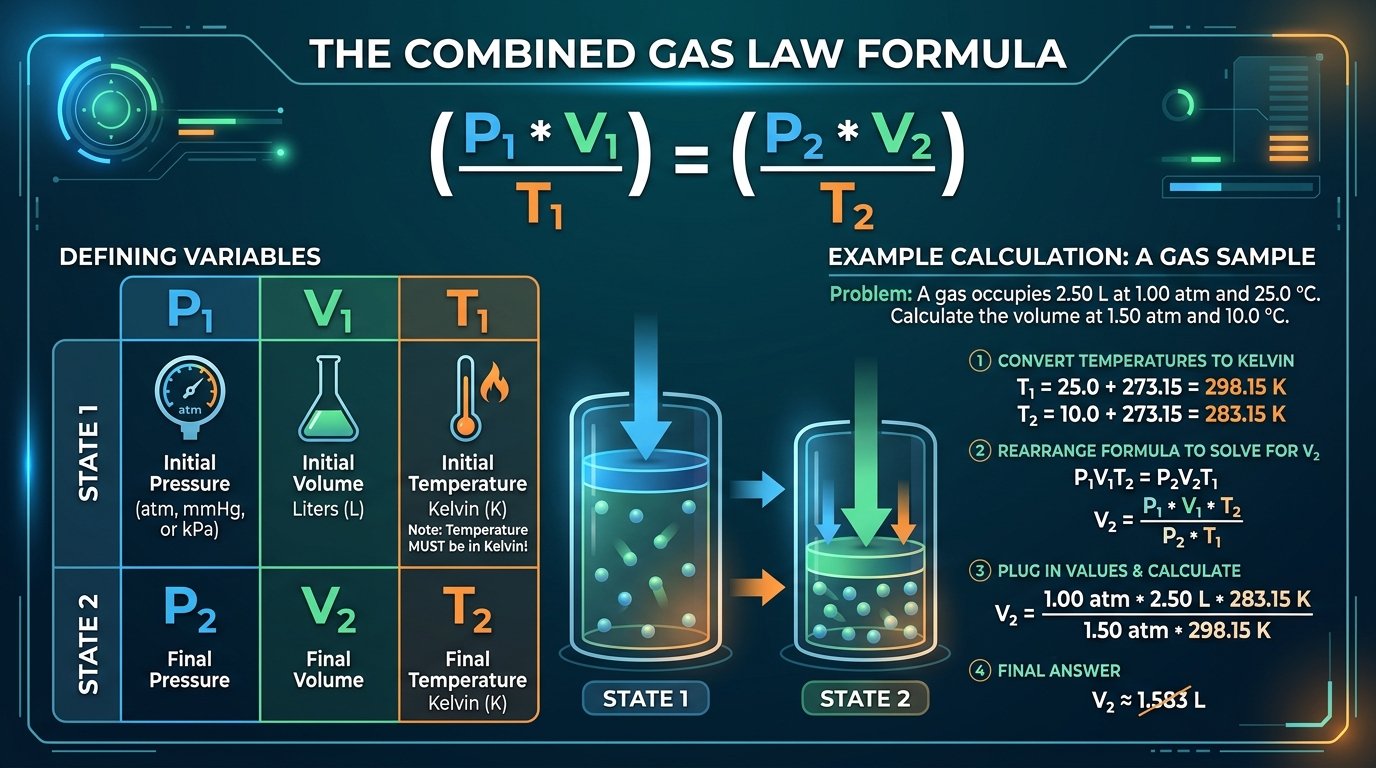
The combined gas law calculator starts with one compact statement:
Cross multiplication gives P₁V₁T₂ = P₂V₂T₁. From that form, isolate the unknown by dividing both sides by the factors attached to it. The six useful rearrangements are:
| Unknown | Rearranged equation |
|---|---|
| P₁ | P₁ = P₂V₂T₁/(V₁T₂) |
| V₁ | V₁ = P₂V₂T₁/(P₁T₂) |
| T₁ | T₁ = P₁V₁T₂/(P₂V₂) |
| P₂ | P₂ = P₁V₁T₂/(T₁V₂) |
| V₂ | V₂ = P₁V₁T₂/(T₁P₂) |
| T₂ | T₂ = P₂V₂T₁/(P₁V₁) |
You do not need to memorize all six lines. Write the original proportion, cross multiply, and isolate the target. The combined gas law calculator displays the correct rearrangement, so it also works as a learning check rather than a black box.
🌡️ Why Temperature Must Be in Kelvin
Absolute temperature is not optional. Gas-law proportionality begins at absolute zero, so temperature ratios must use Kelvin. A Celsius ratio has no physical meaning: 40°C is not twice as hot as 20°C. In Kelvin, those temperatures are 313.15 K and 293.15 K, revealing the real ratio of about 1.068.
The combined gas law calculator handles °C, °F, and K. It uses K = °C + 273.15 and K = (°F − 32) × 5/9 + 273.15. If the unknown is temperature, the calculation is performed in Kelvin and then converted back to your selected output unit.
A quick reasonableness check helps. If a flexible balloon warms while external pressure stays constant, its volume should increase, but not in direct proportion to Celsius numbers. Moving from 20°C to 40°C raises absolute temperature by only 6.8%, so the ideal-gas volume also rises by about 6.8%, not 100%.
🔄 Which Pressure, Volume, and Temperature Units Should You Use?
The equation works with any pressure unit when P₁ and P₂ are expressed in the same unit. Common choices include atmospheres, kilopascals, pascals, bar, millimeters of mercury, torr, and psi. Likewise, V₁ and V₂ may use liters, milliliters, cubic meters, or cubic centimeters when the pair is consistent.
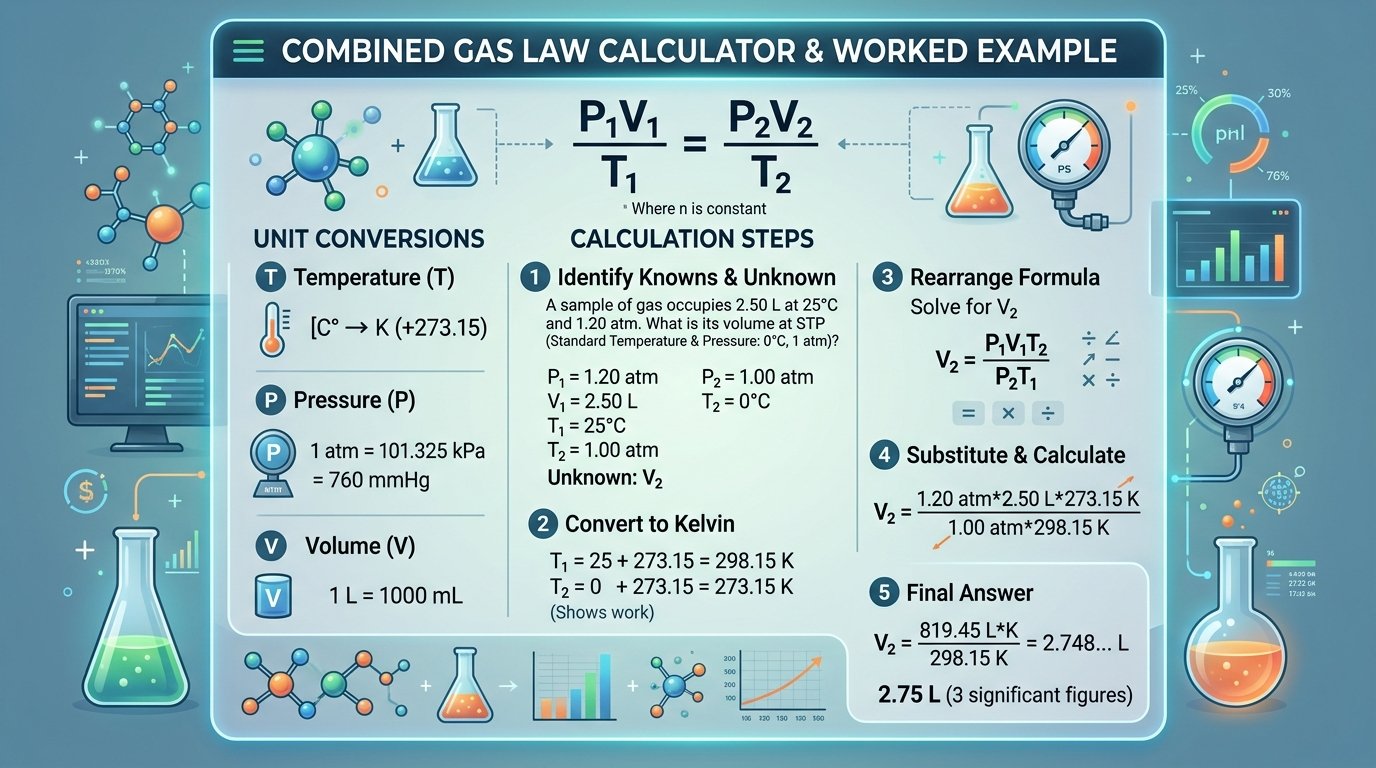
The combined gas law calculator allows mixed units because it converts internally: 1 atm = 101.325 kPa = 760 mmHg = 760 torr ≈ 14.6959 psi, while 1 L = 1000 mL = 0.001 m³. This feature is convenient, but students should still understand dimensional consistency. A value of 250 mL cannot be substituted beside 2.0 L without conversion.
Absolute versus gauge pressure is another critical distinction. Gas laws require absolute pressure. Add local atmospheric pressure to gauge pressure before entering it. A tire reading of 30 psi gauge is roughly 44.7 psi absolute at standard atmospheric pressure. Using 30 psi as if it were absolute changes every predicted state.
🎈 How Pressure, Volume, and Temperature Work Together
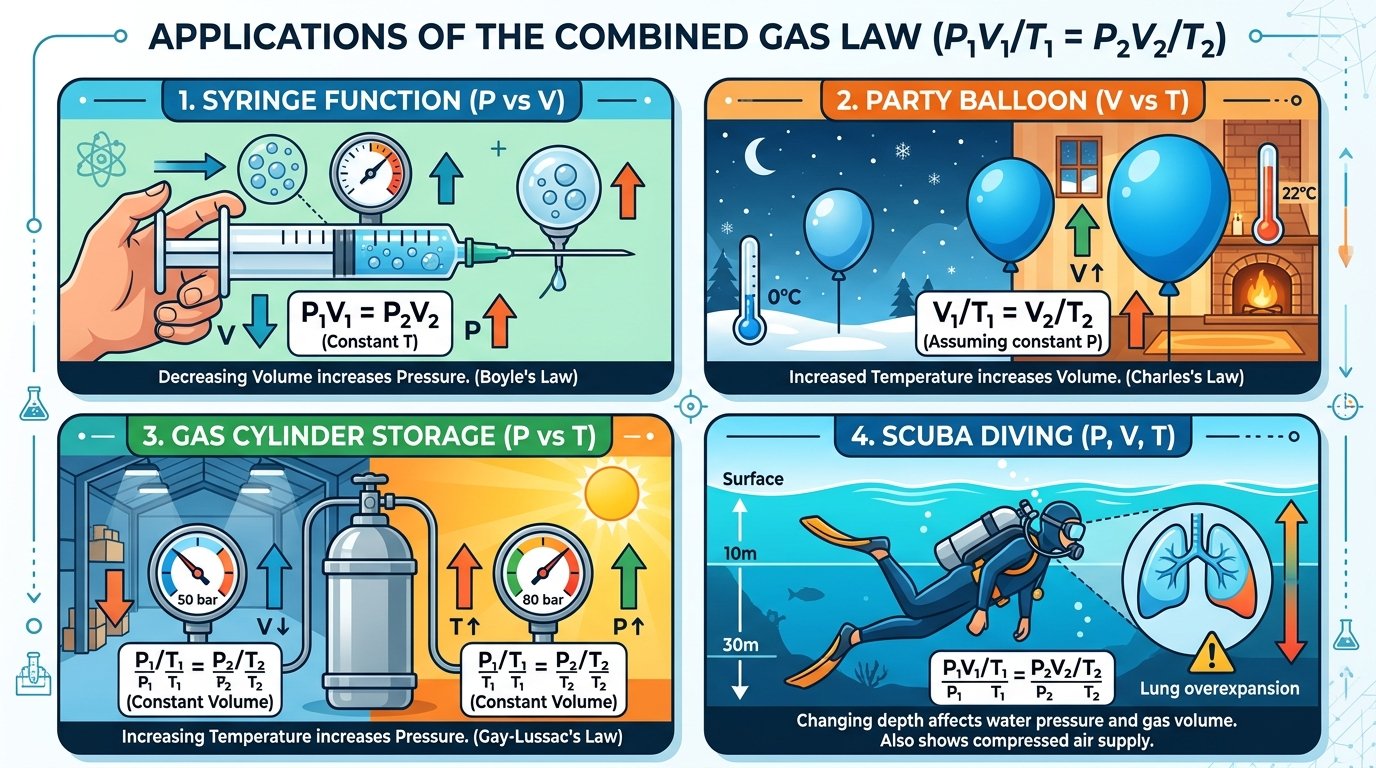
The combined gas law calculator is easier to understand when each directional relationship is clear. At constant temperature, pressure and volume are inversely proportional: squeezing a gas into half the volume doubles its absolute pressure. At constant pressure, volume is directly proportional to absolute temperature. At constant volume, pressure is directly proportional to absolute temperature.
Real questions often change all three variables. Expansion may lower pressure while heating pushes it upward. The final result reflects both effects. Instead of relying on a single verbal trend, compare the ratios. For final pressure, P₂/P₁ = (V₁/V₂)(T₂/T₁). Expansion contributes a factor below one; heating contributes a factor above one. Multiplying them reveals which effect dominates.
This ratio view is also a fast estimate. If volume rises 20% while Kelvin temperature rises 10%, pressure should become roughly 1.10/1.20 = 0.917 of its original value, an 8.3% drop. The detailed output makes that logic visible.
✍️ Four Worked Examples, Step by Step
Example 1: a warming balloon
A 2.00 L balloon at 1.00 atm and 20°C warms to 35°C while pressure falls to 0.85 atm. For V₂, convert 20°C to 293.15 K and 35°C to 308.15 K. Then V₂ = (1.00 × 2.00 × 308.15)/(293.15 × 0.85) = 2.47 L. The combined gas law calculator shows the substitutions and the percentage changes.
Example 2: a rigid heated tank
A fixed 10.0 L tank contains gas at 100 kPa and 20°C. It is heated to 120°C without changing volume. P₂ = (100 × 10.0 × 393.15)/(293.15 × 10.0) = 134.1 kPa. Because volume cancels, this is also Gay-Lussac’s law.
Example 3: a diver’s air bubble
A 1.00 L bubble at 3.00 atm and −5°C rises to 1.00 atm water at 20°C. V₂ = (3.00 × 1.00 × 293.15)/(268.15 × 1.00) = 3.28 L. Both lower pressure and higher temperature make the bubble expand.
Example 4: solve for temperature
Gas begins at 1.00 atm, 2.00 L, and 20°C, then reaches 1.40 atm and 1.80 L. T₂ = (1.40 × 1.80 × 293.15)/(1.00 × 2.00) = 369.37 K, or 96.22°C. A combined gas law calculator avoids the common error of reporting 369.37°C.
📊 Reference Table: Common Two-State Gas Problems
The table provides quick benchmark values for familiar scenarios. Each answer assumes a fixed amount of ideal gas, absolute pressure, and equilibrium at both states.
| Scenario | Initial state | Final information | Expected result |
|---|---|---|---|
| Rigid tank heating | 100 kPa, 10 L, 20°C | 10 L, 120°C | P₂ ≈ 134.1 kPa |
| Balloon warming | 1 atm, 2 L, 20°C | 0.85 atm, 35°C | V₂ ≈ 2.47 L |
| Diver bubble ascent | 3 atm, 1 L, −5°C | 1 atm, 20°C | V₂ ≈ 3.28 L |
| Gas compression | 1 atm, 2 L, 20°C | 1.4 atm, 1.8 L | T₂ ≈ 369.4 K |
| Weather balloon | 101 kPa, 5 L, 15°C | 72 kPa, −10°C | V₂ ≈ 6.40 L |
| Lab sample correction | 760 torr, 250 mL, 25°C | 690 torr, 50°C | V₂ ≈ 294.8 mL |
| Constant-temperature compression | 1 atm, 4 L, 300 K | 2 atm, 300 K | V₂ = 2 L |
| Constant-pressure warming | 1 atm, 1 L, 273.15 K | 1 atm, 546.3 K | V₂ = 2 L |
Use benchmark rows as direction checks rather than universal constants. Real laboratory values differ with local pressure, instrument uncertainty, humidity, gas leakage, and departure from ideal behavior.
🔬 Boyle, Charles, Gay-Lussac, and the Ideal Gas Law
The combined equation is three familiar laws packaged together. If temperature remains constant, T₁ and T₂ cancel, leaving P₁V₁ = P₂V₂, Boyle’s law. If pressure remains constant, pressure cancels and V₁/T₁ = V₂/T₂, Charles’s law. If volume remains constant, volume cancels and P₁/T₁ = P₂/T₂, Gay-Lussac’s law.
The combined gas law calculator therefore solves each special case without needing a different engine. Enter equal values for the controlled quantity, or use the appropriate measurements. Recognizing cancellation is still valuable because it simplifies hand calculations and helps diagnose whether the selected data make sense.
Avogadro’s law is not explicitly present because the amount of gas is assumed constant. If moles change, use the general gas law P₁V₁/(n₁T₁) = P₂V₂/(n₂T₂), or apply the ideal gas law calculator with PV = nRT.
⚠️ Assumptions and Limits of the Model
A combined gas law calculator models a fixed quantity of ideal gas between two equilibrium states. It assumes particles have negligible volume, intermolecular attractions are insignificant, and measured pressure and temperature describe the whole sample. Most dilute gases near room conditions behave closely enough for school and routine estimates.
Accuracy declines near condensation, at very high pressure, or at very low temperature. Polar gases and large molecules may deviate sooner than helium, hydrogen, or nitrogen. In those regions, compressibility factors or equations of state such as van der Waals, Redlich–Kwong, or Peng–Robinson may be required.
The formula also fails if gas escapes, dissolves, reacts, or is produced. A leaking bicycle pump does not contain a fixed amount. An airbag reaction generates new gas. A wet-gas experiment may involve vapor pressure that must be subtracted from total pressure. The numerical answer can look precise even when the physical model is wrong, so always inspect assumptions before trusting decimals.
👥 Who Uses Combined Gas Law Calculations?
- Students use the equation in general chemistry, physics, environmental science, and engineering courses.
- Chemistry teachers use two-state examples to connect Boyle’s, Charles’s, and Gay-Lussac’s laws.
- Laboratory technicians correct collected gas volumes and compare measurements made at different conditions.
- Environmental teams normalize gas samples to a stated pressure and temperature.
- Diving instructors explain why bubbles and flexible air spaces expand during ascent.
- Weather researchers use idealized estimates to discuss balloon expansion with altitude.
- Process and mechanical engineers use the relationship for preliminary checks before applying real-gas or energy-balance models.
- Medical and safety trainers use it to demonstrate how sealed or flexible gas spaces respond to heating and pressure change.
The same algebra appears across these fields, but the required accuracy and model complexity differ. A classroom estimate may be sufficient for a balloon, while an industrial vessel requires certified data, safety factors, and a real-gas equation of state.
🧪 Full Laboratory Walkthrough: Measure, Calculate, and Verify
For experimental work, record pressure, volume, and temperature with units and instrument resolution. Convert gauge pressure to absolute pressure. Allow the gas to reach thermal equilibrium before reading temperature. A sensor touching a warm vessel wall may not represent the gas core.
Use the check-two-states mode of the combined gas law calculator to calculate both PV/T values. Perfect equality is unlikely because measurements carry uncertainty. Compare the percentage difference with expected uncertainty from the pressure gauge, thermometer, and volume markings. A 0.5% mismatch may be excellent with classroom equipment; it may be unacceptable with calibrated digital sensors.
Repeat trials and report a mean rather than selecting the closest result. Keep extra digits through intermediate steps, then round according to significant figures at the end. Document atmospheric pressure if gauge instruments were used. These habits turn a simple equation into defensible experimental evidence.
🕰️ A Short History: From Separate Rules to One Equation
Robert Boyle published the inverse pressure–volume relationship in the seventeenth century after experiments with trapped air. His work showed that, at roughly constant temperature, reducing a gas volume raises its pressure in a predictable way.
Jacques Charles and later Joseph Louis Gay-Lussac established temperature relationships for gases. Charles’s law connects volume with absolute temperature at constant pressure, while Gay-Lussac’s pressure law connects pressure with absolute temperature at constant volume.
These observations became much clearer after the development of an absolute temperature scale. Kelvin temperature makes gas ratios physically meaningful because zero Kelvin represents the extrapolated limit of thermal motion rather than an arbitrary freezing point.
Amedeo Avogadro’s proposal connected volume with particle amount, and the ideal gas equation PV = nRT eventually gathered pressure, volume, temperature, and moles into one model. Holding n constant at two states and dividing the two ideal-gas equations produces P₁V₁/T₁ = P₂V₂/T₂.
The modern equation is therefore not an unrelated fourth rule. It is a compact comparison created from several centuries of experiments, better thermometry, and the particle interpretation of matter.
🌍 Combined Gas Behavior in Everyday Life
The combined gas law calculator supports more than textbook exercises. Weather balloons expand as atmospheric pressure falls and temperature changes with altitude. Scuba bubbles grow during ascent. Aerosol cans gain pressure when heated. Flexible medical ventilation bags respond to pressure and temperature. Engine-cylinder estimates compare compressed and expanded states, although combustion and rapid heat transfer require more advanced models.
Laboratories use the relationship to correct collected gas volumes from room conditions to standard or specified conditions. Environmental sampling systems normalize gas readings. Vacuum equipment checks whether a sealed chamber’s pressure shift can be explained by temperature alone. Refrigeration education uses it for conceptual state changes, while professional refrigerant calculations require phase-equilibrium data rather than an ideal-gas shortcut.
In every application, define the system boundary. Ask whether the same molecules remain inside from state 1 to state 2. If the answer is uncertain, the fixed-amount assumption deserves investigation.
📝 Practice Problems With Answers
Try each question by hand, then verify it with the combined gas law calculator.
1. A 3.00 L gas at 95.0 kPa and 25°C is compressed to 2.20 L and heated to 60°C. Find P₂.
T₁ = 298.15 K, T₂ = 333.15 K. P₂ = (95.0 × 3.00 × 333.15)/(298.15 × 2.20) = 144.8 kPa.
2. A 500 mL sample at 1.20 atm and 10°C reaches 0.90 atm and 40°C. Find V₂.
V₂ = (1.20 × 500 × 313.15)/(283.15 × 0.90) = 737.2 mL.
3. A 2.50 L sample at 100 kPa and 300 K becomes 2.00 L at 125 kPa. Find T₂.
T₂ = (125 × 2.00 × 300)/(100 × 2.50) = 300 K. Pressure-volume changes exactly compensate.
4. A rigid vessel reads 2.00 bar at 15°C and 2.40 bar later. Find T₂.
With constant volume, T₂ = 2.40 × 288.15/2.00 = 345.78 K = 72.63°C.
5. A gas occupies 1.50 m³ at 101 kPa and 280 K. At 90 kPa and 300 K, what volume is expected?
V₂ = (101 × 1.50 × 300)/(280 × 90) = 1.804 m³.
For Students and Teachers
A combined gas law calculator is most valuable after students set up the equation themselves. Use it to check rearrangement, units, and numerical work. The displayed table helps learners see that “initial” and “final” labels describe complete states rather than individual numbers.
Teachers can use presets for prediction discussions. Hide the result, ask whether pressure or volume should rise, collect reasoning, and then reveal the graph. The two-state checker supports lab investigations in which students test whether PV/T remains constant within uncertainty.
Assessment should still include conceptual questions: why Kelvin is necessary, why absolute pressure matters, what fixed amount means, and when real gases deviate. Correct arithmetic without correct modeling is only half a solution.
Advanced Interpretation With Ratios
Dimensionless ratios reveal the structure of the formula. Rearranging gives P₂/P₁ = (V₁/V₂)(T₂/T₁), V₂/V₁ = (P₁/P₂)(T₂/T₁), and T₂/T₁ = (P₂/P₁)(V₂/V₁). Each right-hand factor has no unit, which makes qualitative analysis quick.
The combined gas law calculator reports percentage changes beside the numerical answer. Those changes are descriptive, not additive. A 20% temperature increase does not simply cancel a 20% volume increase in all arrangements because the exact factors are multiplied or divided. Work with 1.20 and 1/1.20 rather than adding signed percentages.
Ratios also reveal invariance. Multiplying both pressures by the same conversion factor leaves P₂/P₁ unchanged, which is why any consistent pressure unit works. The same is true for volume. Temperature is different because Celsius and Fahrenheit conversions include offsets; only an absolute scale creates a valid ratio.
✅ Tips for Fast, Error-Free Work
Start with a six-cell data table labeled P₁, V₁, T₁, P₂, V₂, and T₂. Copy each quantity with its unit. Circle the unknown and convert both temperatures to Kelvin. Convert pressure and volume pairs if necessary. Write P₁V₁/T₁ = P₂V₂/T₂, isolate the circled symbol, substitute, and calculate.
Before opening the combined gas law calculator, predict direction. Compression tends to raise pressure. Heating tends to raise pressure at fixed volume or raise volume at fixed pressure. Cooling tends to do the opposite. If algebra predicts a huge volume decrease for a balloon moved to lower pressure, inspect the setup.
Finally, include a unit and sensible significant figures. A naked number is incomplete. If data are given to three significant figures, a result with ten decimals suggests false certainty. The tool displays additional digits for transparency; your report should match the quality of the measurements.
Combined Gas Law vs Ideal Gas Law
The combined law compares two states and eliminates both the gas constant R and amount n because neither changes. The ideal gas law PV = nRT describes one state and can find moles, molar mass, density, pressure, volume, or temperature when enough information is known.
Choose the combined gas law calculator when the question gives “before” and “after” conditions for the same sealed sample. Choose PV = nRT when moles or gas quantity matter. If both state and amount change, use P₁V₁/(n₁T₁) = P₂V₂/(n₂T₂).
For chemistry conversions around these calculations, the grams to moles calculator, molarity calculator, and molecular weight calculator can supply quantities needed by the ideal-gas equation.
🚫 8 Common Mistakes to Avoid
- Using Celsius directly. Convert to Kelvin before forming a temperature ratio.
- Mixing pressure units. Convert P₁ and P₂ to a shared absolute unit.
- Mixing liters and milliliters. Use consistent volume units.
- Using gauge pressure. Gas equations need absolute pressure.
- Swapping state labels. Keep every initial value together and every final value together.
- Inverting a ratio. Derive the rearrangement rather than guessing.
- Assuming gas amount is fixed when it leaks. Check the system boundary.
- Rounding too early. Preserve calculator precision until the final line.
The combined gas law calculator prevents unit and algebra mistakes, but it cannot decide whether a problem’s physical assumptions are valid. Read the wording, sketch the two states, predict whether the answer should rise or fall, and use that prediction as a final check.
🏆 How This Calculator Is Different
Many calculators solve only P₂ and assume matching units. This combined gas law calculator solves any of the six variables, offers dedicated final-pressure, final-volume, and final-temperature modes, and checks whether two complete states agree. Automatic conversion covers seven pressure units, four volume units, and three temperature scales.
Every answer includes the rearranged equation, base-unit substitutions, a state comparison, percentage changes, and normalized bars. Results can be copied, downloaded as CSV or TXT, printed, shared, and stored in a private browser history. Nothing in the calculation requires an account or sends problem data to a server.
The interface mirrors the site’s established blue calculator design, remains responsive on phones, and scopes its styles to avoid interfering with a WordPress theme. The Reset control clears the active mode without removing unrelated page content.
📚 Where the Numbers and Conversions Come From
The combined gas law calculator uses exact or standard conversion definitions where practical: 1 atm = 101,325 Pa, 1 bar = 100,000 Pa, 1 atm = 760 torr, 1 L = 0.001 m³, and Celsius zero is 273.15 K above absolute zero. Psi conversion is shown to suitable precision for educational work.
Reliable reference information is available from the National Institute of Standards and Technology and the OpenStax Chemistry 2e gas chapter. These are normal dofollow citations to authoritative educational resources.
Conversion accuracy does not repair low-quality measurements. A pressure gauge with ±2% accuracy cannot support a six-decimal conclusion. Record the instrument specification, distinguish resolution from accuracy, and state assumptions in any formal report.
☑️ Exam and Laboratory Checklist
- Is it the same fixed amount of gas in both states?
- Are all pressures absolute rather than gauge?
- Are temperature entries labeled K, °C, or °F correctly?
- Are pressure and volume values positive?
- Did you keep state 1 and state 2 together?
- Does the predicted direction agree with the result?
- Are units and significant figures included?
- Could condensation, leakage, reaction, or non-ideal behavior matter?
Run this checklist before accepting an answer from the combined gas law calculator. It takes seconds and catches most conceptual errors that automated arithmetic cannot see.
❓ Frequently Asked Questions
What is the combined gas law?
It states that PV/T is constant between two states of a fixed ideal-gas sample: P₁V₁/T₁ = P₂V₂/T₂. Use the combined gas law calculator above to verify a numerical example and inspect the rearranged equation.
What can this tool solve?
It can solve any missing P₁, V₁, T₁, P₂, V₂, or T₂ when the other five values are known. Use the combined gas law calculator above to verify a numerical example and inspect the rearranged equation.
Must temperature be in Kelvin?
Yes for the equation. The tool accepts Celsius and Fahrenheit but converts them to Kelvin internally. Use the combined gas law calculator above to verify a numerical example and inspect the rearranged equation.
Can I mix atm and kPa?
Yes. The tool converts each pressure to atmospheres before calculation and returns the selected output unit. Use the combined gas law calculator above to verify a numerical example and inspect the rearranged equation.
Can I mix liters and milliliters?
Yes. Volumes are converted internally to liters, but hand calculations require a consistent pair. Use the combined gas law calculator above to verify a numerical example and inspect the rearranged equation.
Should I use gauge or absolute pressure?
Use absolute pressure. Add atmospheric pressure to a gauge reading before applying a gas law. Use the combined gas law calculator above to verify a numerical example and inspect the rearranged equation.
When does the combined law not apply?
It does not directly apply when gas amount changes, gas reacts or condenses, or non-ideal behavior is substantial. Use the combined gas law calculator above to verify a numerical example and inspect the rearranged equation.
How is it related to Boyle’s law?
At constant temperature, temperature cancels and the equation becomes P₁V₁ = P₂V₂. Use the combined gas law calculator above to verify a numerical example and inspect the rearranged equation.
How is it related to Charles’s law?
At constant pressure, pressure cancels and the equation becomes V₁/T₁ = V₂/T₂. Use the combined gas law calculator above to verify a numerical example and inspect the rearranged equation.
How is it related to Gay-Lussac’s law?
At constant volume, volume cancels and the equation becomes P₁/T₁ = P₂/T₂. Use the combined gas law calculator above to verify a numerical example and inspect the rearranged equation.
Is the calculator free?
Yes. It has no registration requirement or daily calculation limit. Use the combined gas law calculator above to verify a numerical example and inspect the rearranged equation.
Does it save my gas data?
Only recent result summaries are stored in your own browser local storage; Clear All removes them. Use the combined gas law calculator above to verify a numerical example and inspect the rearranged equation.
Why did my answer have a negative Celsius value?
A positive Kelvin result may correspond to a negative Celsius value. That is physically valid if it remains above absolute zero. Use the combined gas law calculator above to verify a numerical example and inspect the rearranged equation.
What does the two-state checker do?
It computes PV/T for both measured states and reports their symmetric percentage difference. Use the combined gas law calculator above to verify a numerical example and inspect the rearranged equation.
How many significant figures should I report?
Usually match the least precise measured input, while retaining extra digits during intermediate calculations. Use the combined gas law calculator above to verify a numerical example and inspect the rearranged equation.
Can it calculate moles?
No. Use PV = nRT when moles are unknown because the combined law assumes the same fixed amount. Use the combined gas law calculator above to verify a numerical example and inspect the rearranged equation.
Can it model a weather balloon?
It provides an ideal-gas estimate if pressure and temperature are known and gas does not leak significantly. Use the combined gas law calculator above to verify a numerical example and inspect the rearranged equation.
Why do pressure and volume move oppositely?
At fixed temperature and amount, reducing available volume increases collision frequency and absolute pressure. Use the combined gas law calculator above to verify a numerical example and inspect the rearranged equation.
What if both pressure and temperature change?
Their effects combine multiplicatively; the calculator evaluates both together with any volume change. Use the combined gas law calculator above to verify a numerical example and inspect the rearranged equation.
Can I use Fahrenheit values directly?
Select °F and enter them; the calculator performs the required absolute-temperature conversion. Use the combined gas law calculator above to verify a numerical example and inspect the rearranged equation.
Standard Conditions, Reference States, and Reporting
Gas volumes are often compared at a reference condition, but “standard” is not universal. One course may use 0°C and 1 atm, another may use 0°C and 100 kPa, while a laboratory method may define 20°C or 25°C as its reporting temperature. Always copy the reference pressure and temperature stated in the question or standard operating procedure rather than assuming a memorized pair.
To correct a measured volume to a reference state, treat the measurement as state 1 and the reference as state 2. The pressure used for a gas collected over water may need correction for water-vapor pressure. Subtract the vapor pressure of water from total pressure to obtain the dry gas pressure, provided the setup and question call for a dry-gas result. Vapor pressure depends strongly on temperature, so use an appropriate reference table.
Atmospheric pressure also varies with weather and altitude. A nominal value of 1 atm may be acceptable in a textbook question but not in careful experimental work. Record the barometer reading at the time of collection. If a sensor reports gauge pressure, convert it to absolute pressure using the local atmospheric value rather than a generic sea-level number.
State whether the final answer describes wet gas, dry gas, ambient conditions, STP, SATP, or another named reference. Include the actual numerical conditions in parentheses because labels can be interpreted differently. For example, write “volume at 273.15 K and 100 kPa” instead of relying only on “STP.” This practice makes results reproducible across textbooks, countries, and laboratory systems.
For a sealed sample, correction between conditions is straightforward. For flowing gas, a reported volumetric flow such as liters per minute can depend on the instrument’s reference state. Standard liters per minute and actual liters per minute are not automatically interchangeable. Professional flow calculations may also require humidity, compressibility, and meter calibration information.
When documenting work, show the original measurements first, then conversions, rearranged formula, substituted values, and rounded result. Keep at least one or two guard digits during arithmetic. If uncertainty is required, propagate sensor uncertainties or use repeated observations; do not infer uncertainty from the number of digits shown by software.
Reasonableness Tests Before You Submit
A strong solution does more than produce a number. Test limiting cases. If initial and final pressure and temperature are equal, volume must remain equal. If only absolute temperature doubles at constant pressure, volume must double. If only volume is halved at constant temperature, pressure must double. These simple cases expose inverted fractions immediately.
Estimate before calculating. Separate the effect of each ratio and multiply rough factors. Suppose pressure drops to three quarters of its original value while Kelvin temperature rises by one tenth. At a flexible final state, the volume factor should be about 1/0.75 × 1.10, or 1.47. An answer near 0.68 indicates that a ratio was reversed.
Check scale and units. A classroom syringe is measured in milliliters, a balloon in liters, and an industrial vessel may be measured in cubic meters. An answer of 2,500 L may be numerically equivalent to 2.5 m³ but confusing if the expected context is a room-sized tank. Choose an output unit that communicates the scale clearly.
Finally, ask whether equilibrium is plausible. Rapid compression can temporarily heat a gas; immediate and delayed readings may describe different states. A flexible container may experience surface tension or elastic resistance, so internal pressure need not exactly equal atmospheric pressure. Identifying these limitations shows scientific judgment even when an introductory equation is the assigned model.
Quick Verification Notes
Use these short prompts as a final audit rather than treating software output as proof by itself.
- Use the combined gas law calculator unit check when a question mixes atmospheres with kilopascals or liters with milliliters.
- The combined gas law calculator Kelvin reminder is especially useful when a problem supplies one temperature in Celsius and another in Fahrenheit.
- Compare the combined gas law calculator pressure result with your prediction: compression usually raises pressure when other effects do not dominate.
- A combined gas law calculator volume answer should grow when external pressure falls and absolute temperature does not fall enough to offset it.
- Keep initial values together before using the combined gas law calculator so a state-label swap cannot reverse the intended ratio.
- Round the combined gas law calculator result only after all conversions and intermediate operations have been completed.
- Check the fixed-amount assumption before trusting a combined gas law calculator answer for a leaking, vented, or reacting system.
- Use the combined gas law calculator direction check to ask whether heating, cooling, compression, or expansion should raise or lower the target.
- In laboratory work, compare the combined gas law calculator prediction with instrument uncertainty instead of demanding perfect equality.
- For homework, let the combined gas law calculator verify your algebra after you have isolated the unknown on paper.
- The combined gas law calculator ratio display helps distinguish a direct temperature effect from an inverse volume effect.
- Read every unit selector in the combined gas law calculator before pressing Calculate; a correct number paired with the wrong unit remains wrong.
- Treat the combined gas law calculator graph as a visual reasonableness aid, not as a substitute for the numerical result.
- Copy the rearranged combined gas law calculator formula into your solution so the mathematical method is clear to the reader.
- Attach a pressure, volume, or temperature unit to every combined gas law calculator result you report.
- When gauge pressure is given, convert it to absolute pressure before entering the value in the combined gas law calculator.
- If the combined gas law calculator returns a negative Celsius temperature, confirm that its Kelvin equivalent is still above absolute zero.
- A very large combined gas law calculator change may be valid, but it deserves a second inspection of decimal points and unit prefixes.
- For gas collected over water, correct the dry-gas pressure before using the combined gas law calculator when the problem requires that adjustment.
- The combined gas law calculator can compare STP or SATP states, but you must enter the numerical reference conditions stated by your source.
- Use extra digits internally while the combined gas law calculator works, then match the final rounding to the least precise measurement.
- If moles change between states, replace the combined gas law calculator model with an equation that explicitly includes n₁ and n₂.
- Near condensation or at high pressure, regard the combined gas law calculator as an ideal estimate rather than an exact real-gas model.
- Reset the combined gas law calculator between unrelated examples so an old entry does not silently become part of the next state.
- Before submission, reproduce one combined gas law calculator result by hand to confirm both the setup and the final unit.
🔟 10 Facts Worth Knowing
- A temperature ratio is valid in Kelvin, not in Celsius or Fahrenheit.
- Gas-law pressure must be absolute; gauge pressure omits the surrounding atmosphere.
- Pressure units may differ at input only if they are converted to a common scale before arithmetic.
- Volume units cancel as a ratio when they are consistent, but liters and milliliters cannot be mixed untreated.
- The equation assumes the amount of gas remains fixed from state 1 to state 2.
- Boyle’s law appears when temperature is constant, and Charles’s law appears when pressure is constant.
- The average kinetic energy of ideal-gas particles depends on absolute temperature.
- A precise digital result can still be inaccurate when the model assumptions or measurements are poor.
- At high pressure or near condensation, real-gas corrections may become important.
- Direction prediction is one of the fastest ways to catch an inverted fraction.
🔗 Trusted external resources
🎯 Final Thoughts
The combined gas law calculator turns a six-variable proportion into a transparent workflow: define two states, convert to absolute units, isolate one unknown, calculate, and test whether the direction makes physical sense. The same method scales from a classroom syringe to a weather balloon estimate.
Bookmark this page for your next gas-law problem, and explore related resources such as the ideal gas law calculator, pressure conversion calculator, and temperature conversion calculator. For corrections or questions, visit the contact page.
Ahmad Raza, M.Phil. Chemistry
Ahmad is a chemistry educator and science content developer with more than 10 years of experience teaching analytical and physical chemistry. He creates practical calculation tools for students, teachers, and laboratory professionals.