
Atomic mass calculator: look up the IUPAC atomic mass of any of the 118 elements by symbol or name, calculate average atomic mass from isotope masses and percent abundances, find protons, neutrons and electrons for any element or ion, convert between atomic mass units (amu/u), grams and kilograms, and compare atomic masses of multiple elements with graphs. Free, no registration.
⚛️ Atomic Mass Calculator
Look up any element's atomic mass, calculate weighted averages from isotopes, find protons-neutrons-electrons, convert amu ↔ grams & compare elements — instantly.
✅ Trusted by Students, Teachers & Lab Professionals WorldwideElement Atomic Mass Lookup
Type an element symbol (Fe) or full name (Iron) — get its atomic mass and full profile.
Average Atomic Mass from Isotopes
Enter each isotope's mass (u) and % abundance — get the weighted average atomic mass. Fill 2–5 rows.
Isotope Mass (u) | Abundance (%)
Protons, Neutrons & Electrons Finder
Enter an element (and optional mass number / ion charge) — get its complete particle count.
amu ↔ grams ↔ kilograms Converter
Convert atomic mass units (u / amu / Da) to grams or kilograms and back — with Avogadro-scale context.
Compare Atomic Masses
One element per line — symbols or names (max 15). Get a sorted comparison table with a graph.
🕘 Recent Lookups Clear All
An atomic mass calculator gives you the exact mass of any element in seconds — no squinting at a tiny periodic table, no flipping through textbook appendices. Type “Fe” or “Iron”, press one button, and you get 55.845 u along with the element’s full profile: atomic number, protons, neutrons, electrons and the mass of a single atom in grams.
The free tool above goes far beyond a simple lookup, though. It solves the classic exam problem — calculating average atomic mass from isotope abundances — shows every step of the working, finds particle counts for ions, converts atomic mass units to grams, and compares up to fifteen elements on one interactive graph.
In this guide, I’ll walk you through every mode of the atomic mass calculator, explain where those strange decimal masses actually come from, and work through the exact isotope problems that appear on every chemistry exam. Let’s get into it.
🔑 KEY TAKEAWAY
An atomic mass calculator is a free online tool that instantly returns the IUPAC standard atomic mass of any of the 118 elements, searched by symbol or name. The calculator on this page offers five modes — element lookup, average atomic mass from isotope abundances, protons-neutrons-electrons finder, amu-to-grams conversion, and multi-element comparison — with step-by-step working, interactive tables and graphs, plus one-click copy, CSV/TXT download, print and share options.
📑 Table of Contents (click to expand)
- What Is an Atomic Mass Calculator?
- How to Use This Atomic Mass Calculator
- The 5 Modes Explained
- Atomic Mass vs Mass Number vs Atomic Weight
- How Average Atomic Mass Is Calculated
- Atomic Mass Table of 25 Common Elements
- Why Atomic Masses Have Decimals: Isotopes
- Who Uses an Atomic Mass Calculator?
- The amu (Dalton) Explained
- Practice Problems With Answers
- Tips for Accurate Results
- Common Mistakes to Avoid
- What Makes This Tool Different
- Where the Data Comes From
- Calculator vs Periodic Table vs Apps
- A Short History of Atomic Mass
- From Atomic Mass to Stoichiometry
- Quick Exam Checklist
- Frequently Asked Questions
- 10 Atomic Mass Facts Worth Knowing
- Final Thoughts
What Is an Atomic Mass Calculator?
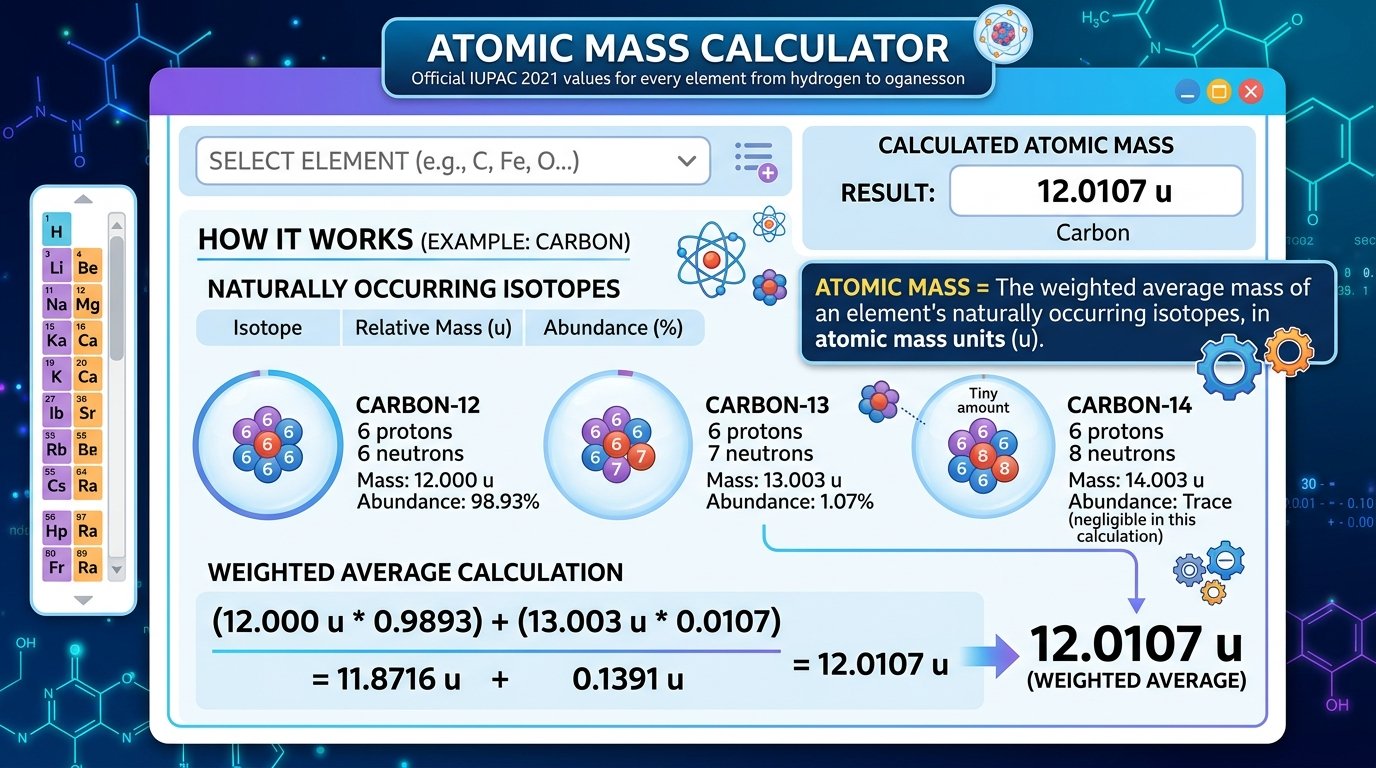
An atomic mass calculator is an online tool that returns the standard atomic mass of any chemical element — the weighted-average mass of its atoms, measured in atomic mass units (u), exactly as published by IUPAC, the international authority on chemical data.
Ask it for carbon and you get 12.011 u. Ask for gold and you get 196.97 u. But a good atomic mass calculator answers the deeper questions too: why is chlorine 35.45 and not a whole number? How do you compute an average atomic mass when an exam gives you isotope abundances? How many neutrons does a copper atom actually have?
The tool at the top of this page handles all of it. It knows all 118 elements by symbol and by name, solves isotope-average problems with full working, counts protons, neutrons and electrons for atoms and ions, and converts between atomic mass units and grams using the CODATA constant. Every answer comes with a table, a graph and an explanation — because a number you understand beats a number you copied.
💡 Quick definition: Atomic mass = the weighted average mass of an element’s naturally occurring isotopes, in atomic mass units (u). Our atomic mass calculator uses official IUPAC 2021 values for every element from hydrogen to oganesson.
How to Use This Atomic Mass Calculator
No sign-up, no downloads, no learning curve. Using this atomic mass calculator takes four steps:
- Pick a mode. The default tab looks up any element’s atomic mass. Four more tabs cover isotope averages, particle counts, unit conversion and element comparison.
- Type an element — any way you like. Symbol (Fe), full name (Iron), even lowercase (iron) — the search understands all of them. Partial names work too: “carb” finds Carbon.
- Hit Calculate. You get the answer in a highlight box, a step-by-step explanation, a detailed table, and an animated graph.
- Use the results. Copy to clipboard, download CSV for Excel, save a TXT file, print a clean report, or share to WhatsApp, Facebook or X.
The atomic mass calculator also remembers your last ten lookups, so yesterday’s element is one click away. And if you need the mass of a whole compound rather than a single element, our molecular weight calculator handles complete formulas like H2SO4 and CuSO4·5H2O with the same one-click simplicity.
The 5 Modes of Our Atomic Mass Calculator Explained
Most element lookup tools stop at one number. This atomic mass calculator is five tools in one interface — here’s what each mode does and when you’d use it.
🔍 Mode 1 — Element Atomic Mass Lookup
The everyday workhorse of the atomic mass calculator. Enter a symbol or name and get the standard atomic mass, atomic number, molar mass, electron count, approximate neutron count and even the mass of a single atom in grams. A neighbor graph shows how the element’s mass compares to the elements beside it on the periodic table — a surprisingly effective way to build intuition.
⚖️ Mode 2 — Average Atomic Mass from Isotopes
The exam classic. Enter each isotope’s mass and percent abundance (2 to 5 isotopes) and the tool computes the weighted average — showing the exact multiplication and addition steps your teacher wants to see. Built-in example buttons load real data for chlorine, copper and magnesium so you can study worked solutions instantly. The tool even catches the most common error: abundances that don’t add up to 100%.
🧮 Mode 3 — Protons, Neutrons & Electrons Finder
Enter an element, optionally a mass number and an ion charge, and get the complete particle inventory. Na with mass number 23 and charge +1? That’s 11 protons, 12 neutrons, 10 electrons — with the three rules (Z, A−Z, Z−charge) spelled out so you learn the method, not just the answer.
🔄 Mode 4 — amu ↔ grams ↔ kilograms Converter
Bridge the atomic world and the lab bench. Convert atomic mass units to grams or kilograms and back, using the exact CODATA constant (1 u = 1.66053906660 × 10⁻²⁴ g). The step box also explains the elegant link: one mole of 1-u particles weighs almost exactly one gram.
📊 Mode 5 — Compare Elements
Paste up to fifteen elements — symbols or names, one per line — and get a sorted table plus a bar chart. Perfect for assignments like “compare the masses of the alkali metals” or simply for seeing, visually, that a single gold atom outweighs sixteen carbon atoms. I haven’t found another free atomic mass calculator that offers batch comparison like this.
Atomic Mass vs Mass Number vs Atomic Weight vs Molar Mass
Four terms, four subtly different meanings — and exam writers love to test whether you know the difference. Here’s the clearest breakdown you’ll find:
| Term | What It Means | Unit | Example (Chlorine) |
|---|---|---|---|
| Atomic mass | Weighted average mass of an element’s natural isotopes | u (amu, Da) | 35.45 u |
| Mass number (A) | Protons + neutrons in ONE specific isotope — always a whole number | none (a count) | 35 or 37 |
| Atomic weight | IUPAC’s formal name for standard atomic mass — same number, official term | u (dimensionless) | 35.45 |
| Molar mass | Mass of one mole (6.022 × 10²³ atoms) — same digits, lab-scale unit | g/mol | 35.45 g/mol |
The one that trips everyone up: mass number is a whole number for one isotope; atomic mass is a decimal average across all isotopes. Chlorine-35 has a mass number of exactly 35, but the element chlorine has an atomic mass of 35.45 because nature mixes Cl-35 and Cl-37 in a roughly 3:1 ratio. Every value in this atomic mass calculator is the decimal average — the number you need for real calculations.
How Average Atomic Mass Is Calculated (Step by Step)
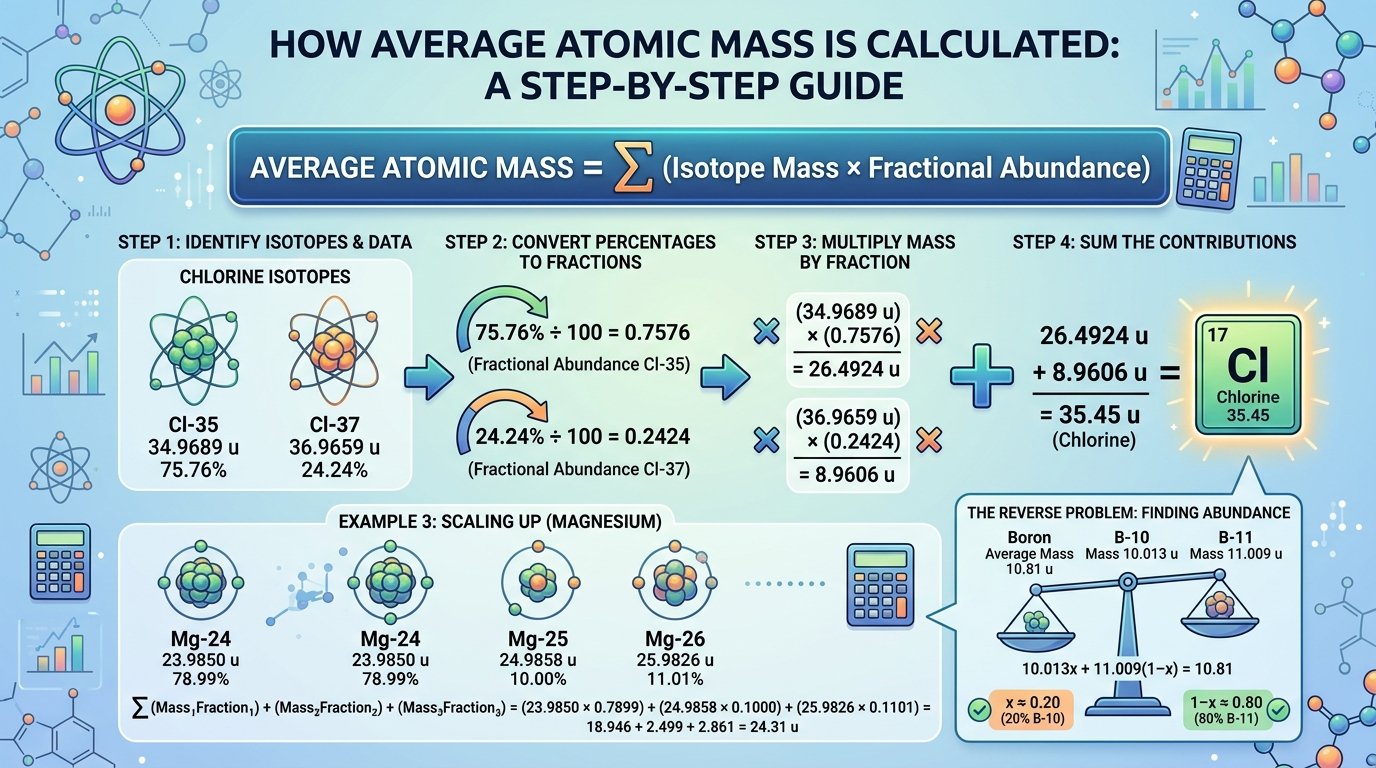
This is the calculation Mode 2 automates — and the one you’ll be asked to do by hand at least once in every chemistry course. The formula is a simple weighted average:
average atomic mass = Σ (isotope mass × fractional abundance)
Example 1: Chlorine
Chlorine is 75.76% Cl-35 (mass 34.9689 u) and 24.24% Cl-37 (mass 36.9659 u). Convert percentages to fractions and multiply: (34.9689 × 0.7576) + (36.9659 × 0.2424) = 26.4924 + 8.9606 = 35.45 u. That’s exactly the decimal on the periodic table — mystery solved.
Example 2: Copper
Copper is 69.15% Cu-63 (62.9296 u) and 30.85% Cu-65 (64.9278 u). So: (62.9296 × 0.6915) + (64.9278 × 0.3085) = 43.516 + 20.030 = 63.55 u. Load the “Example: Copper” button in Mode 2 and watch the atomic mass calculator reproduce every step.
Example 3: Magnesium (three isotopes)
Mg-24 (23.9850 u, 78.99%), Mg-25 (24.9858 u, 10.00%) and Mg-26 (25.9826 u, 11.01%): (23.9850 × 0.7899) + (24.9858 × 0.1000) + (25.9826 × 0.1101) = 18.946 + 2.499 + 2.861 = 24.31 u. Three isotopes, same method — just more terms in the sum. The atomic mass calculator handles up to five.
The reverse problem: finding abundance
Exams also run this backwards: “Boron’s atomic mass is 10.81; B-10 is 10.013 u and B-11 is 11.009 u — find the abundances.” Set x as the fraction of B-10: 10.013x + 11.009(1−x) = 10.81. Solve: x ≈ 0.20, so boron is about 20% B-10 and 80% B-11. Check your algebra by feeding those numbers into the atomic mass calculator — it should return 10.81.
Atomic Mass Table of 25 Common Elements
Bookmark this quick-reference table. Every value comes from the same IUPAC 2021 dataset the atomic mass calculator uses, rounded to sensible precision.
| Element | Symbol | Atomic Number | Atomic Mass (u) |
|---|---|---|---|
| Hydrogen | H | 1 | 1.008 |
| Helium | He | 2 | 4.0026 |
| Lithium | Li | 3 | 6.94 |
| Carbon | C | 6 | 12.011 |
| Nitrogen | N | 7 | 14.007 |
| Oxygen | O | 8 | 15.999 |
| Fluorine | F | 9 | 18.998 |
| Sodium | Na | 11 | 22.990 |
| Magnesium | Mg | 12 | 24.305 |
| Aluminium | Al | 13 | 26.982 |
| Silicon | Si | 14 | 28.085 |
| Phosphorus | P | 15 | 30.974 |
| Sulfur | S | 16 | 32.06 |
| Chlorine | Cl | 17 | 35.45 |
| Potassium | K | 19 | 39.098 |
| Calcium | Ca | 20 | 40.078 |
| Iron | Fe | 26 | 55.845 |
| Copper | Cu | 29 | 63.546 |
| Zinc | Zn | 30 | 65.38 |
| Bromine | Br | 35 | 79.904 |
| Silver | Ag | 47 | 107.87 |
| Iodine | I | 53 | 126.90 |
| Gold | Au | 79 | 196.97 |
| Lead | Pb | 82 | 207.2 |
| Uranium | U | 92 | 238.03 |
Need an element that isn’t listed? All 118 are one search away in the atomic mass calculator above — including every lanthanide, actinide and synthetic superheavy element.
Why Atomic Masses Have Decimals: Isotopes Explained
New students using an atomic mass calculator always ask the same excellent question: if protons and neutrons each weigh about 1 u, why is chlorine 35.45 and not 35 or 36? Two reasons — and the first explains 99% of it.
Reason 1: isotope mixing. Most elements exist in nature as a blend of isotopes — atoms with identical protons but different neutron counts. Chlorine atoms come in two stable varieties: Cl-35 (18 neutrons) and Cl-37 (20 neutrons). Dig up chlorine anywhere on Earth and you’ll get roughly 76% of the light kind and 24% of the heavy kind. The periodic table’s 35.45 is the weighted average of that natural blend — not the mass of any single atom.
Reason 2: binding energy. Even a single isotope’s mass isn’t a perfect whole number. When protons and neutrons bind into a nucleus, a tiny amount of mass converts to binding energy (Einstein’s E = mc²). That “mass defect” is why Cl-35 weighs 34.9689 u instead of exactly 35. It’s a small effect for chemistry, but it’s the entire basis of nuclear power.
Some elements make life easy: fluorine, sodium, aluminium, phosphorus and gold each have only one stable isotope, so their atomic masses sit very close to whole numbers. Others — like tin with ten stable isotopes — are true committee decisions. Whenever you’re curious, the atomic mass calculator‘s lookup mode estimates the dominant isotope’s neutron count for any element.
Who Uses an Atomic Mass Calculator?
A wider crowd than you might guess. Here are the regulars:
Students — from Matric to MSc
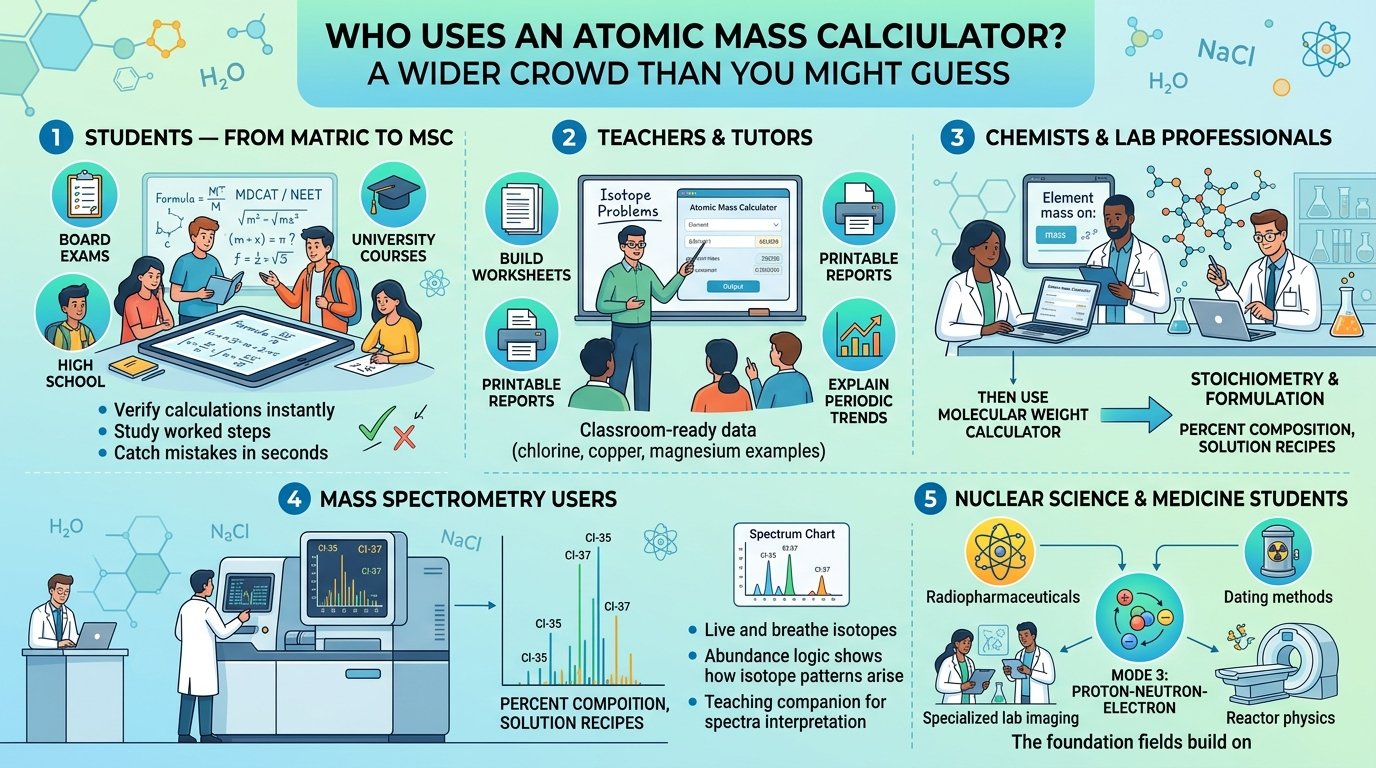
Isotope-average problems appear in every board exam, MDCAT, NEET and first-year university course. An atomic mass calculator lets you verify hand calculations instantly and study from the worked steps — mistakes get caught in seconds, not on the graded paper.
Teachers and Tutors
Building a worksheet of isotope problems? Mode 2’s example buttons (chlorine, copper, magnesium) give classroom-ready data, and the printable reports make clean handouts. The neighbor-comparison graph in lookup mode is a favorite for explaining periodic trends.
Chemists and Lab Professionals
Element masses feed every stoichiometry and formulation calculation. Look up the element here, then take the full compound to our molecular weight calculator for molar mass, percent composition and solution recipes — the two tools are designed to work together.
Mass Spectrometry Users
Mass spec people live and breathe isotopes. While instrument software handles exact isotopic masses, the abundance logic in Mode 2 is precisely how isotope patterns arise — making this a handy teaching companion for interpreting spectra.
Nuclear Science and Medicine Students
Radiopharmaceuticals, dating methods and reactor physics all start with particle counts and isotope masses. Mode 3’s proton-neutron-electron breakdown for atoms and ions is the foundation those fields build on.
The amu (Dalton) Explained — and Why 1 Mole ≈ 1 Gram per u
Every result in an atomic mass calculator is expressed in this unit, so it deserves two minutes of your attention — because it hides the most elegant link in all of chemistry.
The definition: 1 u (also written amu or Da) is one-twelfth the mass of a carbon-12 atom. In SI units, 1 u = 1.66053906660 × 10⁻²⁴ g — the constant Mode 4 of the atomic mass calculator uses for conversions.
The elegant link: Avogadro’s number was deliberately chosen so that one mole of particles weighing 1 u each weighs almost exactly 1 gram. The consequence is beautiful: an element’s atomic mass in u and its molar mass in g/mol are the same number. Carbon: 12.011 u per atom, 12.011 g per mole. No conversion needed — the unit system did the work for you.
This is why you can read the periodic table two ways at once: as the mass of single atoms (u) or as the mass of lab-scale samples (g/mol). It’s also why biochemists describing a “50 kDa protein” and chemists writing “50,000 g/mol” are saying the identical thing. For more detail, see the excellent Dalton unit overview on Wikipedia.
Practice Problems (Try Them, Then Check With the Calculator)
Work these on paper first, then verify each answer with the atomic mass calculator above. Answers are hidden under each problem.
Problem 1 — Silver is 51.84% Ag-107 (106.9051 u) and 48.16% Ag-109 (108.9047 u). Find its average atomic mass.
Answer: (106.9051 × 0.5184) + (108.9047 × 0.4816) = 55.420 + 52.448 = 107.87 u. Enter both isotopes in Mode 2 to see the full working.
Problem 2 — How many protons, neutrons and electrons are in the O²⁻ ion (mass number 16)?
Answer: Protons = 8 (Z of oxygen); neutrons = 16 − 8 = 8; electrons = 8 − (−2) = 10. A 2− charge means two extra electrons. Mode 3 confirms it — enter O, mass number 16, charge −2.
Problem 3 — What is the mass, in grams, of a single gold atom?
Answer: 196.97 u × 1.66054 × 10⁻²⁴ g/u = 3.271 × 10⁻²² g. Look up Au in Mode 1 — the “Mass of ONE atom” row does this automatically.
Problem 4 — Gallium is 60.11% Ga-69 (68.9256 u) and 39.89% Ga-71 (70.9247 u). Average atomic mass?
Answer: (68.9256 × 0.6011) + (70.9247 × 0.3989) = 41.431 + 28.292 = 69.72 u — matching the periodic table value for gallium.
Problem 5 — Lithium’s atomic mass is 6.94. Li-6 is 6.0151 u and Li-7 is 7.0160 u. Estimate the % abundance of each.
Answer: Let x = fraction of Li-6: 6.0151x + 7.0160(1−x) = 6.94 → x ≈ 0.076. So lithium is about 7.6% Li-6 and 92.4% Li-7. Feed those into Mode 2 and you’ll get 6.94 back — algebra verified.
Five for five? Excellent — you’ve mastered the chapter. If any went wrong, re-read the average atomic mass section and try again with the tool’s steps as your guide.
Tips for Accurate Results Every Time
- Check abundance totals. Isotope abundances must sum to 100% (or 1.0 as fractions). The atomic mass calculator flags totals that drift outside 98–102% — a sanity check worth copying into your hand calculations.
- Use exact isotope masses, not mass numbers. In average-mass problems, use 34.9689 u for Cl-35, not “35”. Rounding the inputs shifts the final answer visibly.
- Watch the charge sign in ion problems. A positive charge means fewer electrons; negative means more. Electrons = Z − charge, sign included.
- Round only at the end. Carry full decimals through every step and round the final answer to match the data’s precision.
- Cross-check unusual values. For research-grade isotopic data, verify against the CIAAW (IUPAC’s Commission on Isotopic Abundances and Atomic Weights) or the NIST Chemistry WebBook.
5 Common Mistakes to Avoid
Ten years of marking papers, five recurring errors — every one of them preventable with a quick atomic mass calculator check:
- Confusing mass number with atomic mass. Mass number (35) counts particles in one isotope; atomic mass (35.45) averages across all isotopes. Exams punish this one relentlessly.
- Forgetting to convert % to fraction. 75.76% must become 0.7576 before multiplying. Skipping this inflates your answer 100-fold — instantly recognizable, easily avoided.
- Averaging isotope masses without weights. (35 + 37) ÷ 2 = 36 is wrong for chlorine, because the isotopes aren’t equally abundant. Always weight by abundance.
- Flipping the electron rule for ions. Na⁺ has 10 electrons, not 12. Positive ions have lost electrons.
- Using an element’s average mass for one specific isotope. Carbon-14 dating math needs 14.003 u, not 12.011 u. The average describes the natural blend, not an individual isotope.
What Makes This Atomic Mass Calculator Different?
Plenty of sites list element masses. Here’s an honest comparison of what this atomic mass calculator adds:
| Feature | This Tool | Typical Lookup Site |
|---|---|---|
| Atomic mass lookup (118 elements) | ✅ | ✅ |
| Search by symbol AND name (case-insensitive) | ✅ | Partial |
| Isotope average solver with steps | ✅ | ❌ |
| Protons-neutrons-electrons for ions | ✅ | ❌ |
| amu ↔ grams converter (CODATA constant) | ✅ | ❌ |
| Batch compare up to 15 elements + graph | ✅ | ❌ |
| Copy / CSV / TXT / print / share | ✅ | ❌ |
| Lookup history | ✅ | ❌ |
| Free, no sign-up, no limits | ✅ | Varies |
The design goal was simple: one atomic mass calculator that follows the topic from “what does gold weigh?” all the way to “derive chlorine’s 35.45 from its isotopes” — with a record you can save, print or send to a classmate.
Where the Data Comes From
Every mass in this atomic mass calculator is a standard atomic weight published by IUPAC, maintained by its Commission on Isotopic Abundances and Atomic Weights (CIAAW). For elements whose isotopic composition varies in nature — hydrogen, lithium, boron, chlorine and others — we use the conventional single values IUPAC recommends for everyday calculation.
The amu-to-grams conversions use the CODATA-recommended constant, 1 u = 1.66053906660 × 10⁻²⁴ g. For unstable elements with no standard atomic weight in the atomic mass calculator (like technetium and the superheavies), we display the mass number of the most stable known isotope, which is the standard convention on periodic tables worldwide.
When IUPAC revises a value, our dataset gets updated to match — see our Corrections Policy for how data updates are handled.
Atomic Mass Calculator vs Periodic Table vs Apps
Where does this tool fit among the alternatives? My honest take after a decade of teaching:
The printed periodic table is irreplaceable for learning and is usually the only aid allowed in exams. Know your way around it. Its limits: tiny print, no isotope math, no particle counts for ions, and no way to compare fifteen elements at a glance.
Mobile apps are handy but the good ones cost money, the free ones drown you in ads, and phones are banned in most exams and many labs anyway.
An online atomic mass calculator wins for homework, teaching prep and lab work: instant search by name or symbol, isotope-average solving with steps, exportable results and zero cost. Use the periodic table to learn, use the atomic mass calculator to work — and when your problem grows from single elements to full compounds, our molecular weight calculator picks up exactly where this tool leaves off. Questions about either tool? Reach us via the contact page or learn more about the project.
A Short History of Atomic Mass (Why Carbon-12 Is the Ruler)
The numbers inside every atomic mass calculator have a two-century backstory, and knowing it makes the whole concept click.
1803 — Dalton’s first table. John Dalton proposed that each element has a characteristic atomic weight and published the first table, setting hydrogen = 1. His values were rough — he thought water was HO, so oxygen came out at 8 — but the idea was revolutionary: elements combine in fixed mass ratios because atoms have fixed masses.
1820s — Berzelius gets serious. Jöns Jacob Berzelius measured atomic weights for nearly fifty elements with astonishing care, many within 1% of modern values. His oxygen-based scale dominated chemistry for decades.
1869 — Mendeleev’s masterstroke. Dmitri Mendeleev arranged the elements by atomic weight and discovered the periodic law. Gaps in his table predicted undiscovered elements — gallium and germanium arrived on schedule, with masses close to his predictions. Atomic mass literally built the periodic table.
1913 — isotopes complicate everything. Frederick Soddy and J.J. Thomson showed that one element can have atoms of different masses. Suddenly “the” atomic weight was revealed to be an average — the insight behind Mode 2 of every modern atomic mass calculator.
1961 — the carbon-12 compromise. Physicists and chemists had been using two slightly different oxygen-based scales (physicists used pure O-16; chemists used natural oxygen). The disagreement was resolved by choosing a new ruler: exactly 12 for carbon-12. That definition still anchors the atomic mass unit — and every atomic mass calculator — today, which is why 1 u is defined as one-twelfth of a carbon-12 atom.
Today — living numbers. IUPAC’s CIAAW commission reviews measurements continuously and revises standard atomic weights every couple of years. Some elements now carry interval values (hydrogen’s official weight is a range, [1.00784, 1.00811]) because their isotope ratios genuinely vary between ocean water, rocks and living things. For everyday work, the conventional single values in this atomic mass calculator are what IUPAC recommends.
From Atomic Mass to Stoichiometry: Where This Number Takes You
Atomic mass isn’t an isolated fact to memorize — it’s the first domino in every quantitative chemistry calculation. Here’s the chain, so you can see exactly where an atomic mass calculator fits in your workflow:
- Atomic mass → molar mass. Look up each element (this tool), then add them per the formula. Water: 2(1.008) + 15.999 = 18.02 g/mol. For anything bigger than two or three elements, our molecular weight calculator sums the whole formula automatically.
- Molar mass → moles. Divide the mass you weighed by the molar mass: 36 g of water ÷ 18.02 g/mol = 2.0 mol. This single step converts lab-bench grams into countable particles.
- Moles → reaction quantities. Balanced equations speak in mole ratios. 2H₂ + O₂ → 2H₂O means 2.0 mol of water needed 1.0 mol of O₂ — which the molar masses convert straight back to grams.
- Moles → solution concentrations. Molarity is moles per liter, so every solution prep traces back to an atomic mass lookup you did at step one.
Get step one wrong and every later answer inherits the error — which is exactly why a reliable atomic mass calculator matters more than it first appears. A student who copies 39.95 (argon) instead of 39.10 (potassium) from a cramped periodic table cell will carry a 2% error through an entire titration report. Searching “potassium” by name here makes that mix-up impossible.
💡 Pro workflow: Look up single elements with this atomic mass calculator, build compound molar masses with the molecular weight calculator, and keep both tabs open during homework — the pair covers essentially every mass calculation a chemistry course will throw at you.
Quick Exam Checklist: Atomic Mass in 60 Seconds
Pin this recap before any test — it condenses everything above into eight lines:
- ✅ Atomic mass = weighted average of natural isotopes, in u — the decimal on the periodic table.
- ✅ Mass number (A) = protons + neutrons of ONE isotope — always a whole number.
- ✅ Average formula: Σ (isotope mass × fractional abundance); fractions must sum to 1.
- ✅ Particles: protons = Z; neutrons = A − Z; electrons = Z − charge.
- ✅ Unit bridge: 1 u = 1.6605 × 10⁻²⁴ g; atomic mass in u = molar mass in g/mol.
- ✅ Percent → fraction before multiplying (75.76% → 0.7576).
- ✅ Round last, not at every step.
- ✅ Verify with the atomic mass calculator above before submitting.
Frequently Asked Questions
What is an atomic mass calculator and how does it work?
It’s a tool that returns the IUPAC standard atomic mass of any element you search — by symbol or name — and performs related calculations: isotope weighted averages, particle counts, and amu-to-grams conversions. The one on this page covers all 118 elements with step-by-step working.
Is this atomic mass calculator free?
Yes — completely free, no registration, no daily limits. All five modes, exports and sharing features are open to everyone, on any device.
What’s the difference between atomic mass and mass number?
Mass number is the whole-number count of protons + neutrons in one specific isotope (Cl-35 → 35). Atomic mass is the decimal weighted average across all natural isotopes (chlorine → 35.45 u). Calculations with real samples use the average.
How do I calculate average atomic mass from isotopes?
Multiply each isotope’s mass by its fractional abundance and add the results: for chlorine, (34.9689 × 0.7576) + (36.9659 × 0.2424) = 35.45 u. Mode 2 of the atomic mass calculator does this for up to five isotopes and shows every step.
Are atomic mass and molar mass the same number?
Numerically yes — by design. An element’s atomic mass in u equals its molar mass in g/mol, because Avogadro’s number links the two scales. Carbon is 12.011 u per atom and 12.011 g per mole.
Can I search elements by name instead of symbol?
Yes — type “Iron”, “iron”, “Fe” or even a partial name like “carb” and the calculator finds the right element. Search is case-insensitive across all 118 elements.
How do I find protons, neutrons and electrons for an ion?
Protons = atomic number Z; neutrons = mass number − Z; electrons = Z − charge. For Ca²⁺ (mass number 40): 20 protons, 20 neutrons, 18 electrons. Mode 3 applies these rules automatically for any element and charge.
How accurate is this atomic mass calculator?
It uses current IUPAC 2021 standard atomic weights, accurate to about four significant figures — more than enough for coursework and routine lab math. For mass-spectrometry-grade isotopic masses, consult CIAAW or NIST directly.
Why don’t abundances need to be entered as fractions?
Enter them either way — 75.76 or 0.7576. The calculator detects which format you used from the total, converts internally, and warns you if the values don’t sum to approximately 100% (or 1).
Does it work for compounds like H2O too?
This tool focuses on single elements and isotopes. For complete compounds — molar mass, percent composition, hydrates, solution recipes — use our dedicated molecular weight calculator, built on the same IUPAC data.
10 Atomic Mass Facts Worth Knowing
A few favorites I share with students — each one checkable in seconds with the atomic mass calculator above:
- Hydrogen is the featherweight champion at 1.008 u — and still makes up about 75% of the ordinary mass of the universe.
- One gold atom outweighs sixteen carbon atoms. Load Au and C into the compare mode of the atomic mass calculator and the bar chart makes it visceral.
- Tellurium breaks Mendeleev’s rule: at 127.60 u it’s heavier than iodine (126.90 u) despite coming first in the table — one of five such “pair reversals” caused by isotope abundances.
- Technetium has no standard atomic weight at all — every isotope is radioactive, so tables show the bracketed mass number [98] of its most stable isotope.
- Copper’s 63.546 u matches no copper atom that exists. Every real atom is Cu-63 or Cu-65; the decimal is pure statistics — the deepest lesson an atomic mass calculator can teach.
- Hydrogen’s official atomic weight is an interval, [1.00784, 1.00811], because ocean water, rain and living tissue carry measurably different deuterium levels.
- Carbon-12 is exactly 12 by decree, not by measurement — it’s the definition of the unit itself, fixed in 1961.
- Iron-56 sits near the peak of nuclear stability, which is why fusion in stars stops around iron and heavier elements need supernovae to form.
- Oganesson (Z = 118) weighs about 294 u — roughly 292 times hydrogen — and only a handful of atoms have ever been made.
- Your own body is an isotope blend: about one in every 6,400 hydrogen atoms in you is deuterium, quietly nudging your personal “average atomic mass” of hydrogen above 1.008.
Trusted resources for going deeper
- IUPAC Periodic Table of Elements — the official source of standard atomic weights.
- CIAAW — isotopic abundances and atomic weight revisions, straight from the commission.
- NIST Chemistry WebBook — reference data for thousands of species.
- Our own molecular weight calculator — when single elements grow into full formulas.
Final Thoughts: Bookmark This Atomic Mass Calculator
Atomic mass is where quantitative chemistry begins — every molar mass, every stoichiometry problem, every isotope question builds on it. Understanding how the periodic table’s decimals arise makes you a better chemist; having a fast, trustworthy atomic mass calculator makes you a quicker one.
The tool above gives you both: instant IUPAC-accurate answers and the step-by-step working that teaches the method. Five modes, all 118 elements, interactive graphs, exportable results, zero cost. Try the atomic mass calculator with the element you’re studying right now — and when your problems grow into full compounds, our molecular weight calculator is ready for the next step.
Found a bug, want a feature, or have an element question the tool couldn’t answer? Tell us through the contact page — several features across this site started as user suggestions.
Written & Reviewed By
Ahmad Raza, M.Phil. Chemistry
Ahmad is a chemistry educator and science content developer with over 10 years of experience teaching analytical and physical chemistry. He builds free calculation tools that help students and lab professionals work faster and make fewer errors. When he’s not writing about isotopes, he’s usually grading titration reports.