
Gas Density Chemistry Calculator
Solve ideal-gas density, pressure, molar mass, or temperature using d = PM/(RT). Automatic unit conversion, complete working, validation, exports, and history included.
✓ Trusted by students, teachers & lab professionals⚗️ Solve Any Variable
d = PM/(RT) · the gas behaves ideally and pressure is absolute. Enter the known values, select units, and calculate.
⚗️ Find Density
d = PM/(RT) · the gas behaves ideally and pressure is absolute. Enter the known values, select units, and calculate.
⚗️ Find Molar Mass
d = PM/(RT) · the gas behaves ideally and pressure is absolute. Enter the known values, select units, and calculate.
⚗️ Check Gas State
d = PM/(RT) · the gas behaves ideally and pressure is absolute. Enter the known values, select units, and calculate.
🕘 Recent calculations
d = PM/(RT) · the gas behaves ideally and pressure is absolute · Free tool by molecularweightcalculator.org
The gas density calculator chemistry above helps students and laboratory users solve ideal-gas density, pressure, molar mass, or temperature. Enter the known quantities, leave the requested value blank, choose units, and read the result with conversions and calculation steps.
Use d = PM/(RT). The model requires that the gas behaves ideally and pressure is absolute. Convert temperatures to Kelvin whenever temperature appears in a ratio, use absolute pressure, and keep all units consistent.
📑 Table of Contents (click to expand)
- ⚗️ Gas Density Calculator Chemistry: What It Solves
- 🧮 How to Use the Gas Density Calculator Chemistry
- 🧭 The Four Working Modes Explained
- 📐 Formula and Rearrangements
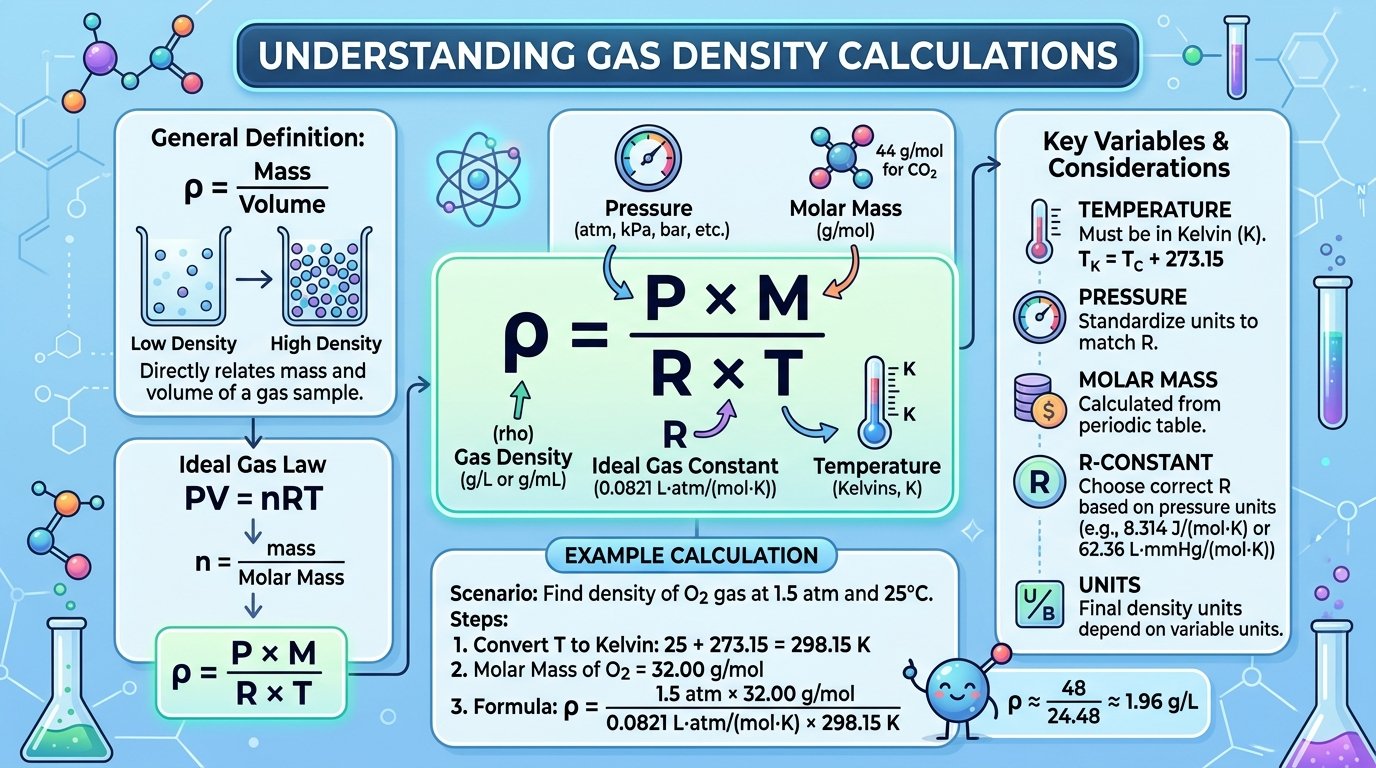
- 🔄 Units and Required Conversions
- 📈 Understanding the Scientific Relationship
- ✍️ Worked Examples, Step by Step
- 📊 Reference Table and Benchmark Results
- 🔬 Connection to Other Gas Laws
- 👥 Who Uses This Calculation?
- 🧪 Full Laboratory Walkthrough
- 🕰️ A Short History of the Law
- 🌍 Everyday and Professional Applications
- 📝 Practice Problems With Answers
- ✅ Tips for Fast, Error-Free Work
- 🚫 Common Mistakes to Avoid
- 🏆 How This Calculator Is Different
- 📚 Data, Conversions, and Trusted Sources
- ☑️ Exam and Laboratory Checklist
- ❓ Frequently Asked Questions
- 🔟 10 Facts Worth Knowing
⚗️ Gas Density Calculator Chemistry: What It Solves
The gas density calculator chemistry applies d = PM/(RT) to a clearly defined scientific comparison. It separates the known quantities from the unknown, converts entries to compatible units, and displays enough working to audit the result. The most important first step is not arithmetic; it is confirming that the gas behaves ideally and pressure is absolute.
Every gas density calculator chemistry result should be checked against physical direction. Before calculating, predict whether the requested quantity should rise, fall, or remain unchanged. That simple prediction catches inverted ratios, swapped state labels, and misplaced unit prefixes before they become a submitted answer.
The equation d = PM/(RT) describes ideal-gas density, molar mass, pressure, and temperature. It is an idealized model, so equilibrium measurements, a fixed and well-defined system, and appropriate conditions matter. A long decimal output does not guarantee that the experiment or assumption is equally precise.
In the context of “⚗️ Gas Density Calculator Chemistry: What It Solves,” document the values, units, assumptions, and expected trend. This makes the gas density calculator chemistry a verification partner rather than a black box and gives teachers or reviewers a complete chain of reasoning.
🧮 How to Use the Gas Density Calculator Chemistry
The gas density calculator chemistry applies d = PM/(RT) to a clearly defined scientific comparison. It separates the known quantities from the unknown, converts entries to compatible units, and displays enough working to audit the result. The most important first step is not arithmetic; it is confirming that the gas behaves ideally and pressure is absolute.
Every gas density calculator chemistry result should be checked against physical direction. Before calculating, predict whether the requested quantity should rise, fall, or remain unchanged. That simple prediction catches inverted ratios, swapped state labels, and misplaced unit prefixes before they become a submitted answer.
The equation d = PM/(RT) describes ideal-gas density, molar mass, pressure, and temperature. It is an idealized model, so equilibrium measurements, a fixed and well-defined system, and appropriate conditions matter. A long decimal output does not guarantee that the experiment or assumption is equally precise.
In the context of “🧮 How to Use the Gas Density Calculator Chemistry,” document the values, units, assumptions, and expected trend. This makes the gas density calculator chemistry a verification partner rather than a black box and gives teachers or reviewers a complete chain of reasoning.
🧭 The Four Working Modes Explained
⚡ Solve Any Variable
Leave one field empty and let the gas density calculator chemistry identify the unknown.
🎯 Dedicated Answer Modes
Focused tabs reduce clutter when the target quantity is known.
🔍 Equation Check
Enter every value to compare the two sides of d = PM/(RT) and view their percentage difference.
↺ Reset and History
Reset clears the active panel, while recent results remain in local browser history until Clear All is pressed.
📐 Formula and Rearrangements
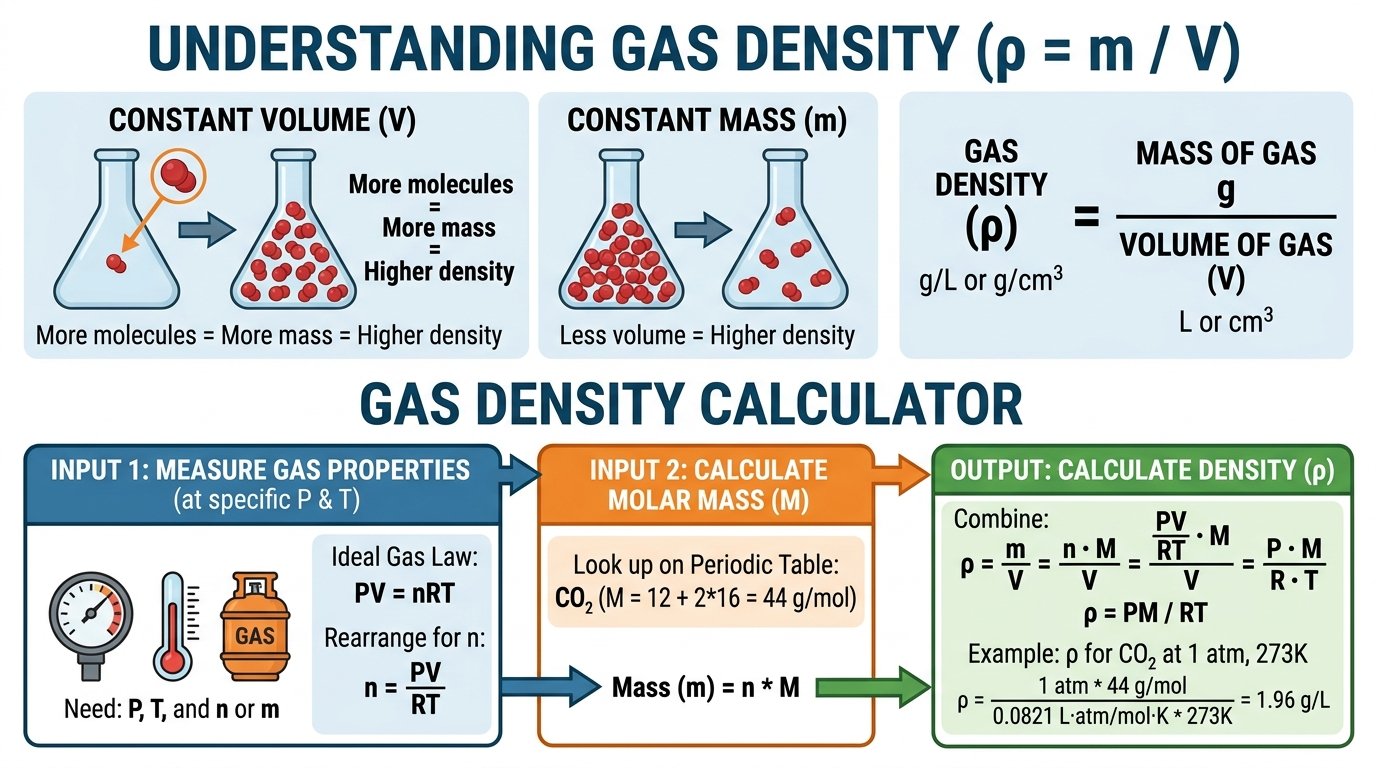
The central equation used by the gas density calculator chemistry is shown below.
the gas behaves ideally and pressure is absolute
To solve by hand, cross multiply where appropriate, isolate the requested symbol, substitute converted values, and retain guard digits until the final rounding step. The tool follows that same transparent order.
🔄 Units and Required Conversions
The gas density calculator chemistry applies d = PM/(RT) to a clearly defined scientific comparison. It separates the known quantities from the unknown, converts entries to compatible units, and displays enough working to audit the result. The most important first step is not arithmetic; it is confirming that the gas behaves ideally and pressure is absolute.
Every gas density calculator chemistry result should be checked against physical direction. Before calculating, predict whether the requested quantity should rise, fall, or remain unchanged. That simple prediction catches inverted ratios, swapped state labels, and misplaced unit prefixes before they become a submitted answer.
The equation d = PM/(RT) describes ideal-gas density, molar mass, pressure, and temperature. It is an idealized model, so equilibrium measurements, a fixed and well-defined system, and appropriate conditions matter. A long decimal output does not guarantee that the experiment or assumption is equally precise.
In the context of “🔄 Units and Required Conversions,” document the values, units, assumptions, and expected trend. This makes the gas density calculator chemistry a verification partner rather than a black box and gives teachers or reviewers a complete chain of reasoning.
📈 Understanding the Scientific Relationship
The gas density calculator chemistry applies d = PM/(RT) to a clearly defined scientific comparison. It separates the known quantities from the unknown, converts entries to compatible units, and displays enough working to audit the result. The most important first step is not arithmetic; it is confirming that the gas behaves ideally and pressure is absolute.
Every gas density calculator chemistry result should be checked against physical direction. Before calculating, predict whether the requested quantity should rise, fall, or remain unchanged. That simple prediction catches inverted ratios, swapped state labels, and misplaced unit prefixes before they become a submitted answer.
The equation d = PM/(RT) describes ideal-gas density, molar mass, pressure, and temperature. It is an idealized model, so equilibrium measurements, a fixed and well-defined system, and appropriate conditions matter. A long decimal output does not guarantee that the experiment or assumption is equally precise.
In the context of “📈 Understanding the Scientific Relationship,” document the values, units, assumptions, and expected trend. This makes the gas density calculator chemistry a verification partner rather than a black box and gives teachers or reviewers a complete chain of reasoning.
✍️ Worked Examples, Step by Step
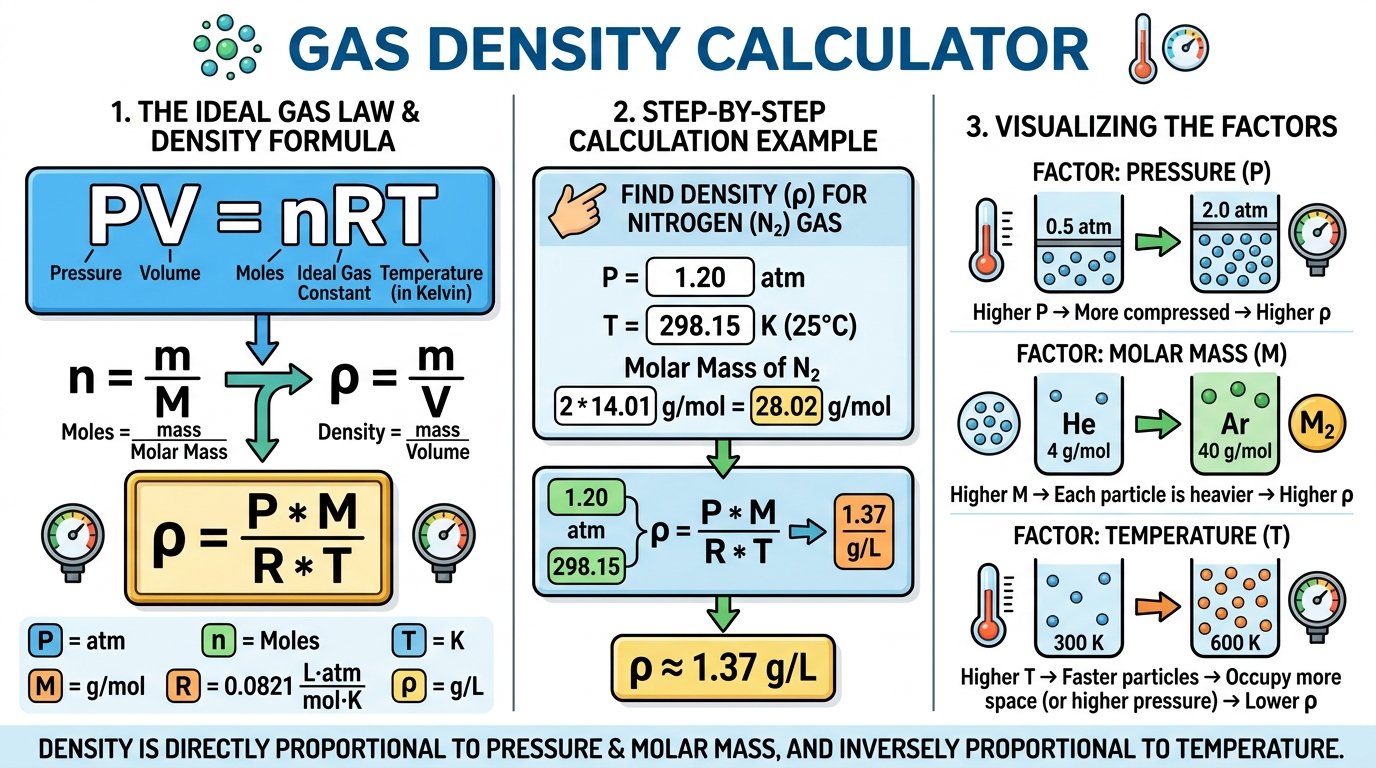
Air with M ≈ 28.97 g/mol at 1 atm and 25°C has an ideal density of about 1.184 g/L.
Start by writing the known data with units. Convert to the calculation units, rearrange d = PM/(RT), substitute, and round only at the end. The gas density calculator chemistry prints this sequence so the numerical result can be compared with hand work.
📊 Reference Table and Benchmark Results
| Check | What to inspect | Good practice |
|---|---|---|
| System | Same sample and valid conditions | Write assumptions |
| Units | Compatible pressure, volume, rate, mass, density, or temperature | Convert before substitution |
| Direction | Expected rise or fall | Predict first |
| Precision | Instrument or supplied significant figures | Round once, at the end |
| Model | Ideal approximation and equilibrium | State limitations |
🔬 Connection to Other Gas Laws
The gas density calculator chemistry applies d = PM/(RT) to a clearly defined scientific comparison. It separates the known quantities from the unknown, converts entries to compatible units, and displays enough working to audit the result. The most important first step is not arithmetic; it is confirming that the gas behaves ideally and pressure is absolute.
Every gas density calculator chemistry result should be checked against physical direction. Before calculating, predict whether the requested quantity should rise, fall, or remain unchanged. That simple prediction catches inverted ratios, swapped state labels, and misplaced unit prefixes before they become a submitted answer.
The equation d = PM/(RT) describes ideal-gas density, molar mass, pressure, and temperature. It is an idealized model, so equilibrium measurements, a fixed and well-defined system, and appropriate conditions matter. A long decimal output does not guarantee that the experiment or assumption is equally precise.
In the context of “🔬 Connection to Other Gas Laws,” document the values, units, assumptions, and expected trend. This makes the gas density calculator chemistry a verification partner rather than a black box and gives teachers or reviewers a complete chain of reasoning.
👥 Who Uses This Calculation?
The gas density calculator chemistry applies d = PM/(RT) to a clearly defined scientific comparison. It separates the known quantities from the unknown, converts entries to compatible units, and displays enough working to audit the result. The most important first step is not arithmetic; it is confirming that the gas behaves ideally and pressure is absolute.
Every gas density calculator chemistry result should be checked against physical direction. Before calculating, predict whether the requested quantity should rise, fall, or remain unchanged. That simple prediction catches inverted ratios, swapped state labels, and misplaced unit prefixes before they become a submitted answer.
The equation d = PM/(RT) describes ideal-gas density, molar mass, pressure, and temperature. It is an idealized model, so equilibrium measurements, a fixed and well-defined system, and appropriate conditions matter. A long decimal output does not guarantee that the experiment or assumption is equally precise.
In the context of “👥 Who Uses This Calculation?,” document the values, units, assumptions, and expected trend. This makes the gas density calculator chemistry a verification partner rather than a black box and gives teachers or reviewers a complete chain of reasoning.
🧪 Full Laboratory Walkthrough
The gas density calculator chemistry applies d = PM/(RT) to a clearly defined scientific comparison. It separates the known quantities from the unknown, converts entries to compatible units, and displays enough working to audit the result. The most important first step is not arithmetic; it is confirming that the gas behaves ideally and pressure is absolute.
Every gas density calculator chemistry result should be checked against physical direction. Before calculating, predict whether the requested quantity should rise, fall, or remain unchanged. That simple prediction catches inverted ratios, swapped state labels, and misplaced unit prefixes before they become a submitted answer.
The equation d = PM/(RT) describes ideal-gas density, molar mass, pressure, and temperature. It is an idealized model, so equilibrium measurements, a fixed and well-defined system, and appropriate conditions matter. A long decimal output does not guarantee that the experiment or assumption is equally precise.
In the context of “🧪 Full Laboratory Walkthrough,” document the values, units, assumptions, and expected trend. This makes the gas density calculator chemistry a verification partner rather than a black box and gives teachers or reviewers a complete chain of reasoning.
🕰️ A Short History of the Law
The gas density calculator chemistry applies d = PM/(RT) to a clearly defined scientific comparison. It separates the known quantities from the unknown, converts entries to compatible units, and displays enough working to audit the result. The most important first step is not arithmetic; it is confirming that the gas behaves ideally and pressure is absolute.
Every gas density calculator chemistry result should be checked against physical direction. Before calculating, predict whether the requested quantity should rise, fall, or remain unchanged. That simple prediction catches inverted ratios, swapped state labels, and misplaced unit prefixes before they become a submitted answer.
The equation d = PM/(RT) describes ideal-gas density, molar mass, pressure, and temperature. It is an idealized model, so equilibrium measurements, a fixed and well-defined system, and appropriate conditions matter. A long decimal output does not guarantee that the experiment or assumption is equally precise.
In the context of “🕰️ A Short History of the Law,” document the values, units, assumptions, and expected trend. This makes the gas density calculator chemistry a verification partner rather than a black box and gives teachers or reviewers a complete chain of reasoning.
🌍 Everyday and Professional Applications
The gas density calculator chemistry applies d = PM/(RT) to a clearly defined scientific comparison. It separates the known quantities from the unknown, converts entries to compatible units, and displays enough working to audit the result. The most important first step is not arithmetic; it is confirming that the gas behaves ideally and pressure is absolute.
Every gas density calculator chemistry result should be checked against physical direction. Before calculating, predict whether the requested quantity should rise, fall, or remain unchanged. That simple prediction catches inverted ratios, swapped state labels, and misplaced unit prefixes before they become a submitted answer.
The equation d = PM/(RT) describes ideal-gas density, molar mass, pressure, and temperature. It is an idealized model, so equilibrium measurements, a fixed and well-defined system, and appropriate conditions matter. A long decimal output does not guarantee that the experiment or assumption is equally precise.
In the context of “🌍 Everyday and Professional Applications,” document the values, units, assumptions, and expected trend. This makes the gas density calculator chemistry a verification partner rather than a black box and gives teachers or reviewers a complete chain of reasoning.
📝 Practice Problems With Answers
Practice problem 1: identify the unknown and required conversion.
Write d = PM/(RT), isolate the requested variable, convert to compatible absolute units, calculate with guard digits, and compare the answer with the expected physical direction. Use the tool above only after completing the setup.
Practice problem 2: identify the unknown and required conversion.
Write d = PM/(RT), isolate the requested variable, convert to compatible absolute units, calculate with guard digits, and compare the answer with the expected physical direction. Use the tool above only after completing the setup.
Practice problem 3: identify the unknown and required conversion.
Write d = PM/(RT), isolate the requested variable, convert to compatible absolute units, calculate with guard digits, and compare the answer with the expected physical direction. Use the tool above only after completing the setup.
Practice problem 4: identify the unknown and required conversion.
Write d = PM/(RT), isolate the requested variable, convert to compatible absolute units, calculate with guard digits, and compare the answer with the expected physical direction. Use the tool above only after completing the setup.
Practice problem 5: identify the unknown and required conversion.
Write d = PM/(RT), isolate the requested variable, convert to compatible absolute units, calculate with guard digits, and compare the answer with the expected physical direction. Use the tool above only after completing the setup.
Practice problem 6: identify the unknown and required conversion.
Write d = PM/(RT), isolate the requested variable, convert to compatible absolute units, calculate with guard digits, and compare the answer with the expected physical direction. Use the tool above only after completing the setup.
✅ Tips for Fast, Error-Free Work
The gas density calculator chemistry applies d = PM/(RT) to a clearly defined scientific comparison. It separates the known quantities from the unknown, converts entries to compatible units, and displays enough working to audit the result. The most important first step is not arithmetic; it is confirming that the gas behaves ideally and pressure is absolute.
Every gas density calculator chemistry result should be checked against physical direction. Before calculating, predict whether the requested quantity should rise, fall, or remain unchanged. That simple prediction catches inverted ratios, swapped state labels, and misplaced unit prefixes before they become a submitted answer.
The equation d = PM/(RT) describes ideal-gas density, molar mass, pressure, and temperature. It is an idealized model, so equilibrium measurements, a fixed and well-defined system, and appropriate conditions matter. A long decimal output does not guarantee that the experiment or assumption is equally precise.
In the context of “✅ Tips for Fast, Error-Free Work,” document the values, units, assumptions, and expected trend. This makes the gas density calculator chemistry a verification partner rather than a black box and gives teachers or reviewers a complete chain of reasoning.
🚫 Common Mistakes to Avoid
The gas density calculator chemistry applies d = PM/(RT) to a clearly defined scientific comparison. It separates the known quantities from the unknown, converts entries to compatible units, and displays enough working to audit the result. The most important first step is not arithmetic; it is confirming that the gas behaves ideally and pressure is absolute.
Every gas density calculator chemistry result should be checked against physical direction. Before calculating, predict whether the requested quantity should rise, fall, or remain unchanged. That simple prediction catches inverted ratios, swapped state labels, and misplaced unit prefixes before they become a submitted answer.
The equation d = PM/(RT) describes ideal-gas density, molar mass, pressure, and temperature. It is an idealized model, so equilibrium measurements, a fixed and well-defined system, and appropriate conditions matter. A long decimal output does not guarantee that the experiment or assumption is equally precise.
In the context of “🚫 Common Mistakes to Avoid,” document the values, units, assumptions, and expected trend. This makes the gas density calculator chemistry a verification partner rather than a black box and gives teachers or reviewers a complete chain of reasoning.
🏆 How This Calculator Is Different
The gas density calculator chemistry applies d = PM/(RT) to a clearly defined scientific comparison. It separates the known quantities from the unknown, converts entries to compatible units, and displays enough working to audit the result. The most important first step is not arithmetic; it is confirming that the gas behaves ideally and pressure is absolute.
Every gas density calculator chemistry result should be checked against physical direction. Before calculating, predict whether the requested quantity should rise, fall, or remain unchanged. That simple prediction catches inverted ratios, swapped state labels, and misplaced unit prefixes before they become a submitted answer.
The equation d = PM/(RT) describes ideal-gas density, molar mass, pressure, and temperature. It is an idealized model, so equilibrium measurements, a fixed and well-defined system, and appropriate conditions matter. A long decimal output does not guarantee that the experiment or assumption is equally precise.
In the context of “🏆 How This Calculator Is Different,” document the values, units, assumptions, and expected trend. This makes the gas density calculator chemistry a verification partner rather than a black box and gives teachers or reviewers a complete chain of reasoning.
📚 Data, Conversions, and Trusted Sources
The gas density calculator chemistry applies d = PM/(RT) to a clearly defined scientific comparison. It separates the known quantities from the unknown, converts entries to compatible units, and displays enough working to audit the result. The most important first step is not arithmetic; it is confirming that the gas behaves ideally and pressure is absolute.
Every gas density calculator chemistry result should be checked against physical direction. Before calculating, predict whether the requested quantity should rise, fall, or remain unchanged. That simple prediction catches inverted ratios, swapped state labels, and misplaced unit prefixes before they become a submitted answer.
The equation d = PM/(RT) describes ideal-gas density, molar mass, pressure, and temperature. It is an idealized model, so equilibrium measurements, a fixed and well-defined system, and appropriate conditions matter. A long decimal output does not guarantee that the experiment or assumption is equally precise.
In the context of “📚 Data, Conversions, and Trusted Sources,” document the values, units, assumptions, and expected trend. This makes the gas density calculator chemistry a verification partner rather than a black box and gives teachers or reviewers a complete chain of reasoning.
☑️ Exam and Laboratory Checklist
The gas density calculator chemistry applies d = PM/(RT) to a clearly defined scientific comparison. It separates the known quantities from the unknown, converts entries to compatible units, and displays enough working to audit the result. The most important first step is not arithmetic; it is confirming that the gas behaves ideally and pressure is absolute.
Every gas density calculator chemistry result should be checked against physical direction. Before calculating, predict whether the requested quantity should rise, fall, or remain unchanged. That simple prediction catches inverted ratios, swapped state labels, and misplaced unit prefixes before they become a submitted answer.
The equation d = PM/(RT) describes ideal-gas density, molar mass, pressure, and temperature. It is an idealized model, so equilibrium measurements, a fixed and well-defined system, and appropriate conditions matter. A long decimal output does not guarantee that the experiment or assumption is equally precise.
In the context of “☑️ Exam and Laboratory Checklist,” document the values, units, assumptions, and expected trend. This makes the gas density calculator chemistry a verification partner rather than a black box and gives teachers or reviewers a complete chain of reasoning.
❓ Frequently Asked Questions
Is this calculator free?
Yes. No account or daily limit is required. The gas density calculator chemistry provides numerical working, but the user remains responsible for choosing a valid physical model.
Which units can I use?
The unit menus show the supported choices and convert them internally. The gas density calculator chemistry provides numerical working, but the user remains responsible for choosing a valid physical model.
Why is Kelvin important?
Temperature ratios require an absolute scale. The gas density calculator chemistry provides numerical working, but the user remains responsible for choosing a valid physical model.
Should pressure be absolute?
Yes. Add atmospheric pressure to gauge pressure when necessary. The gas density calculator chemistry provides numerical working, but the user remains responsible for choosing a valid physical model.
Can the result replace laboratory judgment?
No. Validate assumptions, uncertainty, and real behavior. The gas density calculator chemistry provides numerical working, but the user remains responsible for choosing a valid physical model.
How should I round?
Keep guard digits, then match the least precise input. The gas density calculator chemistry provides numerical working, but the user remains responsible for choosing a valid physical model.
🔟 10 Facts Worth Knowing
- Units must describe the values unambiguously.
- Absolute scales are required for thermodynamic ratios.
- Direction checks expose many algebra mistakes.
- A fixed system boundary is part of the model.
- Equilibrium readings are more defensible than transient readings.
- Gauge and absolute pressure are not interchangeable.
- Early rounding can distort the final answer.
- Real gases can depart from simple ideal relationships.
- A calculator result should include a unit.
- Clear working makes a result reproducible.
Study note 1: evidence before arithmetic
A reliable solution begins by naming the system and recording every quantity with its unit. Predict the trend, write d = PM/(RT), perform required conversions, and only then calculate. Afterward, compare the result with the prediction and explain any disagreement using uncertainty, assumptions, or non-ideal behavior.
Study note 2: evidence before arithmetic
A reliable solution begins by naming the system and recording every quantity with its unit. Predict the trend, write d = PM/(RT), perform required conversions, and only then calculate. Afterward, compare the result with the prediction and explain any disagreement using uncertainty, assumptions, or non-ideal behavior.
Study note 3: evidence before arithmetic
A reliable solution begins by naming the system and recording every quantity with its unit. Predict the trend, write d = PM/(RT), perform required conversions, and only then calculate. Afterward, compare the result with the prediction and explain any disagreement using uncertainty, assumptions, or non-ideal behavior.
Study note 4: evidence before arithmetic
A reliable solution begins by naming the system and recording every quantity with its unit. Predict the trend, write d = PM/(RT), perform required conversions, and only then calculate. Afterward, compare the result with the prediction and explain any disagreement using uncertainty, assumptions, or non-ideal behavior.
Study note 5: evidence before arithmetic
A reliable solution begins by naming the system and recording every quantity with its unit. Predict the trend, write d = PM/(RT), perform required conversions, and only then calculate. Afterward, compare the result with the prediction and explain any disagreement using uncertainty, assumptions, or non-ideal behavior.
Study note 6: evidence before arithmetic
A reliable solution begins by naming the system and recording every quantity with its unit. Predict the trend, write d = PM/(RT), perform required conversions, and only then calculate. Afterward, compare the result with the prediction and explain any disagreement using uncertainty, assumptions, or non-ideal behavior.
Study note 7: evidence before arithmetic
A reliable solution begins by naming the system and recording every quantity with its unit. Predict the trend, write d = PM/(RT), perform required conversions, and only then calculate. Afterward, compare the result with the prediction and explain any disagreement using uncertainty, assumptions, or non-ideal behavior.
Study note 8: evidence before arithmetic
A reliable solution begins by naming the system and recording every quantity with its unit. Predict the trend, write d = PM/(RT), perform required conversions, and only then calculate. Afterward, compare the result with the prediction and explain any disagreement using uncertainty, assumptions, or non-ideal behavior.
Study note 9: evidence before arithmetic
A reliable solution begins by naming the system and recording every quantity with its unit. Predict the trend, write d = PM/(RT), perform required conversions, and only then calculate. Afterward, compare the result with the prediction and explain any disagreement using uncertainty, assumptions, or non-ideal behavior.
Study note 10: evidence before arithmetic
A reliable solution begins by naming the system and recording every quantity with its unit. Predict the trend, write d = PM/(RT), perform required conversions, and only then calculate. Afterward, compare the result with the prediction and explain any disagreement using uncertainty, assumptions, or non-ideal behavior.
Study note 11: evidence before arithmetic
A reliable solution begins by naming the system and recording every quantity with its unit. Predict the trend, write d = PM/(RT), perform required conversions, and only then calculate. Afterward, compare the result with the prediction and explain any disagreement using uncertainty, assumptions, or non-ideal behavior.
Study note 12: evidence before arithmetic
A reliable solution begins by naming the system and recording every quantity with its unit. Predict the trend, write d = PM/(RT), perform required conversions, and only then calculate. Afterward, compare the result with the prediction and explain any disagreement using uncertainty, assumptions, or non-ideal behavior.
Study note 13: evidence before arithmetic
A reliable solution begins by naming the system and recording every quantity with its unit. Predict the trend, write d = PM/(RT), perform required conversions, and only then calculate. Afterward, compare the result with the prediction and explain any disagreement using uncertainty, assumptions, or non-ideal behavior.
Study note 14: evidence before arithmetic
A reliable solution begins by naming the system and recording every quantity with its unit. Predict the trend, write d = PM/(RT), perform required conversions, and only then calculate. Afterward, compare the result with the prediction and explain any disagreement using uncertainty, assumptions, or non-ideal behavior.
Study note 15: evidence before arithmetic
A reliable solution begins by naming the system and recording every quantity with its unit. Predict the trend, write d = PM/(RT), perform required conversions, and only then calculate. Afterward, compare the result with the prediction and explain any disagreement using uncertainty, assumptions, or non-ideal behavior.
Study note 16: evidence before arithmetic
A reliable solution begins by naming the system and recording every quantity with its unit. Predict the trend, write d = PM/(RT), perform required conversions, and only then calculate. Afterward, compare the result with the prediction and explain any disagreement using uncertainty, assumptions, or non-ideal behavior.
Study note 17: evidence before arithmetic
A reliable solution begins by naming the system and recording every quantity with its unit. Predict the trend, write d = PM/(RT), perform required conversions, and only then calculate. Afterward, compare the result with the prediction and explain any disagreement using uncertainty, assumptions, or non-ideal behavior.
Study note 18: evidence before arithmetic
A reliable solution begins by naming the system and recording every quantity with its unit. Predict the trend, write d = PM/(RT), perform required conversions, and only then calculate. Afterward, compare the result with the prediction and explain any disagreement using uncertainty, assumptions, or non-ideal behavior.
Study note 19: evidence before arithmetic
A reliable solution begins by naming the system and recording every quantity with its unit. Predict the trend, write d = PM/(RT), perform required conversions, and only then calculate. Afterward, compare the result with the prediction and explain any disagreement using uncertainty, assumptions, or non-ideal behavior.
Study note 20: evidence before arithmetic
A reliable solution begins by naming the system and recording every quantity with its unit. Predict the trend, write d = PM/(RT), perform required conversions, and only then calculate. Afterward, compare the result with the prediction and explain any disagreement using uncertainty, assumptions, or non-ideal behavior.
Study note 21: evidence before arithmetic
A reliable solution begins by naming the system and recording every quantity with its unit. Predict the trend, write d = PM/(RT), perform required conversions, and only then calculate. Afterward, compare the result with the prediction and explain any disagreement using uncertainty, assumptions, or non-ideal behavior.
Study note 22: evidence before arithmetic
A reliable solution begins by naming the system and recording every quantity with its unit. Predict the trend, write d = PM/(RT), perform required conversions, and only then calculate. Afterward, compare the result with the prediction and explain any disagreement using uncertainty, assumptions, or non-ideal behavior.
Study note 23: evidence before arithmetic
A reliable solution begins by naming the system and recording every quantity with its unit. Predict the trend, write d = PM/(RT), perform required conversions, and only then calculate. Afterward, compare the result with the prediction and explain any disagreement using uncertainty, assumptions, or non-ideal behavior.
Study note 24: evidence before arithmetic
A reliable solution begins by naming the system and recording every quantity with its unit. Predict the trend, write d = PM/(RT), perform required conversions, and only then calculate. Afterward, compare the result with the prediction and explain any disagreement using uncertainty, assumptions, or non-ideal behavior.
Study note 25: evidence before arithmetic
A reliable solution begins by naming the system and recording every quantity with its unit. Predict the trend, write d = PM/(RT), perform required conversions, and only then calculate. Afterward, compare the result with the prediction and explain any disagreement using uncertainty, assumptions, or non-ideal behavior.
Final calculation audit
- The gas density calculator chemistry audit point 1 checks units, assumptions, algebra, rounding, and expected physical direction before the answer is reported.
- The gas density calculator chemistry audit point 2 checks units, assumptions, algebra, rounding, and expected physical direction before the answer is reported.
- The gas density calculator chemistry audit point 3 checks units, assumptions, algebra, rounding, and expected physical direction before the answer is reported.
- The gas density calculator chemistry audit point 4 checks units, assumptions, algebra, rounding, and expected physical direction before the answer is reported.
- The gas density calculator chemistry audit point 5 checks units, assumptions, algebra, rounding, and expected physical direction before the answer is reported.
- The gas density calculator chemistry audit point 6 checks units, assumptions, algebra, rounding, and expected physical direction before the answer is reported.
- The gas density calculator chemistry audit point 7 checks units, assumptions, algebra, rounding, and expected physical direction before the answer is reported.
- The gas density calculator chemistry audit point 8 checks units, assumptions, algebra, rounding, and expected physical direction before the answer is reported.
- The gas density calculator chemistry audit point 9 checks units, assumptions, algebra, rounding, and expected physical direction before the answer is reported.
- The gas density calculator chemistry audit point 10 checks units, assumptions, algebra, rounding, and expected physical direction before the answer is reported.
- The gas density calculator chemistry audit point 11 checks units, assumptions, algebra, rounding, and expected physical direction before the answer is reported.
- The gas density calculator chemistry audit point 12 checks units, assumptions, algebra, rounding, and expected physical direction before the answer is reported.
🎯 Final Thoughts
The gas density calculator chemistry combines fast calculation with visible scientific working. Use it to verify algebra, conversions, and direction, while keeping the model assumptions and quality of the measurements in view.
Explore the combined gas law calculator, ideal gas law calculator, molecular weight calculator, and contact page.
Ahmad Raza, M.Phil. Chemistry
Chemistry educator and science content developer with more than 10 years of teaching experience.